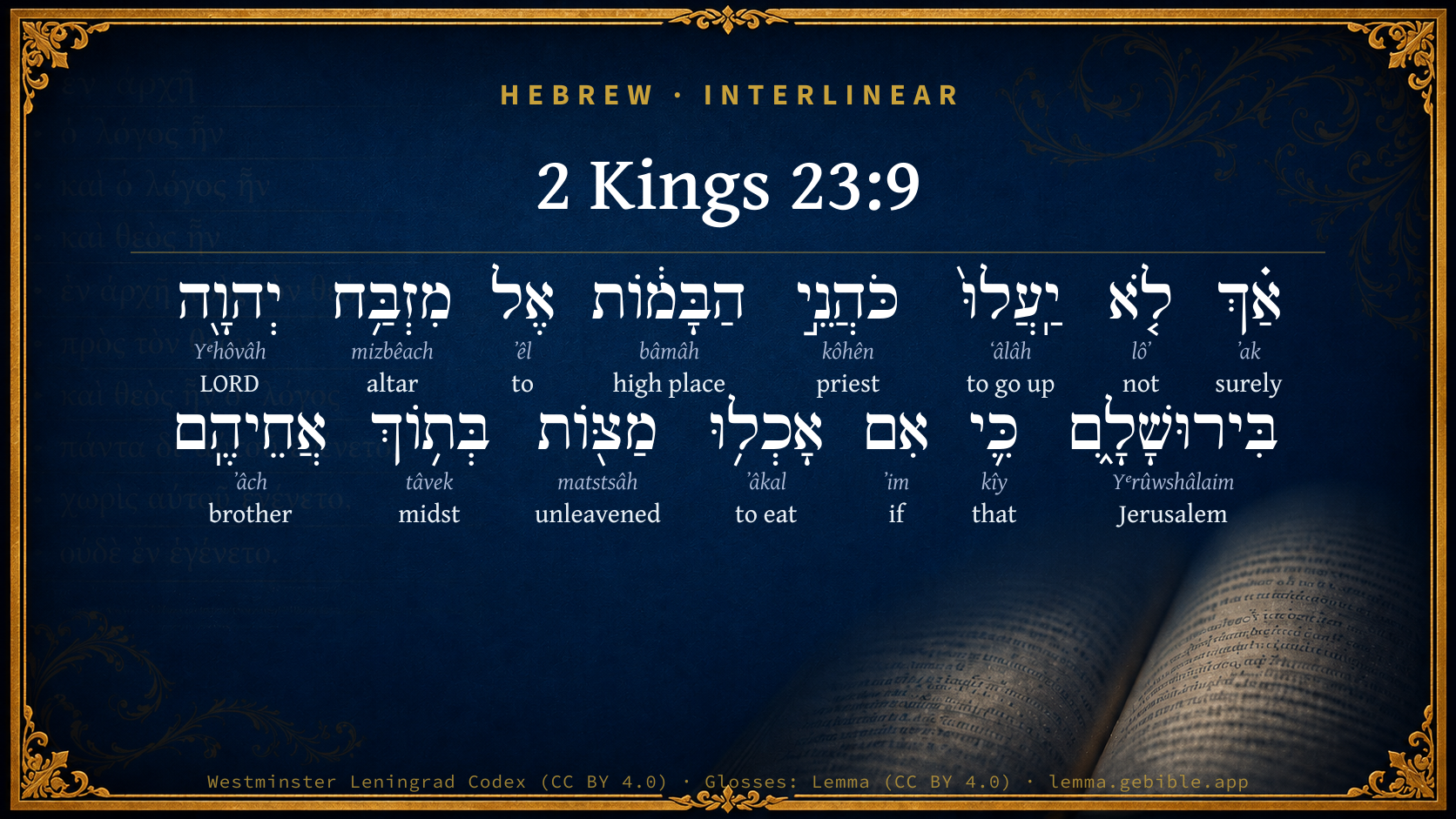
2 Kings 23:9

Hebrew (Westminster Leningrad Codex) 2 Kings 23:9 appears in the Hebrew Old Testament. The text above is from the Westminster Leningrad Codex. Each word links to its Strong’s number, a concise gloss, and parsing drawn from the Open Scriptures Hebrew Bible morphology. Click any word for its full Brown-Driver-Briggs (BDB) entry.
Download image
Cite this verse

2 Kings 23:9 (World English Bible). Public Domain. Lemma interlinear Bible study tool, https://lemma.gebible.app/v/2-kings/23/9.

Show BibTeX & RIS
BibTeX
RIS
English Translation
Nevertheless the priests of the high places didn't come up to the altar of Yahweh in Jerusalem, but they ate unleavened bread among their brothers.
World English Bible · Public Domain
Download a study sheet

One document with this verse’s original text, its word-by-word gloss line, the meaning frame, cross-references with their text, attributed commentary, and full source and license credits — printable, and it pastes into notes with its structure intact.

This verse Autodidact and up

Study sheet (.html) Plain text (.txt)

A passage Seminary Student

Up to 50 verses in one chapter. A passage sheet keeps up to 6 commentary sources and 12 cross-references per verse, in the order this page ranks them, and says so on the sheet whenever that leaves anything out. Ask for a single verse and you get the Autodidact verse sheet above.

Everything on this page stays free to read, with no account — the sheet is a download of what is already on screen, not access to it.

Want to remove ads? Support Godless Engineer
Compare translations 3

The same verse in 3 English versions, stacked beneath the original-language interlinear above. Click any original word for its lexicon entry.

Each is an independent rendering of the whole verse — the interlinear is not word-aligned to these translations.

Highlighted words mark where these versions differ — a whole-verse word diff, not a word-by-word alignment.

  • World English Bible Public Domain
    Nevertheless the priests of the high places didn't come up to the altar of Yahweh in Jerusalem, but they ate unleavened bread among their brothers.
  • King James Version Public Domain
    Nevertheless the priests of the high places came not up to the altar of the LORD in Jerusalem, but they did eat of the unleavened bread among their brethren.
  • unfoldingWord Literal Text CC BY-SA 4.0
    (However, the priests of the high places did not go up to the altar of Yahweh in Jerusalem. Rather, they ate unleavened bread in the midst of their brothers.)

unfoldingWord Literal Text — © unfoldingWord, licensed CC BY-SA 4.0. Word-aligned USFM3 via Door43 (git.door43.org/unfoldingWord/en_ult).

Versions to compare (up to 4)

3 of 4 selected

Show all 18 translations

Every available English version of this verse, each an independent rendering of the whole verse.

  • World English Bible Public Domain
    Nevertheless the priests of the high places didn't come up to the altar of Yahweh in Jerusalem, but they ate unleavened bread among their brothers.
  • Berean Standard Bible Public Domain
    Although the priests of the high places did not come up to the altar of the LORD in Jerusalem, they ate unleavened bread with their fellow priests.
  • Majority Standard Bible Public Domain
    Although the priests of the high places did not come up to the altar of the LORD in Jerusalem, they ate unleavened bread with their fellow priests.
  • King James Version Public Domain
    Nevertheless the priests of the high places came not up to the altar of the LORD in Jerusalem, but they did eat of the unleavened bread among their brethren.
  • American Standard Version (1901) Public Domain
    Nevertheless the priests of the high places came not up to the altar of Jehovah in Jerusalem, but they did eat unleavened bread among their brethren.
  • Revised Version (1885) Public Domain
    Nevertheless the priests of the high places came not up to the altar of the LORD in Jerusalem, but they did eat unleavened bread among their brethren.
  • Geneva Bible (1599) Public Domain
    Neuerthelesse the Priests of the hie places came not vp to the altar of the Lord in Ierusalem, saue onely they did eate of the vnleauened bread among their brethren.
  • Douay-Rheims (1899) Public Domain
    However the priests of the high places came not up to the altar of the Lord in Jerusalem: but only ate of the unleavened bread among their brethren.
  • Young's Literal Translation Public Domain
    only, the priests of the high places come not up unto the altar of Jehovah in Jerusalem, but they have eaten unleavened things in the midst of their brethren.
  • Literal Standard Version CC BY-SA 4.0
    only, the priests of the high places do not come up to the altar of YHWH in Jerusalem, but they have eaten unleavened things in the midst of their brothers.
  • Unlocked Literal Bible CC BY-SA 4.0
    Although the priests of those high places were not allowed to serve at the altar of Yahweh in Jerusalem, they ate unleavened bread among their brothers.
  • unfoldingWord Literal Text CC BY-SA 4.0
    (However, the priests of the high places did not go up to the altar of Yahweh in Jerusalem. Rather, they ate unleavened bread in the midst of their brothers.)
  • Darby Bible Public Domain
    Nevertheless the priests of the high places came not up to the altar of Jehovah in Jerusalem, but they ate of the unleavened bread among their brethren.
  • World Messianic Bible Public Domain
    Nevertheless the priests of the high places didn’t come up to the LORD’s altar in Jerusalem, but they ate unleavened bread among their brothers.
  • Webster's Bible Public Domain
    Nevertheless, the priests of the high places came not up to the altar of the LORD in Jerusalem, but they ate of the unleavened bread among their brethren.
  • Free Bible Version CC BY-SA 4.0
    Though the priests of the high places did not serve at the altar of the Lord in Jerusalem, they did eat unleavened bread with their brother priests.
  • Bible in Basic English Public Domain
    Still the priests of the high places never came up to the altar of the Lord in Jerusalem; but they took their food of unleavened bread among their brothers.
  • JPS Tanakh (1917) Public Domain
    Nevertheless the priests of the high places came not up to the altar of the LORD in Jerusalem, but they did eat unleavened bread among their brethren.

Literal Standard Version (2020), Covenant Press — licensed CC BY-SA 4.0. Text via the HelloAO Bible API (eBible.org). Unlocked Literal Bible (unfoldingWord) — licensed CC BY-SA 4.0. Text via the HelloAO Bible API (eBible.org). unfoldingWord Literal Text — © unfoldingWord, licensed CC BY-SA 4.0. Word-aligned USFM3 via Door43 (git.door43.org/unfoldingWord/en_ult). Free Bible Version, Dr. Jonathan Gallagher — licensed CC BY-SA 4.0. Text via the HelloAO Bible API (eBible.org).

Word by word

More ways to search: Search by grammar → Find every occurrence → Compare this word →

Practice this passage: Drill this verse → Learn its vocabulary →

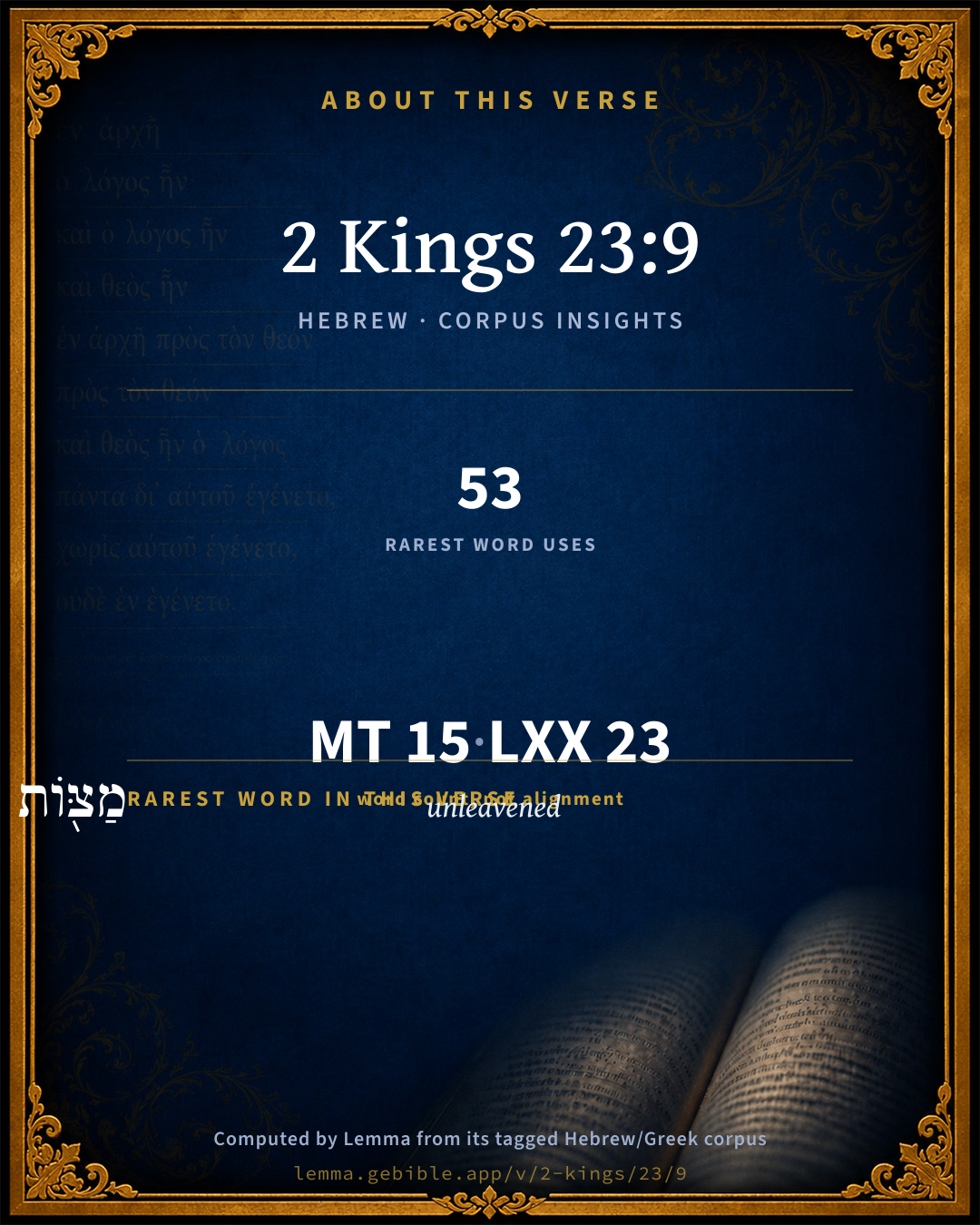
מַצּ֖וֹת
matstsâh
H4682
“unleavened bread”
Noun, Common, Feminine, Plural, Absolute
Part of Speech
Noun
Type
Common
Gender
Feminine
Number
Plural
State
Absolute
Full BDB Definition

Origin: from H4711 in the sense of greedily devouring for sweetness

TWOT: None

unleavened (bread, cake), without leaven.
  1. אַ֗ךְ ʼak H389 “surely” Particle, Accusative
  2. לֹ֤א lôʼ H3808 “not” Particle, Negative
  3. יַֽעֲלוּ֙ ʻâlâh H5927 “to go up” Verb, Qal, Imperfect, 3rd Person, Masculine, Plural
  4. כֹּהֲנֵ֣י kôhên H3548 “priests of” Noun, Common, Masculine, Plural, Construct
  5. הַבָּמ֔וֹת bâmâh H1116 “the · high places” Particle, Definite Article + Noun, Common, Feminine, Plural, Absolute
  6. אֶל ʼêl H413 “to” Preposition
  7. מִזְבַּ֥ח mizbêach H4196 “altar of” Noun, Common, Masculine, Singular, Construct
  8. יְהוָ֖ה Yᵉhôvâh H3068 “LORD” Noun, Proper
  9. בִּירוּשָׁלִָ֑ם Yᵉrûwshâlaim H3389 “in/at · Jerusalem” Preposition + Noun, Proper
  10. כִּ֛י kîy H3588 “that” Conjunction
  11. אִם ʼim H518 “if” Conjunction
  12. אָכְל֥וּ ʼâkal H398 “to eat” Verb, Qal, Perfect, 3rd Person, Common, Plural
  13. בְּת֥וֹךְ tâvek H8432 “in/at · midst of” Preposition + Noun, Common, Masculine, Singular, Construct
  14. אֲחֵיהֶֽם ʼâch H251 “brothers · their” Noun, Common, Masculine, Plural, Construct + Suffix, Personal, 3rd Person, Masculine, Plural

About this verse

These counts appear in no published source. They are computed here, from the morphology-tagged text and Lemma’s own curated glosses. What Lemma adds →

15
words
15
distinct lemmas
Historical
section

Shared distinctive vocabulary

מַצּ֖וֹת unleavened H4682 occurs in 42 verses of the Hebrew Bible. Also found in:

Grammatical profile

  • 2 verbs
  • 8 nouns
  • 1 preposition
  • 2 conjunctions
  • 2 particles

Verb forms

  • יַֽעֲלוּ֙ Qal · Imperfect
  • אָכְל֥וּ Qal · Perfect

Hebrew & Septuagint length

In English translation the verse runs 25 words from the Hebrew and 30 from the Septuagint (LXX English) — closely comparable.

A rough comparison of the two English renderings, which tokenize alike — not a word-level alignment.

Word counts can differ between the Hebrew and the Greek without any difference in meaning — e.g. the Hebrew direct-object marker אֵת has no separate Greek word, and Greek often adds the article ὁ.

In the original languages it is 15 Hebrew tokens and 23 Greek tokens — but the two are counted differently (Hebrew bundles its prefixes and suffixes into one token; the Greek is in lemma form), so that isn’t a like-for-like length.

Cross-references

4

Topical passages linked to 2 Kings 23:9 in the Treasury of Scripture Knowledge — connected by theme and wording, ordered by reader-vote popularity; previews shown in the World English Bible.

  • Ezekiel 44:10–14 But the Levites who went far from me, when Israel went astray, who went astray from me after their idols, they shall bear their iniquity.
  • 1 Samuel 2:36 It shall happen, that everyone who is left in your house shall come and bow down to him for a piece of silver and a loaf of bread, and shall say, Please put me into one of the priests' offices, that I may eat a morsel of bread.
  • Ezekiel 44:29–31 They shall eat the meal-offering, and the sin-offering, and the trespass-offering; and every devoted thing in Israel shall be theirs.
  • Malachi 2:8–9 But you have turned aside out of the way. You have caused many to stumble in the law. You have corrupted the covenant of Levi," says Yahweh of Hosts.

Cross-references courtesy of OpenBible.info (CC BY 4.0).

Hebrew and Greek witnesses Masoretic Hebrew ↔ Greek Septuagint

The same verse in the two great witnesses to the Old Testament, shown verse-for-verse.

These are two independent witnesses, not word-aligned to each other, and the Septuagint is shown in lemma (dictionary) form.

Hebrew 2 Kings 23:9 Masoretic · Westminster Leningrad Codex

אַ֗ךְ לֹ֤א יַֽעֲלוּ֙ כֹּהֲנֵ֣י הַבָּמ֔וֹת אֶל מִזְבַּ֥ח יְהוָ֖ה בִּירוּשָׁלִָ֑ם כִּ֛י אִם אָכְל֥וּ מַצּ֖וֹת בְּת֥וֹךְ אֲחֵיהֶֽם

Nevertheless the priests of the high places didn't come up to the altar of Yahweh in Jerusalem, but they ate unleavened bread among their brothers.

World English Bible · Public Domain

Greek LXX 2 Kings 23:9 Septuagint · lemma form

πλήν οὐ ἀναβαίνω ὁ ἱερεύς ὁ ὑψηλός πρός ὁ θυσιαστήριον κύριος ἐν ἰερουσαλήμ ὅτι εἰ μή ἐσθίω ἄζυμος ἐν μέσος ὁ ἀδελφός αὐτός

Only the priests of the high places went not up to the altar of the Lord in Jerusalem, for they only ate leavened bread in the midst of their brethren.

LXX2012 (modern English Septuagint) · Public Domain

Hebrew: Westminster Leningrad Codex (CC BY 4.0). Greek: Septuagint (public domain); English from LXX2012 (modern English Septuagint) (Public Domain). How the Septuagint differs from the Hebrew →

Targum (Aramaic paraphrase)

1

The Targum is the ancient Jewish Aramaic paraphrase of the Hebrew Scriptures — an interpretive translation, not the Hebrew text itself. Onkelos (literal) and Pseudo-Jonathan (expansive) render the Torah, and Jonathan the Prophets. Coverage is partial: where no permissively-licensed English translation exists for a verse, only the Aramaic is shown. This is verse-level text, not a word-by-word alignment to the Hebrew.

  1. Targum Jonathan Prophets (Joshua–Malachi)
    בְּרַם לָא סַלְקִין כַּהֲנַיָא כּוּמָרֵי בָמָתָא לְדַבָחָא עַל מַדְבְּחָא דַייָ בִּירוּשְׁלֵם אֱלָהֵין אֲכָלוּ פַטִיר בְּגוֹ אֲחֵיהוֹן:

    (no public-domain English translation for this verse)

    Targum Jonathan — Aramaic: “Mikraot Gedolot” (public domain). English: “Sefaria Community Translation” (CC0 1.0 (public-domain dedication)); “London "Chaldee Paraphrase," 1871” (public domain). Text via Sefaria.

Commentary

Notes on 2 Kings 23:9 from classic Christian and Jewish commentators (each source and its license shown beneath its notes). The classic Christian expositions comment on the surrounding passage and are grouped to its opening verse, so a note may address several verses; the Jewish commentaries on the Tanakh (Rashi and others) are per-verse, so they appear only where the commentator wrote on this verse.

Lemma curates 59 commentaries, every one of them public domain or Creative Commons licensed, each selected and text-cleaned for this edition rather than reprinted as found. About our sources →

Trapp's Complete Commentary

John Trapp

2Ki 23:9 Nevertheless the priests of the high places came not up to the altar of the LORD in Jerusalem, but they did eat of the unleavened bread among their brethren.

Ver. 9. But they did eat of the unleavened bread.] Care was taken for their maintenance: (1.) As Levites; (2.) As penitents; though, for service at the altar, they were laid aside. Penitency and punishment are words of one derivation, and are near of kin.

John Trapp, A Commentary or Exposition upon All the Books of the Old and New Testament (1647–1656) — public domain. Text from a community e-Sword module.

Joseph Benson's Commentary

2Ki 23:9. Nevertheless, the priests of the high places — Who had worshipped the true God there. Came not up to the altar of the Lord in Jerusalem — Were not suffered to come thither to exercise their priestly office, as a just punishment for their joining in and contributing to the corruption of God’s worship, and the transgression of so plain and positive a law of God as that in Deu 12:11; which conduct was much worse in them than in the people, as they had more knowledge to discern the will of God, and were under greater obligations to observe it. But they did eat of the unleavened bread — Of the meat-offerings allotted to the priests, wherein there was to be no leaven, (Lev 2:4-11,) and consequently of other provisions belonging to the priests, which are comprehended under this one kind. Thus the king mixed mercy with severity, and they were put into the condition of those priests who had corporal blemishes, (Lev 21:17-22,) who might not offer the bread of their God, but might eat the bread of their God, both of the most holy and the holy: they were shut out from spiritual services, but allowed necessary provisions.

Joseph Benson's Commentary on the Old and New Testaments (1811–1818) — public domain. Text from a community e-Sword module.

Geneva Bible (1599)

Geneva Bible translators

Because that those that had forsaken the Lord to serve idols, were not meet to minister in the service of the Lord for the instruction of others.

Geneva Bible (1599) marginal notes — public domain. Text via Bolls.life.

Adam Clarke's Commentary

Verse 9. The priests of the high places came not up] As these priests had offered sacrifices on the high places, though it was to the true God, yet they were not thought proper to be employed immediately about the temple; but as they were acknowledged to belong to the priesthood, they had a right to their support; therefore a portion of the tithes, offerings, and unleavened bread, shew-bread, c., was appointed to them for their support. Thus they were treated as priests who had some infirmity which rendered it improper for them to minister at the altar. See Le 21:17, &c., and particularly Le 21:22-23.

Adam Clarke's Commentary on the Bible (1810–1826) — public domain. Text from a community e-Sword/MySword module.

Ellicott's Commentary for English Readers

(9) Nevertheless . . . came not up to the altar.—Only the, priests of the high places used not to offer at the altar. They were not permitted to do so, being considered to be incapacitated for that office by their former illegal ministrations.

But they did eat.—They might not even eat their share of the meat offerings in company with the legitimate priests; but had to take their meals apart, “among their brethren,” i.e., in their own company. (Comp. Eze_44:10-14; Lev_21:21-22.)

Eat of the unleavened bread.—Omit of the. The phrase is a technical one, meaning to live upon offerings. (See Lev_2:1-11; Lev_6:16-18; Lev_10:12.) These irregular priests were probably employed in the inferior duties of the Temple.

A Bible Commentary for English Readers, edited by Charles John Ellicott (1878–1897) — public domain. Text from a community e-Sword module.

The Cambridge Bible for Schools and Colleges

gen. ed. J. J. S. Perowne

9. came not up to the altar of the Lord] They had been ministers of the high places, which even if they were erected in the name of the Lord, the God of Israel, were yet forbidden, and so these priests henceforth executed no sacrificial office at the temple. They had their support from the offerings made there, but were a class apart and would continue so till they were all passed away. The defect in their practice was held to disqualify them, as physical defects disqualified men from becoming priests.

the unleavened bread] Mentioned as representing those gifts which, after being offered, were devoted to the maintenance of the priests.

among their brethren] i.e. This whole class lived a life distinct from the other priests, being deposed and as it were degraded from their higher office.

The Cambridge Bible for Schools and Colleges (gen. ed. J. J. S. Perowne; Cambridge University Press, 1878–1918) — public domain. Text from a community e-Sword module.

John Gill's Exposition

And he defiled Topheth,.... A place so called, as is generally thought, from the beating of drums or timbrels in it, that the shrieks of the infants sacrificed here to Molech might not be heard by their parents, and they repent of delivering them to him, and take them away. So the Indians in India now, at the burning of wives with their deceased husbands, attend them with drums and trumpets; and at such time as the fire is put to the wood, the drums and trumpets make a terrible noise for fear their cries should be heard (b); See Gill on Isa 30:33, Jer 7:31 this he defiled by casting any sort of filth or unclean thing into it, in contempt of the idolatry there committed, and to alienate the minds of men from it:

which is the valley of the children of Hinnom; a valley that belonged to the posterity of a man of this name, near to Jerusalem, see Jos 15:8, hence the Greek word "geenna" for hell, in the New Testament:

that no man might make his son or his daughter pass through the fire to Molech; which piece of idolatry used to be committed in this place.

(b) Agreement of Customs between the East Indians and Jews, art. 25. p. 85, 86.

John Gill's Exposition of the Whole Bible (1746–1763) — public domain (CC PDM 1.0). Text via the HelloAO Bible API.

Haydock's Catholic Bible Commentary

Brethren. Thus people are degraded in the Christian Church, that they may suffer some confusion (Calmet) in this world, and repent. (Haydock) --- The priests, who had offered sacrifice unlawfully, where only permitted to perform the minor offices; but provision was made for their support, that they might not be tempted to relapse, Leviticus xxi. 17, 22., and Ezechiel xliv. 10. (Calmet) --- They were reduced to the rank of Levites. (Menochius)

George Leo Haydock (1774–1849), Haydock's Catholic Family Bible and Commentary, 1859 edition — public domain. Excludes Psalms (Douay-Rheims chapter numbering differs from Protestant) and Deuterocanonical books (Catholic canon only).

Matthew Poole's English Annotations

The priests of the high places, which worshipped the true God there.

Came not up to the altar of the Lord in Jerusalem, i.e. were not suffered to come thither to the exercise of their priestly function; as a just punishment for the corruption of God’s worship, and the transgression of so plain and positive a law of God, Deu 12:11, which was much worse in them, who had more knowledge to discern God’s mind therein, and more obligations to observe it, and to engage others to the observation of it. Compare Eze 44:10.

Of the unleavened bread, i.e. of the meat-offerings allotted to the priests, wherein there was to be no leaven, Lev 2:4,5,10,11; and consequently of other provisions belonging to the priests, which by a synecdoche are contained under this one kind. Thus their spiritual blemish puts them into the very same state which corporal blemishes brought them, Lev 21:17, &c. And thus he mitigates their punishment; he shuts them out from spiritual services, but allows them natural and necessary provisions.

Matthew Poole's English Annotations on the Holy Bible (1683–1685) — public domain. Text from a community e-Sword/MySword module.

Whedon's Commentary on the Bible

Daniel D. Whedon

9. Came not up to the altar — That is, to minister thereat by burning incense or offering sacrifice.

But they did eat of the… bread — So these priests were treated as the law prescribed for such as had some blemish or bodily defect. See Lev_21:17-24.

Daniel D. Whedon (gen. ed.), Commentary on the Old and New Testaments (1874–1909) — public domain. Text from a community e-Sword module.

The Pulpit Commentary

Nevertheless the priests of the high places came not up to the altar of the Lord in Jerusalem. Though Josiah recalled to Jerusalem the Levitical priests who had recently been attached to the various high places, yet he did not attach them to the temple, or assign them any part in its services. Their participation in a semi-idolatrous service had disqualified them for the temple ministrations. But they did eat of the unleavened bread among their brethren. They were allowed, i.e. , their maintenance out of the priestly revenues, as were priests disqualified by a personal blemish. (Lev_21:21, Lev_21:22) Practically they lived on the altar gifts intended for the priests, (Lev_6:9, Lev_6:10, Lev_6:22) in which it was unlawful to mix leaven.

The Pulpit Commentary (1880–1919), ed. H.D.M. Spence-Jones & Joseph S. Exell — public domain. Text from a community e-Sword module.

John Wesley's Explanatory Notes

The priest - Who worshipped the true God there. In Jerusalem - Were not suffered to come thither to the exercise of their priestly function; as a just punishment for the corruption of God's worship, and the transgression of so plain and positive a law of God, Deut. xii, 11, which was much worse in them who had more knowledge to discern the will of God, and more obligations to observe it. Did eat - Of the meal-offerings, allotted to the priests, wherein there was to be no leaven, Lev. ii, 4, 5, 10, 11, and consequently of other provisions belonging to the priests, which are contained under this one kind. Thus their spiritual blemish puts them into the very same state which corporal blemishes brought them, Lev. xxi, 17, &c. And thus he mitigates their punishment: he shuts them out from spiritual services, but allows them necessary provisions.

John Wesley, Explanatory Notes Upon the Whole Bible (1754–1765) — public domain. Text via the GEBible commentary corpus.

Rashi

Rabbi Shlomo Yitzchaki (Rashi)

Were not permitted to ascend. The priests who burned incense on the high places to idols, were not permitted to ascend anymore to serve on the Altar of Adonoy.

They would eat matzohs. I.e., but in this thing they would not be disqualified from their priesthood, that they are allowed to eat hallowed things. They are like blemished [kohanim] and they share and eat [of the sacrifice], but they may not offer [sacrifices].

They would eat matzohs. Meal-offerings, and similarly, all hallowed things.

Rashi on the Tanakh — English translations: “The Judaica Press complete Tanach with Rashi, translated by A. J. Rosenberg” (CC BY 4.0); “Pentateuch with Rashi's commentary by M. Rosenbaum and A.M. Silbermann, 1929-1934” (public domain); “The Metsudah Tanach series, Lakewood, N.J” (CC BY 4.0); and “The Book of Joshua, Metsudah Publications, 1997” (CC BY 4.0). Text via Sefaria.

Lesson kit

Teaching starters — assembled from the data on this page, not authored interpretation. Every prompt links to the verse data it draws on. Edit before teaching.

2 Kings, in the Historical, opens this verse with 15 words (15 distinct Hebrew lemmas). Its most distinctive word is matstsâh (“unleavened”). A historical commentator’s framing appears above. Read the whole chapter for the surrounding context.

Discussion questions

  1. The word matstsâh carries the sense “unleavened.” How does it shape the verse?
  2. Genesis 19:3 shares the word «unleavened» with this verse. How do the two illuminate each other?
  3. The translations on this page render this verse differently — a whole-verse word diff, not a word-by-word alignment. What might account for the different wordings?
  4. The verb «יַֽעֲלוּ֙» is Qal Imperfect. How does its form color the action?
  5. Reading how Trapp's Complete Commentary and Joseph Benson's Commentary read this verse, where do the two commentators agree and where do they part?

Things to notice

Reading settings

Reading text

Shown beneath each verse's original-language words.

Old Testament
Old Testament edition

Read the OT as the Masoretic Hebrew (MT) or the Greek Septuagint (LXX).

English shown for the Greek Septuagint (in the Hebrew ↔ Greek comparison).

Comparing translations? Open the Compare panel on any verse page to stack up to four side by side.