
1 Kings 8:64

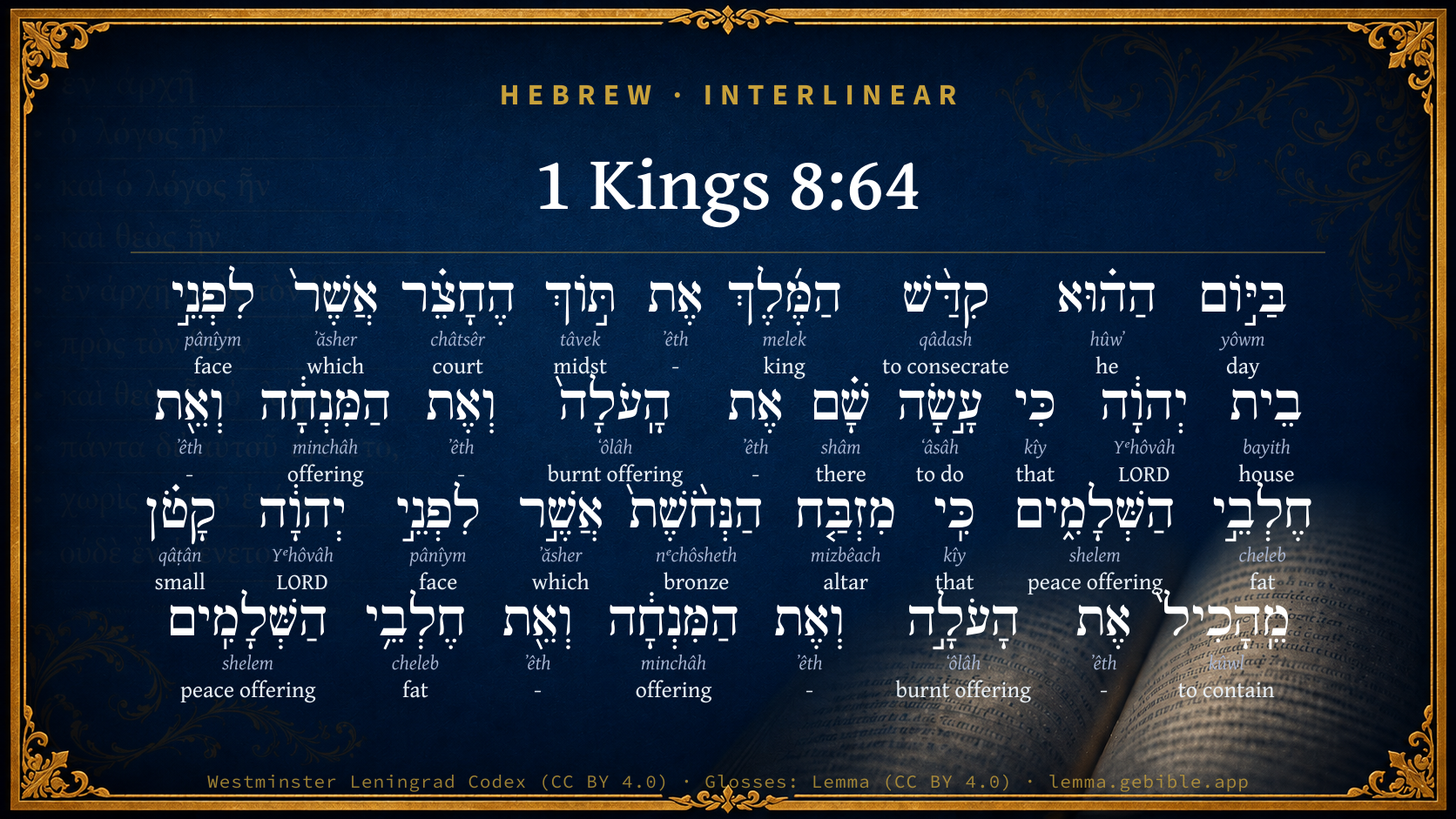
Hebrew (Westminster Leningrad Codex) 1 Kings 8:64 appears in the Hebrew Old Testament. The text above is from the Westminster Leningrad Codex. Each word links to its Strong’s number, a concise gloss, and parsing drawn from the Open Scriptures Hebrew Bible morphology. Click any word for its full Brown-Driver-Briggs (BDB) entry.
Download image
Cite this verse

1 Kings 8:64 (World English Bible). Public Domain. Lemma interlinear Bible study tool, https://lemma.gebible.app/v/1-kings/8/64.

Show BibTeX & RIS
BibTeX
RIS
English Translation
The same day did the king make the middle of the court holy that was before the house of Yahweh; for there he offered the burnt offering, and the meal-offering, and the fat of the peace-offerings, because the brazen altar that was before Yahweh was too little to receive the burnt offering, and the meal-offering, and the fat of the peace-offerings.
World English Bible · Public Domain
Download a study sheet

One document with this verse’s original text, its word-by-word gloss line, the meaning frame, cross-references with their text, attributed commentary, and full source and license credits — printable, and it pastes into notes with its structure intact.

This verse Autodidact and up

Study sheet (.html) Plain text (.txt)

A passage Seminary Student

Up to 50 verses in one chapter. A passage sheet keeps up to 6 commentary sources and 12 cross-references per verse, in the order this page ranks them, and says so on the sheet whenever that leaves anything out. Ask for a single verse and you get the Autodidact verse sheet above.

Everything on this page stays free to read, with no account — the sheet is a download of what is already on screen, not access to it.

Want to remove ads? Support Godless Engineer
Compare translations 3

The same verse in 3 English versions, stacked beneath the original-language interlinear above. Click any original word for its lexicon entry.

Each is an independent rendering of the whole verse — the interlinear is not word-aligned to these translations.

Highlighted words mark where these versions differ — a whole-verse word diff, not a word-by-word alignment.

  • World English Bible Public Domain
    The same day did the king make the middle of the court holy that was before the house of Yahweh; for there he offered the burnt offering, and the meal-offering, and the fat of the peace-offerings, because the brazen altar that was before Yahweh was too little to receive the burnt offering, and the meal-offering, and the fat of the peace-offerings.
  • King James Version Public Domain
    The same day did the king hallow the middle of the court that was before the house of the LORD: for there he offered burnt offerings, and meat offerings, and the fat of the peace offerings: because the brazen altar that was before the LORD was too little to receive the burnt offerings, and meat offerings, and the fat of the peace offerings.
  • unfoldingWord Literal Text CC BY-SA 4.0
    On that day the king consecrated the middle of the courtyard that was to the face of the house of Yahweh, so that there he made the burnt offering and the grain offering and the fat of the peace offerings, for the altar of bronze that to the face of Yahweh was small from the containing of the burnt offering and the grain offering and the fat of the peace offerings.

unfoldingWord Literal Text — © unfoldingWord, licensed CC BY-SA 4.0. Word-aligned USFM3 via Door43 (git.door43.org/unfoldingWord/en_ult).

Versions to compare (up to 4)

3 of 4 selected

Show all 18 translations

Every available English version of this verse, each an independent rendering of the whole verse.

  • World English Bible Public Domain
    The same day did the king make the middle of the court holy that was before the house of Yahweh; for there he offered the burnt offering, and the meal-offering, and the fat of the peace-offerings, because the brazen altar that was before Yahweh was too little to receive the burnt offering, and the meal-offering, and the fat of the peace-offerings.
  • Berean Standard Bible Public Domain
    On that same day the king consecrated the middle of the courtyard in front of the house of the LORD, and there he offered the burnt offerings, the grain offerings, and the fat of the peace offerings, since the bronze altar before the LORD was too small to contain all these offerings.
  • Majority Standard Bible Public Domain
    On that same day the king consecrated the middle of the courtyard in front of the house of the LORD, and there he offered the burnt offerings, the grain offerings, and the fat of the peace offerings, since the bronze altar before the LORD was too small to contain all these offerings.
  • King James Version Public Domain
    The same day did the king hallow the middle of the court that was before the house of the LORD: for there he offered burnt offerings, and meat offerings, and the fat of the peace offerings: because the brazen altar that was before the LORD was too little to receive the burnt offerings, and meat offerings, and the fat of the peace offerings.
  • American Standard Version (1901) Public Domain
    The same day did the king hallow the middle of the court that was before the house of Jehovah; for there he offered the burnt-offering, and the meal-offering, and the fat of the peace-offerings, because the brazen altar that was before Jehovah was too little to receive the burnt-offering, and the meal-offering, and the fat of the peace-offerings.
  • Revised Version (1885) Public Domain
    The same day did the king hallow the middle of the court that was before the house of the LORD: for there he offered the burnt offering, and the meal offering, and the fat of the peace offerings: because the brasen altar that was before the LORD was too little to receive the burnt offering, and the meal offering, and the fat of the peace offerings.
  • Geneva Bible (1599) Public Domain
    The same day did the King halowe the middle of the court, that was before the house of the Lord: for there he made burnt offerings, and the meate offrings, and the fat of the peace offeringes, because the brasen altar that was before the Lord, was too litle to receiue the burnt offerings, and the meate offerings, and the fat of the peace offrings.
  • Douay-Rheims (1899) Public Domain
    In that day the king sanctified the middle of the court that was before the house of the Lord: for there he offered the holocaust, and sacrifice, and fat of the peace offerings: because the brazen altar that was before the Lord, was too little to receive the holocaust, and sacrifice, and fat of the peace offerings.
  • Young's Literal Translation Public Domain
    On that day hath the king sanctified the middle of the court that `is' before the house of Jehovah, for he hath made there the burnt-offering, and the present, and the fat of the peace-offerings; for the altar of brass that `is' before Jehovah `is' too little to contain the burnt-offering, and the present, and the fat of the peace-offerings.
  • Literal Standard Version CC BY-SA 4.0
    On that day the king has sanctified the middle of the court that [is] before the house of YHWH, for he has made the burnt-offering, and the present, and the fat of the peace-offerings there; for the altar of bronze that [is] before YHWH [is] too small to contain the burnt-offering, and the present, and the fat of the peace-offerings.
  • Unlocked Literal Bible CC BY-SA 4.0
    The same day the king set apart the middle of the courtyard in front of the temple of Yahweh, for there he offered the burnt offerings, the grain offerings, and the fat of the fellowship offerings, because the bronze altar that was before Yahweh was too small to receive the burnt offering, the grain offerings, and the fat of the fellowship offerings.
  • unfoldingWord Literal Text CC BY-SA 4.0
    On that day the king consecrated the middle of the courtyard that was to the face of the house of Yahweh, so that there he made the burnt offering and the grain offering and the fat of the peace offerings, for the altar of bronze that to the face of Yahweh was small from the containing of the burnt offering and the grain offering and the fat of the peace offerings.
  • Darby Bible Public Domain
    The same day the king hallowed the middle of the court that was before the house of Jehovah; for there he offered the burnt-offerings, and the oblations, and the fat of the peace-offerings, because the brazen altar that was before Jehovah was too small to receive the burnt-offerings, and the oblations, and the fat of the peace-offerings.
  • World Messianic Bible Public Domain
    The same day the king made the middle of the court holy that was before the LORD’s house; for there he offered the burnt offering, the meal offering, and the fat of the peace offerings, because the bronze altar that was before the LORD was too little to receive the burnt offering, the meal offering, and the fat of the peace offerings.
  • Webster's Bible Public Domain
    The same day did the king consecrate the middle of the court that was before the house of the LORD: for there he offered burnt-offerings, and meat-offerings, and the fat of the peace-offerings: because the brazen altar that was before the LORD was too little to receive the burnt-offerings, and meat-offerings, and the fat of the peace-offerings.
  • Free Bible Version CC BY-SA 4.0
    On that same day, the king dedicated the center of the courtyard in front of the Lord's Temple. There he presented burnt offerings, grain offerings, and the fat of the friendship offerings, since the bronze altar in the Lord's presence was too small to hold all these offerings.
  • Bible in Basic English Public Domain
    The same day the king made holy the middle of the open square in front of the house of the Lord, offering there the burned offering and the meal offering and the fat of the peace-offerings; for there was not room on the brass altar of the Lord for the burned offerings and the meal offerings and the fat of the peace-offerings.
  • JPS Tanakh (1917) Public Domain
    The same day did the king hallow the middle of the court that was before the house of the LORD; for there he offered the burnt-offering, and the meal-offering, and the fat of the peace-offerings; because the brazen altar that was before the LORD was too little to receive the burnt-offering, and the meal-offering, and the fat of the peace-offerings.

Literal Standard Version (2020), Covenant Press — licensed CC BY-SA 4.0. Text via the HelloAO Bible API (eBible.org). Unlocked Literal Bible (unfoldingWord) — licensed CC BY-SA 4.0. Text via the HelloAO Bible API (eBible.org). unfoldingWord Literal Text — © unfoldingWord, licensed CC BY-SA 4.0. Word-aligned USFM3 via Door43 (git.door43.org/unfoldingWord/en_ult). Free Bible Version, Dr. Jonathan Gallagher — licensed CC BY-SA 4.0. Text via the HelloAO Bible API (eBible.org).

Word by word

More ways to search: Search by grammar → Find every occurrence → Compare this word →

Practice this passage: Drill this verse → Learn its vocabulary →

מֵֽהָכִיל֙
kûwl
H3557
“from · to contain”
Preposition + Verb, Hiphil, Infinitive Construct
Part of Speech
Preposition + Verb
Stem
Hiphil
Form
Infinitive Construct
Full BDB Definition

Origin: a primitive root

TWOT: 962

to seize, contain, measure - (Qal) to measure, calculate - (Pilpel) to sustain, maintain, contain - to sustain, support, nourish - to contain, hold in, restrain - to support, endure - (Polpal) to be supplied - (Hiphil) to contain, hold, hold in, endure - to contain - to sustain, endure
  1. בַּיּ֣וֹם yôwm H3117 “in/at the · day” Preposition, Determined + Noun, Common, Masculine, Singular, Absolute
  2. הַה֗וּא hûwʼ H1931 “the · he” Particle, Definite Article + Pronoun, Personal, 3rd Person, Masculine, Singular
  3. קִדַּ֨שׁ qâdash H6942 “to consecrate” Verb, Piel, Perfect, 3rd Person, Masculine, Singular
  4. הַמֶּ֜לֶךְ melek H4428 “the · king” Particle, Definite Article + Noun, Common, Masculine, Singular, Absolute
  5. אֶת ʼêth H853 “-” Particle, Direct Object
  6. תּ֣וֹךְ tâvek H8432 “midst of” Noun, Common, Masculine, Singular, Construct
  7. הֶחָצֵ֗ר châtsêr H2691 “the · court” Particle, Definite Article + Noun, Common, Both, Singular, Absolute
  8. אֲשֶׁר֙ ʼăsher H834 “which” Particle, Relative
  9. לִפְנֵ֣י pânîym H6440 “to/for · face(s) of” Preposition + Noun, Common, Both, Plural, Construct
  10. בֵית bayith H1004 “house of” Noun, Common, Masculine, Singular, Construct
  11. יְהוָ֔ה Yᵉhôvâh H3068 “LORD” Noun, Proper
  12. כִּי kîy H3588 “that” Conjunction
  13. עָ֣שָׂה ʻâsâh H6213 “to do” Verb, Qal, Perfect, 3rd Person, Masculine, Singular
  14. שָׁ֗ם shâm H8033 “there” Adverb
  15. אֶת ʼêth H853 “-” Particle, Direct Object
  16. הָֽעֹלָה֙ ʻôlâh H5930 “the · burnt offering” Particle, Definite Article + Noun, Common, Feminine, Singular, Absolute
  17. וְאֶת ʼêth H853 “and · -” Conjunction + Particle, Direct Object
  18. הַמִּנְחָ֔ה minchâh H4503 “the · offering” Particle, Definite Article + Noun, Common, Feminine, Singular, Absolute
  19. וְאֵ֖ת ʼêth H853 “and · -” Conjunction + Particle, Direct Object
  20. חֶלְבֵ֣י cheleb H2459 “fat of” Noun, Common, Masculine, Plural, Construct
  21. הַשְּׁלָמִ֑ים shelem H8002 “the · peace offerings” Particle, Definite Article + Noun, Common, Masculine, Plural, Absolute
  22. כִּֽי kîy H3588 “that” Conjunction
  23. מִזְבַּ֤ח mizbêach H4196 “altar of” Noun, Common, Masculine, Singular, Construct
  24. הַנְּחֹ֨שֶׁת֙ nᵉchôsheth H5178 “the · bronze” Particle, Definite Article + Noun, Common, Feminine, Singular, Absolute
  25. אֲשֶׁ֣ר ʼăsher H834 “which” Particle, Relative
  26. לִפְנֵ֣י pânîym H6440 “to/for · face(s) of” Preposition + Noun, Common, Both, Plural, Construct
  27. יְהוָ֔ה Yᵉhôvâh H3068 “LORD” Noun, Proper
  28. קָטֹ֗ן qâṭân H6996 “small” Adjective, Adjective, Masculine, Singular, Absolute
  29. אֶת ʼêth H853 “-” Particle, Direct Object
  30. הָעֹלָ֣ה ʻôlâh H5930 “the · burnt offering” Particle, Definite Article + Noun, Common, Feminine, Singular, Absolute
  31. וְאֶת ʼêth H853 “and · -” Conjunction + Particle, Direct Object
  32. הַמִּנְחָ֔ה minchâh H4503 “the · offering” Particle, Definite Article + Noun, Common, Feminine, Singular, Absolute
  33. וְאֵ֖ת ʼêth H853 “and · -” Conjunction + Particle, Direct Object
  34. חֶלְבֵ֥י cheleb H2459 “fat of” Noun, Common, Masculine, Plural, Construct
  35. הַשְּׁלָמִֽים shelem H8002 “the · peace offerings” Particle, Definite Article + Noun, Common, Masculine, Plural, Absolute

About this verse

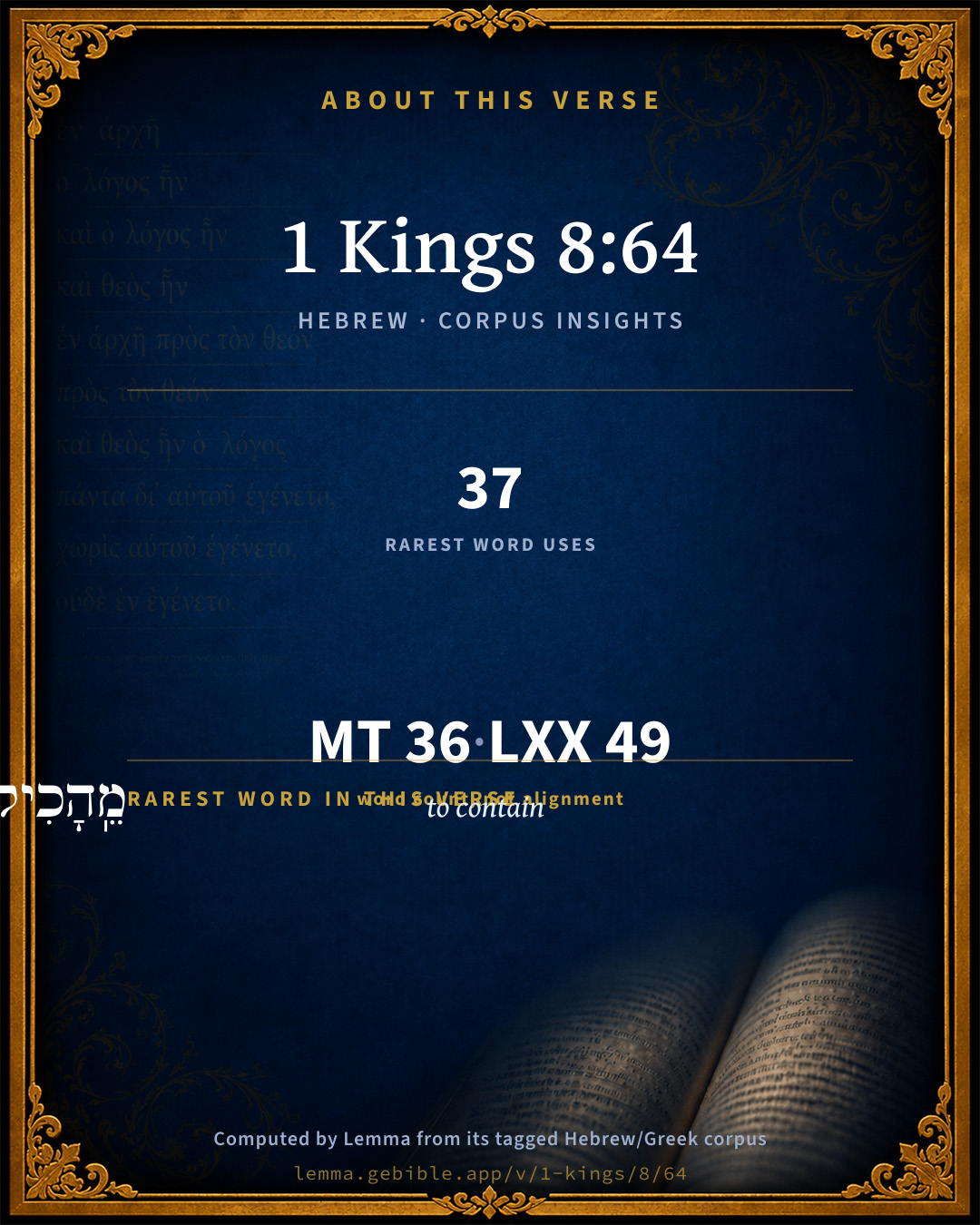
These counts appear in no published source. They are computed here, from the morphology-tagged text and Lemma’s own curated glosses. What Lemma adds →

36
words
22
distinct lemmas
Historical
section

Shared distinctive vocabulary

מֵֽהָכִיל֙ to contain H3557 occurs in 36 verses of the Hebrew Bible. Also found in:

Grammatical profile

  • 3 verbs
  • 19 nouns
  • 1 adjective
  • 1 pronoun
  • 2 conjunctions
  • 1 adverb
  • 9 particles

Verb forms

  • קִדַּ֨שׁ Piel · Perfect
  • עָ֣שָׂה Qal · Perfect
  • מֵֽהָכִיל֙ Hiphil · Infinitive Construct

Repetition

Words recur within this verse — often emphatic in Hebrew:

  • לִפְנֵ֣י face H6440 ×2
  • יְהוָ֔ה LORD H3068 ×2
  • הָֽעֹלָה֙ burnt offering H5930 ×2
  • הַמִּנְחָ֔ה offering H4503 ×2
  • חֶלְבֵ֣י fat H2459 ×2
  • הַשְּׁלָמִ֑ים peace offering H8002 ×2
  • אֲשֶׁר֙ which H834 ×2
  • כִּי that H3588 ×2

Hebrew & Septuagint length

In English translation the verse runs 61 words from the Hebrew and 60 from the Septuagint (LXX English) — closely comparable.

A rough comparison of the two English renderings, which tokenize alike — not a word-level alignment.

Word counts can differ between the Hebrew and the Greek without any difference in meaning — e.g. the Hebrew direct-object marker אֵת has no separate Greek word, and Greek often adds the article ὁ.

In the original languages it is 36 Hebrew tokens and 49 Greek tokens — but the two are counted differently (Hebrew bundles its prefixes and suffixes into one token; the Greek is in lemma form), so that isn’t a like-for-like length.

Cross-references

2

Topical passages linked to 1 Kings 8:64 in the Treasury of Scripture Knowledge — connected by theme and wording, ordered by reader-vote popularity; previews shown in the World English Bible.

  • 2 Chronicles 4:1 Moreover he made an altar of brass, twenty cubits the length of it, and twenty cubits the breadth of it, and ten cubits the height of it.
  • 2 Chronicles 7:7 Moreover Solomon made the middle of the court holy that was before the house of Yahweh; for there he offered the burnt offerings, and the fat of the peace-offerings, because the brazen altar which Solomon had made was not able to receive the burnt offering, and the meal-offering, and the fat.

Cross-references courtesy of OpenBible.info (CC BY 4.0).

Hebrew and Greek witnesses Masoretic Hebrew ↔ Greek Septuagint

The same verse in the two great witnesses to the Old Testament, shown verse-for-verse.

These are two independent witnesses, not word-aligned to each other, and the Septuagint is shown in lemma (dictionary) form.

Hebrew 1 Kings 8:64 Masoretic · Westminster Leningrad Codex

בַּיּ֣וֹם הַה֗וּא קִדַּ֨שׁ הַמֶּ֜לֶךְ אֶת תּ֣וֹךְ הֶחָצֵ֗ר אֲשֶׁר֙ לִפְנֵ֣י בֵית יְהוָ֔ה כִּי עָ֣שָׂה שָׁ֗ם אֶת הָֽעֹלָה֙ וְאֶת הַמִּנְחָ֔ה וְאֵ֖ת חֶלְבֵ֣י הַשְּׁלָמִ֑ים כִּֽי מִזְבַּ֤ח הַנְּחֹ֨שֶׁת֙ אֲשֶׁ֣ר לִפְנֵ֣י יְהוָ֔ה קָטֹ֗ן מֵֽהָכִיל֙ אֶת הָעֹלָ֣ה וְאֶת הַמִּנְחָ֔ה וְאֵ֖ת חֶלְבֵ֥י הַשְּׁלָמִֽים

The same day did the king make the middle of the court holy that was before the house of Yahweh; for there he offered the burnt offering, and the meal-offering, and the fat of the peace-offerings, because the brazen altar that was before Yahweh was too little to receive the burnt offering, and the meal-offering, and the fat of the peace-offerings.

World English Bible · Public Domain

Greek LXX 1 Kings 8:64 Septuagint · lemma form

ὁ ἡμέρα ἐκεῖνος ἁγιάζω ὁ βασιλεύς ὁ μέσος ὁ αὐλή ὁ κατά πρόσωπον ὁ οἶκος κύριος ὅτι ποιέω ἐκεῖ ὁ ὁλοκαύτωσις καί ὁ θυσία καί ὁ στέαρ ὁ εἰρηνικός ὅτι ὁ θυσιαστήριον ὁ χαλκοῦς ὁ ἐνώπιον κύριος μικρός ὁ μή δύναμαι ὁ ὁλοκαύτωσις καί ὁ θυσία ὁ εἰρηνικός ὑποφέρω

In that day the king consecrated the middle of the court in the front of the house of the Lord; for there he offered the whole burnt offering, and the sacrifices, and the fat of the peace-offerings, because the brazen altar which was before the Lord was too little to bear the whole burnt offering and the sacrifices of peace-offerings.

LXX2012 (modern English Septuagint) · Public Domain

Hebrew: Westminster Leningrad Codex (CC BY 4.0). Greek: Septuagint (public domain); English from LXX2012 (modern English Septuagint) (Public Domain). How the Septuagint differs from the Hebrew →

Targum (Aramaic paraphrase)

1

The Targum is the ancient Jewish Aramaic paraphrase of the Hebrew Scriptures — an interpretive translation, not the Hebrew text itself. Onkelos (literal) and Pseudo-Jonathan (expansive) render the Torah, and Jonathan the Prophets. Coverage is partial: where no permissively-licensed English translation exists for a verse, only the Aramaic is shown. This is verse-level text, not a word-by-word alignment to the Hebrew.

  1. Targum Jonathan Prophets (Joshua–Malachi)
    בְּיוֹמָא הַהוּא קַדִישׁ מַלְכָּא יַת גוֹ דָרְתָא דִי קֳדָם בֵּית מַקְדְשָׁא דַייָ אֲרֵי עֲבַד תַּמָן יַת עֲלָתָא וְיַת מִנְחָתָא וְיַת תַּרְבֵּי נִכְסַת קוּדְשַׁיָא אֲרֵי מַדְבְּחָא דִנְחָשָׁא דִי קֳדָם יְיָ דָחִיק מִלְסוֹבָרָא יַת עֲלָתָא וְיַת מִנְחָתָא וְיַת תַּרְבֵּי נִכְסַת קוּדְשַׁיָא:

    (no public-domain English translation for this verse)

    Targum Jonathan — Aramaic: “Mikraot Gedolot” (public domain). English: “Sefaria Community Translation” (CC0 1.0 (public-domain dedication)); “London "Chaldee Paraphrase," 1871” (public domain). Text via Sefaria.

Commentary

Notes on 1 Kings 8:64 from classic Christian and Jewish commentators (each source and its license shown beneath its notes). The classic Christian expositions comment on the surrounding passage and are grouped to its opening verse, so a note may address several verses; the Jewish commentaries on the Tanakh (Rashi and others) are per-verse, so they appear only where the commentator wrote on this verse.

Lemma curates 59 commentaries, every one of them public domain or Creative Commons licensed, each selected and text-cleaned for this edition rather than reprinted as found. About our sources →

Trapp's Complete Commentary

John Trapp

1Ki 8:64 The same day did the king hallow the middle of the court that [was] before the house of the LORD: for there he offered burnt offerings, and meat offerings, and the fat of the peace offerings: because the brasen altar that [was] before the LORD [was] too little to receive the burnt offerings, and meat offerings, and the fat of the peace offerings.

Ver. 64. The king hallowed,] i.e., saith Lyra, He caused the high priest to sanctify the pavement of that court near unto the altar, by reason of the multitude of the sacrifices, and incapacity of the altar.

John Trapp, A Commentary or Exposition upon All the Books of the Old and New Testament (1647–1656) — public domain. Text from a community e-Sword module.

Joseph Benson's Commentary

1Ki 8:64. The same day — Or rather, at the same time. For it can scarcely be supposed that it could all be done the same day. Did the king hallow the middle of the court — Namely, the court of the priests in which the great altar was. This he consecrated as he did the great altar, by sacrifices; but with this difference, that he consecrated that for perpetual use, but this only for the present occasion, being warranted to do so both by the necessity of it for God’s service, and for the present solemn work, for which the brazen altar was not sufficient; and by the direction of God’s Spirit, wherewith Solomon was endowed, as being a prophet, as well as a king. Here therefore he suddenly reared up divers altars, which, after this solemnity, were demolished.

Joseph Benson's Commentary on the Old and New Testaments (1811–1818) — public domain. Text from a community e-Sword module.

Jamieson, Fausset & Brown

Robert Jamieson, A. R. Fausset & David Brown

The same day did the king hallow the middle of the court--that is, the whole extent of the priests' court--the altar of burnt offerings, though large (Ch2 4:1), being totally inadequate for the vast number of sacrifices that distinguished this occasion. It was only a temporary erection to meet the demands of an extraordinary season, in aid of the established altar, and removed at the conclusion of the sacred festival. [See on Ch2 7:7.]

Jamieson, Fausset & Brown — Commentary Critical and Explanatory on the Whole Bible (1871) — public domain (CC PDM 1.0). Text via the HelloAO Bible API.

Adam Clarke's Commentary

Verse 64. Did the king hallow the middle of the court] The great altar of burnt-offerings was not sufficient for the number of sacrifices which were then made; therefore the middle of the court was set apart, and an altar erected there for the same purpose.

Adam Clarke's Commentary on the Bible (1810–1826) — public domain. Text from a community e-Sword/MySword module.

The Cambridge Bible for Schools and Colleges

gen. ed. J. J. S. Perowne

64. meat offerings] These consisted (see Lev_2:4-7) of fine flour with oil and incense. In modern English the sense of ‘meat’ has become so restricted to flesh, that the R.V., to give a nearer idea of the true nature of the offering, has changed the word to meal-offering, though this does not quite adequately convey the meaning. In 2Ch_7:6 we read that the Levites accompanied these sacrifices with music, on instruments which David had made for religious services, and the priests blew the trumpets before them.

The Cambridge Bible for Schools and Colleges (gen. ed. J. J. S. Perowne; Cambridge University Press, 1878–1918) — public domain. Text from a community e-Sword module.

Albert Barnes' Notes on the Bible

The middle of the court - Or, “the whole area of the court “ - all the “mid” space within the enclosing walls, which thus became one huge altar, on any part of which victims might be offered at one and the same time.

Albert Barnes' Notes on the Bible (1834–1885) — public domain. Text from a community e-Sword/MySword module.

Haydock's Catholic Bible Commentary

Court of the priests. An altar was there erected, in haste. Fire from heaven came to consume the victims, 2 Paralipomenon vii. 1. (Calmet)

George Leo Haydock (1774–1849), Haydock's Catholic Family Bible and Commentary, 1859 edition — public domain. Excludes Psalms (Douay-Rheims chapter numbering differs from Protestant) and Deuterocanonical books (Catholic canon only).

Matthew Poole's English Annotations

The middle of the court, to wit, of the priests’ court, in which the great altar was. This he consecrated as he did the great altar, to wit, by sacrifices; but with this difference, that he consecrated that for lasting and perpetual use, but this only for the present time and occasion, being warranted to do so both by the necessity of it for God’s service; and for the present solemn work, for which the brazen altar was not sufficient, as it here follows; and by the direction of God’s Spirit, wherewith Solomon was endowed, as being a prophet as well as a king. Here therefore he suddenly reared up divers altars, which after this solemnity were demolished.

Matthew Poole's English Annotations on the Holy Bible (1683–1685) — public domain. Text from a community e-Sword/MySword module.

Whedon's Commentary on the Bible

Daniel D. Whedon

64. The same day — The same time that the multitude of these sacrifices were offered.

Hallow — Sanctify; consecrate. The purpose for which this inner court was hallowed bears further testimony to the vast number of the sacrifices offered on that occasion. The brazen altar was insufficient, and therefore Solomon caused the erection of other altars in the midst of the court, thus sanctifying the whole middle of its area for sacrificial purposes.

Daniel D. Whedon (gen. ed.), Commentary on the Old and New Testaments (1874–1909) — public domain. Text from a community e-Sword module.

The Pulpit Commentary

The same day did the king hallow the middle of the court i.e., the entire area of the court of the priests. (1Ki_6:36) Ewald (287 g) translates "the inner court." The whole space may have been regarded as "one huge altar" (Rawlinson), or temporary altars may have been erected all over the area. As already observed, this fact alone points to an enormous number of victims that was before the house of the Lord: for there he offered burnt offerings Heb. the burnt offerings, i.e., either the usual daily burnt offerings, (Num_28:3) or more probably, those appropriate to such a special function, (Num_29:13 sqq.; cf. 1Ki_3:4) and meat offerings Heb. the meat offering. Both this and the preceding word (hlOh) are singular (generic) in the original, and the fat of the peace offerings: because the brazen altar that was before the Lord i.e., house of the Lord was too little to receive the burnt offerings, and meat offerings, and the fat of the peace offerings and yet it was 20 cubits (30 feet) square, and so would offer a surface of 100 (Keil 144) square yards.

The Pulpit Commentary (1880–1919), ed. H.D.M. Spence-Jones & Joseph S. Exell — public domain. Text from a community e-Sword module.

John Wesley's Explanatory Notes

Middle of the court - Of the priests court, in which the great altar was. This he consecrated as he did the great altar, by sacrifices; but with this difference, that he consecrated that for perpetual use: but this only for the present occasion, being warranted to do so both by the necessity of it for God's service, and for the present solemn work, for which the brazen altar was not sufficient; and by the direction of God's spirit, wherewith Solomon was endowed, as being a prophet, as well as a king. Here therefore he suddenly reared up divers altars, which, after this solemnity were demolished.

John Wesley, Explanatory Notes Upon the Whole Bible (1754–1765) — public domain. Text via the GEBible commentary corpus.

unfoldingWord translationNotes

Door43 World Missions Community

the bronze altar that was before Yahweh

"the bronze altar that was in Yahweh's presence." Since the temple is Yahweh's dwelling place among his people, the altar is described as being in his presence.

translationWords

set apart

court

temple

Yahweh

burnt offering

grain offering

fellowship offering

bronze

altar

receive

unfoldingWord translationNotes — © Distant Shores Media and the Door43 World Missions Community, licensed CC BY-SA 4.0. Source: git.door43.org/Door43/en_tn.

Rashi

Rabbi Shlomo Yitzchaki (Rashi)

The inside of the Courtyard. These words are to be taken literally, according to Rabbi Yehudah; [i.e.,] he hallowed the floor of the court with the [same] sanctity of the Altar, [enabling one] to offer sacrifices on the floor.

For the copper altar. The stone altar that he [Shlomo] constructed in lieu of the copper altar.

Too small to contain the burnt-offerings and the meal offerings. For they brought many. Rabbi Yose said to him [Rabbi Yehudah], “Is it not already written, ‘Shlomo offered a thousand burnt-offerings upon that altar,’ which Moshe had made,” and when you compute the number of amohs and the number of burnt offerings, this one of stones was larger than Moshe’s, for on Moshe’s altar the place used for the sacrifice, was one amoh by one amoh, but this one’s place used for the sacrifice was twenty-four [amohs] by twenty-four [amohs]. Therefore Shlomo’s [altar] was 576 times as large as Moshe’s. If so, what is the meaning of, “the king sanctified the middle of the Courtyard?” [It means] that he set the stone altar into it, firmly connected to the floor.

Was too small to contain. He is referring to Moshe’s [altar], like a person says to his friend, “So and so is a dwarf,” [i.e.,] he is disqualified to perform the service.

Rashi on the Tanakh — English translations: “The Judaica Press complete Tanach with Rashi, translated by A. J. Rosenberg” (CC BY 4.0); “Pentateuch with Rashi's commentary by M. Rosenbaum and A.M. Silbermann, 1929-1934” (public domain); “The Metsudah Tanach series, Lakewood, N.J” (CC BY 4.0); and “The Book of Joshua, Metsudah Publications, 1997” (CC BY 4.0). Text via Sefaria.

Lesson kit

Teaching starters — assembled from the data on this page, not authored interpretation. Every prompt links to the verse data it draws on. Edit before teaching.

1 Kings, in the Historical, opens this verse with 36 words (22 distinct Hebrew lemmas). Its most distinctive word is kûwl (“to contain”). A historical commentator’s framing appears above. Read the whole chapter for the surrounding context.

Discussion questions

  1. What does “to contain” (kûwl) contribute to the verse as a whole?
  2. How does Genesis 45:11, which shares the word «to contain», read alongside this verse?
  3. What does the repetition of “face” (2× in this one verse) do in this verse?
  4. These translations render this verse differently. What is at stake in choosing one wording over another?
  5. «קִדַּ֨שׁ» is a Piel Perfect verb. How does that grammatical form shape the action described?
  6. Compare how Trapp's Complete Commentary and Joseph Benson's Commentary read this verse. Where do they agree or differ?

Things to notice

Reading settings

Reading text

Shown beneath each verse's original-language words.

Old Testament
Old Testament edition

Read the OT as the Masoretic Hebrew (MT) or the Greek Septuagint (LXX).

English shown for the Greek Septuagint (in the Hebrew ↔ Greek comparison).

Comparing translations? Open the Compare panel on any verse page to stack up to four side by side.