
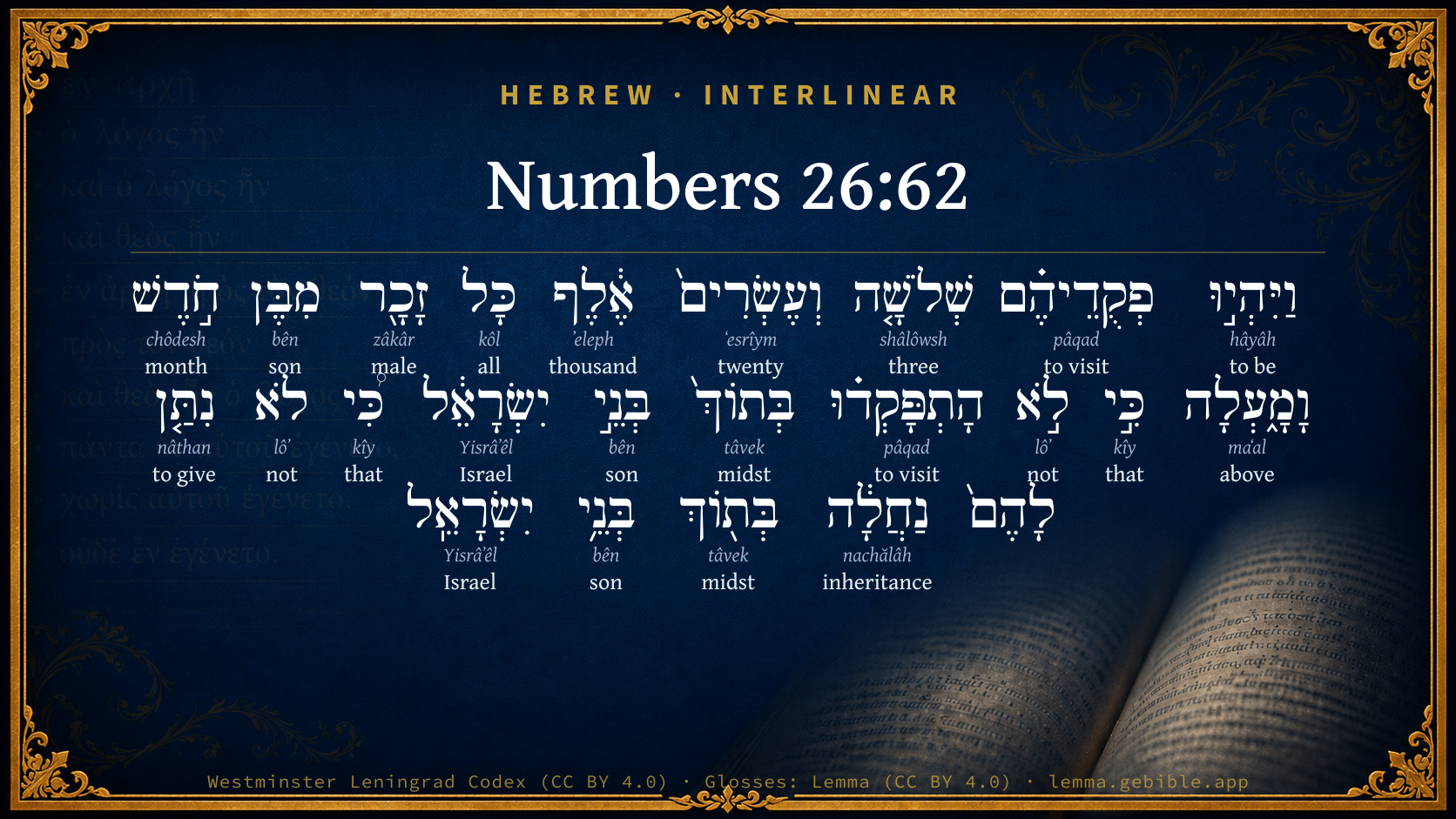
Numbers 26:62

Hebrew (Westminster Leningrad Codex) Numbers 26:62 appears in the Hebrew Old Testament. The text above is from the Westminster Leningrad Codex. Each word links to its Strong’s number, a concise gloss, and parsing drawn from the Open Scriptures Hebrew Bible morphology. Click any word for its full Brown-Driver-Briggs (BDB) entry.
Download image
Cite this verse

Numbers 26:62 (World English Bible). Public Domain. Lemma interlinear Bible study tool, https://lemma.gebible.app/v/numbers/26/62.

Show BibTeX & RIS
BibTeX
RIS
English Translation
Those who were numbered of them were twenty-three thousand, every male from a month old and upward: for they were not numbered among the children of Israel, because there was no inheritance given them among the children of Israel.
World English Bible · Public Domain
Download a study sheet

One document with this verse’s original text, its word-by-word gloss line, the meaning frame, cross-references with their text, attributed commentary, and full source and license credits — printable, and it pastes into notes with its structure intact.

This verse Autodidact and up

Study sheet (.html) Plain text (.txt)

A passage Seminary Student

Up to 50 verses in one chapter. A passage sheet keeps up to 6 commentary sources and 12 cross-references per verse, in the order this page ranks them, and says so on the sheet whenever that leaves anything out. Ask for a single verse and you get the Autodidact verse sheet above.

Everything on this page stays free to read, with no account — the sheet is a download of what is already on screen, not access to it.

Want to remove ads? Support Godless Engineer
Compare translations 3

The same verse in 3 English versions, stacked beneath the original-language interlinear above. Click any original word for its lexicon entry.

Each is an independent rendering of the whole verse — the interlinear is not word-aligned to these translations.

Highlighted words mark where these versions differ — a whole-verse word diff, not a word-by-word alignment.

  • World English Bible Public Domain
    Those who were numbered of them were twenty-three thousand, every male from a month old and upward: for they were not numbered among the children of Israel, because there was no inheritance given them among the children of Israel.
  • King James Version Public Domain
    And those that were numbered of them were twenty and three thousand, all males from a month old and upward: for they were not numbered among the children of Israel, because there was no inheritance given them among the children of Israel.
  • unfoldingWord Literal Text CC BY-SA 4.0
    And their counted ones were 23, 000, every male from a son of a month and upward. But they were not counted in the midst of the sons of Israel because an inheritance in the midst of the sons of Israel was not given to them.

unfoldingWord Literal Text — © unfoldingWord, licensed CC BY-SA 4.0. Word-aligned USFM3 via Door43 (git.door43.org/unfoldingWord/en_ult).

Versions to compare (up to 4)

3 of 4 selected

Show all 18 translations

Every available English version of this verse, each an independent rendering of the whole verse.

  • World English Bible Public Domain
    Those who were numbered of them were twenty-three thousand, every male from a month old and upward: for they were not numbered among the children of Israel, because there was no inheritance given them among the children of Israel.
  • Berean Standard Bible Public Domain
    The registration of the Levites totaled 23,000, every male a month old or more; they were not numbered among the other Israelites, because no inheritance was given to them among the Israelites.
  • Majority Standard Bible Public Domain
    The registration of the Levites totaled 23,000, every male a month old or more; they were not numbered among the other Israelites, because no inheritance was given to them among the Israelites.
  • King James Version Public Domain
    And those that were numbered of them were twenty and three thousand, all males from a month old and upward: for they were not numbered among the children of Israel, because there was no inheritance given them among the children of Israel.
  • American Standard Version (1901) Public Domain
    And they that were numbered of them were twenty and three thousand, every male from a month old and upward: for they were not numbered among the children of Israel, because there was no inheritance given them among the children of Israel.
  • Revised Version (1885) Public Domain
    And they that were numbered of them were twenty and three thousand, every male from a month old and upward: for they were not numbered among the children of Israel, because there was no inheritance given them among the children of Israel.
  • Geneva Bible (1599) Public Domain
    And their nombers were three and twentie thousand, all males from a moneth old and aboue: for they were not nombred among the children of Israel, because there was none inheritance giuen them among the children of Israel.
  • Douay-Rheims (1899) Public Domain
    And all that were numbered, were twenty-three thousand males from one month old and upward: for they were not reckoned up among the children of Israel, neither was a possession given to them with the rest.
  • Young's Literal Translation Public Domain
    And their numbered ones are three and twenty thousand, every male from a son of a month and upwards, for they have not numbered themselves in the midst of the sons of Israel; for an inheritance hath not been given to them in the midst of the sons of Israel.
  • Literal Standard Version CC BY-SA 4.0
    And their numbered ones are twenty-three thousand, every male from a son of a month and upwards, for they have not numbered themselves in the midst of the sons of Israel, because an inheritance has not been given to them in the midst of the sons of Israel.
  • Unlocked Literal Bible CC BY-SA 4.0
    The males who were counted among them numbered twenty-three thousand, all males one month old and up. But they were not counted among Israel's descendants because no inheritance was given to them among the people of Israel.
  • unfoldingWord Literal Text CC BY-SA 4.0
    And their counted ones were 23, 000, every male from a son of a month and upward. But they were not counted in the midst of the sons of Israel because an inheritance in the midst of the sons of Israel was not given to them.
  • Darby Bible Public Domain
    And those that were numbered of the [Levites] were twenty-three thousand, all males from a month old and upward; for they were not numbered among the children of Israel, because there was no inheritance given them among the children of Israel.
  • World Messianic Bible Public Domain
    Those who were counted of them were twenty-three thousand, every male from a month old and upward; for they were not counted among the children of Israel, because there was no inheritance given them among the children of Israel.
  • Webster's Bible Public Domain
    And those that were numbered of them were twenty and three thousand, all males from a month old and upward: for they were not numbered among the children of Israel, because there was no inheritance given them among the children of Israel.
  • Free Bible Version CC BY-SA 4.0
    The number of the Levites censused totaled 23,000. This included every male one month old or older. However, they were not counted with the other Israelites, because no land allotment was given to them with the other Israelites.
  • Bible in Basic English Public Domain
    Of these, twenty-three thousand males, from one month old and over, were numbered: they were not numbered with the rest of the children of Israel, for they had no heritage among the children of Israel.
  • JPS Tanakh (1917) Public Domain
    And they that were numbered of them were twenty and three thousand, every male from a month old and upward; for they were not numbered among the children of Israel, because there was no inheritance given them among the children of Israel.

Literal Standard Version (2020), Covenant Press — licensed CC BY-SA 4.0. Text via the HelloAO Bible API (eBible.org). Unlocked Literal Bible (unfoldingWord) — licensed CC BY-SA 4.0. Text via the HelloAO Bible API (eBible.org). unfoldingWord Literal Text — © unfoldingWord, licensed CC BY-SA 4.0. Word-aligned USFM3 via Door43 (git.door43.org/unfoldingWord/en_ult). Free Bible Version, Dr. Jonathan Gallagher — licensed CC BY-SA 4.0. Text via the HelloAO Bible API (eBible.org).

Word by word

More ways to search: Search by grammar → Find every occurrence → Compare this word →

Practice this passage: Drill this verse → Learn its vocabulary →

זָכָ֖ר
zâkâr
H2145
“male”
Adjective, Adjective, Masculine, Singular, Absolute
Part of Speech
Adjective
Type
Adjective
Gender
Masculine
Number
Singular
State
Absolute
Full BDB Definition

Origin: from H2142

TWOT: 551e

male (of humans and animals) (noun masculine) - male (of humans) (adjective)
  1. וַיִּהְי֣וּ hâyâh H1961 “and · to be” Conjunction + Verb, Qal, Sequential Imperfect, 3rd Person, Masculine, Plural
  2. פְקֻדֵיהֶ֗ם pâqad H6485 “visited · them” Verb, Qal, Participle Passive, Masculine, Plural, Construct + Suffix, Personal, 3rd Person, Masculine, Plural
  3. שְׁלֹשָׁ֤ה shâlôwsh H7969 “three” Adjective, Cardinal number, Masculine, Singular, Absolute
  4. וְעֶשְׂרִים֙ ʻesrîym H6242 “and · twenty” Conjunction + Adjective, Cardinal number, Both, Plural, Absolute
  5. אֶ֔לֶף ʼeleph H505 “thousand” Adjective, Cardinal number, Both, Singular, Absolute
  6. כָּל kôl H3605 “all of” Noun, Common, Masculine, Singular, Construct
  7. מִבֶּן bên H1121 “from · son of” Preposition + Noun, Common, Masculine, Singular, Construct
  8. חֹ֣דֶשׁ chôdesh H2320 “month” Noun, Common, Masculine, Singular, Absolute
  9. וָמָ֑עְלָה maʻal H4605 “and · above · toward” Conjunction + Adverb + Suffix, Demonstrative
  10. כִּ֣י kîy H3588 “that” Conjunction
  11. לֹ֣א lôʼ H3808 “not” Particle, Negative
  12. הָתְפָּקְד֗וּ pâqad H6485 “to visit” Verb, Hothpaal, Perfect, 3rd Person, Common, Plural
  13. בְּתוֹךְ֙ tâvek H8432 “in/at · midst of” Preposition + Noun, Common, Masculine, Singular, Construct
  14. בְּנֵ֣י bên H1121 “sons of” Noun, Common, Masculine, Plural, Construct
  15. יִשְׂרָאֵ֔ל Yisrâʼêl H3478 “Israel” Noun, Proper
  16. כִּ֠י kîy H3588 “that” Conjunction
  17. לֹא lôʼ H3808 “not” Particle, Negative
  18. נִתַּ֤ן nâthan H5414 “to give” Verb, Niphal, Perfect, 3rd Person, Masculine, Singular
  19. נַחֲלָ֔ה nachălâh H5159 “inheritance” Noun, Common, Feminine, Singular, Absolute
  20. בְּת֖וֹךְ tâvek H8432 “in/at · midst of” Preposition + Noun, Common, Masculine, Singular, Construct
  21. בְּנֵ֥י bên H1121 “sons of” Noun, Common, Masculine, Plural, Construct
  22. יִשְׂרָאֵֽל Yisrâʼêl H3478 “Israel” Noun, Proper

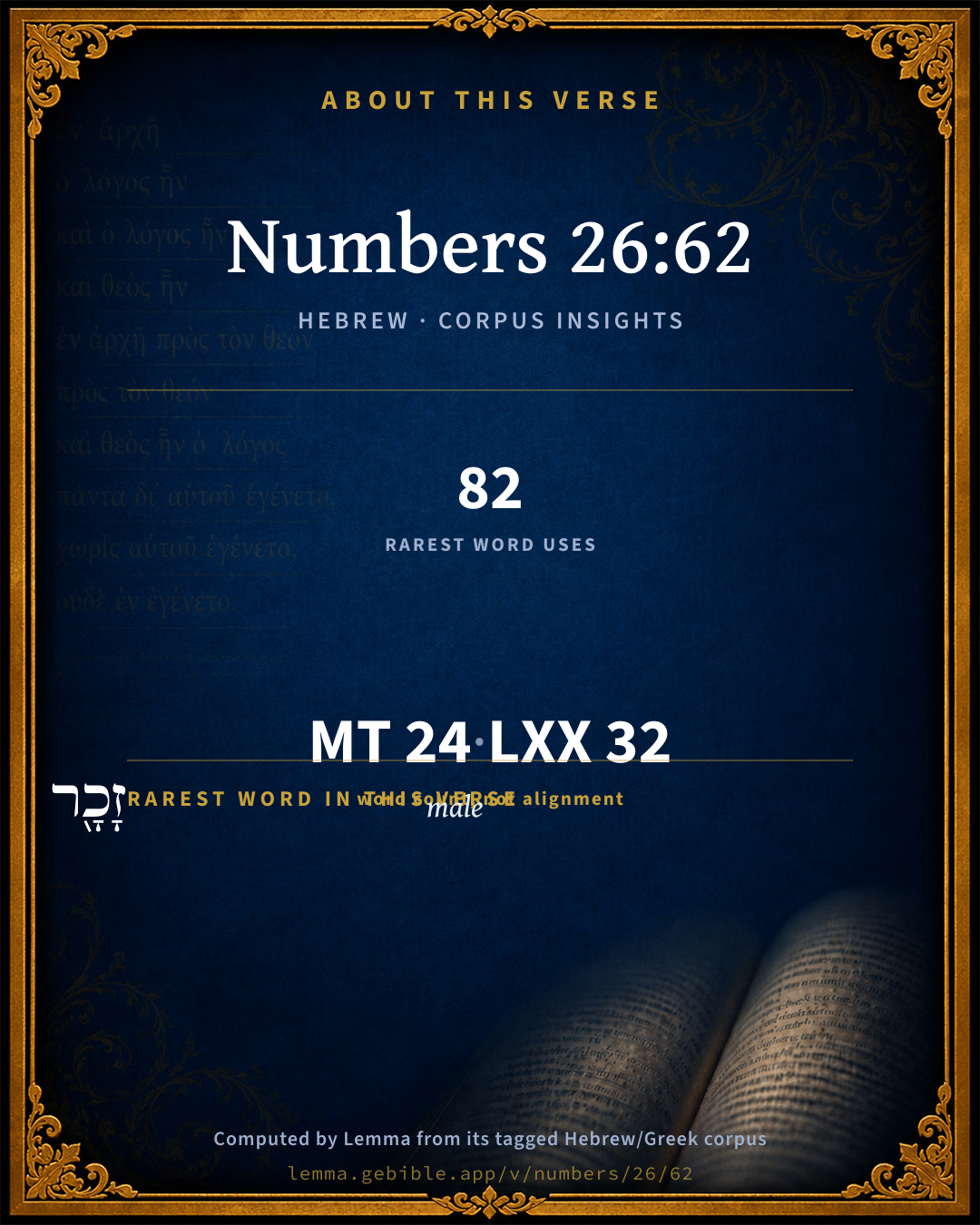
About this verse

These counts appear in no published source. They are computed here, from the morphology-tagged text and Lemma’s own curated glosses. What Lemma adds →

24
words
16
distinct lemmas
Pentateuch
section

Grammatical profile

  • 4 verbs
  • 10 nouns
  • 4 adjectives
  • 1 preposition
  • 2 conjunctions
  • 1 adverb
  • 2 particles

Verb forms

  • וַיִּהְי֣וּ Qal · Sequential Imperfect
  • פְקֻדֵיהֶ֗ם Qal · Participle Passive
  • הָתְפָּקְד֗וּ Hothpaal · Perfect
  • נִתַּ֤ן Niphal · Perfect

Repetition

Words recur within this verse — often emphatic in Hebrew:

  • מִבֶּן son H1121 ×3
  • פְקֻדֵיהֶ֗ם to visit H6485 ×2
  • בְּתוֹךְ֙ midst H8432 ×2
  • יִשְׂרָאֵ֔ל Israel H3478 ×2
  • כִּ֣י that H3588 ×2
  • לֹ֣א not H3808 ×2

Hebrew & Septuagint length

In English translation the verse runs 39 words from the Hebrew and 40 from the Septuagint (LXX English) — closely comparable.

A rough comparison of the two English renderings, which tokenize alike — not a word-level alignment.

Word counts can differ between the Hebrew and the Greek without any difference in meaning — e.g. the Hebrew direct-object marker אֵת has no separate Greek word, and Greek often adds the article ὁ.

In the original languages it is 24 Hebrew tokens and 32 Greek tokens — but the two are counted differently (Hebrew bundles its prefixes and suffixes into one token; the Greek is in lemma form), so that isn’t a like-for-like length.

Cross-references

13

Topical passages linked to Numbers 26:62 in the Treasury of Scripture Knowledge — connected by theme and wording, ordered by reader-vote popularity; previews shown in the World English Bible.

  • Numbers 1:49 "Only the tribe of Levi you shall not number, neither shall you take a census of them among the children of Israel;
  • Numbers 3:39 All who were numbered of the Levites, whom Moses and Aaron numbered at the commandment of Yahweh, by their families, all the males from a month old and upward, were twenty-two thousand.
  • Numbers 35:2–8 Command the children of Israel that they give to the Levites of the inheritance of their possession cities to dwell in; and suburbs for the cities round about them shall you give to the Levites.
  • Deuteronomy 10:9 Therefore Levi has no portion nor inheritance with his brothers; Yahweh is his inheritance, according as Yahweh your God spoke to him.)
  • Numbers 18:20–24 Yahweh said to Aaron, You shall have no inheritance in their land, neither shall you have any portion among them: I am your portion and your inheritance among the children of Israel.
  • Deuteronomy 14:27–29 The Levite who is within your gates, you shall not forsake him; for he has no portion nor inheritance with you.
  • Deuteronomy 18:1–2 The priests the Levites, [even] all the tribe of Levi, shall have no portion nor inheritance with Israel: they shall eat the offerings of Yahweh made by fire, and his inheritance.
  • Joshua 13:14 Only to the tribe of Levi he gave no inheritance; the offerings of Yahweh, the God of Israel, made by fire are his inheritance, as he spoke to him.
  • Joshua 13:33 But to the tribe of Levi Moses gave no inheritance: Yahweh, the God of Israel, is their inheritance, as he spoke to them.
  • Joshua 14:3 For Moses had given the inheritance of the two tribes and the half-tribe beyond the Jordan: but to the Levites he gave no inheritance among them.
  • Numbers 1:47 But the Levites after the tribe of their fathers were not numbered among them.
  • Numbers 4:27 At the commandment of Aaron and his sons shall be all the service of the sons of the Gershonites, in all their burden, and in all their service; and you shall appoint to them in charge all their burden.
  • Numbers 4:48 even those who were numbered of them, were eight thousand five hundred eighty.

Cross-references courtesy of OpenBible.info (CC BY 4.0).

Hebrew and Greek witnesses Masoretic Hebrew ↔ Greek Septuagint

The same verse in the two great witnesses to the Old Testament, shown verse-for-verse.

These are two independent witnesses, not word-aligned to each other, and the Septuagint is shown in lemma (dictionary) form.

Hebrew Numbers 26:62 Masoretic · Westminster Leningrad Codex

וַיִּהְי֣וּ פְקֻדֵיהֶ֗ם שְׁלֹשָׁ֤ה וְעֶשְׂרִים֙ אֶ֔לֶף כָּל זָכָ֖ר מִבֶּן חֹ֣דֶשׁ וָמָ֑עְלָה כִּ֣י לֹ֣א הָתְפָּקְד֗וּ בְּתוֹךְ֙ בְּנֵ֣י יִשְׂרָאֵ֔ל כִּ֠י לֹא נִתַּ֤ן לָהֶם֙ נַחֲלָ֔ה בְּת֖וֹךְ בְּנֵ֥י יִשְׂרָאֵֽל

Those who were numbered of them were twenty-three thousand, every male from a month old and upward: for they were not numbered among the children of Israel, because there was no inheritance given them among the children of Israel.

World English Bible · Public Domain

Greek LXX Numbers 26:62 Septuagint · lemma form

καί γίγνομαι ἐκ ἐπίσκεψις αὐτός τρεῖς καί εἴκοσι χιλιάς πᾶς ἀρσενικός ἀπό μηνιαῖος καί ἐπάνω οὐ γάρ συν ἐπισκέπτομαι ἐν μέσος υἱός ἰσραήλ ὅτι οὐ δίδωμι αὐτός κλῆρος ἐν μέσος υἱός ἰσραήλ

And there were according to their numbering, twenty-three thousand, every male from a month old and upward; for they were not numbered among the children of Israel, because they have no inheritance in the midst of the children of Israel.

LXX2012 (modern English Septuagint) · Public Domain

Hebrew: Westminster Leningrad Codex (CC BY 4.0). Greek: Septuagint (public domain); English from LXX2012 (modern English Septuagint) (Public Domain). How the Septuagint differs from the Hebrew →

Targum (Aramaic paraphrase)

2

The Targum is the ancient Jewish Aramaic paraphrase of the Hebrew Scriptures — an interpretive translation, not the Hebrew text itself. Onkelos (literal) and Pseudo-Jonathan (expansive) render the Torah, and Jonathan the Prophets. Coverage is partial: where no permissively-licensed English translation exists for a verse, only the Aramaic is shown. This is verse-level text, not a word-by-word alignment to the Hebrew.

  1. Targum Onkelos Torah (Genesis–Deuteronomy)
    וַהֲווֹ מִנְיָנֵיהוֹן עַשְׂרִין וּתְלָתָא אַלְפִין כָּל דְכוּרָא מִבַּר יַרְחָא וּלְעֵילָא אֲרֵי לָא אִתְמְנִיאוּ בְּגוֹ בְּנֵי יִשְׂרָאֵל אֲרֵי לָא אִתְיְהִיבַת לְהוֹן אַחֲסָנָא בְּגוֹ בְּנֵי יִשְׂרָאֵל

    (no public-domain English translation for this verse)

    Targum Onkelos — Aramaic: “Onkelos Genesis” (public domain); “Onkelos Exodus” (public domain); “Onkelos Leviticus” (public domain); “Onkelos Numbers” (public domain); “Onkelos Deuteronomy” (public domain). English: “Sefaria Community Translation” (CC0 1.0 (public-domain dedication)); “J.W. Etheridge. The Targums of Onkelos and Jonathan Ben Uzziel on the Pentateuch. London: Longmans, Green, 1862” (public domain). Text via Sefaria.

  2. Targum Pseudo-Jonathan Torah (Genesis–Deuteronomy)
    וַהֲווֹ סְכוּמְהוֹן עַשְרִין וּתְלָתָא אַלְפִין כָּל דְכוּרָא מִבַּר יַרְחָא וּלְעֵילָא אֲרוּם לָא אִתְמְנִיאוּ בְּגוֹ בְּנֵי יִשְרָאֵל אֲרוּם לָא אִתְיְהִיבַת לְהוֹן אַחְסָנָא בְּגוֹ בְּנֵי יִשְרָאֵל

    And the number of them (the Levites) was twenty-three thousand, every male from a month old, and upward; for they were not reckoned among the children of Israel, as no possession was given them among the sons of Israel.

    Targum Pseudo-Jonathan — Aramaic: “Targum Jonathan on Genesis” (public domain); “Targum Jonathan on Exodus” (public domain); “Targum Jonathan on Leviticus” (public domain); “Targum Jonathan on Numbers” (public domain); “Targum Jonathan on Deuteronomy” (public domain). English: “The Targum of Jonathan ben Uzziel, trans. J. W. Etheridge, London, 1862” (public domain). Text via Sefaria.

Commentary

Notes on Numbers 26:62 from classic Christian and Jewish commentators (each source and its license shown beneath its notes). The classic Christian expositions comment on the surrounding passage and are grouped to its opening verse, so a note may address several verses; the Jewish commentaries on the Tanakh (Rashi and others) are per-verse, so they appear only where the commentator wrote on this verse.

Lemma curates 59 commentaries, every one of them public domain or Creative Commons licensed, each selected and text-cleaned for this edition rather than reprinted as found. About our sources →

Tyndale Open Study Notes

Tyndale Open Resources

26:62 The Levites were numbered separately (cp. 1:47-49; 3:14-39). • one month old or older: Cp. 3:15. • they were not given an allotment of land when it was divided among the Israelites: The Levites were given forty-eight towns for their use, but they received no large territory through the process described in 26:52-56 (35:1-8; cp. 18:23-24).

Tyndale Open Study Notes — © Tyndale Open Resources, licensed CC BY-SA 4.0. Text via the HelloAO Bible API.

Jamieson, Fausset & Brown

Robert Jamieson, A. R. Fausset & David Brown

twenty and three thousand--so that there was an increase of a thousand (Num 3:39).

males from a month old and upward--(See on Num 3:14).

Jamieson, Fausset & Brown — Commentary Critical and Explanatory on the Whole Bible (1871) — public domain (CC PDM 1.0). Text via the HelloAO Bible API.

Ellicott's Commentary for English Readers

(62) Twenty and three thousand.—At the former census the number was 22,000 or 22,300 (See Num_3:39, and Note.)

A Bible Commentary for English Readers, edited by Charles John Ellicott (1878–1897) — public domain. Text from a community e-Sword module.

The Cambridge Bible for Schools and Colleges

gen. ed. J. J. S. Perowne

62. twenty and three thousand] At the first census the Levites numbered 22,000.

The Cambridge Bible for Schools and Colleges (gen. ed. J. J. S. Perowne; Cambridge University Press, 1878–1918) — public domain. Text from a community e-Sword module.

Albert Barnes' Notes on the Bible

The total number of male Levites, 23,000, shows an increase of 1,000 on the number at Sinai Num 3:39. It is doubtless to be taken as a round number; and, as before, includes the male children from a month old and upward, as well as the male adults.

Albert Barnes' Notes on the Bible (1834–1885) — public domain. Text from a community e-Sword/MySword module.

Matthew Poole's English Annotations

Twenty and three thousand; one thousand more than they were Num 3:39. The reason of which different way of numbering, see on Num 3:15.

Matthew Poole's English Annotations on the Holy Bible (1683–1685) — public domain. Text from a community e-Sword/MySword module.

Whedon's Commentary on the Bible

Daniel D. Whedon

62. Twenty and three thousand — A gain of only seven hundred and twenty-seven since the Sinaitic census. The tribe of Levi was not numbered among the children of Israel, or enrolled in the general census, for two reasons — it was made on a different basis, from a month old and upward, and it had no reference to the conquest and division of Canaan, in which Levi had no tribal allotment.

Daniel D. Whedon (gen. ed.), Commentary on the Old and New Testaments (1874–1909) — public domain. Text from a community e-Sword module.

The Pulpit Commentary

Those that were numbered of them. We have here again a round number (23, 000), showing an increase of 1000 since the former census. It is evident that the males of Levi were not counted by anything less than hundreds, and probable that they were counted by thousands. (see note on Num_3:29) The smallness of the increase in a tribe which was excepted from the general doom at Kadesh, and which in other ways was so favourably situated, seems to point to some considerable losses. It is possible that portions of the tribe suffered severely for their share in the rebellion of Korah; if so, the families of the Shimites and of the Uzzielites may have been so much reduced as to be merged in the remaining families.

The Pulpit Commentary (1880–1919), ed. H.D.M. Spence-Jones & Joseph S. Exell — public domain. Text from a community e-Sword module.

Keil & Delitzsch

C. F. Keil & F. Delitzsch

The Levites were not mustered along with the rest of the tribes of Israel, because the mustering took place with especial reference to the conquest of Canaan, and the Levites were not to receive any territory as a tribe (see at Num 18:20).

Keil & Delitzsch — Biblical Commentary on the Old Testament (1861–1891) — public domain (CC PDM 1.0). Text via the HelloAO Bible API. (Old Testament only.)

Rashi

Rabbi Shlomo Yitzchaki (Rashi)

כי לא התפקדו בתוך בני ישראל FOR THEY WERE NOT NUMBERED AMONGST THE CHILDREN OF ISRAEL, that they should also be numbered from twenty years old and upwards. What was the reason that they were not numbered from twenty years old? כי לא נתן להם נחלה BECAUSE NO INHERITANCE WAS TO BE GIVEN THEM, while those who were counted from twenty years old were persons who were recipients of an inheritance, as it is said, (v. 54) “to everyone shall his inheritance be given according to those that were numbered of them”, (consequently the Levites had to form a different group for the census).

Rashi on the Tanakh — English translations: “The Judaica Press complete Tanach with Rashi, translated by A. J. Rosenberg” (CC BY 4.0); “Pentateuch with Rashi's commentary by M. Rosenbaum and A.M. Silbermann, 1929-1934” (public domain); “The Metsudah Tanach series, Lakewood, N.J” (CC BY 4.0); and “The Book of Joshua, Metsudah Publications, 1997” (CC BY 4.0). Text via Sefaria.

Lesson kit

Teaching starters — assembled from the data on this page, not authored interpretation. Every prompt links to the verse data it draws on. Edit before teaching.

Numbers, in the Pentateuch, opens this verse with 24 words (16 distinct Hebrew lemmas). Its most distinctive word is zâkâr (“male”). A historical commentator’s framing appears above. Read the whole chapter for the surrounding context.

Discussion questions

  1. What does “male” (zâkâr) contribute to the verse as a whole?
  2. Numbers 1:49 shares this passage’s theme. How do the two illuminate each other?
  3. “son” occurs 3× in this one verse. What is the effect of the repetition?
  4. The translations on this page render this verse differently — a whole-verse word diff, not a word-by-word alignment. What might account for the different wordings?
  5. The verb «וַיִּהְי֣וּ» is Qal Sequential Imperfect. How does its form color the action?
  6. Reading how Tyndale Open Study Notes and Jamieson, Fausset & Brown read this verse, where do the two commentators agree and where do they part?

Things to notice

Reading settings

Reading text

Shown beneath each verse's original-language words.

Old Testament
Old Testament edition

Read the OT as the Masoretic Hebrew (MT) or the Greek Septuagint (LXX).

English shown for the Greek Septuagint (in the Hebrew ↔ Greek comparison).

Comparing translations? Open the Compare panel on any verse page to stack up to four side by side.