
Joshua 7:21

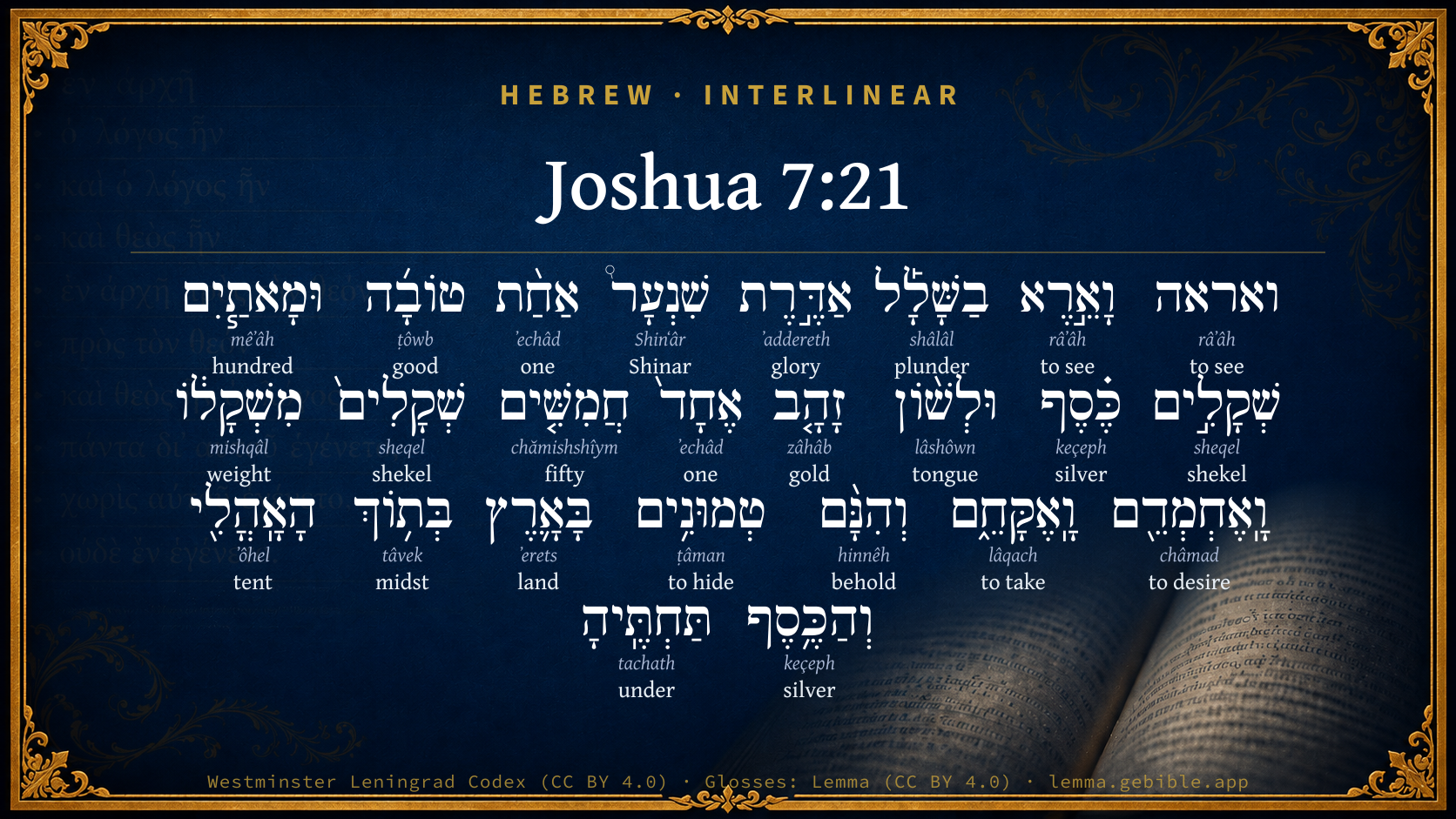
Hebrew (Westminster Leningrad Codex) Joshua 7:21 appears in the Hebrew Old Testament. The text above is from the Westminster Leningrad Codex. Each word links to its Strong’s number, a concise gloss, and parsing drawn from the Open Scriptures Hebrew Bible morphology. Click any word for its full Brown-Driver-Briggs (BDB) entry.
Download image
Cite this verse

Joshua 7:21 (World English Bible). Public Domain. Lemma interlinear Bible study tool, https://lemma.gebible.app/v/joshua/7/21.

Show BibTeX & RIS
BibTeX
RIS
English Translation
when I saw among the spoil a goodly Babylonian mantle, and two hundred shekels of silver, and a wedge of gold of fifty shekels weight, then I coveted them, and took them; and, behold, they are hid in the earth in the midst of my tent, and the silver under it.
World English Bible · Public Domain
Download a study sheet

One document with this verse’s original text, its word-by-word gloss line, the meaning frame, cross-references with their text, attributed commentary, and full source and license credits — printable, and it pastes into notes with its structure intact.

This verse Autodidact and up

Study sheet (.html) Plain text (.txt)

A passage Seminary Student

Up to 50 verses in one chapter. A passage sheet keeps up to 6 commentary sources and 12 cross-references per verse, in the order this page ranks them, and says so on the sheet whenever that leaves anything out. Ask for a single verse and you get the Autodidact verse sheet above.

Everything on this page stays free to read, with no account — the sheet is a download of what is already on screen, not access to it.

Want to remove ads? Support Godless Engineer
Compare translations 3

The same verse in 3 English versions, stacked beneath the original-language interlinear above. Click any original word for its lexicon entry.

Each is an independent rendering of the whole verse — the interlinear is not word-aligned to these translations.

Highlighted words mark where these versions differ — a whole-verse word diff, not a word-by-word alignment.

  • World English Bible Public Domain
    when I saw among the spoil a goodly Babylonian mantle, and two hundred shekels of silver, and a wedge of gold of fifty shekels weight, then I coveted them, and took them; and, behold, they are hid in the earth in the midst of my tent, and the silver under it.
  • King James Version Public Domain
    When I saw among the spoils a goodly Babylonish garment, and two hundred shekels of silver, and a wedge of gold of fifty shekels weight, then I coveted them, and took them; and, behold, they are hid in the earth in the midst of my tent, and the silver under it.
  • unfoldingWord Literal Text CC BY-SA 4.0
    Now I saw among the spoil one good coat of Shinar and 200 shekels of silver and one wedge of gold, 50 shekels its weight. And I desired them and took them. And behold, they are hidden in the earth in the midst of my tent, and the silver under it.”

unfoldingWord Literal Text — © unfoldingWord, licensed CC BY-SA 4.0. Word-aligned USFM3 via Door43 (git.door43.org/unfoldingWord/en_ult).

Versions to compare (up to 4)

3 of 4 selected

Show all 18 translations

Every available English version of this verse, each an independent rendering of the whole verse.

  • World English Bible Public Domain
    when I saw among the spoil a goodly Babylonian mantle, and two hundred shekels of silver, and a wedge of gold of fifty shekels weight, then I coveted them, and took them; and, behold, they are hid in the earth in the midst of my tent, and the silver under it.
  • Berean Standard Bible Public Domain
    When I saw among the spoils a beautiful cloak from Shinar, two hundred shekels of silver, and a bar of gold weighing fifty shekels, I coveted them and took them. They are hidden in the ground inside my tent, with the silver underneath.”
  • Majority Standard Bible Public Domain
    When I saw among the spoils a beautiful cloak from Shinar, two hundred shekels of silver, and a bar of gold weighing fifty shekels, I coveted them and took them. They are hidden in the ground inside my tent, with the silver underneath.”
  • King James Version Public Domain
    When I saw among the spoils a goodly Babylonish garment, and two hundred shekels of silver, and a wedge of gold of fifty shekels weight, then I coveted them, and took them; and, behold, they are hid in the earth in the midst of my tent, and the silver under it.
  • American Standard Version (1901) Public Domain
    when I saw among the spoil a goodly Babylonish mantle, and two hundred shekels of silver, and a wedge of gold of fifty shekels weight, then I coveted them, and took them; and, behold, they are hid in the earth in the midst of my tent, and the silver under it.
  • Revised Version (1885) Public Domain
    when I saw among the spoil a goodly Babylonish mantle, and two hundred shekels of silver, and a wedge of gold of fifty shekels weight, then I coveted them, and took them; and, beheld, they are hid in the earth in the midst of my tent, and the silver under it.
  • Geneva Bible (1599) Public Domain
    I sawe among the spoyle a goodly Babylonish garment, and two hundreth shekels of siluer, and a wedge of golde of fiftie shekels weight, and I coueted them, and tooke them: and behold, they lye hid in the earth in the mids of my tent, and the siluer vnder it.
  • Douay-Rheims (1899) Public Domain
    For I saw among the spoils a scarlet garment exceeding good, and two hundred sides of silver, and a golden rule of fifty sides: and I coveted them, and I took them away, and hid them in the ground is the midst of my tent, and the silver I covered with the earth that I dug up.
  • Young's Literal Translation Public Domain
    and I see among the spoil a goodly robe of Shinar, and two hundred shekels of silver, and one wedge of gold, whose weight `is' fifty shekels, and I desire them, and take them; and lo, they `are' hid in the earth, in the midst of my tent, and the silver under it.'
  • Literal Standard Version CC BY-SA 4.0
    and I see among the spoil a good robe of Shinar, and two hundred shekels of silver, and one wedge of gold, whose weight [is] fifty shekels, and I desire them, and take them; and behold, they [are] hid in the earth, in the midst of my tent, and the silver [is] under it.”
  • Unlocked Literal Bible CC BY-SA 4.0
    When I saw among the plunder a beautiful coat from Babylon, two hundred shekels of silver, and a bar of gold weighing fifty shekels, I desired them and took them. They are hidden in the ground in the middle of my tent, and the silver is under it.”
  • unfoldingWord Literal Text CC BY-SA 4.0
    Now I saw among the spoil one good coat of Shinar and 200 shekels of silver and one wedge of gold, 50 shekels its weight. And I desired them and took them. And behold, they are hidden in the earth in the midst of my tent, and the silver under it.”
  • Darby Bible Public Domain
    I saw among the spoils a beautiful mantle of Shinar, and two hundred shekels of silver, and a golden bar of fifty shekels weight, and I coveted them and took them; and behold, they are hid in the earth in the midst of my tent, and the silver under it.
  • World Messianic Bible Public Domain
    When I saw among the plunder a beautiful Babylonian robe, two hundred shekels of silver, and a wedge of gold weighing fifty shekels, then I coveted them and took them. Behold, they are hidden in the ground in the middle of my tent, with the silver under it.”
  • Webster's Bible Public Domain
    When I saw among the spoils a goodly Babylonish garment, and two hundred shekels of silver, and a wedge of gold of fifty shekels weight, then I coveted them, and took them, and behold, they are hid in the earth in the midst of my tent, and the silver under it.
  • Free Bible Version CC BY-SA 4.0
    Among the plunder I saw a beautiful cloak from Babylonia, two hundred shekels of silver, and a bar of gold weighing fifty shekels. I really wanted them, so I took them. They're hidden in the ground inside my tent, with the silver buried deeper.”
  • Bible in Basic English Public Domain
    When I saw among their goods a fair robe of Babylon and two hundred shekels of silver, and a mass of gold, fifty shekels in weight, I was overcome by desire and took them; and they are put away in the earth in my tent, and the silver is under it.
  • JPS Tanakh (1917) Public Domain
    When I saw among the spoil a goodly Shinar mantle, and two hundred shekels of silver, and a wedge of gold of fifty shekels weight, then I coveted them, and took them; and, behold, they are hid in the earth in the midst of my tent, and the silver under it.'

Literal Standard Version (2020), Covenant Press — licensed CC BY-SA 4.0. Text via the HelloAO Bible API (eBible.org). Unlocked Literal Bible (unfoldingWord) — licensed CC BY-SA 4.0. Text via the HelloAO Bible API (eBible.org). unfoldingWord Literal Text — © unfoldingWord, licensed CC BY-SA 4.0. Word-aligned USFM3 via Door43 (git.door43.org/unfoldingWord/en_ult). Free Bible Version, Dr. Jonathan Gallagher — licensed CC BY-SA 4.0. Text via the HelloAO Bible API (eBible.org).

Word by word

More ways to search: Search by grammar → Find every occurrence → Compare this word →

Practice this passage: Drill this verse → Learn its vocabulary →

שִׁנְעָר֩
Shinʻâr
H8152
“Shinar”
Noun, Proper
Part of Speech
Noun
Type
Proper
Full BDB Definition

Origin: probably of foreign derivation

TWOT: 2424

Shinar = "country of two rivers" - the ancient name for the territory later known as Babylonia or Chaldea
  1. ואראה râʼâh H7200 “and · to see” Conjunction + Verb, Qal, Sequential Imperfect, 1st Person, Common, Singular
  2. וָאֵ֣רֶא râʼâh H7200 “and · to see” Conjunction + Verb, Qal, Sequential Imperfect, 1st Person, Common, Singular
  3. בַשָּׁלָ֡ל shâlâl H7998 “in/at the · plunder” Preposition, Determined + Noun, Common, Masculine, Singular, Absolute
  4. אַדֶּ֣רֶת ʼaddereth H155 “glory of” Noun, Common, Feminine, Singular, Construct
  5. אַחַ֨ת ʼechâd H259 “one” Adjective, Cardinal number, Feminine, Singular, Absolute
  6. טוֹבָ֜ה ṭôwb H2896 “good” Adjective, Adjective, Feminine, Singular, Absolute
  7. וּמָאתַ֧יִם mêʼâh H3967 “and · hundred” Conjunction + Adjective, Cardinal number, Both, Dual, Absolute
  8. שְׁקָלִ֣ים sheqel H8255 “shekels” Noun, Common, Masculine, Plural, Absolute
  9. כֶּ֗סֶף keçeph H3701 “silver” Noun, Common, Masculine, Singular, Absolute
  10. וּלְשׁ֨וֹן lâshôwn H3956 “and · tongue of” Conjunction + Noun, Common, Both, Singular, Construct
  11. זָהָ֤ב zâhâb H2091 “gold” Noun, Common, Masculine, Singular, Absolute
  12. אֶחָד֙ ʼechâd H259 “one” Adjective, Cardinal number, Masculine, Singular, Absolute
  13. חֲמִשִּׁ֤ים chămishshîym H2572 “fifty” Adjective, Cardinal number, Both, Plural, Absolute
  14. שְׁקָלִים֙ sheqel H8255 “shekels” Noun, Common, Masculine, Plural, Absolute
  15. מִשְׁקָל֔וֹ mishqâl H4948 “weight · his” Noun, Common, Masculine, Singular, Construct + Suffix, Personal, 3rd Person, Masculine, Singular
  16. וָֽאֶחְמְדֵ֖ם châmad H2530 “and · to desire · them” Conjunction + Verb, Qal, Sequential Imperfect, 1st Person, Common, Singular + Suffix, Personal, 3rd Person, Masculine, Plural
  17. וָֽאֶקָּחֵ֑ם lâqach H3947 “and · to take · them” Conjunction + Verb, Qal, Sequential Imperfect, 1st Person, Common, Singular + Suffix, Personal, 3rd Person, Masculine, Plural
  18. וְהִנָּ֨ם hinnêh H2009 “and · behold · them” Conjunction + Particle, Demonstrative + Suffix, Personal, 3rd Person, Masculine, Plural
  19. טְמוּנִ֥ים ṭâman H2934 “hidden” Verb, Qal, Participle Passive, Masculine, Plural, Absolute
  20. בָּאָ֛רֶץ ʼerets H776 “in/at the · land” Preposition, Determined + Noun, Common, Both, Singular, Absolute
  21. בְּת֥וֹךְ tâvek H8432 “in/at · midst of” Preposition + Noun, Common, Masculine, Singular, Construct
  22. הָאָֽהֳלִ֖י ʼôhel H168 “the · tent · my” Particle, Definite Article + Noun, Common, Masculine, Singular, Construct + Suffix, Personal, 1st Person, Common, Singular
  23. וְהַכֶּ֥סֶף keçeph H3701 “and · the · silver” Conjunction + Particle, Definite Article + Noun, Common, Masculine, Singular, Absolute
  24. תַּחְתֶּֽיהָ tachath H8478 “under · her” Preposition + Suffix, Personal, 3rd Person, Feminine, Singular

About this verse

These counts appear in no published source. They are computed here, from the morphology-tagged text and Lemma’s own curated glosses. What Lemma adds →

25
words
21
distinct lemmas
Historical
section

Notable vocabulary

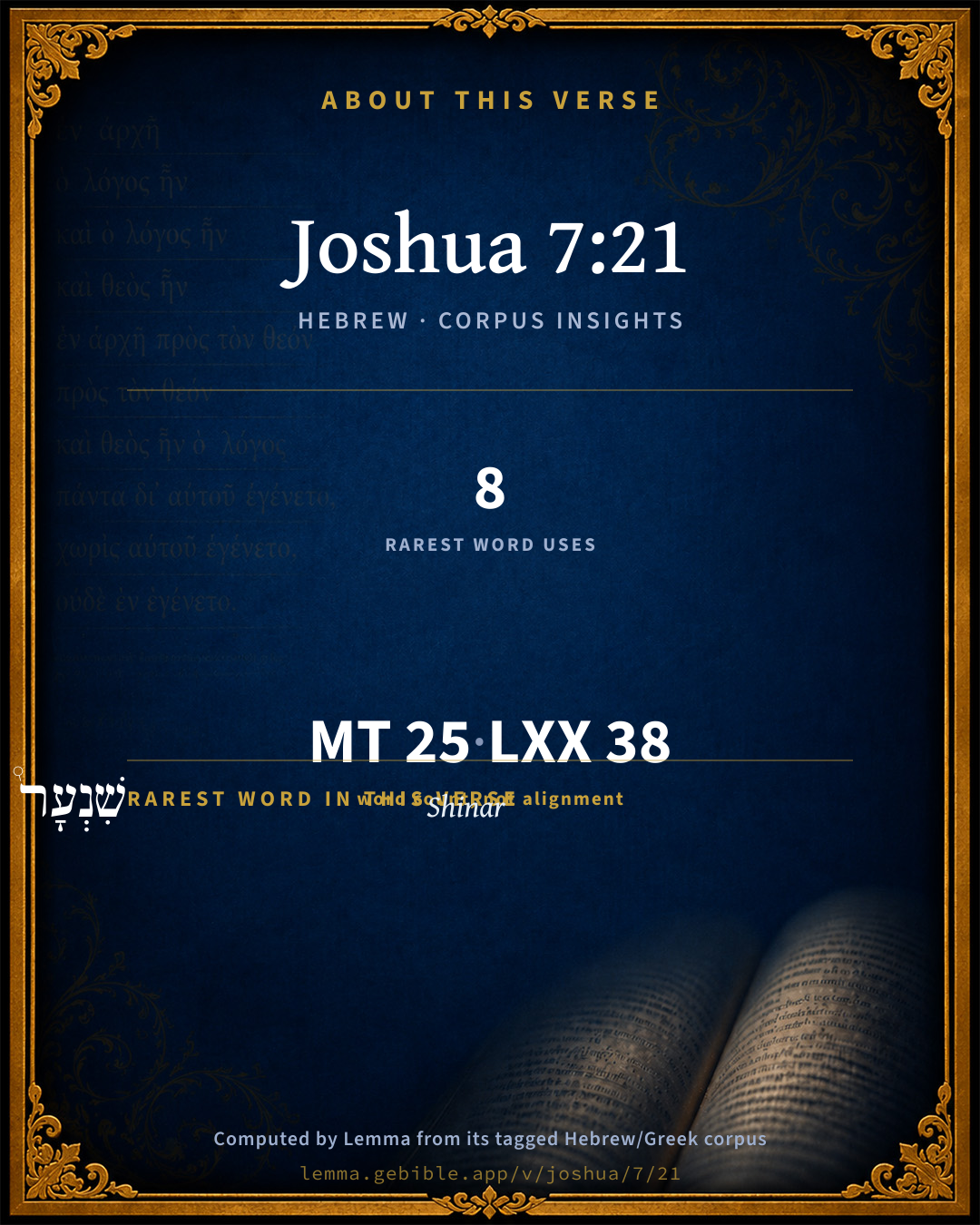
The rarest word here is שִׁנְעָר֩ Shinar H8152 — appearing just 8 times in the whole Hebrew Bible.

Shared distinctive vocabulary

שִׁנְעָר֩ Shinar H8152 occurs in 8 verses of the Hebrew Bible. Also found in:

Grammatical profile

  • 5 verbs
  • 13 nouns
  • 5 adjectives
  • 1 preposition
  • 1 particle

Verb forms

  • ואראה Qal · Sequential Imperfect
  • וָאֵ֣רֶא Qal · Sequential Imperfect
  • וָֽאֶחְמְדֵ֖ם Qal · Sequential Imperfect
  • וָֽאֶקָּחֵ֑ם Qal · Sequential Imperfect
  • טְמוּנִ֥ים Qal · Participle Passive

Repetition

Words recur within this verse — often emphatic in Hebrew:

  • ואראה to see H7200 ×2
  • אַחַ֨ת one H259 ×2
  • שְׁקָלִ֣ים shekel H8255 ×2
  • כֶּ֗סֶף silver H3701 ×2

Hebrew & Septuagint length

In English translation the verse runs 51 words from the Hebrew and 43 from the Septuagint (LXX English) — closely comparable.

A rough comparison of the two English renderings, which tokenize alike — not a word-level alignment.

Word counts can differ between the Hebrew and the Greek without any difference in meaning — e.g. the Hebrew direct-object marker אֵת has no separate Greek word, and Greek often adds the article ὁ.

In the original languages it is 25 Hebrew tokens and 38 Greek tokens — but the two are counted differently (Hebrew bundles its prefixes and suffixes into one token; the Greek is in lemma form), so that isn’t a like-for-like length.

Cross-references

30

Topical passages linked to Joshua 7:21 in the Treasury of Scripture Knowledge — connected by theme and wording, ordered by reader-vote popularity; previews shown in the World English Bible.

  • James 1:15 Then the lust, when it has conceived, bears sin; and the sin, when it is full grown, brings forth death.
  • Psalms 119:37 Turn my eyes away from looking at worthless things. Revive me in your ways.
  • Luke 12:15 He said to them, "Beware! Keep yourselves from covetousness, for a man's life doesn't consist of the abundance of the things which he possesses."
  • 1 John 2:15–16 Don't love the world, neither the things that are in the world. If anyone loves the world, the Father's love isn't in him.
  • Deuteronomy 7:25 The engraved images of their gods shall you burn with fire: you shall not covet the silver or the gold that is on them, nor take it to you, lest you be snared therein; for it is an abomination to Yahweh your God.
  • 2 Peter 2:15 forsaking the right way, they went astray, having followed the way of Balaam the son of Beor, who loved the wages of wrong-doing;
  • Genesis 3:6 When the woman saw that the tree was good for food, and that it was a delight to the eyes, and that the tree was to be desired to make one wise, she took of the fruit of it, and ate; and she gave some to her husband with her, and he ate.
  • Genesis 6:2 that God's sons saw that men's daughters were beautiful, and they took for themselves wives of all that they chose.
  • 2 Samuel 11:2 It happened at evening, that David arose from off his bed, and walked on the roof of the king's house: and from the roof he saw a woman bathing; and the woman was very beautiful to look on.
  • 1 Kings 21:1–2 It happened after these things, that Naboth the Jezreelite had a vineyard, which was in Jezreel, hard by the palace of Ahab king of Samaria.
  • 2 Kings 5:20–27 But Gehazi the servant of Elisha the man of God, said, Behold, my master has spared this Naaman the Syrian, in not receiving at his hands that which he brought: as Yahweh lives, I will run after him, and take somewhat of him.
  • Proverbs 28:22 A stingy man hurries after riches, And doesn't know that poverty waits for him.
  • 1 Timothy 6:9–10 But those who are determined to be rich fall into a temptation and a snare and many foolish and harmful lusts, such as drown men in ruin and destruction.
  • Hebrews 13:5 Be free from the love of money, content with such things as you have, for he has said, "I will in no way leave you, neither will I in any way forsake you."
  • Genesis 10:10 The beginning of his kingdom was Babel, Erech, Accad, and Calneh, in the land of Shinar.
  • Exodus 20:17 "You shall not covet your neighbor's house. You shall not covet your neighbor's wife, nor his man-servant, nor his maid-servant, nor his ox, nor his donkey, nor anything that is your neighbor's."
  • 2 Samuel 11:6–17 David sent to Joab, [saying], Send me Uriah the Hittite. Joab sent Uriah to David.
  • Job 31:1 "I made a covenant with my eyes, How then should I look lustfully at a young woman?
  • Proverbs 4:23 Keep your heart with all diligence, For out of it is the wellspring of life.
  • Proverbs 23:31 Don't look at the wine when it is red, When it sparkles in the cup, When it goes down smoothly:
  • Isaiah 28:15 Because you have said, We have made a covenant with death, and with Sheol are we at agreement; when the overflowing scourge shall pass through, it shall not come to us; for we have made lies our refuge, and under falsehood have we hid ourselves:
  • Isaiah 29:15 Woe to those who hide deep their counsel from Yahweh, and whose works are in the dark, and who say, Who sees us? and who knows us?
  • Micah 2:1–2 Woe to those who devise iniquity And work evil on their beds! When the morning is light, they practice it, Because it is in the power of their hand.
  • Habakkuk 2:9 Woe to him who gets an evil gain for his house, that he may set his nest on high, that he may be delivered from the hand of evil!
  • Matthew 5:28–29 but I tell you that everyone who gazes at a woman to lust after her has committed adultery with her already in his heart.
  • Luke 12:2 But there is nothing covered up, that will not be revealed, nor hidden, that will not be known.
  • Romans 7:7–8 What shall we say then? Is the law sin? May it never be! However, I wouldn't have known sin, except through the law. For I wouldn't have known coveting, unless the law had said, "You shall not covet."
  • Ephesians 5:3 But sexual immorality, and all uncleanness, or covetousness, let it not even be mentioned among you, as becomes saints;
  • Ephesians 5:5 Know this for sure, that no sexually immoral person, nor unclean person, nor covetous man, who is an idolater, has any inheritance in the Kingdom of Christ and God.
  • Colossians 3:5 Put to death therefore your members which are on the earth: sexual immorality, uncleanness, depraved passion, evil desire, and covetousness, which is idolatry;

Cross-references courtesy of OpenBible.info (CC BY 4.0).

Hebrew and Greek witnesses Masoretic Hebrew ↔ Greek Septuagint

The same verse in the two great witnesses to the Old Testament, shown verse-for-verse.

These are two independent witnesses, not word-aligned to each other, and the Septuagint is shown in lemma (dictionary) form.

Hebrew Joshua 7:21 Masoretic · Westminster Leningrad Codex

ואראה וָאֵ֣רֶא בַשָּׁלָ֡ל אַדֶּ֣רֶת שִׁנְעָר֩ אַחַ֨ת טוֹבָ֜ה וּמָאתַ֧יִם שְׁקָלִ֣ים כֶּ֗סֶף וּלְשׁ֨וֹן זָהָ֤ב אֶחָד֙ חֲמִשִּׁ֤ים שְׁקָלִים֙ מִשְׁקָל֔וֹ וָֽאֶחְמְדֵ֖ם וָֽאֶקָּחֵ֑ם וְהִנָּ֨ם טְמוּנִ֥ים בָּאָ֛רֶץ בְּת֥וֹךְ הָאָֽהֳלִ֖י וְהַכֶּ֥סֶף תַּחְתֶּֽיהָ

when I saw among the spoil a goodly Babylonian mantle, and two hundred shekels of silver, and a wedge of gold of fifty shekels weight, then I coveted them, and took them; and, behold, they are hid in the earth in the midst of my tent, and the silver under it.

World English Bible · Public Domain

Greek LXX Joshua 7:21 Septuagint · lemma form

ὁράω ἐν ὁ προνομή ψιλός ποικίλος καλός καί διακόσιοι δίδραγμον ἀργύριον καί γλῶσσα εἷς χρυσοῦς πεντήκοντα δίδραγμον καί ἐνθυμέομαι αὐτός λαμβάνω καί ἰδού αὐτός ἐνκρύπτω ἐν ὁ γῆ ἐν ὁ σκηνή ἐγώ καί ὁ ἀργύριον κρύπτω ὑποκάτω αὐτός

I saw in the spoil an embroidered mantle, and two hundred didrachmas of silver, and one golden wedge of fifty didrachmas, and I desired them and took them; and, behold, they are hid in my tent, and the silver is hid under them.

LXX2012 (modern English Septuagint) · Public Domain

On this verse, Adam Clarke's Commentary discusses the Septuagint’s reading. Read the note in Commentary ↓

Hebrew: Westminster Leningrad Codex (CC BY 4.0). Greek: Septuagint (public domain); English from LXX2012 (modern English Septuagint) (Public Domain). How the Septuagint differs from the Hebrew →

Targum (Aramaic paraphrase)

1

The Targum is the ancient Jewish Aramaic paraphrase of the Hebrew Scriptures — an interpretive translation, not the Hebrew text itself. Onkelos (literal) and Pseudo-Jonathan (expansive) render the Torah, and Jonathan the Prophets. Coverage is partial: where no permissively-licensed English translation exists for a verse, only the Aramaic is shown. This is verse-level text, not a word-by-word alignment to the Hebrew.

  1. Targum Jonathan Prophets (Joshua–Malachi)
    וַחֲזִית בְּבִזְתָא אִצְטְלִי בַּבְלִי חָד שַׁפִּיר וּמָאתָן סַלְעִין דִכְסַף וְלִישְׁנָא דְדַהֲבָא חָד חַמְשִׁין סַלְעִין מַתְקְלֵיהּ וְרִגַגְתִינוּן וּנְסֵבְתִּנוּן וְהָא אִנוּן טְמִירִין בְּאַרְעָא בְּגוֹ מַשְׁכְּנִי וְכַסְפָּא תְּחוֹתָא:

    (no public-domain English translation for this verse)

    Targum Jonathan — Aramaic: “Mikraot Gedolot” (public domain). English: “Sefaria Community Translation” (CC0 1.0 (public-domain dedication)); “London "Chaldee Paraphrase," 1871” (public domain). Text via Sefaria.

Commentary

Notes on Joshua 7:21 from classic Christian and Jewish commentators (each source and its license shown beneath its notes). The classic Christian expositions comment on the surrounding passage and are grouped to its opening verse, so a note may address several verses; the Jewish commentaries on the Tanakh (Rashi and others) are per-verse, so they appear only where the commentator wrote on this verse.

Lemma curates 59 commentaries, every one of them public domain or Creative Commons licensed, each selected and text-cleaned for this edition rather than reprinted as found. About our sources →

Trapp's Complete Commentary

John Trapp

Jos 7:21 When I saw among the spoils a goodly Babylonish garment, and two hundred shekels of silver, and a wedge of gold of fifty shekels weight, then I coveted them, and took them; and, behold, they [are] hid in the earth in the midst of my tent, and the silver under it.

Ver. 21. When I saw, &c.] Millions have died of the wound in the eye. Covetousness is called "the lust of the eye," {1Jn 2:16} and by this window much wickedness windeth itself into the heart, said the wise heathen.

John Trapp, A Commentary or Exposition upon All the Books of the Old and New Testament (1647–1656) — public domain. Text from a community e-Sword module.

Joseph Benson's Commentary

Jos 7:21. When I saw — a goodly Babylonish garment — Such garments were composed with great art, of divers colours, and of great price, as appears both from the Scriptures and from heathen authors. Two hundred shekels — Not in coin, but in weight; for as yet they received and paid money by weight. When I saw — He accurately describes the progress of his sin, which began at his eye. This he permitted to gaze upon these things. Hereby his desire for them was inflamed, and that desire induced him to take them, and, having taken, to resolve to keep them, and to that end, hide them in his tent. Then I coveted them — See what comes of suffering the heart to go after the eyes, and what need we have to “make a covenant with our eyes!” He was drawn away, like Eve, of his own lust, and enticed; and lust having conceived, by getting the consent of his will, brought forth sin, and sin, being committed, brought forth death. Thus we see, that they who would be kept from sinful actions, must check and mortify sinful desires, particularly the desire of wealth, which we more especially term covetousness. For of what a world of evil is the love of money the root! How does it draw men into, and drown men in, destruction and perdition! 1Ti 6:9. They are hid in my tent, and the silver under it — That is, under the Babylonish garment; covered with it, or wrapped up in it.

Joseph Benson's Commentary on the Old and New Testaments (1811–1818) — public domain. Text from a community e-Sword module.

Tyndale Open Study Notes

Tyndale Open Resources

7:21 The robe should have been burned with the rest of Jericho’s goods. It was from Babylon, evidence that long-distance trade was a significant part of life in the ancient Near East. • 200 silver coins: Achan took pieces or lumps of silver that functioned as money; coinage per se was not invented until the 600s BC. • I wanted them so much is translated “covet” in the tenth commandment (Exod 20:17). Achan’s coveting had prompted his theft.

Tyndale Open Study Notes — © Tyndale Open Resources, licensed CC BY-SA 4.0. Text via the HelloAO Bible API.

Geneva Bible (1599)

Geneva Bible translators

Such a rich garment as the states of Babylon did wear.

Geneva Bible (1599) marginal notes — public domain. Text via Bolls.life.

Jamieson, Fausset & Brown

Robert Jamieson, A. R. Fausset & David Brown

a goodly Babylonish garment--literally, "a mantle of Shinar." The plain of Shinar was in early times celebrated for its gorgeous robes, which were of brilliant and various colors, generally arranged in figured patterns, probably resembling those of modern Turkish carpets, and the colors were either interwoven in the loom or embroidered with the needle.

two hundred shekels of silver--equivalent to £22 10s. sterling, according to the old Mosaic shekel, or the half of that sum, reckoning by the common shekel.

a wedge of gold--literally, an ingot or bar in the shape of a tongue.

Jamieson, Fausset & Brown — Commentary Critical and Explanatory on the Whole Bible (1871) — public domain (CC PDM 1.0). Text via the HelloAO Bible API.

Adam Clarke's Commentary

Verse 21. A goodly Babylonish garment] אדרת שנער addereth shinar, a splendid or costly robe of Shinar; but as Babylon or Babel was built in the plain of Shinar, the word has in general been translated Babylon in this place. It is very probable that this was the robe of the king of Jericho, for the same word is used, Jon 3:6, to express the royal robe, of the king of Nineveh which he laid aside in order to humble himself before God.

Bochart and Calmet have shown at large that Babylonish robes were very splendid, and in high reputation. "They are," says Calmet, "generally allowed to have been of various colours, though some suppose they were woven thus; others, that they were embroidered with the needle; and others, that they were painted. SILIUS ITALICUS appears to think they were woven thus: -

Vestis spirantes referens subtemine vultus,

Quos radio caelat BABYLON.

Punic. lib. xiv., ver. 667.

MARTIAL seems to say they were embroidered with the needle: -

Non ego praetulerim BABYLONIA PICTA superbe

Textra, Semiramia quae variantur ACU.

Lib. viii., E. 28, ver. 17.

PLINY (lib. viii., c. 48) and APULEIUS (Florid. lib. i.) speak of them as if painted: "Colores diversos picturae intexere Babylon maxime celebravit, et nomen imposuit."

Thus far Calmet: but it may be observed that the clothes woven of divers colours at Babylon, which were so greatly celebrated, and hence called Babylonish garments, appear rather to have had the pictures woven or embroidered in them than painted on them, as Calmet supposes, though it is most likely the figures referred to were the work of the needle after the cloth came from the loom.

AQUILA translates the original, אדרת שנער addereth shinar, by στολην βαβυλονικην, a Babylonish robe; SYMMACHUS, ενδυμα συναρ, a robe of Synar; the SEPTUAGINT, ψιλην ποικιλην, a fine garment of different colours; and the VULGATE, pallium coccineum, a scarlet cloak. There is no doubt it was both beautiful and costly, and on these grounds it was coveted by Achan.

Two hundred shekels of silver] At three shillings per shekel, amount to about 30£. sterling.

A wedge of gold] A tongue of gold, לשון זהב leshon zahab what we commonly call an ingot of gold, a corruption of the word lingot, signifying a little tongue, of fifty shekels weight. These fifty shekels, in weight 29 oz. 15 15/31 gr., at 2£. 5s. 2½ 42/93d. per shekel, would be worth about 113£. Os. 10 3/4d.

This verse gives us a notable instance of the progress of sin. It

1. enters by the eye;

2. sinks into the heart;

3. actuates the hand; and,

4. leads to secrecy and dissimulation.

I saw, c, I coveted, &c. I took and hid them in the earth. Thus says St. James: "When lust (evil desire) is conceived it bringeth forth sin and when sin is finished it bringeth forth death," Jos 1:15.

Adam Clarke's Commentary on the Bible (1810–1826) — public domain. Text from a community e-Sword/MySword module.

Ellicott's Commentary for English Readers

(21) A goodly Babylonish garment.—Literally, A certain goodly mantle of Shinar.

I coveted them.—The very word employed, not only in the tenth commandment (Deu_5:21), but also in Deu_7:25, the passage which forbids Israel to desire the spoils of idolatry. This coincidence of terms makes it somewhat probable that the whole were found in some idol’s temple, and were part of the spoils of the shrine.

A Bible Commentary for English Readers, edited by Charles John Ellicott (1878–1897) — public domain. Text from a community e-Sword module.

The Cambridge Bible for Schools and Colleges

gen. ed. J. J. S. Perowne

21. a goodly Babylonish garment] Literally, a goodly mantle of Shinar, i.e. Babylonia. Comp. Gen_11:2, “They found a plain in the land of Shinar, and they dwelt there,” 9, “therefore is the name of it called Babel.” The word here translated “garment,” means a long robe, such as was worn by kings on state occasions; comp. Jon_3:6, and by prophets, 1Ki_19:13; 2Ki_2:13-14; Zec_13:4. Probably it was stuff embroidered, made in the loom with many colours, and wrought of gold and silk threads. On the elaborate and beautiful products of the Babylonian looms see Heeren’s Asiatic Nations 1. 2, ff. 22; Layard’s Nineveh 2:319; Kitto’s Bible Illustrations 2:204. The word employed points to the existence of a trade already between Canaan and Mesopotamia. Wyclif renders it “a reed mentil ful good.”

a wedge of gold] Literally, a tongue of gold. Vulg. regula aurea, “a golden bar,” or “a tongue-shaped jewel made of gold,” “a golden rewle of fifti siclis,” Wyclif. The name lingula was given by the Romans to a spoon, and to an oblong dagger made in the shape of a tongue. The weight of the wedge was 50 shekels = about 25 ounces. See The Speaker’s Commentary in loc.

the silver under it] The mantle would naturally lie at the top, then the tongue of gold, and the silver lowest.

The Cambridge Bible for Schools and Colleges (gen. ed. J. J. S. Perowne; Cambridge University Press, 1878–1918) — public domain. Text from a community e-Sword module.

John Gill's Exposition

When I saw among the spoils a goodly Babylonish garment,.... One, as the Targum adds, for no more was taken; a garment made of Babylonish wool, as Jarchi; or a valuable garment made in Babylon, called "Shinar", for that is the word in the text, so Kimchi and Abarbinel; and Babylonian garments were in great esteem in other nations: Pliny says (c) Babylon was famous for garments interwoven with pictures of divers colours, and which gave name to them; and Plutarch (d) relates, that Cato in his great modesty, and being an enemy to luxury, having a Babylonish garment that came to him by inheritance, ordered it immediately to be sold: the Vulgate Latin version calls it a scarlet robe; and in some Jewish writings (e) it is interpreted, a garment of Babylonian purple, as if it only respected the colour; and purple and scarlet are sometimes promiscuously used and put for the same, see Mat 27:28; and were the colour worn by kings: and Josephus here calls it a royal garment, wholly interwoven with gold (f); and some have thought it to be the garment of the king of Jericho, which is not unlikely; however, it is much more probable than that Jericho was subject to the king of Babylon, and that he had palaces in Jericho, and when he came thither was clothed with this robe, so Jarchi; as is elsewhere said (g) by others, that he had a deputy who resided in Jericho, who sent dates to the king of Babylon, and the king sent him gifts, among which was a garment of Shinar or Babylon:

and two hundred shekels of silver; which, if coined money, was near twenty five English pounds:

and a wedge of gold of fifty shekels weight: or a "tongue of gold" (h); a plate of gold in the shape of a tongue, as Kimchi and Abarbinel; a piece of unwrought gold which weighed fifty shekels, and worth of our money about seventy five pounds, according to Brererwood (i): where he saw these, and from whence he took them, is not said; according to some Jewish writers, these belonged to one of their idols; it is said (k), he saw the Teraphim and the silver they offered before it, and the garment which was spread before it, and the tongue or wedge of gold in its mouth; and he desired them in his heart, and went and took them, and hid them in the midst of his tent: and the Samaritan Chronicle (l) makes him confess that he went into a temple in Jericho and found the above things there: and Masius conjectures that the wedge of gold was a little golden sword, with which the men of Jericho had armed their god, since an ancient poet (m) calls a little sword a little tongue:

then I coveted them, and took them; he is very particular in the account, and gradually proceeds in relating the temptation he was under, and the prevalence of it; it began with his eyes, which were caught with the goodliness of the garments, and the riches he saw; these affected his heart and stirred up covetous desires, which influenced and directed his hands to take them:

and, behold, they are hid in the earth in the midst of my tent; Josephus (n) says, he dug a deep hole or ditch in his tent, and put them there, that is, the Babylonish garment and the wedge of gold; which, as Ben Gersom gathers from Jos 7:25, was wrapped up and hid within the garment; which is not improbable, since otherwise no account is given of that:

and the silver under it; the two hundred shekels of silver lay under the garment in which was the wedge of gold, and so it lay under them both.

(c) Nat. Hist. l. 8. c. 48. (d) In Vita Catonis. (e) Bereshit Rabba, sect. 85. fol. 75. 2. (f) Ut supra. (Nat. Hist. l. 8. c. 48.) (g) Bereshit Rabba, ib. (h) "linguam auream", Montanus, Tigurine version, Masius; "lingulam auream", Junius & Tremellius, Piscator. (i) De Ponder. &. Pret. Vet. Num. c. 5. (k) Pirke Eliezer, ut supra. (c. 38.) (l) Apud Hottinger, ut supra. (Smegm. Oriental. l. 1. c. 8. p. 505.) (m) Naevius apud A. Cell. Noct. Attic. l. 10. c. 25. (n) Ut supra. (Nat. Hist. l. 8. c. 48.)

John Gill's Exposition of the Whole Bible (1746–1763) — public domain (CC PDM 1.0). Text via the HelloAO Bible API.

Albert Barnes' Notes on the Bible

A goodly Babylonian garment - literally, “a robe or cloak of Shinar,” the plain in which Babylon was situated Gen 10:10. It was a long robe such as was worn by kings on state occasions Jon 3:6, and by prophets 1Ki 19:13; Zec 13:4. The Assyrians were in early times famous for the manufacture of beautiful dyed and richly embroidered robes (compare Eze 23:15). That such a robe should be found in a Canaanite city is natural enough. The productions of the far East found their way through Palestine both southward toward Egypt and westward through Tyre to the countries bordering on the Mediterranean. (Compare Eze 27:24 and the context.)

Wedge of gold - i. e. some implement or ornament of gold shaped like a wedge or tongue. The name lingula was given by the Romans to a spoon and to an oblong dagger made in shape of a tongue. The weight of this “wedge” was fifty shekels, i. e. about twenty-five ounces (see Exo 38:24 note). The silver was under the rest of the stolen property. The mantle would naturally be placed uppermost, and be used to cover up the others.

Albert Barnes' Notes on the Bible (1834–1885) — public domain. Text from a community e-Sword/MySword module.

Haydock's Catholic Bible Commentary

Garment. Hebrew, "a robe of Sannaar, or of Babylon." This city was famous for embroidered, or painted robes, such as were worn by kings, Jonas iii. 6. (Pliny, [Natural History?] viii. 48.) --- Rule, or linget. No coin was yet used. (Calmet)

George Leo Haydock (1774–1849), Haydock's Catholic Family Bible and Commentary, 1859 edition — public domain. Excludes Psalms (Douay-Rheims chapter numbering differs from Protestant) and Deuterocanonical books (Catholic canon only).

Matthew Poole's English Annotations

He accurately describes the progress of his sin, which began at his eye, which he permitted to gaze and fix upon them, which inflamed his desire, and made him covet them; and that desire put him upon action, and made him take them; and having taken, resolve to keep them, and to that end hide them in his tent. Babylonish garments were composed with great art with divers colours, and of great price, as appears both from Scripture, Eze 23:15, and from divers heathen authors. See my Latin Synopsis.

Two hundred shekels, to wit, in weight, not in coin; for as yet they received and paid money by weight.

Under it, i.e. under the Babylonish garment; covered with it, or wrapt up in it.

Matthew Poole's English Annotations on the Holy Bible (1683–1685) — public domain. Text from a community e-Sword/MySword module.

Whedon's Commentary on the Bible

Daniel D. Whedon

21. A goodly Babylonish garment — [Literally, a mantle of Shinar, one of excellence. The mention of this garment indicates that Jericho had enriched itself by commerce with Babylon, in the land of Shinar.

Gen_11:2. This was rendered easy by the caravans of merchantmen, such as that to which Joseph was sold, (Gen_37:25-28,) which frequently must have passed near Jericho on their journeys between Egypt and the East.] The original intimates that it was a splendid mantle. Some think it was a military cloak, embroidered with brilliant colors; others, that it was a kingly robe, woven with gold. It is probable that its appearance dazzled the eye of Achan, and through the eye awakened covetousness in his heart. [Herodotus (i, 195) says: “The dress of the Babylonians is a linen tunic reaching to the feet, and above it another tunic made in wool, besides which they have a short white cloak thrown around them.” The Babylonian cylinders furnish us with representations of a flounced robe, reaching from the neck to the feet.]

And two hundred shekels of silver — The word shekel signifies weight, generally a definite weight of unstamped gold, silver, brass, or iron. Here it may mean definite pieces of silver passing current, with the weight marked. In different periods the shekel varied in value. The shekel of the sanctuary differed from the shekel of the king. Its usual value was about sixty-two and one half cents. The whole value of the silver was about $125, when a dollar had nearly ten times the purchasing power that it now has.

A wedge of gold of fifty shekels weight — The shekel of gold was about five and a half dollars, so that this oblong or tongue-shaped bar was worth $275.

And the silver under it — That is, under the Babylonish garment. All the stolen goods were probably placed in some box or bag, and buried where no human eye could see them. The frankness and apparent penitence of this confession affects our hearts with sorrow for the sad fate of Achan. It lacked but two elements — spontaneity and seasonableness — which will be lacking in the confession of every impenitent sinner before the judgment seat of Christ. The whole philosophy of temptation and sin is here strikingly illustrated. In the sacking of Jericho, Achan, unobserved by any witness, finds, possibly in the king’s palace, a beautiful robe and a quantity of gold and silver. The splendour of the garment and the glitter of the precious metals struck his eye and awakened desire. Instead of turning away his eyes, he continued to look and to desire, till desire ripened into volition, and this into action. “When lust hath conceived it bringeth forth sin, and sin, when it is finished, bringeth forth death.”

Daniel D. Whedon (gen. ed.), Commentary on the Old and New Testaments (1874–1909) — public domain. Text from a community e-Sword module.

The Pulpit Commentary

A goodly Babylonish garment. Literally, "a mantle of Shinar, one goodly one." Babylon was in the "land of Shinar". (see Gen_11:2 Gen_14:1 Isa_11:11 Zec_5:11) The trda derived from rda great, glorious, was an ample cloak, sometimes of hair or fur. (Gen_25:25; cf. 1Ki_19:13, 19 2Ki_2:13, 14 Jon_3:6, etc.) The Babylonish mantle was famed for its beauty (poikilh , LXX), and was, no doubt, worked artistically with figures of men and animals. "Of all Asiatic nations, the Babylonians were the most noted for the weaving of cloth of divers colours. Into these stuffs gold threads were introduced into the woof of many hues. Amongst those who traded in "blue clothes and embroidered work" with Tyro were the merchants of Asshur, or Assyria; and that the garments of Babylon were brought into Syria and greatly esteemed at a very early period, we learn from their being classed amongst the most precious articles of spoil, even with gold, in the time of Joshua" (Layard, "Nineveh," II 413). From this, among other passages, we may infer the early date of the Book of Joshua. It marks an early stage of civilisation when an embroidered garment can be considered as in any degree equivalent to gold. The Israelites, it must be remembered, were not unaccustomed in Egypt to the highest degree of civilisation then known. "Nam Persarum, finitimarumque gentium luxum eo se ostentare solere vel ex eo constat quod captis ab Alexandro Magno Susis illicinventa fuerit 10 millia pondo, sive talents purpurae Hermionicae, teste Plutarcho in Alexandro" (Corn. a Lapide). A wedge of gold. Literally, "a tongue of gold." Some derive our word ingot from the French lingot, or little tongue. But others derive it with greater probability from the Dutch ingieten the same as the German einqiesen, to pour in. "Si ergo invenias spud philosophos perversa dogmata luculenti sermonis assertionibus decorata, ista eat lingua aurea. Sed vide, nete decipiat fulgor operis, ne te rapiat sermonis aurei pulchritudo: memento, quia Jesus anathema jussit esse omni aurum quod in Jericho fuerit inventum. Si poetam legeris modulatis versibus et praefulgido carmine Deos Deasque texentem, ne delecteris eloquentiae suavitate. Lingua aurea est: si eam sustuleritis, et posueris in tabernaculo tuo: polluis omnem ecclesiam Domini" (Orig., Hom. 7 on Joshua).

HOMILIES BY R. GLOVER Ver. 21. A sin of greed.

Here we have much profitable study. Some sins are peculiar to certain ages or countries. But greed is found in all lands and times. It specially thrives in periods of wealth and of prosperity. It creeps in where faults of uglier aspect are denied admission. It flourishes wherever the power of religion has decayed while its profession continues. Here is an instance of its action in all its meanness, disclosure, mischief, and retribution. Consider it.

I Mark ACHAN"S FAULT. There was this feature peculiar in the capture of Jericho that man had no hand in it. It was God"s work throughout. No risk, no loss was entailed on Israel. The earthquake of God if such was the mode of its destruction threw the walls down fiat. The capture, God"s work; the spoil was, in a special sense, God"s spoil. The first fruits of their booty; He required the entire consecration of all the gold and silver to His service. In all their subsequent operations of wax the spoil they take will be their own. In this God claims all. In such a prescription there was nothing that was unreasonable, but much that was divinely wise. Israel as a whole obeyed the Divine command, doubtless helped thereto by the solemnity which the presence and miracles of God imparted to their task. The destruction righteously ordained was carried out as God ordered. The whole of the wealth that was indestructible was reserved for God. But Achan is tempted. He suddenly lights on one hundred ounces of silver and twenty-five ounces of gold a large sum in those days probably more in purchasing power than a thousand pounds today. To see is to covet intensely, and to find a score of reasons rising within him for disobedience. "To take it hurts no one." "Nobody need know anything about it." "The sanctuary is quite rich enough." "There will be plenty left untouched by his more scrupulous neighbours." "It will stock a farm and build a house." So the vivid imagination of greed discovers a multitude of reasons for taking the spoil. And, somehow, the suddenness of the opportunity and the impulse stuns all his better nature and makes it speechless. There is no voice to remind him that he will despise himself, or that he imperils his nation. It is nothing to him that within an hour, and just at hand, God"s omnipotence had been working a miracle. Under the very shadow of the Almighty he dares to sin. And every thought but that of his material advantage banished from his mind, he takes the forbidden treasure, and, concealing it in his clothes, hurries with it to his tent, and, with or without the connivance of his family more probably the former buries it in the earth. It is these sudden temptations that test a man. A good habit is the only protection from a bad impulse. Had he been habitually honourable, he would not so have sinned. But he was one of those who like to be deemed smart and clever, and who often imagine that self preservation is "the fulfilling of all law." Did he enjoy his loot that night? Probably with some faintest misgiving he enjoyed it greatly, and his wife and family and himself made out a most plausible case of self justification, and built pleasant castles in the air out of their treasures. But

II Mark how ACHAN"S SIN FINDS HIM OUT. No sin is ever entirely concealed. Every virtue puts its seal upon the brow, and every fault its mark. When concealment is perfect, the man is still embarrassed preoccupied. His taste, and with his taste his look, degenerates. Something of restlessness makes at least his spirit a "fugitive and a vagabond in the earth." His eye is on fence, and he alternates between a glance which, in its curiosity to know whether you suspect him, glares on you, and the averted look which shuns your eye altogether. So every fault, however secret, gives some tokens of something being wrong so much so, that the special form of wrong can often be detected in the mere look. And in addition, how strikingly is it the case that often just one precaution has been left untaken that brings the truth to light. God is light, and is always illuminating by His providence our hidden deeds of darkness; sometimes by methods more, and sometimes by methods less miraculous, God does this. In this instance how swift, terrible, and certain is the discovery! The unexpected, needless failure of the attack on Ai, where success was easy, suggests something wrong. In answer to Joshua"s prayer, God"s oracle reveals it. The culprit is not named, but, using the lot probably, the tribe to which he belongs, then his division of the tribe, then his family, then himself, are successively indicated; and he who but a day or two before felt so secure in the absolute secrecy of his crime, stands revealed to all the people in all the meanness of his greed! Your sin and my sin will find us out. It is better for us to find it out, to own and end it. Plume not yourself on craft or subtlety. For God"s light will disclose whatever God"s eye discerns. If you do not wish a wrong thing to be known, keep it undone. All sin finds out the doer of it.

III Mark THE RESULTS OF HIS WRONG. How different from what they dreamed! There was no comfort; no farm, no castle ever came of it only shame, disappointment, death. Mark specifically its mischiefs.

1. Israel was damaged. In the two attacks on Ai rendered necessary by this sin, many lives were lost needlessly. The heart of the people was discouraged, and the success of their enterprise imperilled.

2. Then there is the probable corruption of the man"s family, the digging and hiding being hardly possible without their knowledge. It is an awful penalty of a parent"s sin that it tends so directly and strongly to corrupt the children. Let us see that those whom God has given us be not harmed by what they see in us.

3. It involves all his family in the penalty of death. The law of Moses was explicit that the child should not be put to death for the father"s sin. But here whether because the family had been partakers of his crime, or because that crime was one of terrible presumptuousness the family share his fate. Whatever the reason, it reminds us of the fact that God "visits the iniquity of the fathers upon the children to the third and fourth generation of those that hate him, and shows mercy unto thousands of generations of them that love him and keep his commandments." Here the parent"s fault involves the family in ruin. Such is too often the case. Let us guard against the possibility of it.

4. It costs him his own life: he is stoned to death. Late repentance perhaps letting him make a fairer start in the other world, but not availing to prolong his existence here. How dearly he paid for his silver and his gold! How commonly men do this; how much they part with to get what sometimes only hurts them when they gain it! Let not greed be our ruin. Be generous in self protection, if from no higher motive. Only goodness is wisdom, and they consult worst for their own advantage that seek to further it with craft or with impiety. G.

The Pulpit Commentary (1880–1919), ed. H.D.M. Spence-Jones & Joseph S. Exell — public domain. Text from a community e-Sword module.

John Wesley's Explanatory Notes

When I saw - He accurately describes the progress of his sin, which began at his eye, which he permitted to gaze upon them, which inflamed his desire, and made him covet them; and that desire made him take them; and having taken, resolve to keep them; and to that end hide them in his tent. Babylonish garment - Which were composed with great art with divers colours, and of great price, as appears both from scripture, and Heathen authors. Two hundred shekels - To wit, in weight, not in coin; for as yet they received and payed money by weight. The silver under it - That is, under the Babylonish garment; covered with it, or wrapt up in it.

John Wesley, Explanatory Notes Upon the Whole Bible (1754–1765) — public domain. Text via the GEBible commentary corpus.

Rashi

Rabbi Shlomo Yitzchaki (Rashi)

I saw amidst the spoils—I gave thought to what is written in the Torah, understands וָאֵרֶה as referring to intellectual comprehension. ‘and you shall consume, [the booty] etc.’

A Babylonian garment. This is translated according to the Targum. Any king who did not possess a palace in Eretz Yisroel, was not content with his kingship, as it is said, ‘And I will give you a desired land, and inheritance desired by many nations.’ The king of Babylonia had a palace in Yericho, and when he visited here he would wear them.

Rashi on the Tanakh — English translations: “The Judaica Press complete Tanach with Rashi, translated by A. J. Rosenberg” (CC BY 4.0); “Pentateuch with Rashi's commentary by M. Rosenbaum and A.M. Silbermann, 1929-1934” (public domain); “The Metsudah Tanach series, Lakewood, N.J” (CC BY 4.0); and “The Book of Joshua, Metsudah Publications, 1997” (CC BY 4.0). Text via Sefaria.

Lesson kit

Teaching starters — assembled from the data on this page, not authored interpretation. Every prompt links to the verse data it draws on. Edit before teaching.

Joshua, in the Historical, opens this verse with 25 words (21 distinct Hebrew lemmas). Its most distinctive word is Shinʻâr (“Shinar”). A historical commentator’s framing appears above. Read the whole chapter for the surrounding context.

Discussion questions

  1. What does “Shinar” (Shinʻâr) contribute to the verse as a whole?
  2. Genesis 10:10 shares the word «Shinar» with this verse. How do the two illuminate each other?
  3. “to see” occurs 2× in this one verse. What is the effect of the repetition?
  4. The translations on this page render this verse differently — a whole-verse word diff, not a word-by-word alignment. What might account for the different wordings?
  5. The verb «ואראה» is Qal Sequential Imperfect. How does its form color the action?
  6. Reading how Trapp's Complete Commentary and Joseph Benson's Commentary read this verse, where do the two commentators agree and where do they part?

Things to notice

Reading settings

Reading text

Shown beneath each verse's original-language words.

Old Testament
Old Testament edition

Read the OT as the Masoretic Hebrew (MT) or the Greek Septuagint (LXX).

English shown for the Greek Septuagint (in the Hebrew ↔ Greek comparison).

Comparing translations? Open the Compare panel on any verse page to stack up to four side by side.