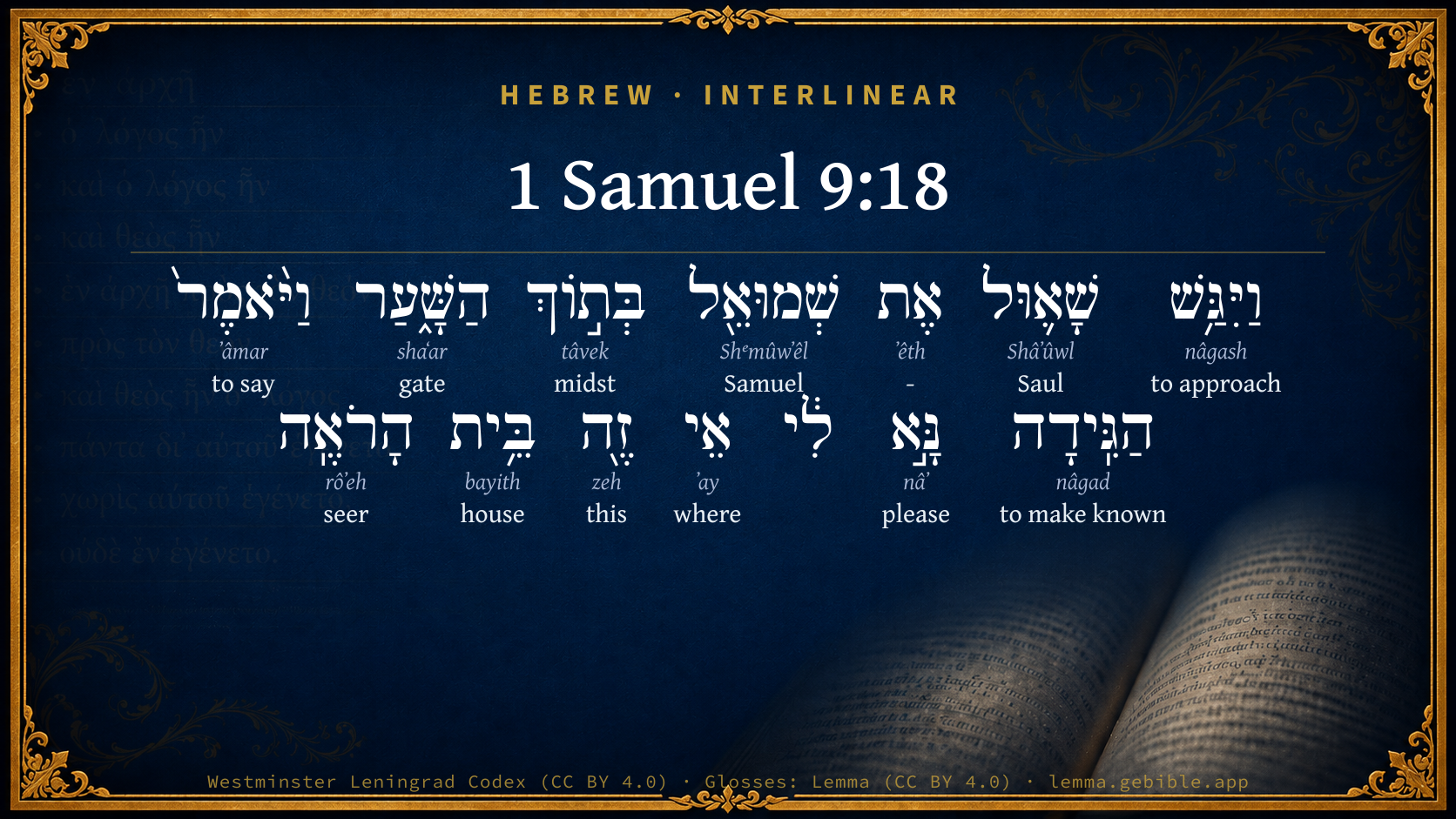
1 Samuel 9:18

Hebrew (Westminster Leningrad Codex) 1 Samuel 9:18 appears in the Hebrew Old Testament. The text above is from the Westminster Leningrad Codex. Each word links to its Strong’s number, a concise gloss, and parsing drawn from the Open Scriptures Hebrew Bible morphology. Click any word for its full Brown-Driver-Briggs (BDB) entry.
Download image
Cite this verse

1 Samuel 9:18 (World English Bible). Public Domain. Lemma interlinear Bible study tool, https://lemma.gebible.app/v/1-samuel/9/18.

Show BibTeX & RIS
BibTeX
RIS
English Translation
Then Saul drew near to Samuel in the gate, and said, Tell me, Please, where the seer's house is.
World English Bible · Public Domain
Download a study sheet

One document with this verse’s original text, its word-by-word gloss line, the meaning frame, cross-references with their text, attributed commentary, and full source and license credits — printable, and it pastes into notes with its structure intact.

This verse Autodidact and up

Study sheet (.html) Plain text (.txt)

A passage Seminary Student

Up to 50 verses in one chapter. A passage sheet keeps up to 6 commentary sources and 12 cross-references per verse, in the order this page ranks them, and says so on the sheet whenever that leaves anything out. Ask for a single verse and you get the Autodidact verse sheet above.

Everything on this page stays free to read, with no account — the sheet is a download of what is already on screen, not access to it.

Want to remove ads? Support Godless Engineer
Compare translations 3

The same verse in 3 English versions, stacked beneath the original-language interlinear above. Click any original word for its lexicon entry.

Each is an independent rendering of the whole verse — the interlinear is not word-aligned to these translations.

Highlighted words mark where these versions differ — a whole-verse word diff, not a word-by-word alignment.

  • World English Bible Public Domain
    Then Saul drew near to Samuel in the gate, and said, Tell me, Please, where the seer's house is.
  • King James Version Public Domain
    Then Saul drew near to Samuel in the gate, and said, Tell me, I pray thee, where the seer's house is.
  • unfoldingWord Literal Text CC BY-SA 4.0
    And Saul approached Samuel in the midst of the gate. And he said, “Please declare to me, where this, the house of the seer?”

unfoldingWord Literal Text — © unfoldingWord, licensed CC BY-SA 4.0. Word-aligned USFM3 via Door43 (git.door43.org/unfoldingWord/en_ult).

Versions to compare (up to 4)

3 of 4 selected

Show all 18 translations

Every available English version of this verse, each an independent rendering of the whole verse.

  • World English Bible Public Domain
    Then Saul drew near to Samuel in the gate, and said, Tell me, Please, where the seer's house is.
  • Berean Standard Bible Public Domain
    Saul approached Samuel in the gateway and asked, “Would you please tell me where the seer’s house is?”
  • Majority Standard Bible Public Domain
    Saul approached Samuel in the gateway and asked, “Would you please tell me where the seer’s house is?”
  • King James Version Public Domain
    Then Saul drew near to Samuel in the gate, and said, Tell me, I pray thee, where the seer's house is.
  • American Standard Version (1901) Public Domain
    Then Saul drew near to Samuel in the gate, and said, Tell me, I pray thee, where the seer's house is.
  • Revised Version (1885) Public Domain
    Then Saul drew near to Samuel in the gate, and said, Tell me, I pray thee, where the seer’s house is.
  • Geneva Bible (1599) Public Domain
    Then went Saul to Samuel in the middes of the gate, and said, Tell me, I pray thee, where the Seers house is.
  • Douay-Rheims (1899) Public Domain
    And Saul came to Samuel in the midst of the gate and said: Tell me, I pray thee, where is the house of the seer?
  • Young's Literal Translation Public Domain
    And Saul draweth nigh to Samuel in the midst of the gate, and saith, `Declare, I pray thee, to me, where `is' this -- the seer's house?'
  • Literal Standard Version CC BY-SA 4.0
    And Saul draws near to Samuel in the midst of the gate and says, “Please declare to me where this seer’s house [is].”
  • Unlocked Literal Bible CC BY-SA 4.0
    Then Saul came close to Samuel in the gate and said, “Tell me where is the house of the seer?”
  • unfoldingWord Literal Text CC BY-SA 4.0
    And Saul approached Samuel in the midst of the gate. And he said, “Please declare to me, where this, the house of the seer?”
  • Darby Bible Public Domain
    And Saul drew near to Samuel in the midst of the gate, and said, Tell me, I pray thee, where the seer's house is.
  • World Messianic Bible Public Domain
    Then Saul approached Samuel in the gateway, and said, “Please tell me where the seer’s house is.”
  • Webster's Bible Public Domain
    Then Saul drew near to Samuel in the gate, and said, Tell me, I pray thee, where the seer's house is.
  • Free Bible Version CC BY-SA 4.0
    Saul went up to Samuel in the gateway and asked him, “Could you please tell me where the house of the seer is?”
  • Bible in Basic English Public Domain
    Then Saul came up to Samuel in the doorway of the town and said, Give me directions, if you will be so good, to the house of the seer.
  • JPS Tanakh (1917) Public Domain
    Then Saul drew near to Samuel in the gate, and said: 'Tell me, I pray thee, where the seer's house is.'

Literal Standard Version (2020), Covenant Press — licensed CC BY-SA 4.0. Text via the HelloAO Bible API (eBible.org). Unlocked Literal Bible (unfoldingWord) — licensed CC BY-SA 4.0. Text via the HelloAO Bible API (eBible.org). unfoldingWord Literal Text — © unfoldingWord, licensed CC BY-SA 4.0. Word-aligned USFM3 via Door43 (git.door43.org/unfoldingWord/en_ult). Free Bible Version, Dr. Jonathan Gallagher — licensed CC BY-SA 4.0. Text via the HelloAO Bible API (eBible.org).

Word by word

More ways to search: Search by grammar → Find every occurrence → Compare this word →

Practice this passage: Drill this verse → Learn its vocabulary →

הָרֹאֶֽה
rôʼeh
H7203
“the · seer”
Particle, Definite Article + Verb, Qal, Participle Active, Masculine, Singular, Absolute
Part of Speech
Particle + Verb
Stem
Qal
Form
Participle Active
Gender
Masculine
Number
Singular
State
Absolute
Full BDB Definition

Origin: act part of H7200

TWOT: 2095b , 2095c

seer, prophet - (prophetic) vision
  1. וַיִּגַּ֥שׁ nâgash H5066 “and · to approach” Conjunction + Verb, Qal, Sequential Imperfect, 3rd Person, Masculine, Singular
  2. שָׁא֛וּל Shâʼûwl H7586 “Saul” Noun, Proper
  3. אֶת ʼêth H853 “-” Particle, Direct Object
  4. שְׁמוּאֵ֖ל Shᵉmûwʼêl H8050 “Samuel” Noun, Proper
  5. בְּת֣וֹךְ tâvek H8432 “in/at · midst of” Preposition + Noun, Common, Masculine, Singular, Construct
  6. הַשָּׁ֑עַר shaʻar H8179 “the · gate” Particle, Definite Article + Noun, Common, Masculine, Singular, Absolute
  7. וַיֹּ֨אמֶר֙ ʼâmar H559 “and · to say” Conjunction + Verb, Qal, Sequential Imperfect, 3rd Person, Masculine, Singular
  8. הַגִּֽידָה nâgad H5046 “make known” Verb, Hiphil, Imperative, 2nd Person, Masculine, Singular + Suffix, h
  9. נָּ֣א nâʼ H4994 “please” Particle, Interjection
  10. אֵי ʼay H335 “where” Particle, Interrogative
  11. זֶ֖ה zeh H2088 “this” Pronoun, Demonstrative, Masculine, Singular
  12. בֵּ֥ית bayith H1004 “house of” Noun, Common, Masculine, Singular, Construct

About this verse

These counts appear in no published source. They are computed here, from the morphology-tagged text and Lemma’s own curated glosses. What Lemma adds →

14
words
13
distinct lemmas
Historical
section

Notable vocabulary

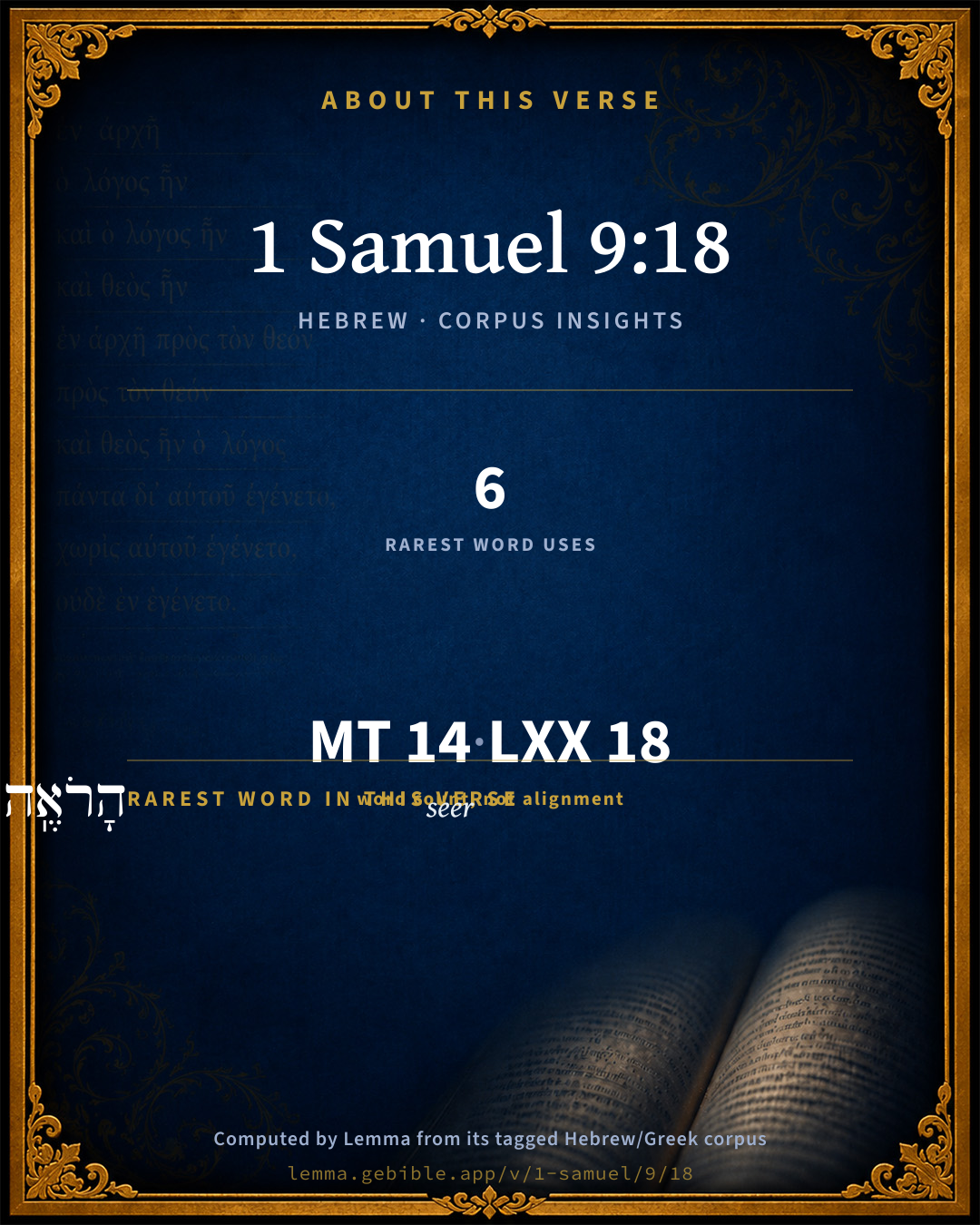
The rarest word here is הָרֹאֶֽה seer H7203 — appearing just 6 times in the whole Hebrew Bible.

Shared distinctive vocabulary

הָרֹאֶֽה seer H7203 occurs in 5 verses of the Hebrew Bible. Also found in:

Grammatical profile

  • 4 verbs
  • 5 nouns
  • 1 pronoun
  • 1 preposition
  • 3 particles

Verb forms

  • וַיִּגַּ֥שׁ Qal · Sequential Imperfect
  • וַיֹּ֨אמֶר֙ Qal · Sequential Imperfect
  • הַגִּֽידָה Hiphil · Imperative
  • הָרֹאֶֽה Qal · Participle Active

Hebrew & Septuagint length

In English translation the verse runs 19 words from the Hebrew and 24 from the Septuagint (LXX English) — closely comparable.

A rough comparison of the two English renderings, which tokenize alike — not a word-level alignment.

Word counts can differ between the Hebrew and the Greek without any difference in meaning — e.g. the Hebrew direct-object marker אֵת has no separate Greek word, and Greek often adds the article ὁ.

In the original languages it is 14 Hebrew tokens and 18 Greek tokens — but the two are counted differently (Hebrew bundles its prefixes and suffixes into one token; the Greek is in lemma form), so that isn’t a like-for-like length.

Hebrew and Greek witnesses Masoretic Hebrew ↔ Greek Septuagint

The same verse in the two great witnesses to the Old Testament, shown verse-for-verse.

These are two independent witnesses, not word-aligned to each other, and the Septuagint is shown in lemma (dictionary) form.

Hebrew 1 Samuel 9:18 Masoretic · Westminster Leningrad Codex

וַיִּגַּ֥שׁ שָׁא֛וּל אֶת שְׁמוּאֵ֖ל בְּת֣וֹךְ הַשָּׁ֑עַר וַיֹּ֨אמֶר֙ הַגִּֽידָה נָּ֣א לִ֔י אֵי זֶ֖ה בֵּ֥ית הָרֹאֶֽה

Then Saul drew near to Samuel in the gate, and said, Tell me, Please, where the seer's house is.

World English Bible · Public Domain

Greek LXX 1 Samuel 9:18 Septuagint · lemma form

καί προςἄγω σαούλ πρός σαμουηλ εἰς μέσος ὁ πόλις καί εἶπον ἀποἀγγέλλω δή ποῖος ὁ οἶκος ὁ βλέπω

And Saul drew near to Samuel into the midst of the city, and said, Tell me now which is the house of the seer?

LXX2012 (modern English Septuagint) · Public Domain

On this verse, Ellicott's Commentary for English Readers discusses the Septuagint’s reading. Read the note in Commentary ↓

Hebrew: Westminster Leningrad Codex (CC BY 4.0). Greek: Septuagint (public domain); English from LXX2012 (modern English Septuagint) (Public Domain). How the Septuagint differs from the Hebrew →

Targum (Aramaic paraphrase)

1

The Targum is the ancient Jewish Aramaic paraphrase of the Hebrew Scriptures — an interpretive translation, not the Hebrew text itself. Onkelos (literal) and Pseudo-Jonathan (expansive) render the Torah, and Jonathan the Prophets. Coverage is partial: where no permissively-licensed English translation exists for a verse, only the Aramaic is shown. This is verse-level text, not a word-by-word alignment to the Hebrew.

  1. Targum Jonathan Prophets (Joshua–Malachi)
    וַעֲרַע שָׁאוּל יַת שְׁמוּאֵל בְּגוֹ תַרְעָא וַאֲמַר חַוֵי כְעַן לִי אֵי דֵין בֵּית חָזְוַיָא:

    (no public-domain English translation for this verse)

    Targum Jonathan — Aramaic: “Mikraot Gedolot” (public domain). English: “Sefaria Community Translation” (CC0 1.0 (public-domain dedication)); “London "Chaldee Paraphrase," 1871” (public domain). Text via Sefaria.

Commentary

Notes on 1 Samuel 9:18 from classic Christian and Jewish commentators (each source and its license shown beneath its notes). The classic Christian expositions comment on the surrounding passage and are grouped to its opening verse, so a note may address several verses; the Jewish commentaries on the Tanakh (Rashi and others) are per-verse, so they appear only where the commentator wrote on this verse.

Lemma curates 59 commentaries, every one of them public domain or Creative Commons licensed, each selected and text-cleaned for this edition rather than reprinted as found. About our sources →

Matthew Henry's Commentary

Providence having at length brought Samuel and Saul together, we have here an account of what passed between them in the gate, at the feast, and in private.

I. In the gate of the city; passing through that, Saul found him (Sa1 9:18), and, little thinking that he was Samuel himself, asked him the way to Samuel's house: Tell me where the seer's house is; for there he expected to find him. See how mean a figure Samuel made, though so great a man: he took not any state, had no attendants, no ensigns of honour carried before him, nor any distinguishing habit, no, not when he went to church, but appeared, in all respects, so much a common person that Saul, though he was told he should meet him, never suspected that it was he, but, as if he looked more like a porter than a prophet, asked him the way to the seer's house. Thus is great worth oftentimes hidden under a very despicable appearance. Samuel knew that it was not the house, but the man, that he wanted, and therefore answered him, "I am the seer, the person you enquire for," Sa1 9:19. Samuel knew him before he knew Samuel; thus, though all that are called to the kingdom of glory are brought to know God, yet first they were known of him, Gal 4:9. Now, 1. Samuel obliges him to stay with him till the next day. The greatest part of this day had been spent in sacrificing, and the rest of it was to be spent in holy feasting, and therefore, "Tomorrow I will let thee go, and not sooner; now go up before me to the high place; let us pray together, and then we will talk together." Saul had nothing in his mind but to find his asses, but Samuel would take him off from that care, and dispose him to the exercises of piety; and therefore bids him go to the high place, and go before him, because, it may be, some business obliged Samuel to call by the way. 2. He satisfies him about his asses (Sa1 9:20): Set not thy mind on them, be not in further care about them; they are found. By this Saul might perceive that he was a prophet, that he could give him an answer to the enquiry which he had not yet made, and tell him what he thought; and thence he might infer, if a man of God can do this, much more doth God himself understand our thoughts afar off. 3. He surprises him with an intimation of preferment before him: "On whom is all the desire of Israel? Is it not a king that they are set upon, and there is never a man in Israel that will suit them as thou wilt." It does not appear that the country had as yet any eye upon him for the government, because they had left it wholly to God to choose for them; but such a one as he they wished for, and his advancement would be the advancement of his family and relations, as Abner, and others. 4. To this strange intimation Saul returns a very modest answer, Sa1 9:21. Samuel, he thought, did but banter him, because he was a tall man, but a very unlikely man to be a king; for, though the historian says (Sa1 9:1) his father was a mighty man of power, yet he himself speaks diminishingly of his tribe and family. "Benjamin, the youngest of Jacob's sons, when grown up to be a man, was called a little one (Gen 44:20); that tribe was diminished by the war of Gibeah; and I am a Benjamite, my family the least," probably a younger house, not in any place of honour or trust, no, not in their own tribe. Gideon had expressed himself thus, Jdg 6:15. A humble disposition is a good presage of preferment.

II. At the public feast; thither Samuel took him and his servant. Though the advancement of Saul would be the deposing of Samuel, yet that good prophet was so far from envying him, or bearing him any ill-will for it, that he was the first and forwardest man to do him honour, in compliance with the will of God. If this be the man whom God has chosen, though he be none of Samuel's particular friends or confidants, yet he is heartily welcome to his table, nay, to his bosom. We may suppose it was no unseasonable kindness to Saul to give him a meal's meat, for it seems, by what he said (Sa1 9:7), that all their meat and money were spent. But this was not all. Samuel treats him not as a common person, but a person of quality and distinction, to prepare both him and the people for what was to follow. Two marks of honour he put upon him: - 1. He set him in the best place, as more honourable than any other of the guests, to whom he said, Give this man place, Luk 14:9. Though we may suppose the magistrates were there, who in their own city would claim precedency, yet the master of the feast made Saul and his servant too (who, if Saul was a king, must be respected as his prime minister of state) sit in the chief place, Sa1 9:22. Note, Civil respects must be paid to those who in civil things have the precedency given them by the divine providence. 2. He presented him with the best dish, which, having had notice from heaven the day before of his coming (Sa1 9:16), he had designed for him, and ordered the cook to secure for him, when he gave orders for inviting the guests and making preparation for them. And what should this precious dish be, which was so very carefully reserved for the king-elect? One would expect it should be something very nice and delicate. No, it was a plain shoulder of mutton (Sa1 9:23, Sa1 9:24). The right shoulder of the peace-offerings was to be given to the priests, who were God's receivers (Lev 7:32); the next in honour to that was the left shoulder, which probably was always allotted to those that sat at the upper end of the table, and was wont to be Samuel's mess at other times; so that his giving it to Saul now was an implicit resignation of his place to him. Some observe a significancy in this dish. The shoulder denotes strength, and the breast, which some think went with it, denotes affection: he that was king had the government upon his shoulder, for he must bear the weight of it; and the people in his bosom, for they must be dear to him.

III. What passed between them in private. Both that evening and early the next morning Samuel communed with Saul upon the flat roof of the house, Sa1 9:25, Sa1 9:26. We may suppose Samuel now told him the whole story of the people's desire of a king, the grounds of their desire, and God's grant of it, to all which Saul, living very privately, was perhaps a stranger; he satisfied him that he was the person God had pitched upon for the government; and whereas Saul would object that Samuel was in possession, and he would not for all the world take it out of his hands, Samuel, we may suppose, gave him all the assurance he could desire of his willingness to resign. Early in the morning he sent him towards home, brought him part of the way, bade him send his servant before, that they might be private (Sa1 9:27), and there, as we find in the beginning of the next chapter, he anointed him, and therein showed him the word of the Lord, that is, gave him full satisfaction that he was the person chosen to be king, for he would not jest with that sacred rite. It is by the unction of the Holy Ghost that Christ, the great prophet, shows us the word of the Lord. Jo1 2:27, the same anointing teacheth you of all things.

Matthew Henry's Commentary on the Whole Bible (1708–1710) — public domain (CC PDM 1.0). Text via the HelloAO Bible API.

Trapp's Complete Commentary

John Trapp

1Sa 9:18 Then Saul drew near to Samuel in the gate, and said, Tell me, I pray thee, where the seer’s house [is].

Ver. 18. In the gate.] Heb., In the midst of the gate; Sept., In the midst of the city; Chaldee, Within the gate.

Tell me, I pray thee, where the seer’s house is.] It seemeth, then, that Samuel bore no great import in his outside. Saul knew him not, though judge of Israel, by his clothes, or by his attendants.

John Trapp, A Commentary or Exposition upon All the Books of the Old and New Testament (1647–1656) — public domain. Text from a community e-Sword module.

The Biblical Illustrator

Joseph S. Exell

1Sa_9:18

The people will not eat until he come, because he doth bless the sacrifice.

Religious ordinances

There is a striking resemblance between the outlines of the Mosaic, and of the Christian Church. Each arose upon a Divine basis. Each had its form of imitation and symbolic rites. Each had its three orders of ministers in the sanctuary. And each boasts of a Divine Being at its head. As in the one, so in the other, the covenant is in the hands of a Mediator, and its principles and laws are deposited in a sacred code. There is, indeed, in the Christian Church, a higher degree of spirituality than is found under any other dispensation. Here, the daily sacrifice and oblation cease, absorbed, in their significance, in that great sacrifice, of which, to the eye of faith, they all were figures. But in the constitution of this Church, our blessed Lord did not overlook the ancient pattern of heavenly things, nor forget the nature of man.

1. The first point to which I would call your attention, is the fitness and utility of Religious Ordinances. There are in truth, no such obvious, simple, and universal means of preserving communities distinct, and manifesting their members to the world and to each other, as characteristic rights and peculiar badges. Nature prompts to the use of them; for the savage of the woods has the song and the ceremonies of his ancestors, and by the gashings and daubings with which he disfigures his form, denotes his tribe. Reason and policy have discovered their utility; for the armies of the ambitious have their uniforms and their standards; and almost every nation has its mode of naturalising subjects, its oaths of allegiance, and its arms. Indeed so fit and necessary are they, that few communities continue long without them, or survive the loss of them; and they who denounce all rites as useless, are obliged to recur to peculiarity of dress, of phrase, or of gesture, when they would be known to each other, and distinguished from the world. Hitherto our observations have been of a general nature applicable go any community. What, then, shall we say of the propriety and importance of rites and ordinances, in the service of religion? To the Jews, God appointed a system of ceremonies, to connect them together, and shadow forth the sublime subjects of faith to their understandings. And our adorable Redeemer instituted for His followers a baptism, which should represent their death unto sin, and new birth unto righteousness; and a supper, in which they should commemorate the foundation of all their hopes and joys, His offering Himself in the body once for all. Religious ordinances are of unspeakable advantage, in uniting members of the same body, and attaching them affectionately to each other. They form a kind of visible chain connoting men together; the first and last links of which are connected with God. Community of interest begets confidence; and while we are pursuing the same objects, under consciousness of the saint infirmities, but with reliance upon the same hopes, we are filled, involuntarily, with affection for each other. This strikingly illustrated in the natural tendency, and no doubt was strong in our Redeemers view at the gracious institution, of the Lords Supper.

2. There arises from the nature of the Christian ordinances, a peculiar necessity for an authorised ministry. These sacraments are of high and holy import. Like the ark of the covenant, they are not to be carried by unhallowed hands. They are seals of an engagement between God and men. They are compacts between the Almighty Father and His repentant children, in which He pledges Himself, upon condition of their faith and obedience, to give them the pardon of their sins, the blessings of His Spirit, and the enjoyment of eternal life. And who can sign the covenant of such mercies unto men, but they who act in Gods behalf? And who can act in Gods behalf, but they who act by Gods authority? Not, that in those to whom this ministry is committed, there is any elevation above the ordinary qualities of their fellow beings. We have this treasure, says St. Paul, speaking of the great Christian behests entrusted to the ministry, we have this treasure in earthen vessels, that the excellency of the power may be of God, and not of us.

3. Here we are brought to notice the obligations, which the truths we have been considering devolve upon ministers and people. The first and most obvious inference is, that it is incumbent upon us all to respect and observe the institutions of the Gospel. But the truths we have been considering, press upon our observation the holiness, and importance, and duties of the ministry. They are the keepers of the fountain, which is set open for mankind to wash in from sin and from uncleanness, and they are the dispensers of the word, by which we are instructed in righteousness, and begotten again to the blessed hope of everlasting life. Under the Christian dispensation, much more than under the Jewish economy, should there be written upon the foreheads of the priesthood, and upon all their sacred vestments, Holiness unto the Lord. But, finally, we must remark, that there arises from what has been said, an obligation upon the people to abide by, and cooperate with those, who are regularly appointed to minister in holy things. In vain will God have instituted ordinances in the Church, in vain will He have established in it pastors and teachers, if the body of Christians neglect, or profane, these sacred institutions, or with Gallios temper, care for none of these things. (Bishop Dehon.)

The Biblical Illustrator, edited by Joseph S. Exell (c. 1880s–1900s) — public domain. Text from a community e-Sword module.

Keil & Delitzsch

C. F. Keil & F. Delitzsch

The thread of the narrative, which was broken off in Sa1 9:15, is resumed in Sa1 9:18. Saul drew near to Samuel in the gate, and asked him for the seer's house. The expression השּׁער בּתוך is used to define more precisely the general phrase in Sa1 9:14, העיר בּתוך בּאים; and there is no necessity to alter העיר in Sa1 9:14 into השּׁער, as Thenius proposes, for העיר בּתוך כּוא does not mean to go (or be) in the middle of the town, as he imagines, but to go into, or enter, the town; and the entrance to the town was through the gate.

Sa1 9:19-21

Samuel replied, "I am the seer: go up before me to the high place, and eat with me to-day; and to-morrow I will send thee away, and make known to thee all that is in thy heart." Letting a person go in front was a sign of great esteem. The change from the singular עלה to the plural אכלתּם may be explained on the ground that, whilst Samuel only spoke to Saul, he intended expressly to invite his servant to the meal as well as himself. "All that is in thine heart" does not mean "all that thou hast upon thy heart," i.e., all that troubles thee, for Samuel relieved him of all anxiety about the asses at once by telling him that they were found; but simply the thoughts of thy heart generally. Samuel would make these known to him, to prove to him that he was a prophet. He then first of all satisfied him respecting the asses (Sa1 9:20): "As for the asses that were lost to thee to-day three days (three days ago), do not set thy heart upon them (i.e., do not trouble thyself about them), for they are found." After this quieting announcement, by which he had convinced Saul of his seer's gift, Samuel directed Saul's thoughts to that higher thing which Jehovah had appointed for him: "And to whom does all that is worth desiring of Israel belong? Is it not to thee, and to all thy father's house?" "The desire of Israel" (optima quaeque Israel, Vulg.; "the best in Israel," Luther) is not all that Israel desires, but all that Israel possesses of what is precious or worth desiring (see Hag 2:7). "The antithesis here is between the asses and every desirable thing" (Seb. Schmidt). Notwithstanding the indefinite character of the words, they held up such glorious things as in prospect for Saul, that he replied in amazement (Sa1 9:21), "Am not I a Benjaminite, of the smallest of the tribes of Israel? and my family is the least of all the families of the tribe of Benjamin (בן שׁבטי is unquestionably a copyist's error for בן שׁבת); and how speakest thou such a word to me?" Samuel made no reply to this, as he simply wanted first of all to awaken the expectation in Saul's mind of things that he had never dreamt of before.

Sa1 9:22

When they arrived at the high place, he conducted Saul and his servant into the cell (the apartment prepared for the sacrificial meal), and gave them (the servant as well as Saul, according to the simple customs of antiquity, as being also his guest) a place at the upper end among those who had been invited. There were about thirty persons present, no doubt the most distinguished men of the city, whilst the rest of the people probably encamped in the open air.

Sa1 9:23-24

He then ordered the cook to bring the piece which he had directed him to set aside, and to place it before Saul, namely the leg and העליה (the article in the place of the relative; see Ewald, 331, b.); i.e., not what was over it, viz., the broth poured upon it (Dathe and Maurer), but what was attached to it (Luther). The reference, however, is not to the kidney as the choicest portion (Thenius), for the kidneys were burned upon the altar in the case of all the slain sacrifices (Lev 3:4), and only the flesh of the animals offered in sacrifice was applied to the sacrificial meal. What was attached to the leg, therefore, can only have been such of the fat upon the flesh as was not intended for the altar. Whether the right or left leg, is not stated: the earlier commentators decide in favour of the left, because the right leg fell to the share of the priests (Lev 7:32.). But as Samuel conducted the whole of the sacrificial ceremony, he may also have offered the sacrifice itself by virtue of his prophetic calling, so that the right leg would fall to his share, and he might have it reserved for his guest. In any case, however, the leg, as the largest and best portion, was to be a piece of honour for Saul (see Gen 43:34). There is no reason to seek for any further symbolical meaning in it. The fact that it was Samuel's intention to distinguish and honour Saul above all his other guests, is evident enough from what he said to Saul when the cook had brought the leg: "Behold, that which is reserved is set before thee (שׂים is the passive participle, as in Num 24:21); for unto this time hath it been kept for thee, as I said I have invited the people." למּועד is either "to the appointed time of thy coming," or possibly, "for the (this) meeting together." Samuel mentions this to give Saul his guest to understand that he had foreseen his coming in a supernatural way. לאמר, saying, i.e., as I said (to the cook).

Keil & Delitzsch — Biblical Commentary on the Old Testament (1861–1891) — public domain (CC PDM 1.0). Text via the HelloAO Bible API. (Old Testament only.)

Jamieson, Fausset & Brown

Robert Jamieson, A. R. Fausset & David Brown

Tell me, I pray thee, where the seer's house is--Satisfying the stranger's inquiry, Samuel invited him to the feast, as well as to sojourn till the morrow; and, in order to reconcile him to the delay, he assured him that the strayed asses had been recovered.

Jamieson, Fausset & Brown — Commentary Critical and Explanatory on the Whole Bible (1871) — public domain (CC PDM 1.0). Text via the HelloAO Bible API.

Ellicott's Commentary for English Readers

(18) In the gate.—The LXX. (Greek Version) here reads, “in the midst of the city.” It is not improbable that this is the original reading, it being very possible for a scribe to write the Hebrew word “gate” for “city.”

A Bible Commentary for English Readers, edited by Charles John Ellicott (1878–1897) — public domain. Text from a community e-Sword module.

The Cambridge Bible for Schools and Colleges

gen. ed. J. J. S. Perowne

18. in the gate] Heb. “In the midst of the gate,” i.e. the gateway, where they would naturally halt to inquire for the Seer’s house.

The Cambridge Bible for Schools and Colleges (gen. ed. J. J. S. Perowne; Cambridge University Press, 1878–1918) — public domain. Text from a community e-Sword module.

John Gill's Exposition

Then Saul drew near to Samuel in the gate,.... Either at the door of his own house, just as he was coming out of it, or within the gate of the city as Saul entered that, Samuel came to it, in order to go through it to the high place, which it is probable was without the city; wherefore it is very properly said that Samuel came out to meet them, Sa1 9:14.

and said, tell me, I pray thee, where the seer's house is; one knows not which to wonder at most, the simplicity and humility of Samuel to be in so plain an habit, unattended by servants, and yet going to a public festival, so that he seemed to be no other than a common man, to be inquired of whereabout his house was; or the ignorance of Saul, who had lived so long in the world, and so near Samuel, and yet had never seen and knew not the chief magistrate in the nation, so famous both for his civil and religious character.

John Gill's Exposition of the Whole Bible (1746–1763) — public domain (CC PDM 1.0). Text via the HelloAO Bible API.

Haydock's Catholic Bible Commentary

Gate. Septuagint, "city." Chaldean, "within the gate," where business was transacted.

George Leo Haydock (1774–1849), Haydock's Catholic Family Bible and Commentary, 1859 edition — public domain. Excludes Psalms (Douay-Rheims chapter numbering differs from Protestant) and Deuterocanonical books (Catholic canon only).

Matthew Poole's English Annotations

In the gate; the gate, either, first, Of Samuel’s house. But he was come out thence before, 1Sa 9:14. Or rather, secondly, Of the city; for the word gate being put by itself, according to reason and common use, must be understood of the most eminent in its kind, which the gate of the city is. And through this gate Samuel seems now to have been passing to go to the high place, which probably was without the city; and there he makes a stand, to hear what these persons now approaching to him were about to speak.

Matthew Poole's English Annotations on the Holy Bible (1683–1685) — public domain. Text from a community e-Sword/MySword module.

Whedon's Commentary on the Bible

Daniel D. Whedon

18. The seer’s house — The house where he abides while in the city; the place he temporarily makes his home.

Daniel D. Whedon (gen. ed.), Commentary on the Old and New Testaments (1874–1909) — public domain. Text from a community e-Sword module.

The Pulpit Commentary

In the gate. The same preposition is used here as that translated "into the city" in ver. 14. The contradiction which many commentators suppose that they find between the two verses arises from their not remembering that prepositions constantly lose their original meaning. Literally the preposition means in the middle, but its common meaning is simply within. So with us immediately has lost all reference to the middle, though derived from that word, and signifies directly, at once. Saul, then, and his servant were just going (it is a present participle) within the city when they meet Samuel coming out, and accost him in the very portal.

Vers. 18-24.

Shadows of coming events.

The facts are

1. Saul, on accosting Samuel, is invited to stay with him, is assured of thesafety of the asses, and is caused to know that great honour is in store for him.

2. Saul, taken by surprise, desires to have further explanations of thelanguage used.

3. Samuel entertains Saul with all the honours due to a distinguished guest.The position of Samuel was one of relative advantage, for Saul was ignorant of the Divine intent, while he knew the purpose of God. The course taken by Samuel was as follows: First he intimated to Saul that it would be well to accept his proffered hospitality, as he had a communication to make which would draw out his interest (ver. 19). Then he relieves his care about his father"s property, and awakens more curiosity by the further intimation that the choice things of Israel were in reserve for him and his father"s house. To prevent hasty explanations, he next induces him to take his place in an entertainment as chief guest; thus by a significant act preparing him and the people for something more definite. And with all the kindliness and courtesy due to distinction, he threw a gleam of light on the strange proceeding by reminding him that though his presence there seemed accidental, it was not quite so, as he was the person for whom the dish of honour had been reserved (ver. 24). Thus was the nomination of Saul as the king shadowed forth. In all this the prophet acted in his official capacity as representative of God. May we not see here how God prepares us for disclosures of his will?

I The FULL TRUTH GOD WOULD HAVE US KNOW IS BROKEN UP AND MADE CLEAR BY DEGREES. The prophet here was slightly opening the veil before the eyes of Saul; he was qualifying his sight for dazzling splendour. And that is just what all the prophets of God have done and are doing for us. They intimate to us that there are great truths in reserve, and so speak to us by the way as to indicate in dim outline what some day will stand out in eternal clearness. The figures, the types, the allusions to the "unspeakable," the reminders that we are but disciples, children all are foreshadowings of great realities on which the mind will in future gaze. "We know in part." It is true the Bible is all we need for salvation, and contains more spiritual truth than elsewhere to be found; but in one sense it is to men a treasure, and we are only fitted to receive out of it a dim intimation of the truth, as Saul was fitted only to receive from the mind of the prophet a portion of what was there for him. The process by which God"s truth was given to the world by allusion, dim prophecy, type, historical examples foreshadowing the Christ, till at last the full announcement came is another illustration of the gentleness and wisdom wherewith God has "spoken" to men.

II The FULL HONOURS GOD HAS IN RESERVE FOR HIS PEOPLE ARE GRADUALLY REVEALED. Saul wondered what distinction was awaiting him. lie felt unworthy of such language as that used by the prophet. His wonder was not satisfied at once. Men have been known to die under the sudden declarations of bliss awaiting them. Equally so God has in reserve for all who are one with Christ a crown, a glory, an honour, which though we know by name, we know not in reality. "We know not what we shall be." There is a joy and glory unspeakable. There are things which an apostle could not utter. Future realities are only dimly shadowed forth by earthly words and symbols. A full vision of coming honours might paralyse the strongest frame.

General lessons:

1. Deep interest in the welfare of the Church of God will suppress all feelings of personal jealousy.

2. A good man will enter heartily into new methods recognised by God,even though at first they were distressing to his own heart.

3. The qualities of gentleness and courtesy towards God"s servants havethe highest sanction, and do much to facilitate private and public business.

4. The keenest sense of unworthiness is that experienced when Godconfers on us the choice honours and treasures of his kingdom.

5. The transition to the full glory of the future will be natural and easy in sofar as we avail ourselves of the shadowings forth of the reality contained in God"s word.

The Pulpit Commentary (1880–1919), ed. H.D.M. Spence-Jones & Joseph S. Exell — public domain. Text from a community e-Sword module.

Rashi

Rabbi Shlomo Yitzchaki (Rashi)

Approached. Targum Yonoson renders, 'met.'

Rashi on the Tanakh — English translations: “The Judaica Press complete Tanach with Rashi, translated by A. J. Rosenberg” (CC BY 4.0); “Pentateuch with Rashi's commentary by M. Rosenbaum and A.M. Silbermann, 1929-1934” (public domain); “The Metsudah Tanach series, Lakewood, N.J” (CC BY 4.0); and “The Book of Joshua, Metsudah Publications, 1997” (CC BY 4.0). Text via Sefaria.

Lesson kit

Teaching starters — assembled from the data on this page, not authored interpretation. Every prompt links to the verse data it draws on. Edit before teaching.

1 Samuel, in the Historical, opens this verse with 14 words (13 distinct Hebrew lemmas). Its most distinctive word is rôʼeh (“seer”). A historical commentator’s framing appears above. Read the whole chapter for the surrounding context.

Discussion questions

  1. How does “seer” (rôʼeh) shape what this verse is saying?
  2. 1 Samuel 9:9 shares the word «seer» with this verse. How do the two illuminate each other?
  3. The translations on this page render this verse differently — a whole-verse word diff, not a word-by-word alignment. What might account for the different wordings?
  4. The verb «וַיִּגַּ֥שׁ» is Qal Sequential Imperfect. How does its form color the action?
  5. Reading how Matthew Henry's Commentary and Trapp's Complete Commentary read this verse, where do the two commentators agree and where do they part?

Things to notice

Reading settings

Reading text

Shown beneath each verse's original-language words.

Old Testament
Old Testament edition

Read the OT as the Masoretic Hebrew (MT) or the Greek Septuagint (LXX).

English shown for the Greek Septuagint (in the Hebrew ↔ Greek comparison).

Comparing translations? Open the Compare panel on any verse page to stack up to four side by side.