
Joshua 8:22

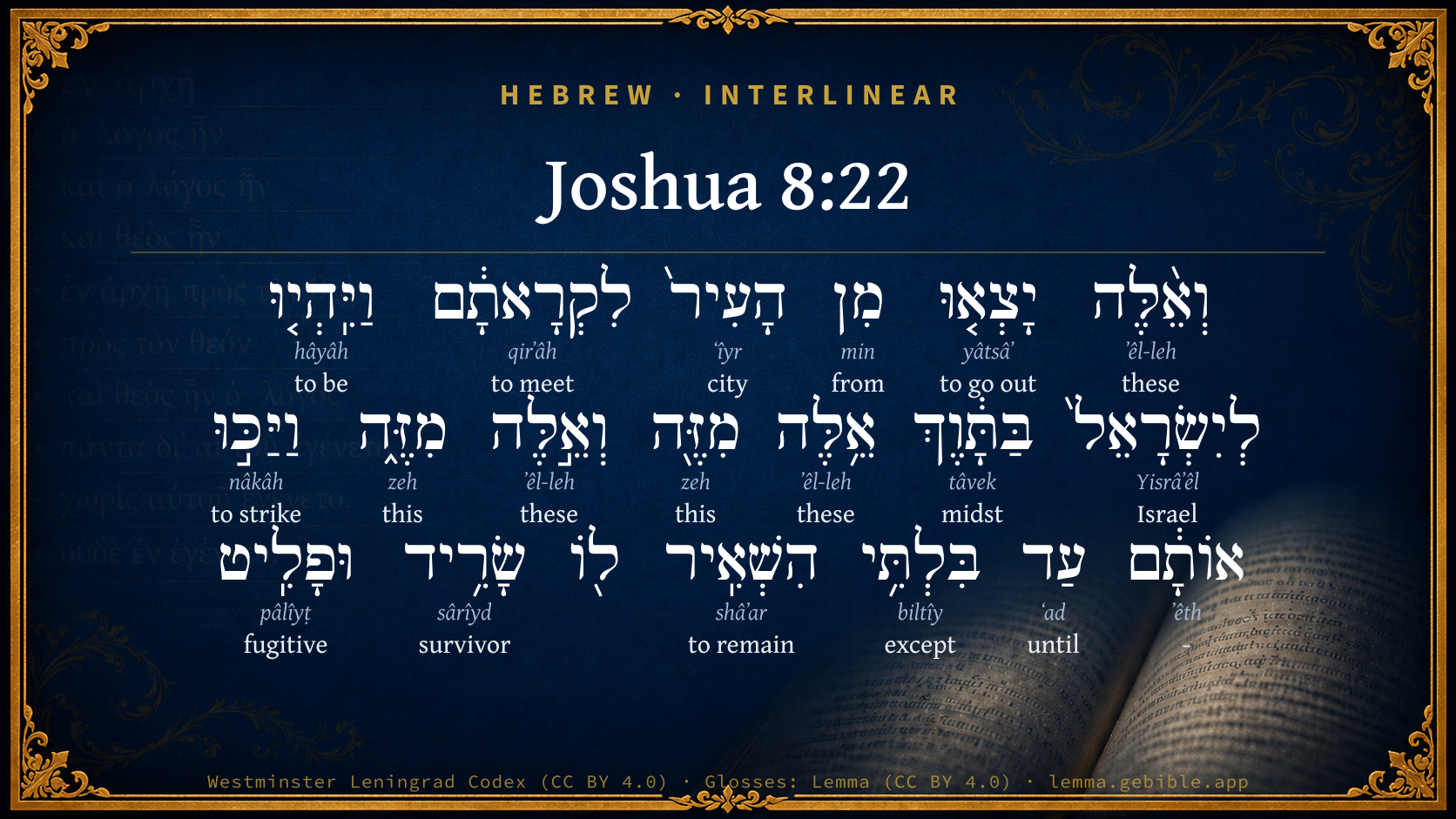
Hebrew (Westminster Leningrad Codex) Joshua 8:22 appears in the Hebrew Old Testament. The text above is from the Westminster Leningrad Codex. Each word links to its Strong’s number, a concise gloss, and parsing drawn from the Open Scriptures Hebrew Bible morphology. Click any word for its full Brown-Driver-Briggs (BDB) entry.
Download image
Cite this verse

Joshua 8:22 (World English Bible). Public Domain. Lemma interlinear Bible study tool, https://lemma.gebible.app/v/joshua/8/22.

Show BibTeX & RIS
BibTeX
RIS
English Translation
The others came forth out of the city against them; so they were in the midst of Israel, some on this side, and some on that side: and they struck them, so that they let none of them remain or escape.
World English Bible · Public Domain
Download a study sheet

One document with this verse’s original text, its word-by-word gloss line, the meaning frame, cross-references with their text, attributed commentary, and full source and license credits — printable, and it pastes into notes with its structure intact.

This verse Autodidact and up

Study sheet (.html) Plain text (.txt)

A passage Seminary Student

Up to 50 verses in one chapter. A passage sheet keeps up to 6 commentary sources and 12 cross-references per verse, in the order this page ranks them, and says so on the sheet whenever that leaves anything out. Ask for a single verse and you get the Autodidact verse sheet above.

Everything on this page stays free to read, with no account — the sheet is a download of what is already on screen, not access to it.

Want to remove ads? Support Godless Engineer
Compare translations 3

The same verse in 3 English versions, stacked beneath the original-language interlinear above. Click any original word for its lexicon entry.

Each is an independent rendering of the whole verse — the interlinear is not word-aligned to these translations.

Highlighted words mark where these versions differ — a whole-verse word diff, not a word-by-word alignment.

  • World English Bible Public Domain
    The others came forth out of the city against them; so they were in the midst of Israel, some on this side, and some on that side: and they struck them, so that they let none of them remain or escape.
  • King James Version Public Domain
    And the other issued out of the city against them; so they were in the midst of Israel, some on this side, and some on that side: and they smote them, so that they let none of them remain or escape.
  • unfoldingWord Literal Text CC BY-SA 4.0
    And these came out from the city to meet them, so they were in the midst of Israel, these from here and these from there. And they struck them until he left to him no survivor or fugitive.

unfoldingWord Literal Text — © unfoldingWord, licensed CC BY-SA 4.0. Word-aligned USFM3 via Door43 (git.door43.org/unfoldingWord/en_ult).

Versions to compare (up to 4)

3 of 4 selected

Show all 18 translations

Every available English version of this verse, each an independent rendering of the whole verse.

  • World English Bible Public Domain
    The others came forth out of the city against them; so they were in the midst of Israel, some on this side, and some on that side: and they struck them, so that they let none of them remain or escape.
  • Berean Standard Bible Public Domain
    Meanwhile, those in the ambush came out of the city against them, and the men of Ai were trapped between the Israelite forces on both sides. So Israel struck them down until no survivor or fugitive remained.
  • Majority Standard Bible Public Domain
    Meanwhile, those in the ambush came out of the city against them, and the men of Ai were trapped between the Israelite forces on both sides. So Israel struck them down until no survivor or fugitive remained.
  • King James Version Public Domain
    And the other issued out of the city against them; so they were in the midst of Israel, some on this side, and some on that side: and they smote them, so that they let none of them remain or escape.
  • American Standard Version (1901) Public Domain
    And the others came forth out of the city against them; so they were in the midst of Israel, some on this side, and some on that side: and they smote them, so that they let none of them remain or escape.
  • Revised Version (1885) Public Domain
    And the other came forth out of the city against them; so they were in the midst of Israel, some on this side, and some on that side: and they smote them, so that they let none of them remain or escape.
  • Geneva Bible (1599) Public Domain
    Also the other issued out of the citie against them: so were they in the middes of Israel, these being on the one side, and the rest on the other side: and they slewe them, so that they let none of them remaine nor escape.
  • Douay-Rheims (1899) Public Domain
    And they also that had taken and set the city on fire, issuing out of the city to meet their own men, began to cut off the enemies who were surrounded by them. So that the enemies being cut off on both sides, not one of so great a multitude was saved.
  • Young's Literal Translation Public Domain
    and these have come out from the city to meet them, and they are in the midst of Israel, some on this side, and some on that, and they smite them till he hath not left to them a remnant and escaped one;
  • Literal Standard Version CC BY-SA 4.0
    and these have come out from the city to meet them, and they are in the midst of Israel, some on this [side], and some on that [side], and they strike them until he has not left a remnant and escaped one to them;
  • Unlocked Literal Bible CC BY-SA 4.0
    The other soldiers of Israel, those who had gone in the city, came out to attack them. So the men of Ai were caught between the armies of Israel, some on this side and some on that side. Israel attacked the men of Ai; none of them survived or escaped.
  • unfoldingWord Literal Text CC BY-SA 4.0
    And these came out from the city to meet them, so they were in the midst of Israel, these from here and these from there. And they struck them until he left to him no survivor or fugitive.
  • Darby Bible Public Domain
    And the others went out of the city against them; so they were in the midst of Israel, some on this side, and some on that side; and they smote them, until they let none of them escape or flee away.
  • World Messianic Bible Public Domain
    The others came out of the city against them, so they were in the middle of Israel, some on this side, and some on that side. They struck them, so that they let none of them remain or escape.
  • Webster's Bible Public Domain
    And the other issued out of the city against them; so they were in the midst of Israel, some on this side, and some on that side: and they smote them, so that they let none of them remain or escape.
  • Free Bible Version CC BY-SA 4.0
    The men from the ambush also came from the town and attacked them, so they were caught in the middle, with the Israelites on both sides. The Israelites cut them down—not a single man survived or got away.
  • Bible in Basic English Public Domain
    Then the other force came out of the town against them, so that they were being attacked on this side and on that: and Israel overcame them and let not one of them get away with his life.
  • JPS Tanakh (1917) Public Domain
    And the other came forth out of the city against them; so they were in the midst of Israel, some on this side, and some on that side; and they smote them, so that they let none of them remain or escape.

Literal Standard Version (2020), Covenant Press — licensed CC BY-SA 4.0. Text via the HelloAO Bible API (eBible.org). Unlocked Literal Bible (unfoldingWord) — licensed CC BY-SA 4.0. Text via the HelloAO Bible API (eBible.org). unfoldingWord Literal Text — © unfoldingWord, licensed CC BY-SA 4.0. Word-aligned USFM3 via Door43 (git.door43.org/unfoldingWord/en_ult). Free Bible Version, Dr. Jonathan Gallagher — licensed CC BY-SA 4.0. Text via the HelloAO Bible API (eBible.org).

Word by word

More ways to search: Search by grammar → Find every occurrence → Compare this word →

Practice this passage: Drill this verse → Learn its vocabulary →

וּפָלִֽיט
pâlîyṭ
H6412
“and · fugitive”
Conjunction + Noun, Common, Masculine, Singular, Absolute
Part of Speech
Conjunction + Noun
Type
Common
Gender
Masculine
Number
Singular
State
Absolute
Full BDB Definition

Origin: from H6403

TWOT: 1774b , 1774c

refugee, fugitive, escaped one
  1. וְאֵ֨לֶּה ʼêl-leh H428 “and · these” Conjunction + Pronoun, Demonstrative, Common, Plural
  2. יָצְא֤וּ yâtsâʼ H3318 “to go out” Verb, Qal, Perfect, 3rd Person, Common, Plural
  3. מִן min H4480 “from” Preposition
  4. הָעִיר֙ ʻîyr H5892 “the · city” Particle, Definite Article + Noun, Common, Feminine, Singular, Absolute
  5. לִקְרָאתָ֔ם qirʼâh H7125 “to meet · them” Preposition + Verb, Qal, Infinitive Construct + Suffix, Personal, 3rd Person, Masculine, Plural
  6. וַיִּֽהְי֤וּ hâyâh H1961 “and · to be” Conjunction + Verb, Qal, Sequential Imperfect, 3rd Person, Masculine, Plural
  7. לְיִשְׂרָאֵל֙ Yisrâʼêl H3478 “to/for · Israel” Preposition + Noun, Proper
  8. בַּתָּ֔וֶךְ tâvek H8432 “in/at the · midst” Preposition, Determined + Noun, Common, Masculine, Singular, Absolute
  9. אֵ֥לֶּה ʼêl-leh H428 “these” Pronoun, Demonstrative, Common, Plural
  10. מִזֶּ֖ה zeh H2088 “from · this” Preposition + Pronoun, Demonstrative, Masculine, Singular
  11. וְאֵ֣לֶּה ʼêl-leh H428 “and · these” Conjunction + Pronoun, Demonstrative, Common, Plural
  12. מִזֶּ֑ה zeh H2088 “from · this” Preposition + Pronoun, Demonstrative, Masculine, Singular
  13. וַיַּכּ֣וּ nâkâh H5221 “and · to strike” Conjunction + Verb, Hiphil, Sequential Imperfect, 3rd Person, Masculine, Plural
  14. אוֹתָ֔ם ʼêth H853 “- · them” Particle, Direct Object + Suffix, Personal, 3rd Person, Masculine, Plural
  15. עַד ʻad H5704 “until” Preposition
  16. בִּלְתִּ֥י biltîy H1115 “except” Conjunction
  17. הִשְׁאִֽיר shâʼar H7604 “to remain” Verb, Hiphil, Perfect, 3rd Person, Masculine, Singular
  18. שָׂרִ֥יד sârîyd H8300 “survivor” Noun, Common, Masculine, Singular, Absolute

About this verse

These counts appear in no published source. They are computed here, from the morphology-tagged text and Lemma’s own curated glosses. What Lemma adds →

20
words
16
distinct lemmas
Historical
section

Notable vocabulary

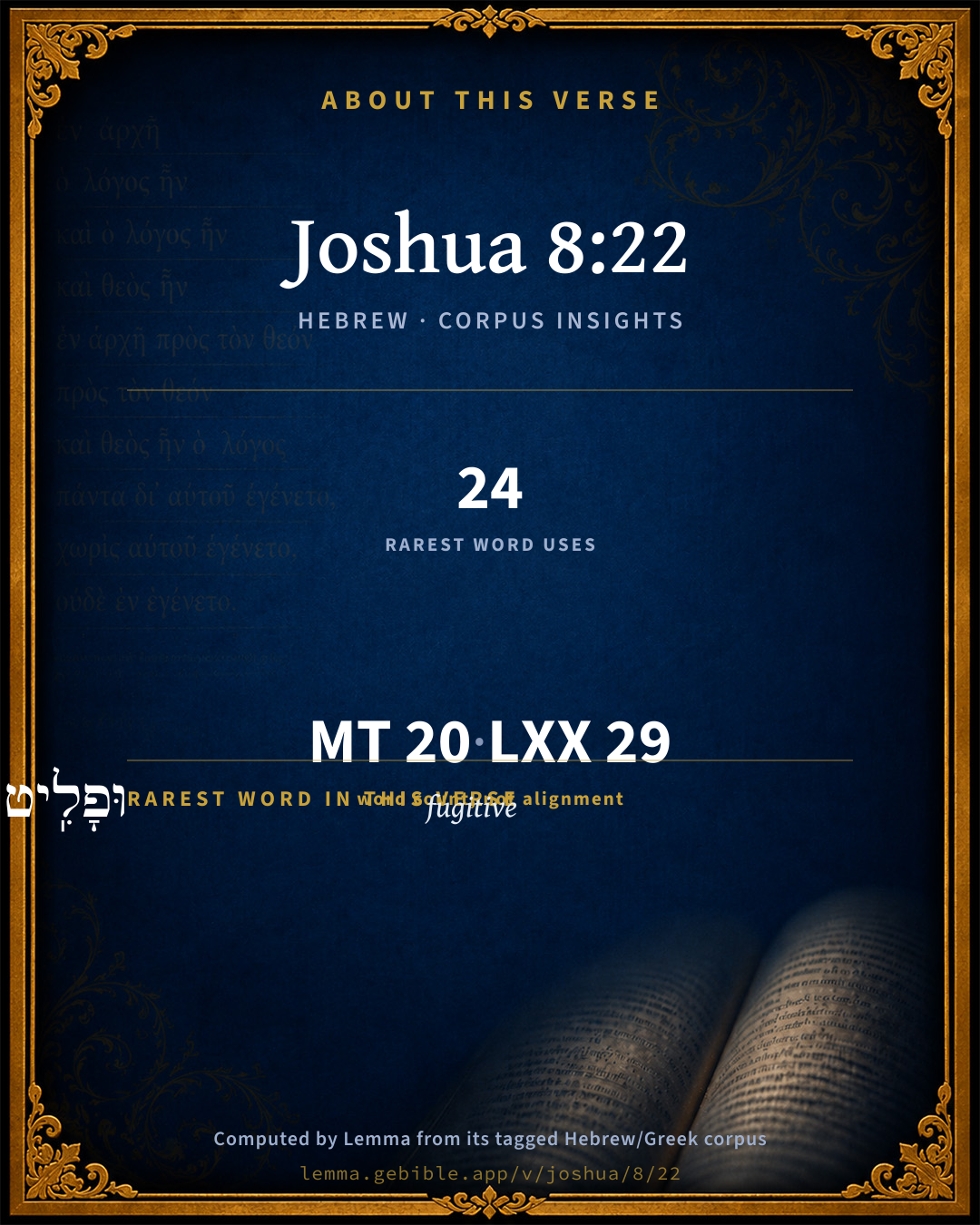
The rarest word here is וּפָלִֽיט fugitive H6412 — appearing just 24 times in the whole Hebrew Bible.

Shared distinctive vocabulary

וּפָלִֽיט fugitive H6412 occurs in 23 verses of the Hebrew Bible. Also found in:

Grammatical profile

  • 5 verbs
  • 5 nouns
  • 5 pronouns
  • 3 prepositions
  • 1 conjunction
  • 1 particle

Verb forms

  • יָצְא֤וּ Qal · Perfect
  • לִקְרָאתָ֔ם Qal · Infinitive Construct
  • וַיִּֽהְי֤וּ Qal · Sequential Imperfect
  • וַיַּכּ֣וּ Hiphil · Sequential Imperfect
  • הִשְׁאִֽיר Hiphil · Perfect

Repetition

Words recur within this verse — often emphatic in Hebrew:

  • וְאֵ֨לֶּה these H428 ×3
  • מִזֶּ֖ה this H2088 ×2

Hebrew & Septuagint length

In English translation the verse runs 41 words from the Hebrew and 45 from the Septuagint (LXX English) — closely comparable.

A rough comparison of the two English renderings, which tokenize alike — not a word-level alignment.

Word counts can differ between the Hebrew and the Greek without any difference in meaning — e.g. the Hebrew direct-object marker אֵת has no separate Greek word, and Greek often adds the article ὁ.

In the original languages it is 20 Hebrew tokens and 29 Greek tokens — but the two are counted differently (Hebrew bundles its prefixes and suffixes into one token; the Greek is in lemma form), so that isn’t a like-for-like length.

Cross-references

7

Topical passages linked to Joshua 8:22 in the Treasury of Scripture Knowledge — connected by theme and wording, ordered by reader-vote popularity; previews shown in the World English Bible.

  • Deuteronomy 7:2 and when Yahweh your God shall deliver them up before you, and you shall strike them; then you shall utterly destroy them: you shall make no covenant with them, nor show mercy to them;
  • Joshua 6:21 They utterly destroyed all that was in the city, both man and woman, both young and old, and ox, and sheep, and donkey, with the edge of the sword.
  • Joshua 10:28 Joshua took Makkedah on that day, and struck it with the edge of the sword, and the king of it: he utterly destroyed them and all the souls who were therein; he left none remaining; and he did to the king of Makkedah as he had done to the king of Jericho.
  • Joshua 11:11–12 They struck all the souls who were therein with the edge of the sword, utterly destroying them; there was none left who breathed: and he burnt Hazor with fire.
  • Job 20:5 That the triumphing of the wicked is short, The joy of the godless but for a moment?
  • Luke 17:26–30 As it happened in the days of Noah, even so will it be also in the days of the Son of Man.
  • 1 Thessalonians 5:3 For when they are saying, "Peace and safety," then sudden destruction will come on them, like birth pains on a pregnant woman; and they will in no way escape.

Cross-references courtesy of OpenBible.info (CC BY 4.0).

Hebrew and Greek witnesses Masoretic Hebrew ↔ Greek Septuagint

The same verse in the two great witnesses to the Old Testament, shown verse-for-verse.

These are two independent witnesses, not word-aligned to each other, and the Septuagint is shown in lemma (dictionary) form.

Hebrew Joshua 8:22 Masoretic · Westminster Leningrad Codex

וְאֵ֨לֶּה יָצְא֤וּ מִן הָעִיר֙ לִקְרָאתָ֔ם וַיִּֽהְי֤וּ לְיִשְׂרָאֵל֙ בַּתָּ֔וֶךְ אֵ֥לֶּה מִזֶּ֖ה וְאֵ֣לֶּה מִזֶּ֑ה וַיַּכּ֣וּ אוֹתָ֔ם עַד בִּלְתִּ֥י הִשְׁאִֽיר ל֖וֹ שָׂרִ֥יד וּפָלִֽיט

The others came forth out of the city against them; so they were in the midst of Israel, some on this side, and some on that side: and they struck them, so that they let none of them remain or escape.

World English Bible · Public Domain

Greek LXX Joshua 8:22 Septuagint · lemma form

καί οὗτος ἐκἔρχομαι ἐκ ὁ πόλις εἰς συνάντησις καί γίγνομαι ἀνά μέσος ὁ παρεμβολή οὗτος ἐντεῦθεν καί οὗτος ἐντεῦθεν καί πατάσσω ἕως ὁ μή καταλείπω αὐτός σώζω καί διαφεύγω

And these came forth out of the city to meet them; and they were in the midst of the army, some being on this side, and some on that; and they struck them until there was not left of them one who survived and escaped.

LXX2012 (modern English Septuagint) · Public Domain

Hebrew: Westminster Leningrad Codex (CC BY 4.0). Greek: Septuagint (public domain); English from LXX2012 (modern English Septuagint) (Public Domain). How the Septuagint differs from the Hebrew →

Targum (Aramaic paraphrase)

1

The Targum is the ancient Jewish Aramaic paraphrase of the Hebrew Scriptures — an interpretive translation, not the Hebrew text itself. Onkelos (literal) and Pseudo-Jonathan (expansive) render the Torah, and Jonathan the Prophets. Coverage is partial: where no permissively-licensed English translation exists for a verse, only the Aramaic is shown. This is verse-level text, not a word-by-word alignment to the Hebrew.

  1. Targum Jonathan Prophets (Joshua–Malachi)
    וְאִלֵין נְפַקוּ מִן קַרְתָּא לִקְדָמוּתְהוּן וַהֲווֹ לְיִשְׂרָאֵל בִּמְצִיעָא אִלֵין מִכָּא וְאִלֵין מִכָּא וּמִחוֹ יַתְהוֹן עַד דְלָא אִשְׁתָּאַר לְהוֹן שְׁאֵר וּמְשֵׁזֵיב:

    (no public-domain English translation for this verse)

    Targum Jonathan — Aramaic: “Mikraot Gedolot” (public domain). English: “Sefaria Community Translation” (CC0 1.0 (public-domain dedication)); “London "Chaldee Paraphrase," 1871” (public domain). Text via Sefaria.

Commentary

Notes on Joshua 8:22 from classic Christian and Jewish commentators (each source and its license shown beneath its notes). The classic Christian expositions comment on the surrounding passage and are grouped to its opening verse, so a note may address several verses; the Jewish commentaries on the Tanakh (Rashi and others) are per-verse, so they appear only where the commentator wrote on this verse.

Lemma curates 59 commentaries, every one of them public domain or Creative Commons licensed, each selected and text-cleaned for this edition rather than reprinted as found. About our sources →

Trapp's Complete Commentary

John Trapp

Jos 8:22 And the other issued out of the city against them; so they were in the midst of Israel, some on this side, and some on that side: and they smote them, so that they let none of them remain or escape.

Ver. 22. So they were in the midst of Israel.] See Jos 8:20.

John Trapp, A Commentary or Exposition upon All the Books of the Old and New Testament (1647–1656) — public domain. Text from a community e-Sword module.

Geneva Bible (1599)

Geneva Bible translators

Which came out of the ambush.

Geneva Bible (1599) marginal notes — public domain. Text via Bolls.life.

The Cambridge Bible for Schools and Colleges

gen. ed. J. J. S. Perowne

22. so they were in the midst of Israel] “The host of Israel now turned again, while those who had set Ai on fire advanced in an opposite direction. Between these two forces the men of Ai were literally crushed.”

The Cambridge Bible for Schools and Colleges (gen. ed. J. J. S. Perowne; Cambridge University Press, 1878–1918) — public domain. Text from a community e-Sword module.

John Gill's Exposition

And the other issued out of the city against them,.... That is, the ambush, or at least a part of them:

so that they were in the midst of Israel, some on this side, and some on that side; or, as we commonly say, they were between two fires, the ambush on one side, the army of Israel on the other:

and they smote them, so that they let none of them remain or escape; not one was saved alive, excepting their king, as in Jos 8:23; no quarter was given them, nor any suffered to make their escape.

John Gill's Exposition of the Whole Bible (1746–1763) — public domain (CC PDM 1.0). Text via the HelloAO Bible API.

Matthew Poole's English Annotations

The other; they who lay in ambush. So their late success was a real mischief to them, as being the occasion of their total ruin.

Matthew Poole's English Annotations on the Holy Bible (1683–1685) — public domain. Text from a community e-Sword/MySword module.

Whedon's Commentary on the Bible

Daniel D. Whedon

22. They let none of them… escape — Considering the Israelites’ superior numbers, their advantage in the strife, and the panic of the men of Ai, their total destruction was an easy matter. Rarely in those times were prisoners taken in battle. The sword devoured utterly.

Daniel D. Whedon (gen. ed.), Commentary on the Old and New Testaments (1874–1909) — public domain. Text from a community e-Sword module.

The Pulpit Commentary

So that they let none of them remain or escape. Literally, until there remained to them neither remainder nor fugitive.

The Pulpit Commentary (1880–1919), ed. H.D.M. Spence-Jones & Joseph S. Exell — public domain. Text from a community e-Sword module.

John Wesley's Explanatory Notes

The other - They who lay in ambush.

John Wesley, Explanatory Notes Upon the Whole Bible (1754–1765) — public domain. Text via the GEBible commentary corpus.

unfoldingWord translationNotes

Door43 World Missions Community

translationWords

Israel

Ai

king

life

Joshua

unfoldingWord translationNotes — © Distant Shores Media and the Door43 World Missions Community, licensed CC BY-SA 4.0. Source: git.door43.org/Door43/en_tn.

Rashi

Rabbi Shlomo Yitzchaki (Rashi)

And the others came out of the city. The “others” refers to the ambush party that had set fire to the city.

Rashi on the Tanakh — English translations: “The Judaica Press complete Tanach with Rashi, translated by A. J. Rosenberg” (CC BY 4.0); “Pentateuch with Rashi's commentary by M. Rosenbaum and A.M. Silbermann, 1929-1934” (public domain); “The Metsudah Tanach series, Lakewood, N.J” (CC BY 4.0); and “The Book of Joshua, Metsudah Publications, 1997” (CC BY 4.0). Text via Sefaria.

Lesson kit

Teaching starters — assembled from the data on this page, not authored interpretation. Every prompt links to the verse data it draws on. Edit before teaching.

Joshua, in the Historical, opens this verse with 20 words (16 distinct Hebrew lemmas). Its most distinctive word is pâlîyṭ (“fugitive”). A historical commentator’s framing appears above. Read the whole chapter for the surrounding context.

Discussion questions

  1. The word pâlîyṭ carries the sense “fugitive.” How does it shape the verse?
  2. Genesis 14:13 shares the word «fugitive» with this verse. How do the two illuminate each other?
  3. “these” occurs 3× in this one verse. What is the effect of the repetition?
  4. These translations render this verse differently. What is at stake in choosing one wording over another?
  5. The verb «יָצְא֤וּ» is Qal Perfect. How does its form color the action?
  6. Reading how Trapp's Complete Commentary and Geneva Bible (1599) read this verse, where do the two commentators agree and where do they part?

Things to notice

Reading settings

Reading text

Shown beneath each verse's original-language words.

Old Testament
Old Testament edition

Read the OT as the Masoretic Hebrew (MT) or the Greek Septuagint (LXX).

English shown for the Greek Septuagint (in the Hebrew ↔ Greek comparison).

Comparing translations? Open the Compare panel on any verse page to stack up to four side by side.