
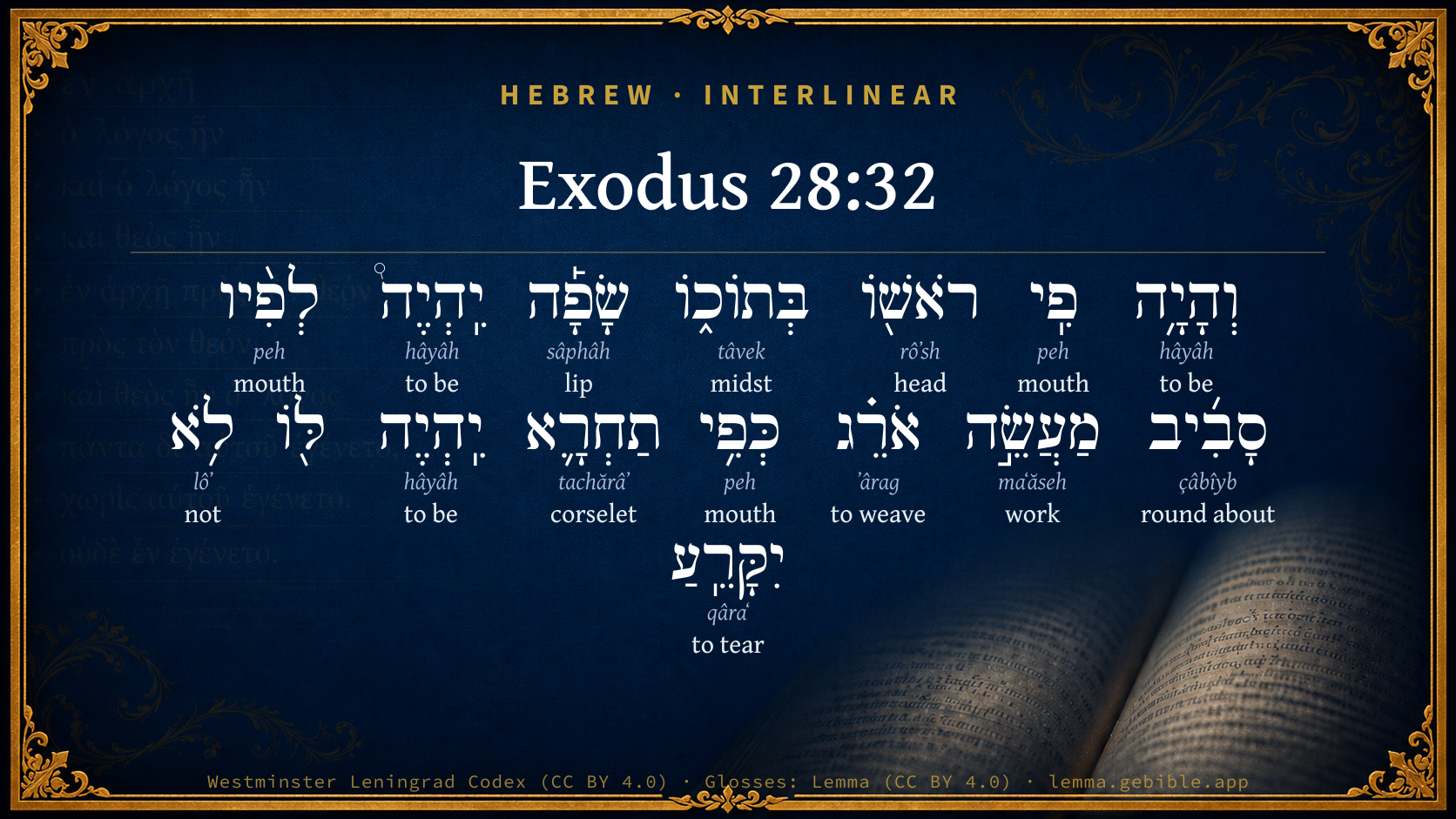
Exodus 28:32

Hebrew (Westminster Leningrad Codex) Exodus 28:32 appears in the Hebrew Old Testament. The text above is from the Westminster Leningrad Codex. Each word links to its Strong’s number, a concise gloss, and parsing drawn from the Open Scriptures Hebrew Bible morphology. Click any word for its full Brown-Driver-Briggs (BDB) entry.
Download image
Cite this verse

Exodus 28:32 (World English Bible). Public Domain. Lemma interlinear Bible study tool, https://lemma.gebible.app/v/exodus/28/32.

Show BibTeX & RIS
BibTeX
RIS
English Translation
It shall have a hole for the head in the midst of it: it shall have a binding of woven work round about the hole of it, as it were the hole of a coat of mail, that it not be torn.
World English Bible · Public Domain
Highlights Full analysis ↓
Download a study sheet

One document with this verse’s original text, its word-by-word gloss line, the meaning frame, cross-references with their text, attributed commentary, and full source and license credits — printable, and it pastes into notes with its structure intact.

This verse Autodidact and up

Study sheet (.html) Plain text (.txt)

A passage Seminary Student

Up to 50 verses in one chapter. A passage sheet keeps up to 6 commentary sources and 12 cross-references per verse, in the order this page ranks them, and says so on the sheet whenever that leaves anything out. Ask for a single verse and you get the Autodidact verse sheet above.

Everything on this page stays free to read, with no account — the sheet is a download of what is already on screen, not access to it.

Want to remove ads? Support Godless Engineer
Compare translations 3

The same verse in 3 English versions, stacked beneath the original-language interlinear above. Click any original word for its lexicon entry.

Each is an independent rendering of the whole verse — the interlinear is not word-aligned to these translations.

Highlighted words mark where these versions differ — a whole-verse word diff, not a word-by-word alignment.

  • World English Bible Public Domain
    It shall have a hole for the head in the midst of it: it shall have a binding of woven work round about the hole of it, as it were the hole of a coat of mail, that it not be torn.
  • King James Version Public Domain
    And there shall be an hole in the top of it, in the midst thereof: it shall have a binding of woven work round about the hole of it, as it were the hole of an habergeon, that it be not rent.
  • unfoldingWord Literal Text CC BY-SA 4.0
    And there shall be an opening for his head in the middle of it. There shall be an edge for its opening all around, so it can not tear—the work of a weaver, it shall be like an opening of a garment.

unfoldingWord Literal Text — © unfoldingWord, licensed CC BY-SA 4.0. Word-aligned USFM3 via Door43 (git.door43.org/unfoldingWord/en_ult).

Versions to compare (up to 4)

3 of 4 selected

Show all 18 translations

Every available English version of this verse, each an independent rendering of the whole verse.

  • World English Bible Public Domain
    It shall have a hole for the head in the midst of it: it shall have a binding of woven work round about the hole of it, as it were the hole of a coat of mail, that it not be torn.
  • Berean Standard Bible Public Domain
    with an opening at its top in the center. Around the opening shall be a woven collar with an opening like that of a garment, so that it will not tear.
  • Majority Standard Bible Public Domain
    with an opening at its top in the center. Around the opening shall be a woven collar with an opening like that of a garment, so that it will not tear.
  • King James Version Public Domain
    And there shall be an hole in the top of it, in the midst thereof: it shall have a binding of woven work round about the hole of it, as it were the hole of an habergeon, that it be not rent.
  • American Standard Version (1901) Public Domain
    And it shall have a hole for the head in the midst thereof: it shall have a binding of woven work round about the hole of it, as it were the hole of a coat of mail, that it be not rent.
  • Revised Version (1885) Public Domain
    And it shall have a hole for the head in the midst thereof: it shall have a binding of woven work round about the hole of it, as it were the hole of a coat of mail, that it be not rent.
  • Geneva Bible (1599) Public Domain
    And the hole for his head shalbe in the middes of it, hauing an edge of wouen woorke rounde about the coller of it: so it shalbe as the coller of an habergeon that it rent not.
  • Douay-Rheims (1899) Public Domain
    In the midst whereof above shall be a hole for the head, and a border round about it woven, as is wont to be made in the outmost parts of garments, that it may not easily be broken.
  • Young's Literal Translation Public Domain
    and the opening for its head hath been in its midst, a border is to its opening round about, work of a weaver, as the opening of a habergeon there is to it; it is not rent.
  • Literal Standard Version CC BY-SA 4.0
    and the opening for his head has been in its midst; there is a border for its opening all around—the work of a weaver—[and] there is as the opening of a [linen] habergeon for it; it is not torn.
  • Unlocked Literal Bible CC BY-SA 4.0
    It must have an opening for the head in the middle. The opening must have a woven edge round about so that it does not tear. This must be the work of a weaver.
  • unfoldingWord Literal Text CC BY-SA 4.0
    And there shall be an opening for his head in the middle of it. There shall be an edge for its opening all around, so it can not tear—the work of a weaver, it shall be like an opening of a garment.
  • Darby Bible Public Domain
    And its opening for the head shall be in the midst thereof; there shall be a binding of woven work at its opening round about; as the opening of a coat of mail, it shall be in it -- it shall not rend.
  • World Messianic Bible Public Domain
    It shall have a hole for the head in the middle of it. It shall have a binding of woven work around its hole, as it were the hole of a coat of mail, that it not be torn.
  • Webster's Bible Public Domain
    And there shall be a hole in the top of it, in the midst of it: it shall have a binding of woven work round about the hole of it, as the hole of an habergeon, that it be not rent.
  • Free Bible Version CC BY-SA 4.0
    with an opening in the middle at the top. Stitch a woven collar around the opening to strengthen it so it won't tear.
  • Bible in Basic English Public Domain
    With a hole at the top, in the middle of it; the hole is to be edged with a band to make it strong like the hole in the coat of a fighting-man, so that it may not be broken open.
  • JPS Tanakh (1917) Public Domain
    And it shall have a hole for the head in the midst thereof; it shall have a binding of woven work round about the hole of it, as it were the hole of a coat of mail that it be not rent.

Literal Standard Version (2020), Covenant Press — licensed CC BY-SA 4.0. Text via the HelloAO Bible API (eBible.org). Unlocked Literal Bible (unfoldingWord) — licensed CC BY-SA 4.0. Text via the HelloAO Bible API (eBible.org). unfoldingWord Literal Text — © unfoldingWord, licensed CC BY-SA 4.0. Word-aligned USFM3 via Door43 (git.door43.org/unfoldingWord/en_ult). Free Bible Version, Dr. Jonathan Gallagher — licensed CC BY-SA 4.0. Text via the HelloAO Bible API (eBible.org).

Word by word

More ways to search: Search by grammar → Find every occurrence → Compare this word →

Practice this passage: Drill this verse → Learn its vocabulary →

תַחְרָ֛א
tachărâʼ
H8473
“corselet”
Noun, Common, Masculine, Singular, Absolute
Part of Speech
Noun
Type
Common
Gender
Masculine
Number
Singular
State
Absolute
Full BDB Definition

Origin: from H2734 in the original sense of H2352 or H2353

TWOT: 2502

corselet
  1. וְהָיָ֥ה hâyâh H1961 “and · to be” Conjunction + Verb, Qal, Sequential Perfect, 3rd Person, Masculine, Singular
  2. פִֽי peh H6310 “mouth of” Noun, Common, Masculine, Singular, Construct
  3. רֹאשׁ֖וֹ rôʼsh H7218 “head · his” Noun, Common, Masculine, Singular, Construct + Suffix, Personal, 3rd Person, Masculine, Singular
  4. בְּתוֹכ֑וֹ tâvek H8432 “in/at · midst · his” Preposition + Noun, Common, Masculine, Singular, Construct + Suffix, Personal, 3rd Person, Masculine, Singular
  5. שָׂפָ֡ה sâphâh H8193 “lip” Noun, Common, Feminine, Singular, Absolute
  6. יִֽהְיֶה֩ hâyâh H1961 “to be” Verb, Qal, Imperfect, 3rd Person, Masculine, Singular
  7. לְפִ֨יו peh H6310 “to/for · mouth · his” Preposition + Noun, Common, Masculine, Singular, Construct + Suffix, Personal, 3rd Person, Masculine, Singular
  8. סָבִ֜יב çâbîyb H5439 “round about” Noun, Common, Both, Singular, Absolute
  9. מַעֲשֵׂ֣ה maʻăseh H4639 “work of” Noun, Common, Masculine, Singular, Construct
  10. אֹרֵ֗ג ʼârag H707 “weaving” Verb, Qal, Participle Active, Masculine, Singular, Absolute
  11. כְּפִ֥י peh H6310 “like/as · mouth of” Preposition + Noun, Common, Masculine, Singular, Construct
  12. יִֽהְיֶה hâyâh H1961 “to be” Verb, Qal, Imperfect, 3rd Person, Masculine, Singular
  13. לֹ֥א lôʼ H3808 “not” Particle, Negative
  14. יִקָּרֵֽעַ qâraʻ H7167 “to tear” Verb, Niphal, Imperfect, 3rd Person, Masculine, Singular

About this verse

These counts appear in no published source. They are computed here, from the morphology-tagged text and Lemma’s own curated glosses. What Lemma adds →

16
words
11
distinct lemmas
Pentateuch
section

Notable vocabulary

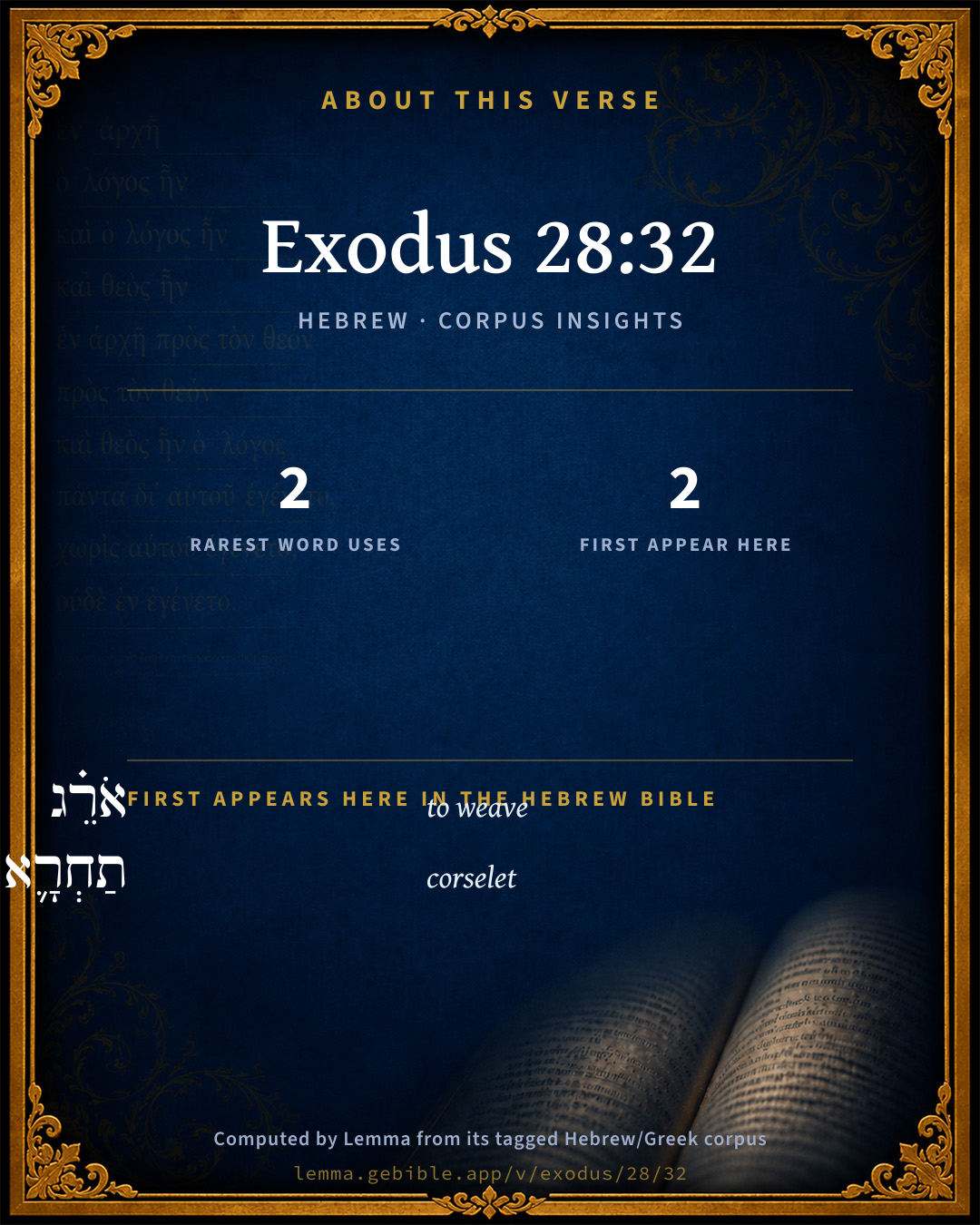
The rarest word here is תַחְרָ֛א corselet H8473 — appearing just 2 times in the whole Hebrew Bible.

First appearance in Scripture

These words make their first canonical appearance in the Hebrew Bible here:

  • אֹרֵ֗ג to weave H707
  • תַחְרָ֛א corselet H8473

Shared distinctive vocabulary

תַחְרָ֛א corselet H8473 occurs in 2 verses of the Hebrew Bible. Also found in:

Grammatical profile

  • 5 verbs
  • 9 nouns
  • 1 preposition
  • 1 particle

Verb forms

  • וְהָיָ֥ה Qal · Sequential Perfect
  • יִֽהְיֶה֩ Qal · Imperfect
  • אֹרֵ֗ג Qal · Participle Active
  • יִֽהְיֶה Qal · Imperfect
  • יִקָּרֵֽעַ Niphal · Imperfect

Repetition

Words recur within this verse — often emphatic in Hebrew:

  • וְהָיָ֥ה to be H1961 ×3
  • פִֽי mouth H6310 ×3

Hebrew & Septuagint length

In English translation the verse runs 42 words from the Hebrew and 25 from the Septuagint (LXX English) — the Septuagint runs noticeably shorter here. See the side-by-side →

A rough comparison of the two English renderings, which tokenize alike — not a word-level alignment.

Word counts can differ between the Hebrew and the Greek without any difference in meaning — e.g. the Hebrew direct-object marker אֵת has no separate Greek word, and Greek often adds the article ὁ.

Cross-references

6

Topical passages linked to Exodus 28:32 in the Treasury of Scripture Knowledge — connected by theme and wording, ordered by reader-vote popularity; previews shown in the World English Bible.

  • Exodus 39:28 and the turban of fine linen, and the linen headbands of fine linen, and the linen breeches of fine twined linen,
  • 2 Chronicles 26:14 Uzziah prepared for them, even for all the host, shields, and spears, and helmets, and coats of mail, and bows, and stones for slinging.
  • Nehemiah 4:16 It happened from that time forth, that half of my servants worked in the work, and half of them held the spears, the shields, and the bows, and the coats of mail; and the rulers were behind all the house of Judah.
  • Job 41:26 If one lay at him with the sword, it can't avail; Nor the spear, the dart, nor the pointed shaft.
  • John 19:23–24 Then the soldiers, when they had crucified Jesus, took his garments and made four parts, to every soldier a part; and also the coat. Now the coat was without seam, woven from the top throughout.
  • Ephesians 4:3–16 being eager to keep the unity of the Spirit in the bond of peace.

Cross-references courtesy of OpenBible.info (CC BY 4.0).

Hebrew and Greek witnesses Masoretic Hebrew ↔ Greek Septuagint

The same verse in the two great witnesses to the Old Testament, shown verse-for-verse.

Here the Septuagint runs noticeably shorter than the Hebrew — LXX2012 (modern English Septuagint) 25 words vs World English Bible 42. A rough length comparison of the two English translations, not a word-level alignment — read both below.

These are two independent witnesses, not word-aligned to each other, and the Septuagint is shown in lemma (dictionary) form.

Hebrew Exodus 28:32 Masoretic · Westminster Leningrad Codex

וְהָיָ֥ה פִֽי רֹאשׁ֖וֹ בְּתוֹכ֑וֹ שָׂפָ֡ה יִֽהְיֶה֩ לְפִ֨יו סָבִ֜יב מַעֲשֵׂ֣ה אֹרֵ֗ג כְּפִ֥י תַחְרָ֛א יִֽהְיֶה לּ֖וֹ לֹ֥א יִקָּרֵֽעַ

It shall have a hole for the head in the midst of it: it shall have a binding of woven work round about the hole of it, as it were the hole of a coat of mail, that it not be torn.

World English Bible · Public Domain

Greek LXX Exodus 28:32 Septuagint · lemma form

καί εἰμί ὁ περιστόμιον ἐκ αὐτός μέσος ὤ

And you shall make a plate of pure gold, and you shall grave on it as the graving of a signet, Holiness of the Lord.

LXX2012 (modern English Septuagint) · Public Domain

Hebrew: Westminster Leningrad Codex (CC BY 4.0). Greek: Septuagint (public domain); English from LXX2012 (modern English Septuagint) (Public Domain). How the Septuagint differs from the Hebrew →

Targum (Aramaic paraphrase)

2

The Targum is the ancient Jewish Aramaic paraphrase of the Hebrew Scriptures — an interpretive translation, not the Hebrew text itself. Onkelos (literal) and Pseudo-Jonathan (expansive) render the Torah, and Jonathan the Prophets. Coverage is partial: where no permissively-licensed English translation exists for a verse, only the Aramaic is shown. This is verse-level text, not a word-by-word alignment to the Hebrew.

  1. Targum Onkelos Torah (Genesis–Deuteronomy)
    וִיהֵי פוּם רֵישֵׁהּ כָּפִיל לְגַוֵּהּ תּוֹרָא יְהֵא מַקַף לְפוּמֵהּ סְחוֹר סְחוֹר עוֹבַד מָחֵי כְּפוּם שִׂרְיָן יְהֵי לֵהּ לָא יִתְבְּזָע:

    (no public-domain English translation for this verse)

    Targum Onkelos — Aramaic: “Onkelos Genesis” (public domain); “Onkelos Exodus” (public domain); “Onkelos Leviticus” (public domain); “Onkelos Numbers” (public domain); “Onkelos Deuteronomy” (public domain). English: “Sefaria Community Translation” (CC0 1.0 (public-domain dedication)); “J.W. Etheridge. The Targums of Onkelos and Jonathan Ben Uzziel on the Pentateuch. London: Longmans, Green, 1862” (public domain). Text via Sefaria.

  2. Targum Pseudo-Jonathan Torah (Genesis–Deuteronomy)
    וִיהֵי פּוּם רֵישֵׁיהּ בְּמִיצְעֵיהּ תּוֹרָא בְּשִיפְמֵיהּ יְהֵי מַקִּיף לְפוּמֵיהּ חֲזוֹר חֲזוֹר עוֹבַד גִרְדָאֵי הֵי כְפוּם לַשִּׁירַיָא יְהֵי לֵיהּ לָא יִתְבְּזָע

    and an orifice shall be in the middle of its upper part; a border shall be upon its opening round about its orifice, the work of the sewer; as the orifice of a coat of mail it shall be, that it may not be rent.

    Targum Pseudo-Jonathan — Aramaic: “Targum Jonathan on Genesis” (public domain); “Targum Jonathan on Exodus” (public domain); “Targum Jonathan on Leviticus” (public domain); “Targum Jonathan on Numbers” (public domain); “Targum Jonathan on Deuteronomy” (public domain). English: “The Targum of Jonathan ben Uzziel, trans. J. W. Etheridge, London, 1862” (public domain). Text via Sefaria.

Commentary

Notes on Exodus 28:32 from classic Christian and Jewish commentators (each source and its license shown beneath its notes). The classic Christian expositions comment on the surrounding passage and are grouped to its opening verse, so a note may address several verses; the Jewish commentaries on the Tanakh (Rashi and others) are per-verse, so they appear only where the commentator wrote on this verse.

Lemma curates 59 commentaries, every one of them public domain or Creative Commons licensed, each selected and text-cleaned for this edition rather than reprinted as found. About our sources →

Trapp's Complete Commentary

John Trapp

Exo 28:32 And there shall be an hole in the top of it, in the midst thereof: it shall have a binding of woven work round about the hole of it, as it were the hole of an habergeon, that it be not rent.

Ver. 32. That it be not rent.] To show that there should be no rents or schisms in the Church. {1Co 1:10; 1Co 1:13 1Ti 1:3}

John Trapp, A Commentary or Exposition upon All the Books of the Old and New Testament (1647–1656) — public domain. Text from a community e-Sword module.

Joseph Benson's Commentary

Exo 28:32-33. An habergeon — A coat of armour. Pomegranates — The figures of pomegranates, but flat and embroidered.

Joseph Benson's Commentary on the Old and New Testaments (1811–1818) — public domain. Text from a community e-Sword module.

Ellicott's Commentary for English Readers

(32) As it were the hole of a habergeon.—Linen corselets, or “habergeons,” were common in Egypt, and were shaped as is here indicated. The word used for “habergeon,” taklãrah, is thought to be Egyptian.

A Bible Commentary for English Readers, edited by Charles John Ellicott (1878–1897) — public domain. Text from a community e-Sword module.

The Cambridge Bible for Schools and Colleges

gen. ed. J. J. S. Perowne

32. a hole for the head, &c.] It was not open behind or in front: it had simply a hole at the top, and was thrown over the head in the manner of a jersey.

woven work] the work of the weaver (Exo_36:1). In ch. 39. these words are attached not to the ‘binding’ (v. 23), but to the robe itself (v. 22); and that is probably their original place here (after ‘of the ephod’ in v. 31). The binding was to keep the edge of the hole from fraying.

a coat of mail] Heb. taḥãrâh, only here and in the ||, Exo_39:23 : Onk. שריון a coat of mail. No doubt, a linen corselet, the λινοθώρηξ of the Greeks (Il. ii. 529), is what is meant; Herodotus (ii. 182, iii. 47) mentions two made in Egypt for Amâsis.

The Cambridge Bible for Schools and Colleges (gen. ed. J. J. S. Perowne; Cambridge University Press, 1878–1918) — public domain. Text from a community e-Sword module.

John Gill's Exposition

And beneath upon the hem of it,.... Or the skirts of it, at the bottom of the robe:

thou shalt make pomegranates of blue, and of purple, and of scarlet, round about the hem thereof; these were figures made of blue, purple, and scarlet yarn, in the form of pomegranates: Jarchi says they were round and hollow, and made like hens' eggs, about the size of them, and of an oval form:

and bells of gold between them round about; according to some, the bells were put into the pomegranates, which is supposed to be the meaning of the phrase "between them", or, "in the midst of them"; and so Aben Ezra observes, that some say the bells did not appear, they were only in the midst of the pomegranates, and there they caused their sound to be heard: but according to our version and others, the bells were placed between the pomegranates, between every pomegranate and pomegranate there was a golden bell; and this seems to be plainly the sense of the following verse.

John Gill's Exposition of the Whole Bible (1746–1763) — public domain (CC PDM 1.0). Text via the HelloAO Bible API.

The Pulpit Commentary

A hole in the top of it. A mere circular hole for the head to go through, unaccompanied by a slit or longitudinal opening. In the midst of it. Midway between the two arm-holes. A binding of woven work round about the hole of it. This would strengthen the edge of the opening) and prevent it from tearing or fraying. The binding was probably sewn on after the frock was woven. As it were the hole of an habergeon. Linen corselets or habergeons have been found in Egypt. They were sometimes covered with metal scales, and were of the make here indicated. (See the author"s History of Egypt, vol. 1. p. 446.) The word here used for "habergeon" (takharah) is Egyptian.

The Pulpit Commentary (1880–1919), ed. H.D.M. Spence-Jones & Joseph S. Exell — public domain. Text from a community e-Sword module.

John Wesley's Explanatory Notes

An habergeon - A coat of armour.

John Wesley, Explanatory Notes Upon the Whole Bible (1754–1765) — public domain. Text via the GEBible commentary corpus.

Rashi

Rabbi Shlomo Yitzchaki (Rashi)

והיה פי ראשו AND THE HOLE IN THE HEAD OF IT SHALL BE — the hole of the Robe which is at its top — that is, the opening which serves as a receptacle for the neck,

בתוכו IN THE MIDST THEREOF — Understand this as the Targum renders it: כפיל לגויה “turned in towards the inside” — the turn-in shall serve as its seam. It was weaver’s work (woven as such with the Robe) and not made with a needle.

כפי תחרא AS IT WERE THE HOLE OF A HABERGEON — This informs us that their habergeons had the neck-opening turned in.

לא יקרע means SO THAT IT BE NOT RENT — Indeed, whoever rends it, transgresses thereby a negative commandment because this is among the number of the negative commands contained in the Torah. The same is the case with (v. 28) “that the breast-plate be not loosened”, and similarly, (Exodus 25:15) “they shall not depart from it”, which is said of the staves of the ark (Yoma 72a).

Rashi on the Tanakh — English translations: “The Judaica Press complete Tanach with Rashi, translated by A. J. Rosenberg” (CC BY 4.0); “Pentateuch with Rashi's commentary by M. Rosenbaum and A.M. Silbermann, 1929-1934” (public domain); “The Metsudah Tanach series, Lakewood, N.J” (CC BY 4.0); and “The Book of Joshua, Metsudah Publications, 1997” (CC BY 4.0). Text via Sefaria.

Lesson kit

Teaching starters — assembled from the data on this page, not authored interpretation. Every prompt links to the verse data it draws on. Edit before teaching.

Exodus, in the Pentateuch, opens this verse with 16 words (11 distinct Hebrew lemmas). Its most distinctive word is tachărâʼ (“corselet”). The Greek Septuagint runs shorter here. A historical commentator’s framing appears above. Read the whole chapter for the surrounding context.

Discussion questions

  1. What does “corselet” (tachărâʼ) contribute to the verse as a whole?
  2. 2 words make their first appearance in Scripture here. What does this debut establish?
  3. How does Exodus 39:23, which shares the word «corselet», read alongside this verse?
  4. What does the repetition of “to be” (3× in this one verse) do in this verse?
  5. The Septuagint runs shorter here than the Hebrew. What might account for the difference?
  6. The translations on this page render this verse differently — a whole-verse word diff, not a word-by-word alignment. What might account for the different wordings?
  7. «וְהָיָ֥ה» is a Qal Sequential Perfect verb. How does that grammatical form shape the action described?
  8. Compare how Trapp's Complete Commentary and Joseph Benson's Commentary read this verse. Where do they agree or differ?

Things to notice

  • 2 words make their first canonical appearance in Scripture here.
  • These translations choose different wording for 26 words in this verse.
  • “to be” occurs 3× in this single verse.
  • 11 distinct Hebrew lemmas span 16 words in this verse.

Reading settings

Reading text

Shown beneath each verse's original-language words.

Old Testament
Old Testament edition

Read the OT as the Masoretic Hebrew (MT) or the Greek Septuagint (LXX).

English shown for the Greek Septuagint (in the Hebrew ↔ Greek comparison).

Comparing translations? Open the Compare panel on any verse page to stack up to four side by side.