
2 Samuel 6:17

Hebrew (Westminster Leningrad Codex) 2 Samuel 6:17 appears in the Hebrew Old Testament. The text above is from the Westminster Leningrad Codex. Each word links to its Strong’s number, a concise gloss, and parsing drawn from the Open Scriptures Hebrew Bible morphology. Click any word for its full Brown-Driver-Briggs (BDB) entry.
Download image
Cite this verse

2 Samuel 6:17 (World English Bible). Public Domain. Lemma interlinear Bible study tool, https://lemma.gebible.app/v/2-samuel/6/17.

Show BibTeX & RIS
BibTeX
RIS
English Translation
They brought in the ark of Yahweh, and set it in its place, in the midst of the tent that David had pitched for it; and David offered burnt offerings and peace-offerings before Yahweh.
World English Bible · Public Domain
Download a study sheet

One document with this verse’s original text, its word-by-word gloss line, the meaning frame, cross-references with their text, attributed commentary, and full source and license credits — printable, and it pastes into notes with its structure intact.

This verse Autodidact and up

Study sheet (.html) Plain text (.txt)

A passage Seminary Student

Up to 50 verses in one chapter. A passage sheet keeps up to 6 commentary sources and 12 cross-references per verse, in the order this page ranks them, and says so on the sheet whenever that leaves anything out. Ask for a single verse and you get the Autodidact verse sheet above.

Everything on this page stays free to read, with no account — the sheet is a download of what is already on screen, not access to it.

Want to remove ads? Support Godless Engineer
Compare translations 3

The same verse in 3 English versions, stacked beneath the original-language interlinear above. Click any original word for its lexicon entry.

Each is an independent rendering of the whole verse — the interlinear is not word-aligned to these translations.

Highlighted words mark where these versions differ — a whole-verse word diff, not a word-by-word alignment.

  • World English Bible Public Domain
    They brought in the ark of Yahweh, and set it in its place, in the midst of the tent that David had pitched for it; and David offered burnt offerings and peace-offerings before Yahweh.
  • King James Version Public Domain
    And they brought in the ark of the LORD, and set it in his place, in the midst of the tabernacle that David had pitched for it: and David offered burnt offerings and peace offerings before the LORD.
  • unfoldingWord Literal Text CC BY-SA 4.0
    And they brought the Box of Yahweh, and they set it in its place in the midst of the tent that David had pitched for it. And David offered burnt offerings and peace offerings to the face of Yahweh.

unfoldingWord Literal Text — © unfoldingWord, licensed CC BY-SA 4.0. Word-aligned USFM3 via Door43 (git.door43.org/unfoldingWord/en_ult).

Versions to compare (up to 4)

3 of 4 selected

Show all 18 translations

Every available English version of this verse, each an independent rendering of the whole verse.

  • World English Bible Public Domain
    They brought in the ark of Yahweh, and set it in its place, in the midst of the tent that David had pitched for it; and David offered burnt offerings and peace-offerings before Yahweh.
  • Berean Standard Bible Public Domain
    So they brought the ark of the LORD and set it in its place inside the tent that David had pitched for it. Then David offered burnt offerings and peace offerings before the LORD.
  • Majority Standard Bible Public Domain
    So they brought the ark of the LORD and set it in its place inside the tent that David had pitched for it. Then David offered burnt offerings and peace offerings before the LORD.
  • King James Version Public Domain
    And they brought in the ark of the LORD, and set it in his place, in the midst of the tabernacle that David had pitched for it: and David offered burnt offerings and peace offerings before the LORD.
  • American Standard Version (1901) Public Domain
    And they brought in the ark of Jehovah, and set it in its place, in the midst of the tent that David had pitched for it; and David offered burnt-offerings and peace-offerings before Jehovah.
  • Revised Version (1885) Public Domain
    And they brought in the ark of the LORD, and set it in its place, in the midst of the tent that David had pitched for it: and David offered burnt offerings and peace offerings before the LORD.
  • Geneva Bible (1599) Public Domain
    And when they had brought in the Arke of the Lord, they set it in his place, in the mids of the tabernacle that Dauid had pitched for it: then Dauid offred burnt offrings, and peace offrings before the Lord.
  • Douay-Rheims (1899) Public Domain
    And they brought the ark of the Lord, and set it in its place in the midst of the tabernacle, which David had pitched for it: and David offered holocausts, and peace offerings before the Lord.
  • Young's Literal Translation Public Domain
    And they bring in the ark of Jehovah, and set it up in its place, in the midst of the tent which David hath spread out for it, and David causeth to ascend burnt-offerings before Jehovah, and peace-offerings.
  • Literal Standard Version CC BY-SA 4.0
    And they bring in the Ark of YHWH, and set it up in its place, in the midst of the tent which David has spread out for it, and David causes burnt-offerings and peace-offerings to ascend before YHWH.
  • Unlocked Literal Bible CC BY-SA 4.0
    They brought in the ark of Yahweh and put it in its place, in the middle of the tent that David had set up for it. Then David offered burnt offerings and fellowship offerings before Yahweh.
  • unfoldingWord Literal Text CC BY-SA 4.0
    And they brought the Box of Yahweh, and they set it in its place in the midst of the tent that David had pitched for it. And David offered burnt offerings and peace offerings to the face of Yahweh.
  • Darby Bible Public Domain
    And they brought in the ark of Jehovah, and set it in its place, in the midst of the tent that David had spread for it. And David offered up burnt-offerings and peace-offerings before Jehovah.
  • World Messianic Bible Public Domain
    They brought in the LORD’s ark, and set it in its place in the middle of the tent that David had pitched for it; and David offered burnt offerings and peace offerings before the LORD.
  • Webster's Bible Public Domain
    And they brought in the ark of the LORD, and set it in its place, in the midst of the tabernacle that David had pitched for it: and David offered burnt-offerings and peace-offerings before the LORD.
  • Free Bible Version CC BY-SA 4.0
    They brought the Ark of the Lord and put it in its place inside the tent that David had set up for it. Then David offered burnt offerings and friendship offerings before the Lord.
  • Bible in Basic English Public Domain
    And they took in the ark of the Lord, and put it in its place inside the tent which David had put up for it: and David made burned offerings and peace-offerings to the Lord.
  • JPS Tanakh (1917) Public Domain
    And they brought in the ark of the LORD, and set it in its place, in the midst of the tent that David had pitched for it; and David offered burnt-offerings and peace-offerings before the LORD.

Literal Standard Version (2020), Covenant Press — licensed CC BY-SA 4.0. Text via the HelloAO Bible API (eBible.org). Unlocked Literal Bible (unfoldingWord) — licensed CC BY-SA 4.0. Text via the HelloAO Bible API (eBible.org). unfoldingWord Literal Text — © unfoldingWord, licensed CC BY-SA 4.0. Word-aligned USFM3 via Door43 (git.door43.org/unfoldingWord/en_ult). Free Bible Version, Dr. Jonathan Gallagher — licensed CC BY-SA 4.0. Text via the HelloAO Bible API (eBible.org).

Word by word

More ways to search: Search by grammar → Find every occurrence → Compare this word →

Practice this passage: Drill this verse → Learn its vocabulary →

וַיַּצִּ֤גוּ
yâtsag
H3322
“and · to set”
Conjunction + Verb, Hiphil, Sequential Imperfect, 3rd Person, Masculine, Plural
Part of Speech
Conjunction + Verb
Stem
Hiphil
Form
Sequential Imperfect
Person
3rd Person
Gender
Masculine
Number
Plural
Full BDB Definition

Origin: a primitive root

TWOT: 895

to place, set, establish - (Hiphil) - to set, place - to present - to exhibit - (Hophal) to be stopped, be stayed, be detained
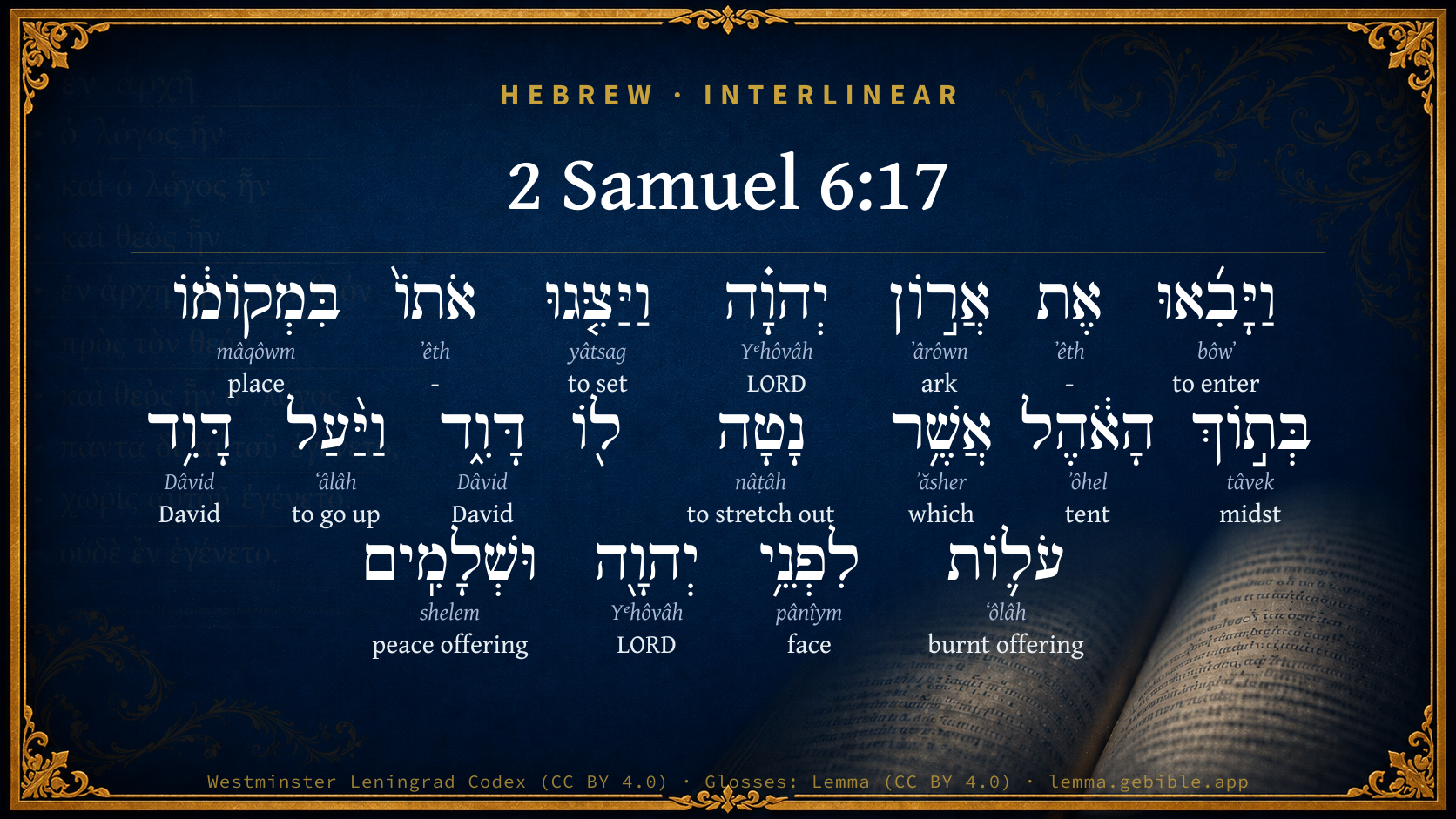
  1. וַיָּבִ֜אוּ bôwʼ H935 “and · to enter” Conjunction + Verb, Hiphil, Sequential Imperfect, 3rd Person, Masculine, Plural
  2. אֶת ʼêth H853 “-” Particle, Direct Object
  3. אֲר֣וֹן ʼârôwn H727 “ark of” Noun, Common, Both, Singular, Construct
  4. יְהוָ֗ה Yᵉhôvâh H3068 “LORD” Noun, Proper
  5. אֹתוֹ֙ ʼêth H853 “- · him” Particle, Direct Object + Suffix, Personal, 3rd Person, Masculine, Singular
  6. בִּמְקוֹמ֔וֹ mâqôwm H4725 “in/at · place · his” Preposition + Noun, Common, Masculine, Singular, Construct + Suffix, Personal, 3rd Person, Masculine, Singular
  7. בְּת֣וֹךְ tâvek H8432 “in/at · midst of” Preposition + Noun, Common, Masculine, Singular, Construct
  8. הָאֹ֔הֶל ʼôhel H168 “the · tent” Particle, Definite Article + Noun, Common, Masculine, Singular, Absolute
  9. אֲשֶׁ֥ר ʼăsher H834 “which” Particle, Relative
  10. נָטָה nâṭâh H5186 “to stretch out” Verb, Qal, Perfect, 3rd Person, Masculine, Singular
  11. דָּוִ֑ד Dâvid H1732 “David” Noun, Proper
  12. וַיַּ֨עַל ʻâlâh H5927 “and · to go up” Conjunction + Verb, Hiphil, Sequential Imperfect, 3rd Person, Masculine, Singular
  13. דָּוִ֥ד Dâvid H1732 “David” Noun, Proper
  14. עֹל֛וֹת ʻôlâh H5930 “burnt offerings” Noun, Common, Feminine, Plural, Absolute
  15. לִפְנֵ֥י pânîym H6440 “to/for · face(s) of” Preposition + Noun, Common, Both, Plural, Construct
  16. יְהוָ֖ה Yᵉhôvâh H3068 “LORD” Noun, Proper
  17. וּשְׁלָמִֽים shelem H8002 “and · peace offerings” Conjunction + Noun, Common, Masculine, Plural, Absolute

About this verse

These counts appear in no published source. They are computed here, from the morphology-tagged text and Lemma’s own curated glosses. What Lemma adds →

19
words
15
distinct lemmas
Historical
section

Notable vocabulary

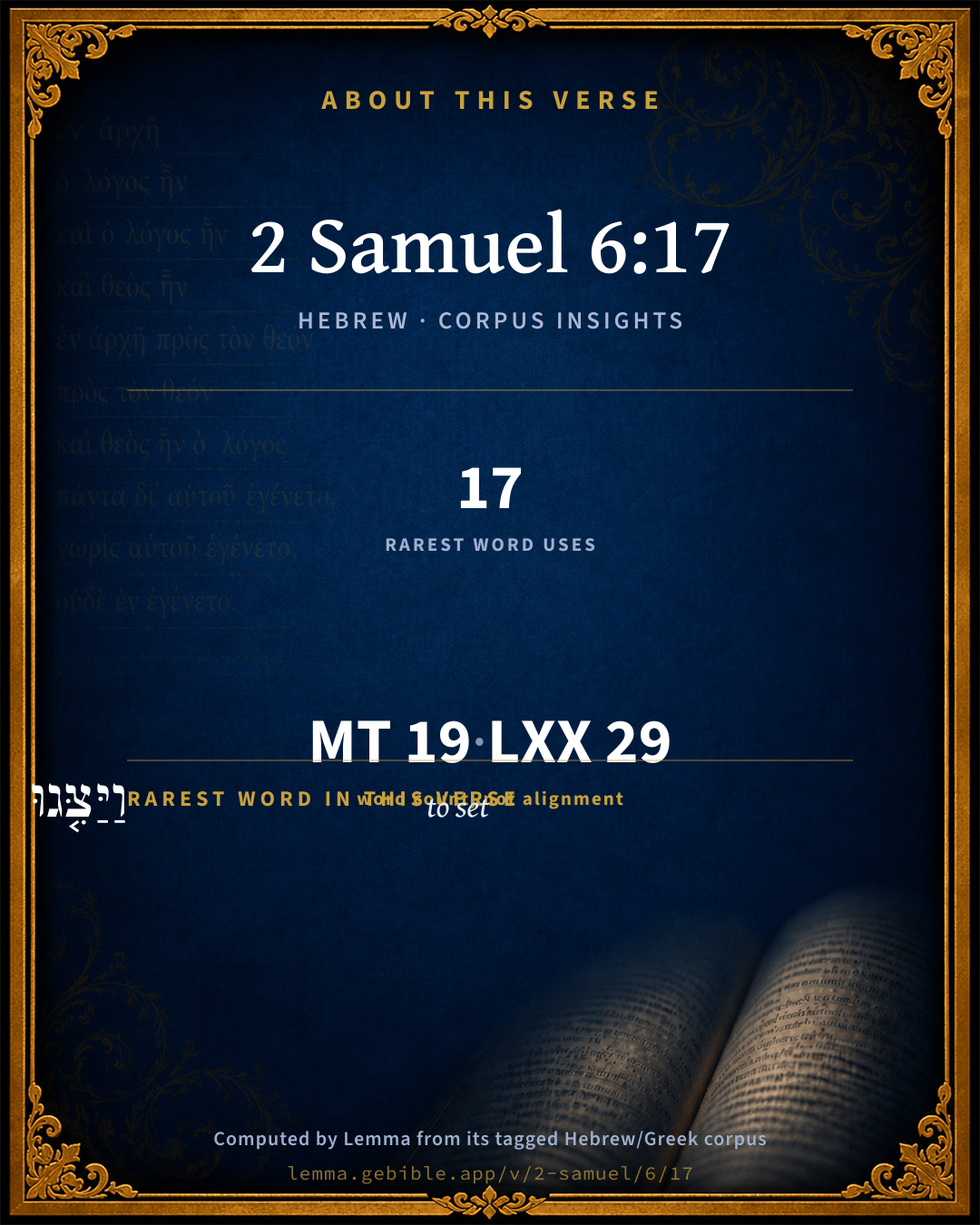
The rarest word here is וַיַּצִּ֤גוּ to set H3322 — appearing just 17 times in the whole Hebrew Bible.

Shared distinctive vocabulary

וַיַּצִּ֤גוּ to set H3322 occurs in 16 verses of the Hebrew Bible. Also found in:

Grammatical profile

  • 4 verbs
  • 11 nouns
  • 1 preposition
  • 3 particles

Verb forms

  • וַיָּבִ֜אוּ Hiphil · Sequential Imperfect
  • וַיַּצִּ֤גוּ Hiphil · Sequential Imperfect
  • נָטָה Qal · Perfect
  • וַיַּ֨עַל Hiphil · Sequential Imperfect

Repetition

Words recur within this verse — often emphatic in Hebrew:

  • יְהוָ֗ה LORD H3068 ×2
  • דָּוִ֑ד David H1732 ×2

Hebrew & Septuagint length

In English translation the verse runs 34 words from the Hebrew and 36 from the Septuagint (LXX English) — closely comparable.

A rough comparison of the two English renderings, which tokenize alike — not a word-level alignment.

Word counts can differ between the Hebrew and the Greek without any difference in meaning — e.g. the Hebrew direct-object marker אֵת has no separate Greek word, and Greek often adds the article ὁ.

In the original languages it is 19 Hebrew tokens and 29 Greek tokens — but the two are counted differently (Hebrew bundles its prefixes and suffixes into one token; the Greek is in lemma form), so that isn’t a like-for-like length.

Cross-references

9

Topical passages linked to 2 Samuel 6:17 in the Treasury of Scripture Knowledge — connected by theme and wording, ordered by reader-vote popularity; previews shown in the World English Bible.

  • 1 Chronicles 15:1 [David] made him houses in the city of David; and he prepared a place for the ark of God, and pitched for it a tent.
  • 2 Chronicles 1:4 But David had brought the ark of God up from Kiriath Jearim to [the place] that David had prepared for it; for he had pitched a tent for it at Jerusalem.
  • 1 Kings 8:5 King Solomon and all the congregation of Israel, who were assembled to him, were with him before the ark, sacrificing sheep and oxen, that could not be counted nor numbered for multitude.
  • 1 Kings 8:62–65 The king, and all Israel with him, offered sacrifice before Yahweh.
  • Psalms 132:8 Arise, Yahweh, into your resting place; You, and the ark of your strength.
  • 2 Chronicles 5:6 King Solomon and all the congregation of Israel, that were assembled to him, were before the ark, sacrificing sheep and oxen, that could not be counted nor numbered for multitude.
  • 2 Chronicles 7:5–7 King Solomon offered a sacrifice of twenty-two thousand oxen, and a hundred and twenty thousand sheep. So the king and all the people dedicated the house of God.
  • Ezra 6:16–17 The children of Israel, the priests, and the Levites, and the rest of the children of the captivity, kept the dedication of this house of God with joy.
  • 1 Chronicles 16:1 They brought in the ark of God, and set it in the midst of the tent that David had pitched for it: and they offered burnt offerings and peace-offerings before God.

Cross-references courtesy of OpenBible.info (CC BY 4.0).

Hebrew and Greek witnesses Masoretic Hebrew ↔ Greek Septuagint

The same verse in the two great witnesses to the Old Testament, shown verse-for-verse.

These are two independent witnesses, not word-aligned to each other, and the Septuagint is shown in lemma (dictionary) form.

Hebrew 2 Samuel 6:17 Masoretic · Westminster Leningrad Codex

וַיָּבִ֜אוּ אֶת אֲר֣וֹן יְהוָ֗ה וַיַּצִּ֤גוּ אֹתוֹ֙ בִּמְקוֹמ֔וֹ בְּת֣וֹךְ הָאֹ֔הֶל אֲשֶׁ֥ר נָטָה ל֖וֹ דָּוִ֑ד וַיַּ֨עַל דָּוִ֥ד עֹל֛וֹת לִפְנֵ֥י יְהוָ֖ה וּשְׁלָמִֽים

They brought in the ark of Yahweh, and set it in its place, in the midst of the tent that David had pitched for it; and David offered burnt offerings and peace-offerings before Yahweh.

World English Bible · Public Domain

Greek LXX 2 Samuel 6:17 Septuagint · lemma form

καί φέρω ὁ κιβωτός ὁ κύριος καί ἀνατίθημι αὐτός εἰς ὁ τόπος αὐτός εἰς μέσος ὁ σκηνή ὅς πήγνυμι αὐτός δαυίδ καί ἀναφέρω δαυίδ ὁλοκαύτωμα ἐνώπιον κύριος καί εἰρηνικός

And they bring the ark of the Lord, and set it in its place in the midst of the tabernacle which David pitched for it: and David offered whole burnt offerings before the Lord, and peace-offerings.

LXX2012 (modern English Septuagint) · Public Domain

Hebrew: Westminster Leningrad Codex (CC BY 4.0). Greek: Septuagint (public domain); English from LXX2012 (modern English Septuagint) (Public Domain). How the Septuagint differs from the Hebrew →

Targum (Aramaic paraphrase)

1

The Targum is the ancient Jewish Aramaic paraphrase of the Hebrew Scriptures — an interpretive translation, not the Hebrew text itself. Onkelos (literal) and Pseudo-Jonathan (expansive) render the Torah, and Jonathan the Prophets. Coverage is partial: where no permissively-licensed English translation exists for a verse, only the Aramaic is shown. This is verse-level text, not a word-by-word alignment to the Hebrew.

  1. Targum Jonathan Prophets (Joshua–Malachi)
    וְאַיְתִיאוּ יַת אֲרוֹנָא דַייָ וַאֲקִימוּ יָתֵיהּ בְּאַתְרֵיהּ בְּגוֹ מַשְׁכְּנָא דִי פְרַס לֵיהּ דָוִד וְאַסִיק דָוִד עֲלַוָן קֳדָם יְיָ וְנִכְסַת קוּדְשִׁין:

    (no public-domain English translation for this verse)

    Targum Jonathan — Aramaic: “Mikraot Gedolot” (public domain). English: “Sefaria Community Translation” (CC0 1.0 (public-domain dedication)); “London "Chaldee Paraphrase," 1871” (public domain). Text via Sefaria.

Commentary

Notes on 2 Samuel 6:17 from classic Christian and Jewish commentators (each source and its license shown beneath its notes). The classic Christian expositions comment on the surrounding passage and are grouped to its opening verse, so a note may address several verses; the Jewish commentaries on the Tanakh (Rashi and others) are per-verse, so they appear only where the commentator wrote on this verse.

Lemma curates 59 commentaries, every one of them public domain or Creative Commons licensed, each selected and text-cleaned for this edition rather than reprinted as found. About our sources →

Trapp's Complete Commentary

John Trapp

2Sa 6:17 And they brought in the ark of the LORD, and set it in his place, in the midst of the tabernacle that David had pitched for it: and David offered burnt offerings and peace offerings before the LORD.

Ver. 17. And peace offerings.] With abundance of sweet odours, saith Josephus, so that all the air thereabouts was perfumed ita ut etiam longe remotis sentiretur: yea, the neighbour villages sucking in the air of that holy city, breathed righteousness, as Plutarch saith of Rome in Numa’s days.

John Trapp, A Commentary or Exposition upon All the Books of the Old and New Testament (1647–1656) — public domain. Text from a community e-Sword module.

Joseph Benson's Commentary

2Sa 6:17. The tabernacle that David had pitched for it — For the ancient tabernacle made by Moses remained still at Gibeon, 1Ch 16:39; 1Ch 21:29; 2Ch 1:3. From whence David did not think fit to fetch it, because he intended soon to build a temple to place it in. For the present, therefore, he only hung some curtains round about the ark, after the fashion of the tabernacle. See 2Sa 7:2. David offered burnt- offerings and peace-offerings — To implore the continuance of God’s mercies to them, and to thank him for those they had received.

Joseph Benson's Commentary on the Old and New Testaments (1811–1818) — public domain. Text from a community e-Sword module.

Tyndale Open Study Notes

Tyndale Open Resources

6:17 While the special tent for the Ark was not as opulent as the tent used during the wilderness wandering, this tent was a return to the wilderness tradition suspended two generations earlier at the destruction of Shiloh (Ps 78:60-61). David’s special tent was the very last Tabernacle; Solomon, David’s successor, built a permanent Temple for the Lord. Because this occasion was joyous, not penitential, the sacrifice included burnt offerings and peace offerings but not sin or guilt offerings.

Tyndale Open Study Notes — © Tyndale Open Resources, licensed CC BY-SA 4.0. Text via the HelloAO Bible API.

Jamieson, Fausset & Brown

Robert Jamieson, A. R. Fausset & David Brown

they brought in the ark of the Lord, and set it in his place, in the midst of the tabernacle that David had pitched for it--The old tabernacle remained at Gibeon (Ch1 16:39; Ch1 21:29; Ch2 1:3). Probably it was not removed because it was too large for the temporary place the king had appropriated, and because he contemplated the building of a temple.

Jamieson, Fausset & Brown — Commentary Critical and Explanatory on the Whole Bible (1871) — public domain (CC PDM 1.0). Text via the HelloAO Bible API.

Ellicott's Commentary for English Readers

(17) The tabernacle.—Not the tabernacle made for it in the wilderness, and which seems to have been now at Gibeon, but a special tent which David, as is immediately added, had prepared for it.

A Bible Commentary for English Readers, edited by Charles John Ellicott (1878–1897) — public domain. Text from a community e-Sword module.

The Cambridge Bible for Schools and Colleges

gen. ed. J. J. S. Perowne

17. the tabernacle] Rather, the tent, as in 1Ch_15:1. The tabernacle proper was at Gibeon (1Ch_16:39).

The Cambridge Bible for Schools and Colleges (gen. ed. J. J. S. Perowne; Cambridge University Press, 1878–1918) — public domain. Text from a community e-Sword module.

John Gill's Exposition

And as soon as David had made an end of offering burnt offerings and peace offerings,.... Or these were performed according to his order:

he blessed the people in the name of the Lord of hosts; not as a priest, but as a prince, as the common father of them, wishing them all happiness and prosperity outward and inward, praying to God to bless them with all blessings temporal and spiritual, who is the God of armies above and below, and can do what he pleases, and more than his people can ask or think.

John Gill's Exposition of the Whole Bible (1746–1763) — public domain (CC PDM 1.0). Text via the HelloAO Bible API.

Matthew Poole's English Annotations

In the tabernacle that David had pitched for it; for Moses’s tabernacle was still at Gibeon, 1Ch 16:39; 21:29; 2Ch 1:3, which David left there, because he designed to build a temple at Jerusalem with all speed, though he was countermanded therein by God himself.

Matthew Poole's English Annotations on the Holy Bible (1683–1685) — public domain. Text from a community e-Sword/MySword module.

Whedon's Commentary on the Bible

Daniel D. Whedon

17. The tabernacle that David had pitched for it — But why did David make a new tabernacle for the ark, and not bring to his city the old one, which seems to have remained at Gibeon? Several reasons may be given. Since the desecration of Shiloh the old tabernacle was removed from one place to another, and had probably been so often remodelled and repaired that it had lost its sacredness in the eyes of the nation, and David deemed it far better to build an entirely new tabernacle. A weightier reason was, that there were now two high priests, Abiathar, who had long been attached to David, and Zadok, whom Saul had anointed in the room of the slain Abimelech, and who was now at Gibeon. 1Ch_16:39. It would have been imprudent for David to depose either of these, and therefore he wisely kept up the service of the tabernacle at Gibeon to afford Zadok the opportunity of exercising his office without interfering with Abiathar. He doubtless built this new tabernacle after the pattern of the old one, and his place in the midst, in which the ark was set, was the holy of holies.

Daniel D. Whedon (gen. ed.), Commentary on the Old and New Testaments (1874–1909) — public domain. Text from a community e-Sword module.

The Pulpit Commentary

In the midst of the tabernacle (i.e. tent). This tent would he arranged as nearly as possible like that erected by Moses in the wilderness. The ark would be placed in the holy of holies, a shrine probably of cedarwood, and the burnt offerings and peace offerings would then be offered and would consecrate the whole. When it is said that David offered them, it means that the sacrifices were at his cost and by his command.

Vers. 17-19. (ZION.) (1Ch 16)

The ark established in its chosen restingplace.

The ascent of the ark into "the city of David" may be regarded as:

1. A termination of a state of things that had long prevailed, in which the relation of the people of Israel to their Divine King was interrupted, his service neglected, their power impaired. Even the early military successes of Saul were followed by disaster, dissension, and civil strife, which had been only recently healed. Once more there was rest. (1Ch_23:25)

2. An inauguration of a new era: the more manifest and abiding presence of Jehovah among his people, the more general recognition of his sovereignty, the organization of a worthier and more attractive form of worship, the more complete union of the tribes under the Lord"s Anointed (Messiah), and the victorious expansion of his kingdom. "It was the greatest day of David"s life .... It was felt to be the turning point in the history of the nation. It recalled the great epoch of the passage through the wilderness. David was on that day the founder, not of freedom only, not of religion only, but of a Church, a commonwealth" (Stanley).

3. A representation (a type, or at least an emblem) of the coming of "Messiah the Prince" in his kingdom; either, more generally, in his whole mediatorial course from his first advent to his final triumph, or, more specially, at his ascension "far above all, the heavens, that he might fill all things". (Eph_4:8-10)

Thou hast ascended up on high, Thou hast led captives captive," etc. (Psa_68:18)

I A GLORIOUS CONSUMMATION. "And they brought in the ark of the Lord, and set it in its place," etc. "This is my rest forever," etc. (Psa_132:13, Psa_132:14) To this occasion may be referred Psalm 24., "The King of glory entering his sanctuary.

The earth is Jehovah"s, and the fulness thereof; The world, and they that dwell therein .... Who shall ascend into the hill of Jehovah? And who shall stand in his holy place? (Psa_24:1-6)

It is here declared that the proper preparation for communion with God is moral purity, not merely external pomp (vers. 9, 11 Ps 15; (Isa_33:15, Isa_33:16) The former part of this grand choral hymn was probably sung on the way to Zion; the latter on entering the gates of the venerable fortress and city of Melchizedek.

Lift up your heads, O ye gates, And be ye lift up, ye everlasting doors, That the King of glory may come in.

Who is, then, the King of glory

Jehovah strong and mighty, Jehovah mighty in battle.

Lift up your heads, O ye gates

Who is, then, that King of glory?

Jehovah of hosts; He is the King of glory. (Psa_24:7-10)

the glorious wave of song and praise, the ark was placed in the tabernacle." So Christ (in whom the Divine and human king are one) has entered the heavenly Zion, dwells with men, and prepares those who receive him, in faith and love, to dwelt with him forever. (Heb_10:12, Heb_10:22)

II AN ACCEPTABLE SACRIFICE. "And David" (as head and representative of priestly nation, (Exo_19:6) "offered burnt offerings and peace offerings before Jehovah;" the former expressive of self-dedication, the latter of thanksgiving, praise, and joyous fellowship with God and one another. At the close of the service of dedication he instituted a regular "service of song in the house of the Lord" (see Hengstenberg, "On the History of the Psalmodic Poetry"), due in part to the influence of Samuel and his prophet associates, (1Sa_19:20) but having him for its real author, and, receiving its mightiest impulse from his sublime compositions. He was a prophet as truly as Samuel or Moses. (Act_2:30) "David, as well as Moses, was made like to Christ the Son of David in this respect, that by him God gave a new ecclesiastical establishment and new ordinances of worship" (Jon. Edwards). On that day then David ordered for the first time to thank the Lord by Asaph and his brethren". (1Ch_16:7)

Thank ye the Lord, call on his Name, Make known his deeds among the people, etc. (1Ch_16:8-22; Psa_105:1-15)

Sing ye to the Lord, all the earth, Proclaim from day today his salvation," etc. (1Ch_16:23-36; Psa_96:2-13 Psa_106:1, Psa_106:47, Psa_106:48)

"A day to be remembered for all time! Then "the sweet singer of Israel" first gave the suggestions of his inspiration, and the product of his pen, to embody and guide the praises of the Church. What effects have followed that first hymn! What streams of praise what clouds of incense have gushed and risen and are ever rising and gushing the world over at this moment, from the immortal impulse of that Divine act!" (Binney). Yet it is Christ himself "in the midst of the Church" (Heb_2:12) who inspires its noblest praises, and by whom the sacrifice is rendered acceptable to God. (Heb_13:15)

III A GRACIOUS BENEDICTION. "And he blessed the people in the name of the Lord of hosts;" recognizing him as "the God of omnipotent power in heaven, who victoriously accomplishes his work of salvation", (1Sa_1:3) and solemnly invoking a blessing on his people in accordance with his Name and covenant. His act, although not strictly an assumption of the office of the Levitical priesthood, was of a priestly character (even more so than the patriarchal blessing); "and thus, though but in a passing and temporary manner, he prefigured in his own person the union of the kingly and priestly offices (Perowne), alluded to in Psalm 110. (written after this event), "The victorious king and priest.

Jehovah hath sworn, and will not repent: Thou art a priest forever After the order of Melchizedek. (Psa_110:4)

It was while the Lord Jesus "lifted up his hands and blessed them" that "he parted from them, and was carried up into heaven" (Luk_24:51) a sign of his continual intercession and benediction. "Wherefore also he is able to save," etc.. (Heb_7:25)

IV A GENEROUS BENEFACTION. "And he distributed to all the people, even to the whole multitude of Israel, as well to the women as to the men, to every one a cake of Dread, and a measure of wine, and a raisin cake," that they might feast together before the Lord (according to custom in the case of peace offerings, (1Sa_1:4 1Sa_9:13) as a nation, with thankfulness, gladness, and charity. "It is a good thing when benedicere and benefacere go together, and when in a prince is seen, not only piety toward God, but love and liberality toward his people" (Guild). How much greater are the benefits bestowed by the exalted Redeemer than those conferred by any earthly monarch (Mar_16:20; Act_2:33) I "Christ has risen bodily into heaven that he may be spiritually present in the earthly heaven of the Church; the bodily ascension and the spiritual indwelling are two aspects of the same act The mystical David, from his own high home, dispenses his own flesh for the life of the world, and that spiritual bread which he that hungers after righteousness shall eat of and be satisfied, and that "fruit of the vine" which is even now to be drunk in the earthly "kingdom of the Father (W. Archer Butler). D.

The ark and the Bible.

The ark of the covenant has been taken as representative of religion, of Christ, of the Church, or of the sacraments and means of grace. It may also be compared with the Bible (or Scriptures of the old and new covenants), which is of even greater value to us than the ark was to Israel. The resemblance appears in their:

1. Supernatural origin. The ark was made according to the pattern shown (in vision) by God to Moses in the mount, (Exo_25:9) by Bezaleel, who was "filled with the Spirit of God", (Exo_31:3) and other wise-hearted men; and the tables of stone which, it contained were "written with the finger of God". (Exo_34:1) The Bible is the product of Divine inspiration, (2Ti_3:16) though, like the ark, in connection with the (literary) skill of man. "It is a Divine-human book.

1. External characteristics, such as choice and precious materials (acacia wood and pure gold), durability, painstaking workmanship

2. ("beaten work"), simplicity, compactness, beauty ("a crown of gold round about"), practical utility (rings and staves), which are all apparent in the Scriptures.

3. Spiritual significance the presence of God, the Law (as a testimony against sin and a rule of life), atoning mercy, Divine fellowship and favour. "In the words of God we have the heart of God." The ark was a sign of these sublime realities, "not the very things themselves." With the Bible, wherein they are so much more clearly and fully set forth, it is the same.

1. Wondrous achievements; not, indeed, by their inherent virtue, but by the Divine might of which they were appointed instruments; in blessing or bane according to the diverse moral relationships of men. By the ark the Israelites were led through the wilderness, their enemies scattered, the waves of the Jordan arrested, the walls of Jericho demolished, the land subdued, Dagon destroyed, the rebellious punished, the irreverent smitten, the obedient blessed. Who shall describe the achievements of the Word of God? What enemies it has overcome! what reformations effected! what blessings conferred!

2. Varied fortunes: after long wanderings finding rest; misunderstood and superstitiously perverted, lost for a season to its appointed guardians, persistently striven against, treated with irreverent curiosity, buried in obscurity and neglect, eagerly sought after and found, cherished in private dwellings, exalted to the highest honour.

3. Transcendent claims on human regard attention, reverence, faith, love, and obedience.

4. Preparatory purpose and temporary duration. At the destruction of Jerusalem by the Babylonians the ark perished or was lost beyond recovery; in the new dispensation there is no place for it; (Jer_3:16) but the mercy and judgment which it symbolized cannot fail. (Rev_11:19) The Bible is necessary only in a state where" we see by means of a mirror obscurely", (1Co_13:12, 1Co_13:13) not where we see "face to face." But, though in its outward form it vanish away, yet in the spiritual realities of which it testifies, the efforts which it produces, the fulfilment of its promises and threatenings, "the Word of the Lord endureth forever. D.

The Pulpit Commentary (1880–1919), ed. H.D.M. Spence-Jones & Joseph S. Exell — public domain. Text from a community e-Sword module.

John Wesley's Explanatory Notes

David had pitched - For Moses tabernacle was still at Gibeon, 1 Chron. xvi, 39; xxi, 29; 2 Chron. i, 3, which David left there, because he designed to build a temple at Jerusalem with all speed.

John Wesley, Explanatory Notes Upon the Whole Bible (1754–1765) — public domain. Text via the GEBible commentary corpus.

Keil & Delitzsch

C. F. Keil & F. Delitzsch

When the ark was brought to the place appointed for it upon Mount Zion, and was deposited in the tent which David had prepared for it, he offered burnt-offerings and thank-offerings before the Lord. "In its place" is still further defined as "in the midst of the tent which David," etc., i.e., in the Most Holy Place; for the tent would certainly be constructed according to the type of the Mosaic tabernacle. The burnt-offerings and peace-offerings were offered to consecrate the newly erected house of God.

Keil & Delitzsch — Biblical Commentary on the Old Testament (1861–1891) — public domain (CC PDM 1.0). Text via the HelloAO Bible API. (Old Testament only.)

Lesson kit

Teaching starters — assembled from the data on this page, not authored interpretation. Every prompt links to the verse data it draws on. Edit before teaching.

2 Samuel, in the Historical, opens this verse with 19 words (15 distinct Hebrew lemmas). Its most distinctive word is yâtsag (“to set”). A historical commentator’s framing appears above. Read the whole chapter for the surrounding context.

Discussion questions

  1. The word yâtsag carries the sense “to set.” How does it shape the verse?
  2. How does Genesis 30:38, which shares the word «to set», read alongside this verse?
  3. What does the repetition of “LORD” (2× in this one verse) do in this verse?
  4. These translations render this verse differently. What is at stake in choosing one wording over another?
  5. «וַיָּבִ֜אוּ» is a Hiphil Sequential Imperfect verb. How does that grammatical form shape the action described?
  6. Compare how Trapp's Complete Commentary and Joseph Benson's Commentary read this verse. Where do they agree or differ?

Things to notice

Reading settings

Reading text

Shown beneath each verse's original-language words.

Old Testament
Old Testament edition

Read the OT as the Masoretic Hebrew (MT) or the Greek Septuagint (LXX).

English shown for the Greek Septuagint (in the Hebrew ↔ Greek comparison).

Comparing translations? Open the Compare panel on any verse page to stack up to four side by side.