
Numbers 15:14

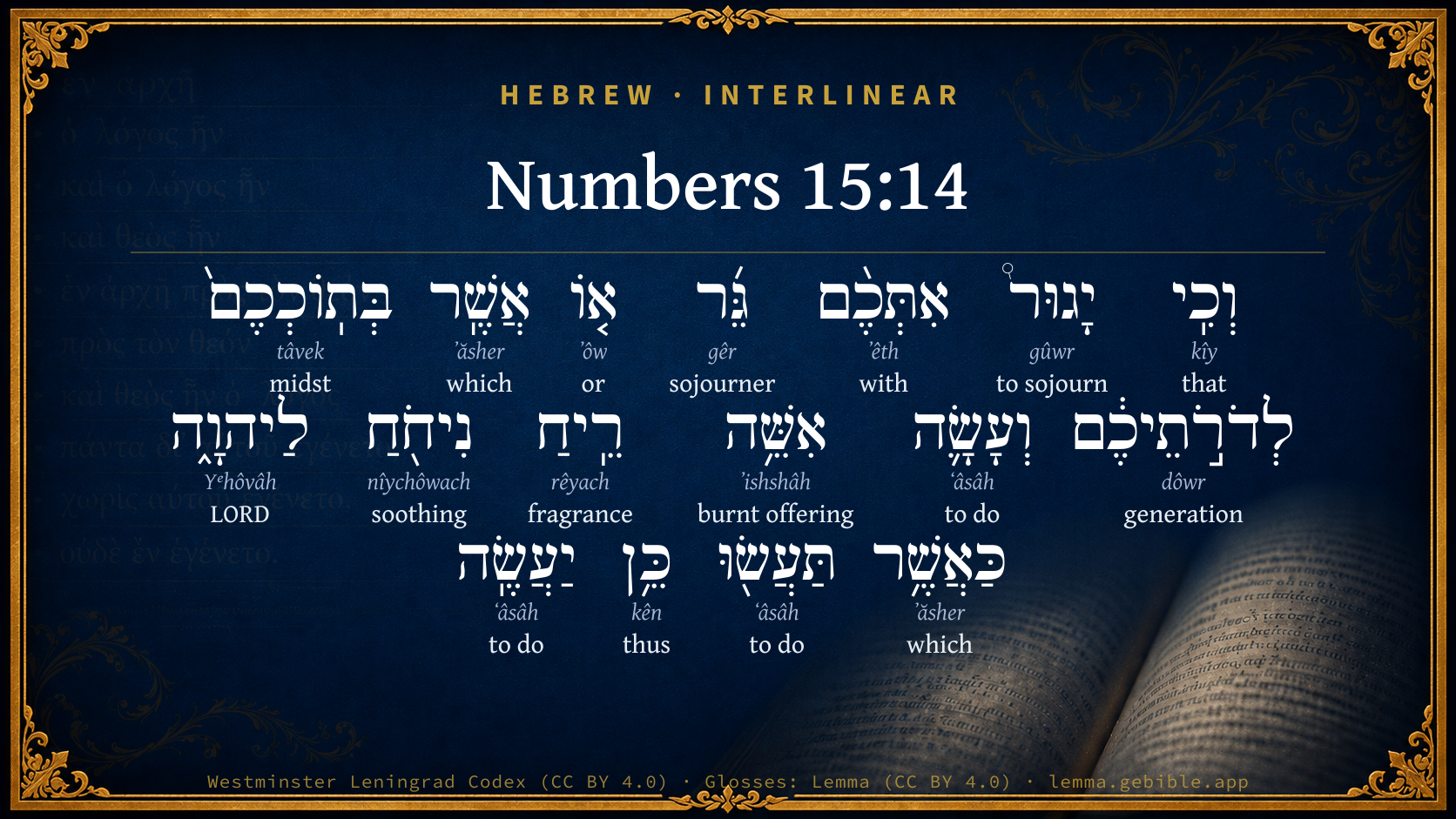
Hebrew (Westminster Leningrad Codex) Numbers 15:14 appears in the Hebrew Old Testament. The text above is from the Westminster Leningrad Codex. Each word links to its Strong’s number, a concise gloss, and parsing drawn from the Open Scriptures Hebrew Bible morphology. Click any word for its full Brown-Driver-Briggs (BDB) entry.
Download image
Cite this verse

Numbers 15:14 (World English Bible). Public Domain. Lemma interlinear Bible study tool, https://lemma.gebible.app/v/numbers/15/14.

Show BibTeX & RIS
BibTeX
RIS
English Translation
If a stranger lives as a foreigner with you, or whoever may be among you throughout your generations, and will offer an offering made by fire, of a sweet savor to Yahweh; as you do, so he shall do.
World English Bible · Public Domain
Download a study sheet

One document with this verse’s original text, its word-by-word gloss line, the meaning frame, cross-references with their text, attributed commentary, and full source and license credits — printable, and it pastes into notes with its structure intact.

This verse Autodidact and up

Study sheet (.html) Plain text (.txt)

A passage Seminary Student

Up to 50 verses in one chapter. A passage sheet keeps up to 6 commentary sources and 12 cross-references per verse, in the order this page ranks them, and says so on the sheet whenever that leaves anything out. Ask for a single verse and you get the Autodidact verse sheet above.

Everything on this page stays free to read, with no account — the sheet is a download of what is already on screen, not access to it.

Want to remove ads? Support Godless Engineer
Compare translations 3

The same verse in 3 English versions, stacked beneath the original-language interlinear above. Click any original word for its lexicon entry.

Each is an independent rendering of the whole verse — the interlinear is not word-aligned to these translations.

Highlighted words mark where these versions differ — a whole-verse word diff, not a word-by-word alignment.

  • World English Bible Public Domain
    If a stranger lives as a foreigner with you, or whoever may be among you throughout your generations, and will offer an offering made by fire, of a sweet savor to Yahweh; as you do, so he shall do.
  • King James Version Public Domain
    And if a stranger sojourn with you, or whosoever be among you in your generations, and will offer an offering made by fire, of a sweet savor unto the LORD; as ye do, so he shall do.
  • unfoldingWord Literal Text CC BY-SA 4.0
    And if a sojourner sojourns with you, or who in your midst for your generations, and he makes a gift, a scent of pleasing for Yahweh, just as you shall do, thus he shall do.

unfoldingWord Literal Text — © unfoldingWord, licensed CC BY-SA 4.0. Word-aligned USFM3 via Door43 (git.door43.org/unfoldingWord/en_ult).

Versions to compare (up to 4)

3 of 4 selected

Show all 18 translations

Every available English version of this verse, each an independent rendering of the whole verse.

  • World English Bible Public Domain
    If a stranger lives as a foreigner with you, or whoever may be among you throughout your generations, and will offer an offering made by fire, of a sweet savor to Yahweh; as you do, so he shall do.
  • Berean Standard Bible Public Domain
    And for the generations to come, if a foreigner residing with you or someone else among you wants to prepare an offering made by fire as a pleasing aroma to the LORD, he is to do exactly as you do.
  • Majority Standard Bible Public Domain
    And for the generations to come, if a foreigner residing with you or someone else among you wants to prepare a food offering as a pleasing aroma to the LORD, he is to do exactly as you do.
  • King James Version Public Domain
    And if a stranger sojourn with you, or whosoever be among you in your generations, and will offer an offering made by fire, of a sweet savor unto the LORD; as ye do, so he shall do.
  • American Standard Version (1901) Public Domain
    And if a stranger sojourn with you, or whosoever may be among you throughout your generations, and will offer an offering made by fire, of a sweet savor unto Jehovah; as ye do, so he shall do.
  • Revised Version (1885) Public Domain
    And if a stranger sojourn with you, or whosoever be among you throughout your generations, and will offer an offering made by fire, of a sweet savour unto the LORD; as ye do, so he shall do.
  • Geneva Bible (1599) Public Domain
    And if a stranger soiourne with you, or whosoeuer bee among you in your generations, and will make an offring by fire of a sweete sauour vnto the Lord, as ye do, so hee shall doe.
  • Douay-Rheims (1899) Public Domain
    Shall offer sacrifices after the same rite.
  • Young's Literal Translation Public Domain
    and when a sojourner sojourneth with you, or whoso `is' in your midst to your generations, and he hath made a fire-offering of sweet fragrance to Jehovah, as ye do so he doth.
  • Literal Standard Version CC BY-SA 4.0
    and when a sojourner sojourns with you, or whoever [is] in your midst throughout your generations, and he has made a fire-offering of refreshing fragrance to YHWH, as you do so he does.
  • Unlocked Literal Bible CC BY-SA 4.0
    If a foreigner is staying with you, or whoever may live among you throughout your people's generations, he must make an offering made by fire, to produce a sweet aroma for Yahweh. He must act as you act.
  • unfoldingWord Literal Text CC BY-SA 4.0
    And if a sojourner sojourns with you, or who in your midst for your generations, and he makes a gift, a scent of pleasing for Yahweh, just as you shall do, thus he shall do.
  • Darby Bible Public Domain
    And if a stranger sojourn with you, or whoever be among you throughout your generations, and will offer an offering by fire of a sweet odour to Jehovah, -- as ye do, so shall he do.
  • World Messianic Bible Public Domain
    If a stranger lives as a foreigner with you, or whoever may be among you throughout your generations, and will offer an offering made by fire, of a pleasant aroma to the LORD, as you do, so he shall do.
  • Webster's Bible Public Domain
    And if a stranger shall sojourn with you, or whoever shall be among you in your generations, and will offer an offering made by fire, of a sweet savor to the LORD; as ye do, so he shall do.
  • Free Bible Version CC BY-SA 4.0
    This also applies for all future generations that if a foreigner living among you or anyone else among you wishes to present an offering acceptable to the Lord: they are to do exactly what you do.
  • Bible in Basic English Public Domain
    And if a man from another country or any other person living among you, through all your generations, has the desire to give an offering made by fire of a sweet smell to the Lord, let him do as you do.
  • JPS Tanakh (1917) Public Domain
    And if a stranger sojourn with you, or whosoever may be among you, throughout your generations, and will offer an offering made by fire, of a sweet savour unto the LORD; as ye do, so he shall do.

Literal Standard Version (2020), Covenant Press — licensed CC BY-SA 4.0. Text via the HelloAO Bible API (eBible.org). Unlocked Literal Bible (unfoldingWord) — licensed CC BY-SA 4.0. Text via the HelloAO Bible API (eBible.org). unfoldingWord Literal Text — © unfoldingWord, licensed CC BY-SA 4.0. Word-aligned USFM3 via Door43 (git.door43.org/unfoldingWord/en_ult). Free Bible Version, Dr. Jonathan Gallagher — licensed CC BY-SA 4.0. Text via the HelloAO Bible API (eBible.org).

Word by word

More ways to search: Search by grammar → Find every occurrence → Compare this word →

Practice this passage: Drill this verse → Learn its vocabulary →

נִיחֹ֖חַ
nîychôwach
H5207
“soothing”
Noun, Common, Masculine, Singular, Absolute
Part of Speech
Noun
Type
Common
Gender
Masculine
Number
Singular
State
Absolute
Full BDB Definition

Origin: from H5117

TWOT: 1323c

soothing, quieting, tranquillising
  1. וְכִֽי kîy H3588 “and · that” Conjunction + Conjunction
  2. יָגוּר֩ gûwr H1481 “to sojourn” Verb, Qal, Imperfect, 3rd Person, Masculine, Singular
  3. אִתְּכֶ֨ם ʼêth H854 “with · you” Preposition + Suffix, Personal, 2nd Person, Masculine, Plural
  4. גֵּ֜ר gêr H1616 “sojourner” Noun, Common, Masculine, Singular, Absolute
  5. א֤וֹ ʼôw H176 “or” Conjunction
  6. אֲשֶֽׁר ʼăsher H834 “which” Particle, Relative
  7. בְּתֽוֹכְכֶם֙ tâvek H8432 “in/at · midst · your” Preposition + Noun, Common, Masculine, Singular, Construct + Suffix, Personal, 2nd Person, Masculine, Plural
  8. לְדֹרֹ֣תֵיכֶ֔ם dôwr H1755 “to/for · generations · your” Preposition + Noun, Common, Masculine, Plural, Construct + Suffix, Personal, 2nd Person, Masculine, Plural
  9. וְעָשָׂ֛ה ʻâsâh H6213 “and · to do” Conjunction + Verb, Qal, Sequential Perfect, 3rd Person, Masculine, Singular
  10. אִשֵּׁ֥ה ʼishshâh H801 “burnt offering of” Noun, Common, Masculine, Singular, Construct
  11. רֵֽיחַ rêyach H7381 “fragrance of” Noun, Common, Masculine, Singular, Construct
  12. לַיהוָ֑ה Yᵉhôvâh H3068 “to/for · LORD” Preposition + Noun, Proper
  13. כַּאֲשֶׁ֥ר ʼăsher H834 “like/as · which” Preposition + Particle, Relative
  14. תַּעֲשׂ֖וּ ʻâsâh H6213 “to do” Verb, Qal, Imperfect, 2nd Person, Masculine, Plural
  15. כֵּ֥ן kên H3651 “thus” Particle, Demonstrative
  16. יַעֲשֶֽׂה ʻâsâh H6213 “to do” Verb, Qal, Jussive, 3rd Person, Masculine, Singular

About this verse

These counts appear in no published source. They are computed here, from the morphology-tagged text and Lemma’s own curated glosses. What Lemma adds →

17
words
14
distinct lemmas
Pentateuch
section

Shared distinctive vocabulary

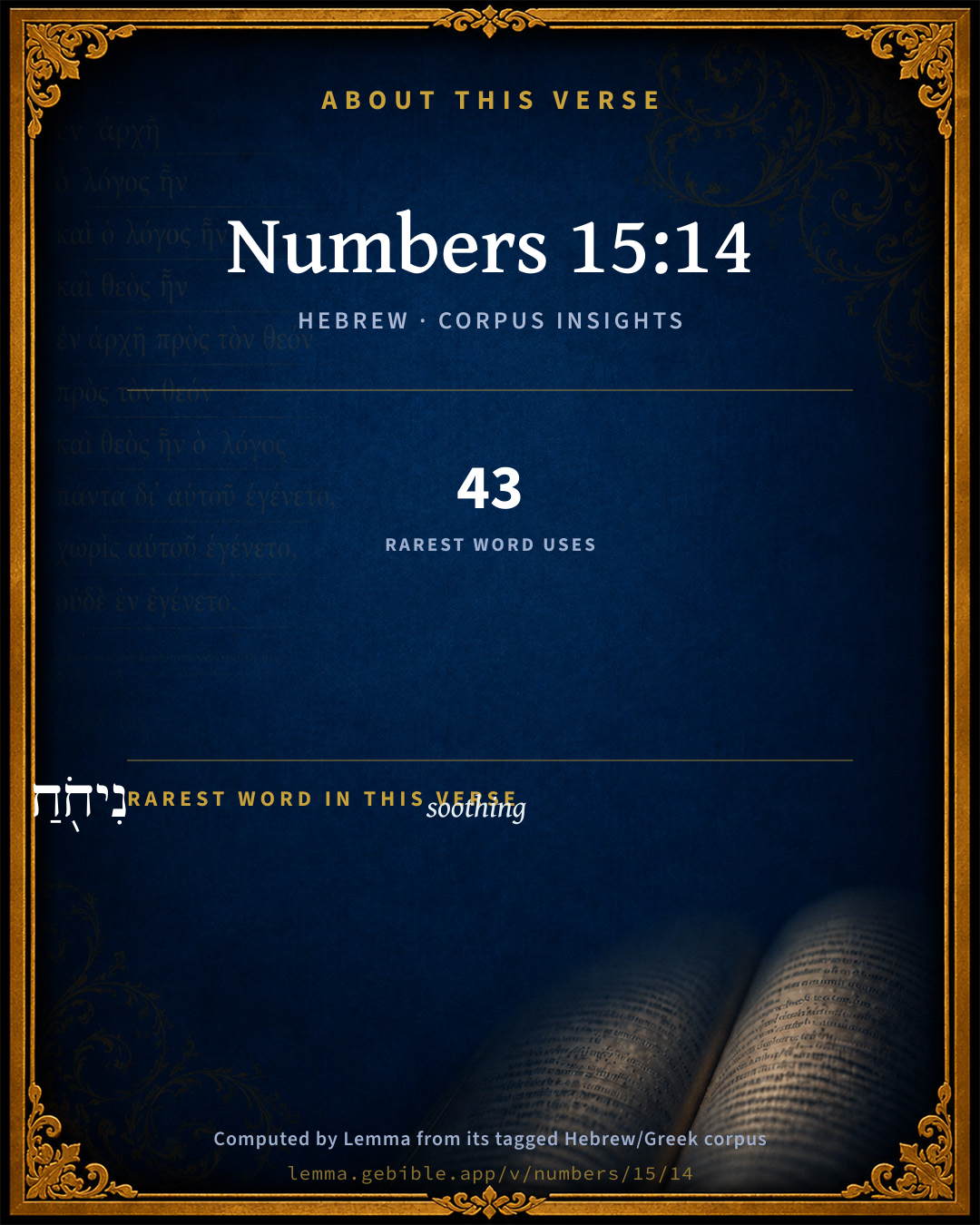
נִיחֹ֖חַ soothing H5207 occurs in 43 verses of the Hebrew Bible. Also found in:

Grammatical profile

  • 4 verbs
  • 7 nouns
  • 1 preposition
  • 2 conjunctions
  • 3 particles

Verb forms

  • יָגוּר֩ Qal · Imperfect
  • וְעָשָׂ֛ה Qal · Sequential Perfect
  • תַּעֲשׂ֖וּ Qal · Imperfect
  • יַעֲשֶֽׂה Qal · Jussive

Repetition

Words recur within this verse — often emphatic in Hebrew:

  • וְעָשָׂ֛ה to do H6213 ×3
  • אֲשֶֽׁר which H834 ×2

Hebrew & Septuagint length

In English translation the verse runs 39 words from the Hebrew and 48 from the Septuagint (LXX English) — closely comparable.

A rough comparison of the two English renderings, which tokenize alike — not a word-level alignment.

Word counts can differ between the Hebrew and the Greek without any difference in meaning — e.g. the Hebrew direct-object marker אֵת has no separate Greek word, and Greek often adds the article ὁ.

Hebrew and Greek witnesses Masoretic Hebrew ↔ Greek Septuagint

The same verse in the two great witnesses to the Old Testament, shown verse-for-verse.

These are two independent witnesses, not word-aligned to each other, and the Septuagint is shown in lemma (dictionary) form.

Hebrew Numbers 15:14 Masoretic · Westminster Leningrad Codex

וְכִֽי יָגוּר֩ אִתְּכֶ֨ם גֵּ֜ר א֤וֹ אֲשֶֽׁר בְּתֽוֹכְכֶם֙ לְדֹרֹ֣תֵיכֶ֔ם וְעָשָׂ֛ה אִשֵּׁ֥ה רֵֽיחַ נִיחֹ֖חַ לַיהוָ֑ה כַּאֲשֶׁ֥ר תַּעֲשׂ֖וּ כֵּ֥ן יַעֲשֶֽׂה

If a stranger lives as a foreigner with you, or whoever may be among you throughout your generations, and will offer an offering made by fire, of a sweet savor to Yahweh; as you do, so he shall do.

World English Bible · Public Domain

Greek LXX Numbers 15:14 Septuagint · lemma form

ἐάν δέ προσήλυτος ἐν σύ προςγίγνομαι ἐν ὁ γῆ σύ ἤ ὅς ἄν γίγνομαι ἐν σύ ἐν ὁ γενεά σύ καί ποιέω κάρπωμα ὀσμή εὐωδία κύριος ὅς τρόπος ποιέω σύ οὕτως ποιέω ὁ συναγωγή κύριος

And if there should be a stranger among you in your land, or one who should be born to you among your generations, and he will offer a sacrifice, a smell of sweet savor to the Lord—as you⌃ do, so the whole congregation shall offer to the Lord.

LXX2012 (modern English Septuagint) · Public Domain

On this verse, The Pulpit Commentary discusses the Septuagint’s reading. Read the note in Commentary ↓

Hebrew: Westminster Leningrad Codex (CC BY 4.0). Greek: Septuagint (public domain); English from LXX2012 (modern English Septuagint) (Public Domain). How the Septuagint differs from the Hebrew →

Targum (Aramaic paraphrase)

2

The Targum is the ancient Jewish Aramaic paraphrase of the Hebrew Scriptures — an interpretive translation, not the Hebrew text itself. Onkelos (literal) and Pseudo-Jonathan (expansive) render the Torah, and Jonathan the Prophets. Coverage is partial: where no permissively-licensed English translation exists for a verse, only the Aramaic is shown. This is verse-level text, not a word-by-word alignment to the Hebrew.

  1. Targum Onkelos Torah (Genesis–Deuteronomy)
    וַאֲרֵי יִתְגַיַר עִמְכוֹן גִיוֹרָא אוֹ דִי בֵינֵיכוֹן לְדָרֵיכוֹן וְיַעְבֵּד קֻרְבַּן דְמִתְקַּבֵּל בְּרַעֲוָא קֳדָם יְיָ כְּמָא דִי תַעְבְּדוּן כֵּן יַעְבֵּד

    (no public-domain English translation for this verse)

    Targum Onkelos — Aramaic: “Onkelos Genesis” (public domain); “Onkelos Exodus” (public domain); “Onkelos Leviticus” (public domain); “Onkelos Numbers” (public domain); “Onkelos Deuteronomy” (public domain). English: “Sefaria Community Translation” (CC0 1.0 (public-domain dedication)); “J.W. Etheridge. The Targums of Onkelos and Jonathan Ben Uzziel on the Pentateuch. London: Longmans, Green, 1862” (public domain). Text via Sefaria.

  2. Targum Pseudo-Jonathan Torah (Genesis–Deuteronomy)
    וַאֲרוּם יִתְגַיֵיר עִמְכוֹן גִיוֹרָא אוֹ מַן דְהוּא כְּדוֹן בֵּינֵיכוֹן לְדָרֵיכוֹן וְיֶעֱבַד קוּרְבַּן דְמִתְקַבֵּל בְּרַעֲוָא קֳדָם יְיָ הֵיכְמָא דְתַעַבְדוּן כֵּן יַעֲבֵד

    And when a sojourner who sojourneth with you, or whoever is among you now, or in your generations, will bring an oblation to be received with favour before the Lord, as you do so shall he.

    Targum Pseudo-Jonathan — Aramaic: “Targum Jonathan on Genesis” (public domain); “Targum Jonathan on Exodus” (public domain); “Targum Jonathan on Leviticus” (public domain); “Targum Jonathan on Numbers” (public domain); “Targum Jonathan on Deuteronomy” (public domain). English: “The Targum of Jonathan ben Uzziel, trans. J. W. Etheridge, London, 1862” (public domain). Text via Sefaria.

Commentary

Notes on Numbers 15:14 from classic Christian and Jewish commentators (each source and its license shown beneath its notes). The classic Christian expositions comment on the surrounding passage and are grouped to its opening verse, so a note may address several verses; the Jewish commentaries on the Tanakh (Rashi and others) are per-verse, so they appear only where the commentator wrote on this verse.

Lemma curates 59 commentaries, every one of them public domain or Creative Commons licensed, each selected and text-cleaned for this edition rather than reprinted as found. About our sources →

Joseph Benson's Commentary

Num 15:14. If a stranger sojourn with you — It is plain this is to be understood of such strangers as had renounced idolatry and become proselytes to the worship of the true God. And if strangers, who were intermixed with the Jews, and resided in their country, had not been obliged to conform to the same ceremonies of public worship with the Jews, their example might, by degrees, have produced a change in, and corruption of, that form of worship which God himself had instituted.

Joseph Benson's Commentary on the Old and New Testaments (1811–1818) — public domain. Text from a community e-Sword module.

Adam Clarke's Commentary

Verse 14. If a stranger sojourn] See the notes on Le 19:33; Le 22:9. When the case of the Jewish people is fairly considered, and their situation with respect to the surrounding idolatrous nations, we shall see the absolute necessity of having but one form of worship in the land. That alone was genuine which was prescribed by the Almighty, and no others could be tolerated, because they were idolatrous. All strangers - all that came to sojourn in the land, were required to conform to it; and it was right that those who did conform to it should have equal rights and privileges with the Hebrews themselves, which we find was the case. But under the Christian dispensation, as no particular form of worship is prescribed, the types and ceremonies of the Mosaic institution being all fulfilled, unlimited toleration should be allowed; and while the sacred writings are made the basis of the worship offered to God, every man should be allowed to worship according to his own conscience, for in this respect every one is

"Lord of himself, accountable to none

But to his conscience and his God alone."

Adam Clarke's Commentary on the Bible (1810–1826) — public domain. Text from a community e-Sword/MySword module.

The Cambridge Bible for Schools and Colleges

gen. ed. J. J. S. Perowne

14. a stranger] a sojourner. For this word and the ‘homeborn,’ see on Num_9:14.

or whosoever be among you] This appears to mean one who is residing in the land but has not been granted the definite status of a gêr or ‘sojourner.’ Some, with less probability, understand it of a foreigner who is staying temporarily with Israelites.

throughout your generations] i.e. at any future time.

The Cambridge Bible for Schools and Colleges (gen. ed. J. J. S. Perowne; Cambridge University Press, 1878–1918) — public domain. Text from a community e-Sword module.

John Gill's Exposition

One ordinance shall be both for you of the congregation,.... Or "O congregation" (i), as Ben Melech, and so the Targum of Jonathan, "O whole congregation"; though Aben Ezra denies it to be vocative:

and also for the stranger that sojourneth with you; the same ordinance, statute, or appointment, respecting the above things, were equally binding on one side as on the other, an homeborn Israelite and a proselyte of righteousness:

an ordinance for ever in your generations; to be observed by them, one and the other, in all ages, until the Messiah came and abolished the law of commandments contained in ordinances:

as ye are so shall the stranger be before the Lord; not in things civil, but religious, and particularly with respect to the above sacrifices and offerings: Ben Gersom and Aben Ezra say this respects the burnt offering only, which was before the Lord.

(i) "O Congregatio", Noldius, p. 237. No. 1077.

John Gill's Exposition of the Whole Bible (1746–1763) — public domain (CC PDM 1.0). Text via the HelloAO Bible API.

Matthew Poole's English Annotations

A stranger, to wit, proselyte, for such offerings were not accepted from others.

Matthew Poole's English Annotations on the Holy Bible (1683–1685) — public domain. Text from a community e-Sword/MySword module.

The Pulpit Commentary

A stranger. Septuagint, proshlutov .

The Pulpit Commentary (1880–1919), ed. H.D.M. Spence-Jones & Joseph S. Exell — public domain. Text from a community e-Sword module.

unfoldingWord translationNotes

Door43 World Missions Community

he must make an offering made by fire

This can be stated in active form. AT: "he must burn an offering on the altar" (See: Active or Passive)

to produce a sweet aroma for Yahweh

"to produce a smell that pleases Yahweh." The Lord being pleased with the sincere worshiper who offers the sacrifice is spoken of as if God were pleased with the aroma of the sacrifice. AT: "to please Yahweh by offering it" (See: Metaphor)

As you are, so also must be the traveler

Possible meanings are 1) "You and the traveler staying with you are alike before Yahweh" or 2) "The same law applies to both you and the traveler"

He must act as you act before Yahweh

"He must act as you act in Yahweh's presence." Because it says that they must act as the Israelites in Yahweh's presence, it is implied that they must obey all of Yahweh's commands. AT: "he must act as you act and obey all of Yahweh's commands" (See: Assumed Knowledge and Implicit Information)

translationWords

alien

life

generation

law, laws

decree

unfoldingWord translationNotes — © Distant Shores Media and the Door43 World Missions Community, licensed CC BY-SA 4.0. Source: git.door43.org/Door43/en_tn.

Lesson kit

Teaching starters — assembled from the data on this page, not authored interpretation. Every prompt links to the verse data it draws on. Edit before teaching.

Numbers, in the Pentateuch, opens this verse with 17 words (14 distinct Hebrew lemmas). Its most distinctive word is nîychôwach (“soothing”). A historical commentator’s framing appears above. Read the whole chapter for the surrounding context.

Discussion questions

  1. The word nîychôwach carries the sense “soothing.” How does it shape the verse?
  2. How does Genesis 8:21, which shares the word «soothing», read alongside this verse?
  3. What does the repetition of “to do” (3× in this one verse) do in this verse?
  4. The translations on this page render this verse differently — a whole-verse word diff, not a word-by-word alignment. What might account for the different wordings?
  5. «יָגוּר֩» is a Qal Imperfect verb. How does that grammatical form shape the action described?
  6. Compare how Joseph Benson's Commentary and Adam Clarke's Commentary read this verse. Where do they agree or differ?

Things to notice

Reading settings

Reading text

Shown beneath each verse's original-language words.

Old Testament
Old Testament edition

Read the OT as the Masoretic Hebrew (MT) or the Greek Septuagint (LXX).

English shown for the Greek Septuagint (in the Hebrew ↔ Greek comparison).

Comparing translations? Open the Compare panel on any verse page to stack up to four side by side.