
Numbers 27:7

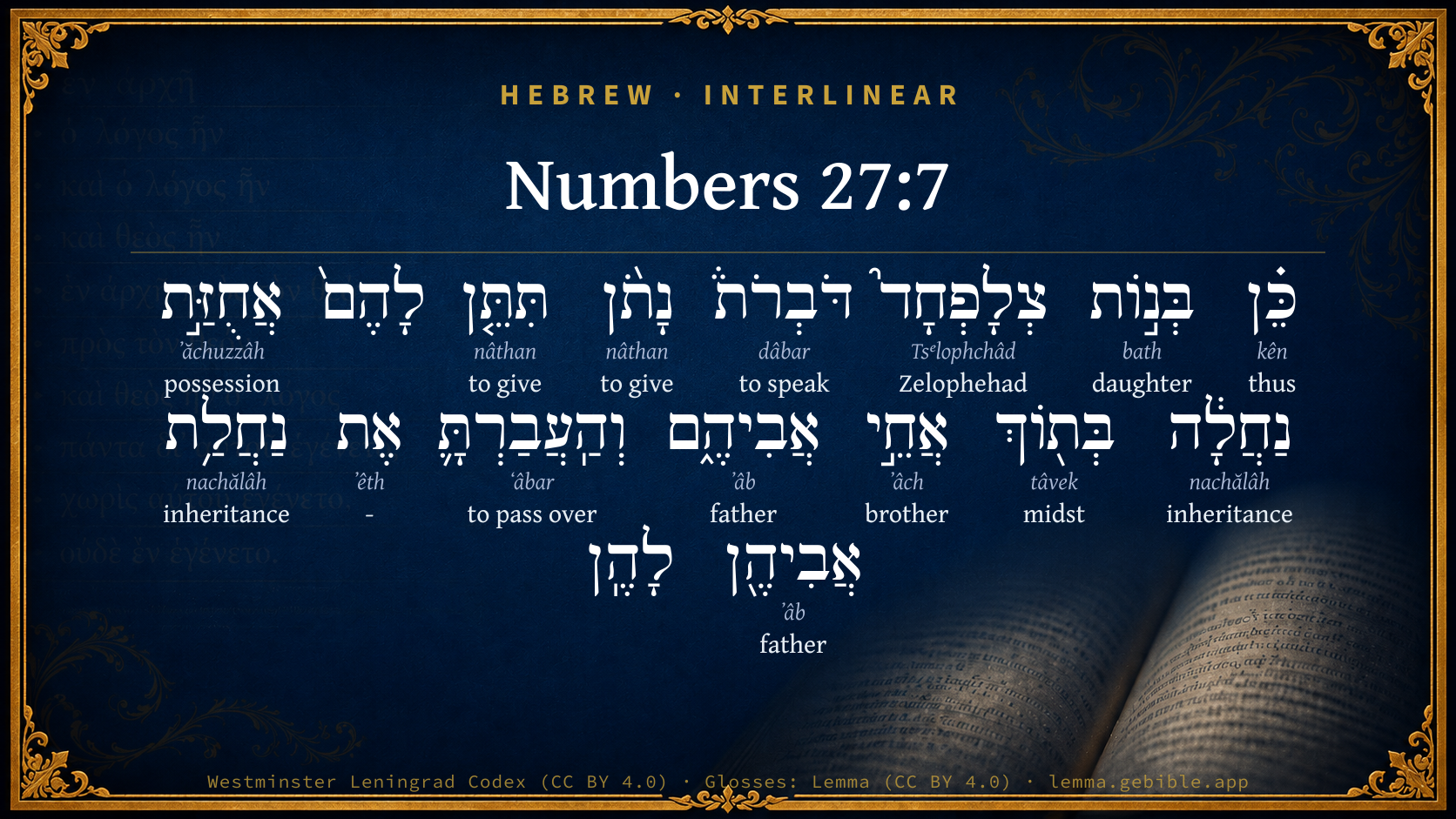
Hebrew (Westminster Leningrad Codex) Numbers 27:7 appears in the Hebrew Old Testament. The text above is from the Westminster Leningrad Codex. Each word links to its Strong’s number, a concise gloss, and parsing drawn from the Open Scriptures Hebrew Bible morphology. Click any word for its full Brown-Driver-Briggs (BDB) entry.
Download image
Cite this verse

Numbers 27:7 (World English Bible). Public Domain. Lemma interlinear Bible study tool, https://lemma.gebible.app/v/numbers/27/7.

Show BibTeX & RIS
BibTeX
RIS
English Translation
The daughters of Zelophehad speak right: you shall surely give them a possession of an inheritance among their father's brothers; and you shall cause the inheritance of their father to pass to them.
World English Bible · Public Domain
Download a study sheet

One document with this verse’s original text, its word-by-word gloss line, the meaning frame, cross-references with their text, attributed commentary, and full source and license credits — printable, and it pastes into notes with its structure intact.

This verse Autodidact and up

Study sheet (.html) Plain text (.txt)

A passage Seminary Student

Up to 50 verses in one chapter. A passage sheet keeps up to 6 commentary sources and 12 cross-references per verse, in the order this page ranks them, and says so on the sheet whenever that leaves anything out. Ask for a single verse and you get the Autodidact verse sheet above.

Everything on this page stays free to read, with no account — the sheet is a download of what is already on screen, not access to it.

Want to remove ads? Support Godless Engineer
Compare translations 3

The same verse in 3 English versions, stacked beneath the original-language interlinear above. Click any original word for its lexicon entry.

Each is an independent rendering of the whole verse — the interlinear is not word-aligned to these translations.

Highlighted words mark where these versions differ — a whole-verse word diff, not a word-by-word alignment.

  • World English Bible Public Domain
    The daughters of Zelophehad speak right: you shall surely give them a possession of an inheritance among their father's brothers; and you shall cause the inheritance of their father to pass to them.
  • King James Version Public Domain
    The daughters of Zelophehad speak right: thou shalt surely give them a possession of an inheritance among their father's brethren; and thou shalt cause the inheritance of their father to pass unto them.
  • unfoldingWord Literal Text CC BY-SA 4.0
    “The daughters of Zelophehad are speaking rightly. You shall certainly give to them the possession of an inheritance in the midst of the brothers of their father, and you shall cause the inheritance of their father to pass over to them.

unfoldingWord Literal Text — © unfoldingWord, licensed CC BY-SA 4.0. Word-aligned USFM3 via Door43 (git.door43.org/unfoldingWord/en_ult).

Versions to compare (up to 4)

3 of 4 selected

Show all 18 translations

Every available English version of this verse, each an independent rendering of the whole verse.

  • World English Bible Public Domain
    The daughters of Zelophehad speak right: you shall surely give them a possession of an inheritance among their father's brothers; and you shall cause the inheritance of their father to pass to them.
  • Berean Standard Bible Public Domain
    “The daughters of Zelophehad speak correctly. You certainly must give them property as an inheritance among their father’s brothers, and transfer their father’s inheritance to them.
  • Majority Standard Bible Public Domain
    “The daughters of Zelophehad speak correctly. You certainly must give them property as an inheritance among their father’s brothers and transfer their father’s inheritance to them.
  • King James Version Public Domain
    The daughters of Zelophehad speak right: thou shalt surely give them a possession of an inheritance among their father's brethren; and thou shalt cause the inheritance of their father to pass unto them.
  • American Standard Version (1901) Public Domain
    The daughters of Zelophehad speak right: thou shalt surely give them a possession of an inheritance among their father's brethren; and thou shalt cause the inheritance of their father to pass unto them.
  • Revised Version (1885) Public Domain
    The daughters of Zelophehad speak right: thou shalt surely give them a possession of an inheritance among their father’s brethren; and thou shalt cause the inheritance of their father to pass unto them.
  • Geneva Bible (1599) Public Domain
    The daughters of Zelophehad speake right: thou shalt giue them a possession to inherite among their fathers brethren, and shalt turne the inheritance of their father vnto them.
  • Douay-Rheims (1899) Public Domain
    And to the children of Israel thou shalt speak these things:
  • Young's Literal Translation Public Domain
    `Rightly are the daughters of Zelophehad speaking; thou dost certainly give to them a possession of an inheritance in the midst of their father's brethren, and hast caused to pass over the inheritance of their father to them.
  • Literal Standard Version CC BY-SA 4.0
    “The daughters of Zelophehad are speaking correctly; you certainly give to them a possession of an inheritance in the midst of their father’s brothers, and have caused the inheritance of their father to pass over to them.
  • Unlocked Literal Bible CC BY-SA 4.0
    “Zelophehad's daughters are speaking correctly. You must certainly give them land as an inheritance among their father's relatives, and you must ensure that their father's inheritance passes on to them.
  • unfoldingWord Literal Text CC BY-SA 4.0
    “The daughters of Zelophehad are speaking rightly. You shall certainly give to them the possession of an inheritance in the midst of the brothers of their father, and you shall cause the inheritance of their father to pass over to them.
  • Darby Bible Public Domain
    The daughters of Zelophehad speak right: thou shalt surely give them a possession of an inheritance among their father's brethren; and thou shalt cause the inheritance of their father to pass unto them.
  • World Messianic Bible Public Domain
    “The daughters of Zelophehad speak right. You shall surely give them a possession of an inheritance among their father’s brothers. You shall cause the inheritance of their father to pass to them.
  • Webster's Bible Public Domain
    The daughters of Zelophehad speak what is right: thou shalt surely give them a possession of an inheritance among their father's brethren; and thou shalt cause the inheritance of their father to pass to them.
  • Free Bible Version CC BY-SA 4.0
    “What the daughters of Zelophehad are saying is right. You really must give them land to own alongside their uncles—give to them what would have been allocated to their father.
  • Bible in Basic English Public Domain
    What the daughters of Zelophehad say is right: certainly you are to give them a heritage among their father's brothers: and let the property which would have been their father's go to them.
  • JPS Tanakh (1917) Public Domain
    'The daughters of Zelophehad speak right: thou shalt surely give them a possession of an inheritance among their father's brethren; and thou shalt cause the inheritance of their father to pass unto them.

Literal Standard Version (2020), Covenant Press — licensed CC BY-SA 4.0. Text via the HelloAO Bible API (eBible.org). Unlocked Literal Bible (unfoldingWord) — licensed CC BY-SA 4.0. Text via the HelloAO Bible API (eBible.org). unfoldingWord Literal Text — © unfoldingWord, licensed CC BY-SA 4.0. Word-aligned USFM3 via Door43 (git.door43.org/unfoldingWord/en_ult). Free Bible Version, Dr. Jonathan Gallagher — licensed CC BY-SA 4.0. Text via the HelloAO Bible API (eBible.org).

Word by word

More ways to search: Search by grammar → Find every occurrence → Compare this word →

Practice this passage: Drill this verse → Learn its vocabulary →

צְלָפְחָד֮
Tsᵉlophchâd
H6765
“Zelophehad”
Noun, Proper
Part of Speech
Noun
Type
Proper
Full BDB Definition

Origin: from the same as H6764 and H259

TWOT: None

Zelophehad = "first-born" - a Manassite, son of Hepher and grandson of Gilead; came out of Egypt with Moses and died in the wilderness leaving only five daughters as heirs; their right to the inheritance was confirmed by divine direction
  1. כֵּ֗ן kên H3651 “thus” Particle, Demonstrative
  2. בְּנ֣וֹת bath H1323 “daughters of” Noun, Common, Feminine, Plural, Construct
  3. דֹּבְרֹת֒ dâbar H1696 “speaking” Verb, Qal, Participle Active, Feminine, Plural, Absolute
  4. נָתֹ֨ן nâthan H5414 “to give” Verb, Qal, Infinitive Absolute
  5. תִּתֵּ֤ן nâthan H5414 “to give” Verb, Qal, Imperfect, 2nd Person, Masculine, Singular
  6. אֲחֻזַּ֣ת ʼăchuzzâh H272 “possession of” Noun, Common, Feminine, Singular, Construct
  7. נַחֲלָ֔ה nachălâh H5159 “inheritance” Noun, Common, Feminine, Singular, Absolute
  8. בְּת֖וֹךְ tâvek H8432 “in/at · midst of” Preposition + Noun, Common, Masculine, Singular, Construct
  9. אֲחֵ֣י ʼâch H251 “brothers of” Noun, Common, Masculine, Plural, Construct
  10. אֲבִיהֶ֑ם ʼâb H1 “father · their” Noun, Common, Masculine, Singular, Construct + Suffix, Personal, 3rd Person, Masculine, Plural
  11. וְהַֽעֲבַרְתָּ֛ ʻâbar H5674 “and · to pass over” Conjunction + Verb, Hiphil, Sequential Perfect, 2nd Person, Masculine, Singular
  12. אֶת ʼêth H853 “-” Particle, Direct Object
  13. נַחֲלַ֥ת nachălâh H5159 “inheritance of” Noun, Common, Feminine, Singular, Construct
  14. אֲבִיהֶ֖ן ʼâb H1 “father · their” Noun, Common, Masculine, Singular, Construct + Suffix, Personal, 3rd Person, Feminine, Plural

About this verse

These counts appear in no published source. They are computed here, from the morphology-tagged text and Lemma’s own curated glosses. What Lemma adds →

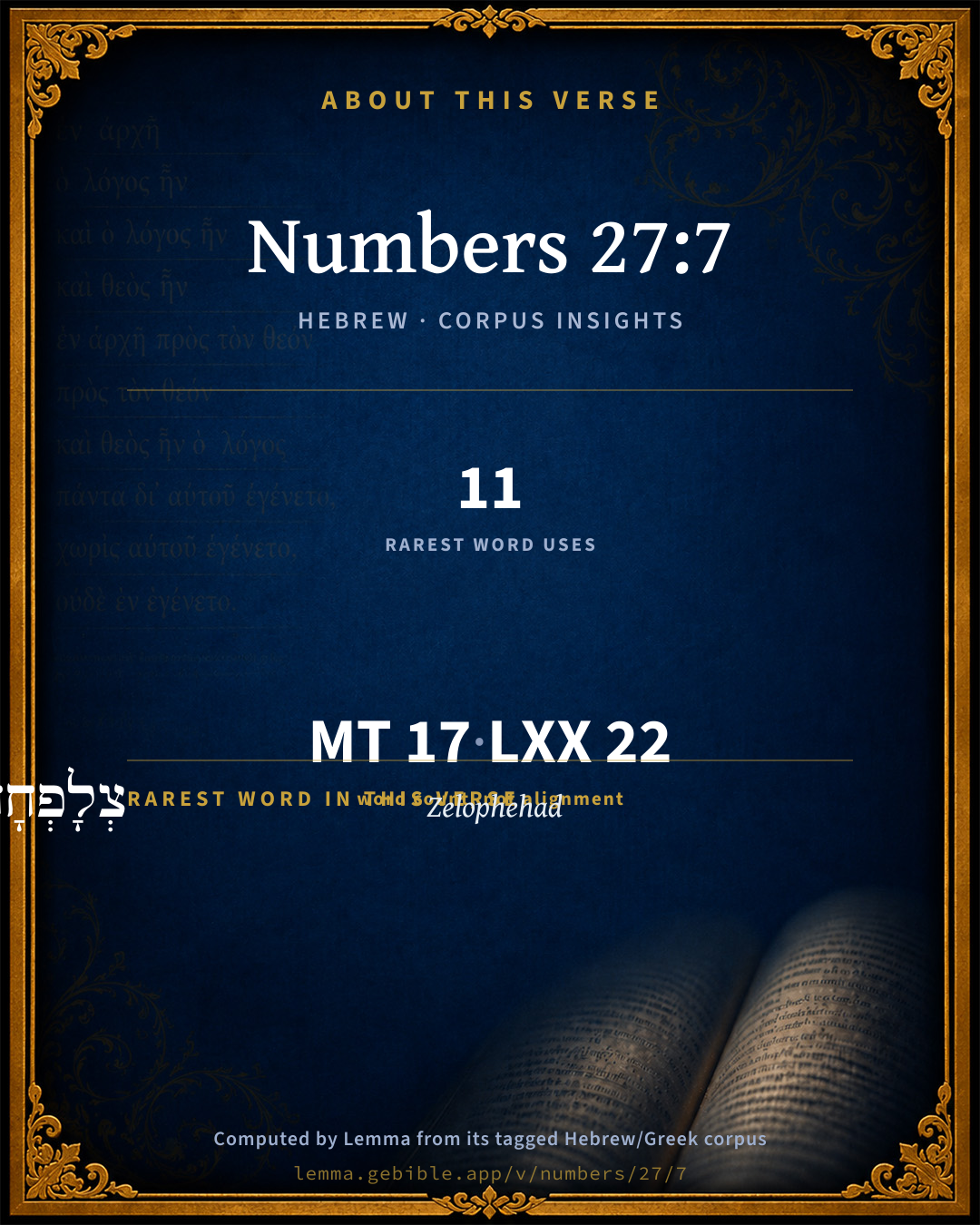
17
words
12
distinct lemmas
Pentateuch
section

Notable vocabulary

The rarest word here is צְלָפְחָד֮ Zelophehad H6765 — appearing just 11 times in the whole Hebrew Bible.

Shared distinctive vocabulary

צְלָפְחָד֮ Zelophehad H6765 occurs in 9 verses of the Hebrew Bible. Also found in:

Grammatical profile

  • 4 verbs
  • 9 nouns
  • 2 prepositions
  • 2 particles

Verb forms

  • דֹּבְרֹת֒ Qal · Participle Active
  • נָתֹ֨ן Qal · Infinitive Absolute
  • תִּתֵּ֤ן Qal · Imperfect
  • וְהַֽעֲבַרְתָּ֛ Hiphil · Sequential Perfect

Repetition

Words recur within this verse — often emphatic in Hebrew:

  • נָתֹ֨ן to give H5414 ×2
  • נַחֲלָ֔ה inheritance H5159 ×2
  • אֲבִיהֶ֑ם father H1 ×2

Hebrew & Septuagint length

In English translation the verse runs 33 words from the Hebrew and 10 from the Septuagint (LXX English) — the Septuagint runs noticeably shorter here. See the side-by-side →

A rough comparison of the two English renderings, which tokenize alike — not a word-level alignment.

Word counts can differ between the Hebrew and the Greek without any difference in meaning — e.g. the Hebrew direct-object marker אֵת has no separate Greek word, and Greek often adds the article ὁ.

In the original languages it is 17 Hebrew tokens and 22 Greek tokens — but the two are counted differently (Hebrew bundles its prefixes and suffixes into one token; the Greek is in lemma form), so that isn’t a like-for-like length.

Cross-references

5

Topical passages linked to Numbers 27:7 in the Treasury of Scripture Knowledge — connected by theme and wording, ordered by reader-vote popularity; previews shown in the World English Bible.

  • Jeremiah 49:11 Leave your fatherless children, I will preserve them alive; and let your widows trust in me.
  • Galatians 3:28 There is neither Jew nor Greek, there is neither slave nor free man, there is neither male nor female; for you are all one in Christ Jesus.
  • Numbers 36:1–2 The heads of the fathers' [houses] of the family of the children of Gilead, the son of Machir, the son of Manasseh, of the families of the sons of Joseph, came near, and spoke before Moses, and before the princes, the heads of the fathers' [houses] of the children of Israel:
  • Joshua 17:4 They came near before Eleazar the priest, and before Joshua the son of Nun, and before the princes, saying, Yahweh commanded Moses to give us an inheritance among our brothers: therefore according to the commandment of Yahweh he gave them an inheritance among the brothers of their father.
  • Psalms 68:5 A father of the fatherless, and a defender of the widows, Is God in his holy habitation.

Cross-references courtesy of OpenBible.info (CC BY 4.0).

Hebrew and Greek witnesses Masoretic Hebrew ↔ Greek Septuagint

The same verse in the two great witnesses to the Old Testament, shown verse-for-verse.

Here the Septuagint runs noticeably shorter than the Hebrew — LXX2012 (modern English Septuagint) 10 words vs World English Bible 33. A rough length comparison of the two English translations, not a word-level alignment — read both below.

These are two independent witnesses, not word-aligned to each other, and the Septuagint is shown in lemma (dictionary) form.

Hebrew Numbers 27:7 Masoretic · Westminster Leningrad Codex

כֵּ֗ן בְּנ֣וֹת צְלָפְחָד֮ דֹּבְרֹת֒ נָתֹ֨ן תִּתֵּ֤ן לָהֶם֙ אֲחֻזַּ֣ת נַחֲלָ֔ה בְּת֖וֹךְ אֲחֵ֣י אֲבִיהֶ֑ם וְהַֽעֲבַרְתָּ֛ אֶת נַחֲלַ֥ת אֲבִיהֶ֖ן לָהֶֽן

The daughters of Zelophehad speak right: you shall surely give them a possession of an inheritance among their father's brothers; and you shall cause the inheritance of their father to pass to them.

World English Bible · Public Domain

Greek LXX Numbers 27:7 Septuagint · lemma form

ὀρθῶς θυγάτηρ σαλπααδ λαλέω δόμα δίδωμι αὐτός κατάσχεσις κληρονομία ἐν μέσος ἀδελφός πατήρ αὐτός καί περιτίθημι ὁ κλῆρος ὁ πατήρ αὐτός αὐτός

And you shall speak to the children of Israel, saying,

LXX2012 (modern English Septuagint) · Public Domain

Hebrew: Westminster Leningrad Codex (CC BY 4.0). Greek: Septuagint (public domain); English from LXX2012 (modern English Septuagint) (Public Domain). How the Septuagint differs from the Hebrew →

Targum (Aramaic paraphrase)

2

The Targum is the ancient Jewish Aramaic paraphrase of the Hebrew Scriptures — an interpretive translation, not the Hebrew text itself. Onkelos (literal) and Pseudo-Jonathan (expansive) render the Torah, and Jonathan the Prophets. Coverage is partial: where no permissively-licensed English translation exists for a verse, only the Aramaic is shown. This is verse-level text, not a word-by-word alignment to the Hebrew.

  1. Targum Onkelos Torah (Genesis–Deuteronomy)
    יָאוּת בְּנַת צְלָפְחָד מְמַלְלָן מִתַּן תִּתֵּן לְהוֹן אֲחוּדַת אַחֲסָנָא בְּגוֹ אֲחֵי אֲבוּהֶן וְתַעֲבַר יַת אַחֲסָנַת אֲבוּהֶן לָהֶן

    (no public-domain English translation for this verse)

    Targum Onkelos — Aramaic: “Onkelos Genesis” (public domain); “Onkelos Exodus” (public domain); “Onkelos Leviticus” (public domain); “Onkelos Numbers” (public domain); “Onkelos Deuteronomy” (public domain). English: “Sefaria Community Translation” (CC0 1.0 (public-domain dedication)); “J.W. Etheridge. The Targums of Onkelos and Jonathan Ben Uzziel on the Pentateuch. London: Longmans, Green, 1862” (public domain). Text via Sefaria.

  2. Targum Pseudo-Jonathan Torah (Genesis–Deuteronomy)
    יָאוּת בְּנַת צְלָפְחָד מְמַלְלָן כְּתִיבָא הֲוַות דָא קֳדָמַי אֱלָהֵין זַכָּאִין לְאִיתְאַמְרָא עַל יְדֵיהֶן מִתֵּן תִּתֵּן לְהוֹן יֵרְתוּ וְאַחְסָנָא בְּגוֹ אֲחֵי אֲבוּהֶן וְתַעֲבֵר יַת אַחְסָנַת אֲבוּהֶן לְהוֹן

    The daughters of Zelophehad have fitly spoken: this hath been written before Me: but they are worthy that it be said of them, Give them possession and inheritance among the brethren of their father, and make over their father's possession unto them.

    Targum Pseudo-Jonathan — Aramaic: “Targum Jonathan on Genesis” (public domain); “Targum Jonathan on Exodus” (public domain); “Targum Jonathan on Leviticus” (public domain); “Targum Jonathan on Numbers” (public domain); “Targum Jonathan on Deuteronomy” (public domain). English: “The Targum of Jonathan ben Uzziel, trans. J. W. Etheridge, London, 1862” (public domain). Text via Sefaria.

Commentary

Notes on Numbers 27:7 from classic Christian and Jewish commentators (each source and its license shown beneath its notes). The classic Christian expositions comment on the surrounding passage and are grouped to its opening verse, so a note may address several verses; the Jewish commentaries on the Tanakh (Rashi and others) are per-verse, so they appear only where the commentator wrote on this verse.

Lemma curates 59 commentaries, every one of them public domain or Creative Commons licensed, each selected and text-cleaned for this edition rather than reprinted as found. About our sources →

Trapp's Complete Commentary

John Trapp

Num 27:7 The daughters of Zelophehad speak right: thou shalt surely give them a possession of an inheritance among their father’s brethren; and thou shalt cause the inheritance of their father to pass unto them.

Ver. 7. And thou shalt cause the inheritance.] Let the French defend their Salic law as they can. It was a witty essay of him who styled women the second edition of the epitome of the whole world; witness Artemisia, Zenobia, Blandina, the Lady Jane Gray (whose excellent beauty, adorned with all variety of virtues, as a clear sky with stars, as a princely diadem with jewels, gave her the style of Eruditionis, pietatis, et modestiae delicium), and Queen Elizabeth, in whom, besides her sex, there was nothing womanlike or weak: as if (what philosophy saith) the souls of those noble creatures had followed the temperament of their bodies, which consist of a frame of rarer rooms, of a more exact composition than man’s cloth; and, if place be any privilege, we find theirs built in paradise, when man’s was made out of it. Besides, "in Christ Jesus there is neither male nor female," but all are one, souls having no sexes, and whosoever are "Christ’s, are Abraham’s seed, and heirs according to the promise." {Gal 3:28-29}

John Trapp, A Commentary or Exposition upon All the Books of the Old and New Testament (1647–1656) — public domain. Text from a community e-Sword module.

Joseph Benson's Commentary

Num 27:7. Cause the inheritance of their father to pass unto them — They were to enjoy what would have fallen to their father’s share, had he been alive; because they stood in his place, and represented his person. Accordingly they had their portion in the land, Jos 17:1-3, &c.

Joseph Benson's Commentary on the Old and New Testaments (1811–1818) — public domain. Text from a community e-Sword module.

Adam Clarke's Commentary

Verse 7. Thou shalt surely give them-an inheritance among their father's brethren] There is a curious anomaly here in the Hebrew text which cannot be seen in our translation. In Hebrew they, them, and their, you, ye, and your, are both of the masculine and feminine genders, according as the nouns are to which they are affixed; but these words are of no gender in English. In this verse, speaking of the brethren of the father of those women, the masculine termination הם hem, THEIR, is used instead of the feminine, הן hen, governed by בנות benoth, daughters. So להם lahem, to THEM, and אביהם abihem, THEIR fathers, masculine, are found in the present text, instead of להן lahen and אביהן abihen, feminine. Interpreters have sought for a hidden meaning here, and they have found several, whether hidden here or not. One says, "the masculine gender is used because these daughters are treated as if they were heirs male." Another, "that it is because of their faith and conscientious regard to the ancient customs, and to keep the memory of their father in being, which might well benefit men." Another, "that it signifies the free gift of God in Christ, where there is neither male nor female, bond or free, for all are one in Christ;" and so on, for where there is no rule there is no end to conjecture. Now the plain truth is, that the masculine is in the present printed text a mistake for the feminine. The Samaritan, which many think by far the most authentic copy of the Pentateuch, has the feminine gender in both places; so also have upwards of fourscore of the MSS. collated by Kennicott and De Rossi. Therefore all the curious reasons for this anomaly offered by interpreters are only serious trifling on the blunder of some heedless copyists.

While on the subject of mysterious reasons and meanings, some might think it unpardonable if I passed by the mystery of the fall, recovery, and full salvation of man, signified, as some will have it, by the names of Zelophehad and his daughters.

"1. Zelophehad's daughters, claiming a portion in the promised land, may represent believers in Christ claiming an inheritance among the saints in light.

2. These five virgins may be considered as the five wise virgins, (Mt 25:1-10), who took oil in their vessels with their lamps, and consequently are types of those who make a wise provision for their eternal state.

3. They are examples of encouragement to weak and destitute believers, who, though they are orphans in this world, shall not be deprived of their heavenly inheritance.

4. Their names are mysterious; for Zelophehad, צלפחד TSELOPHCHAD, signifies the shadow of fear or dread.

His first daughter, מחלה MACHLAH, infirmity;

the second, נעה NOAH, wandering;

the third, חגלה CHOGLAH, turning about or dancing for joy:

the fourth, מלכה MILCAH, a queen;

the fifth, תרצה TIRTSAH, well-pleasing or acceptable.

By these names we may observe our reviving by grace in Christ; for we are all born of the shadow of fear, (Tselophchad), being brought forth in sin, and through fear of death being all our life time subject to bondage, Heb 2:15. This begets (Machlah) infirmity or sickness - grief of heart for our estate. After which (Noah) wandering about for help and comfort we find it in Christ, by whom our sorrow is turned into joy (Choglah). He communicates of his royalty (Milcah) to us, making us kings and priests unto God and his Father, Re 1:6. So we shall at last be presented unto him glorious and without blemish, being (Tirtsah) well-pleasing and acceptable in his sight." This is a specimen of pious INGENUITY, which has been endeavouring to do the work of an EVANGELIST in the Church of God from the time of Origen to the present day.

Adam Clarke's Commentary on the Bible (1810–1826) — public domain. Text from a community e-Sword/MySword module.

Ellicott's Commentary for English Readers

(7) Thou shalt surely give them . . . —The pronoun them is in the masculine gender in the Hebrew. Either the reference must be to the sons of Zelophehad’s daughters, or the daughters must be regarded in the light of sons.

A Bible Commentary for English Readers, edited by Charles John Ellicott (1878–1897) — public domain. Text from a community e-Sword module.

John Gill's Exposition

And thou shalt speak unto the children of Israel,.... The above affair occasioned a law to be made, in which all the people would have a concern, among whom such cases should happen, as after related:

saying, if a man die, and have no son, then ye shall cause his inheritance to pass unto his daughter; as in the above case of the daughters of Zelophehad; what was determined as to their particular case was made into a general law.

John Gill's Exposition of the Whole Bible (1746–1763) — public domain (CC PDM 1.0). Text via the HelloAO Bible API.

Matthew Poole's English Annotations

Give them: in Hebrew it is of the masculine gender, to show that women in this case should enjoy the man’s privilege, and that the heavenly Canaan, whereof this was a type, did belong no less to women than to men, Gal 3:28.

The inheritance of their fathers, i.e. which belonged to their fathers in case they had lived.

Matthew Poole's English Annotations on the Holy Bible (1683–1685) — public domain. Text from a community e-Sword/MySword module.

Whedon's Commentary on the Bible

Daniel D. Whedon

7. Speak right — The dictates of an unperverted conscience are always in harmony with the will of Jehovah. This case illustrates the importance of the advocacy of one’s rights until they are recognised.

Daniel D. Whedon (gen. ed.), Commentary on the Old and New Testaments (1874–1909) — public domain. Text from a community e-Sword module.

Rashi

Rabbi Shlomo Yitzchaki (Rashi)

כן בנות צלפחד דברת THE DAUGHTERS OF ZELOPHEHAD SPEAK RIGHT — Understand the word כן as the Targum does: יאות rightly, properly. God said: Exactly so is this chapter written before me on High (The Law has long since been fixed) (Sifrei Bamidbar 134:1). This tells us that their eye saw what Moses’ eye did not see. (They had a finer perception of what was just in the law of inheritance than Moses had.) (cf. Midrash Tanchuma, Pinchas 8).

כן בנות צלפחד דברת — “They have made a fair claim”. Happy is the person with whose words the Holy One, blessed be He, agrees (Sifrei Bamidbar 134:1).

נתן תתן lit., GIVING THOU SHALT GIVE [A POSSESSION OF AN INHERITANCE AMONGST THEIR FATHER’S BRETHREN] — This suggests: thou shalt give two portions, viz., the portion of their father (אחזת נחלה) who was one of those who came out of Egypt, and his portion that he should have had together with his brothers (נחלה בתוך אחי אביהם) in the property of his father Hefer (who also was one of those who left Egypt) (cf. Rashi on Numbers 26:55) (cf. Sifrei Bamidbar 134:1; Bava Batra 118b).

והעברת — This is an expression (also) denoting “wrath” and it is used here instead of a form of נתן found throughout the chapter to suggest that God’s wrath is directed against one who leaves no son to be his heir (Bava Batra 116a). Another explanation is that the form of העבר “causing to pass” is exceptionally used in the case of a daughter being her father’s heiress because a daughter as heiress ordinarily causes the inheritance to pass from one tribe to another tribe, since her son and her husband are her heirs (Sifrei Bamidbar 134:2; Bava Batra 147a), for it must be born in mind that the command (Numbers 36:7), “The inheritance shall not move from tribe to tribe” was laid only upon that generation (Bava Batra 120a). And so, for the same reason, we have this verb used in (v. 8): “Then ye shall cause his inheritance to pass to his daughter”, for you see that in all of them (the other cases mentioned here) it says, ונתתם, “and ye shall give” (vv. 9, 10, 11), but in the case of a daughter it says, והעברתם, “and ye shall cause it to pass”.

Rashi on the Tanakh — English translations: “The Judaica Press complete Tanach with Rashi, translated by A. J. Rosenberg” (CC BY 4.0); “Pentateuch with Rashi's commentary by M. Rosenbaum and A.M. Silbermann, 1929-1934” (public domain); “The Metsudah Tanach series, Lakewood, N.J” (CC BY 4.0); and “The Book of Joshua, Metsudah Publications, 1997” (CC BY 4.0). Text via Sefaria.

Lesson kit

Teaching starters — assembled from the data on this page, not authored interpretation. Every prompt links to the verse data it draws on. Edit before teaching.

Numbers, in the Pentateuch, opens this verse with 17 words (12 distinct Hebrew lemmas). Its most distinctive word is Tsᵉlophchâd (“Zelophehad”). The Greek Septuagint runs shorter here. A historical commentator’s framing appears above. Read the whole chapter for the surrounding context.

Discussion questions

  1. The word Tsᵉlophchâd carries the sense “Zelophehad.” How does it shape the verse?
  2. Numbers 26:33 shares the word «Zelophehad» with this verse. How do the two illuminate each other?
  3. “to give” occurs 2× in this one verse. What is the effect of the repetition?
  4. Compared with the Hebrew, the Septuagint runs shorter here. What questions does that raise?
  5. These translations render this verse differently; the difference is in the English rendering, not the original. What questions does that raise?
  6. The verb «דֹּבְרֹת֒» is Qal Participle Active. How does its form color the action?
  7. Reading how Trapp's Complete Commentary and Joseph Benson's Commentary read this verse, where do the two commentators agree and where do they part?

Things to notice

Reading settings

Reading text

Shown beneath each verse's original-language words.

Old Testament
Old Testament edition

Read the OT as the Masoretic Hebrew (MT) or the Greek Septuagint (LXX).

English shown for the Greek Septuagint (in the Hebrew ↔ Greek comparison).

Comparing translations? Open the Compare panel on any verse page to stack up to four side by side.