
Nehemiah 7:4

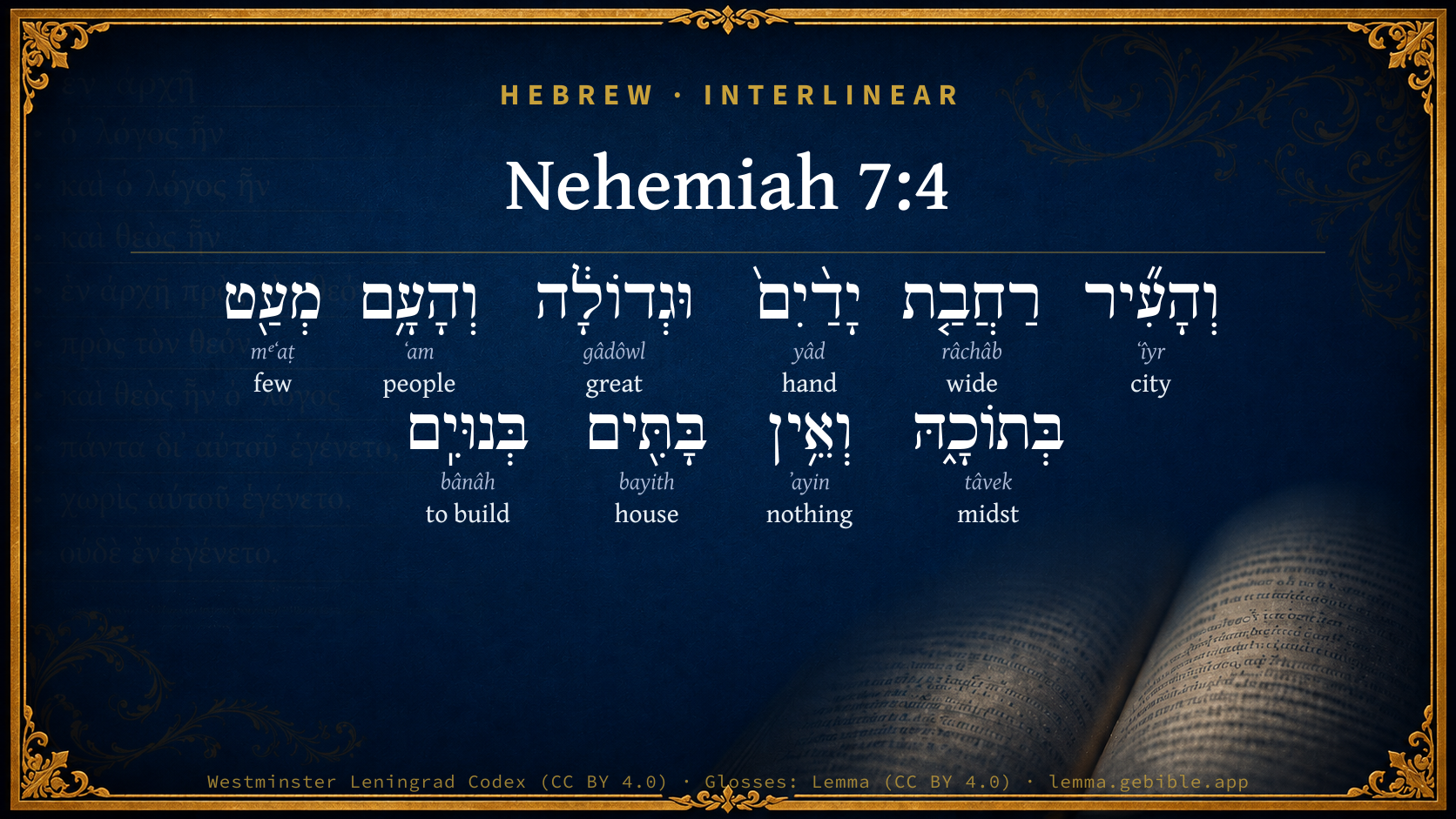
Hebrew (Westminster Leningrad Codex) Nehemiah 7:4 appears in the Hebrew Old Testament. The text above is from the Westminster Leningrad Codex. Each word links to its Strong’s number, a concise gloss, and parsing drawn from the Open Scriptures Hebrew Bible morphology. Click any word for its full Brown-Driver-Briggs (BDB) entry.
Download image
Cite this verse

Nehemiah 7:4 (World English Bible). Public Domain. Lemma interlinear Bible study tool, https://lemma.gebible.app/v/nehemiah/7/4.

Show BibTeX & RIS
BibTeX
RIS
English Translation
Now the city was wide and large; but the people were few therein, and the houses were not built.
World English Bible · Public Domain
Download a study sheet

One document with this verse’s original text, its word-by-word gloss line, the meaning frame, cross-references with their text, attributed commentary, and full source and license credits — printable, and it pastes into notes with its structure intact.

This verse Autodidact and up

Study sheet (.html) Plain text (.txt)

A passage Seminary Student

Up to 50 verses in one chapter. A passage sheet keeps up to 6 commentary sources and 12 cross-references per verse, in the order this page ranks them, and says so on the sheet whenever that leaves anything out. Ask for a single verse and you get the Autodidact verse sheet above.

Everything on this page stays free to read, with no account — the sheet is a download of what is already on screen, not access to it.

Want to remove ads? Support Godless Engineer
Compare translations 3

The same verse in 3 English versions, stacked beneath the original-language interlinear above. Click any original word for its lexicon entry.

Each is an independent rendering of the whole verse — the interlinear is not word-aligned to these translations.

Highlighted words mark where these versions differ — a whole-verse word diff, not a word-by-word alignment.

  • World English Bible Public Domain
    Now the city was wide and large; but the people were few therein, and the houses were not built.
  • King James Version Public Domain
    Now the city was large and great: but the people were few therein, and the houses were not builded.
  • unfoldingWord Literal Text CC BY-SA 4.0
    Now the city was wide on two hands and great, and the people were few in the midst of it. And there were no built houses.

unfoldingWord Literal Text — © unfoldingWord, licensed CC BY-SA 4.0. Word-aligned USFM3 via Door43 (git.door43.org/unfoldingWord/en_ult).

Versions to compare (up to 4)

3 of 4 selected

Show all 18 translations

Every available English version of this verse, each an independent rendering of the whole verse.

  • World English Bible Public Domain
    Now the city was wide and large; but the people were few therein, and the houses were not built.
  • Berean Standard Bible Public Domain
    Now the city was large and spacious, but there were few people in it, and the houses had not yet been rebuilt.
  • Majority Standard Bible Public Domain
    Now the city was large and spacious, but there were few people in it, and the houses had not yet been rebuilt.
  • King James Version Public Domain
    Now the city was large and great: but the people were few therein, and the houses were not builded.
  • American Standard Version (1901) Public Domain
    Now the city was wide and large; but the people were few therein, and the houses were not builded.
  • Revised Version (1885) Public Domain
    Now the city was wide and large: but the people were few therein, and the houses were not builded.
  • Geneva Bible (1599) Public Domain
    Nowe the citie was large and great, but the people were few therein, and the houses were not buylded.
  • Douay-Rheims (1899) Public Domain
    And the city was very wide and great, and the people few in the midst thereof, and the houses were not built.
  • Young's Literal Translation Public Domain
    And the city `is' broad on both sides, and great, and the people `are' few in its midst, and there are no houses builded;
  • Literal Standard Version CC BY-SA 4.0
    And the city [is] broad on both sides, and great, and the people [are] few in its midst, and there are no houses built;
  • Unlocked Literal Bible CC BY-SA 4.0
    Now the city was wide and large, but there were few people within it, and no houses had yet been rebuilt.
  • unfoldingWord Literal Text CC BY-SA 4.0
    Now the city was wide on two hands and great, and the people were few in the midst of it. And there were no built houses.
  • Darby Bible Public Domain
    Now the city was large and great; but the people in it were few, and no houses were built.
  • World Messianic Bible Public Domain
    Now the city was wide and large; but the people were few therein, and the houses were not built.
  • Webster's Bible Public Domain
    Now the city was large and great: but the people in it were few, and the houses were not built.
  • Free Bible Version CC BY-SA 4.0
    In those times the city was large with plenty of space, but there weren't many people in it, and the houses hadn't been rebuilt.
  • Bible in Basic English Public Domain
    Now the town was wide and great: but the people in it were only a small number, and the houses had not been put up.
  • JPS Tanakh (1917) Public Domain
    Now the city was wide and large; but the people were few therein, and the houses were not builded.

Literal Standard Version (2020), Covenant Press — licensed CC BY-SA 4.0. Text via the HelloAO Bible API (eBible.org). Unlocked Literal Bible (unfoldingWord) — licensed CC BY-SA 4.0. Text via the HelloAO Bible API (eBible.org). unfoldingWord Literal Text — © unfoldingWord, licensed CC BY-SA 4.0. Word-aligned USFM3 via Door43 (git.door43.org/unfoldingWord/en_ult). Free Bible Version, Dr. Jonathan Gallagher — licensed CC BY-SA 4.0. Text via the HelloAO Bible API (eBible.org).

Word by word

More ways to search: Search by grammar → Find every occurrence → Compare this word →

Practice this passage: Drill this verse → Learn its vocabulary →

רַחֲבַ֤ת
râchâb
H7342
“wide of”
Adjective, Adjective, Feminine, Singular, Construct
Part of Speech
Adjective
Type
Adjective
Gender
Feminine
Number
Singular
State
Construct
Full BDB Definition

Origin: from H7337

TWOT: 2143c

broad, wide
  1. וְהָעִ֞יר ʻîyr H5892 “and · the · city” Conjunction + Particle, Definite Article + Noun, Common, Feminine, Singular, Absolute
  2. יָדַ֨יִם֙ yâd H3027 “hands” Noun, Common, Both, Dual, Absolute
  3. וּגְדוֹלָ֔ה gâdôwl H1419 “and · great” Conjunction + Adjective, Adjective, Feminine, Singular, Absolute
  4. וְהָעָ֥ם ʻam H5971 “and · the · people” Conjunction + Particle, Definite Article + Noun, Common, Masculine, Singular, Absolute
  5. מְעַ֖ט mᵉʻaṭ H4592 “few” Noun, Common, Masculine, Singular, Absolute
  6. בְּתוֹכָ֑הּ tâvek H8432 “in/at · midst · her” Preposition + Noun, Common, Masculine, Singular, Construct + Suffix, Personal, 3rd Person, Feminine, Singular
  7. וְאֵ֥ין ʼayin H369 “and · nothing” Conjunction + Particle, Negative
  8. בָּתִּ֖ים bayith H1004 “houses” Noun, Common, Masculine, Plural, Absolute
  9. בְּנוּיִֽם bânâh H1129 “built” Verb, Qal, Participle Passive, Masculine, Plural, Absolute

About this verse

These counts appear in no published source. They are computed here, from the morphology-tagged text and Lemma’s own curated glosses. What Lemma adds →

10
words
10
distinct lemmas
Historical
section

Notable vocabulary

The rarest word here is רַחֲבַ֤ת wide H7342 — appearing just 21 times in the whole Hebrew Bible.

Shared distinctive vocabulary

רַחֲבַ֤ת wide H7342 occurs in 21 verses of the Hebrew Bible. Also found in:

Grammatical profile

  • 1 verb
  • 6 nouns
  • 2 adjectives
  • 1 particle

Verb forms

  • בְּנוּיִֽם Qal · Participle Passive

Cross-references

3

Topical passages linked to Nehemiah 7:4 in the Treasury of Scripture Knowledge — connected by theme and wording, ordered by reader-vote popularity; previews shown in the World English Bible.

  • Isaiah 58:12 Those who shall be of you shall build the old waste places; you shall raise up the foundations of many generations; and you shall be called The repairer of the breach, The restorer of paths to dwell in.
  • Haggai 1:4–6 "Is it a time for you yourselves to dwell in your paneled houses, while this house lies waste?
  • Matthew 6:33 But seek first God's Kingdom, and his righteousness; and all these things will be given to you as well.

Cross-references courtesy of OpenBible.info (CC BY 4.0).

Hebrew and Greek witnesses Masoretic Hebrew ↔ Greek Septuagint

The same verse in the two great witnesses to the Old Testament, shown verse-for-verse.

These are two independent witnesses, not word-aligned to each other, and the Septuagint is shown in lemma (dictionary) form.

Hebrew Nehemiah 7:4 Masoretic · Westminster Leningrad Codex

וְהָעִ֞יר רַחֲבַ֤ת יָדַ֨יִם֙ וּגְדוֹלָ֔ה וְהָעָ֥ם מְעַ֖ט בְּתוֹכָ֑הּ וְאֵ֥ין בָּתִּ֖ים בְּנוּיִֽם

Now the city was wide and large; but the people were few therein, and the houses were not built.

World English Bible · Public Domain

Greek LXX Structure differs

The Septuagint has no separate book of Nehemiah. Its Greek text is the second half of Esdras B (2 Esdras), chapters 11–23; Ezra is the first half (1–10).

A verse-for-verse comparison isn’t shown here because the chapters and verses don’t line up. Switch to the LXX edition with the MT / LXX toggle above to read the Greek directly.

Hebrew: Westminster Leningrad Codex (CC BY 4.0). Greek: Septuagint (public domain); English from a public-domain English Septuagint. How the Septuagint differs from the Hebrew →

Commentary

Notes on Nehemiah 7:4 from classic Christian and Jewish commentators (each source and its license shown beneath its notes). The classic Christian expositions comment on the surrounding passage and are grouped to its opening verse, so a note may address several verses; the Jewish commentaries on the Tanakh (Rashi and others) are per-verse, so they appear only where the commentator wrote on this verse.

Lemma curates 59 commentaries, every one of them public domain or Creative Commons licensed, each selected and text-cleaned for this edition rather than reprinted as found. About our sources →

Trapp's Complete Commentary

John Trapp

Neh 7:4 Now the city [was] large and great: but the people [were] few therein, and the houses [were] not builded.

Ver. 4. Now the city was large] Heb. Broad in spans or spaces.

And great] Yet nothing so great as Nineveh was of old; or Babylon then; or Alcair and Quinsay at this day. Of the former Bunting saith, that it is sixty miles in compass. Of the latter, Paulus Venetus (who himself dwelt therein about the year 1260) writeth, that it is a hundred miles about, being of all the cities in the world the greatest. Jerusalem was a great city and spacious, though it fell far short of these.

And the people were few therein] But how exceedingly they multiplied afterwards appeareth by those many thousands of persons there destroyed and carried away by the Romans at the last desolation; as testifieth Josephus, an eyewitness, quem lege, et luge, what he collected and lamented. For present, they were so few that they were not able, without help, to defend the walls in so large a circuit.

And the houses were not builded] All could not be done in a day. But some ceiled houses there were, Hag 1:4, and Nehemiah was all his time busy in building the old waste places, and raising up the foundations of many generations; so that he was worthily called, "The repairer of the breach, The restorer of paths to dwell in," Isa 58:12. Eusebius saith, Nehemiah was twelve years in building the walls; he should have said, the city. Jerome likewise saith, that he came to Jerusalem in the twentieth year of Artaxerxes, and made an end of building the wall and city in the two and thirtieth year; so that, during the whole twelve years of his government, he was in action.

John Trapp, A Commentary or Exposition upon All the Books of the Old and New Testament (1647–1656) — public domain. Text from a community e-Sword module.

Joseph Benson's Commentary

Neh 7:4. The houses were not builded — That is, not all, nor completely built; but only some slight buildings of boards or stones were erected, for the present use of the generality of the people.

Joseph Benson's Commentary on the Old and New Testaments (1811–1818) — public domain. Text from a community e-Sword module.

Whedon's Commentary on the Bible

Daniel D. Whedon

GENEALOGICAL REGISTRY OF THE PEOPLE, Neh_7:4-73.

4. The city was large — Broad-sided, extensive; so that it required many watchers to keep guard on every side.

The people were few therein — That is, comparatively few, and far from sufficient to occupy the great space enclosed by the walls.

And the houses… not builded — That is, the majority of the houses of the ancient city were fallen in ruins, and comparatively few had been fitted up for the present use of the returned exiles.

Daniel D. Whedon (gen. ed.), Commentary on the Old and New Testaments (1874–1909) — public domain. Text from a community e-Sword module.

Tyndale Open Study Notes

Tyndale Open Resources

7:4-5 Most people lived in the country near their fields, so the population of Jerusalem was small. Apparently, a registration would encourage more people to settle in and near Jerusalem (7:73).

Tyndale Open Study Notes — © Tyndale Open Resources, licensed CC BY-SA 4.0. Text via the HelloAO Bible API.

Jamieson, Fausset & Brown

Robert Jamieson, A. R. Fausset & David Brown

Now the city was large and great--The walls being evidently built on the old foundations, the city covered a large extent of surface, as all Oriental towns do, the houses standing apart with gardens and orchards intervening. This extent, in the then state of Jerusalem, was the more observable as the population was comparatively small, and the habitations of the most rude and simple construction--mere wooden sheds or coverings of loose, unmortared stones.

Jamieson, Fausset & Brown — Commentary Critical and Explanatory on the Whole Bible (1871) — public domain (CC PDM 1.0). Text via the HelloAO Bible API.

Adam Clarke's Commentary

Verse 4. The houses were not builded.] The city was not yet rebuilt, only a row of houses in the inside of the wall all round.

Adam Clarke's Commentary on the Bible (1810–1826) — public domain. Text from a community e-Sword/MySword module.

The Cambridge Bible for Schools and Colleges

gen. ed. J. J. S. Perowne

4. large and great] R.V. wide and large. The phrase rendered ‘wide’ (cf. Gen_34:21; Jdg_18:10) denotes extension on every side; its literal rendering would be ‘wide on both hands.’

the people were few] The inhabitants of Jerusalem were in Nehemiah’s time very few in comparison with what they had been before the captivity, see Neh_11:1-2. The number of Jews that had returned with Zerubbabel had been 42360 (Ezr_2:64; Neh_7:66). With Ezra there had come rather more than 1500 (Ezr_8:1-20). Others had come from time to time. But of the whole number of 50,000 or so, a very large proportion were settled in the country and towns in the neighbourhood, as appears from Neh_7:73, Neh_11:25-36, Neh_12:27-29.

the houses were not builded] An expression that cannot be understood literally. The meaning is, there were large open spaces within the walls unoccupied.

The Cambridge Bible for Schools and Colleges (gen. ed. J. J. S. Perowne; Cambridge University Press, 1878–1918) — public domain. Text from a community e-Sword module.

John Gill's Exposition

Now the city was large and great,.... The circumference of it, all within the wall; for that was built on its old foundation, and enclosed as much ground as ever it did: Hecataeus (b), an Heathen writer, says the circumference of Jerusalem was fifty furlongs, which was more than six miles; but Josephus (c) makes the circuit of it but thirty three furlongs or about six miles:

but the people were few therein; in comparison of the largeness of the place; for though there were 42,360 that came up at first with Zerubbabel, and many more with Ezra, yet a great number chose to settle in the towns and cities in the country, Jerusalem being in such a desolate condition:

and the houses were not builded; some were, but they were but few, many of them still lay in ruins.

(b) Apud Euseb. Praepar. par. Evangel. l. 9. c. 4. p. 408. & apud Joseph. contr. Apion, l. 1. c. 22. (c) De Bell. Jud. l. 5. c. 4. sect. 3.

John Gill's Exposition of the Whole Bible (1746–1763) — public domain (CC PDM 1.0). Text via the HelloAO Bible API.

Albert Barnes' Notes on the Bible

The people were few - The number of those who returned with Zerubbabel was no more than 42,360 Neh 7:66. Less than 2,000 people had come with Ezra Ezra 8:1-20.

Albert Barnes' Notes on the Bible (1834–1885) — public domain. Text from a community e-Sword/MySword module.

Haydock's Catholic Bible Commentary

Not built, sufficient for so great a multitude. (Calmet) --- They lodged under tents, or in huts. (Haydock)

George Leo Haydock (1774–1849), Haydock's Catholic Family Bible and Commentary, 1859 edition — public domain. Excludes Psalms (Douay-Rheims chapter numbering differs from Protestant) and Deuterocanonical books (Catholic canon only).

Matthew Poole's English Annotations

i.e. Not all, nor completely built; but only some slight buildings of boards or stones were made for the present use of the generality of the people.

Matthew Poole's English Annotations on the Holy Bible (1683–1685) — public domain. Text from a community e-Sword/MySword module.

The Pulpit Commentary

The city was large. Literally, "broad every way." The houses were not builded. Much of the city consisted of open spaces, in which no houses had been as yet built.

The Pulpit Commentary (1880–1919), ed. H.D.M. Spence-Jones & Joseph S. Exell — public domain. Text from a community e-Sword module.

Rashi

Rabbi Shlomo Yitzchaki (Rashi)

a wide place Heb. רַחֲבַת יָדַיִם, a wide and large place.

Rashi on the Tanakh — English translations: “The Judaica Press complete Tanach with Rashi, translated by A. J. Rosenberg” (CC BY 4.0); “Pentateuch with Rashi's commentary by M. Rosenbaum and A.M. Silbermann, 1929-1934” (public domain); “The Metsudah Tanach series, Lakewood, N.J” (CC BY 4.0); and “The Book of Joshua, Metsudah Publications, 1997” (CC BY 4.0). Text via Sefaria.

Lesson kit

Teaching starters — assembled from the data on this page, not authored interpretation. Every prompt links to the verse data it draws on. Edit before teaching.

Nehemiah, in the Historical, opens this verse with 10 words (10 distinct Hebrew lemmas). Its most distinctive word is râchâb (“wide”). A historical commentator’s framing appears above. Read the whole chapter for the surrounding context.

Discussion questions

  1. How does “wide” (râchâb) shape what this verse is saying?
  2. Genesis 34:21 shares the word «wide» with this verse. How do the two illuminate each other?
  3. These translations render this verse differently; the difference is in the English rendering, not the original. What questions does that raise?
  4. The verb «בְּנוּיִֽם» is Qal Participle Passive. How does its form color the action?
  5. Reading how Trapp's Complete Commentary and Joseph Benson's Commentary read this verse, where do the two commentators agree and where do they part?

Things to notice

Reading settings

Reading text

Shown beneath each verse's original-language words.

Old Testament
Old Testament edition

Read the OT as the Masoretic Hebrew (MT) or the Greek Septuagint (LXX).

English shown for the Greek Septuagint (in the Hebrew ↔ Greek comparison).

Comparing translations? Open the Compare panel on any verse page to stack up to four side by side.