
Judges 9:51

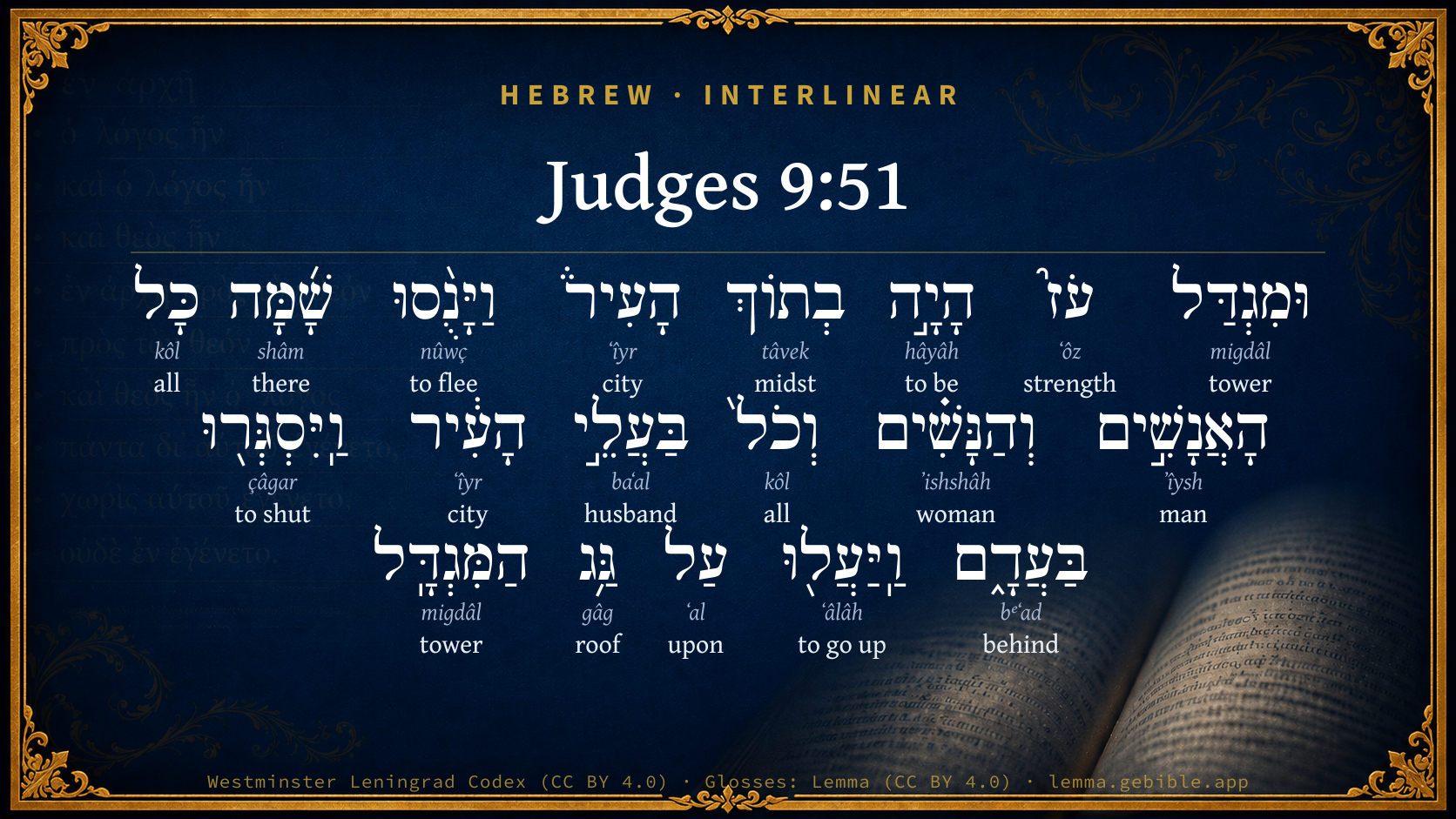
Hebrew (Westminster Leningrad Codex) Judges 9:51 appears in the Hebrew Old Testament. The text above is from the Westminster Leningrad Codex. Each word links to its Strong’s number, a concise gloss, and parsing drawn from the Open Scriptures Hebrew Bible morphology. Click any word for its full Brown-Driver-Briggs (BDB) entry.
Download image
Cite this verse

Judges 9:51 (World English Bible). Public Domain. Lemma interlinear Bible study tool, https://lemma.gebible.app/v/judges/9/51.

Show BibTeX & RIS
BibTeX
RIS
English Translation
But there was a strong tower within the city, and there fled all the men and women, and all they of the city, and shut themselves in, and got them up to the roof of the tower.
World English Bible · Public Domain
Download a study sheet

One document with this verse’s original text, its word-by-word gloss line, the meaning frame, cross-references with their text, attributed commentary, and full source and license credits — printable, and it pastes into notes with its structure intact.

This verse Autodidact and up

Study sheet (.html) Plain text (.txt)

A passage Seminary Student

Up to 50 verses in one chapter. A passage sheet keeps up to 6 commentary sources and 12 cross-references per verse, in the order this page ranks them, and says so on the sheet whenever that leaves anything out. Ask for a single verse and you get the Autodidact verse sheet above.

Everything on this page stays free to read, with no account — the sheet is a download of what is already on screen, not access to it.

Want to remove ads? Support Godless Engineer
Compare translations 3

The same verse in 3 English versions, stacked beneath the original-language interlinear above. Click any original word for its lexicon entry.

Each is an independent rendering of the whole verse — the interlinear is not word-aligned to these translations.

Highlighted words mark where these versions differ — a whole-verse word diff, not a word-by-word alignment.

  • World English Bible Public Domain
    But there was a strong tower within the city, and there fled all the men and women, and all they of the city, and shut themselves in, and got them up to the roof of the tower.
  • King James Version Public Domain
    But there was a strong tower within the city, and thither fled all the men and women, and all they of the city, and shut it to them, and gat them up to the top of the tower.
  • unfoldingWord Literal Text CC BY-SA 4.0
    But a strong tower was in the midst of the city, and all of the men and women and all of the lords of the city fled there. And they closed behind them and went up onto the roof of the tower.

unfoldingWord Literal Text — © unfoldingWord, licensed CC BY-SA 4.0. Word-aligned USFM3 via Door43 (git.door43.org/unfoldingWord/en_ult).

Versions to compare (up to 4)

3 of 4 selected

Show all 18 translations

Every available English version of this verse, each an independent rendering of the whole verse.

  • World English Bible Public Domain
    But there was a strong tower within the city, and there fled all the men and women, and all they of the city, and shut themselves in, and got them up to the roof of the tower.
  • Berean Standard Bible Public Domain
    But there was a strong tower inside the city, and all the men, women, and leaders of the city fled there. They locked themselves in and went up to the roof of the tower.
  • Majority Standard Bible Public Domain
    But there was a strong tower inside the city, and all the men, women, and leaders of the city fled there. They locked themselves in and went up to the roof of the tower.
  • King James Version Public Domain
    But there was a strong tower within the city, and thither fled all the men and women, and all they of the city, and shut it to them, and gat them up to the top of the tower.
  • American Standard Version (1901) Public Domain
    But there was a strong tower within the city, and thither fled all the men and women, and all they of the city, and shut themselves in, and gat them up to the roof of the tower.
  • Revised Version (1885) Public Domain
    But there was a strong tower within the city, and thither fled all the men and women, and all they of the city, and shut themselves in, and gat them up to the roof of the tower.
  • Geneva Bible (1599) Public Domain
    But there was a strong towre within the citie, and thither fledde all the men and women, and all the chiefe of the citie, and shut it to them, and went vp to the toppe of the towre.
  • Douay-Rheims (1899) Public Domain
    And there was in the midst of the city a high tower, to which both the men and the women were fled together, and all the princes of the city, and having shut and strongly barred the gate, they stood upon the battlements of the tower to defend themselves.
  • Young's Literal Translation Public Domain
    and a strong tower hath been in the midst of the city, and thither flee do all the men and the women, and all the masters of the city, and they shut `it' behind them, and go up on the roof of the tower.
  • Literal Standard Version CC BY-SA 4.0
    and a strong tower has been in the midst of the city, and all the men and the women flee there, and all the masters of the city, and they shut [it] behind them, and go up on the roof of the tower.
  • Unlocked Literal Bible CC BY-SA 4.0
    But there was a strong tower in the city, and all the men and women and all the leaders of the city fled to it and shut themselves in. Then they went up to the roof of the tower.
  • unfoldingWord Literal Text CC BY-SA 4.0
    But a strong tower was in the midst of the city, and all of the men and women and all of the lords of the city fled there. And they closed behind them and went up onto the roof of the tower.
  • Darby Bible Public Domain
    But there was a strong tower within the city, and all the people of the city fled to it, all the men and women, and shut themselves in; and they went to the roof of the tower.
  • World Messianic Bible Public Domain
    But there was a strong tower within the city, and all the men and women of the city fled there, and shut themselves in, and went up to the roof of the tower.
  • Webster's Bible Public Domain
    But there was a strong tower within the city, and thither fled all the men and women, and all they of the city, and shut it after them, and ascended to the top of the tower.
  • Free Bible Version CC BY-SA 4.0
    But there was a strong tower inside the city. All the men and women and the town leaders ran there and barricaded themselves in, and then went up to the roof of the tower.
  • Bible in Basic English Public Domain
    But in the middle of the town there was a strong tower, to which all the men and women of the town went in flight and, shutting themselves in, went up to the roof of the tower.
  • JPS Tanakh (1917) Public Domain
    But there was a strong tower within the city, and thither fled all the men and women, even all they of the city, and shut themselves in, and got them up to the roof of the tower.

Literal Standard Version (2020), Covenant Press — licensed CC BY-SA 4.0. Text via the HelloAO Bible API (eBible.org). Unlocked Literal Bible (unfoldingWord) — licensed CC BY-SA 4.0. Text via the HelloAO Bible API (eBible.org). unfoldingWord Literal Text — © unfoldingWord, licensed CC BY-SA 4.0. Word-aligned USFM3 via Door43 (git.door43.org/unfoldingWord/en_ult). Free Bible Version, Dr. Jonathan Gallagher — licensed CC BY-SA 4.0. Text via the HelloAO Bible API (eBible.org).

Word by word

More ways to search: Search by grammar → Find every occurrence → Compare this word →

Practice this passage: Drill this verse → Learn its vocabulary →

גַּ֥ג
gâg
H1406
“roof of”
Noun, Common, Masculine, Singular, Construct
Part of Speech
Noun
Type
Common
Gender
Masculine
Number
Singular
State
Construct
Full BDB Definition

Origin: probably by reduplication from H1342

TWOT: 312

roof, top, housetop - roof (of house) - top (of altar of incense)
  1. וּמִגְדַּל migdâl H4026 “and · tower of” Conjunction + Noun, Common, Both, Singular, Construct
  2. עֹז֮ ʻôz H5797 “strength” Noun, Common, Masculine, Singular, Absolute
  3. הָיָ֣ה hâyâh H1961 “to be” Verb, Qal, Perfect, 3rd Person, Masculine, Singular
  4. בְתוֹךְ tâvek H8432 “in/at · midst of” Preposition + Noun, Common, Masculine, Singular, Construct
  5. הָעִיר֒ ʻîyr H5892 “the · city” Particle, Definite Article + Noun, Common, Feminine, Singular, Absolute
  6. וַיָּנֻ֨סוּ nûwç H5127 “and · to flee” Conjunction + Verb, Qal, Sequential Imperfect, 3rd Person, Masculine, Plural
  7. שָׁ֜מָּה shâm H8033 “there · toward” Adverb + Suffix, Demonstrative
  8. כָּל kôl H3605 “all of” Noun, Common, Masculine, Singular, Construct
  9. הָאֲנָשִׁ֣ים ʼîysh H376 “the · men” Particle, Definite Article + Noun, Common, Masculine, Plural, Absolute
  10. וְהַנָּשִׁ֗ים ʼishshâh H802 “and · the · women” Conjunction + Particle, Definite Article + Noun, Common, Feminine, Plural, Absolute
  11. וְכֹל֙ kôl H3605 “and · all of” Conjunction + Noun, Common, Masculine, Singular, Construct
  12. בַּעֲלֵ֣י baʻal H1167 “husbands of” Noun, Common, Masculine, Plural, Construct
  13. הָעִ֔יר ʻîyr H5892 “the · city” Particle, Definite Article + Noun, Common, Feminine, Singular, Absolute
  14. וַֽיִּסְגְּר֖וּ çâgar H5462 “and · to shut” Conjunction + Verb, Qal, Sequential Imperfect, 3rd Person, Masculine, Plural
  15. בַּעֲדָ֑ם bᵉʻad H1157 “behind · them” Preposition + Suffix, Personal, 3rd Person, Masculine, Plural
  16. וַֽיַּעֲל֖וּ ʻâlâh H5927 “and · to go up” Conjunction + Verb, Qal, Sequential Imperfect, 3rd Person, Masculine, Plural
  17. עַל ʻal H5921 “upon” Preposition
  18. הַמִּגְדָּֽל migdâl H4026 “the · tower” Particle, Definite Article + Noun, Common, Both, Singular, Absolute

About this verse

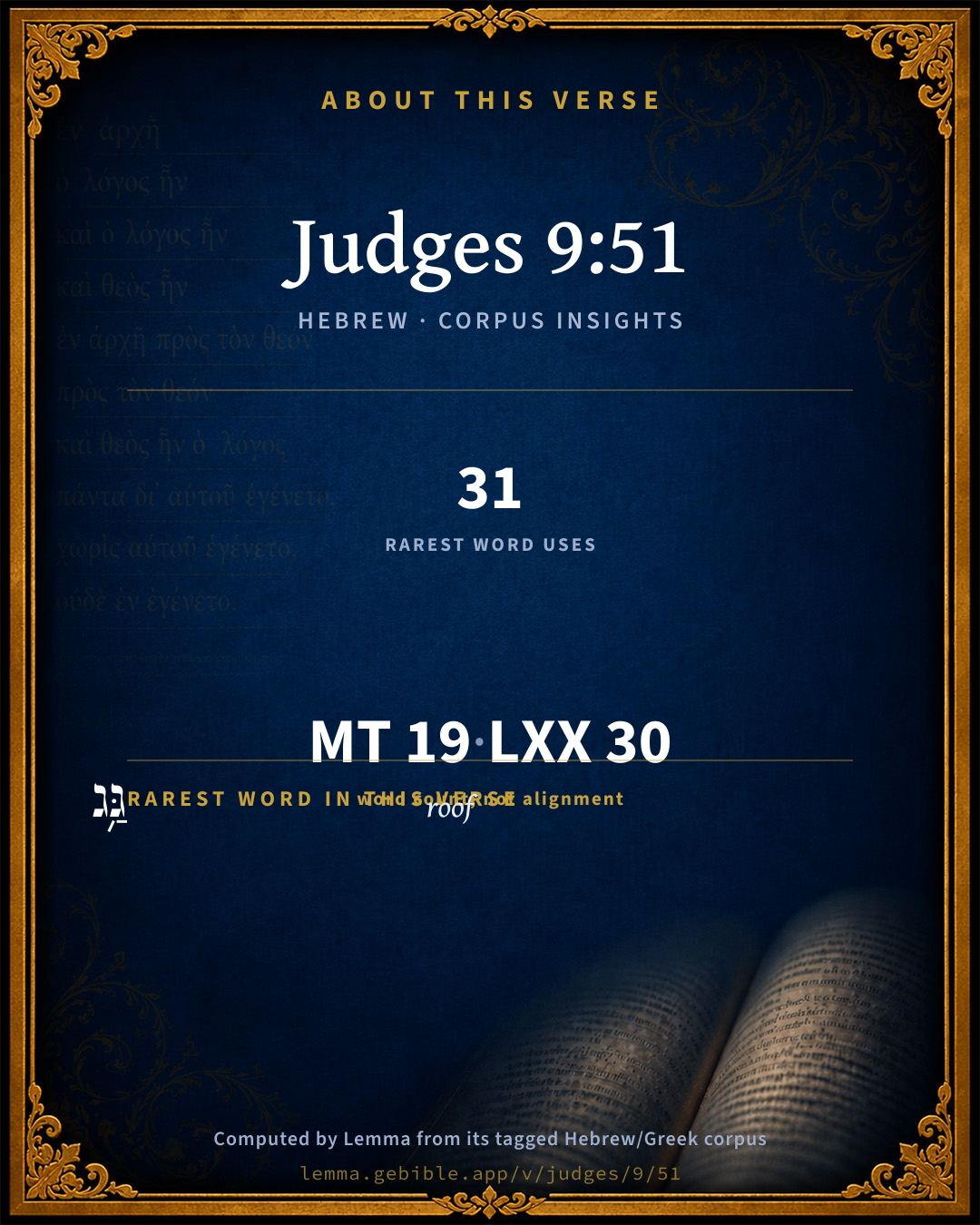
These counts appear in no published source. They are computed here, from the morphology-tagged text and Lemma’s own curated glosses. What Lemma adds →

19
words
16
distinct lemmas
Historical
section

Shared distinctive vocabulary

גַּ֥ג roof H1406 occurs in 27 verses of the Hebrew Bible. Also found in:

Grammatical profile

  • 4 verbs
  • 12 nouns
  • 2 prepositions
  • 1 adverb

Verb forms

  • הָיָ֣ה Qal · Perfect
  • וַיָּנֻ֨סוּ Qal · Sequential Imperfect
  • וַֽיִּסְגְּר֖וּ Qal · Sequential Imperfect
  • וַֽיַּעֲל֖וּ Qal · Sequential Imperfect

Repetition

Words recur within this verse — often emphatic in Hebrew:

  • וּמִגְדַּל tower H4026 ×2
  • הָעִיר֒ city H5892 ×2
  • כָּל all H3605 ×2

Hebrew & Septuagint length

In English translation the verse runs 37 words from the Hebrew and 39 from the Septuagint (LXX English) — closely comparable.

A rough comparison of the two English renderings, which tokenize alike — not a word-level alignment.

Word counts can differ between the Hebrew and the Greek without any difference in meaning — e.g. the Hebrew direct-object marker אֵת has no separate Greek word, and Greek often adds the article ὁ.

In the original languages it is 19 Hebrew tokens and 30 Greek tokens — but the two are counted differently (Hebrew bundles its prefixes and suffixes into one token; the Greek is in lemma form), so that isn’t a like-for-like length.

Hebrew and Greek witnesses Masoretic Hebrew ↔ Greek Septuagint

The same verse in the two great witnesses to the Old Testament, shown verse-for-verse.

These are two independent witnesses, not word-aligned to each other, and the Septuagint is shown in lemma (dictionary) form.

Hebrew Judges 9:51 Masoretic · Westminster Leningrad Codex

וּמִגְדַּל עֹז֮ הָיָ֣ה בְתוֹךְ הָעִיר֒ וַיָּנֻ֨סוּ שָׁ֜מָּה כָּל הָאֲנָשִׁ֣ים וְהַנָּשִׁ֗ים וְכֹל֙ בַּעֲלֵ֣י הָעִ֔יר וַֽיִּסְגְּר֖וּ בַּעֲדָ֑ם וַֽיַּעֲל֖וּ עַל גַּ֥ג הַמִּגְדָּֽל

But there was a strong tower within the city, and there fled all the men and women, and all they of the city, and shut themselves in, and got them up to the roof of the tower.

World English Bible · Public Domain

Greek LXX Judges 9:51 Septuagint · lemma form

καί πύργος ἰσχυρός εἰμί ἐν μέσος ὁ πόλις καί φεύγω ἐκεῖ πᾶς ὁ ἀνήρ καί ὁ γυνή ὁ πόλις καί κλείω ἔξωθεν αὐτός καί ἀναβαίνω ἐπί ὁ δῶμα ὁ πύργος

And there was a strong tower in the midst of the city; and there all the men and the women of the city fled, and shut the door without them, and went up on the roof of the tower.

LXX2012 (modern English Septuagint) · Public Domain

Hebrew: Westminster Leningrad Codex (CC BY 4.0). Greek: Septuagint (public domain); English from LXX2012 (modern English Septuagint) (Public Domain). How the Septuagint differs from the Hebrew →

Targum (Aramaic paraphrase)

1

The Targum is the ancient Jewish Aramaic paraphrase of the Hebrew Scriptures — an interpretive translation, not the Hebrew text itself. Onkelos (literal) and Pseudo-Jonathan (expansive) render the Torah, and Jonathan the Prophets. Coverage is partial: where no permissively-licensed English translation exists for a verse, only the Aramaic is shown. This is verse-level text, not a word-by-word alignment to the Hebrew.

  1. Targum Jonathan Prophets (Joshua–Malachi)
    וּמִגְדַל תַּקִיף הֲוָה בְּגוֹ קַרְתָּא וְאַפִיכוּ לְתַמָן כָּל גַבְרַיָא וּנְשַׁיָא וְכָל יַתְבֵי קַרְתָּא וְאַגִיפוּ בְּאַפֵּיהוֹן וּסְלִיקוּ עַל אִגַר מִגְדָלָא:

    (no public-domain English translation for this verse)

    Targum Jonathan — Aramaic: “Mikraot Gedolot” (public domain). English: “Sefaria Community Translation” (CC0 1.0 (public-domain dedication)); “London "Chaldee Paraphrase," 1871” (public domain). Text via Sefaria.

Commentary

Notes on Judges 9:51 from classic Christian and Jewish commentators (each source and its license shown beneath its notes). The classic Christian expositions comment on the surrounding passage and are grouped to its opening verse, so a note may address several verses; the Jewish commentaries on the Tanakh (Rashi and others) are per-verse, so they appear only where the commentator wrote on this verse.

Lemma curates 59 commentaries, every one of them public domain or Creative Commons licensed, each selected and text-cleaned for this edition rather than reprinted as found. About our sources →

Trapp's Complete Commentary

John Trapp

Jdg 9:51 But there was a strong tower within the city, and thither fled all the men and women, and all they of the city, and shut [it] to them, and gat them up to the top of the tower.

Ver. 51. Thither fled all the men and women.] As all creatures in times of danger run to their refuges. {Pro 30:26; Pro 18:11 Psa 104:18 Dan 4:10-11}

John Trapp, A Commentary or Exposition upon All the Books of the Old and New Testament (1647–1656) — public domain. Text from a community e-Sword module.

Jamieson, Fausset & Brown

Robert Jamieson, A. R. Fausset & David Brown

all the men and women, . . . gat them up to the top of the tower--The Canaanite forts were generally mountain fastnesses or keeps, and they often had a strong tower which served as a last refuge. The Assyrian bas-reliefs afford counterparts of the scene here described so vivid and exact, that we might almost suppose them to be representations of the same historic events. The besieged city--the strong tower within--the men and women crowding its battlements--the fire applied to the doors, and even the huge fragments of stone dropping from the hands of one of the garrison on the heads of the assailants, are all well represented to the life--just as they are here described in the narrative of inspired truth [GOSS].

Next: Judges Chapter 10

Jamieson, Fausset & Brown — Commentary Critical and Explanatory on the Whole Bible (1871) — public domain (CC PDM 1.0). Text via the HelloAO Bible API.

Ellicott's Commentary for English Readers

(51) There was a strong tower within the city.—This constant mention of towers and strongholds (Jdg_8:9, &c.) shows the disturbed state of the country, which probably resembled the state of England in the days of King Stephen.

To the top of the tower.—“Standing about the battlements upon the roof of the tower” (Vulg.).

A Bible Commentary for English Readers, edited by Charles John Ellicott (1878–1897) — public domain. Text from a community e-Sword module.

The Cambridge Bible for Schools and Colleges

gen. ed. J. J. S. Perowne

51. and all they of the city] (even) all the citizens of the city, the same word as that translated men in Jdg_9:2 (see note), Jdg_9:23; Jdg_9:26 etc.; and should be omitted, unless citizens means ‘the chief men,’ which is not the case elsewhere in this chapter.

The Cambridge Bible for Schools and Colleges (gen. ed. J. J. S. Perowne; Cambridge University Press, 1878–1918) — public domain. Text from a community e-Sword module.

John Gill's Exposition

And Abimelech came unto the tower,.... With his army to besiege it:

and fought against it; using all the methods he could to oblige those in it to surrender:

and went hard unto the door of the tower to burn it with fire; in order to get entrance into it; and perhaps the tower was built of stone, so that no other part could be set fire to; and to do this he drew near to the door himself, for nothing more is meant by the phrase, "went hard", than drawing near in his own person to the door; hazarding his life in the enterprise, being so bent upon it, thinking to do by this tower what he had done to the hold of the temple of Baalberith.

John Gill's Exposition of the Whole Bible (1746–1763) — public domain (CC PDM 1.0). Text via the HelloAO Bible API.

Haydock's Catholic Bible Commentary

Battlements, or roof of the tower, which was flat. Hence the defendants hurled down stones, &c., upon the enemy.

George Leo Haydock (1774–1849), Haydock's Catholic Family Bible and Commentary, 1859 edition — public domain. Excludes Psalms (Douay-Rheims chapter numbering differs from Protestant) and Deuterocanonical books (Catholic canon only).

Matthew Poole's English Annotations

All the men and women; all that were not slain in the taking of the town; or they all forsook the town, and retired to their strong hold.

The top of the tower was flat and plain, after their manner of building.

Matthew Poole's English Annotations on the Holy Bible (1683–1685) — public domain. Text from a community e-Sword/MySword module.

Whedon's Commentary on the Bible

Daniel D. Whedon

51. A strong tower within the city — Unwalled cities and villages were often provided with such a strong tower or castle, to which the inhabitants resorted in time of danger. Walled cities, too, sometimes had a tower built in the wall.

Daniel D. Whedon (gen. ed.), Commentary on the Old and New Testaments (1874–1909) — public domain. Text from a community e-Sword module.

The Pulpit Commentary

They of the city. In Hebrew (baaley) the men of the city, i.e. the owners or citizens, the same phrase as is used throughout the chapter of the men of Shechem. (cf. Jos_24:11 1Sa_23:11, 1Sa_23:12) The English phrase master, or my masters, is very similar. The A.V has here paraphrased it they of the city, to avoid the repetition of the word men. The top the flat roof or house-top.

The Pulpit Commentary (1880–1919), ed. H.D.M. Spence-Jones & Joseph S. Exell — public domain. Text from a community e-Sword module.

John Wesley's Explanatory Notes

And all - All that were not slain in the taking of the town. Top of the tower - Which was flat and plain, after their manner of building.

John Wesley, Explanatory Notes Upon the Whole Bible (1754–1765) — public domain. Text via the GEBible commentary corpus.

Lesson kit

Teaching starters — assembled from the data on this page, not authored interpretation. Every prompt links to the verse data it draws on. Edit before teaching.

Judges, in the Historical, opens this verse with 19 words (16 distinct Hebrew lemmas). Its most distinctive word is gâg (“roof”). A historical commentator’s framing appears above. Read the whole chapter for the surrounding context.

Discussion questions

  1. How does “roof” (gâg) shape what this verse is saying?
  2. How does Exodus 30:3, which shares the word «roof», read alongside this verse?
  3. What does the repetition of “tower” (2× in this one verse) do in this verse?
  4. These translations render this verse differently. What is at stake in choosing one wording over another?
  5. «הָיָ֣ה» is a Qal Perfect verb. How does that grammatical form shape the action described?
  6. Compare how Trapp's Complete Commentary and Jamieson, Fausset & Brown read this verse. Where do they agree or differ?

Things to notice

Reading settings

Reading text

Shown beneath each verse's original-language words.

Old Testament
Old Testament edition

Read the OT as the Masoretic Hebrew (MT) or the Greek Septuagint (LXX).

English shown for the Greek Septuagint (in the Hebrew ↔ Greek comparison).

Comparing translations? Open the Compare panel on any verse page to stack up to four side by side.