
Numbers 35:15

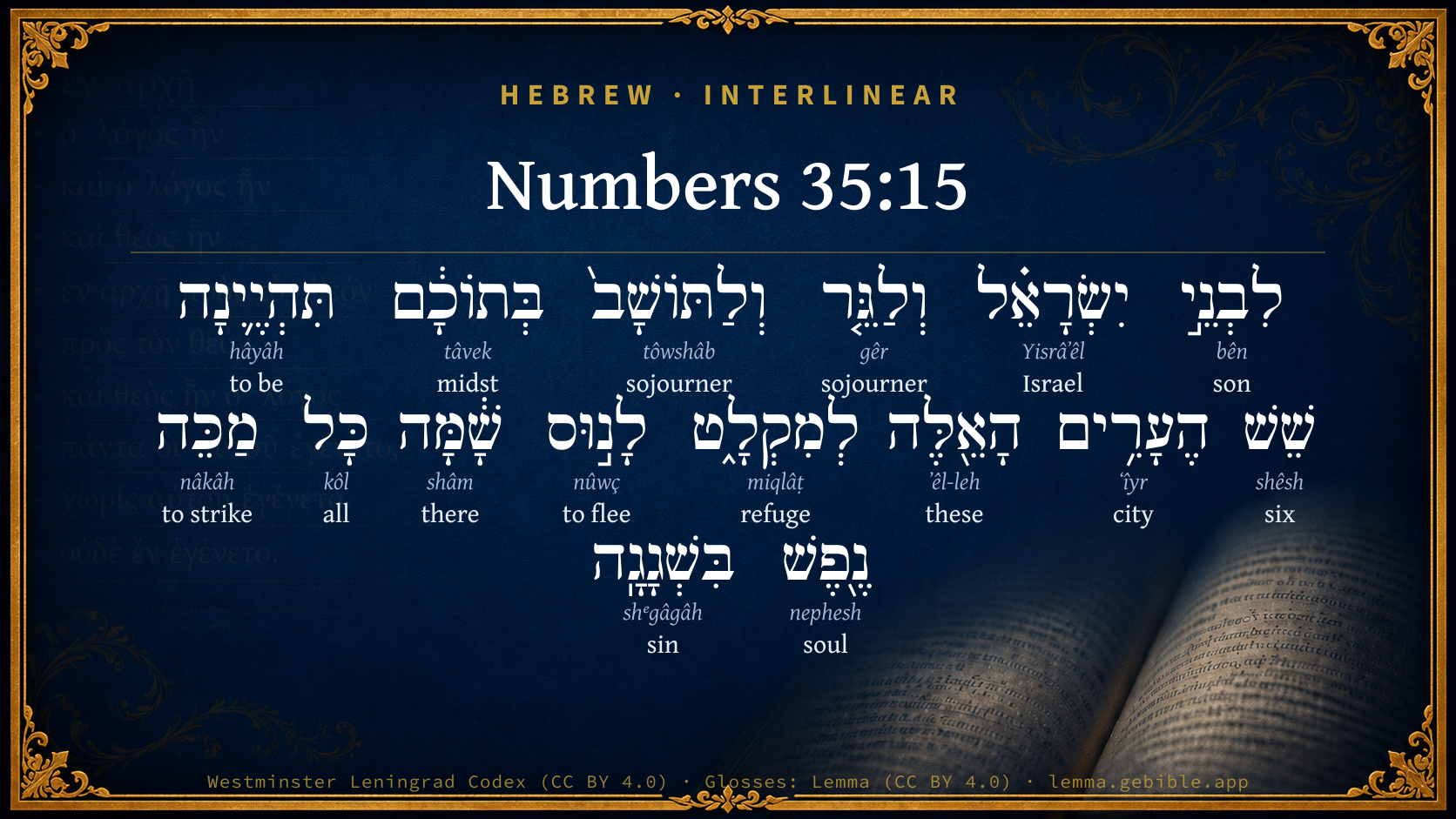
Hebrew (Westminster Leningrad Codex) Numbers 35:15 appears in the Hebrew Old Testament. The text above is from the Westminster Leningrad Codex. Each word links to its Strong’s number, a concise gloss, and parsing drawn from the Open Scriptures Hebrew Bible morphology. Click any word for its full Brown-Driver-Briggs (BDB) entry.
Download image
Cite this verse

Numbers 35:15 (World English Bible). Public Domain. Lemma interlinear Bible study tool, https://lemma.gebible.app/v/numbers/35/15.

Show BibTeX & RIS
BibTeX
RIS
English Translation
For the children of Israel, and for the stranger and for the foreigner living among them, shall these six cities be for refuge; that everyone who kills any person unwittingly may flee there.
World English Bible · Public Domain
Download a study sheet

One document with this verse’s original text, its word-by-word gloss line, the meaning frame, cross-references with their text, attributed commentary, and full source and license credits — printable, and it pastes into notes with its structure intact.

This verse Autodidact and up

Study sheet (.html) Plain text (.txt)

A passage Seminary Student

Up to 50 verses in one chapter. A passage sheet keeps up to 6 commentary sources and 12 cross-references per verse, in the order this page ranks them, and says so on the sheet whenever that leaves anything out. Ask for a single verse and you get the Autodidact verse sheet above.

Everything on this page stays free to read, with no account — the sheet is a download of what is already on screen, not access to it.

Want to remove ads? Support Godless Engineer
Compare translations 3

The same verse in 3 English versions, stacked beneath the original-language interlinear above. Click any original word for its lexicon entry.

Each is an independent rendering of the whole verse — the interlinear is not word-aligned to these translations.

Highlighted words mark where these versions differ — a whole-verse word diff, not a word-by-word alignment.

  • World English Bible Public Domain
    For the children of Israel, and for the stranger and for the foreigner living among them, shall these six cities be for refuge; that everyone who kills any person unwittingly may flee there.
  • King James Version Public Domain
    These six cities shall be a refuge, both for the children of Israel, and for the stranger, and for the sojourner among them: that every one that killeth any person unawares may flee thither.
  • unfoldingWord Literal Text CC BY-SA 4.0
    For the sons of Israel, and for the sojourner, and for the temporary dweller in your midst, these six cities shall be for refuge to flee to, every one who has struck down a person by mistake.

unfoldingWord Literal Text — © unfoldingWord, licensed CC BY-SA 4.0. Word-aligned USFM3 via Door43 (git.door43.org/unfoldingWord/en_ult).

Versions to compare (up to 4)

3 of 4 selected

Show all 18 translations

Every available English version of this verse, each an independent rendering of the whole verse.

  • World English Bible Public Domain
    For the children of Israel, and for the stranger and for the foreigner living among them, shall these six cities be for refuge; that everyone who kills any person unwittingly may flee there.
  • Berean Standard Bible Public Domain
    These six cities will serve as a refuge for the Israelites and for the foreigner or stranger among them, so that anyone who kills a person unintentionally may flee there.
  • Majority Standard Bible Public Domain
    These six cities will serve as a refuge for the Israelites and for the foreigner or stranger among them, so that anyone who kills a person unintentionally may flee there.
  • King James Version Public Domain
    These six cities shall be a refuge, both for the children of Israel, and for the stranger, and for the sojourner among them: that every one that killeth any person unawares may flee thither.
  • American Standard Version (1901) Public Domain
    For the children of Israel, and for the stranger and for the sojourner among them, shall these six cities be for refuge; that every one that killeth any person unwittingly may flee thither.
  • Revised Version (1885) Public Domain
    For the children of Israel, and for the stranger and for the sojourner among them, shall these six cities be for refuge: that every one that killeth any person unwittingly may flee thither.
  • Geneva Bible (1599) Public Domain
    These six cities shalbe a refuge for the children of Israel, and for the stranger, and for him that dwelleth among you, that euery one which killeth any person vnwares, may flee thither.
  • Douay-Rheims (1899) Public Domain
    As well for the children of Israel as for strangers and sojourners, that he may flee to them, who hath shed blood against his will.
  • Young's Literal Translation Public Domain
    To sons of Israel, and to a sojourner, and to a settler in their midst, are these six cities for a refuge, for the fleeing thither of any one smiting a person unawares.
  • Literal Standard Version CC BY-SA 4.0
    For sons of Israel, and for a sojourner, and for a settler in their midst, are these six cities for a refuge, for the fleeing there of anyone striking a person through ignorance.
  • Unlocked Literal Bible CC BY-SA 4.0
    For the people of Israel, for the foreigners, for anyone living among you, these six cities will serve as a refuge to which anyone who kills someone unintentionally can flee.
  • unfoldingWord Literal Text CC BY-SA 4.0
    For the sons of Israel, and for the sojourner, and for the temporary dweller in your midst, these six cities shall be for refuge to flee to, every one who has struck down a person by mistake.
  • Darby Bible Public Domain
    For the children of Israel, and for the stranger, and for the sojourner among them shall these six cities be a refuge, that one who smiteth a person mortally without intent may flee thither.
  • World Messianic Bible Public Domain
    These six cities shall be refuge for the children of Israel, for the stranger, and for the foreigner living among them, that everyone who kills any person unwittingly may flee there.
  • Webster's Bible Public Domain
    These six cities shall be a refuge, both for the children of Israel, and for the stranger, and for the sojourner among them: that every one that killeth any person unawares may flee thither.
  • Free Bible Version CC BY-SA 4.0
    These six cities will be places of sanctuary for the Israelites and for foreigners or settlers among them, so that anyone who kills a person by mistake may run there.
  • Bible in Basic English Public Domain
    For the children of Israel and for the man from another country who is living among them, these six towns are to be safe places, where anyone causing the death of another through error may go in flight.
  • JPS Tanakh (1917) Public Domain
    For the children of Israel, and for the stranger and for the settler among them, shall these six cities be for refuge, that every one that killeth any person through error may flee thither.

Literal Standard Version (2020), Covenant Press — licensed CC BY-SA 4.0. Text via the HelloAO Bible API (eBible.org). Unlocked Literal Bible (unfoldingWord) — licensed CC BY-SA 4.0. Text via the HelloAO Bible API (eBible.org). unfoldingWord Literal Text — © unfoldingWord, licensed CC BY-SA 4.0. Word-aligned USFM3 via Door43 (git.door43.org/unfoldingWord/en_ult). Free Bible Version, Dr. Jonathan Gallagher — licensed CC BY-SA 4.0. Text via the HelloAO Bible API (eBible.org).

Word by word

More ways to search: Search by grammar → Find every occurrence → Compare this word →

Practice this passage: Drill this verse → Learn its vocabulary →

וְלַתּוֹשָׁב֙
tôwshâb
H8453
“and · to/for the · sojourner”
Conjunction + Preposition, Determined + Noun, Common, Masculine, Singular, Absolute
Part of Speech
Conjunction + Preposition + Noun
Type
Common
Gender
Masculine
Number
Singular
State
Absolute
Full BDB Definition

Origin: from H3427

TWOT: 922d

sojourner, stranger
  1. לִבְנֵ֣י bên H1121 “to/for · sons of” Preposition + Noun, Common, Masculine, Plural, Construct
  2. יִשְׂרָאֵ֗ל Yisrâʼêl H3478 “Israel” Noun, Proper
  3. וְלַגֵּ֤ר gêr H1616 “and · to/for the · sojourner” Conjunction + Preposition, Determined + Noun, Common, Masculine, Singular, Absolute
  4. בְּתוֹכָ֔ם tâvek H8432 “in/at · midst · their” Preposition + Noun, Common, Masculine, Singular, Construct + Suffix, Personal, 3rd Person, Masculine, Plural
  5. תִּהְיֶ֛ינָה hâyâh H1961 “to be” Verb, Qal, Imperfect, 3rd Person, Feminine, Plural
  6. שֵׁשׁ shêsh H8337 “six” Adjective, Cardinal number, Feminine, Singular, Absolute
  7. הֶעָרִ֥ים ʻîyr H5892 “the · cities” Particle, Definite Article + Noun, Common, Feminine, Plural, Absolute
  8. הָאֵ֖לֶּה ʼêl-leh H428 “the · these” Particle, Definite Article + Pronoun, Demonstrative, Common, Plural
  9. לְמִקְלָ֑ט miqlâṭ H4733 “to/for · refuge” Preposition + Noun, Common, Masculine, Singular, Absolute
  10. לָנ֣וּס nûwç H5127 “to flee” Preposition + Verb, Qal, Infinitive Construct
  11. שָׁ֔מָּה shâm H8033 “there · toward” Adverb + Suffix, Demonstrative
  12. כָּל kôl H3605 “all of” Noun, Common, Masculine, Singular, Construct
  13. מַכֵּה nâkâh H5221 “striking” Verb, Hiphil, Participle Active, Masculine, Singular, Construct
  14. נֶ֖פֶשׁ nephesh H5315 “soul” Noun, Common, Both, Singular, Absolute
  15. בִּשְׁגָגָֽה shᵉgâgâh H7684 “in/at · sin” Preposition + Noun, Common, Feminine, Singular, Absolute

About this verse

These counts appear in no published source. They are computed here, from the morphology-tagged text and Lemma’s own curated glosses. What Lemma adds →

16
words
16
distinct lemmas
Pentateuch
section

Notable vocabulary

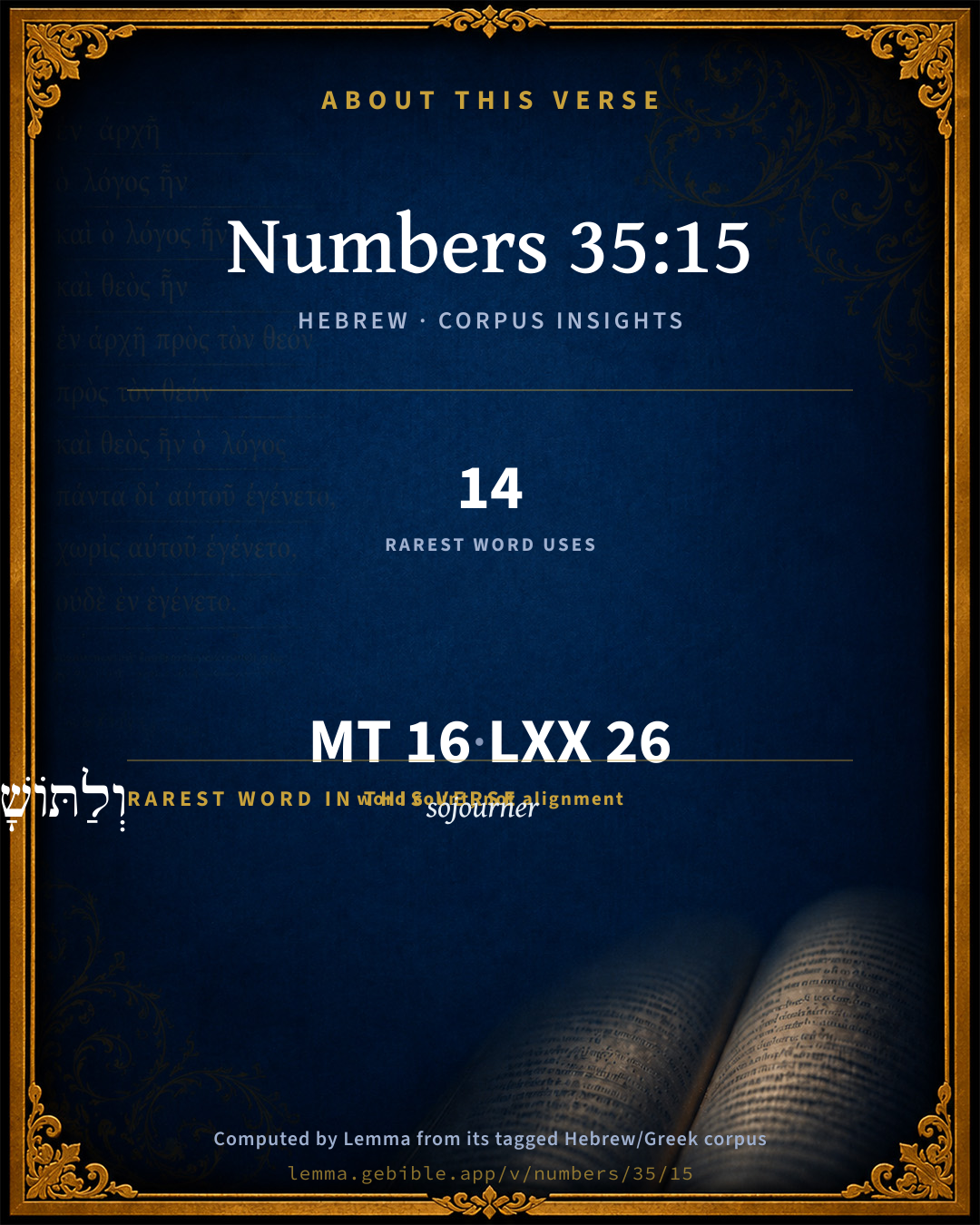
The rarest word here is וְלַתּוֹשָׁב֙ sojourner H8453 — appearing just 14 times in the whole Hebrew Bible.

Shared distinctive vocabulary

וְלַתּוֹשָׁב֙ sojourner H8453 occurs in 13 verses of the Hebrew Bible. Also found in:

Grammatical profile

  • 3 verbs
  • 10 nouns
  • 1 adjective
  • 1 pronoun
  • 1 adverb

Verb forms

  • תִּהְיֶ֛ינָה Qal · Imperfect
  • לָנ֣וּס Qal · Infinitive Construct
  • מַכֵּה Hiphil · Participle Active

Hebrew & Septuagint length

In English translation the verse runs 33 words from the Hebrew and 44 from the Septuagint (LXX English) — closely comparable.

A rough comparison of the two English renderings, which tokenize alike — not a word-level alignment.

Word counts can differ between the Hebrew and the Greek without any difference in meaning — e.g. the Hebrew direct-object marker אֵת has no separate Greek word, and Greek often adds the article ὁ.

In the original languages it is 16 Hebrew tokens and 26 Greek tokens — but the two are counted differently (Hebrew bundles its prefixes and suffixes into one token; the Greek is in lemma form), so that isn’t a like-for-like length.

Cross-references

5

Topical passages linked to Numbers 35:15 in the Treasury of Scripture Knowledge — connected by theme and wording, ordered by reader-vote popularity; previews shown in the World English Bible.

  • Numbers 15:16 One law and one ordinance shall be for you, and for the stranger who lives as a foreigner with you.
  • Exodus 12:49 One law shall be to him who is born at home, and to the stranger who lives as a foreigner among you."
  • Leviticus 24:22 You shall have one kind of law, for the foreigner as well as the native-born: for I am Yahweh your God.'"
  • Romans 3:29 Or is God the God of Jews only? Isn't he the God of Gentiles also? Yes, of Gentiles also,
  • Galatians 3:28 There is neither Jew nor Greek, there is neither slave nor free man, there is neither male nor female; for you are all one in Christ Jesus.

Cross-references courtesy of OpenBible.info (CC BY 4.0).

Hebrew and Greek witnesses Masoretic Hebrew ↔ Greek Septuagint

The same verse in the two great witnesses to the Old Testament, shown verse-for-verse.

These are two independent witnesses, not word-aligned to each other, and the Septuagint is shown in lemma (dictionary) form.

Hebrew Numbers 35:15 Masoretic · Westminster Leningrad Codex

לִבְנֵ֣י יִשְׂרָאֵ֗ל וְלַגֵּ֤ר וְלַתּוֹשָׁב֙ בְּתוֹכָ֔ם תִּהְיֶ֛ינָה שֵׁשׁ הֶעָרִ֥ים הָאֵ֖לֶּה לְמִקְלָ֑ט לָנ֣וּס שָׁ֔מָּה כָּל מַכֵּה נֶ֖פֶשׁ בִּשְׁגָגָֽה

For the children of Israel, and for the stranger and for the foreigner living among them, shall these six cities be for refuge; that everyone who kills any person unwittingly may flee there.

World English Bible · Public Domain

Greek LXX Numbers 35:15 Septuagint · lemma form

φυγάδιον εἰμί ὁ υἱός ἰσραήλ καί ὁ προσήλυτος καί ὁ πάροικος ὁ ἐν σύ εἰμί ὁ πόλις οὗτος εἰς φυγαδευτήριον φεύγω ἐκεῖ πᾶς πατάσσω ψυχή ἀκουσίως

It shall be a place of refuge for the children of Israel, and for the stranger, and for him that sojourns among you; these cities shall be for a place of refuge, for every one to flee there who has killed a man unintentionally.

LXX2012 (modern English Septuagint) · Public Domain

Hebrew: Westminster Leningrad Codex (CC BY 4.0). Greek: Septuagint (public domain); English from LXX2012 (modern English Septuagint) (Public Domain). How the Septuagint differs from the Hebrew →

Targum (Aramaic paraphrase)

2

The Targum is the ancient Jewish Aramaic paraphrase of the Hebrew Scriptures — an interpretive translation, not the Hebrew text itself. Onkelos (literal) and Pseudo-Jonathan (expansive) render the Torah, and Jonathan the Prophets. Coverage is partial: where no permissively-licensed English translation exists for a verse, only the Aramaic is shown. This is verse-level text, not a word-by-word alignment to the Hebrew.

  1. Targum Onkelos Torah (Genesis–Deuteronomy)
    לִבְנֵי יִשְׂרָאֵל וּלְגִיוֹרַיָא וּלְתוֹתָבַיָא דְבֵינֵיכוֹן יֶהֶוְיַן שִׁית קִרְוַיָא הָאִלֵין לְשֵׁזָבָא לְמֵעֲרַק לְתַמָן כָּל דְיִקְטוֹל נַפְשָׁא בְּשָׁלוּ

    (no public-domain English translation for this verse)

    Targum Onkelos — Aramaic: “Onkelos Genesis” (public domain); “Onkelos Exodus” (public domain); “Onkelos Leviticus” (public domain); “Onkelos Numbers” (public domain); “Onkelos Deuteronomy” (public domain). English: “Sefaria Community Translation” (CC0 1.0 (public-domain dedication)); “J.W. Etheridge. The Targums of Onkelos and Jonathan Ben Uzziel on the Pentateuch. London: Longmans, Green, 1862” (public domain). Text via Sefaria.

  2. Targum Pseudo-Jonathan Torah (Genesis–Deuteronomy)
    לִבְנֵי יִשְרָאֵל וּלְגִיוֹרָא וּלְתוֹתְבַיָא דְבֵינֵיהוֹן יֶהֱוְיָן שִׁית קִרְוַיָא הָאִילֵן לְשֵׁזָבָא לְמֵעֲרוֹק לְתַמָן כָּל דְיִקְטוֹל בַּר נַשׁ בְּשָׁלוּ

    For the sons of Israel and the sojourners among you shall be these six cities of refuge, that thither whoever hath killed a man through ignorance may flee.

    Targum Pseudo-Jonathan — Aramaic: “Targum Jonathan on Genesis” (public domain); “Targum Jonathan on Exodus” (public domain); “Targum Jonathan on Leviticus” (public domain); “Targum Jonathan on Numbers” (public domain); “Targum Jonathan on Deuteronomy” (public domain). English: “The Targum of Jonathan ben Uzziel, trans. J. W. Etheridge, London, 1862” (public domain). Text via Sefaria.

Commentary

Notes on Numbers 35:15 from classic Christian and Jewish commentators (each source and its license shown beneath its notes). The classic Christian expositions comment on the surrounding passage and are grouped to its opening verse, so a note may address several verses; the Jewish commentaries on the Tanakh (Rashi and others) are per-verse, so they appear only where the commentator wrote on this verse.

Lemma curates 59 commentaries, every one of them public domain or Creative Commons licensed, each selected and text-cleaned for this edition rather than reprinted as found. About our sources →

Trapp's Complete Commentary

John Trapp

Num 35:15 These six cities shall be a refuge, [both] for the children of Israel, and for the stranger, and for the sojourner among them: that every one that killeth any person unawares may flee thither.

Ver. 15. Shall be a refuge.] Christ is our asylum, to whom running for refuge, when pursued by the guilt of an evil conscience, we are safe; none can take us out of his hands; if we be in Christ the Rock, temptations and oppositions, as waves, dash upon us, but break themselves.

John Trapp, A Commentary or Exposition upon All the Books of the Old and New Testament (1647–1656) — public domain. Text from a community e-Sword module.

Tyndale Open Study Notes

Tyndale Open Resources

35:15-24 The Old Testament makes a clear distinction between deliberate murder and involuntary manslaughter (35:11, 22-23; Exod 21:12-14; cp. Num 15:22-31). Murder required a penalty of execution, but an accidental death did not. The cities of refuge provided protection only for those who killed another person by accident. • The use of a weapon was proof of malicious intent.

35:15 Israelites, foreigners living among you, and traveling merchants. Anyone: The same law applied impartially to everyone; Israel had one standard of justice, not two (one for citizens, another for noncitizens), as in many societies (see also Lev 19:15; Deut 1:16-17; 1 Tim 5:21; Jas 2:2-4).

Tyndale Open Study Notes — © Tyndale Open Resources, licensed CC BY-SA 4.0. Text via the HelloAO Bible API.

Geneva Bible (1599)

Geneva Bible translators

Hebrew, among them.

Geneva Bible (1599) marginal notes — public domain. Text via Bolls.life.

Ellicott's Commentary for English Readers

(15) For the stranger, and for the sojourner . . . —The word ger, “stranger,” properly denotes a foreigner who took up a temporary abode amongst the Israelites; whereas toshab, “sojourner,” denotes one who was settled in Israel. Sometimes, however, the words ger and toshab appear to be used as a compound term, as in Lev_25:47, where they occur with the conjunctive (or disjunctive) particle in the former part of the verse, and without it in the latter. “The cities of refuge,” says Dr. Gill, “were of God’s appointing: so Christ, as a Saviour and rock of refuge to His people, is appointed and foreordained of God; they were well known for refuges, as the Lord is in the palaces of Zion; they were open for all at all times, as Christ is for all sinners, even the chief of sinners—Jews or Gentiles; they are all one in Christ—the Israelites, and the stranger and sojourner; all impediments were removed out of the way of them, and plain directions given, as are in the Gospel, and by the ministers of it; and there is always room in Christ for such that flee to Him, as there was in those cities; and being in Him, they are safe from the curse and condemnation of the law, from wrath to come, and from the second death; and their redemption and atonement, peace and reconciliation, liberty, life and salvation, are owing to the death of Christ, their High Priest.” (Comp. Num_15:29.)

A Bible Commentary for English Readers, edited by Charles John Ellicott (1878–1897) — public domain. Text from a community e-Sword module.

The Cambridge Bible for Schools and Colleges

gen. ed. J. J. S. Perowne

15. The cities may be used by every class of the community, the true born Israelite, the sojourner (gêr) and the stranger (tôshâbh). See on Num_9:14. Nothing is here said of slaves; they had no legal rights, and it is therefore improbable that they could claim any asylum.

The Cambridge Bible for Schools and Colleges (gen. ed. J. J. S. Perowne; Cambridge University Press, 1878–1918) — public domain. Text from a community e-Sword module.

John Gill's Exposition

These six cities shall be a refuge both for the children of Israel and for the stranger,.... For an Israelite, and a proselyte of righteousness, one that embraced the Jewish religion, and in all things conformed to it, and to whom there was but one law in things civil and religious:

and for the sojourner among you; the proselyte of the gate, who renounced idolatry, and observed the commands of the sons of Noah, but in other things did not comply with the Jewish ceremonies, yet had the benefit of the cities of refuge equally with the other; though the Jews say (p), such a proselyte or sojourner had only this privilege, who slew a proselyte, but not if he slew an Israelite; but for this distinction there is no foundation in the text:

that everyone that killeth any person unawares may flee thither; whether an Israelite, or a proselyte of righteousness or of the gate.

(p) Misn. Maccot, c. 2. sect. 3.

John Gill's Exposition of the Whole Bible (1746–1763) — public domain (CC PDM 1.0). Text via the HelloAO Bible API.

Matthew Poole's English Annotations

For the stranger; not the proselyte only, but all strangers, this being no matter of religious privilege, but of common right, and agreeable to the law of nature and practice of wise heathens.

Matthew Poole's English Annotations on the Holy Bible (1683–1685) — public domain. Text from a community e-Sword/MySword module.

Whedon's Commentary on the Bible

Daniel D. Whedon

15. The stranger — A temporary resident.

The sojourner — Literally the dweller — one who remains a settler in Israel but is not an owner of land (Lev_25:40) nor a partaker of the sacred gifts. Lev_22:10; Lev_23:22, notes.

May flee thither — To facilitate the flight Moses commanded the roads to the cities of refuge to be kept open. Deu_19:3. The Talmud adds that at the crossroads posts were erected bearing the word REFUGE to direct the fugitive, lest he should miss his way and fall into the hands of the avenger.

Daniel D. Whedon (gen. ed.), Commentary on the Old and New Testaments (1874–1909) — public domain. Text from a community e-Sword module.

Lesson kit

Teaching starters — assembled from the data on this page, not authored interpretation. Every prompt links to the verse data it draws on. Edit before teaching.

Numbers, in the Pentateuch, opens this verse with 16 words (16 distinct Hebrew lemmas). Its most distinctive word is tôwshâb (“sojourner”). A historical commentator’s framing appears above. Read the whole chapter for the surrounding context.

Discussion questions

  1. What does “sojourner” (tôwshâb) contribute to the verse as a whole?
  2. Genesis 23:4 shares the word «sojourner» with this verse. How do the two illuminate each other?
  3. These translations render this verse differently. What is at stake in choosing one wording over another?
  4. The verb «תִּהְיֶ֛ינָה» is Qal Imperfect. How does its form color the action?
  5. Reading how Trapp's Complete Commentary and Tyndale Open Study Notes read this verse, where do the two commentators agree and where do they part?

Things to notice

Reading settings

Reading text

Shown beneath each verse's original-language words.

Old Testament
Old Testament edition

Read the OT as the Masoretic Hebrew (MT) or the Greek Septuagint (LXX).

English shown for the Greek Septuagint (in the Hebrew ↔ Greek comparison).

Comparing translations? Open the Compare panel on any verse page to stack up to four side by side.