
Numbers 25:11

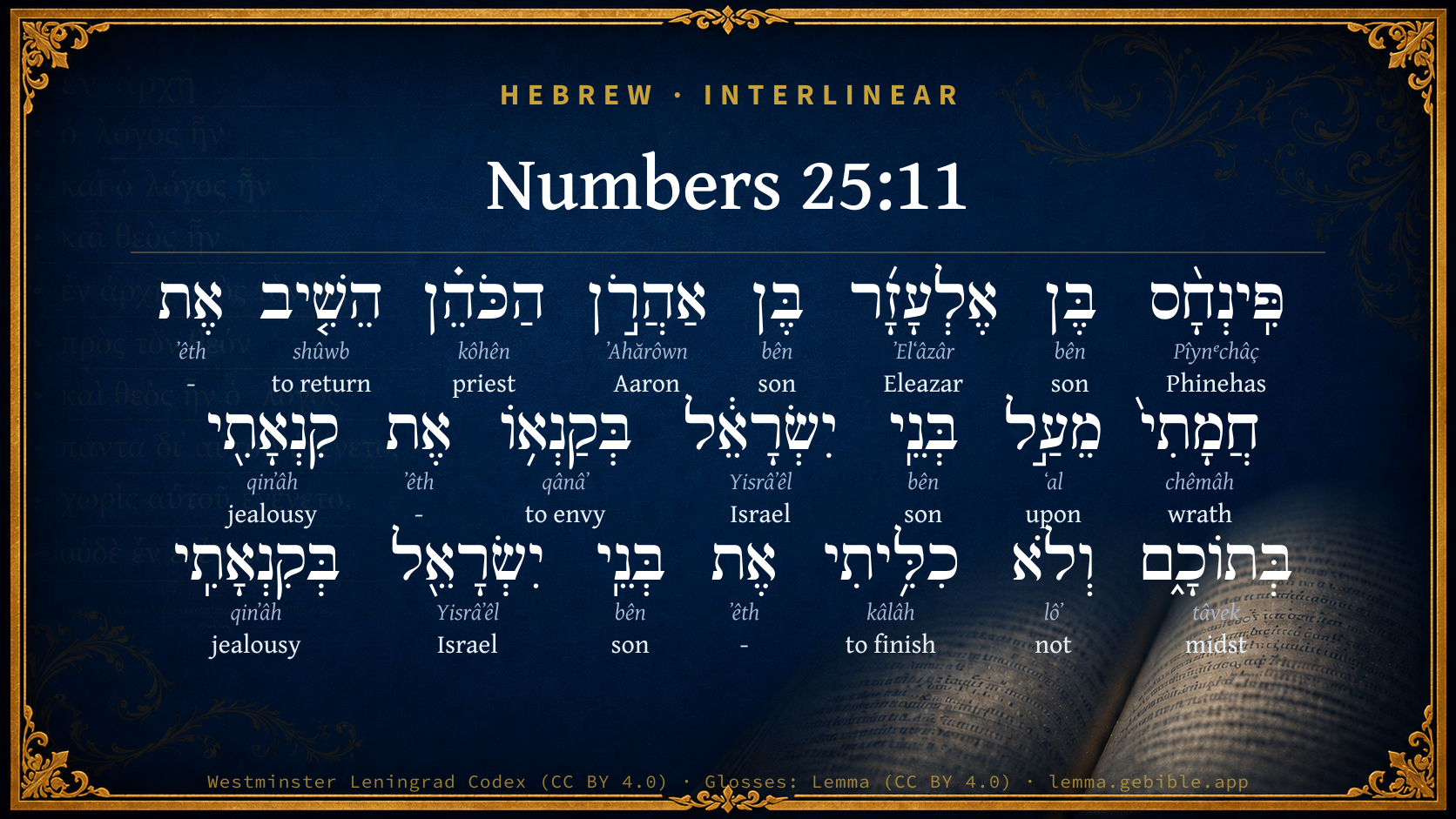
Hebrew (Westminster Leningrad Codex) Numbers 25:11 appears in the Hebrew Old Testament. The text above is from the Westminster Leningrad Codex. Each word links to its Strong’s number, a concise gloss, and parsing drawn from the Open Scriptures Hebrew Bible morphology. Click any word for its full Brown-Driver-Briggs (BDB) entry.
Download image
Cite this verse

Numbers 25:11 (World English Bible). Public Domain. Lemma interlinear Bible study tool, https://lemma.gebible.app/v/numbers/25/11.

Show BibTeX & RIS
BibTeX
RIS
English Translation
Phinehas, the son of Eleazar, the son of Aaron the priest, has turned my wrath away from the children of Israel, in that he was jealous with my jealousy among them, so that I didn't consume the children of Israel in my jealousy.
World English Bible · Public Domain
Download a study sheet

One document with this verse’s original text, its word-by-word gloss line, the meaning frame, cross-references with their text, attributed commentary, and full source and license credits — printable, and it pastes into notes with its structure intact.

This verse Autodidact and up

Study sheet (.html) Plain text (.txt)

A passage Seminary Student

Up to 50 verses in one chapter. A passage sheet keeps up to 6 commentary sources and 12 cross-references per verse, in the order this page ranks them, and says so on the sheet whenever that leaves anything out. Ask for a single verse and you get the Autodidact verse sheet above.

Everything on this page stays free to read, with no account — the sheet is a download of what is already on screen, not access to it.

Want to remove ads? Support Godless Engineer
Compare translations 3

The same verse in 3 English versions, stacked beneath the original-language interlinear above. Click any original word for its lexicon entry.

Each is an independent rendering of the whole verse — the interlinear is not word-aligned to these translations.

Highlighted words mark where these versions differ — a whole-verse word diff, not a word-by-word alignment.

  • World English Bible Public Domain
    Phinehas, the son of Eleazar, the son of Aaron the priest, has turned my wrath away from the children of Israel, in that he was jealous with my jealousy among them, so that I didn't consume the children of Israel in my jealousy.
  • King James Version Public Domain
    Phinehas, the son of Eleazar, the son of Aaron the priest, hath turned my wrath away from the children of Israel, while he was zealous for my sake among them, that I consumed not the children of Israel in my jealousy.
  • unfoldingWord Literal Text CC BY-SA 4.0
    “Phinehas the son of Eleazar, the son of Aaron the priest, has turned my heat from on the sons of Israel by his being zealous with my zeal in the midst of them. And I will not make an end of the sons of Israel in my zeal.

unfoldingWord Literal Text — © unfoldingWord, licensed CC BY-SA 4.0. Word-aligned USFM3 via Door43 (git.door43.org/unfoldingWord/en_ult).

Versions to compare (up to 4)

3 of 4 selected

Show all 18 translations

Every available English version of this verse, each an independent rendering of the whole verse.

  • World English Bible Public Domain
    Phinehas, the son of Eleazar, the son of Aaron the priest, has turned my wrath away from the children of Israel, in that he was jealous with my jealousy among them, so that I didn't consume the children of Israel in my jealousy.
  • Berean Standard Bible Public Domain
    “Phinehas son of Eleazar, the son of Aaron the priest, has turned My wrath away from the Israelites; for he was zealous for My sake among them, so that I did not consume the Israelites in My zeal.
  • Majority Standard Bible Public Domain
    “Phinehas son of Eleazar, the son of Aaron the priest, has turned My wrath away from the Israelites; for he was zealous for My sake among them, so that I did not consume the Israelites in My zeal.
  • King James Version Public Domain
    Phinehas, the son of Eleazar, the son of Aaron the priest, hath turned my wrath away from the children of Israel, while he was zealous for my sake among them, that I consumed not the children of Israel in my jealousy.
  • American Standard Version (1901) Public Domain
    Phinehas, the son of Eleazar, the son of Aaron the priest, hath turned my wrath away from the children of Israel, in that he was jealous with my jealousy among them, so that I consumed not the children of Israel in my jealousy.
  • Revised Version (1885) Public Domain
    Phinehas, the son of Eleazar, the son of Aaron the priest, hath turned my wrath away from the children of Israel, in that he was jealous with my jealousy among them, so that I consumed not the children of Israel in my jealousy.
  • Geneva Bible (1599) Public Domain
    Phinehas the sonne of Eleazar, the sonne of Aaron the Priest, hath turned mine anger away from the children of Israel, while hee was zealous for my sake among them: therefore I haue not consumed the children of Israel in my ielousie.
  • Douay-Rheims (1899) Public Domain
    Phinees the son of Eleazar the son of Aaron the priest, hath turned away my wrath from the children of Israel: because he was moved with my zeal against them, that I myself might not destroy the children of Israel in my zeal.
  • Young's Literal Translation Public Domain
    `Phinehas, son of Eleazar, son of Aaron the priest, hath turned back My fury from the sons of Israel, by his being zealous with My zeal in their midst, and I have not consumed the sons of Israel in My zeal.
  • Literal Standard Version CC BY-SA 4.0
    “Phinehas, son of Eleazar, son of Aaron the priest, has turned back My fury from the sons of Israel by his being zealous with My zeal in their midst, and I have not consumed the sons of Israel in My zeal.
  • Unlocked Literal Bible CC BY-SA 4.0
    “Phinehas son of Eleazar son of Aaron the priest, has turned my rage away from the people of Israel because he was passionate with my zeal among them. So I have not consumed the people of Israel in my fierceness.
  • unfoldingWord Literal Text CC BY-SA 4.0
    “Phinehas the son of Eleazar, the son of Aaron the priest, has turned my heat from on the sons of Israel by his being zealous with my zeal in the midst of them. And I will not make an end of the sons of Israel in my zeal.
  • Darby Bible Public Domain
    Phinehas, the son of Eleazar, the son of Aaron the priest, hath turned my wrath away from the children of Israel, in that he was jealous with my jealousy among them, so that I consumed not the children of Israel in my jealousy.
  • World Messianic Bible Public Domain
    “Phinehas, the son of Eleazar, the son of Aaron the priest, has turned my wrath away from the children of Israel, in that he was jealous with my jealousy among them, so that I didn’t consume the children of Israel in my jealousy.
  • Webster's Bible Public Domain
    Phinehas, the son of Eleazar, the son of Aaron the priest, hath turned my wrath away from the children of Israel, (while he was zealous for my sake among them,) that I consumed not the children of Israel in my jealousy.
  • Free Bible Version CC BY-SA 4.0
    “Phinehas son of Eleazar, the son of Aaron the priest, has turned my anger away from the Israelites, because out of all of them he was passionately dedicated to me, so I did not destroy the Israelites in my passionate anger.
  • Bible in Basic English Public Domain
    Through Phinehas, and because of his passion for my honour, my wrath has been turned away from the children of Israel, so that I have not sent destruction on them all in my wrath.
  • JPS Tanakh (1917) Public Domain
    'Phinehas, the son of Eleazar, the son of Aaron the priest, hath turned My wrath away from the children of Israel, in that he was very jealous for My sake among them, so that I consumed not the children of Israel in My jealousy.

Literal Standard Version (2020), Covenant Press — licensed CC BY-SA 4.0. Text via the HelloAO Bible API (eBible.org). Unlocked Literal Bible (unfoldingWord) — licensed CC BY-SA 4.0. Text via the HelloAO Bible API (eBible.org). unfoldingWord Literal Text — © unfoldingWord, licensed CC BY-SA 4.0. Word-aligned USFM3 via Door43 (git.door43.org/unfoldingWord/en_ult). Free Bible Version, Dr. Jonathan Gallagher — licensed CC BY-SA 4.0. Text via the HelloAO Bible API (eBible.org).

Word by word

More ways to search: Search by grammar → Find every occurrence → Compare this word →

Practice this passage: Drill this verse → Learn its vocabulary →

פִּֽינְחָ֨ס
Pîynᵉchâç
H6372
“Phinehas”
Noun, Proper
Part of Speech
Noun
Type
Proper
Full BDB Definition

Origin: apparently from H6310 and a variation of H5175

TWOT: None

Phinehas = "mouth of brass" - son of Eleazar and grandson of Aaron; his zealousness for the Lord averted a plague on Israel and gained him the promise of the Lord of an everlasting priesthood in his family - a priest and the son of the priest Eli - the father of a helper of Ezra
  1. בֶּן bên H1121 “son of” Noun, Common, Masculine, Singular, Construct
  2. אֶלְעָזָ֜ר ʼElʻâzâr H499 “Eleazar” Noun, Proper
  3. בֶּן bên H1121 “son of” Noun, Common, Masculine, Singular, Construct
  4. אַהֲרֹ֣ן ʼAhărôwn H175 “Aaron” Noun, Proper
  5. הַכֹּהֵ֗ן kôhên H3548 “the · priest” Particle, Definite Article + Noun, Common, Masculine, Singular, Absolute
  6. הֵשִׁ֤יב shûwb H7725 “to return” Verb, Hiphil, Perfect, 3rd Person, Masculine, Singular
  7. אֶת ʼêth H853 “-” Particle, Direct Object
  8. חֲמָתִי֙ chêmâh H2534 “wrath · my” Noun, Common, Feminine, Singular, Construct + Suffix, Personal, 1st Person, Common, Singular
  9. מֵעַ֣ל ʻal H5921 “from · upon” Preposition + Preposition
  10. בְּנֵֽי bên H1121 “sons of” Noun, Common, Masculine, Plural, Construct
  11. יִשְׂרָאֵ֔ל Yisrâʼêl H3478 “Israel” Noun, Proper
  12. בְּקַנְא֥וֹ qânâʼ H7065 “in/at · to envy · him” Preposition + Verb, Piel, Infinitive Construct + Suffix, Personal, 3rd Person, Masculine, Singular
  13. אֶת ʼêth H853 “-” Particle, Direct Object
  14. קִנְאָתִ֖י qinʼâh H7068 “jealousy · my” Noun, Common, Feminine, Singular, Construct + Suffix, Personal, 1st Person, Common, Singular
  15. בְּתוֹכָ֑ם tâvek H8432 “in/at · midst · their” Preposition + Noun, Common, Masculine, Singular, Construct + Suffix, Personal, 3rd Person, Masculine, Plural
  16. וְלֹא lôʼ H3808 “and · not” Conjunction + Particle, Negative
  17. כִלִּ֥יתִי kâlâh H3615 “to finish” Verb, Piel, Perfect, 1st Person, Common, Singular
  18. אֶת ʼêth H853 “-” Particle, Direct Object
  19. בְּנֵֽי bên H1121 “sons of” Noun, Common, Masculine, Plural, Construct
  20. יִשְׂרָאֵ֖ל Yisrâʼêl H3478 “Israel” Noun, Proper
  21. בְּקִנְאָתִֽי qinʼâh H7068 “in/at · jealousy · my” Preposition + Noun, Common, Feminine, Singular, Construct + Suffix, Personal, 1st Person, Common, Singular

About this verse

These counts appear in no published source. They are computed here, from the morphology-tagged text and Lemma’s own curated glosses. What Lemma adds →

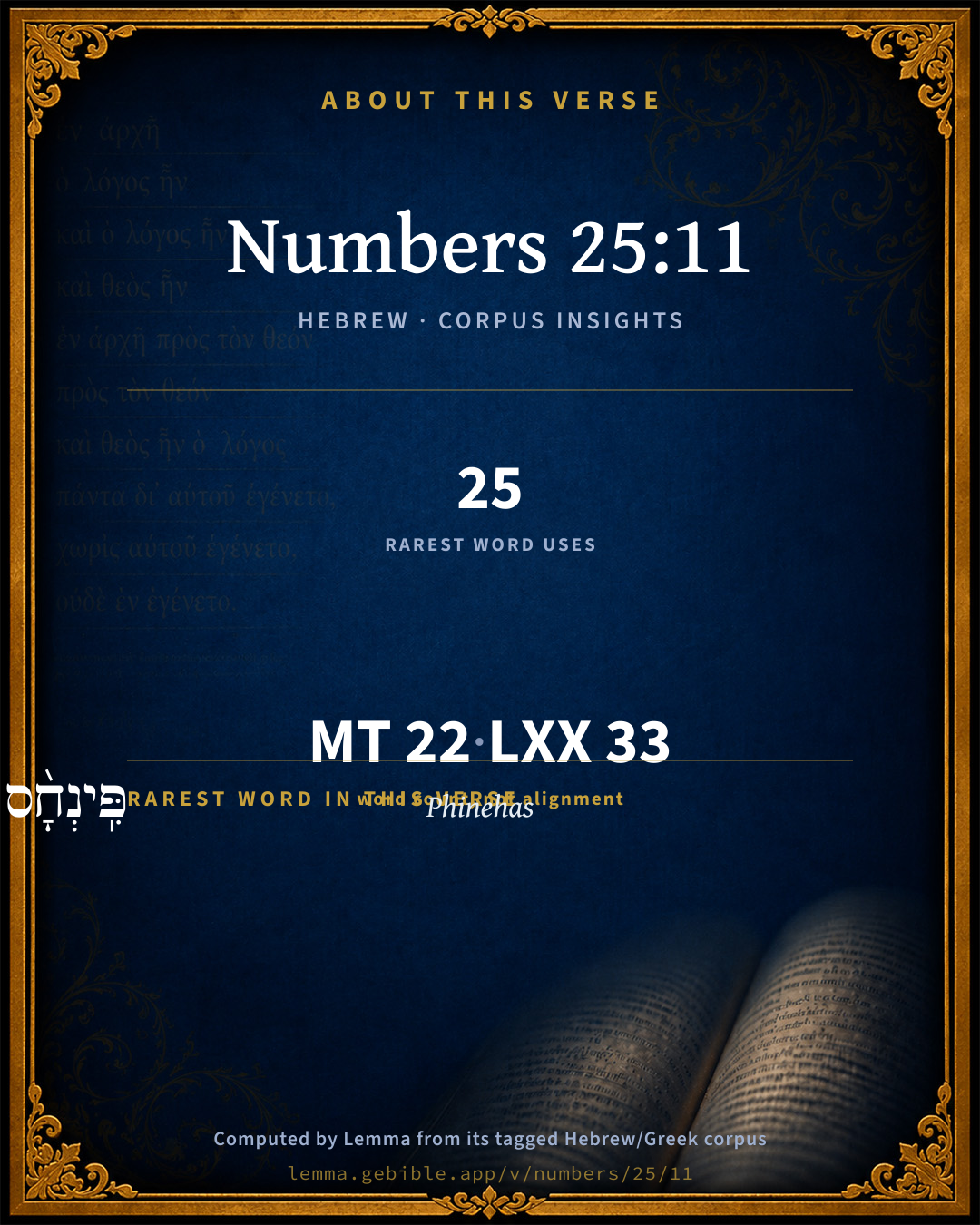
22
words
15
distinct lemmas
Pentateuch
section

Notable vocabulary

The rarest word here is פִּֽינְחָ֨ס Phinehas H6372 — appearing just 25 times in the whole Hebrew Bible.

Shared distinctive vocabulary

פִּֽינְחָ֨ס Phinehas H6372 occurs in 24 verses of the Hebrew Bible. Also found in:

Grammatical profile

  • 3 verbs
  • 14 nouns
  • 1 preposition
  • 4 particles

Verb forms

  • הֵשִׁ֤יב Hiphil · Perfect
  • בְּקַנְא֥וֹ Piel · Infinitive Construct
  • כִלִּ֥יתִי Piel · Perfect

Repetition

Words recur within this verse — often emphatic in Hebrew:

  • בֶּן son H1121 ×4
  • יִשְׂרָאֵ֔ל Israel H3478 ×2
  • קִנְאָתִ֖י jealousy H7068 ×2

Hebrew & Septuagint length

In English translation the verse runs 43 words from the Hebrew and 41 from the Septuagint (LXX English) — closely comparable.

A rough comparison of the two English renderings, which tokenize alike — not a word-level alignment.

Word counts can differ between the Hebrew and the Greek without any difference in meaning — e.g. the Hebrew direct-object marker אֵת has no separate Greek word, and Greek often adds the article ὁ.

In the original languages it is 22 Hebrew tokens and 33 Greek tokens — but the two are counted differently (Hebrew bundles its prefixes and suffixes into one token; the Greek is in lemma form), so that isn’t a like-for-like length.

Cross-references

21

Topical passages linked to Numbers 25:11 in the Treasury of Scripture Knowledge — connected by theme and wording, ordered by reader-vote popularity; previews shown in the World English Bible.

  • Deuteronomy 32:16 They moved him to jealousy with strange [gods]; With abominations provoked they him to anger.
  • Deuteronomy 32:21 They have moved me to jealousy with that which is not God; They have provoked me to anger with their vanities: I will move them to jealousy with those who are not a people; I will provoke them to anger with a foolish nation.
  • Psalms 78:58 For they provoked him to anger with their high places, And moved him to jealousy with their engraved images.
  • Exodus 20:5 you shall not bow yourself down to them, nor serve them, for I, Yahweh your God, am a jealous God, visiting the iniquity of the fathers on the children, on the third and on the fourth generation of those who hate me,
  • 1 Kings 14:22 Judah did that which was evil in the sight of Yahweh, and they provoked him to jealousy with their sins which they committed, above all that their fathers had done.
  • Zephaniah 1:18 Neither their silver nor their gold will be able to deliver them in the day of Yahweh's wrath, but the whole land will be devoured by the fire of his jealousy; for he will make an end, yes, a terrible end, of all those who dwell in the land.
  • Zephaniah 3:8 "Therefore wait for me," says Yahweh, "until the day that I rise up to the prey, for my determination is to gather the nations, that I may assemble the kingdoms, to pour on them my indignation, even all my fierce anger, for all the earth will be devoured with the fire of my jealousy.
  • 1 Corinthians 10:22 Or do we provoke the Lord to jealousy? Are we stronger than he?
  • 2 Corinthians 11:2 For I am jealous over you with a godly jealousy. For I married you to one husband, that I might present you as a pure virgin to Christ.
  • Exodus 22:5 "If a man causes a field or vineyard to be eaten, and lets his animal loose, and it grazes in another man's field, he shall make restitution from the best of his own field, and from the best of his own vineyard.
  • Exodus 34:14 for you shall worship no other god: for Yahweh, whose name is Jealous, is a jealous God.
  • Deuteronomy 4:24 For Yahweh your God is a devouring fire, a jealous God.
  • Deuteronomy 29:20 Yahweh will not pardon him, but then the anger of Yahweh and his jealousy will smoke against that man, and all the curse that is written in this book shall lie on him, and Yahweh will blot out his name from under the sky.
  • Joshua 7:25–26 Joshua said, Why have you troubled us? Yahweh shall trouble you this day. All Israel stoned him with stones; and they burned them with fire, and stoned them with stones.
  • Joshua 24:19 Joshua said to the people, You can't serve Yahweh; for he is a holy God; he is a jealous God; he will not forgive your disobedience nor your sins.
  • 2 Samuel 21:14 They buried the bones of Saul and Jonathan his son in the country of Benjamin in Zela, in the tomb of Kish his father: and they performed all that the king commanded. After that God was entreated for the land.
  • Psalms 106:23 Therefore he said that he would destroy them, Had Moses, his chosen, not stood before him in the breach, To turn away his wrath, so that he wouldn't destroy them.
  • Psalms 106:30 Then Phinehas stood up, and executed judgment, So the plague was stopped.
  • Ezekiel 16:38 I will judge you, as women who break wedlock and shed blood are judged; and I will bring on you the blood of wrath and jealousy.
  • Nahum 1:2 Yahweh is a jealous God and avenges. Yahweh avenges and is full of wrath. Yahweh takes vengeance on his adversaries, and he maintains wrath against his enemies.
  • John 3:36 One who believes in the Son has eternal life, but one who disobeys the Son won't see life, but the wrath of God remains on him."

Cross-references courtesy of OpenBible.info (CC BY 4.0).

Hebrew and Greek witnesses Masoretic Hebrew ↔ Greek Septuagint

The same verse in the two great witnesses to the Old Testament, shown verse-for-verse.

These are two independent witnesses, not word-aligned to each other, and the Septuagint is shown in lemma (dictionary) form.

Hebrew Numbers 25:11 Masoretic · Westminster Leningrad Codex

פִּֽינְחָ֨ס בֶּן אֶלְעָזָ֜ר בֶּן אַהֲרֹ֣ן הַכֹּהֵ֗ן הֵשִׁ֤יב אֶת חֲמָתִי֙ מֵעַ֣ל בְּנֵֽי יִשְׂרָאֵ֔ל בְּקַנְא֥וֹ אֶת קִנְאָתִ֖י בְּתוֹכָ֑ם וְלֹא כִלִּ֥יתִי אֶת בְּנֵֽי יִשְׂרָאֵ֖ל בְּקִנְאָתִֽי

Phinehas, the son of Eleazar, the son of Aaron the priest, has turned my wrath away from the children of Israel, in that he was jealous with my jealousy among them, so that I didn't consume the children of Israel in my jealousy.

World English Bible · Public Domain

Greek LXX Numbers 25:11 Septuagint · lemma form

φινεες υἱός ελεαζαρ υἱός ἀαρών ὁ ἱερεύς καταπαύω ὁ θυμός ἐγώ ἀπό υἱός ἰσραήλ ἐν ὁ ζηλόω ἐγώ ὁ ζῆλος ἐν αὐτός καί οὐ ἐκ ἀναἁλίσκω ὁ υἱός ἰσραήλ ἐν ὁ ζῆλος ἐγώ

Phinees the son of Eleazar the son of Aaron the priest has caused my wrath to cease from the children of Israel, when I was exceedingly jealous among them, and I did not consume the children of Israel in my jealousy.

LXX2012 (modern English Septuagint) · Public Domain

On this verse, The Pulpit Commentary discusses the Septuagint’s reading. Read the note in Commentary ↓

Hebrew: Westminster Leningrad Codex (CC BY 4.0). Greek: Septuagint (public domain); English from LXX2012 (modern English Septuagint) (Public Domain). How the Septuagint differs from the Hebrew →

Targum (Aramaic paraphrase)

2

The Targum is the ancient Jewish Aramaic paraphrase of the Hebrew Scriptures — an interpretive translation, not the Hebrew text itself. Onkelos (literal) and Pseudo-Jonathan (expansive) render the Torah, and Jonathan the Prophets. Coverage is partial: where no permissively-licensed English translation exists for a verse, only the Aramaic is shown. This is verse-level text, not a word-by-word alignment to the Hebrew.

  1. Targum Onkelos Torah (Genesis–Deuteronomy)
    פִּינְחָס בַּר אֶלְעָזָר בַּר אַהֲרֹן כַּהֲנָא אֲתֵיב יַת חֵמְתִי מֵעַל בְּנֵי יִשְׂרָאֵל בִּדְקַנֵי יַת קִנְאָתִי בֵּינֵיהוֹן וְלָא שֵׁיצֵיתִי יַת בְּנֵי יִשְׂרָאֵל בְּקִנְאָתִי

    (no public-domain English translation for this verse)

    Targum Onkelos — Aramaic: “Onkelos Genesis” (public domain); “Onkelos Exodus” (public domain); “Onkelos Leviticus” (public domain); “Onkelos Numbers” (public domain); “Onkelos Deuteronomy” (public domain). English: “Sefaria Community Translation” (CC0 1.0 (public-domain dedication)); “J.W. Etheridge. The Targums of Onkelos and Jonathan Ben Uzziel on the Pentateuch. London: Longmans, Green, 1862” (public domain). Text via Sefaria.

  2. Targum Pseudo-Jonathan Torah (Genesis–Deuteronomy)
    פִּנְחָס קַנָאָה בַּר אֶלְעָזָר בַּר אַהֲרן כַּהֲנָא אָתֵיב יַת רִתְחִי מֵעַל בְּנֵי יִשְרָאֵל בִּזְמַן דְקַנֵי יַת קִנְאָתָא וְקָטִיל חַיָיבָא דְבֵינֵיהוֹן וְאַמְטוּלֵיהּ לָא שֵׁיצְיַית יַת בְּנֵי יִשְרָאֵל בְּקִנְאָתִי

    Phinehas the zealous, the son of Elazar bar Aharon, the priest, hath turned away mine anger from the children of Israel, in that, when zealous with My zeal, he hath slain the sinners who were among them; and for his sake I have not destroyed the children of Israel in My indignation.

    Targum Pseudo-Jonathan — Aramaic: “Targum Jonathan on Genesis” (public domain); “Targum Jonathan on Exodus” (public domain); “Targum Jonathan on Leviticus” (public domain); “Targum Jonathan on Numbers” (public domain); “Targum Jonathan on Deuteronomy” (public domain). English: “The Targum of Jonathan ben Uzziel, trans. J. W. Etheridge, London, 1862” (public domain). Text via Sefaria.

Commentary

Notes on Numbers 25:11 from classic Christian and Jewish commentators (each source and its license shown beneath its notes). The classic Christian expositions comment on the surrounding passage and are grouped to its opening verse, so a note may address several verses; the Jewish commentaries on the Tanakh (Rashi and others) are per-verse, so they appear only where the commentator wrote on this verse.

Lemma curates 59 commentaries, every one of them public domain or Creative Commons licensed, each selected and text-cleaned for this edition rather than reprinted as found. About our sources →

Joseph Benson's Commentary

Num 25:11. That I consumed not the children of Israel in my jealousy — When God ascribes jealousy and the passions to himself, in Scripture, he speaks after the manner of men, and in conformity to our apprehension. The meaning is, that his own glory and the salvation of mankind render it necessary that he should proceed with severity against some particular crimes, like that wherewith men proceed when they are prompted by jealousy and other angry passions.

Joseph Benson's Commentary on the Old and New Testaments (1811–1818) — public domain. Text from a community e-Sword module.

Geneva Bible (1599)

Geneva Bible translators

He was zealous to maintain my glory.

Geneva Bible (1599) marginal notes — public domain. Text via Bolls.life.

Jamieson, Fausset & Brown

Robert Jamieson, A. R. Fausset & David Brown

Phinehas . . . hath turned my wrath away--This assurance was a signal mark of honor that the stain of blood, instead of defiling, confirmed him in office and that his posterity should continue as long as the national existence of Israel.

Jamieson, Fausset & Brown — Commentary Critical and Explanatory on the Whole Bible (1871) — public domain (CC PDM 1.0). Text via the HelloAO Bible API.

Ellicott's Commentary for English Readers

(11) Phinehas, the son of Eleazar, the son of Aaron the priest . . . —The description of Phinehas, as in Num_25:7, is repeated in full, as if to denote that he was not a private individual, but one invested with public authority.

While he was zealous for my sake among them.—Better, in that he was jealous with my jealousy (or, in that he displayed my jealousy).

A Bible Commentary for English Readers, edited by Charles John Ellicott (1878–1897) — public domain. Text from a community e-Sword module.

The Cambridge Bible for Schools and Colleges

gen. ed. J. J. S. Perowne

11. jealous with my jealousy] His jealousy was so deep and real that it adequately expressed the jealousy of Jehovah, rendering it unnecessary for Jehovah to express it further by consuming Israel. Cf. the ‘godly sorrow’ felt by the Corinthians with regard to a similar sin (2Co_7:9-11). The divine ‘jealousy’ is that which makes Him claim an exclusive right over His people. This right was violated when they gave themselves up to whoredom. Cf. Exo_20:5; Exo_34:14, Nah_1:2, Jas_4:5 (R.V. marg.).

The Cambridge Bible for Schools and Colleges (gen. ed. J. J. S. Perowne; Cambridge University Press, 1878–1918) — public domain. Text from a community e-Sword module.

John Gill's Exposition

Wherefore say,.... Moses is bid to tell what follows to Phinehas himself, for his comfort and encouragement, and to the people of Israel, that they might take notice of it, and give him honour and respect, as one highly esteemed by the Lord:

behold, I give unto him my covenant of peace; not only hereby assuring him that he had nothing to fear from the brethren and relations of the person he had slain, as Aben Ezra; but that he should enjoy all peace and happiness, external, internal, and eternal: Baal Hatfurira on the place says, that "Shalom", peace, is by geometry, or numerically, the Messiah; who is the peace, the peace maker, and peace giver, and in whom all the blessings of grace and peace are: and if this covenant is the same with the covenant of the priesthood in the next verse, it may be so called, because the priests had a peculiar nearness to God, and enjoyed his friendship, favour, and peace with him, and because the right administration of their office was the means of peace between God and his people; in this also Phinehas was a type of Christ; the covenant of grace made with him is called the covenant of peace, Isa 54:10 for in this covenant the scheme of peace and reconciliation was formed, agreed to, and settled; Christ was appointed the peace maker, which he agreed to be; and in consequence of it was sent and obtained peace by the blood of his cross, which is published in the everlasting Gospel, called therefore the Gospel of peace.

John Gill's Exposition of the Whole Bible (1746–1763) — public domain (CC PDM 1.0). Text via the HelloAO Bible API.

Albert Barnes' Notes on the Bible

Hath turned my wrath away - The signal example thus made of a leading offender by Phinehas was accepted by God as an expiation (literally in Num 25:13 “covering;” see the note at the typical significance Lev 1:4), and the exterminating wrath which had gone forth against the whole people was arrested Psa 106:30.

The act of Phinehas must be regarded as exceptional. It was an extraordinary deed of vengeance, justified by the singular atrocity of the crime which provoked it; but it does not confer the right to every man to punish summarily any gross and flagrant breach of divine law committed in his presence. Compare the act of Mattathias (1 Macc. 2:24-26).

The act was its own justification. Its merit consisted in the evidence it gave that the heart of Phinehas was right before God. He was “zealous with God’s zeal,” and abhorred the presumptuous wickedness of Zimri, as God abhorred it. He therefore risked his own life by dealing according to their deserts with two influential and defiant evil-doers; and his act, done in the face of Moses and the people, and for them, was accepted by God as a national atonement; and rewarded by the people (compare the leadership assigned to him in Num 31:6; Jos 22:13).

Albert Barnes' Notes on the Bible (1834–1885) — public domain. Text from a community e-Sword/MySword module.

Matthew Poole's English Annotations

He was zealous, fervent and resolute and valiant,

for my sake, for my satisfaction and vindication.

Matthew Poole's English Annotations on the Holy Bible (1683–1685) — public domain. Text from a community e-Sword/MySword module.

Whedon's Commentary on the Bible

Daniel D. Whedon

PHINEHAS REWARDED WITH AN EVERLASTING PRIESTHOOD, Num_25:10-13.

11. Zealous for my sake — Literally, with my zeal, not zeal for me, but “my zeal” — the vehement zeal of Jehovah, with which this grandson of Aaron was suddenly baptized. R.V., “Jealous with my jealousy.”

Daniel D. Whedon (gen. ed.), Commentary on the Old and New Testaments (1874–1909) — public domain. Text from a community e-Sword module.

The Pulpit Commentary

While he was zealous for my sake. Rather, "while he was zealous with my zeal" (ytianqiAta. Septuagint, en tw zhlwsai mou to zhlon , where mou stands emphatically before zhlon ). In my jealousy. Rather, "in my zeal;" the same word is used.

The Pulpit Commentary (1880–1919), ed. H.D.M. Spence-Jones & Joseph S. Exell — public domain. Text from a community e-Sword module.

Rashi

Rabbi Shlomo Yitzchaki (Rashi)

פינחס בן אלעזר בן אהרן הכהן PHINEAS THE SON OF ELEAZAR THE SON OF AARON THE PRIEST — Because the tribes spoke disparagingly of him, saying, “Have you seen this grandson of Puti the father of whose mother used to fatten (פטם) calves for idolatrous sacrifices (see Exodus 6:25 that Eleazar his father had married a daughter of Putiel who is identified with Jethro; see Rashi on that verse and Exodus 18:1), and he has dared to slay a prince of one of Israel’s tribes!”, therefore Scripture comes and connects his genealogy with Aaron (Sanhedrin 82b).

בקנאו את קנאתי means “when he executed my vengeance” (more lit., when he avenged my avenging) — when he displayed the anger that I should have displayed. The expression קנאה always denotes glowing with anger to execute vengeance for a thing; in O. F. emportment (cf. Rashi on 11:29).

Rashi on the Tanakh — English translations: “The Judaica Press complete Tanach with Rashi, translated by A. J. Rosenberg” (CC BY 4.0); “Pentateuch with Rashi's commentary by M. Rosenbaum and A.M. Silbermann, 1929-1934” (public domain); “The Metsudah Tanach series, Lakewood, N.J” (CC BY 4.0); and “The Book of Joshua, Metsudah Publications, 1997” (CC BY 4.0). Text via Sefaria.

Ramban (Nachmanides)

Rabbi Moshe ben Nachman (Ramban / Nachmanides)

PHINEHAS, THE SON OF ELEAZAR. The Holy One, blessed be He, [here] informed Moses that He would give Phinehas a good reward for his zeal, because he was zealous for his G-d, and for the righteousness [Phinehas] for righteousness. which he did for Israel by bringing about atonement for them, so that they did not all die in the plague. He [also] commanded Moses to tell Israel that he [Phinehas] would be a priest forever, and this is the sense of the phrase, Therefore say, …] was G-d’s communication exclusively to Moses, telling him that He is desirous of rewarding Phinehas for the reasons stated in that verse, but He did not tell him what was to constitute the reward. Verse 12 then continues with the thought: “Since it is My desire to reward Phinehas, Therefore say to the children of Israel … ” Thus the contents of Verse 11 was not to be told to Israel (Aboab). This interpretation of Ramban is unlike that of Rashi from whose words it may be implied that even the contents of Verse 11 was to be told to the people, the object being that they were not to speak disparagingly of Phinehas for having killed a prince of Israel, for G-d testified that he is a descendant of Aaron, who was a lover of peace, and what Phinehas did was to save the honor of Israel. that Moses was to tell this to Israel. Now Scripture does not say: “and it shall be unto him, and to his seed after him ‘an everlasting priesthood, ’” as He said about Aaron,. but instead it says: ‘the covenant’ of an everlasting priesthood, and it [also] says, I give unto him ‘My covenant’ of peace, meaning that He will give him a covenant with peace cleaving to it, whereas in the case of Aaron it says for splendor and for beauty. and tiphereth, which represent certain Emanations], it was not necessary to mention ‘the covenant of’ an everlasting priesthood, indicating the perfect Unity. But in the case of Phinehas it does not say that his priesthood was for splendor and for beauty; therefore the verse had to mention ‘the covenant of an everlasting priesthood, indicating that Phinehas’ priesthood was also in the perfect Unity, because he was zealous for his G-d (Abusaula). See also my Hebrew commentary, p. 305. Therefore it says [here concerning Phinehas]: because he was zealous for his G-d. The student learned [in the mysteries of the Cabala] will understand.Scripture mentions, Now the name of the man of Israel that was slain; And the name of the Midianite woman that was slain, in order to indicate that [Phinehas] deserved this great reward because he killed a prince of Israel, and the daughter of a heathen king and [nonetheless] he feared them not in his zeal for his G-d. And after He had requited His good reward to the righteous one [Phinehas], He commanded Moses to punish the wicked ones, and He told him, Harass the Midianites, but first He commanded him to count the people. This is the intent of [the phrase] And it came to pass after the plague [that the Eternal spoke unto Moses … ‘Take the sum etc.’], meaning that the taking of the census should be done first [before the punishment of the Midianites].

Ramban (Nachmanides) on the Tanakh — English translation: “Commentary on the Torah by Ramban (Nachmanides). Translated and annotated by Charles B. Chavel. New York, Shilo Pub. House, 1971-1976” (CC BY 4.0). Text via Sefaria.

Lesson kit

Teaching starters — assembled from the data on this page, not authored interpretation. Every prompt links to the verse data it draws on. Edit before teaching.

Numbers, in the Pentateuch, opens this verse with 22 words (15 distinct Hebrew lemmas). Its most distinctive word is Pîynᵉchâç (“Phinehas”). A historical commentator’s framing appears above. Read the whole chapter for the surrounding context.

Discussion questions

  1. How does “Phinehas” (Pîynᵉchâç) shape what this verse is saying?
  2. How does Exodus 6:25, which shares the word «Phinehas», read alongside this verse?
  3. What does the repetition of “son” (4× in this one verse) do in this verse?
  4. These translations render this verse differently; the difference is in the English rendering, not the original. What questions does that raise?
  5. «הֵשִׁ֤יב» is a Hiphil Perfect verb. How does that grammatical form shape the action described?
  6. Compare how Joseph Benson's Commentary and Geneva Bible (1599) read this verse. Where do they agree or differ?

Things to notice

Reading settings

Reading text

Shown beneath each verse's original-language words.

Old Testament
Old Testament edition

Read the OT as the Masoretic Hebrew (MT) or the Greek Septuagint (LXX).

English shown for the Greek Septuagint (in the Hebrew ↔ Greek comparison).

Comparing translations? Open the Compare panel on any verse page to stack up to four side by side.