
2 Chronicles 6:13

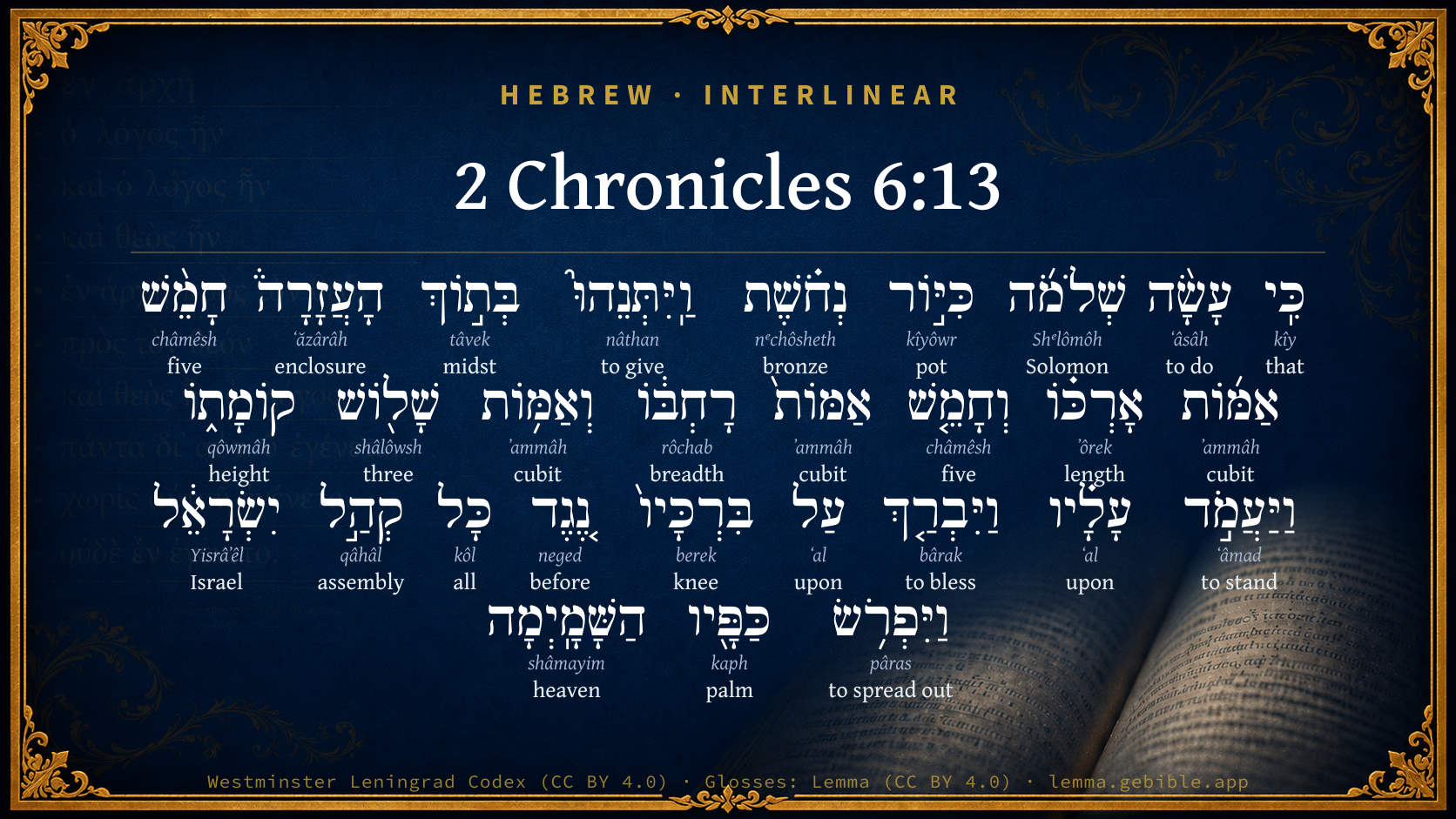
Hebrew (Westminster Leningrad Codex) 2 Chronicles 6:13 appears in the Hebrew Old Testament. The text above is from the Westminster Leningrad Codex. Each word links to its Strong’s number, a concise gloss, and parsing drawn from the Open Scriptures Hebrew Bible morphology. Click any word for its full Brown-Driver-Briggs (BDB) entry.
Download image
Cite this verse

2 Chronicles 6:13 (World English Bible). Public Domain. Lemma interlinear Bible study tool, https://lemma.gebible.app/v/2-chronicles/6/13.

Show BibTeX & RIS
BibTeX
RIS
English Translation
(for Solomon had made a brazen scaffold, five cubits long, and five cubits broad, and three cubits high, and had set it in the midst of the court; and on it he stood, and kneeled down on his knees before all the assembly of Israel, and spread forth his hands toward heaven;)
World English Bible · Public Domain
Download a study sheet

One document with this verse’s original text, its word-by-word gloss line, the meaning frame, cross-references with their text, attributed commentary, and full source and license credits — printable, and it pastes into notes with its structure intact.

This verse Autodidact and up

Study sheet (.html) Plain text (.txt)

A passage Seminary Student

Up to 50 verses in one chapter. A passage sheet keeps up to 6 commentary sources and 12 cross-references per verse, in the order this page ranks them, and says so on the sheet whenever that leaves anything out. Ask for a single verse and you get the Autodidact verse sheet above.

Everything on this page stays free to read, with no account — the sheet is a download of what is already on screen, not access to it.

Want to remove ads? Support Godless Engineer
Compare translations 3

The same verse in 3 English versions, stacked beneath the original-language interlinear above. Click any original word for its lexicon entry.

Each is an independent rendering of the whole verse — the interlinear is not word-aligned to these translations.

Highlighted words mark where these versions differ — a whole-verse word diff, not a word-by-word alignment.

  • World English Bible Public Domain
    (for Solomon had made a brazen scaffold, five cubits long, and five cubits broad, and three cubits high, and had set it in the midst of the court; and on it he stood, and kneeled down on his knees before all the assembly of Israel, and spread forth his hands toward heaven;)
  • King James Version Public Domain
    For Solomon had made a brazen scaffold of five cubits long, and five cubits broad, and three cubits high, and had set it in the midst of the court: and upon it he stood, and kneeled down upon his knees before all the congregation of Israel, and spread forth his hands toward heaven.
  • unfoldingWord Literal Text CC BY-SA 4.0
    for Solomon made a platform of bronze, and he placed it in the midst of the court, five cubits its length, and five cubits its width, and three cubits its height. And he stood on it, and he knelt down on his knees in front of all the assembly of Israel, and he spread out his hands to the heavens.

unfoldingWord Literal Text — © unfoldingWord, licensed CC BY-SA 4.0. Word-aligned USFM3 via Door43 (git.door43.org/unfoldingWord/en_ult).

Versions to compare (up to 4)

3 of 4 selected

Show all 18 translations

Every available English version of this verse, each an independent rendering of the whole verse.

  • World English Bible Public Domain
    (for Solomon had made a brazen scaffold, five cubits long, and five cubits broad, and three cubits high, and had set it in the midst of the court; and on it he stood, and kneeled down on his knees before all the assembly of Israel, and spread forth his hands toward heaven;)
  • Berean Standard Bible Public Domain
    Now Solomon had made a bronze platform five cubits long, five cubits wide, and three cubits high, and had placed it in the middle of the courtyard. He stood on it, knelt down before the whole assembly of Israel, spread out his hands toward heaven,
  • Majority Standard Bible Public Domain
    Now Solomon had made a bronze platform five cubits long, five cubits wide, and three cubits high and had placed it in the middle of the courtyard. He stood on it, knelt down before the whole assembly of Israel, spread out his hands toward heaven,
  • King James Version Public Domain
    For Solomon had made a brazen scaffold of five cubits long, and five cubits broad, and three cubits high, and had set it in the midst of the court: and upon it he stood, and kneeled down upon his knees before all the congregation of Israel, and spread forth his hands toward heaven.
  • American Standard Version (1901) Public Domain
    (for Solomon had made a brazen scaffold, five cubits long, and five cubits broad, and three cubits high, and had set it in the midst of the court; and upon it he stood, and kneeled down upon his knees before all the assembly of Israel, and spread forth his hands toward heaven;)
  • Revised Version (1885) Public Domain
    (for Solomon had made a brasen scaffold, of five cubits long, and five cubits broad, and three cubits high, and had set it in the midst of the court; and upon it he stood, and kneeled down upon his knees before all the congregation of Israel, and spread forth his hands toward heaven:)
  • Geneva Bible (1599) Public Domain
    (For Salomon had made a brasen skaffold and set it in the middes of the court, of fiue cubites long, and fiue cubites broade, and three cubites of height, and vpon it he stoode, and kneeled downe vpon his knees before all the Congregation of Israel, and stretched out his hands toward heauen)
  • Douay-Rheims (1899) Public Domain
    For Solomon had made a brazen scaffold, and had set it in the midst of the temple, which was five cubits long, and five cubits broad, and three cubits high: and he stood upon it: then kneeling down in the presence of all the multitude of Israel, and lifting up his hands towards heaven,
  • Young's Literal Translation Public Domain
    for Solomon hath made a scaffold of brass, and putteth it in the midst of the court, five cubits its length, and five cubits its breadth, and three cubits its height, and he standeth upon it, and kneeleth on his knees over-against all the assembly of Israel, and spreadeth forth his hands towards the heavens --
  • Literal Standard Version CC BY-SA 4.0
    for Solomon has made a scaffold of bronze, and puts it in the midst of the court, five cubits its length, and five cubits its breadth, and three cubits its height, and he stands on it, and kneels on his knees in front of all the assembly of Israel, and spreads forth his hands toward the heavens—
  • Unlocked Literal Bible CC BY-SA 4.0
    For he had made a bronze platform, five cubits long, five cubits wide, and three cubits high. He had placed it in the middle of the courtyard. He stood on it and knelt down before all the assembly of Israel, and then he spread out his hands toward the heavens.
  • unfoldingWord Literal Text CC BY-SA 4.0
    for Solomon made a platform of bronze, and he placed it in the midst of the court, five cubits its length, and five cubits its width, and three cubits its height. And he stood on it, and he knelt down on his knees in front of all the assembly of Israel, and he spread out his hands to the heavens.
  • Darby Bible Public Domain
    For Solomon had made a platform of bronze, five cubits long, and five cubits broad, and three cubits high, and had set it in the midst of the court; and upon it he stood, and he kneeled down on his knees before the whole congregation of Israel, and spread forth his hands toward the heavens,
  • World Messianic Bible Public Domain
    (for Solomon had made a bronze platform, five cubits long, five cubits wide, and three cubits high, and had set it in the middle of the court; and he stood on it, and knelt down on his knees before all the assembly of Israel, and spread out his hands toward heaven).
  • Webster's Bible Public Domain
    (For Solomon had made a brazen scaffold, of five cubits long, and five cubits broad, and three cubits high, and had set it in the midst of the court: and upon it he stood, and kneeled upon his knees before all the congregation of Israel, and spread forth his hands towards heaven,)
  • Free Bible Version CC BY-SA 4.0
    Solomon had made a bronze platform five cubits long, five cubits wide, and three cubits high. He had set it in the middle of the courtyard, and he was standing on it. Then he knelt down before the whole assembly of Israel, and spread out his hands toward heaven.
  • Bible in Basic English Public Domain
    (For Solomon had made a brass stage, five cubits long, five cubits wide and three cubits high, and had put it in the middle of the open space; on this he took his place and went down on his knees before all the meeting of Israel, stretching out his hands to heaven.)
  • JPS Tanakh (1917) Public Domain
    for Solomon had made a brazen scaffold, of five cubits long, and five cubits broad, and three cubits high, and had set it in the midst of the court; and upon it he stood, and kneeled down upon his knees before all the congregation of Israel, and spread forth his hands toward heaven —

Literal Standard Version (2020), Covenant Press — licensed CC BY-SA 4.0. Text via the HelloAO Bible API (eBible.org). Unlocked Literal Bible (unfoldingWord) — licensed CC BY-SA 4.0. Text via the HelloAO Bible API (eBible.org). unfoldingWord Literal Text — © unfoldingWord, licensed CC BY-SA 4.0. Word-aligned USFM3 via Door43 (git.door43.org/unfoldingWord/en_ult). Free Bible Version, Dr. Jonathan Gallagher — licensed CC BY-SA 4.0. Text via the HelloAO Bible API (eBible.org).

Word by word

More ways to search: Search by grammar → Find every occurrence → Compare this word →

Practice this passage: Drill this verse → Learn its vocabulary →

הָעֲזָרָה֒
ʻăzârâh
H5835
“the · enclosure”
Particle, Definite Article + Noun, Common, Feminine, Singular, Absolute
Part of Speech
Particle + Noun
Type
Common
Gender
Feminine
Number
Singular
State
Absolute
Full BDB Definition

Origin: from H5826 in its original meaning of surrounding

TWOT: 1599a

enclosure - ledge (surrounding Ezekiel's altar) - court (outer one of temple)
  1. כִּֽי kîy H3588 “that” Conjunction
  2. עָשָׂ֨ה ʻâsâh H6213 “to do” Verb, Qal, Perfect, 3rd Person, Masculine, Singular
  3. שְׁלֹמֹ֜ה Shᵉlômôh H8010 “Solomon” Noun, Proper
  4. כִּיּ֣וֹר kîyôwr H3595 “pot of” Noun, Common, Masculine, Singular, Construct
  5. נְחֹ֗שֶׁת nᵉchôsheth H5178 “bronze” Noun, Common, Feminine, Singular, Absolute
  6. וַֽיִּתְּנֵהוּ֮ nâthan H5414 “and · to give · him” Conjunction + Verb, Qal, Sequential Imperfect, 3rd Person, Masculine, Singular + Suffix, Personal, 3rd Person, Masculine, Singular
  7. בְּת֣וֹךְ tâvek H8432 “in/at · midst of” Preposition + Noun, Common, Masculine, Singular, Construct
  8. חָמֵ֨שׁ châmêsh H2568 “five” Adjective, Cardinal number, Feminine, Singular, Absolute
  9. אַמּ֜וֹת ʼammâh H520 “cubits” Noun, Common, Feminine, Plural, Absolute
  10. אָרְכּ֗וֹ ʼôrek H753 “length · his” Noun, Common, Masculine, Singular, Construct + Suffix, Personal, 3rd Person, Masculine, Singular
  11. וְחָמֵ֤שׁ châmêsh H2568 “and · five” Conjunction + Adjective, Cardinal number, Feminine, Singular, Absolute
  12. אַמּוֹת֙ ʼammâh H520 “cubits” Noun, Common, Feminine, Plural, Absolute
  13. רָחְבּ֔וֹ rôchab H7341 “breadth · his” Noun, Common, Masculine, Singular, Construct + Suffix, Personal, 3rd Person, Masculine, Singular
  14. וְאַמּ֥וֹת ʼammâh H520 “and · cubits” Conjunction + Noun, Common, Feminine, Plural, Absolute
  15. שָׁל֖וֹשׁ shâlôwsh H7969 “three” Adjective, Cardinal number, Feminine, Singular, Absolute
  16. קוֹמָת֑וֹ qôwmâh H6967 “height · his” Noun, Common, Feminine, Singular, Construct + Suffix, Personal, 3rd Person, Masculine, Singular
  17. וַיַּעֲמֹ֣ד ʻâmad H5975 “and · to stand” Conjunction + Verb, Qal, Sequential Imperfect, 3rd Person, Masculine, Singular
  18. עָלָ֗יו ʻal H5921 “upon · him” Preposition + Suffix, Personal, 3rd Person, Masculine, Singular
  19. וַיִּבְרַ֤ךְ bârak H1288 “and · to bless” Conjunction + Verb, Qal, Sequential Imperfect, 3rd Person, Masculine, Singular
  20. עַל ʻal H5921 “upon” Preposition
  21. בִּרְכָּיו֙ berek H1290 “knees · his” Noun, Common, Feminine, Dual, Construct + Suffix, Personal, 3rd Person, Masculine, Singular
  22. נֶ֚גֶד neged H5048 “before” Preposition
  23. כָּל kôl H3605 “all of” Noun, Common, Masculine, Singular, Construct
  24. קְהַ֣ל qâhâl H6951 “assembly of” Noun, Common, Masculine, Singular, Construct
  25. יִשְׂרָאֵ֔ל Yisrâʼêl H3478 “Israel” Noun, Proper
  26. וַיִּפְרֹ֥שׂ pâras H6566 “and · to spread out” Conjunction + Verb, Qal, Sequential Imperfect, 3rd Person, Masculine, Singular
  27. כַּפָּ֖יו kaph H3709 “palms · his” Noun, Common, Feminine, Dual, Construct + Suffix, Personal, 3rd Person, Masculine, Singular
  28. הַשָּׁמָֽיְמָה shâmayim H8064 “the · heaven(s) · toward” Particle, Definite Article + Noun, Common, Masculine, Plural, Absolute + Suffix, Demonstrative

About this verse

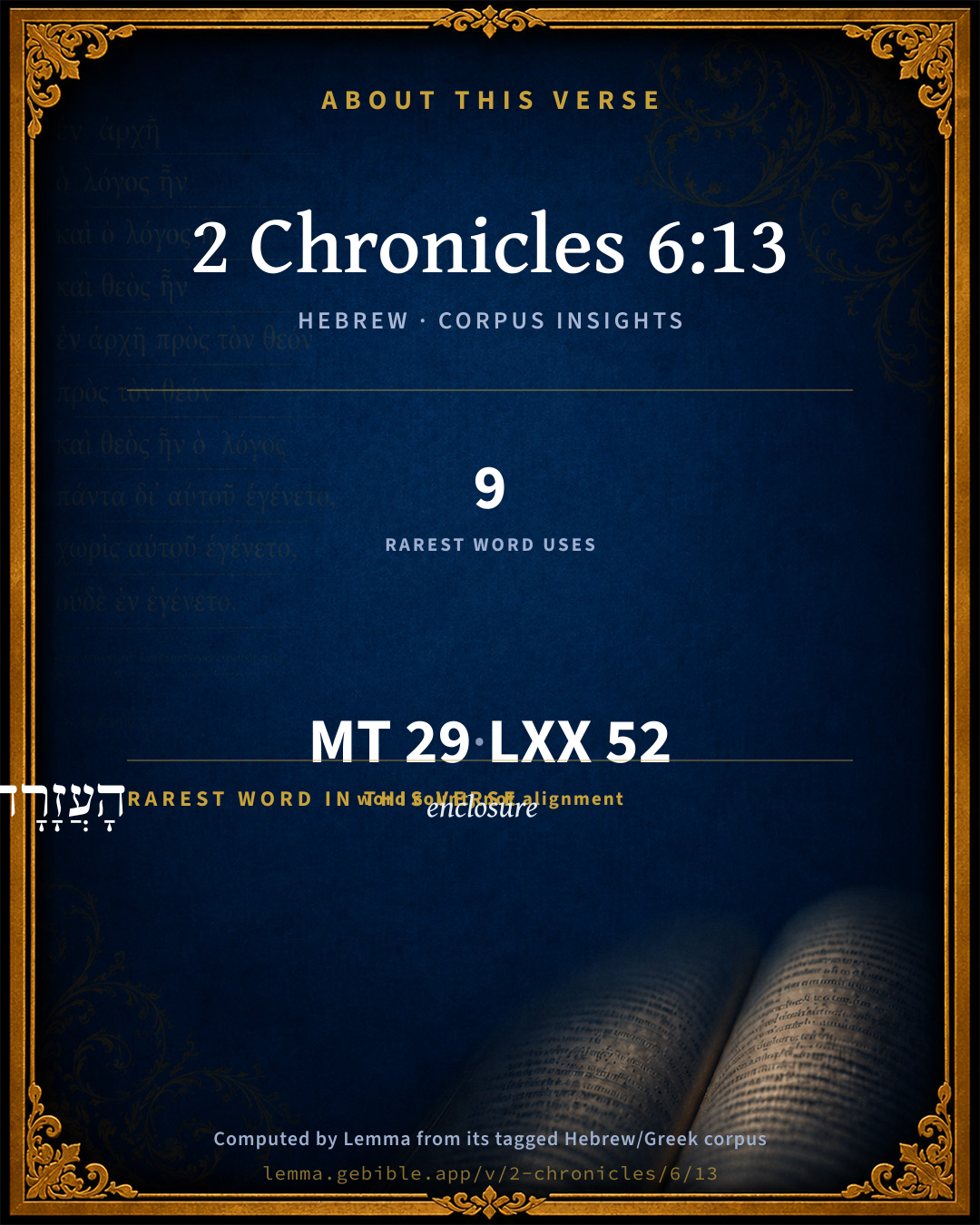
These counts appear in no published source. They are computed here, from the morphology-tagged text and Lemma’s own curated glosses. What Lemma adds →

29
words
25
distinct lemmas
Historical
section

Notable vocabulary

The rarest word here is הָעֲזָרָה֒ enclosure H5835 — appearing just 9 times in the whole Hebrew Bible.

Shared distinctive vocabulary

הָעֲזָרָה֒ enclosure H5835 occurs in 6 verses of the Hebrew Bible. Also found in:

Grammatical profile

  • 5 verbs
  • 17 nouns
  • 3 adjectives
  • 3 prepositions
  • 1 conjunction

Verb forms

  • עָשָׂ֨ה Qal · Perfect
  • וַֽיִּתְּנֵהוּ֮ Qal · Sequential Imperfect
  • וַיַּעֲמֹ֣ד Qal · Sequential Imperfect
  • וַיִּבְרַ֤ךְ Qal · Sequential Imperfect
  • וַיִּפְרֹ֥שׂ Qal · Sequential Imperfect

Repetition

Words recur within this verse — often emphatic in Hebrew:

  • אַמּ֜וֹת cubit H520 ×3
  • חָמֵ֨שׁ five H2568 ×2
  • עָלָ֗יו upon H5921 ×2

Hebrew & Septuagint length

In English translation the verse runs 52 words from the Hebrew and 63 from the Septuagint (LXX English) — closely comparable.

A rough comparison of the two English renderings, which tokenize alike — not a word-level alignment.

Word counts can differ between the Hebrew and the Greek without any difference in meaning — e.g. the Hebrew direct-object marker אֵת has no separate Greek word, and Greek often adds the article ὁ.

In the original languages it is 29 Hebrew tokens and 52 Greek tokens — but the two are counted differently (Hebrew bundles its prefixes and suffixes into one token; the Greek is in lemma form), so that isn’t a like-for-like length.

Cross-references

11

Topical passages linked to 2 Chronicles 6:13 in the Treasury of Scripture Knowledge — connected by theme and wording, ordered by reader-vote popularity; previews shown in the World English Bible.

  • 1 Kings 8:54 It was so, that when Solomon had made an end of praying all this prayer and supplication to Yahweh, he arose from before the altar of Yahweh, from kneeling on his knees with his hands spread forth toward heaven.
  • Nehemiah 8:4 Ezra the scribe stood on a pulpit of wood, which they had made for the purpose; and beside him stood Mattithiah, and Shema, and Anaiah, and Uriah, and Hilkiah, and Maaseiah, on his right hand; and on his left hand, Pedaiah, and Mishael, and Malchijah, and Hashum, and Hashbaddanah, Zechariah, [and] Meshullam.
  • Ezra 9:5 At the evening offering I arose up from my humiliation, even with my garment and my robe torn; and I fell on my knees, and spread out my hands to Yahweh my God;
  • Psalms 95:6 Oh come, let's worship and bow down. Let's kneel before Yahweh, our Maker,
  • 1 Kings 6:36 He built the inner court with three courses of hewn stone, and a course of cedar beams.
  • 1 Kings 7:12 The great court round about had three courses of hewn stone, and a course of cedar beams; like as the inner court of the house of Yahweh, and the porch of the house.
  • 2 Chronicles 4:9 Furthermore he made the court of the priests, and the great court, and doors for the court, and overlaid the doors of them with brass.
  • Daniel 6:10 When Daniel knew that the writing was signed, he went into his house (now his windows were open in his chamber toward Jerusalem) and he kneeled on his knees three times a day, and prayed, and gave thanks before his God, as he did before.
  • Luke 22:41 He was withdrawn from them about a stone's throw, and he knelt down and prayed,
  • Acts 20:36 When he had spoken these things, he knelt down and prayed with them all.
  • Acts 21:5 When it happened that we had accomplished the days, we departed and went on our journey. They all, with wives and children, brought us on our way until we were out of the city. Kneeling down on the beach, we prayed.

Cross-references courtesy of OpenBible.info (CC BY 4.0).

Hebrew and Greek witnesses Masoretic Hebrew ↔ Greek Septuagint

The same verse in the two great witnesses to the Old Testament, shown verse-for-verse.

These are two independent witnesses, not word-aligned to each other, and the Septuagint is shown in lemma (dictionary) form.

Hebrew 2 Chronicles 6:13 Masoretic · Westminster Leningrad Codex

כִּֽי עָשָׂ֨ה שְׁלֹמֹ֜ה כִּיּ֣וֹר נְחֹ֗שֶׁת וַֽיִּתְּנֵהוּ֮ בְּת֣וֹךְ הָעֲזָרָה֒ חָמֵ֨שׁ אַמּ֜וֹת אָרְכּ֗וֹ וְחָמֵ֤שׁ אַמּוֹת֙ רָחְבּ֔וֹ וְאַמּ֥וֹת שָׁל֖וֹשׁ קוֹמָת֑וֹ וַיַּעֲמֹ֣ד עָלָ֗יו וַיִּבְרַ֤ךְ עַל בִּרְכָּיו֙ נֶ֚גֶד כָּל קְהַ֣ל יִשְׂרָאֵ֔ל וַיִּפְרֹ֥שׂ כַּפָּ֖יו הַשָּׁמָֽיְמָה

(for Solomon had made a brazen scaffold, five cubits long, and five cubits broad, and three cubits high, and had set it in the midst of the court; and on it he stood, and kneeled down on his knees before all the assembly of Israel, and spread forth his hands toward heaven;)

World English Bible · Public Domain

Greek LXX 2 Chronicles 6:13 Septuagint · lemma form

ὅτι ποιέω σαλωμών βάσις χαλκοῦς καί τίθημι αὐτός ἐν μέσος ὁ αὐλή ὁ ἱερός πέντε πῆχυς ὁ μῆκος αὐτός καί πέντε πῆχυς ὁ εὖρος αὐτός καί τρεῖς πῆχυς ὁ ὕψος αὐτός καί ἵστημι ἐπί αὐτός καί πίπτω ἐπί ὁ γόνυ ἔναντι πᾶς ἐκκλησία ἰσραήλ καί διαπετάζω ὁ χείρ αὐτός εἰς ὁ οὐρανός

For Solomon had made a brazen scaffold, and set it in the midst of the court of the sanctuary; the length of it was five cubits, and the breadth of it five cubits, and the height of it three cubits: and he stood upon it, and fell upon his knees before the whole congregation of Israel, and spread abroad his hands to heaven,

LXX2012 (modern English Septuagint) · Public Domain

On this verse, Haydock's Catholic Bible Commentary discusses the Septuagint’s reading. Read the note in Commentary ↓

Hebrew: Westminster Leningrad Codex (CC BY 4.0). Greek: Septuagint (public domain); English from LXX2012 (modern English Septuagint) (Public Domain). How the Septuagint differs from the Hebrew →

Commentary

Notes on 2 Chronicles 6:13 from classic Christian and Jewish commentators (each source and its license shown beneath its notes). The classic Christian expositions comment on the surrounding passage and are grouped to its opening verse, so a note may address several verses; the Jewish commentaries on the Tanakh (Rashi and others) are per-verse, so they appear only where the commentator wrote on this verse.

Lemma curates 59 commentaries, every one of them public domain or Creative Commons licensed, each selected and text-cleaned for this edition rather than reprinted as found. About our sources →

Geneva Bible (1599)

Geneva Bible translators

Both to give thanks for the great benefits of God bestowed upon him, and also to pray for the perseverance and prosperity of his people.

Geneva Bible (1599) marginal notes — public domain. Text via Bolls.life.

Jamieson, Fausset & Brown

Robert Jamieson, A. R. Fausset & David Brown

Solomon had made a brazen scaffold--a sort of platform. But the Hebrew term rendered "scaffold," being the same as that used to designate the basin, suggests the idea that this throne might bear some resemblance, in form or structure, to those lavers in the temple, being a sort of round and elevated pulpit, placed in the middle of the court, and in front of the altar of burnt offering.

upon it he stood, and kneeled down upon his knees--After ascending the brazen scaffold, he assumed those two attitudes in succession, and with different objects in view. He stood while he addressed and blessed the surrounding multitude (Ch2 6:3-11). Afterwards he knelt down and stretched out his hands towards heaven, with his face probably turned towards the altar, while he gave utterance to the beautiful and impressive prayer which is recorded in the remainder of this chapter. It is deserving of notice that there was no seat in this pulpit--for the king either stood or knelt all the time he was in it. It is not improbable that it was surmounted by a canopy, or covered by a veil, to screen the royal speaker from the rays of the sun.

Jamieson, Fausset & Brown — Commentary Critical and Explanatory on the Whole Bible (1871) — public domain (CC PDM 1.0). Text via the HelloAO Bible API.

Ellicott's Commentary for English Readers

(13) For Solomon had made a brasen scaffold.—This verse is not in Kings. But it may once have followed 1Ki_8:22. At least, marks of the chronicler’s individual style are not apparent in it.

Scaffold.—Literally, pan (kîyôr; see 2Ch_4:6). The “scaffold” looked like a “laver” turned upside down, and was doubtless hollow underneath. (Comp. Neh_9:4 for an analogous structure.)

Kneeled down upon his knees, and spread forth his hands.—An attitude of prayer which may be seen figured upon the monuments of ancient Egypt.

Toward heaven (ha-shâmấy’mâh).—The chronicler has used the exact form for the less precise hashâmấayim of 1Ki_8:22.

A Bible Commentary for English Readers, edited by Charles John Ellicott (1878–1897) — public domain. Text from a community e-Sword module.

Haydock's Catholic Bible Commentary

Scaffold, (basim.) The Hebrew (kiyor) is used for "a shell, (concha.; Tirinus) or bowl," as the throne was probably of the same form, and was placed on a square pedestal, at the higher end of the court of the people, (Calmet) which is here styled the temple, (basilicæ) or "hall," chap. iv. 9. Septuagint Greek: aules. Hebrew chatsar, which denotes that great court where (Haydock) the body of the people stood bare-headed, before the Lord, (Grotius, &c.; chap. xx. 5.) in the open air. (Du Hamel) --- We are assured that the king himself never sat in his tribune. (Calmet) --- Others reserve that privilege to him alone. (Haydock) --- While he addressed the people, he turned towards them.

George Leo Haydock (1774–1849), Haydock's Catholic Family Bible and Commentary, 1859 edition — public domain. Excludes Psalms (Douay-Rheims chapter numbering differs from Protestant) and Deuterocanonical books (Catholic canon only).

The Pulpit Commentary

A brazen scaffold. The Hebrew word is rwOYKi. The word occurs twenty-one times. It is translated, in the Authorized Version, "laver" eighteen times, once "pan", (1Sa_2:14) once "hearth", (Zec_12:6) and once "scaffold," here. The meaning evidently is that the stand was in some sort basin-shaped.

The Pulpit Commentary (1880–1919), ed. H.D.M. Spence-Jones & Joseph S. Exell — public domain. Text from a community e-Sword module.

Rashi

Rabbi Shlomo Yitzchaki (Rashi)

For Solomon had made This refers back to “opposite all the congregation of Israel,” i.e., how was he higher than all of them to make his words heard?

and he stood on it And now, all Israel could see him, and since he interrupted the topic, he had to repeat, “opposite all the congregation of Israel,” and so, “and he spread forth his hands toward heaven.”

Rashi on the Tanakh — English translations: “The Judaica Press complete Tanach with Rashi, translated by A. J. Rosenberg” (CC BY 4.0); “Pentateuch with Rashi's commentary by M. Rosenbaum and A.M. Silbermann, 1929-1934” (public domain); “The Metsudah Tanach series, Lakewood, N.J” (CC BY 4.0); and “The Book of Joshua, Metsudah Publications, 1997” (CC BY 4.0). Text via Sefaria.

Lesson kit

Teaching starters — assembled from the data on this page, not authored interpretation. Every prompt links to the verse data it draws on. Edit before teaching.

2 Chronicles, in the Historical, opens this verse with 29 words (25 distinct Hebrew lemmas). Its most distinctive word is ʻăzârâh (“enclosure”). A historical commentator’s framing appears above. Read the whole chapter for the surrounding context.

Discussion questions

  1. The word ʻăzârâh carries the sense “enclosure.” How does it shape the verse?
  2. 2 Chronicles 4:9 shares the word «enclosure» with this verse. How do the two illuminate each other?
  3. “cubit” occurs 3× in this one verse. What is the effect of the repetition?
  4. The translations on this page render this verse differently — a whole-verse word diff, not a word-by-word alignment. What might account for the different wordings?
  5. The verb «עָשָׂ֨ה» is Qal Perfect. How does its form color the action?
  6. Reading how Geneva Bible (1599) and Jamieson, Fausset & Brown read this verse, where do the two commentators agree and where do they part?

Things to notice

Reading settings

Reading text

Shown beneath each verse's original-language words.

Old Testament
Old Testament edition

Read the OT as the Masoretic Hebrew (MT) or the Greek Septuagint (LXX).

English shown for the Greek Septuagint (in the Hebrew ↔ Greek comparison).

Comparing translations? Open the Compare panel on any verse page to stack up to four side by side.