Exodus 3:4

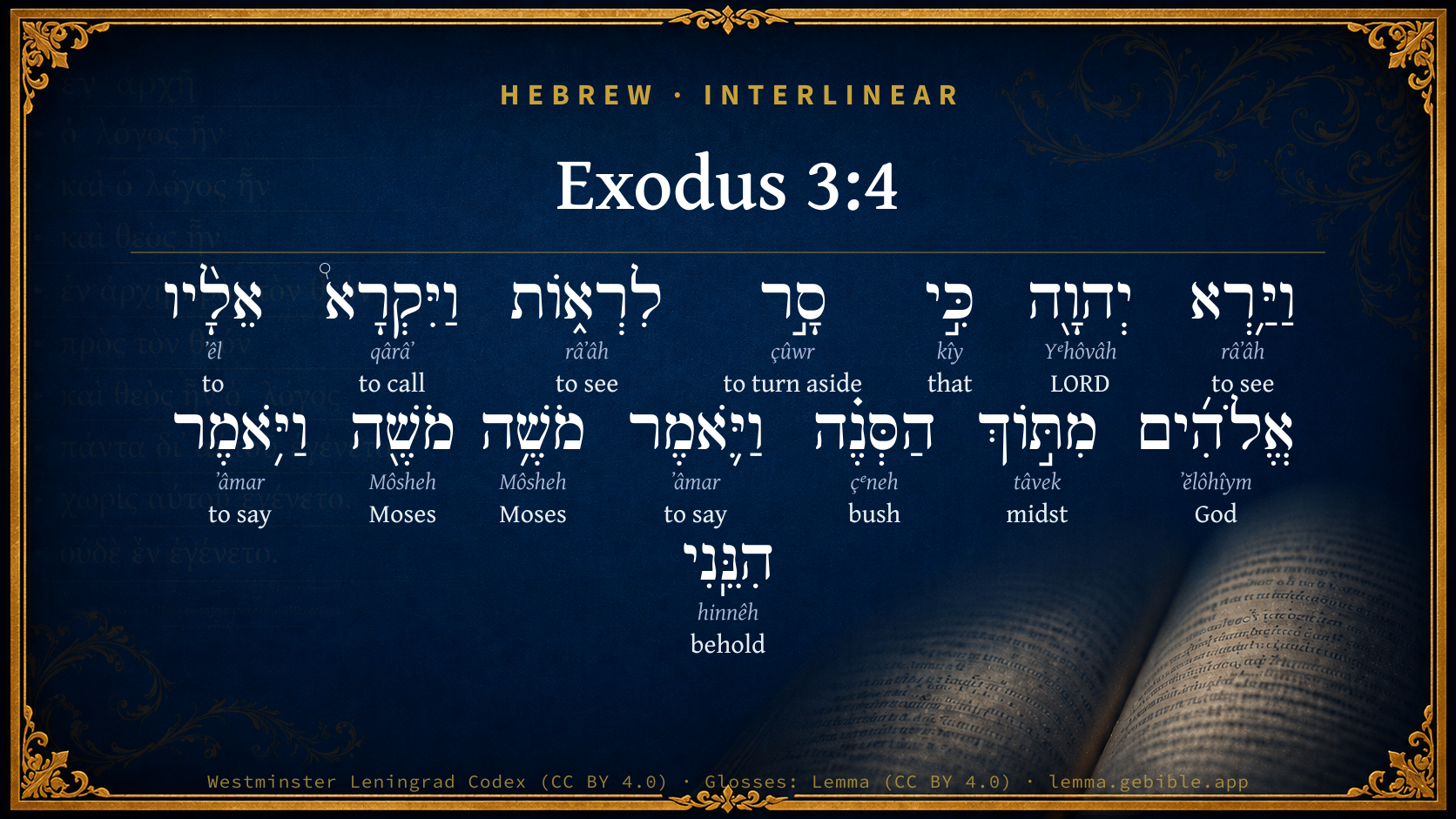
Hebrew (Westminster Leningrad Codex) Exodus 3:4 appears in the Hebrew Old Testament. The text above is from the Westminster Leningrad Codex. Each word links to its Strong’s number, a concise gloss, and parsing drawn from the Open Scriptures Hebrew Bible morphology. Click any word for its full Brown-Driver-Briggs (BDB) entry.
Download image
Cite this verse

Exodus 3:4 (World English Bible). Public Domain. Lemma interlinear Bible study tool, https://lemma.gebible.app/v/exodus/3/4.

Show BibTeX & RIS
BibTeX
RIS
English Translation
When Yahweh saw that he turned aside to see, God called to him out of the midst of the bush, and said, "Moses! Moses!" He said, "Here I am."
World English Bible · Public Domain
Download a study sheet

One document with this verse’s original text, its word-by-word gloss line, the meaning frame, cross-references with their text, attributed commentary, and full source and license credits — printable, and it pastes into notes with its structure intact.

This verse Autodidact and up

Study sheet (.html) Plain text (.txt)

A passage Seminary Student

Up to 50 verses in one chapter. A passage sheet keeps up to 6 commentary sources and 12 cross-references per verse, in the order this page ranks them, and says so on the sheet whenever that leaves anything out. Ask for a single verse and you get the Autodidact verse sheet above.

Everything on this page stays free to read, with no account — the sheet is a download of what is already on screen, not access to it.

Want to remove ads? Support Godless Engineer
Compare translations 3

The same verse in 3 English versions, stacked beneath the original-language interlinear above. Click any original word for its lexicon entry.

Each is an independent rendering of the whole verse — the interlinear is not word-aligned to these translations.

Highlighted words mark where these versions differ — a whole-verse word diff, not a word-by-word alignment.

  • World English Bible Public Domain
    When Yahweh saw that he turned aside to see, God called to him out of the midst of the bush, and said, "Moses! Moses!" He said, "Here I am."
  • King James Version Public Domain
    And when the LORD saw that he turned aside to see, God called unto him out of the midst of the bush, and said, Moses, Moses. And he said, Here am I.
  • unfoldingWord Literal Text CC BY-SA 4.0
    And Yahweh saw that he had turned aside in order to look, and God called to him from the middle of the bush, and he said, “Moses, Moses.” And he said, “Behold me!”

unfoldingWord Literal Text — © unfoldingWord, licensed CC BY-SA 4.0. Word-aligned USFM3 via Door43 (git.door43.org/unfoldingWord/en_ult).

Versions to compare (up to 4)

3 of 4 selected

Show all 18 translations

Every available English version of this verse, each an independent rendering of the whole verse.

  • World English Bible Public Domain
    When Yahweh saw that he turned aside to see, God called to him out of the midst of the bush, and said, "Moses! Moses!" He said, "Here I am."
  • Berean Standard Bible Public Domain
    When the LORD saw that he had gone over to look, God called out to him from within the bush, “Moses, Moses!” “Here I am,” he answered.
  • Majority Standard Bible Public Domain
    When the LORD saw that he had gone over to look, God called out to him from within the bush, “Moses, Moses!” “Here I am,” he answered.
  • King James Version Public Domain
    And when the LORD saw that he turned aside to see, God called unto him out of the midst of the bush, and said, Moses, Moses. And he said, Here am I.
  • American Standard Version (1901) Public Domain
    And when Jehovah saw that he turned aside to see, God called unto him out of the midst of the bush, and said, Moses, Moses. And he said, Here am I.
  • Revised Version (1885) Public Domain
    And when the LORD saw that he turned aside to see, God called unto him out of the midst of the bush, and said, Moses, Moses. And he said, Here am I.
  • Geneva Bible (1599) Public Domain
    And when the Lord sawe that he turned aside to see, God called vnto him out of the middes of the bush, and said, Moses, Moses. And he answered, I am here.
  • Douay-Rheims (1899) Public Domain
    And when the Lord saw that he went forward to see, he called to him out of the midst of the bush, and said: Moses, Moses. And he answered: Here I am.
  • Young's Literal Translation Public Domain
    and Jehovah seeth that he hath turned aside to see, and God calleth unto him out of the midst of the bush, and saith, `Moses, Moses;' and he saith, `Here `am' I.'
  • Literal Standard Version CC BY-SA 4.0
    And YHWH sees that he has turned aside to see, and God calls to him out of the midst of the bush and says, “Moses! Moses!” And he says, “Here I [am].”
  • Unlocked Literal Bible CC BY-SA 4.0
    When Yahweh saw that he had turned aside to look, God called to him out of the bush and said, “Moses, Moses.” Moses said, “Here I am.”
  • unfoldingWord Literal Text CC BY-SA 4.0
    And Yahweh saw that he had turned aside in order to look, and God called to him from the middle of the bush, and he said, “Moses, Moses.” And he said, “Behold me!”
  • Darby Bible Public Domain
    And Jehovah saw that he turned aside to see, and God called to him out of the midst of the thorn-bush and said, Moses, Moses! And he said, Here am I.
  • World Messianic Bible Public Domain
    When the LORD saw that he came over to see, God called to him out of the middle of the bush, and said, “Moses! Moses!” He said, “Here I am.”
  • Webster's Bible Public Domain
    And when the LORD saw that he turned aside to see, God called to him out of the midst of the bush, and said, Moses, Moses. And he said, Here am I.
  • Free Bible Version CC BY-SA 4.0
    When the Lord saw that Moses was coming to take a look, God called to him from inside the bush, “Moses! Moses!” “I'm here,” Moses replied.
  • Bible in Basic English Public Domain
    And when the Lord saw him turning to one side to see, God said his name out of the tree, crying, Moses, Moses. And he said, Here am I.
  • JPS Tanakh (1917) Public Domain
    And when the LORD saw that he turned aside to see, God called unto him out of the midst of the bush, and said: 'Moses, Moses.' And he said: 'Here am I.'

Literal Standard Version (2020), Covenant Press — licensed CC BY-SA 4.0. Text via the HelloAO Bible API (eBible.org). Unlocked Literal Bible (unfoldingWord) — licensed CC BY-SA 4.0. Text via the HelloAO Bible API (eBible.org). unfoldingWord Literal Text — © unfoldingWord, licensed CC BY-SA 4.0. Word-aligned USFM3 via Door43 (git.door43.org/unfoldingWord/en_ult). Free Bible Version, Dr. Jonathan Gallagher — licensed CC BY-SA 4.0. Text via the HelloAO Bible API (eBible.org).

Word by word

More ways to search: Search by grammar → Find every occurrence → Compare this word →

Practice this passage: Drill this verse → Learn its vocabulary →

הַסְּנֶ֗ה
çᵉneh
H5572
“the · bush”
Particle, Definite Article + Noun, Common, Masculine, Singular, Absolute
Part of Speech
Particle + Noun
Type
Common
Gender
Masculine
Number
Singular
State
Absolute
Full BDB Definition

Origin: from an unused root meaning to prick

TWOT: 1520

a bush, thorny bush - the burning bush of Moses - perhaps a blackberry bush
  1. וַיַּ֥רְא râʼâh H7200 “and · to see” Conjunction + Verb, Qal, Sequential Imperfect, 3rd Person, Masculine, Singular
  2. יְהוָ֖ה Yᵉhôvâh H3068 “LORD” Noun, Proper
  3. כִּ֣י kîy H3588 “that” Conjunction
  4. סָ֣ר çûwr H5493 “to turn aside” Verb, Qal, Perfect, 3rd Person, Masculine, Singular
  5. לִרְא֑וֹת râʼâh H7200 “to see” Preposition + Verb, Qal, Infinitive Construct
  6. וַיִּקְרָא֩ qârâʼ H7121 “and · to call” Conjunction + Verb, Qal, Sequential Imperfect, 3rd Person, Masculine, Singular
  7. אֵלָ֨יו ʼêl H413 “to · him” Preposition + Suffix, Personal, 3rd Person, Masculine, Singular
  8. אֱלֹהִ֜ים ʼĕlôhîym H430 “God(s)” Noun, Common, Masculine, Plural, Absolute
  9. מִתּ֣וֹךְ tâvek H8432 “from · midst of” Preposition + Noun, Common, Masculine, Singular, Construct
  10. וַיֹּ֛אמֶר ʼâmar H559 “and · to say” Conjunction + Verb, Qal, Sequential Imperfect, 3rd Person, Masculine, Singular
  11. מֹשֶׁ֥ה Môsheh H4872 “Moses” Noun, Proper
  12. מֹשֶׁ֖ה Môsheh H4872 “Moses” Noun, Proper
  13. וַיֹּ֥אמֶר ʼâmar H559 “and · to say” Conjunction + Verb, Qal, Sequential Imperfect, 3rd Person, Masculine, Singular
  14. הִנֵּֽנִי hinnêh H2009 “behold · me” Particle, Demonstrative + Suffix, Personal, 1st Person, Common, Singular

About this verse

These counts appear in no published source. They are computed here, from the morphology-tagged text and Lemma’s own curated glosses. What Lemma adds →

15
words
12
distinct lemmas
Pentateuch
section

Notable vocabulary

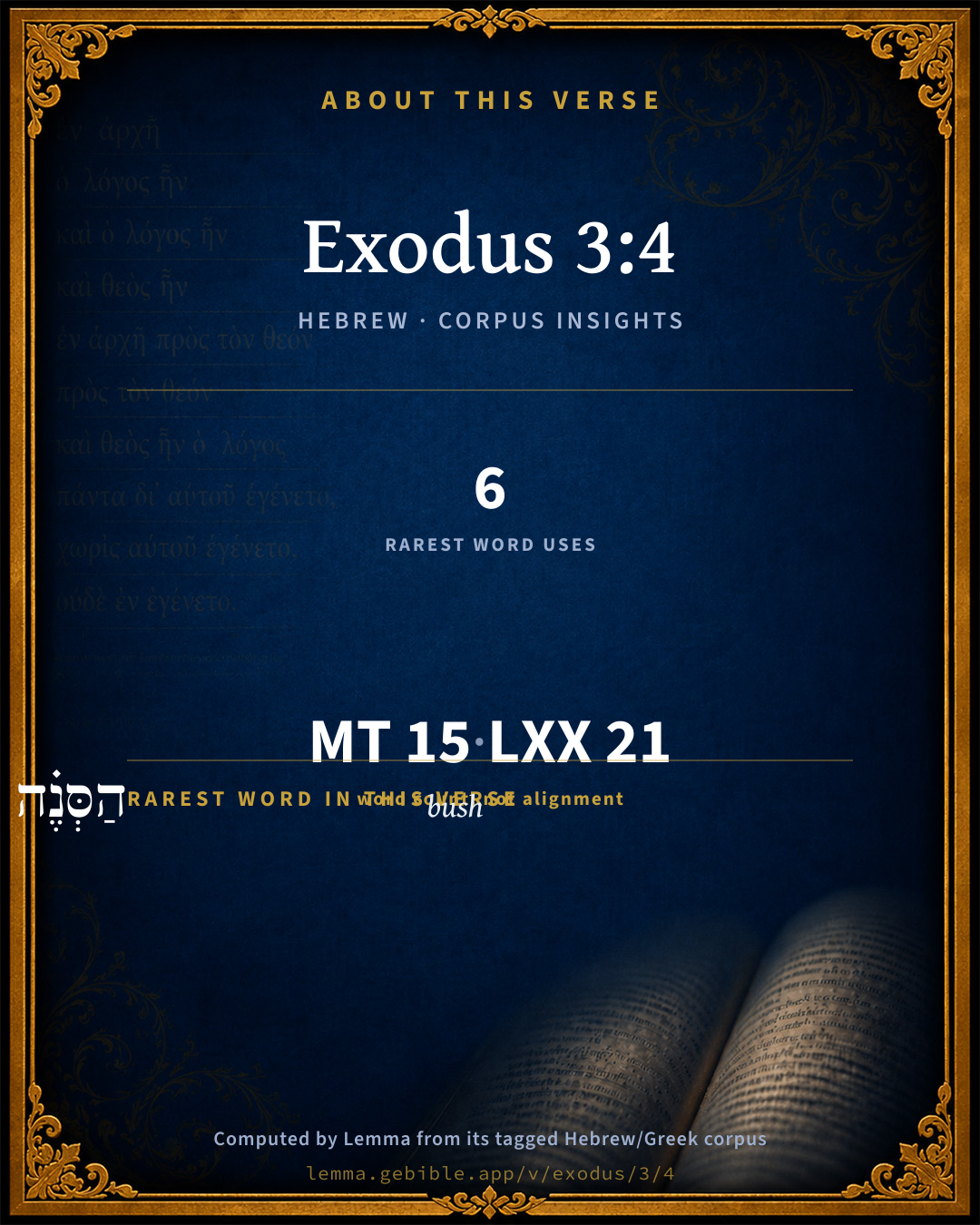
The rarest word here is הַסְּנֶ֗ה bush H5572 — appearing just 6 times in the whole Hebrew Bible.

Shared distinctive vocabulary

הַסְּנֶ֗ה bush H5572 occurs in 4 verses of the Hebrew Bible. Also found in:

Grammatical profile

  • 6 verbs
  • 6 nouns
  • 1 preposition
  • 1 conjunction
  • 1 particle

Verb forms

  • וַיַּ֥רְא Qal · Sequential Imperfect
  • סָ֣ר Qal · Perfect
  • לִרְא֑וֹת Qal · Infinitive Construct
  • וַיִּקְרָא֩ Qal · Sequential Imperfect
  • וַיֹּ֛אמֶר Qal · Sequential Imperfect
  • וַיֹּ֥אמֶר Qal · Sequential Imperfect

Repetition

Words recur within this verse — often emphatic in Hebrew:

  • וַיַּ֥רְא to see H7200 ×2
  • וַיֹּ֛אמֶר to say H559 ×2
  • מֹשֶׁ֥ה Moses H4872 ×2

Hebrew & Septuagint length

In English translation the verse runs 29 words from the Hebrew and 28 from the Septuagint (LXX English) — closely comparable.

A rough comparison of the two English renderings, which tokenize alike — not a word-level alignment.

Word counts can differ between the Hebrew and the Greek without any difference in meaning — e.g. the Hebrew direct-object marker אֵת has no separate Greek word, and Greek often adds the article ὁ.

In the original languages it is 15 Hebrew tokens and 21 Greek tokens — but the two are counted differently (Hebrew bundles its prefixes and suffixes into one token; the Greek is in lemma form), so that isn’t a like-for-like length.

Cross-references

12

Topical passages linked to Exodus 3:4 in the Treasury of Scripture Knowledge — connected by theme and wording, ordered by reader-vote popularity; previews shown in the World English Bible.

  • Deuteronomy 33:16 For the precious things of the earth and the fullness of it, The good will of him who lived in the bush. Let [the blessing] come on the head of Joseph, On the crown of the head of him who was separate from his brothers.
  • Genesis 22:1 It happened after these things, that God tested Abraham, and said to him, "Abraham!" He said, "Here I am."
  • Genesis 22:11 The angel of Yahweh called to him out of the sky, and said, "Abraham, Abraham!" He said, "Here I am."
  • Genesis 46:2 God spoke to Israel in the visions of the night, and said, "Jacob, Jacob!" He said, "Here I am."
  • 1 Samuel 3:4 that Yahweh called Samuel; and he said, Here am I.
  • 1 Samuel 3:6 Yahweh called yet again, Samuel. Samuel arose and went to Eli, and said, Here am I; for you called me. He answered, I didn't call, my son; lie down again.
  • 1 Samuel 3:8 Yahweh called Samuel again the third time. He arose and went to Eli, and said, Here am I; for you called me. Eli perceived that Yahweh had called the child.
  • Acts 9:4 He fell on the earth, and heard a voice saying to him, "Saul, Saul, why do you persecute me?"
  • Psalms 62:11 God has spoken once, Twice I have heard this, That power belongs to God.
  • Acts 10:3 At about the ninth hour of the day, he clearly saw in a vision an angel of God coming to him, and saying to him, "Cornelius!"
  • 1 Samuel 3:10 Yahweh came, and stood, and called as at other times, Samuel, Samuel. Then Samuel said, Speak; for your servant hears.
  • Acts 10:13 A voice came to him, "Rise, Peter, kill and eat!"

Cross-references courtesy of OpenBible.info (CC BY 4.0).

Hebrew and Greek witnesses Masoretic Hebrew ↔ Greek Septuagint

The same verse in the two great witnesses to the Old Testament, shown verse-for-verse.

These are two independent witnesses, not word-aligned to each other, and the Septuagint is shown in lemma (dictionary) form.

Hebrew Exodus 3:4 Masoretic · Westminster Leningrad Codex

וַיַּ֥רְא יְהוָ֖ה כִּ֣י סָ֣ר לִרְא֑וֹת וַיִּקְרָא֩ אֵלָ֨יו אֱלֹהִ֜ים מִתּ֣וֹךְ הַסְּנֶ֗ה וַיֹּ֛אמֶר מֹשֶׁ֥ה מֹשֶׁ֖ה וַיֹּ֥אמֶר הִנֵּֽנִי

When Yahweh saw that he turned aside to see, God called to him out of the midst of the bush, and said, "Moses! Moses!" He said, "Here I am."

World English Bible · Public Domain

Greek LXX Exodus 3:4 Septuagint · lemma form

ὡς δέ ὁράω κύριος ὅτι προςἄγω ὁράω καλέω αὐτός κύριος ἐκ ὁ βάτος λέγω μωυσῆς μωυσῆς ὁ δέ εἶπον τίς εἰμί

And when the Lord saw that he drew near to see, the Lord called him out of the bush, saying, Moses, Moses; and he said, What is it?

LXX2012 (modern English Septuagint) · Public Domain

Hebrew: Westminster Leningrad Codex (CC BY 4.0). Greek: Septuagint (public domain); English from LXX2012 (modern English Septuagint) (Public Domain). How the Septuagint differs from the Hebrew →

Targum (Aramaic paraphrase)

2

The Targum is the ancient Jewish Aramaic paraphrase of the Hebrew Scriptures — an interpretive translation, not the Hebrew text itself. Onkelos (literal) and Pseudo-Jonathan (expansive) render the Torah, and Jonathan the Prophets. Coverage is partial: where no permissively-licensed English translation exists for a verse, only the Aramaic is shown. This is verse-level text, not a word-by-word alignment to the Hebrew.

  1. Targum Onkelos Torah (Genesis–Deuteronomy)
    וַחֲזָא יְיָ אֲרֵי אִתְפְּנֵי לְמֶחֱזֵי וּקְרָא לֵהּ יְיָ מִגוֹ אַסָנָא וַאֲמַר משֶׁה משֶׁה וַאֲמַר הָא אֲנָא:

    (no public-domain English translation for this verse)

    Targum Onkelos — Aramaic: “Onkelos Genesis” (public domain); “Onkelos Exodus” (public domain); “Onkelos Leviticus” (public domain); “Onkelos Numbers” (public domain); “Onkelos Deuteronomy” (public domain). English: “Sefaria Community Translation” (CC0 1.0 (public-domain dedication)); “J.W. Etheridge. The Targums of Onkelos and Jonathan Ben Uzziel on the Pentateuch. London: Longmans, Green, 1862” (public domain). Text via Sefaria.

  2. Targum Pseudo-Jonathan Torah (Genesis–Deuteronomy)
    וּגְלֵי קֳדָם יְיָ אֲרוּם אִיתְפְּנֵי לְמֵיחְמֵי וּקְרָא לֵיהּ יְיָ מִגוֹ סַנְיָא וַאֲמַר משֶׁה משֶׁה וַאֲמַר הָא אֲנָא

    And when it was seen before the Lord that he turned to look, the Lord called to him from the midst of the bush and said, Mosheh, Mosheh! And he said, Behold me.

    Targum Pseudo-Jonathan — Aramaic: “Targum Jonathan on Genesis” (public domain); “Targum Jonathan on Exodus” (public domain); “Targum Jonathan on Leviticus” (public domain); “Targum Jonathan on Numbers” (public domain); “Targum Jonathan on Deuteronomy” (public domain). English: “The Targum of Jonathan ben Uzziel, trans. J. W. Etheridge, London, 1862” (public domain). Text via Sefaria.

Commentary

Notes on Exodus 3:4 from classic Christian and Jewish commentators (each source and its license shown beneath its notes). The classic Christian expositions comment on the surrounding passage and are grouped to its opening verse, so a note may address several verses; the Jewish commentaries on the Tanakh (Rashi and others) are per-verse, so they appear only where the commentator wrote on this verse.

Lemma curates 59 commentaries, every one of them public domain or Creative Commons licensed, each selected and text-cleaned for this edition rather than reprinted as found. About our sources →

Trapp's Complete Commentary

John Trapp

Exo 3:4 And when the LORD saw that he turned aside to see, God called unto him out of the midst of the bush, and said, Moses, Moses. And he said, Here [am] I.

Ver. 4. And when the Lord saw, &c.] God "meeteth him that rejoiceth and worketh righteousness." {Isa 64:5} Acti; agimus. The miller cannot command a wind; yet he will spread his sails, be in the way to have it, if it come. As our liberty, in external acts, is still some - as to come to church, to hear, to repeat, &c. - so must our endeavours be answerable.

John Trapp, A Commentary or Exposition upon All the Books of the Old and New Testament (1647–1656) — public domain. Text from a community e-Sword module.

The Pulpit Commentary

When the Lord saw God called. This collocation of words is fatal in the entire Elohistic and Jehovistic theory, for no one can suppose that two different writers wrote the two clauses of the sentence. Nor, if the same term was originally used in both clauses, would any reviser have altered one without altering both. Out of the midst of the bush. A voice, which was the true voice of God, appeared to Moses to proceed out of the midst of the fire which enveloped the thorn-bush. An objective reality is described, not a vision. Moses, Moses. The double call implies urgency. Compare the call of Samuel. (1Sa_3:10) Vers. 4-6. The prohibition, and the ground of it.

Suddenly the steps of the inquirer are arrested. Wonder upon wonder! a voice calls to him out of the bush, and calls him by his own name, "Moses, Moses!" Now must have dawned on him the conviction that it was indeed a "great thing" which he was witnessing; that the ordinary course of nature was broken in upon; that he was about to be the recipient of one of those wonderful communications which God from time to time had vouchsafed to his forefathers, as to Adam, Enoch, Noah, Abraham, Isaac, and Israel. Hence his submissive, child-like answer, "Here I am." (Compare 1Sa_3:4, 1Sa_3:6) Then came the solemn prohibition, "Draw not nigh hither." Man, until sanctified, until brought into covenant, must not approach near to the dread presence of the Supreme Being. At Sinai Moses was commanded to "set bounds" to keep the people off, that no one might "go up into the mount, nor touch the border of it". (Exo_19:12) The men of Bethshemesh were smitten with death, to the number of 50, 070, for looking into the ark of the covenant. (1Sa_6:19) Uzzah was slain for putting forth his hand to touch it, when he thought that there was danger of its falling. (2Sa_6:7) God, under the Old Covenant, impressed on man in a multitude off ways his unapproachableness. Hence all the arrangements of the Temple; the veil guarding the sanctuary, into which only the high-priest could enter once in the year; the main temple-building, only to be entered by the priests; the courts of the Levites, of the Israelites, and of the Gentiles, each more and more remote from the Divine Presence. Hence the purifications of the priests and of the Levites before they could acceptably offer sacrifice; hence the carrying of the Ark by means of staves forming no part of it; hence the side-chambers of the Temple, emplaced on "rests" in the walls, "that the beams should not be fastened in the walls of the house". (1Ki_6:6) It was so needful to impress on men, apt to conceive of God as "such a one as themselves," his awful majesty, purity, and holiness, that artificial barriers were everywhere created to check man"s rash intrusion into a Presence for which he was unfit. Thus reverence was taught, man was made to know and to feel his own unworthiness, and, little by little, came to have some faint conception of the absolute perfectness and incomprehensible greatness of the Supreme One. Further, God being such as this, each place where he makes himself manifest, becomes at once holy ground. Though "heaven is his throne, and earth his footstool," and no "place" seems worthy of him or can contain him, yet it pleases him, in condescension to our infirmities and our finiteness, to choose some spots rather than others where he will mare himself known and make his presence felt. And these at once are sacred. So was the mount to which Moses went up; so was Shiloh; so was Araunah"s threshingfloor; so was Jerusalem. And so in our own days are churches and the precincts of churches. God"s presence, manifested in them, albeit spiritually and not materially, hallows them. And the reverent heart feels this, and cannot but show its reverence by outward signs. In the East shoos were put off. With us the head should be uncovered, the voice hushed, the eye cast down. We should feel that "God is in the midst of us." So felt Moses, when God had proclaimed himself (ver. 6), and not only bared his feet as commanded, but shrouded his face in his robe "for he was afraid to look upon God." All his own sinfulness and imperfection rushed to his thought, all his unworthiness to behold God and live. Jacob had once seen God "face to face," and had marvelled that "his life was preserved". (Gen_32:30) Moses shut out the awful Vision. So Elijah, on the same site, when he heard the "still small; (1Ki_19:13) and so even the seraphim who wast continually before God"s Throne in heaven. (Isa_6:2) Consciousness of imperfection forces the creature to stand abashed in the presence of the Creator.

The Pulpit Commentary (1880–1919), ed. H.D.M. Spence-Jones & Joseph S. Exell — public domain. Text from a community e-Sword module.

Tyndale Open Study Notes

Tyndale Open Resources

3:4 Moses! Moses! God knows his people by name, and individuals are important to him.

Tyndale Open Study Notes — © Tyndale Open Resources, licensed CC BY-SA 4.0. Text via the HelloAO Bible API.

Geneva Bible (1599)

Geneva Bible translators

Whom he calleth the Angel, verse 2.

Geneva Bible (1599) marginal notes — public domain. Text via Bolls.life.

Jamieson, Fausset & Brown

Robert Jamieson, A. R. Fausset & David Brown

when the Lord saw that he turned aside to see--The manifestations which God anciently made of Himself were always accompanied by clear, unmistakable signs that the communications were really from heaven. This certain evidence was given to Moses. He saw a fire, but no human agent to kindle it; he heard a voice, but no human lips from which it came; he saw no living Being, but One was in the bush, in the heat of the flames, who knew him and addressed him by name. Who could this be but the Divine Being?

Jamieson, Fausset & Brown — Commentary Critical and Explanatory on the Whole Bible (1871) — public domain (CC PDM 1.0). Text via the HelloAO Bible API.

Ellicott's Commentary for English Readers

(4) When the Lord saw . . . God called.—Heb., When Jehovah saw, Elohim called. The German theory of two authors of Exodus, one Jehovistic and the other Elohistic, is completely refuted by this passage; for it is impossible to ascribe one clause of a sentence to one author, and the next to another. If originally the same term had been used in both places, a reviser would not have altered one without altering both.

Moses, Moses.—Comp. Gen_26:11; 1Sa_3:10; and Act_9:4. The repetition marks extreme urgency.

A Bible Commentary for English Readers, edited by Charles John Ellicott (1878–1897) — public domain. Text from a community e-Sword module.

The Cambridge Bible for Schools and Colleges

gen. ed. J. J. S. Perowne

4. And when, &c.] In the Heb., And Jehovah saw …, and God called, &c., to which the division of sources does no violence.

The Cambridge Bible for Schools and Colleges (gen. ed. J. J. S. Perowne; Cambridge University Press, 1878–1918) — public domain. Text from a community e-Sword module.

John Gill's Exposition

And when the Lord saw that he turned aside to see,.... Who is before called the Angel of the Lord, here Jehovah, the omniscient and omnipresent Being, who observing Moses turning aside and going onward to gratify his curiosity, by examining more narrowly this strange phenomenon:

God called unto him out of the midst of the bush; with an articulate voice, being the eternal Word:

and said, Moses, Moses; for the Lord knows his people distinctly, and can call them by name; and the repetition of his name not only shows familiarity and a strong vehement affection for him, but haste to stop him, that he might proceed no further; and this was done in order to stir him up to hearken to what would be said to him:

and he said, here am I; ready to hear what shall be said, and to obey whatever is commanded.

John Gill's Exposition of the Whole Bible (1746–1763) — public domain (CC PDM 1.0). Text via the HelloAO Bible API.

Albert Barnes' Notes on the Bible

The Lord saw - The interchange of the two divine names is to be observed; “Jehovah” (Yahweh) saw, “God” called.

Albert Barnes' Notes on the Bible (1834–1885) — public domain. Text from a community e-Sword/MySword module.

Matthew Poole's English Annotations

He doubles the name, partly to show kindness and familiarity, and principally to make Moses more attentive to the business before him.

Matthew Poole's English Annotations on the Holy Bible (1683–1685) — public domain. Text from a community e-Sword/MySword module.

John Wesley's Explanatory Notes

When the Lord saw that he turned aside to see it, God called to him - If he had carelessly neglected it, it is likely God had departed and said nothing to him. God called and said, Moses, Moses - This which he heard could not but surprise him much more than what he saw. Divine calls are then effectual, when the spirit of God makes them particular, and calls us as by name. The Word calls, Ho, every one; the Spirit, by the application of that, calls, Ho, such a one; I know thee by name. Here am I - Not only to hear what is said, but to do what I am bidden.

John Wesley, Explanatory Notes Upon the Whole Bible (1754–1765) — public domain. Text via the GEBible commentary corpus.

unfoldingWord translationNotes

Door43 World Missions Community

set apart

"made holy"

the God of your father, the God of Abraham, the God of Isaac, and the God of Jacob

All of these men worshiped the same God. AT: "the God of your father, of Abraham, of Isaac, and of Jacob"

your father

Possible meanings are 1) "your ancestor" or 2) "your father." If it means "your ancestor," then the phrases following it clarify who "your father" refers to: it refers to Abraham, Isaac, and Jacob. If it means "your father," then it refers to Moses's own father.

translationWords

set apart

ancestor

Abraham

Isaac

Jacob

unfoldingWord translationNotes — © Distant Shores Media and the Door43 World Missions Community, licensed CC BY-SA 4.0. Source: git.door43.org/Door43/en_tn.

Lesson kit

Teaching starters — assembled from the data on this page, not authored interpretation. Every prompt links to the verse data it draws on. Edit before teaching.

Exodus, in the Pentateuch, opens this verse with 15 words (12 distinct Hebrew lemmas). Its most distinctive word is çᵉneh (“bush”). A historical commentator’s framing appears above. Read the whole chapter for the surrounding context.

Discussion questions

  1. How does “bush” (çᵉneh) shape what this verse is saying?
  2. How does Exodus 3:2, which shares the word «bush», read alongside this verse?
  3. What does the repetition of “to see” (2× in this one verse) do in this verse?
  4. These translations render this verse differently; the difference is in the English rendering, not the original. What questions does that raise?
  5. «וַיַּ֥רְא» is a Qal Sequential Imperfect verb. How does that grammatical form shape the action described?
  6. Compare how Trapp's Complete Commentary and The Pulpit Commentary read this verse. Where do they agree or differ?

Things to notice

Reading settings

Reading text

Shown beneath each verse's original-language words.

Old Testament
Old Testament edition

Read the OT as the Masoretic Hebrew (MT) or the Greek Septuagint (LXX).

English shown for the Greek Septuagint (in the Hebrew ↔ Greek comparison).

Comparing translations? Open the Compare panel on any verse page to stack up to four side by side.