
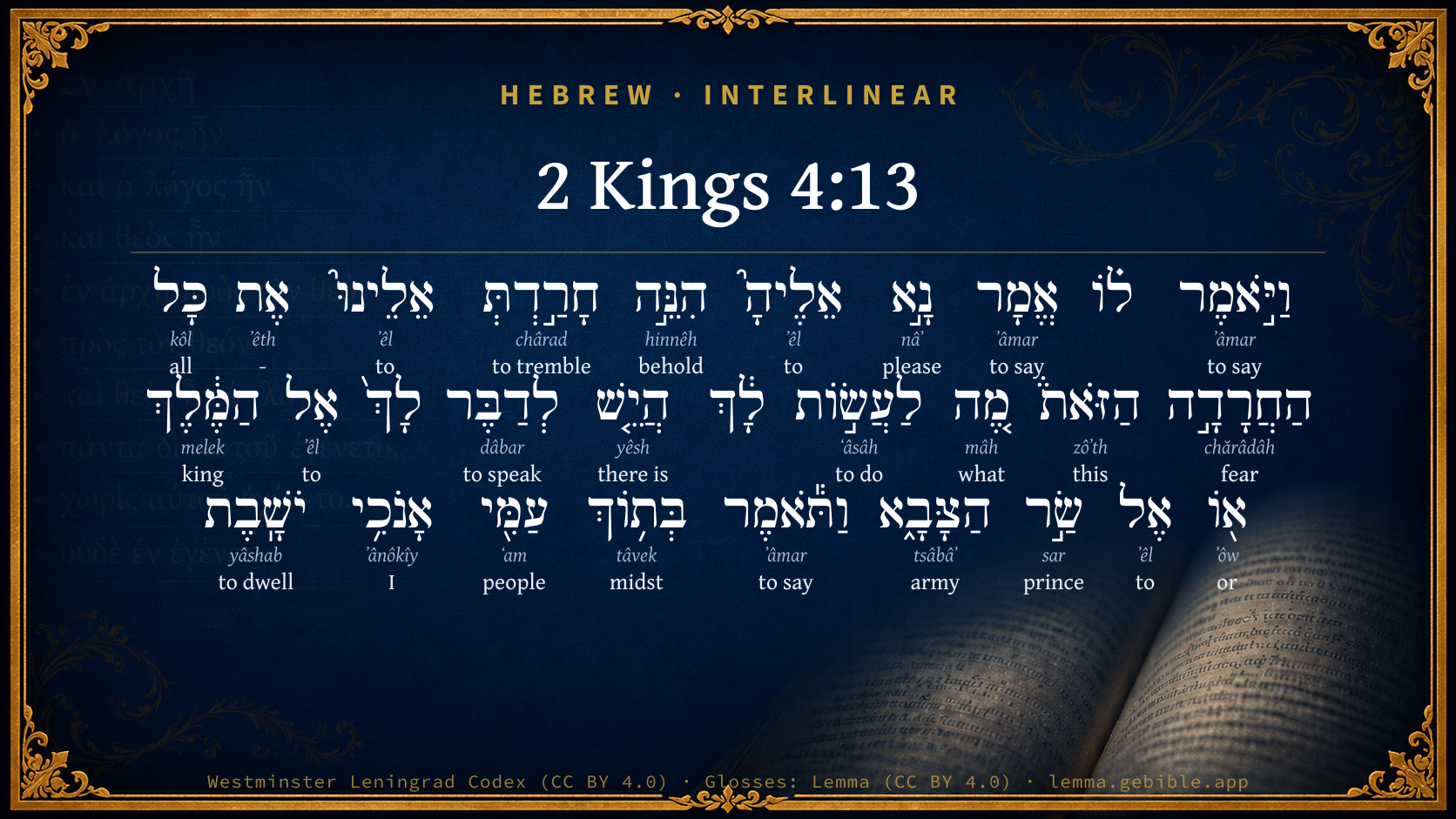
2 Kings 4:13

Hebrew (Westminster Leningrad Codex) 2 Kings 4:13 appears in the Hebrew Old Testament. The text above is from the Westminster Leningrad Codex. Each word links to its Strong’s number, a concise gloss, and parsing drawn from the Open Scriptures Hebrew Bible morphology. Click any word for its full Brown-Driver-Briggs (BDB) entry.
Download image
Cite this verse

2 Kings 4:13 (World English Bible). Public Domain. Lemma interlinear Bible study tool, https://lemma.gebible.app/v/2-kings/4/13.

Show BibTeX & RIS
BibTeX
RIS
English Translation
He said to him, Say now to her, Behold, you have been careful for us with all this care; what is to be done for you? would you be spoken for to the king, or to the captain of the host? She answered, I dwell among my own people.
World English Bible · Public Domain
Download a study sheet

One document with this verse’s original text, its word-by-word gloss line, the meaning frame, cross-references with their text, attributed commentary, and full source and license credits — printable, and it pastes into notes with its structure intact.

This verse Autodidact and up

Study sheet (.html) Plain text (.txt)

A passage Seminary Student

Up to 50 verses in one chapter. A passage sheet keeps up to 6 commentary sources and 12 cross-references per verse, in the order this page ranks them, and says so on the sheet whenever that leaves anything out. Ask for a single verse and you get the Autodidact verse sheet above.

Everything on this page stays free to read, with no account — the sheet is a download of what is already on screen, not access to it.

Want to remove ads? Support Godless Engineer
Compare translations 3

The same verse in 3 English versions, stacked beneath the original-language interlinear above. Click any original word for its lexicon entry.

Each is an independent rendering of the whole verse — the interlinear is not word-aligned to these translations.

Highlighted words mark where these versions differ — a whole-verse word diff, not a word-by-word alignment.

  • World English Bible Public Domain
    He said to him, Say now to her, Behold, you have been careful for us with all this care; what is to be done for you? would you be spoken for to the king, or to the captain of the host? She answered, I dwell among my own people.
  • King James Version Public Domain
    And he said unto him, Say now unto her, Behold, thou hast been careful for us with all this care; what is to be done for thee? wouldest thou be spoken for to the king, or to the captain of the host? And she answered, I dwell among mine own people.
  • unfoldingWord Literal Text CC BY-SA 4.0
    And he said to him, “Please say to her, ‘Behold, you have cared all of this care for us. What to do for you? Is there to speak for you to the king or to the commander of the army?’” But she said, “I am living in the midst of my people.”

unfoldingWord Literal Text — © unfoldingWord, licensed CC BY-SA 4.0. Word-aligned USFM3 via Door43 (git.door43.org/unfoldingWord/en_ult).

Versions to compare (up to 4)

3 of 4 selected

Show all 18 translations

Every available English version of this verse, each an independent rendering of the whole verse.

  • World English Bible Public Domain
    He said to him, Say now to her, Behold, you have been careful for us with all this care; what is to be done for you? would you be spoken for to the king, or to the captain of the host? She answered, I dwell among my own people.
  • Berean Standard Bible Public Domain
    and Elisha said to Gehazi, “Now tell her, ‘Look, you have gone to all this trouble for us. What can we do for you? Can we speak on your behalf to the king or the commander of the army?’” “I have a home among my own people,” she replied.
  • Majority Standard Bible Public Domain
    and Elisha said to Gehazi, “Now tell her, ‘Look, you have gone to all this trouble for us. What can we do for you? Can we speak on your behalf to the king or the commander of the army?’” “I have a home among my own people,” she replied.
  • King James Version Public Domain
    And he said unto him, Say now unto her, Behold, thou hast been careful for us with all this care; what is to be done for thee? wouldest thou be spoken for to the king, or to the captain of the host? And she answered, I dwell among mine own people.
  • American Standard Version (1901) Public Domain
    And he said unto him, Say now unto her, Behold, thou hast been careful for us with all this care; what is to be done for thee? wouldest thou be spoken for to the king, or to the captain of the host? And she answered, I dwell among mine own people.
  • Revised Version (1885) Public Domain
    And he said unto him, Say now unto her, Behold, thou hast been careful for us with all this care; what is to be done for thee? wouldest thou be spoken for to the king, or to the captain of the host? And she answered, I dwell among mine own people.
  • Geneva Bible (1599) Public Domain
    Then he sayd vnto him, Say vnto her now, Beholde, thou hast had all this great care for vs, what shall we doe for thee? Is there any thing to bee spoken for thee to the King or to the captaine of the hoste? And shee answered, I dwell among mine owne people.
  • Douay-Rheims (1899) Public Domain
    He said to his servant: Say to her Behold thou hast diligently served us in all things, what wilt thou have me to de for thee? hast thou any business, and wilt thou that I speak to the king, or to the general of the army? And she answered: I dwell in the midst of my own people.
  • Young's Literal Translation Public Domain
    And he saith to him, `Say, I pray thee, unto her, Lo, thou hast troubled thyself concerning us with all this trouble; what -- to do for thee? is it to speak for thee unto the king, or unto the head of the host?' and she saith, `In the midst of my people I am dwelling.'
  • Literal Standard Version CC BY-SA 4.0
    And he says to him, “Now say to her, Behold, you have troubled yourself concerning us with all this trouble; what can [I] do for you? Is it to speak for you to the king, or to the head of the host?” And she says, “I am dwelling in the midst of my people.”
  • Unlocked Literal Bible CC BY-SA 4.0
    Elisha said to him, “Say to her, 'You have gone to all this trouble to care for us. What can be done for you? Can we speak for you to the king or to the army commander?'” She answered, “I live among my own people.”
  • unfoldingWord Literal Text CC BY-SA 4.0
    And he said to him, “Please say to her, ‘Behold, you have cared all of this care for us. What to do for you? Is there to speak for you to the king or to the commander of the army?’” But she said, “I am living in the midst of my people.”
  • Darby Bible Public Domain
    And he said to him, Say now to her, Behold, thou hast been careful for us with all this care; what is to be done for thee? wouldest thou be spoken for to the king, or to the captain of the host? And she said, I dwell among mine own people.
  • World Messianic Bible Public Domain
    He said to him, “Say now to her, ‘Behold, you have cared for us with all this care. What is to be done for you? Would you like to be spoken for to the king, or to the captain of the army?’” She answered, “I dwell among my own people.”
  • Webster's Bible Public Domain
    And he said to him, Say now to her, Behold, thou hast been careful for us with all this care; what is to be done for thee? wouldst thou be spoken for to the king, or to the captain of the host? And she answered, I dwell among my own people.
  • Free Bible Version CC BY-SA 4.0
    Elisha said to Gehazi, “Please tell her, ‘You have gone to a lot of trouble on our behalf. Now what can we do for you? Do you want us to speak for you to the king or the army commander?’” “I live with my own people,” she replied.
  • Bible in Basic English Public Domain
    And he said to him, Now say to her, See, you have taken all this trouble for us; what is to be done for you? will you have any request made for you to the king or the captain of the army? But she said, I am living among my people.
  • JPS Tanakh (1917) Public Domain
    And he said unto him: 'Say now unto her: Behold, thou hast been careful for us with all this care; what is to be done for thee? wouldest thou be spoken for to the king, or to the captain of the host?' And she answered: 'I dwell among mine own people.'

Literal Standard Version (2020), Covenant Press — licensed CC BY-SA 4.0. Text via the HelloAO Bible API (eBible.org). Unlocked Literal Bible (unfoldingWord) — licensed CC BY-SA 4.0. Text via the HelloAO Bible API (eBible.org). unfoldingWord Literal Text — © unfoldingWord, licensed CC BY-SA 4.0. Word-aligned USFM3 via Door43 (git.door43.org/unfoldingWord/en_ult). Free Bible Version, Dr. Jonathan Gallagher — licensed CC BY-SA 4.0. Text via the HelloAO Bible API (eBible.org).

Word by word

More ways to search: Search by grammar → Find every occurrence → Compare this word →

Practice this passage: Drill this verse → Learn its vocabulary →

הַחֲרָדָ֣ה
chărâdâh
H2731
“the · fear”
Particle, Definite Article + Noun, Common, Feminine, Singular, Absolute
Part of Speech
Particle + Noun
Type
Common
Gender
Feminine
Number
Singular
State
Absolute
Full BDB Definition

Origin: from H2730

TWOT: 735b

fear, anxiety, quaking, trembling, (extreme) anxiety, anxious care - trembling, quaking - anxious care
  1. וַיֹּ֣אמֶר ʼâmar H559 “and · to say” Conjunction + Verb, Qal, Sequential Imperfect, 3rd Person, Masculine, Singular
  2. אֱמָר ʼâmar H559 “say” Verb, Qal, Imperative, 2nd Person, Masculine, Singular
  3. נָ֣א nâʼ H4994 “please” Particle, Exhortation
  4. אֵלֶיהָ֮ ʼêl H413 “to · her” Preposition + Suffix, Personal, 3rd Person, Feminine, Singular
  5. הִנֵּ֣ה hinnêh H2009 “behold” Particle, Demonstrative
  6. חָרַ֣דְתְּ chârad H2729 “to tremble” Verb, Qal, Perfect, 2nd Person, Feminine, Singular
  7. אֵלֵינוּ֮ ʼêl H413 “to · us” Preposition + Suffix, Personal, 1st Person, Common, Plural
  8. אֶת ʼêth H853 “-” Particle, Direct Object
  9. כָּל kôl H3605 “all of” Noun, Common, Masculine, Singular, Construct
  10. הַזֹּאת֒ zôʼth H2063 “the · this” Particle, Definite Article + Pronoun, Demonstrative, Feminine, Singular
  11. מֶ֚ה mâh H4100 “what” Particle, Interrogative
  12. לַעֲשׂ֣וֹת ʻâsâh H6213 “to do” Preposition + Verb, Qal, Infinitive Construct
  13. הֲיֵ֤שׁ yêsh H3426 “there is” Particle, Interrogative + Particle, Demonstrative
  14. לְדַבֶּר dâbar H1696 “to speak” Preposition + Verb, Piel, Infinitive Construct
  15. אֶל ʼêl H413 “to” Preposition
  16. הַמֶּ֔לֶךְ melek H4428 “the · king” Particle, Definite Article + Noun, Common, Masculine, Singular, Absolute
  17. א֖וֹ ʼôw H176 “or” Conjunction
  18. אֶל ʼêl H413 “to” Preposition
  19. שַׂ֣ר sar H8269 “prince of” Noun, Common, Masculine, Singular, Construct
  20. הַצָּבָ֑א tsâbâʼ H6635 “the · army” Particle, Definite Article + Noun, Common, Both, Singular, Absolute
  21. וַתֹּ֕אמֶר ʼâmar H559 “and · to say” Conjunction + Verb, Qal, Sequential Imperfect, 3rd Person, Feminine, Singular
  22. בְּת֥וֹךְ tâvek H8432 “in/at · midst of” Preposition + Noun, Common, Masculine, Singular, Construct
  23. עַמִּ֖י ʻam H5971 “people · my” Noun, Common, Masculine, Singular, Construct + Suffix, Personal, 1st Person, Common, Singular
  24. אָנֹכִ֥י ʼânôkîy H595 “I” Pronoun, Personal, 1st Person, Common, Singular
  25. יֹשָֽׁבֶת yâshab H3427 “dwelling” Verb, Qal, Participle Active, Feminine, Singular, Absolute

About this verse

These counts appear in no published source. They are computed here, from the morphology-tagged text and Lemma’s own curated glosses. What Lemma adds →

29
words
21
distinct lemmas
Historical
section

Notable vocabulary

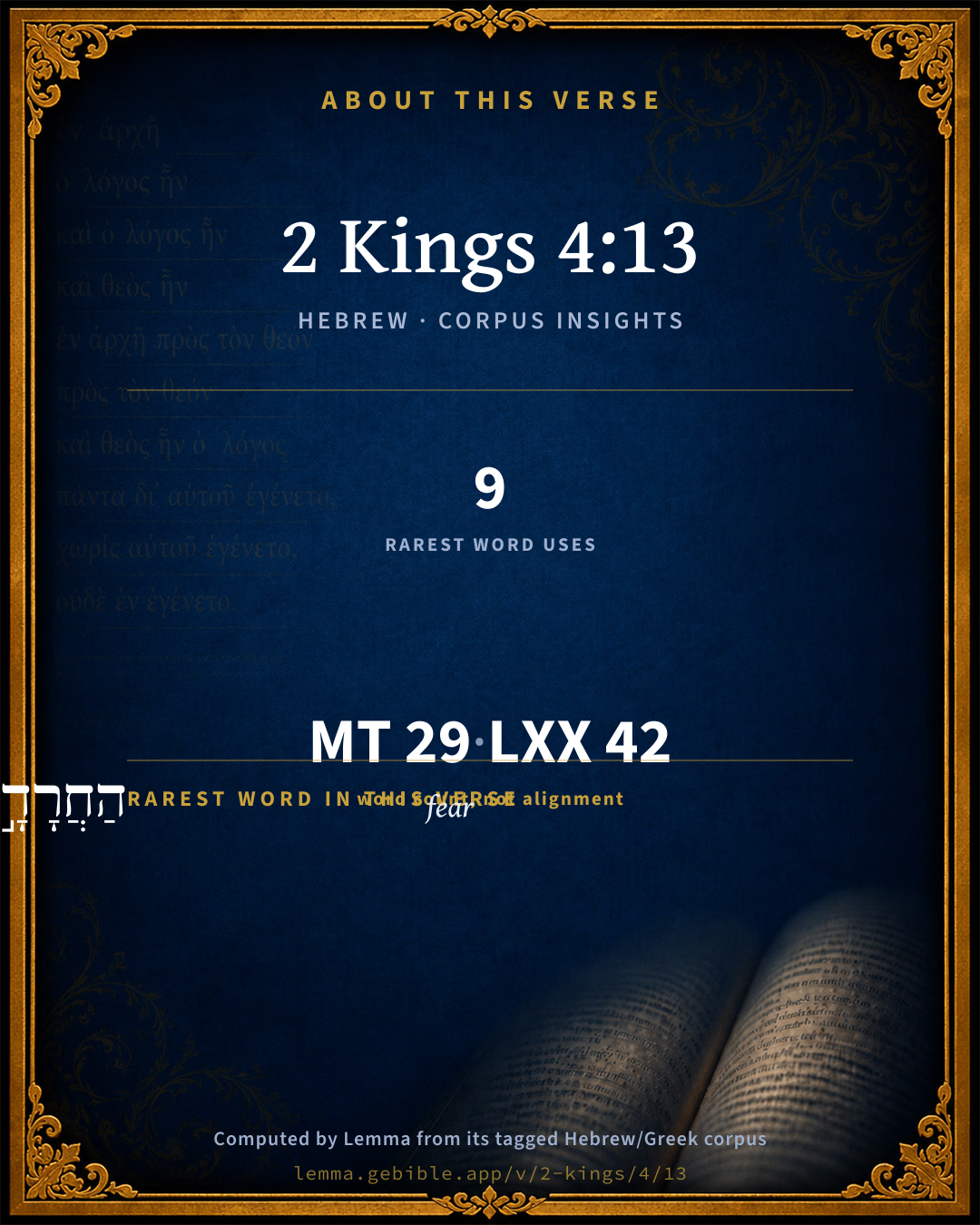
The rarest word here is הַחֲרָדָ֣ה fear H2731 — appearing just 9 times in the whole Hebrew Bible.

Shared distinctive vocabulary

הַחֲרָדָ֣ה fear H2731 occurs in 8 verses of the Hebrew Bible. Also found in:

Grammatical profile

  • 7 verbs
  • 7 nouns
  • 2 pronouns
  • 7 prepositions
  • 1 conjunction
  • 5 particles

Verb forms

  • וַיֹּ֣אמֶר Qal · Sequential Imperfect
  • אֱמָר Qal · Imperative
  • חָרַ֣דְתְּ Qal · Perfect
  • לַעֲשׂ֣וֹת Qal · Infinitive Construct
  • לְדַבֶּר Piel · Infinitive Construct
  • וַתֹּ֕אמֶר Qal · Sequential Imperfect
  • יֹשָֽׁבֶת Qal · Participle Active

Repetition

Words recur within this verse — often emphatic in Hebrew:

  • וַיֹּ֣אמֶר to say H559 ×3
  • אֵלֶיהָ֮ to H413 ×4

Hebrew & Septuagint length

In English translation the verse runs 49 words from the Hebrew and 51 from the Septuagint (LXX English) — closely comparable.

A rough comparison of the two English renderings, which tokenize alike — not a word-level alignment.

Word counts can differ between the Hebrew and the Greek without any difference in meaning — e.g. the Hebrew direct-object marker אֵת has no separate Greek word, and Greek often adds the article ὁ.

In the original languages it is 29 Hebrew tokens and 42 Greek tokens — but the two are counted differently (Hebrew bundles its prefixes and suffixes into one token; the Greek is in lemma form), so that isn’t a like-for-like length.

Cross-references

20

Topical passages linked to 2 Kings 4:13 in the Treasury of Scripture Knowledge — connected by theme and wording, ordered by reader-vote popularity; previews shown in the World English Bible.

  • 2 Timothy 1:16–18 May the Lord grant mercy to the house of Onesiphorus, for he often refreshed me, and was not ashamed of my chain,
  • Philippians 4:18–19 But I have all things, and abound. I am filled, having received from Epaphroditus the things that came from you, a sweet-smelling fragrance, an acceptable and well-pleasing sacrifice to God.
  • Hebrews 6:10 For God is not unrighteous, so as to forget your work and the labor of love which you showed toward his name, in that you served the saints, and still do serve them.
  • 1 Timothy 6:6–8 But godliness with contentment is great gain.
  • 1 Thessalonians 5:12–13 But we beg you, brothers, to know those who labor among you, and are over you in the Lord, and admonish you,
  • Romans 16:6 Greet Mary, who labored much for us.
  • Hebrews 13:5 Be free from the love of money, content with such things as you have, for he has said, "I will in no way leave you, neither will I in any way forsake you."
  • 2 Samuel 19:13 Say you to Amasa, Aren't you my bone and my flesh? God do so to me, and more also, if you aren't captain of the host before me continually in the room of Joab.
  • Psalms 37:3 Trust in Yahweh, and do good. Dwell in the land, and enjoy safe pasture.
  • Matthew 10:40–42 He who receives you receives me, and he who receives me receives him who sent me.
  • Romans 16:2 that you receive her in the Lord, in a way worthy of the saints, and that you assist her in whatever matter she may need from you, for she herself also has been a helper of many, and of my own self.
  • Genesis 14:24 Except only that which the young men have eaten, and the portion of the men who went with me, Aner, Eshcol, and Mamre: let them take their portion."
  • Ruth 1:1–4 It happened in the days when the judges judged, that there was a famine in the land. A certain man of Bethlehem Judah went to sojourn in the country of Moab, he, and his wife, and his two sons.
  • 2 Samuel 19:32–38 Now Barzillai was a very aged man, even eighty years old: and he had provided the king with sustenance while he lay at Mahanaim; for he was a very great man.
  • 1 Kings 2:32 Yahweh will return his blood on his own head, because he fell on two men more righteous and better than he, and killed them with the sword, and my father David didn't know it, [to wit], Abner the son of Ner, captain of the host of Israel, and Amasa the son of Jether, captain of the host of Judah.
  • 2 Kings 3:15–18 But now bring me a minstrel. It happened, when the minstrel played, that the hand of Yahweh came on him.
  • 2 Kings 8:1 Now Elisha had spoken to the woman, whose son he had restored to life, saying, Arise, and go you and your household, and sojourn wherever you can sojourn: for Yahweh has called for a famine; and it shall also come on the land seven years.
  • 2 Kings 8:3–6 It happened at the seven years' end, that the woman returned out of the land of the Philistines: and she went forth to cry to the king for her house and for her land.
  • 2 Kings 9:5 When he came, behold, the captains of the host were sitting; and he said, I have an errand to you, captain. Jehu said, To which of us all? He said, To you, O captain.
  • Luke 9:3–5 He said to them, "Take nothing for your journey--neither staffs, nor wallet, nor bread, nor money; neither have two coats apiece.

Cross-references courtesy of OpenBible.info (CC BY 4.0).

Hebrew and Greek witnesses Masoretic Hebrew ↔ Greek Septuagint

The same verse in the two great witnesses to the Old Testament, shown verse-for-verse.

These are two independent witnesses, not word-aligned to each other, and the Septuagint is shown in lemma (dictionary) form.

Hebrew 2 Kings 4:13 Masoretic · Westminster Leningrad Codex

וַיֹּ֣אמֶר ל֗וֹ אֱמָר נָ֣א אֵלֶיהָ֮ הִנֵּ֣ה חָרַ֣דְתְּ אֵלֵינוּ֮ אֶת כָּל הַחֲרָדָ֣ה הַזֹּאת֒ מֶ֚ה לַעֲשׂ֣וֹת לָ֔ךְ הֲיֵ֤שׁ לְדַבֶּר לָךְ֙ אֶל הַמֶּ֔לֶךְ א֖וֹ אֶל שַׂ֣ר הַצָּבָ֑א וַתֹּ֕אמֶר בְּת֥וֹךְ עַמִּ֖י אָנֹכִ֥י יֹשָֽׁבֶת

He said to him, Say now to her, Behold, you have been careful for us with all this care; what is to be done for you? would you be spoken for to the king, or to the captain of the host? She answered, I dwell among my own people.

World English Bible · Public Domain

Greek LXX 2 Kings 4:13 Septuagint · lemma form

καί εἶπον αὐτός εἶπον δή πρός αὐτός ἰδού ἐκἵστημι ἐγώ πᾶς ὁ ἔκστασις οὗτος τίς δέω ποιέω σύ εἰ εἰμί λόγος σύ πρός ὁ βασιλεύς ἤ πρός ὁ ἄρχων ὁ δύναμις ὁ δέ εἶπον ἐν μέσος ὁ λαός ἐγώ ἐγώ εἰμί οἰκέω

And he said to him, Say now to her, Behold, you have taken all this trouble for us; what should I do for you? Have you any request to make to the king, or to the captain of the host? And she said, I dwell in the midst of my people.

LXX2012 (modern English Septuagint) · Public Domain

On this verse, The Cambridge Bible for Schools and Colleges discusses the Septuagint’s reading. Read the note in Commentary ↓

Hebrew: Westminster Leningrad Codex (CC BY 4.0). Greek: Septuagint (public domain); English from LXX2012 (modern English Septuagint) (Public Domain). How the Septuagint differs from the Hebrew →

Targum (Aramaic paraphrase)

1

The Targum is the ancient Jewish Aramaic paraphrase of the Hebrew Scriptures — an interpretive translation, not the Hebrew text itself. Onkelos (literal) and Pseudo-Jonathan (expansive) render the Torah, and Jonathan the Prophets. Coverage is partial: where no permissively-licensed English translation exists for a verse, only the Aramaic is shown. This is verse-level text, not a word-by-word alignment to the Hebrew.

  1. Targum Jonathan Prophets (Joshua–Malachi)
    וַאֲמַר לֵיהּ אֱמַר כְּעַן לָהּ הָא עַסֵקְתָּא לָנָא יַת כָּל עִסְקָא הָדָא מֶה לְמֶעְבַּד לִיךְ הֲפִתְגַם אִית לִיךְ לְמַלָלָא עִם מַלְכָּא אוֹ עִם רַב חֵילָא וַאֲמַרַת בְּגוֹ עִסְקֵי עַמִי אֲנָא מְסוֹבָרָא:

    (no public-domain English translation for this verse)

    Targum Jonathan — Aramaic: “Mikraot Gedolot” (public domain). English: “Sefaria Community Translation” (CC0 1.0 (public-domain dedication)); “London "Chaldee Paraphrase," 1871” (public domain). Text via Sefaria.

Commentary

Notes on 2 Kings 4:13 from classic Christian and Jewish commentators (each source and its license shown beneath its notes). The classic Christian expositions comment on the surrounding passage and are grouped to its opening verse, so a note may address several verses; the Jewish commentaries on the Tanakh (Rashi and others) are per-verse, so they appear only where the commentator wrote on this verse.

Lemma curates 59 commentaries, every one of them public domain or Creative Commons licensed, each selected and text-cleaned for this edition rather than reprinted as found. About our sources →

Trapp's Complete Commentary

John Trapp

2Ki 4:13 And he said unto him, Say now unto her, Behold, thou hast been careful for us with all this care; what [is] to be done for thee? wouldest thou be spoken for to the king, or to the captain of the host? And she answered, I dwell among mine own people.

Ver. 13. Behold thou hast been careful for us.] A gracious man is a grateful man, and studieth retribution.

I dwell among mine own people.] Privately and peaceably, having no business at court; not affecting great friendships, nor groaning under great oppressions. All this was well, if it might have held. The old Greeks gave this grave counsel, saith Suidas,

“αλευ απο μειζονος ανδρος.” - Suidas.

i.e., Keep aloof from great ones. And the Latin poets say well,

“ Dulcis inexpertis cultura potentis amici,

Expertus metuet … - Horat.

“ Vive tibi, quantumque potes, praelustria vita. ” - Ovid.

But what hold is there of these earthly things? saith another; how long is the Shunammite thus blessed with peace? Stay but a while, you shall see her come on her knees to the king of Israel, pitifully complaining that she was stripped of house and land: and how Gehazi is fain to do that good office for her, which was not accepted from his master. {a} Those that stand fastest upon earth, have but slippery footing. No man can say that he shall not need friends.

{a} Bp. Hall.

John Trapp, A Commentary or Exposition upon All the Books of the Old and New Testament (1647–1656) — public domain. Text from a community e-Sword module.

The Biblical Illustrator

Joseph S. Exell

2Ki_4:13

I dwell among mine own people.

Influence

We contend that there is not a man, who does not dwell among a host of persons who are under his influence, who listen to his voice, and echo his thoughts. None are so mean and powerless as not to shape and bend in some way the mind of an acquaintance. None stand perfectly alone. The distant planets which are jostled in their orbits by the power of another sphere, are but the type of the moral universe, in which one star not only differeth from another star in glory, but kindles a thousand sympathies, and lights a thousand reflective fires.

I. It is the eminent prerogative of the mother to be the educator of the family; a truth which is alike in the expression our mother tongue and our mother country. The arrangements of modern society and commerce separate the father from his family during a great part of the clay; he dwells among other people, and exercises over them another sort of influence. It is the mother who is the keeper at home, and with boundless, indefatigable tenderness moulds the first lispings, and extracts the first thoughts of her young children. They imitate her manners and pronunciation; and she is the interpreter of their self-invented or half-formed words with the world.

II. It may remind mothers of their responsibilities to state, that when a boy escapes from the nursery and enters upon his school career, he becomes in turn an educator, and dwells among his own people. Not to speak of that technical arrangement in some schools, which sets boys to teach boys, there is a constant play of mutual influence, wherever youths congregate. An eminent teacher, whose mantle seems to have fallen upon many of his successors, used to exclaim:--If my sixth form desert me, all our success is at an end! Boys at school are rarely unemphatic and harmless; they do then, as they will do hereafter, the work of God or of Satan.

III. The Hebrew Rabbins used to maintain that they learned much at school, but more from their contemporaries in active life. The most valuable part of our knowledge is self-acquired or obtained by the collision and play of our minds among those of our equals. Our educating power, then, expands with our years, and we teach more truly and successfully, if we are Christians indeed, the older we grow. (T. Jackson, M. A.)

The sphere in which we move

You cannot grow grapes on the north-east wall of a poor cottage, nor English pine-apples in the bare exercise-yard of a workhouse. And you cannot grow noble in the society of those who never feel a noble sentiment or give birth to a fine thought; whose talk is of sport, or intrigue, or cattle, or money; whose one ambition is fine company, and whose god is gold. The soul of the large nature must have its suitable sphere, or like the lark that lives only with sparrows it becomes dumb.

On a contented mind

1. The temper of this worthy Shunammite stands in opposition to that restless and discontented spirit which so often sets men at variance with their condition in the world, makes them look with contempt on that state of life and sphere of action which Providence has allotted them; and encouraging every real or supposed discouragement to prey upon their minds, makes them pine for some change of fortune. It is proper, however, to observe, that this moderation of spirit is not inconsistent with our having a sense of what is uneasy or distressing in our lot, and endeavouring, by fair means, to render our condition more agreeable. Entire apathy, or passive indifference to all the circumstances of our external state, is required by no precept of religion. What a virtuous degree of contentment requires and supposes, is that, with a mind free from rejoining anxiety, we make the best of our condition, whatever it is; enjoying such good things as God is pleased to bestow upon us, with a thankful and cheerful heart; without envy at those who appear more prosperous than us; without any attempt to alter our condition by unfair means; and without any murmuring against the Providence of Heaven.

2. But if this acquiescence in our condition is to be considered as belonging to that contentment which religion requires, what becomes, it will be said, of that laudable ambition, which has prompted many boldly to aspire with honour and success far beyond their original state of life?--I readily admit, that on some among the sons of men, such high talents are bestowed, as mark them out by the hand of God for superior elevation; by rising to which, many, both in ancient and modern times, have had the opportunity of distinguishing themselves as benefactors to their country and to mankind. But these are only a few scattered stars, that shine in a wide hemisphere; such rare examples afford no model for general conduct.

I. Discontent carries in its nature much guilt and sin. A contented temper, we are apt to say, is a great happiness to those who have it; and a discontented one, we call an unlucky turn of mind; as if we were speaking of a good or bad constitution of body, of something that depended not at all on ourselves, but was merely the gift of Nature. Ought this to be the sentiment, either of a reasonable man, or a Christian; of one who knows himself to be endowed with powers for governing his own spirit, or who believes in God and in a world to come? Besides impiety, discontent carries along with it, as its inseparable concomitants, several other sinful passions. It implies pride; or an unreasonable estimation of our own merit, in comparison with others. It implies covetousness, or an inordinate desire for the advantages of external fortune, as the only real goods. It implies, and always engenders, envy, or ill-nature and hatred towards all whom we see rising above us in the world.

II. As this disposition infers much sin, so it argues great folly, and involves men in many miseries. If there be any first principle of wisdom, it is undoubtedly this: the distresses that are removable, endeavour to remove: those which cannot be removed, bear with as little disquiet as you can: in every situation of life there are comforts; find them out, and enjoy them. But this maxim, in all its parts, is disregarded by the man of discontent. He is employed in aggravating his own evils; while he neglects all his own comforts. Let it be further considered, in order to show the folly of a discontented temper, that the more it is indulged, it disqualifies you the more from being free from the grounds of your discontent. First, you have reason to apprehend, that it will turn the displeasure of God against you, and make Him your enemy. Next, by your spleen and discontent, you are certain of bringing yourself into variance with the world as well as with God. Such a temper is likely to create enemies; it can procure you no friends. Such being the mischiefs, such the guilt and the folly of indulging a discontented spirit, I shall now suggest some considerations which may assist us in checking it, and in reconciling our minds to the state in which it has pleased Providence to place us. Let us, for this purpose, attend to three great objects: to God, to ourselves, and to the world around us.

1. Let us speak of God, of His perfections, and government of the world; from which, to every person of reflection who believes in God at all, there cannot but arise some cure to the discontents and griefs of the heart. For, had it been left to ourselves what to devise or wish, in order to secure peace to us in every state, what could we have invented so effectual as the assurance of being under the government of an Almighty Ruler, whose conduct to His creatures can have no other object but their good and welfare. Above all, and independent of all, He can have no temptation to injustice or partiality. Neither jealousy nor envy can dwell with the Supreme Being. He is a rival to none, He is an enemy to none, except to such as, by rebellion against His laws, seek enmity with Him. He is equally above envying the greatest, or despising the meanest of His subjects.

2. In order to correct discontent, let us attend to ourselves and our own state. Let us consider two things there: how little we deserve, and how much we enjoy.

3. Consider the state of the world around you. (H. Blair, D. D.)

The Biblical Illustrator, edited by Joseph S. Exell (c. 1880s–1900s) — public domain. Text from a community e-Sword module.

Joseph Benson's Commentary

2Ki 4:13. What is to be done for thee? — Wherein can I serve thee? For he was very desirous, as all good men are, to be grateful. “They that receive courtesies,” says Henry, “should study to return them. It ill becomes men of God to be ungrateful, or to sponge upon those that are generous.” Wouldst thou be spoken for to the king, &c.? — For an office for thy husband, civil or military? Hast thou any complaint to make; any petition to present; any suit at law depending, that needs the countenance of the higher powers? It seems by this the prophet had got such an interest at court, since the late victory over the Moabites, that though he minded not to prefer himself by it, yet he was capable of preferring his friends. I dwell among my own people — I live among my kindred and friends; nor have I any cause to seek relief from the higher powers.

Joseph Benson's Commentary on the Old and New Testaments (1811–1818) — public domain. Text from a community e-Sword module.

Geneva Bible (1599)

Geneva Bible translators

Thus the servants of God are not unthankful for the benefits they receive.

I am content with that that God hath sent me, and can want nothing that one can do for another.

Geneva Bible (1599) marginal notes — public domain. Text via Bolls.life.

Jamieson, Fausset & Brown

Robert Jamieson, A. R. Fausset & David Brown

what is to be done for thee?--Wishing to testify his gratitude for the hospitable attentions of this family, he announced to her the birth of a son "about this time next year." The interest and importance of such an intelligence can only be estimated by considering that Oriental women, and Jewish in particular, connect ideas of disgrace with barrenness, and cherish a more ardent desire for children than women in any other part of the world (Gen 18:10-15).

Jamieson, Fausset & Brown — Commentary Critical and Explanatory on the Whole Bible (1871) — public domain (CC PDM 1.0). Text via the HelloAO Bible API.

Adam Clarke's Commentary

Verse 13. Wouldest thou be spoken for to the king] Elisha must have had considerable influence with the king, from the part he took in the late war with the Moabites. Jehoram had reason to believe that the prophet, under God, was the sole cause of his success, and therefore he could have no doubt that the king would grant him any reasonable request.

Or to the captain of the host?] As if he had said, Wilt thou that I should procure thee and thy husband a place at court, or get any of thy friends a post in the army?

I dwell among mine own people.] I am perfectly satisfied and contented with my lot in life; I live on the best terms with my neighbours, and am here encompassed with my kindred, and feel no disposition to change my connections or place of abode.

How few are there like this woman on the earth! Who would not wish to be recommended to the king's notice, or get a post for a relative in the army, c.? Who would not like to change the country for the town, and the rough manners of the inhabitants of the villages for the polished conversation and amusements of the court? Who is so contented with what he has as not to desire more? Who trembles at the prospect of riches or believes there are any snares in an elevated state, or in the company and conversation of the great and honourable? How few are there that will not sacrifice every thing-peace, domestic comfort, their friends, their conscience, and their God-for money, honours, grandeur, and parade?

Adam Clarke's Commentary on the Bible (1810–1826) — public domain. Text from a community e-Sword/MySword module.

Ellicott's Commentary for English Readers

(13) And he said unto him—i.e., Elisha, as he lay on the bed (2Ki_4:11), had charged Gehazi to say this when he called their hostess. It is hardly likely that Elisha communicated with her through his servant in order to save his own dignity. He may have thought she would express her wishes more freely to Gehazi than to himself.

Thou hast been careful . . . with all this care.—Literally, trembled all this trembling. Comp. Luk_10:41 (τυρβάζῃ).

Wouldest thou be spoken for to the king?—Literally, is it to speak for thee to the king? that is, dost thou stand in need of an advocate at court? Is there any boon thou desirest from the king? This shows what influence Elisha enjoyed at the time: but it does not prove that Jehu, whom he anointed, was already on the throne, for Jehoram respected and probably feared the prophet.

The captain of the host.—The commander-in- chief, who was the most powerful person next the king.

I dwell among mine own people.—Literally, In the midst of my people I am dwelling—scil., far from the court and courtly interests. I have nothing to seek from such exalted personages; I am a mere commoner living quietly in the country.

A Bible Commentary for English Readers, edited by Charles John Ellicott (1878–1897) — public domain. Text from a community e-Sword module.

The Cambridge Bible for Schools and Colleges

gen. ed. J. J. S. Perowne

13. And he said unto him] i.e. Elisha to Gehazi. The prophet does not himself address the woman. Most likely, in all things which he required, Gehazi was his messenger to the house, and so the woman would more readily reply to him than to his master. It is clear from what follows that Gehazi was acquainted with the family concerns. There may have been also in Elisha’s mind somewhat of the feeling which the disciples of Christ had (Joh_4:27) when ‘they marvelled that their Master was speaking with a woman’.

thou hast been careful for us with all this care] Both the noun and verb in the original are used of ‘fear’ and ‘trembling’. (Cf. Martha’s care and trouble, Luk_10:41.) Hence R.V. in margin gives ‘hast shewed us all this reverence’. The use of such words bears out what has just been said of the distance kept between Elisha and the family at Shunem, though they were his entertainers. The verb is used for that fear which came over the guests of Adonijah (1Ki_1:49) when they found that David had caused Solomon to be proclaimed king. The LXX. recognises the strong meaning of the verb and gives ἐξέστησας ἡμῖν πᾶσαν τὴν ἔκστασιν ταύτην.

wouldest thou be spoken for, &c.] The prophet offers to use his influence, if it can be of any service to his hostess, with the powers of the land. And we cannot but be struck all through his history with the close intimacy which existed between Elisha and the royal family. This was more likely to occur in the reign of Jehoram, than under his brother’s rule or his father’s. But even of him it is recorded (2Ki_3:2) that he did that which was evil in the sight of the Lord, and in the expedition against Moab, Elisha declares (2Ki_3:14) that but for the sake of Jehoshaphat he would not waste even a look on Jehoram. There must have been still a great deal of zeal for Jehovah in the northern kingdom to support the prophet, or after such a declaration he would have had little influence with the king, whereas it is the first thing that comes to his mind as a means of rewarding the attention of the Shunammite. On this Bp Hall remarks: ‘It is a good hearing that an Elisha is in such grace at the court, that he can promise himself access to the king, in a friend’s suit. It was not ever thus. The time was when his master heard, “Hast thou found me, O mine enemy?” Now the late miracle which Elisha wrought, in gratifying the three kings with water and victory, hath endeared him to the king of Israel; and now, Who but Elisha?’

or to the captain of the host] If we may take Joab, in David’s time, as an example, this officer possessed immense influence. The same opinion would be formed from the history of Abner, who was captain of Saul’s host, and so powerful as to be able to bring the tribes who had favoured Ishbosheth over to the side of David (2Sa_3:8-12).

And she answered, I dwell among mine own people] If the king or the captain of the host were to be appealed to, it must be for some case of hardship and oppression. The Shunammite shews she has no necessity of this kind, for all those among whom she lives are friends and relatives. There is no foe to ask protection against, and the kindred are enough to secure her against enemies.

The Cambridge Bible for Schools and Colleges (gen. ed. J. J. S. Perowne; Cambridge University Press, 1878–1918) — public domain. Text from a community e-Sword module.

John Gill's Exposition

And he said unto him,...., To Gehazi, before he went to call her:

say now unto her, behold, thou hast been careful for us with all this care; in building a chamber, and furnishing it with proper household goods, and providing food for them from time to time:

what is to be done for thee? can anything be thought of by thee that will be acceptable, and in my masters power to do for thee, or thy husband?

wouldest thou be spoken for to the king, or to the captain of the host? that her husband might be promoted to some post in the court, or in the camp; intimating, that if either of these was agreeable, Elisha would speak on his behalf, having interest in both through his services in Edom:

and she answered, I will dwell among my own people she was content and satisfied with her present state of life, and the situation she was in, and with her friends and neighbours she lived among, and did not care to remove, though it was to a higher rank of life, and to greater dignity and honour; and she had no suit to make to the king or general, nothing to complain of; and she had friends enough to speak for her, should she want any assistance.

John Gill's Exposition of the Whole Bible (1746–1763) — public domain (CC PDM 1.0). Text via the HelloAO Bible API.

Albert Barnes' Notes on the Bible

Thou hast been careful for us - For the prophet and his servant, who must have been lodged as well as his master.

I dwell among mine own people - The woman declines Elisha’s offer. She has no wrong to complain of, no quarrel with any neighbor, in respect of which she might need the help of one in power. She “dwells among her own people” - her friends, and dependents, with whom she lives peaceably.

Albert Barnes' Notes on the Bible (1834–1885) — public domain. Text from a community e-Sword/MySword module.

Haydock's Catholic Bible Commentary

He said, or "he had said;" (Junius and Piscator) so that we may include this and the following verse within a parenthesis, as alluding to what had passed before; (Calmet) unless the woman, out of modesty, did not come into the chamber of the prophet, who addressed her by an interpreter, (Menochius) or servant. (Haydock) --- Army. Eliseus had acquired great influence with Joram, in the war with Moab. (Calmet) --- The ancient canons exhort bishops to present the petitions of the poor to the prince. (Grotius) --- People. I have nothing to fear, (Haydock) and am not in want. (Tirinus) --- I have no quarrel with any person. (Calmet) --- I am of too mean a condition to have anything to do at court. (Abulensis)

George Leo Haydock (1774–1849), Haydock's Catholic Family Bible and Commentary, 1859 edition — public domain. Excludes Psalms (Douay-Rheims chapter numbering differs from Protestant) and Deuterocanonical books (Catholic canon only).

Matthew Poole's English Annotations

What is to be done for thee? wherewith shall I recompense all thy care and kindness to me and my servant?

To the king, or to the captain of the host; with whom he justly had great power for his eminent service, 2Ki 3.

I dwell among mine own people; I live in love and peace among my kindred and friends; nor have I any cause to complain of them, or to seek relief from higher powers.

Matthew Poole's English Annotations on the Holy Bible (1683–1685) — public domain. Text from a community e-Sword/MySword module.

Whedon's Commentary on the Bible

Daniel D. Whedon

13. Wouldest thou be spoken for to the king — Hast thou any difficulty or concern in which the interference of the king or the captain of the host would be of service to thee? or wouldst thou like a place of honour procured for thee at the king’s court? The question implies that Elisha had great influence with the king; an influence obtained, doubtless, by means of the miracles which God had wrought through him.

I dwell among mine own people — I live quietly and peaceably, and have no broils or difficulties with my neighbours requiring the interference of the king, and I have no desire to change my lot. “Godliness with contentment is great gain.” 1Ti_6:6.

Daniel D. Whedon (gen. ed.), Commentary on the Old and New Testaments (1874–1909) — public domain. Text from a community e-Sword module.

The Pulpit Commentary

And he said unto him, Say now unto her, Behold, thou hast been careful literally, anxiousfor us with all this care or, anxiety; i.e. thou hast taken all this trouble in lodging both me and my servant, and in attending on uswhat is to be done for thee? or, What is there that thou wouldest have done for thee? Is there anything that we can do for thee in return? Wouldest thou be spoken for to the king? Elisha assumes that he has credit at court, and offers to use it in the Shunammite"s favor, if she has any request to prefer. We see something of his influence in 2Ki_6:9-12, 21-23 8:4-6. Or to the captain of the host? i.e. the person whose authority and influence was next to that of the king. And she answered, I dwell among mine own people; i.e. "The court is nothing to me. I want nothing from it. I have no wrong to complain of, no quarrel with any of my neighbors, so as to need the help of one m power. I dwell peaceably among them. They are "my own people friends or dependents." The reply is that of one perfectly content withher position. Perhaps she aims at impressing on Elisha that she has had no selfish motive in what she has done for him, but has merely wished to honor God in his prophet.

The Pulpit Commentary (1880–1919), ed. H.D.M. Spence-Jones & Joseph S. Exell — public domain. Text from a community e-Sword module.

John Wesley's Explanatory Notes

I dwell - I live among my kindred and friends; nor have I any cause to seek relief from higher powers.

John Wesley, Explanatory Notes Upon the Whole Bible (1754–1765) — public domain. Text via the GEBible commentary corpus.

Rashi

Rabbi Shlomo Yitzchaki (Rashi)

You have busied yourself with us. On our account.

With all this attention. To put your heart into this task, as in, “and shudders [=וחרד] concerning My word,” [i.e.,] is diligent concerning the task that it be accomplished, and puts his heart into it.

What can be done for you? What do you need that we do for you, for you busied yourself on our account.

“In the midst of my people.” Among my relatives, [i.e.,] no one harms me. I have no need for the king or for the general of the army.

Rashi on the Tanakh — English translations: “The Judaica Press complete Tanach with Rashi, translated by A. J. Rosenberg” (CC BY 4.0); “Pentateuch with Rashi's commentary by M. Rosenbaum and A.M. Silbermann, 1929-1934” (public domain); “The Metsudah Tanach series, Lakewood, N.J” (CC BY 4.0); and “The Book of Joshua, Metsudah Publications, 1997” (CC BY 4.0). Text via Sefaria.

Lesson kit

Teaching starters — assembled from the data on this page, not authored interpretation. Every prompt links to the verse data it draws on. Edit before teaching.

2 Kings, in the Historical, opens this verse with 29 words (21 distinct Hebrew lemmas). Its most distinctive word is chărâdâh (“fear”). A historical commentator’s framing appears above. Read the whole chapter for the surrounding context.

Discussion questions

  1. The word chărâdâh carries the sense “fear.” How does it shape the verse?
  2. Genesis 27:33 shares the word «fear» with this verse. How do the two illuminate each other?
  3. “to say” occurs 3× in this one verse. What is the effect of the repetition?
  4. These translations render this verse differently. What is at stake in choosing one wording over another?
  5. The verb «וַיֹּ֣אמֶר» is Qal Sequential Imperfect. How does its form color the action?
  6. Reading how Trapp's Complete Commentary and The Biblical Illustrator read this verse, where do the two commentators agree and where do they part?

Things to notice

Reading settings

Reading text

Shown beneath each verse's original-language words.

Old Testament
Old Testament edition

Read the OT as the Masoretic Hebrew (MT) or the Greek Septuagint (LXX).

English shown for the Greek Septuagint (in the Hebrew ↔ Greek comparison).

Comparing translations? Open the Compare panel on any verse page to stack up to four side by side.