
Genesis 9:21

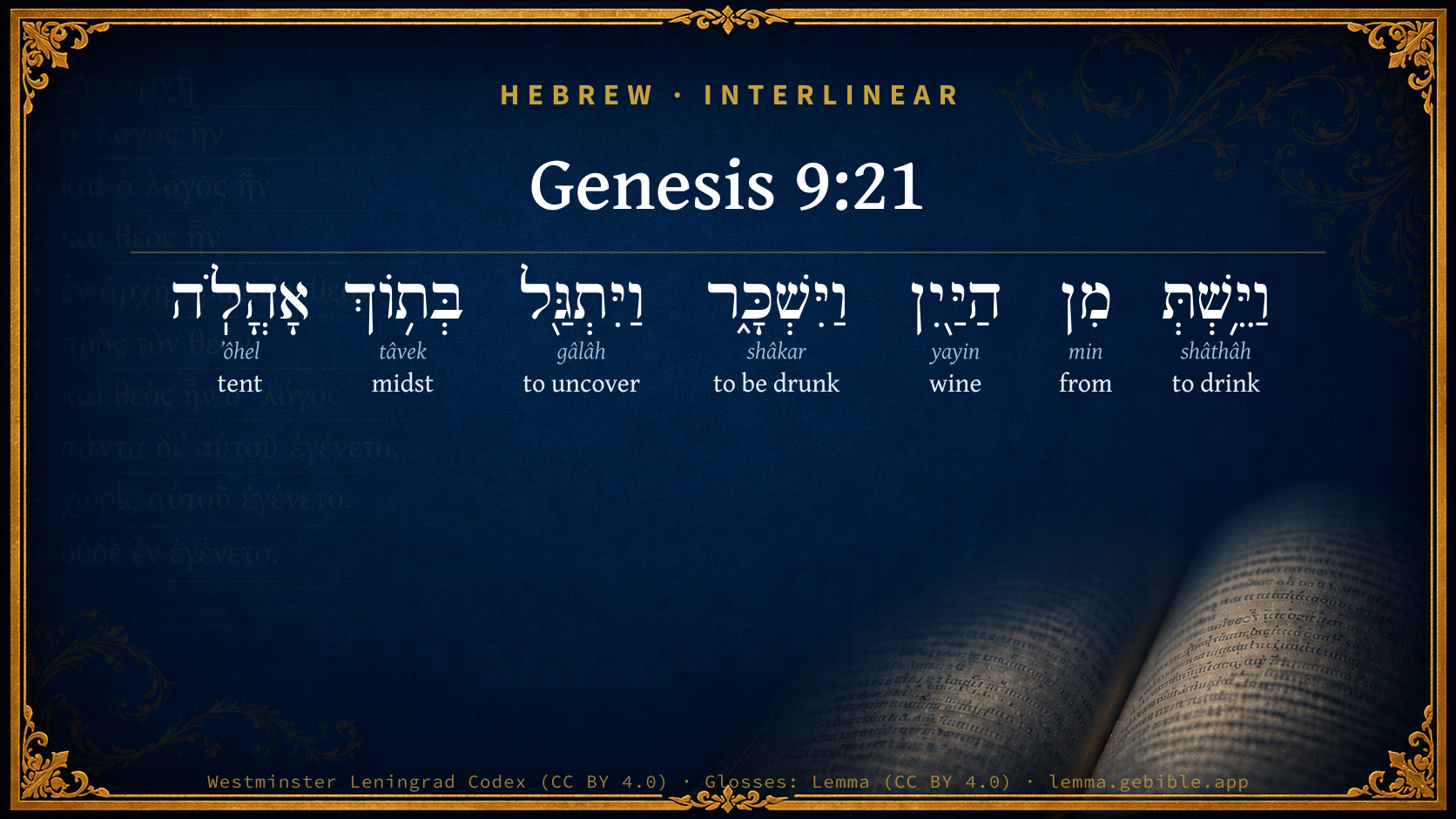
Hebrew (Westminster Leningrad Codex) Genesis 9:21 appears in the Hebrew Old Testament. The text above is from the Westminster Leningrad Codex. Each word links to its Strong’s number, a concise gloss, and parsing drawn from the Open Scriptures Hebrew Bible morphology. Click any word for its full Brown-Driver-Briggs (BDB) entry.
Download image
Cite this verse

Genesis 9:21 (World English Bible). Public Domain. Lemma interlinear Bible study tool, https://lemma.gebible.app/v/genesis/9/21.

Show BibTeX & RIS
BibTeX
RIS
English Translation
He drank of the wine, and got drunk. He was uncovered within his tent.
World English Bible · Public Domain
Highlights
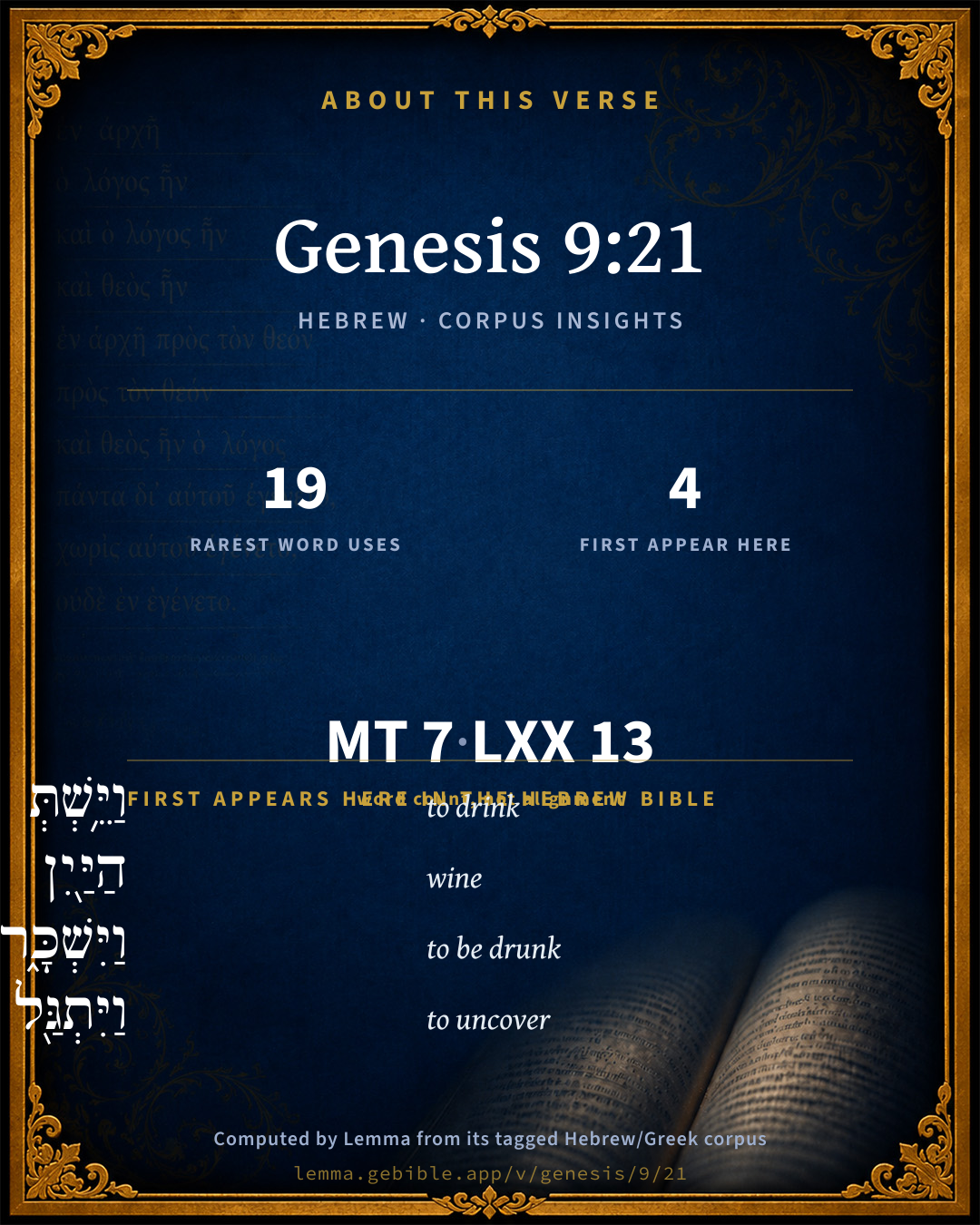
  • 4 first appearances in the Hebrew Bible
Full analysis ↓
Download a study sheet

One document with this verse’s original text, its word-by-word gloss line, the meaning frame, cross-references with their text, attributed commentary, and full source and license credits — printable, and it pastes into notes with its structure intact.

This verse Autodidact and up

Study sheet (.html) Plain text (.txt)

A passage Seminary Student

Up to 50 verses in one chapter. A passage sheet keeps up to 6 commentary sources and 12 cross-references per verse, in the order this page ranks them, and says so on the sheet whenever that leaves anything out. Ask for a single verse and you get the Autodidact verse sheet above.

Everything on this page stays free to read, with no account — the sheet is a download of what is already on screen, not access to it.

Want to remove ads? Support Godless Engineer
Compare translations 3

The same verse in 3 English versions, stacked beneath the original-language interlinear above. Click any original word for its lexicon entry.

Each is an independent rendering of the whole verse — the interlinear is not word-aligned to these translations.

Highlighted words mark where these versions differ — a whole-verse word diff, not a word-by-word alignment.

  • World English Bible Public Domain
    He drank of the wine, and got drunk. He was uncovered within his tent.
  • King James Version Public Domain
    And he drank of the wine, and was drunken; and he was uncovered within his tent.
  • unfoldingWord Literal Text CC BY-SA 4.0
    Then he drank some of the wine, and he became drunk, and he uncovered himself inside his tent.

unfoldingWord Literal Text — © unfoldingWord, licensed CC BY-SA 4.0. Word-aligned USFM3 via Door43 (git.door43.org/unfoldingWord/en_ult).

Versions to compare (up to 4)

3 of 4 selected

Show all 18 translations

Every available English version of this verse, each an independent rendering of the whole verse.

  • World English Bible Public Domain
    He drank of the wine, and got drunk. He was uncovered within his tent.
  • Berean Standard Bible Public Domain
    But when he drank some of its wine, he became drunk and uncovered himself inside his tent.
  • Majority Standard Bible Public Domain
    But when he drank some of its wine, he became drunk and uncovered himself inside his tent.
  • King James Version Public Domain
    And he drank of the wine, and was drunken; and he was uncovered within his tent.
  • American Standard Version (1901) Public Domain
    and he drank of the wine, and was drunken. And he was uncovered within his tent.
  • Revised Version (1885) Public Domain
    and he drank of the wine, and was drunken; and he was uncovered within his tent.
  • Geneva Bible (1599) Public Domain
    And he drunke of ye wine and was drunken, and was vncouered in the middes of his tent.
  • Douay-Rheims (1899) Public Domain
    And drinking of the wine was made drunk, and was uncovered in his tent.
  • Young's Literal Translation Public Domain
    and drinketh of the wine, and is drunken, and uncovereth himself in the midst of the tent.
  • Literal Standard Version CC BY-SA 4.0
    and drinks of the wine, and is drunken, and uncovers himself in the midst of the tent.
  • Unlocked Literal Bible CC BY-SA 4.0
    He drank some of the wine and became drunk. He was lying uncovered in his tent.
  • unfoldingWord Literal Text CC BY-SA 4.0
    Then he drank some of the wine, and he became drunk, and he uncovered himself inside his tent.
  • Darby Bible Public Domain
    And he drank of the wine, and was drunken, and he uncovered himself in his tent.
  • World Messianic Bible Public Domain
    He drank of the wine and got drunk. He was uncovered within his tent.
  • Webster's Bible Public Domain
    And he drank the wine, and was drunken, and he was uncovered within his tent.
  • Free Bible Version CC BY-SA 4.0
    He drank some of the wine he'd produced, got drunk, and fell asleep in his tent, naked.
  • Bible in Basic English Public Domain
    And he took of the wine of it and was overcome by drink; and he was uncovered in his tent.
  • JPS Tanakh (1917) Public Domain
    And he drank of the wine, and was drunken; and he was uncovered within his tent.

Literal Standard Version (2020), Covenant Press — licensed CC BY-SA 4.0. Text via the HelloAO Bible API (eBible.org). Unlocked Literal Bible (unfoldingWord) — licensed CC BY-SA 4.0. Text via the HelloAO Bible API (eBible.org). unfoldingWord Literal Text — © unfoldingWord, licensed CC BY-SA 4.0. Word-aligned USFM3 via Door43 (git.door43.org/unfoldingWord/en_ult). Free Bible Version, Dr. Jonathan Gallagher — licensed CC BY-SA 4.0. Text via the HelloAO Bible API (eBible.org).

Word by word

More ways to search: Search by grammar → Find every occurrence → Compare this word →

Practice this passage: Drill this verse → Learn its vocabulary →

וַיִּשְׁכָּ֑ר
shâkar
H7937
“and · to be drunk”
Conjunction + Verb, Qal, Sequential Imperfect, 3rd Person, Masculine, Singular
Part of Speech
Conjunction + Verb
Stem
Qal
Form
Sequential Imperfect
Person
3rd Person
Gender
Masculine
Number
Singular
Full BDB Definition

Origin: a primitive root

TWOT: 2388

to be or become drunk or drunken, be intoxicated - (Qal) to become drunken - (Piel) to make drunken, cause to be drunk - (Hiphil) to cause to be drunk - (Hithpael) to make oneself drunk
  1. וַיֵּ֥שְׁתְּ shâthâh H8354 “and · to drink” Conjunction + Verb, Qal, Sequential Imperfect, 3rd Person, Masculine, Singular
  2. מִן min H4480 “from” Preposition
  3. הַיַּ֖יִן yayin H3196 “the · wine” Particle, Definite Article + Noun, Common, Masculine, Singular, Absolute
  4. וַיִּתְגַּ֖ל gâlâh H1540 “and · to uncover” Conjunction + Verb, Hithpael, Sequential Imperfect, 3rd Person, Masculine, Singular
  5. בְּת֥וֹךְ tâvek H8432 “in/at · midst of” Preposition + Noun, Common, Masculine, Singular, Construct
  6. אָהֳלֹֽה ʼôhel H168 “tent · his” Noun, Common, Masculine, Singular, Construct + Suffix, Personal, 3rd Person, Masculine, Singular

About this verse

These counts appear in no published source. They are computed here, from the morphology-tagged text and Lemma’s own curated glosses. What Lemma adds →

7
words
7
distinct lemmas
Pentateuch
section

Notable vocabulary

The rarest word here is וַיִּשְׁכָּ֑ר to be drunk H7937 — appearing just 19 times in the whole Hebrew Bible.

First appearance in Scripture

These words make their first canonical appearance in the Hebrew Bible here:

  • וַיֵּ֥שְׁתְּ to drink H8354
  • הַיַּ֖יִן wine H3196
  • וַיִּשְׁכָּ֑ר to be drunk H7937
  • וַיִּתְגַּ֖ל to uncover H1540

Shared distinctive vocabulary

וַיִּשְׁכָּ֑ר to be drunk H7937 occurs in 19 verses of the Hebrew Bible. Also found in:

Grammatical profile

  • 3 verbs
  • 3 nouns
  • 1 preposition

Verb forms

  • וַיֵּ֥שְׁתְּ Qal · Sequential Imperfect
  • וַיִּשְׁכָּ֑ר Qal · Sequential Imperfect
  • וַיִּתְגַּ֖ל Hithpael · Sequential Imperfect

Hebrew & Septuagint length

In English translation the verse runs 14 words from the Hebrew and 15 from the Septuagint (LXX English) — closely comparable.

A rough comparison of the two English renderings, which tokenize alike — not a word-level alignment.

Word counts can differ between the Hebrew and the Greek without any difference in meaning — e.g. the Hebrew direct-object marker אֵת has no separate Greek word, and Greek often adds the article ὁ.

In the original languages it is 7 Hebrew tokens and 13 Greek tokens — but the two are counted differently (Hebrew bundles its prefixes and suffixes into one token; the Greek is in lemma form), so that isn’t a like-for-like length.

Cross-references

12

Topical passages linked to Genesis 9:21 in the Treasury of Scripture Knowledge — connected by theme and wording, ordered by reader-vote popularity; previews shown in the World English Bible.

  • Proverbs 20:1 Wine is a mocker, and beer is a brawler; Whoever is led astray by them is not wise.
  • Habakkuk 2:15–16 "Woe to him who gives his neighbor drink, pouring your inflaming wine until they are drunk, so that you may gaze at their naked bodies!
  • Proverbs 23:31–32 Don't look at the wine when it is red, When it sparkles in the cup, When it goes down smoothly:
  • Galatians 5:21 envyings, murders, drunkenness, orgies, and things like these; of which I forewarn you, even as I also forewarned you, that those who practice such things will not inherit the Kingdom of God.
  • Titus 2:2 that older men should be temperate, sensible, sober-minded, sound in faith, in love, and in patience:
  • Genesis 6:9 This is the history of the generations of Noah. Noah was a righteous man, blameless among the people of his time. Noah walked with God.
  • Genesis 19:32–36 Come, let's make our father drink wine, and we will lie with him, that we may preserve our father's seed."
  • Ecclesiastes 7:20 Surely there is not a righteous man on earth, who does good and doesn't sin.
  • Romans 13:13 Let us walk properly, as in the day; not in reveling and drunkenness, not in sexual promiscuity and lustful acts, and not in strife and jealousy.
  • 1 Corinthians 10:12 Therefore let him who thinks he stands be careful that he doesn't fall.
  • Luke 22:3–4 Satan entered into Judas, who was surnamed Iscariot, who was numbered with the twelve.
  • Revelation 3:18 I counsel you to buy from me gold refined by fire, that you may become rich; and white garments, that you may clothe yourself, and that the shame of your nakedness may not be revealed; and eye salve to anoint your eyes, that you may see.

Cross-references courtesy of OpenBible.info (CC BY 4.0).

Hebrew and Greek witnesses Masoretic Hebrew ↔ Greek Septuagint

The same verse in the two great witnesses to the Old Testament, shown verse-for-verse.

These are two independent witnesses, not word-aligned to each other, and the Septuagint is shown in lemma (dictionary) form.

Hebrew Genesis 9:21 Masoretic · Westminster Leningrad Codex

וַיֵּ֥שְׁתְּ מִן הַיַּ֖יִן וַיִּשְׁכָּ֑ר וַיִּתְגַּ֖ל בְּת֥וֹךְ אָהֳלֹֽה

He drank of the wine, and got drunk. He was uncovered within his tent.

World English Bible · Public Domain

Greek LXX Genesis 9:21 Septuagint · lemma form

καί πίνω ἐκ ὁ οἶνος καί μεθύω καί γυμνόω ἐν ὁ οἶκος αὐτός

And he drank of the wine, and was drunk, and was naked in his house.

LXX2012 (modern English Septuagint) · Public Domain

On this verse, The Pulpit Commentary discusses the Septuagint’s reading. Read the note in Commentary ↓

Hebrew: Westminster Leningrad Codex (CC BY 4.0). Greek: Septuagint (public domain); English from LXX2012 (modern English Septuagint) (Public Domain). How the Septuagint differs from the Hebrew →

Targum (Aramaic paraphrase)

2

The Targum is the ancient Jewish Aramaic paraphrase of the Hebrew Scriptures — an interpretive translation, not the Hebrew text itself. Onkelos (literal) and Pseudo-Jonathan (expansive) render the Torah, and Jonathan the Prophets. Coverage is partial: where no permissively-licensed English translation exists for a verse, only the Aramaic is shown. This is verse-level text, not a word-by-word alignment to the Hebrew.

  1. Targum Onkelos Torah (Genesis–Deuteronomy)
    וּשְׁתִי מִן חַמְרָא וּרְוִי וְאִתְגְּלִי בְּגוֹ מַשְׁכְּנֵהּ

    and he drank of the wine, and was drunk; and he was uncovered in the midst of his tent.

    Targum Onkelos — Aramaic: “Onkelos Genesis” (public domain); “Onkelos Exodus” (public domain); “Onkelos Leviticus” (public domain); “Onkelos Numbers” (public domain); “Onkelos Deuteronomy” (public domain). English: “Sefaria Community Translation” (CC0 1.0 (public-domain dedication)); “J.W. Etheridge. The Targums of Onkelos and Jonathan Ben Uzziel on the Pentateuch. London: Longmans, Green, 1862” (public domain). Text via Sefaria.

  2. Targum Pseudo-Jonathan Torah (Genesis–Deuteronomy)
    וְשָׁתֵי מִן חַמְרָא וְרָוֵי וְאִתְעַרְטַל בְּגוֹ מַשְׁכְּנֵיהּ

    And he drank of the wine and was drunken; and he made himself naked in the midst of his tent.

    Targum Pseudo-Jonathan — Aramaic: “Targum Jonathan on Genesis” (public domain); “Targum Jonathan on Exodus” (public domain); “Targum Jonathan on Leviticus” (public domain); “Targum Jonathan on Numbers” (public domain); “Targum Jonathan on Deuteronomy” (public domain). English: “The Targum of Jonathan ben Uzziel, trans. J. W. Etheridge, London, 1862” (public domain). Text via Sefaria.

Commentary

Notes on Genesis 9:21 from classic Christian and Jewish commentators (each source and its license shown beneath its notes). The classic Christian expositions comment on the surrounding passage and are grouped to its opening verse, so a note may address several verses; the Jewish commentaries on the Tanakh (Rashi and others) are per-verse, so they appear only where the commentator wrote on this verse.

Lemma curates 59 commentaries, every one of them public domain or Creative Commons licensed, each selected and text-cleaned for this edition rather than reprinted as found. About our sources →

Trapp's Complete Commentary

John Trapp

Gen 9:21 And he drank of the wine, and was drunken; and he was uncovered within his tent.

Ver. 21. And was drunk.] For his own shame, but our learning. Instruunt nos patres tum docentes tum labentes .{ a} The best have their blemishes, and a black part, as that cloud had, that conducted Israel out of Egypt; which, while the Egyptians followed, they fell into the sea. {Heb 11:29}

And was uncovered within his tent.] One hour’s drunkenness bewrays that which more than six hundred years’ sobriety had modestly concealed. Well might Solomon say, "Wine is a mocker"; {Pro 20:1} for it mocked Noah with a witness; and exposed him to the mockage of his own bosom-bird.

{a} Augustin.

John Trapp, A Commentary or Exposition upon All the Books of the Old and New Testament (1647–1656) — public domain. Text from a community e-Sword module.

Joseph Benson's Commentary

Gen 9:21. And he drank of the wine, and was drunk — It is highly probable he did not know the effect of it before. And he was uncovered in his tent — Made naked to his shame.

Joseph Benson's Commentary on the Old and New Testaments (1811–1818) — public domain. Text from a community e-Sword module.

Tyndale Open Study Notes

Tyndale Open Resources

9:21 wine . . . became drunk: Wine is a gift from God (Deut 14:26; Ps 104:15; Isa 55:1; see Luke 22:14-20; John 2:1-11). Scripture is clear, however, that excessive consumption of alcohol is a perilous sin (Prov 23:20-21, 29-35; 1 Cor 6:10).

Tyndale Open Study Notes — © Tyndale Open Resources, licensed CC BY-SA 4.0. Text via the HelloAO Bible API.

Geneva Bible (1599)

Geneva Bible translators

This is set before our eyes to show what an horrible thing drunkenness is.

Geneva Bible (1599) marginal notes — public domain. Text via Bolls.life.

Jamieson, Fausset & Brown

Robert Jamieson, A. R. Fausset & David Brown

And he drank of the wine, and was drunken--perhaps at the festivities of the vintage season. This solitary stain on the character of so eminently pious a man must, it is believed, have been the result of age or inadvertency.

Jamieson, Fausset & Brown — Commentary Critical and Explanatory on the Whole Bible (1871) — public domain (CC PDM 1.0). Text via the HelloAO Bible API.

Adam Clarke's Commentary

Verse 21. He drank of the wine, c.] It is very probable that this was the first time the wine was cultivated and it is as probable that the strength or intoxicating power of the expressed juice was never before known. Noah, therefore, might have drunk it at this time without the least blame, as he knew not till this trial the effects it would produce. I once knew a case which I believe to be perfectly parallel. A person who had scarcely ever heard of cider, and whose beverage through his whole life had been only milk or water, coming wet and very much fatigued to a farmer's house in Somersetshire, begged for a little water or milk. The good woman of the house, seeing him very much exhausted, kindly said, "I will give you a little cider, which will do you more good." The honest man, understanding no more of cider than merely that it was the simple juice of apples, after some hesitation drank about a half pint of it; the consequence was, that in less than half an hour he was perfectly intoxicated, and could neither speak plain nor walk! This case I myself witnessed. A stranger to the circumstances, seeing this person, would pronounce him drunk; and perhaps at a third hand he might be represented as a drunkard, and thus his character be blasted; while of the crime of drunkenness he was as innocent as an infant.

This I presume to have been precisely the case with Noah; and no person without an absolute breach of every rule of charity and candour, can attach any blame to the character of Noah on this ground, unless from a subsequent account they were well assured that, knowing the power and effects of the liquor, he had repeated the act. Some expositors seem to be glad to fix on a fact like this, which by their distortion becomes a crime; and then, in a strain of sympathetic tenderness, affect to deplore "the failings and imperfections of the best of men;" when, from the interpretation that should be given of the place, neither failing nor imperfection can possibly appear.

Adam Clarke's Commentary on the Bible (1810–1826) — public domain. Text from a community e-Sword/MySword module.

Ellicott's Commentary for English Readers

(21) He was uncovered is, literally, he uncovered himself. It was no accident, but a wilful breach of modesty.

A Bible Commentary for English Readers, edited by Charles John Ellicott (1878–1897) — public domain. Text from a community e-Sword module.

The Cambridge Bible for Schools and Colleges

gen. ed. J. J. S. Perowne

21. and he drank] The representation is that of the man who first made wine out of grapes, and drinking of it in ignorance was overcome by its potency. No blame is attached to him.

The Cambridge Bible for Schools and Colleges (gen. ed. J. J. S. Perowne; Cambridge University Press, 1878–1918) — public domain. Text from a community e-Sword module.

John Gill's Exposition

And he drank of the wine, and was drunken,.... Either not being acquainted with the strength of it, as is thought by many; or having been used to weaker liquor, as water; or through the infirmity of his age; however, he was overtaken with it, and which is recorded, not to disgrace him, but to caution men against the evil of intemperance, as well as to encourage repenting sinners to expect pardon: and this shows that the best of men are not exempted from sin, nor secure from falling; and that though Noah was a perfect man, yet not as to be without sin; and that whereas he was a righteous man, he was not so by the righteousness of works, but by the righteousness of faith:

and he was uncovered within his tent; being in liquor when he laid down, he was either negligent of his long and loose garments, such as the eastern people wore without breeches, and did not take care to wrap them about him; or in his sleep, through the heat of the weather, or of the wine, or both, threw them off.

John Gill's Exposition of the Whole Bible (1746–1763) — public domain (CC PDM 1.0). Text via the HelloAO Bible API.

Haydock's Catholic Bible Commentary

Drunk. Noe by the judgment of the fathers was not guilty of sin, in being overcome by wine; because he knew not the strength of it. (Challoner) --- Wine, Though vines had grown from the beginning, the art of making wine seems not to have been discovered; and hence Noe’s fault is much extenuated, and was at most only a venial sin. (Menochius) --- His nakedness prefigured the desolate condition of Christ upon the cross, which was a scandal to the Jews, and foolishness to the Gentiles. But by this folly we are made wise; we are redeemed, and enjoy the name of Christians. Sem and Japheth represent the multitude of believers, Cham and Chanaan the audacity and impudence of all unbelievers. (St. Augustine, contra Faust. xii. 24; City of God xvi. 2; St. Cyprian, ep. 63. ad Cæcil.) (Worthington) --- Like the Manichees, modern heretics are very free in condemning many innocent actions of the Patriarchs. (Haydock)

George Leo Haydock (1774–1849), Haydock's Catholic Family Bible and Commentary, 1859 edition — public domain. Excludes Psalms (Douay-Rheims chapter numbering differs from Protestant) and Deuterocanonical books (Catholic canon only).

Matthew Poole's English Annotations

Either through ignorance and inexperience of the nature and strength of that liquor, or through the infirmity of the flesh, which was tempted by its great and, to him, new pleasantness, and by the refreshment he found in it under the weary labours of his body, and the sad thoughts of his mind, for the desolate condition of the world.

He was uncovered, either to relieve himself against the heat of the climate and season, or from his negligence and carelessness; which might easily happen, because men’s garments at that time were loose, as they were in the following ages, when breeches were not in common use, and therefore were peculiarly prescribed to the priests, Exo 28:42; Eze 44:18-19.

Matthew Poole's English Annotations on the Holy Bible (1683–1685) — public domain. Text from a community e-Sword/MySword module.

Whedon's Commentary on the Bible

Daniel D. Whedon

21. Was drunken — Here is the first recorded instance of drunkenness, and its revolting consequences. It is probable that in this case it was a sin of ignorance, for Noah’s character as a “perfect” man, who “walked with God,” seems to warrant this assumption.

Daniel D. Whedon (gen. ed.), Commentary on the Old and New Testaments (1874–1909) — public domain. Text from a community e-Sword module.

The Pulpit Commentary

And he drank of the wine. yiy; "perhaps so called from bubbling up and fermenting;" connected with wy; (Gesenius). Though the first mention of wine in Scripture, it is scarcely probable that the natural process of fermentation for so many centuries escaped the notice of the enterprising Cainites, or even of the Sethites; that, "though grapes had been in use before this, wine had not been extracted from them" (Murphy); or that Noah was unacquainted with the nature and effects of this intoxicating liquor (Chrysostom, Theodoret, Keil, Lunge). The article before yiy indicates that the patriarch was "familiar with the use and treatment" of the grape (Kalisch); and Moses does not say this was the first occasion on which the patriarch tasted the fermented liquor (Calvin, Wordsworth). And was drunken. The verb rkv; (whence shechar, strong, (Num_28:7) to drink to the full, very often signifies to make oneself drunken, or simply to be intoxicated as the result of drinking; and that which the Holy Spirit here reprobates is not the partaking of the fruit of the vine, but the drinking so as to be intoxicated thereby. Since the sin of Noah cannot be ascribed to ignorance, it is perhaps right, as well as charitable, to attribute it to ago and inadvertence. Six hundred years old at the time of the Flood, he must have been considerably beyond this when Ham saw him overtaken in his fault, since Canaan was Ham"s fourth son, (Gen_10:6) and the first was not born till after the exit from the ark. (Gen_8:18) But from whatever cause induced, the drunkenness of Noah was not entirely guiltless; it was sinful in itself, and led to further shame. And he was uncovered. Literally, he uncovered himself. Hithpael of hlG; to make naked, which more correctly indicates the personal guilt of the patriarch than the A.V, or the LXX, ejgumnwqh. That intoxication tends to sensuality cf. the cases of Lot, (Gen_19:33) Ahasuerus, (Est_1:10, Est_1:11) Belshazzar. (Dan_5:1-6) Within his tent. jEn tw oikw aujtou (LXX).

The Pulpit Commentary (1880–1919), ed. H.D.M. Spence-Jones & Joseph S. Exell — public domain. Text from a community e-Sword module.

John Wesley's Explanatory Notes

And he drank of the wine and was drunk - 'Tis highly probable, he did not know the effect of it before. And he was uncovered in his tent - Made naked to his shame.

John Wesley, Explanatory Notes Upon the Whole Bible (1754–1765) — public domain. Text via the GEBible commentary corpus.

Rashi

Rabbi Shlomo Yitzchaki (Rashi)

ויתגל AND HE UNCOVERED HIMSELF — This is the Hithpael form.

אהלה HIS TENT — This word is written אהלה (with ה at end instead of ו) so that it may be regarded as an allusion to the ten tribes who were spoken of as Samaria which was called “אהלה” Ohala and who were exiled because of indulgence in wine, at it is said (Amos 6:6) ‘‘that drink wine in bowls”.

Rashi on the Tanakh — English translations: “The Judaica Press complete Tanach with Rashi, translated by A. J. Rosenberg” (CC BY 4.0); “Pentateuch with Rashi's commentary by M. Rosenbaum and A.M. Silbermann, 1929-1934” (public domain); “The Metsudah Tanach series, Lakewood, N.J” (CC BY 4.0); and “The Book of Joshua, Metsudah Publications, 1997” (CC BY 4.0). Text via Sefaria.

Radak

Rabbi David Kimhi (Radak)

וישת מן היין וישכר, he drank without setting himself a limit until in the end he became drunk and disgraced himself.

ויתגל, by himself, unaided.

בתוך אהלו, the letter ה at the end of אהלה, where we would expect the letter ו for the masculine ending “his,” is interpreted (and quoted by Rashi) as an allusion to the ten tribes who have been referred to as אהלה in Amos 6,6, and whose exile has been attributed to their excessive drinking of strong wine both in Isaiah 28,1 and Amos 6,6). From a grammatical perspective, the construction here is not really so unusual

Radak on the Tanakh — English translations: “Sefaria Community Translation” (CC0 1.0 (public-domain dedication)); “Eliyahu Munk, HaChut Hameshulash” (CC BY 4.0); “Rabbi Mike Feuer, Jerusalem Anthology” (CC BY 4.0); and “R. David Kimhi on the first book of Psalms, Translated by R.G. Finch, London, 1919” (public domain). Text via Sefaria.

Lesson kit

Teaching starters — assembled from the data on this page, not authored interpretation. Every prompt links to the verse data it draws on. Edit before teaching.

Genesis, in the Pentateuch, opens this verse with 7 words (7 distinct Hebrew lemmas). Its most distinctive word is shâkar (“to be drunk”). A historical commentator’s framing appears above. Read the whole chapter for the surrounding context.

Discussion questions

  1. The word shâkar carries the sense “to be drunk.” How does it shape the verse?
  2. 4 words here appear for the first time in Scripture. What is being introduced at this debut?
  3. Genesis 43:34 shares the word «to be drunk» with this verse. How do the two illuminate each other?
  4. These translations render this verse differently. What is at stake in choosing one wording over another?
  5. The verb «וַיֵּ֥שְׁתְּ» is Qal Sequential Imperfect. How does its form color the action?
  6. Reading how Trapp's Complete Commentary and Joseph Benson's Commentary read this verse, where do the two commentators agree and where do they part?

Things to notice

Reading settings

Reading text

Shown beneath each verse's original-language words.

Old Testament
Old Testament edition

Read the OT as the Masoretic Hebrew (MT) or the Greek Septuagint (LXX).

English shown for the Greek Septuagint (in the Hebrew ↔ Greek comparison).

Comparing translations? Open the Compare panel on any verse page to stack up to four side by side.