Numbers 19:6

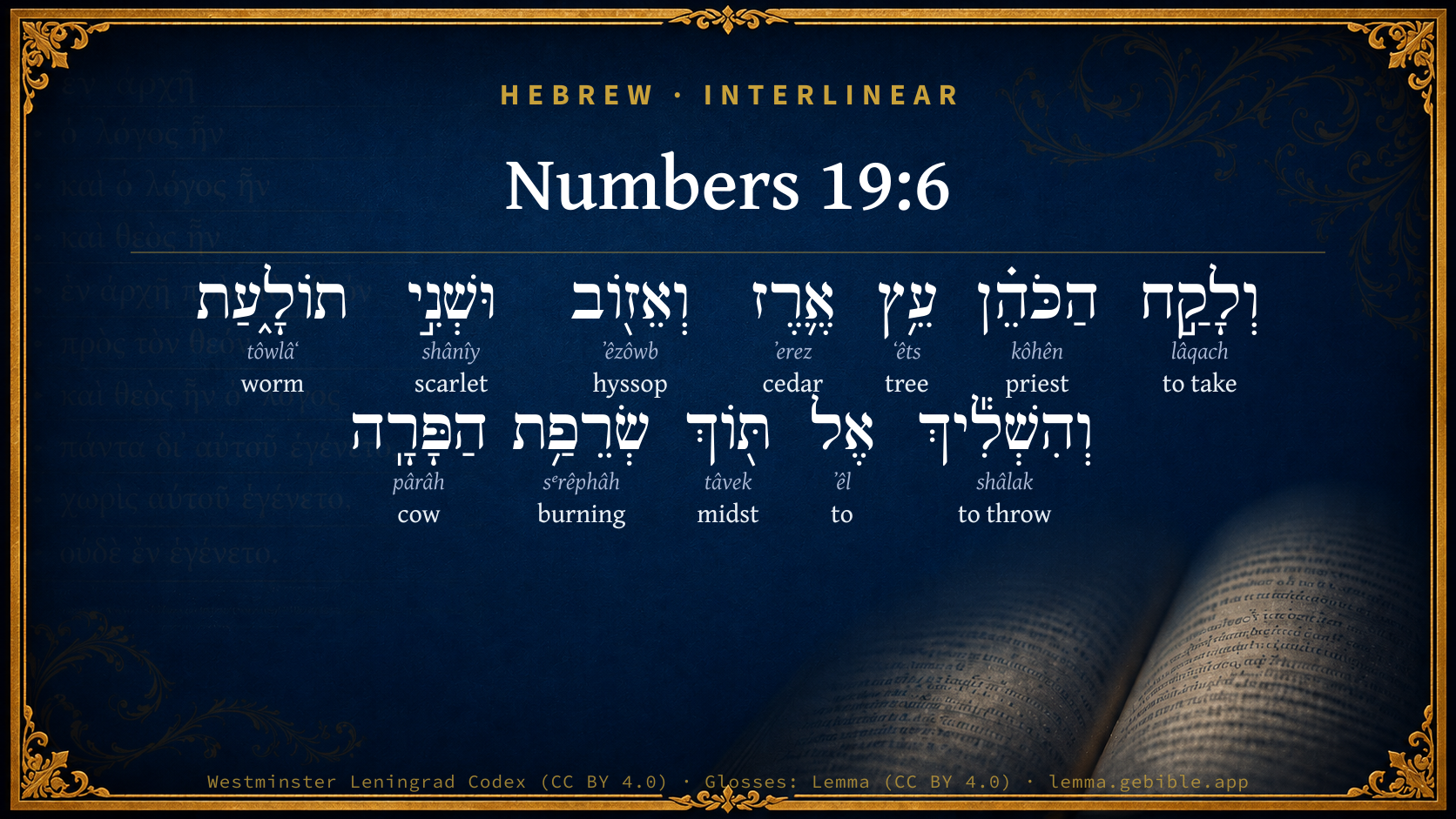
Hebrew (Westminster Leningrad Codex) Numbers 19:6 appears in the Hebrew Old Testament. The text above is from the Westminster Leningrad Codex. Each word links to its Strong’s number, a concise gloss, and parsing drawn from the Open Scriptures Hebrew Bible morphology. Click any word for its full Brown-Driver-Briggs (BDB) entry.
Download image
Cite this verse

Numbers 19:6 (World English Bible). Public Domain. Lemma interlinear Bible study tool, https://lemma.gebible.app/v/numbers/19/6.

Show BibTeX & RIS
BibTeX
RIS
English Translation
and the priest shall take cedar-wood, and hyssop, and scarlet, and cast it into the midst of the burning of the heifer.
World English Bible · Public Domain
Download a study sheet

One document with this verse’s original text, its word-by-word gloss line, the meaning frame, cross-references with their text, attributed commentary, and full source and license credits — printable, and it pastes into notes with its structure intact.

This verse Autodidact and up

Study sheet (.html) Plain text (.txt)

A passage Seminary Student

Up to 50 verses in one chapter. A passage sheet keeps up to 6 commentary sources and 12 cross-references per verse, in the order this page ranks them, and says so on the sheet whenever that leaves anything out. Ask for a single verse and you get the Autodidact verse sheet above.

Everything on this page stays free to read, with no account — the sheet is a download of what is already on screen, not access to it.

Want to remove ads? Support Godless Engineer
Compare translations 3

The same verse in 3 English versions, stacked beneath the original-language interlinear above. Click any original word for its lexicon entry.

Each is an independent rendering of the whole verse — the interlinear is not word-aligned to these translations.

Highlighted words mark where these versions differ — a whole-verse word diff, not a word-by-word alignment.

  • World English Bible Public Domain
    and the priest shall take cedar-wood, and hyssop, and scarlet, and cast it into the midst of the burning of the heifer.
  • King James Version Public Domain
    And the priest shall take cedar wood, and hyssop, and scarlet, and cast it into the midst of the burning of the heifer.
  • unfoldingWord Literal Text CC BY-SA 4.0
    And the priest shall take wood of cedar and hyssop and scarlet of worm and throw into the midst of the burning of the cow.

unfoldingWord Literal Text — © unfoldingWord, licensed CC BY-SA 4.0. Word-aligned USFM3 via Door43 (git.door43.org/unfoldingWord/en_ult).

Versions to compare (up to 4)

3 of 4 selected

Show all 18 translations

Every available English version of this verse, each an independent rendering of the whole verse.

  • World English Bible Public Domain
    and the priest shall take cedar-wood, and hyssop, and scarlet, and cast it into the midst of the burning of the heifer.
  • Berean Standard Bible Public Domain
    The priest is to take cedar wood, hyssop, and scarlet wool and throw them onto the burning heifer.
  • Majority Standard Bible Public Domain
    The priest is to take cedar wood, hyssop, and scarlet wool and throw them onto the burning heifer.
  • King James Version Public Domain
    And the priest shall take cedar wood, and hyssop, and scarlet, and cast it into the midst of the burning of the heifer.
  • American Standard Version (1901) Public Domain
    and the priest shall take cedar-wood, and hyssop, and scarlet, and cast it into the midst of the burning of the heifer.
  • Revised Version (1885) Public Domain
    and the priest shall take cedar wood, and hyssop, and scarlet, and cast it into the midst of the burning of the heifer.
  • Geneva Bible (1599) Public Domain
    Then shall the Priest take cedar wood, and hyssope and skarlet lace, and cast them in the mids of the fire where the kow burneth.
  • Douay-Rheims (1899) Public Domain
    The priest shall also take cedar wood, and hyssop, and scarlet twice dyed, and cast it into the flame, with which the cow is consumed.
  • Young's Literal Translation Public Domain
    and the priest hath taken cedar wood, and hyssop, and scarlet, and hath cast unto the midst of the burning of the cow;
  • Literal Standard Version CC BY-SA 4.0
    and the priest has taken cedar wood, and hyssop, and scarlet, and has cast [them] into the midst of the burning of the cow;
  • Unlocked Literal Bible CC BY-SA 4.0
    The priest must take cedarwood, hyssop, and scarlet wool, and throw it all into the middle of the burning heifer.
  • unfoldingWord Literal Text CC BY-SA 4.0
    And the priest shall take wood of cedar and hyssop and scarlet of worm and throw into the midst of the burning of the cow.
  • Darby Bible Public Domain
    And the priest shall take cedar-wood, and hyssop, and scarlet, and cast them into the midst of the burning of the heifer.
  • World Messianic Bible Public Domain
    The priest shall take cedar wood, hyssop, and scarlet, and cast it into the middle of the burning of the heifer.
  • Webster's Bible Public Domain
    And the priest shall take cedar-wood, and hyssop, and scarlet, and cast it into the midst of the burning of the heifer.
  • Free Bible Version CC BY-SA 4.0
    The priest shall throw cedar wood, hyssop, and crimson thread on the burning cow.
  • Bible in Basic English Public Domain
    Then let the priest take cedar-wood and hyssop and red thread, and put them into the fire where the cow is burning.
  • JPS Tanakh (1917) Public Domain
    And the priest shall take cedar-wood, and hyssop, and scarlet, and cast it into the midst of the burning of the heifer.

Literal Standard Version (2020), Covenant Press — licensed CC BY-SA 4.0. Text via the HelloAO Bible API (eBible.org). Unlocked Literal Bible (unfoldingWord) — licensed CC BY-SA 4.0. Text via the HelloAO Bible API (eBible.org). unfoldingWord Literal Text — © unfoldingWord, licensed CC BY-SA 4.0. Word-aligned USFM3 via Door43 (git.door43.org/unfoldingWord/en_ult). Free Bible Version, Dr. Jonathan Gallagher — licensed CC BY-SA 4.0. Text via the HelloAO Bible API (eBible.org).

Word by word

More ways to search: Search by grammar → Find every occurrence → Compare this word →

Practice this passage: Drill this verse → Learn its vocabulary →

וְאֵז֖וֹב
ʼêzôwb
H231
“and · hyssop”
Conjunction + Noun, Common, Masculine, Singular, Absolute
Part of Speech
Conjunction + Noun
Type
Common
Gender
Masculine
Number
Singular
State
Absolute
Full BDB Definition

Origin: probably of foreign derivation

TWOT: 55

hyssop, a plant used for medicinal and religious purposes
  1. וְלָקַ֣ח lâqach H3947 “and · to take” Conjunction + Verb, Qal, Sequential Perfect, 3rd Person, Masculine, Singular
  2. הַכֹּהֵ֗ן kôhên H3548 “the · priest” Particle, Definite Article + Noun, Common, Masculine, Singular, Absolute
  3. עֵ֥ץ ʻêts H6086 “tree of” Noun, Common, Masculine, Singular, Construct
  4. אֶ֛רֶז ʼerez H730 “cedar” Noun, Common, Masculine, Singular, Absolute
  5. וּשְׁנִ֣י shânîy H8144 “and · scarlet of” Conjunction + Noun, Common, Masculine, Singular, Construct
  6. תוֹלָ֑עַת tôwlâʻ H8438 “worm” Noun, Common, Feminine, Singular, Absolute
  7. וְהִשְׁלִ֕יךְ shâlak H7993 “and · to throw” Conjunction + Verb, Hiphil, Sequential Perfect, 3rd Person, Masculine, Singular
  8. אֶל ʼêl H413 “to” Preposition
  9. תּ֖וֹךְ tâvek H8432 “midst of” Noun, Common, Masculine, Singular, Construct
  10. שְׂרֵפַ֥ת sᵉrêphâh H8316 “burning of” Noun, Common, Feminine, Singular, Construct
  11. הַפָּרָֽה pârâh H6510 “the · cow” Particle, Definite Article + Noun, Common, Feminine, Singular, Absolute

About this verse

These counts appear in no published source. They are computed here, from the morphology-tagged text and Lemma’s own curated glosses. What Lemma adds →

12
words
12
distinct lemmas
Pentateuch
section

Notable vocabulary

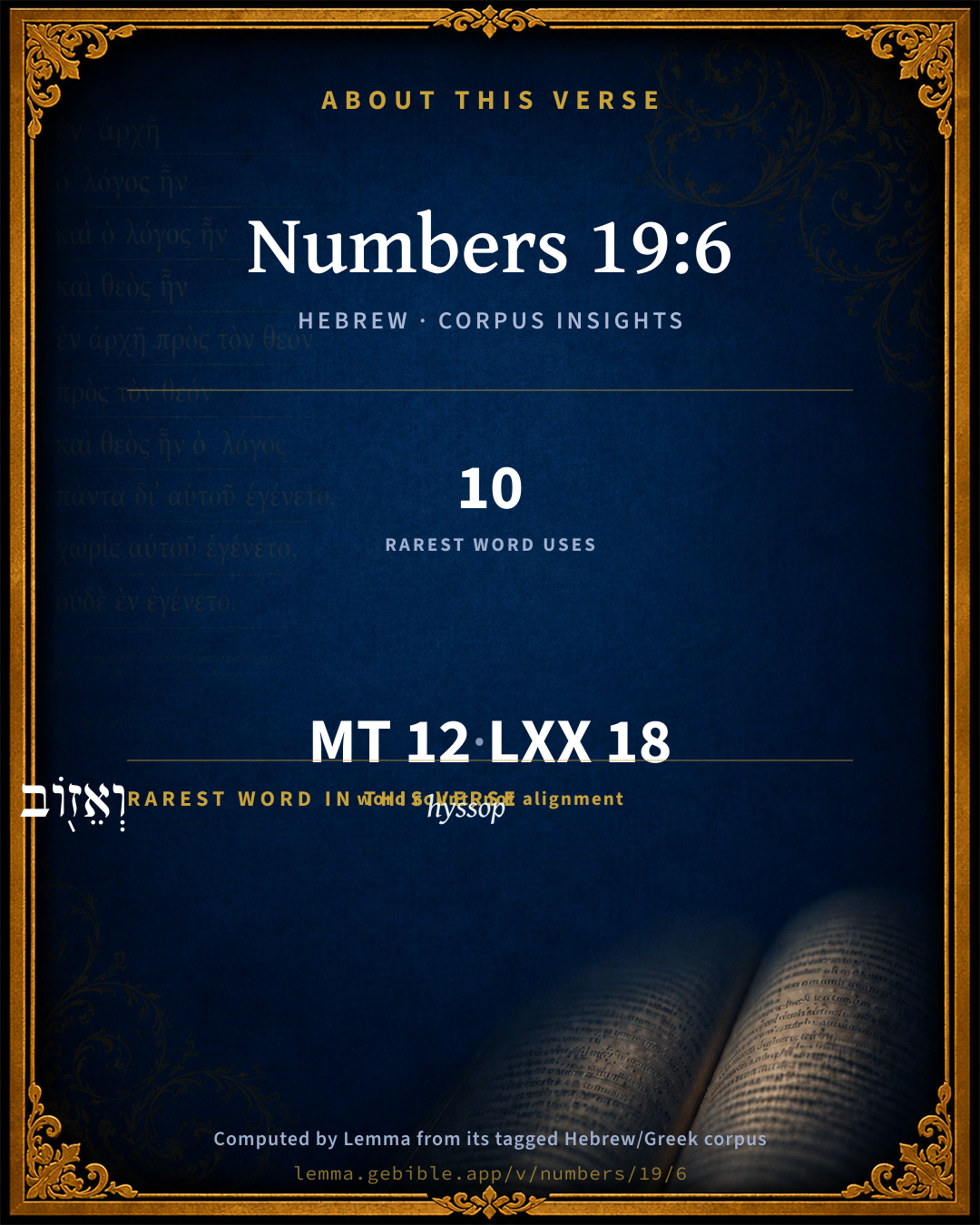
The rarest word here is וְאֵז֖וֹב hyssop H231 — appearing just 10 times in the whole Hebrew Bible.

Shared distinctive vocabulary

וְאֵז֖וֹב hyssop H231 occurs in 10 verses of the Hebrew Bible. Also found in:

Grammatical profile

  • 2 verbs
  • 9 nouns
  • 1 preposition

Verb forms

  • וְלָקַ֣ח Qal · Sequential Perfect
  • וְהִשְׁלִ֕יךְ Hiphil · Sequential Perfect

Hebrew & Septuagint length

In English translation the verse runs 22 words from the Hebrew and 26 from the Septuagint (LXX English) — closely comparable.

A rough comparison of the two English renderings, which tokenize alike — not a word-level alignment.

Word counts can differ between the Hebrew and the Greek without any difference in meaning — e.g. the Hebrew direct-object marker אֵת has no separate Greek word, and Greek often adds the article ὁ.

In the original languages it is 12 Hebrew tokens and 18 Greek tokens — but the two are counted differently (Hebrew bundles its prefixes and suffixes into one token; the Greek is in lemma form), so that isn’t a like-for-like length.

Cross-references

6

Topical passages linked to Numbers 19:6 in the Treasury of Scripture Knowledge — connected by theme and wording, ordered by reader-vote popularity; previews shown in the World English Bible.

  • Leviticus 14:4 then the priest shall command them to take for him who is to be cleansed two living clean birds, and cedar wood, and scarlet, and hyssop.
  • Leviticus 14:6 As for the living bird, he shall take it, and the cedar wood, and the scarlet, and the hyssop, and shall dip them and the living bird in the blood of the bird that was killed over the running water.
  • Leviticus 14:49 To cleanse the house he shall take two birds, and cedar wood, and scarlet, and hyssop.
  • Psalms 51:7 Purify me with hyssop, and I will be clean. Wash me, and I will be whiter than snow.
  • Isaiah 1:18 "Come now, and let us reason together," says Yahweh: "Though your sins be as scarlet, they shall be as white as snow. Though they be red like crimson, they shall be as wool.
  • Hebrews 9:19–23 For when every commandment had been spoken by Moses to all the people according to the law, he took the blood of the calves and the goats, with water and scarlet wool and hyssop, and sprinkled both the book itself and all the people,

Cross-references courtesy of OpenBible.info (CC BY 4.0).

Hebrew and Greek witnesses Masoretic Hebrew ↔ Greek Septuagint

The same verse in the two great witnesses to the Old Testament, shown verse-for-verse.

These are two independent witnesses, not word-aligned to each other, and the Septuagint is shown in lemma (dictionary) form.

Hebrew Numbers 19:6 Masoretic · Westminster Leningrad Codex

וְלָקַ֣ח הַכֹּהֵ֗ן עֵ֥ץ אֶ֛רֶז וְאֵז֖וֹב וּשְׁנִ֣י תוֹלָ֑עַת וְהִשְׁלִ֕יךְ אֶל תּ֖וֹךְ שְׂרֵפַ֥ת הַפָּרָֽה

and the priest shall take cedar-wood, and hyssop, and scarlet, and cast it into the midst of the burning of the heifer.

World English Bible · Public Domain

Greek LXX Numbers 19:6 Septuagint · lemma form

καί λαμβάνω ὁ ἱερεύς ξύλον κέδρινος καί ὕσσοπος καί κόκκινος καί ἐνβάλλω εἰς μέσος ὁ κατάκαυμα ὁ δάμαλις

And the priest shall take cedar wood and hyssop and scarlet wool, and they shall cast them into the midst of the burning of the heifer.

LXX2012 (modern English Septuagint) · Public Domain

Hebrew: Westminster Leningrad Codex (CC BY 4.0). Greek: Septuagint (public domain); English from LXX2012 (modern English Septuagint) (Public Domain). How the Septuagint differs from the Hebrew →

Targum (Aramaic paraphrase)

2

The Targum is the ancient Jewish Aramaic paraphrase of the Hebrew Scriptures — an interpretive translation, not the Hebrew text itself. Onkelos (literal) and Pseudo-Jonathan (expansive) render the Torah, and Jonathan the Prophets. Coverage is partial: where no permissively-licensed English translation exists for a verse, only the Aramaic is shown. This is verse-level text, not a word-by-word alignment to the Hebrew.

  1. Targum Onkelos Torah (Genesis–Deuteronomy)
    וְיִסַב כַּהֲנָא אָעָא דְאַרְזָא וְאֵזוֹבָא וּצְבַע זְהוֹרִי וְיִרְמֵי לְגוֹ יְקִידַת תּוֹרְתָא

    (no public-domain English translation for this verse)

    Targum Onkelos — Aramaic: “Onkelos Genesis” (public domain); “Onkelos Exodus” (public domain); “Onkelos Leviticus” (public domain); “Onkelos Numbers” (public domain); “Onkelos Deuteronomy” (public domain). English: “Sefaria Community Translation” (CC0 1.0 (public-domain dedication)); “J.W. Etheridge. The Targums of Onkelos and Jonathan Ben Uzziel on the Pentateuch. London: Longmans, Green, 1862” (public domain). Text via Sefaria.

  2. Targum Pseudo-Jonathan Torah (Genesis–Deuteronomy)
    וְיִסַב כּהֵן אוֹחֲרַן בִּקְעֲתָא דְקֵיסָא דְגוּלְמוּשׁ וְאֵיזוֹבָא וּצְבַע דְאִשְׁתָּנֵי בִּזְהוֹרִי וְיִטְלוֹק לְגוֹ יְקִידְתָּא דְתוֹרָתָא וְיַסְגֵי דְלֵיקְתָּא לְאַפּוּשֵׁי קִיטְמָא

    And another priest shall take a piece of cedar wood and hyssop, and (wool) whose colour hath been changed to scarlet, and throw them into the midst of the burning of the heifer; and he shall enlarge the burning, that the ashes may be increased.

    Targum Pseudo-Jonathan — Aramaic: “Targum Jonathan on Genesis” (public domain); “Targum Jonathan on Exodus” (public domain); “Targum Jonathan on Leviticus” (public domain); “Targum Jonathan on Numbers” (public domain); “Targum Jonathan on Deuteronomy” (public domain). English: “The Targum of Jonathan ben Uzziel, trans. J. W. Etheridge, London, 1862” (public domain). Text via Sefaria.

Commentary

Notes on Numbers 19:6 from classic Christian and Jewish commentators (each source and its license shown beneath its notes). The classic Christian expositions comment on the surrounding passage and are grouped to its opening verse, so a note may address several verses; the Jewish commentaries on the Tanakh (Rashi and others) are per-verse, so they appear only where the commentator wrote on this verse.

Lemma curates 59 commentaries, every one of them public domain or Creative Commons licensed, each selected and text-cleaned for this edition rather than reprinted as found. About our sources →

Trapp's Complete Commentary

John Trapp

Num 19:6 And the priest shall take cedar wood, and hyssop, and scarlet, and cast [it] into the midst of the burning of the heifer.

Ver. 6. Cedar wood, and hyssop, and scarlet.] Hereby was signified, that Christ, howsoever in respect of our sins he was burnt up with the fire of his Father’s wrath; yet by the everlasting Spirit, whereby he offered up himself without spot to God, and by the gifts and graces of it, he was a full sacrifice of a sweet smelling savour to God to purge offences. {Heb 9:14 Psa 51:9 Eph 5:2}

John Trapp, A Commentary or Exposition upon All the Books of the Old and New Testament (1647–1656) — public domain. Text from a community e-Sword module.

Tyndale Open Study Notes

Tyndale Open Resources

19:6 The only other passage where a stick of cedar, a hyssop branch, and some scarlet yarn occur together is Lev 14, which describes another ceremony (also “outside the camp”) that brought about ceremonial purification. Some scholars suggest that Eleazar added cedarwood and hyssop to produce an aroma. Hyssop is associated with purification (Exod 12:22; Ps 51:7; cp. Heb 9:19), and the scarlet yarn, like the red heifer, probably symbolized blood. Taken together, the cedarwood, hyssop, and scarlet symbolize cleansing.

Tyndale Open Study Notes — © Tyndale Open Resources, licensed CC BY-SA 4.0. Text via the HelloAO Bible API.

Ellicott's Commentary for English Readers

(6) And the priest shall take cedar wood, and hyssop, and scarlet.—According to the Targum of Jonathan, another priest was to do this, but the reference seems to be to Eleazar. Cedar-wood may be regarded as the emblem of fragrance and incorruption; hyssop as the emblem of purification; and scarlet (or crimson) wool or cloth may be regarded as emblematical both of sin, which is compared to it in Isa_1:18, and also of the blood, which is the life, the shedding of which was needful in order to the remission of sin. All of these were used in the purification of the leper (Lev_14:4). In both cases there appears to be a typical reference to the sprinkling of the blood of Christ. (See. Heb_9:13-14).

A Bible Commentary for English Readers, edited by Charles John Ellicott (1878–1897) — public domain. Text from a community e-Sword module.

The Cambridge Bible for Schools and Colleges

gen. ed. J. J. S. Perowne

6. cedar wood, and hyssop] The former, perhaps, for its durability, the latter for its cleansing qualities. It is doubtful, however, if ‘hyssop’ is the true rendering of the Heb. ’çzôbh, since the hyssop is not native to Palestine. The ‘cape’ and the ‘marjoram’ have been suggested.

In the purification of the leper the same objects are employed, but with a different purpose. The cedar wood and ’çzôbh, bound together by a scarlet thread, formed an instrument for sprinkling blood upon the recovered leper and his house (Lev_14:4; Lev_14:6; Lev_14:49; Lev_14:51). See Num_19:18 below.

The Cambridge Bible for Schools and Colleges (gen. ed. J. J. S. Perowne; Cambridge University Press, 1878–1918) — public domain. Text from a community e-Sword module.

John Gill's Exposition

And the priest shall take cedar wood, and hyssop, and scarlet,.... Another priest, according to the Targum of Jonathan; but it seems to design Eleazar the priest, and so, in later times, the same priest that burnt the cow took these things; the Jews say (h), when he took them he said, is this cedar wood? is this hyssop? is this scarlet? so he said three times for everyone of them, and he was answered, yes, three times to each of them: these were the same that were used at the cleansing of the leper, Lev 14:4,

and cast it into the midst of the burning of the heifer; these were rolled or bound up together, as the Jews say (i), and made one bundle of, that they might the more easily be cast into the fire; the hyssop was wrapped about the cedar wood with the scarlet wool: the true reason of the use of these, Maimonides says (k), was never clear to him; but the cedar wood, being durable, may denote the continued efficacy of Christ's sufferings; the hyssop, being purgative and of a good smell, the purging nature of Christ's sacrifice, who by himself purged away our sins, and the sweet odour thereof ascended to the Lord; and the scarlet, the sins of his people destroyed thereby.

(h) Misn. Parah, c. 3. sect. 10. (i) Misn. Parah, c. 3. sect. 11. & Maimon. & Bartenora in ib. (k) Moreh Nevochim, par. 3. c. 47.

John Gill's Exposition of the Whole Bible (1746–1763) — public domain (CC PDM 1.0). Text via the HelloAO Bible API.

Albert Barnes' Notes on the Bible

Compare Lev 14:4 note.

Albert Barnes' Notes on the Bible (1834–1885) — public domain. Text from a community e-Sword/MySword module.

Haydock's Catholic Bible Commentary

Dyed. With which the cedar and hyssop were tied together, as being deemed most proper instruments of purifications, Leviticus xiv. 4, 49. St. Paul informs us (Hebrews ix. 19,) that Moses thus sprinkled the people and the book: and branches of this description were probably used when the people took this holy water, ver. 18. The ashes intimate that those who have sinned, may be purified by the sacrament of penance, ver. 9. (Calmet)

George Leo Haydock (1774–1849), Haydock's Catholic Family Bible and Commentary, 1859 edition — public domain. Excludes Psalms (Douay-Rheims chapter numbering differs from Protestant) and Deuterocanonical books (Catholic canon only).

Matthew Poole's English Annotations

All which are here burnt, and as it were offered to God, that they might be sanctified to this holy use for the future; for of these kinds of things was the sprinkle made wherewith the unclean were sprinkled, Lev 14:4.

Matthew Poole's English Annotations on the Holy Bible (1683–1685) — public domain. Text from a community e-Sword/MySword module.

Whedon's Commentary on the Bible

Daniel D. Whedon

6. Cedar is remarkable for its power to resist decay. The cedar roof of the temple of Diana at Ephesus lasted four hundred years, and beams in the temple of Apollo lasted eleven hundred and seventy years. Hence cedar symbolizes the prolonged continuance of life, and hyssop purification from the corruption of death, and scarlet, or scarlet wool, the strongest vital energy, so that the ashes might be regarded “as the quintessence of all that purified and strengthened life, refined and sublimated by fire.” — Leyrer. See Lev_14:4, note.

Daniel D. Whedon (gen. ed.), Commentary on the Old and New Testaments (1874–1909) — public domain. Text from a community e-Sword module.

The Pulpit Commentary

Cedar wood, and scarlet, and hyssop. See on Lev_14:4-6 for the significance of these things. The antiseptic and medicinal qualities of the cedar (Juniperus oxycedrus) and hyssop (probably Capparis spinosa) make their use readily intelligible; the symbolism of the "scarlet" is much more obscure.

The Pulpit Commentary (1880–1919), ed. H.D.M. Spence-Jones & Joseph S. Exell — public domain. Text from a community e-Sword module.

John Wesley's Explanatory Notes

Cedar-wood, hyssop, scarlet - All which are here burnt, and as it were offered to God, that they might be sanctified to this holy use for the future; for of these kinds of things was the sprinkle made wherewith the unclean were sprinkled, Lev. xiv, 4.

John Wesley, Explanatory Notes Upon the Whole Bible (1754–1765) — public domain. Text via the GEBible commentary corpus.

Lesson kit

Teaching starters — assembled from the data on this page, not authored interpretation. Every prompt links to the verse data it draws on. Edit before teaching.

Numbers, in the Pentateuch, opens this verse with 12 words (12 distinct Hebrew lemmas). Its most distinctive word is ʼêzôwb (“hyssop”). A historical commentator’s framing appears above. Read the whole chapter for the surrounding context.

Discussion questions

  1. What does “hyssop” (ʼêzôwb) contribute to the verse as a whole?
  2. Exodus 12:22 shares the word «hyssop» with this verse. How do the two illuminate each other?
  3. The translations on this page render this verse differently — a whole-verse word diff, not a word-by-word alignment. What might account for the different wordings?
  4. The verb «וְלָקַ֣ח» is Qal Sequential Perfect. How does its form color the action?
  5. Reading how Trapp's Complete Commentary and Tyndale Open Study Notes read this verse, where do the two commentators agree and where do they part?

Things to notice

Reading settings

Reading text

Shown beneath each verse's original-language words.

Old Testament
Old Testament edition

Read the OT as the Masoretic Hebrew (MT) or the Greek Septuagint (LXX).

English shown for the Greek Septuagint (in the Hebrew ↔ Greek comparison).

Comparing translations? Open the Compare panel on any verse page to stack up to four side by side.