
Joshua 15:13

Hebrew (Westminster Leningrad Codex) Joshua 15:13 appears in the Hebrew Old Testament. The text above is from the Westminster Leningrad Codex. Each word links to its Strong’s number, a concise gloss, and parsing drawn from the Open Scriptures Hebrew Bible morphology. Click any word for its full Brown-Driver-Briggs (BDB) entry.
Download image
Cite this verse

Joshua 15:13 (World English Bible). Public Domain. Lemma interlinear Bible study tool, https://lemma.gebible.app/v/joshua/15/13.

Show BibTeX & RIS
BibTeX
RIS
English Translation
To Caleb the son of Jephunneh he gave a portion among the children of Judah, according to the commandment of Yahweh to Joshua, even Kiriath Arba, [which Arba was] the father of Anak (the same is Hebron).
World English Bible · Public Domain
Download a study sheet

One document with this verse’s original text, its word-by-word gloss line, the meaning frame, cross-references with their text, attributed commentary, and full source and license credits — printable, and it pastes into notes with its structure intact.

This verse Autodidact and up

Study sheet (.html) Plain text (.txt)

A passage Seminary Student

Up to 50 verses in one chapter. A passage sheet keeps up to 6 commentary sources and 12 cross-references per verse, in the order this page ranks them, and says so on the sheet whenever that leaves anything out. Ask for a single verse and you get the Autodidact verse sheet above.

Everything on this page stays free to read, with no account — the sheet is a download of what is already on screen, not access to it.

Want to remove ads? Support Godless Engineer
Compare translations 3

The same verse in 3 English versions, stacked beneath the original-language interlinear above. Click any original word for its lexicon entry.

Each is an independent rendering of the whole verse — the interlinear is not word-aligned to these translations.

Highlighted words mark where these versions differ — a whole-verse word diff, not a word-by-word alignment.

  • World English Bible Public Domain
    To Caleb the son of Jephunneh he gave a portion among the children of Judah, according to the commandment of Yahweh to Joshua, even Kiriath Arba, [which Arba was] the father of Anak (the same is Hebron).
  • King James Version Public Domain
    And unto Caleb the son of Jephunneh he gave a part among the children of Judah, according to the commandment of the LORD to Joshua, even the city of Arba the father of Anak, which city is Hebron.
  • unfoldingWord Literal Text CC BY-SA 4.0
    And to Caleb, the son of Jephunneh, he gave a portion in the midst of the sons of Judah according to the mouth of Yahweh to Joshua: Kiriath Arba (the father of the Anak, it Hebron).

unfoldingWord Literal Text — © unfoldingWord, licensed CC BY-SA 4.0. Word-aligned USFM3 via Door43 (git.door43.org/unfoldingWord/en_ult).

Versions to compare (up to 4)

3 of 4 selected

Show all 18 translations

Every available English version of this verse, each an independent rendering of the whole verse.

  • World English Bible Public Domain
    To Caleb the son of Jephunneh he gave a portion among the children of Judah, according to the commandment of Yahweh to Joshua, even Kiriath Arba, [which Arba was] the father of Anak (the same is Hebron).
  • Berean Standard Bible Public Domain
    According to the LORD’s command to him, Joshua gave Caleb son of Jephunneh a portion among the sons of Judah—Kiriath-arba, that is, Hebron. (Arba was the forefather of Anak.)
  • Majority Standard Bible Public Domain
    According to the LORD’s command to him, Joshua gave Caleb son of Jephunneh a portion among the sons of Judah—Kiriath-arba, that is, Hebron. (Arba was the forefather of Anak.)
  • King James Version Public Domain
    And unto Caleb the son of Jephunneh he gave a part among the children of Judah, according to the commandment of the LORD to Joshua, even the city of Arba the father of Anak, which city is Hebron.
  • American Standard Version (1901) Public Domain
    And unto Caleb the son of Jephunneh he gave a portion among the children of Judah, according to the commandment of Jehovah to Joshua, even Kiriath-arba, `which Arba was' the father of Anak (the same is Hebron).
  • Revised Version (1885) Public Domain
    And unto Caleb the son of Jephunneh he gave a portion among the children of Judah, according to the commandment of the LORD to Joshua, even Kirjath-arba, which Arba was the father of Anak (the same is Hebron).
  • Geneva Bible (1599) Public Domain
    And vnto Caleb the sonne of Iephunneh did Ioshua giue a part among the children of Iudah, as the Lord commanded him, euen Kiriath-arba of the father of Anak, which is Hebron.
  • Douay-Rheims (1899) Public Domain
    But to Caleb the son of Jephone he gave a portion in the midst of the children of Juda, as the Lord had commanded him: Cariath-Arbe the father of Enac. which is Hebron.
  • Young's Literal Translation Public Domain
    And to Caleb son of Jephunneh hath he given a portion in the midst of the sons of Judah, according to the command of Jehovah to Joshua, `even' the city of Arba, father of Anak -- it `is' Hebron.
  • Literal Standard Version CC BY-SA 4.0
    And to Caleb son of Jephunneh he has given a portion in the midst of the sons of Judah, according to the command of YHWH to Joshua, [even] the city of Arba, father of Anak—it [is] Hebron.
  • Unlocked Literal Bible CC BY-SA 4.0
    In keeping with the commandment of Yahweh to Joshua, Joshua gave Caleb son of Jephunneh an assignment of land among the tribe of Judah, Kiriath Arba, that is, Hebron (Arba was the father of Anak).
  • unfoldingWord Literal Text CC BY-SA 4.0
    And to Caleb, the son of Jephunneh, he gave a portion in the midst of the sons of Judah according to the mouth of Yahweh to Joshua: Kiriath Arba (the father of the Anak, it Hebron).
  • Darby Bible Public Domain
    And to Caleb the son of Jephunneh he gave a portion among the children of Judah according to the commandment of Jehovah to Joshua, the city of Arba, the father of Anak, that is, Hebron.
  • World Messianic Bible Public Domain
    He gave to Caleb the son of Jephunneh a portion among the children of Judah, according to the commandment of the LORD to Joshua, even Kiriath Arba, named after the father of Anak (also called Hebron).
  • Webster's Bible Public Domain
    And to Caleb the son of Jephunneh he gave a part among the children of Judah, according to the commandment of the LORD to Joshua, even the city of Arba the father of Anak, which city is Hebron.
  • Free Bible Version CC BY-SA 4.0
    The Lord had instructed Joshua to allocate some land in Judah's territory to Caleb, son of Jephunneh, and so he was given the town of Kiriath-arba, or Hebron. (Arba was the father of Anak.)
  • Bible in Basic English Public Domain
    And to Caleb, the son of Jephunneh, he gave a part among the children of Judah, as the Lord had given orders to Joshua, that is, Kiriath-arba, named after Arba, the father of Anak which is Hebron.
  • JPS Tanakh (1917) Public Domain
    And unto Caleb the son of Jephunneh he gave a portion among the children of Judah, according to the commandment of the LORD to Joshua, even Kiriath-arba, which Arba was the father of Anak — the same is Hebron.

Literal Standard Version (2020), Covenant Press — licensed CC BY-SA 4.0. Text via the HelloAO Bible API (eBible.org). Unlocked Literal Bible (unfoldingWord) — licensed CC BY-SA 4.0. Text via the HelloAO Bible API (eBible.org). unfoldingWord Literal Text — © unfoldingWord, licensed CC BY-SA 4.0. Word-aligned USFM3 via Door43 (git.door43.org/unfoldingWord/en_ult). Free Bible Version, Dr. Jonathan Gallagher — licensed CC BY-SA 4.0. Text via the HelloAO Bible API (eBible.org).

Word by word

More ways to search: Search by grammar → Find every occurrence → Compare this word →

Practice this passage: Drill this verse → Learn its vocabulary →

הָעֲנָ֖ק
ʻÂnâq
H6061
“the · Anak”
Particle, Definite Article + Noun, Proper
Part of Speech
Particle + Noun
Type
Proper
Full BDB Definition

Origin: the same as H6060

TWOT: None

Anak = "neck" - progenitor of a family, or tribe of the giant people in Canaan
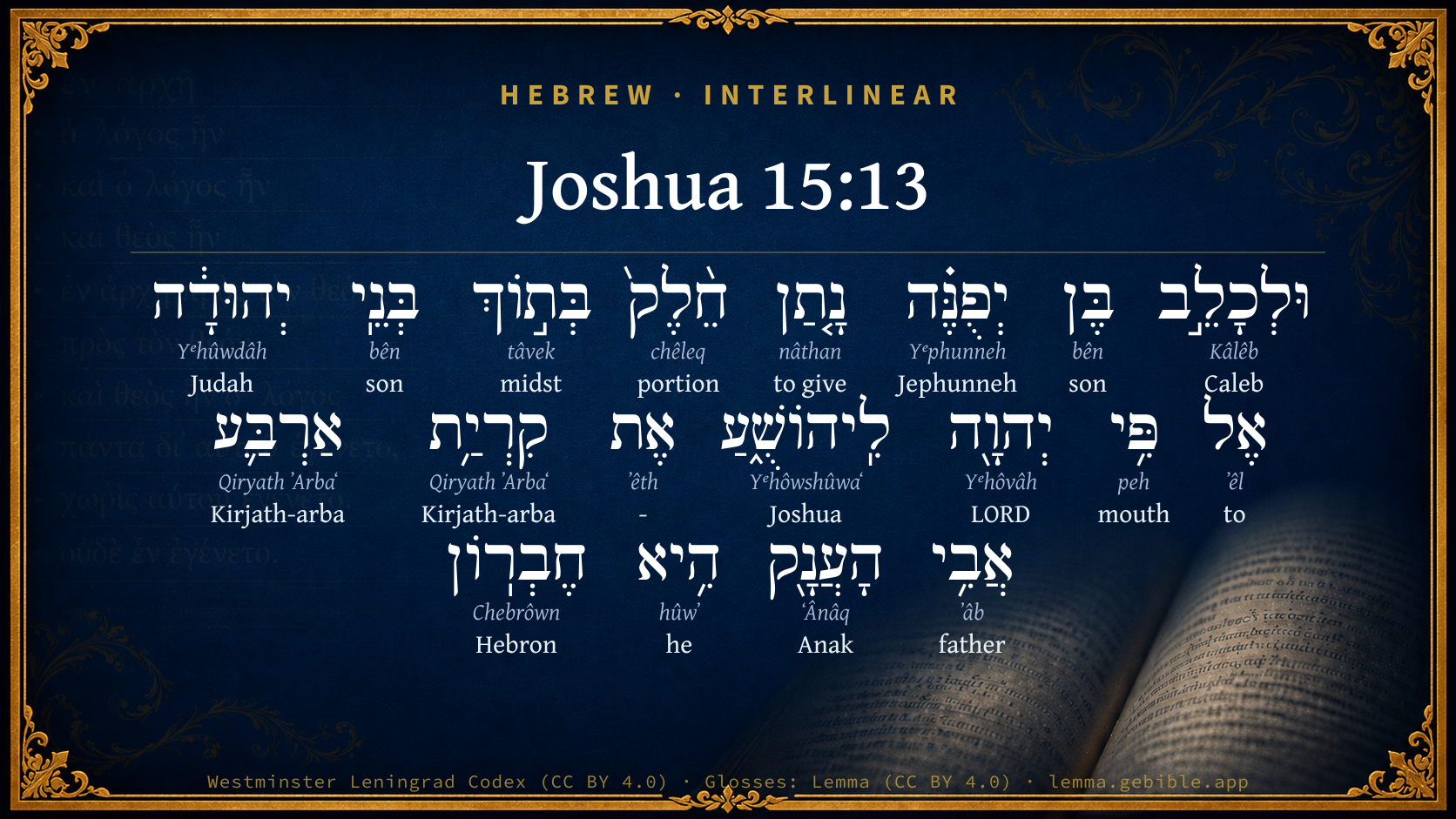
  1. וּלְכָלֵ֣ב Kâlêb H3612 “and · to/for · Caleb” Conjunction + Preposition + Noun, Proper
  2. בֶּן bên H1121 “son of” Noun, Common, Masculine, Singular, Construct
  3. יְפֻנֶּ֗ה Yᵉphunneh H3312 “Jephunneh” Noun, Proper
  4. נָ֤תַן nâthan H5414 “to give” Verb, Qal, Perfect, 3rd Person, Masculine, Singular
  5. חֵ֨לֶק֙ chêleq H2506 “portion” Noun, Common, Masculine, Singular, Absolute
  6. בְּת֣וֹךְ tâvek H8432 “in/at · midst of” Preposition + Noun, Common, Masculine, Singular, Construct
  7. בְּנֵֽי bên H1121 “sons of” Noun, Common, Masculine, Plural, Construct
  8. יְהוּדָ֔ה Yᵉhûwdâh H3063 “Judah” Noun, Proper
  9. אֶל ʼêl H413 “to” Preposition
  10. פִּ֥י peh H6310 “mouth of” Noun, Common, Masculine, Singular, Construct
  11. יְהוָ֖ה Yᵉhôvâh H3068 “LORD” Noun, Proper
  12. לִֽיהוֹשֻׁ֑עַ Yᵉhôwshûwaʻ H3091 “to/for · Joshua” Preposition + Noun, Proper
  13. אֶת ʼêth H853 “-” Particle, Direct Object
  14. קִרְיַ֥ת Qiryath ʼArbaʻ H7153 “Kirjath-arba” Noun, Proper
  15. אַרְבַּ֛ע Qiryath ʼArbaʻ H7153 “Kirjath-arba” Adjective, Cardinal number, Feminine, Singular, Absolute
  16. אֲבִ֥י ʼâb H1 “father of” Noun, Common, Masculine, Singular, Construct
  17. הִ֥יא hûwʼ H1931 “he” Pronoun, Personal, 3rd Person, Feminine, Singular
  18. חֶבְרֽוֹן Chebrôwn H2275 “Hebron” Noun, Proper

About this verse

These counts appear in no published source. They are computed here, from the morphology-tagged text and Lemma’s own curated glosses. What Lemma adds →

19
words
17
distinct lemmas
Historical
section

Notable vocabulary

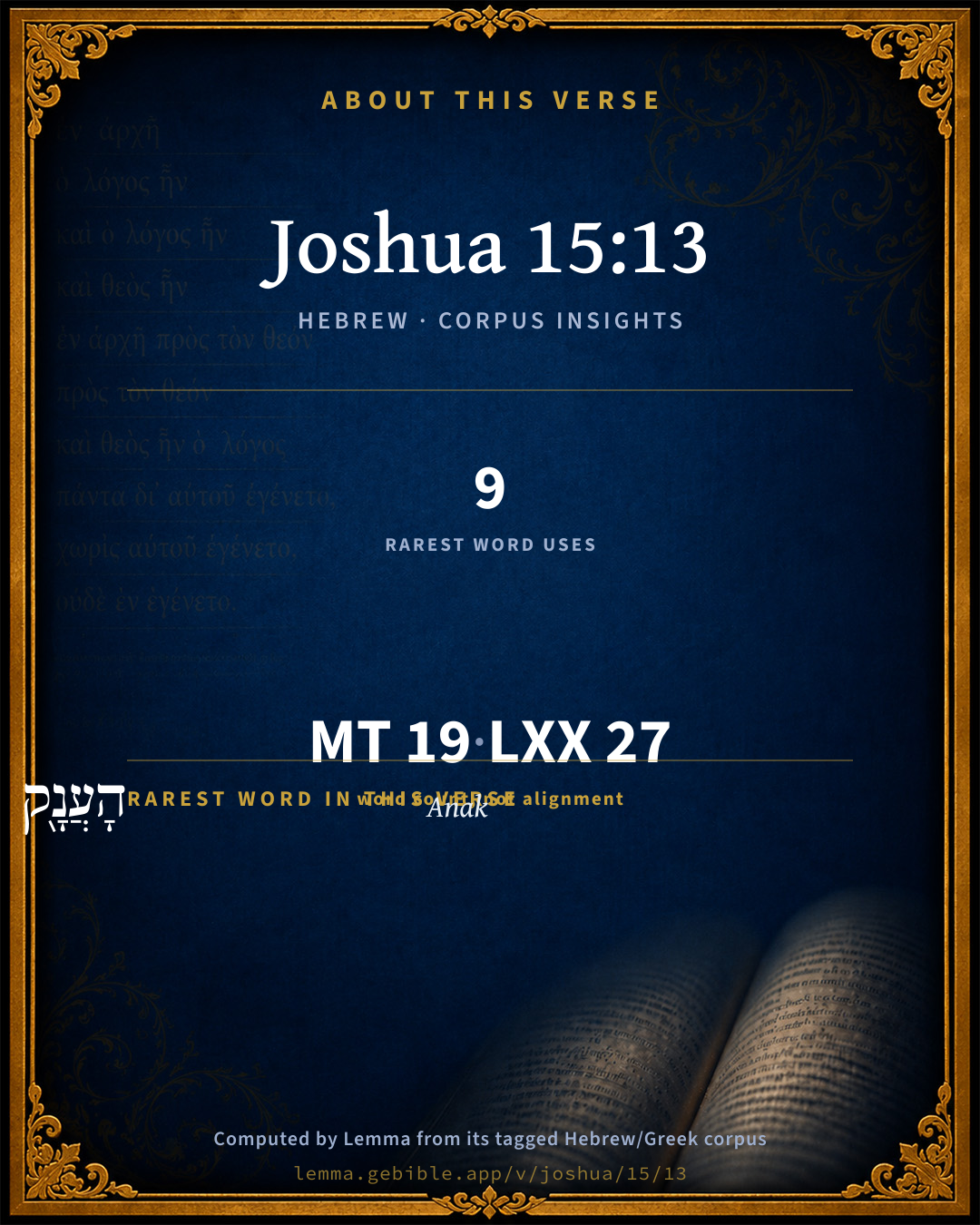
The rarest word here is הָעֲנָ֖ק Anak H6061 — appearing just 9 times in the whole Hebrew Bible.

Shared distinctive vocabulary

הָעֲנָ֖ק Anak H6061 occurs in 8 verses of the Hebrew Bible. Also found in:

Grammatical profile

  • 1 verb
  • 14 nouns
  • 1 adjective
  • 1 pronoun
  • 1 preposition
  • 1 particle

Verb forms

  • נָ֤תַן Qal · Perfect

Repetition

Words recur within this verse — often emphatic in Hebrew:

  • בֶּן son H1121 ×2
  • קִרְיַ֥ת Kirjath-arba H7153 ×2

Hebrew & Septuagint length

In English translation the verse runs 37 words from the Hebrew and 39 from the Septuagint (LXX English) — closely comparable.

A rough comparison of the two English renderings, which tokenize alike — not a word-level alignment.

Word counts can differ between the Hebrew and the Greek without any difference in meaning — e.g. the Hebrew direct-object marker אֵת has no separate Greek word, and Greek often adds the article ὁ.

In the original languages it is 19 Hebrew tokens and 27 Greek tokens — but the two are counted differently (Hebrew bundles its prefixes and suffixes into one token; the Greek is in lemma form), so that isn’t a like-for-like length.

Cross-references

4

Topical passages linked to Joshua 15:13 in the Treasury of Scripture Knowledge — connected by theme and wording, ordered by reader-vote popularity; previews shown in the World English Bible.

  • Numbers 13:30 Caleb stilled the people before Moses, and said, Let us go up at once, and possess it; for we are well able to overcome it.
  • Numbers 14:23–24 surely they shall not see the land which I swore to their fathers, neither shall any of those who despised me see it:
  • Deuteronomy 1:34–36 Yahweh heard the voice of your words, and was angry, and swore, saying,
  • Joshua 14:6–15 Then the children of Judah drew near to Joshua in Gilgal: and Caleb the son of Jephunneh the Kenizzite said to him, You know the thing that Yahweh spoke to Moses the man of God concerning me and concerning you in Kadesh-barnea.

Cross-references courtesy of OpenBible.info (CC BY 4.0).

Hebrew and Greek witnesses Masoretic Hebrew ↔ Greek Septuagint

The same verse in the two great witnesses to the Old Testament, shown verse-for-verse.

These are two independent witnesses, not word-aligned to each other, and the Septuagint is shown in lemma (dictionary) form.

Hebrew Joshua 15:13 Masoretic · Westminster Leningrad Codex

וּלְכָלֵ֣ב בֶּן יְפֻנֶּ֗ה נָ֤תַן חֵ֨לֶק֙ בְּת֣וֹךְ בְּנֵֽי יְהוּדָ֔ה אֶל פִּ֥י יְהוָ֖ה לִֽיהוֹשֻׁ֑עַ אֶת קִרְיַ֥ת אַרְבַּ֛ע אֲבִ֥י הָעֲנָ֖ק הִ֥יא חֶבְרֽוֹן

To Caleb the son of Jephunneh he gave a portion among the children of Judah, according to the commandment of Yahweh to Joshua, even Kiriath Arba, [which Arba was] the father of Anak (the same is Hebron).

World English Bible · Public Domain

Greek LXX Joshua 15:13 Septuagint · lemma form

καί ὁ χαλεβ υἱός ιεφοννη δίδωμι μερίς ἐν μέσος υἱός ιουδα διά πρόσταγμα ὁ θεός καί δίδωμι αὐτός ἰησοῦς ὁ πόλις αρβοκ μητρόπολις ενακ οὗτος εἰμί χεβρων

And to Chaleb the son of Jephone he gave a portion in the midst of the children of Juda by the command of God; and Joshua gave him the city of Arboc the metropolis of Enac; this is Chebron.

LXX2012 (modern English Septuagint) · Public Domain

On this verse, Matthew Henry's Commentary discusses the Septuagint’s reading. Read the note in Commentary ↓

Hebrew: Westminster Leningrad Codex (CC BY 4.0). Greek: Septuagint (public domain); English from LXX2012 (modern English Septuagint) (Public Domain). How the Septuagint differs from the Hebrew →

Targum (Aramaic paraphrase)

1

The Targum is the ancient Jewish Aramaic paraphrase of the Hebrew Scriptures — an interpretive translation, not the Hebrew text itself. Onkelos (literal) and Pseudo-Jonathan (expansive) render the Torah, and Jonathan the Prophets. Coverage is partial: where no permissively-licensed English translation exists for a verse, only the Aramaic is shown. This is verse-level text, not a word-by-word alignment to the Hebrew.

  1. Targum Jonathan Prophets (Joshua–Malachi)
    וּלְכָלֵב בַּר יְפוּנֶה יְהַב חוּלְקָא בְּגוֹ בְּנֵי יְהוּדָה עַל מֵימְרָא דַייָ לִיהוֹשֻׁעַ יַת קִרְיַת אַרְבַּע אֲבוּהוֹן דְגִבָּרַיָא הִיא חֶבְרוֹן:

    (no public-domain English translation for this verse)

    Targum Jonathan — Aramaic: “Mikraot Gedolot” (public domain). English: “Sefaria Community Translation” (CC0 1.0 (public-domain dedication)); “London "Chaldee Paraphrase," 1871” (public domain). Text via Sefaria.

Commentary

Notes on Joshua 15:13 from classic Christian and Jewish commentators (each source and its license shown beneath its notes). The classic Christian expositions comment on the surrounding passage and are grouped to its opening verse, so a note may address several verses; the Jewish commentaries on the Tanakh (Rashi and others) are per-verse, so they appear only where the commentator wrote on this verse.

Lemma curates 59 commentaries, every one of them public domain or Creative Commons licensed, each selected and text-cleaned for this edition rather than reprinted as found. About our sources →

Matthew Henry's Commentary

The historian seems pleased with every occasion to make mention of Caleb and to do him honour, because he had honoured God in following him fully. Observe,

I. The grant Joshua made him of the mountain of Hebron for his inheritance is here repeated (Jos 15:13), and it is said to be given him. 1. According to the commandment of the Lord to Joshua. Though Caleb, in his petition, had made out a very good title to it by promise, yet, because God had ordered Joshua to divide the land by lot, he would not in this one single instance, no, not to gratify his old friend Caleb, do otherwise, without orders from God, whose oracle, it is probable, he consulted upon this occasion. In every doubtful case it is very desirable to know the mind of God, and to see the way of our duty plain. 2. It is said to be a part among the children of Judah; though it was assigned him before the lot of that tribe came up, yet it proved, God so directing the lot, to be in the heart of that tribe, which was graciously ordered in kindness to him, that he might not be as one separated from his brethren and surrounded by those of other tribes.

II. Caleb having obtained this grant, we are told,

1. How he signalized his own valour in the conquest of Hebron (Jos 15:14): He drove thence the three sons of Anak, he and those that he engaged to assist him in this service. This is mentioned here to show that the confidence he had expressed of success in this affair, through the presence of God with him (Jos 14:12), did not deceive him, but the event answered his expectation. It is not said that he slew these giants, but he drove them thence, which intimates that they retired upon his approach and fled before him; the strength and stature of their bodies could not keep up the courage of their minds, but with the countenances of lions they had the hearts of trembling hares. Thus does God often cut off the spirit of princes (Psa 76:12), take away the heart of the chief of the people (Job 12:24), and so shame the confidence of the proud; and thus if we resist the devil, that roaring lion, though he fall not, yet he will flee.

2. How he encouraged the valour of those about him in the conquest of Debir, Jos 15:15, etc. It seems, though Joshua had once made himself master of Debir (Jos 10:39), yet the Canaanites had regained the possession in the absence of the army, so that the work had to be done a second time; and when Caleb had completed the reduction of Hebron, which was for himself and his own family, to show his zeal for the public good, as much as for his own private interest, he pushes on his conquest to Debir, and will not lay down his arms till he sees that city also effectually reduced, which lay but ten miles southward from Hebron, though he had not any particular concern in it, but the reducing of it would be to the general advantage of his tribe. Let us learn hence not to seek and mind our own things only, but to concern and engage ourselves for the welfare of the community we are members of; we are not born for ourselves, nor must we live to ourselves.

(1.) Notice is taken of the name of this city. It had been called Kirjath-sepher, the city of a book, and Kirjath-sannah (Jos 15:49), which some translate the city of learning (so the Septuagint Polis grammaton), whence some conjecture that it had been a university among the Canaanites, like Athens in Greece, in which their youth were educated; or perhaps the books of their chronicles or records, or the antiquities of the nation, were laid up there; and, it may be, this was it that made Caleb so desirous to see Israel master of this city, that they might get acquainted with the ancient learning of the Canaanites.

(2.) The proffer that Caleb made of his daughter, and a good portion with her, to any one that would undertake to reduce that city, and to command the forces that should be employed in that service, Jos 15:16. Thus Saul promised a daughter to him that would kill Goliath (Sa1 17:25), neither of them intending to force his daughter to marry such as she could not love, but both of them presuming upon their daughters' obedience, and submission to their fathers' will, though it might be contrary to their own humour or inclination. Caleb's family was not long honourable and wealthy, but religious; he that himself followed the Lord fully no doubt taught his children to do so, and therefore it could not but be a desirable match to any young gentleman. Caleb, in making the proposal, aims, [1.] To do service to his country by the reducing of that important place; and, [2.] To marry a daughter well, to a man of learning, that would have a particular affection for the city of books, and a man of war, that would be likely to serve his country, and do worthily in his generation. Could he but marry his child to a man of such a character, he would think her well bestowed, whether the share in the lot of his tribe were more or less.

(3.) The place was bravely taken by Othniel, a nephew of Caleb, whom probably Caleb had thoughts of when he made the proffer, Jos 15:17. This Othniel, who thus signalized himself when he was young, had long after, in his advanced years, the honour to be both a deliverer and a judge in Israel, the first single person that presided in their affairs after Joshua's death. It is good for those who are setting out in the world to begin betimes with that which is great and good, that, excelling in service when they are young, they may excel in honour when they grow old.

(4.) Hereupon (all parties being agreed) Othniel married his cousin-german Achsah, Caleb's daughter. It is probable that he had a kindness for her before, which put him upon this bold undertaking to obtain her. Love to his country, an ambition of honour, and a desire to find favour with the princes of his people, might not have engaged him in this great action, but his affection for Achsah did. This made it intolerable to him to think that any one should do more to win her favour than he would, and so inspired him with this generous fire. Thus is love strong as death, and jealousy cruel as the grave.

(5.) Because the historian is now upon the dividing of the land, he gives us an account of Achsah's portion, which was in land, as more valuable because enjoyed by virtue of the divine promise, though we may suppose the conquerors of Canaan, who had had the spoil of so many rich cities, were full of money too. [1.] Some land she obtained by Caleb's free grant, which was allowed while she married within her own tribe and family, as Zelophehad's daughters did. He gave her a south land, Jos 15:19. Land indeed, but a south land, dry, and apt to be parched. [2.] She obtained more upon her request; she would have had her husband to ask for a field, probably some particular field, or champaign ground, which belonged to Caleb's lot, and joined to that south land which he had settled upon his daughter at marriage. She thought her husband had the best interest in her father, who, no doubt, was extremely pleased with his late glorious achievement, but he thought it was more proper for her to ask, and she would be more likely to prevail; accordingly she did, submitting to her husband's judgment, though contrary to her own; and she managed the undertaking with great address. First, She took the opportunity when her father brought her home to the house of her husband, when the satisfaction of having disposed of his daughter so well would make him think nothing too much to do for her. Secondly, She lighted off her ass, in token of respect and reverence to her father, whom she would honour still, as much as before her marriage. She cried or sighed from off her ass, so the Septuagint and the vulgar Latin read it; she expressed some grief and concern, that she might give her father occasion to ask her what she wanted. Thirdly, She calls it a blessing, because it would add much to the comfort of her settlement; and she was sure that, since she married not only with her father's consent, but in obedience to his command, he would not deny her his blessing. Fourthly, She asks only for the water, without which the ground she had would be of little use either for tillage or pasture, but she means the field in which the springs of water were. The modesty and reasonableness of her quest gave it a great advantage. Earth without water would be like a tree without sap, or the body of an animal without blood; therefore, when God gathered the waters into one place, he wisely and graciously left some in every place, that the earth might be enriched for the service of man. See Psa 104:10, etc. Well, Achsah gained her point; her father gave her what she asked, and perhaps more, for he gave her the upper springs and the nether springs, two fields so called from the springs that were in them, as we commonly distinguish between the higher field and the lower field. Those who understand it but of one field, watered both with the rain of heaven and the springs that issued out of the bowels of the earth, give countenance to the allusion we commonly make to this, when we pray for spiritual and heavenly blessings which relate to our souls as blessings of the upper springs, and those which relate to the body and the life that now is as blessings of the nether springs.

From this story we learn, 1. That it is no breach of the tenth commandment moderately to desire those comforts and conveniences of this life which we see attainable in a fair and regular way. 2. That husbands and wives should mutually advise, and jointly agree, about that which is for the common good of their family; and much more should they concur in asking of their heavenly Father the best blessings, those of the upper springs. 3. That parents must never think that lost which is bestowed upon their children for their real advantage, but must be free in giving them portions as well as maintenance, especially when they are dutiful. Caleb had sons (Ch1 4:15), and yet gave thus liberally to his daughter. Those parents forget themselves and their relation who grudge their children what is convenient for them when they can conveniently part with it.

Matthew Henry's Commentary on the Whole Bible (1708–1710) — public domain (CC PDM 1.0). Text via the HelloAO Bible API.

Jamieson, Fausset & Brown

Robert Jamieson, A. R. Fausset & David Brown

CALEB'S PORTION AND CONQUEST. (Jos 15:13-15)

unto Caleb he gave a part among the children of Judah--(See on Jos 14:6).

Jamieson, Fausset & Brown — Commentary Critical and Explanatory on the Whole Bible (1871) — public domain (CC PDM 1.0). Text via the HelloAO Bible API.

The Cambridge Bible for Schools and Colleges

gen. ed. J. J. S. Perowne

13–19. The Request of Achsah, Daughter of Caleb

13. And unto Caleb] This section, from Jos_15:13-19, is repeated with slight alterations almost verbatim in Jdg_1:10-20. The two sections are probably derived from a common source. As occurring here the verses are intended to complete the history of the division of the land amongst the tribes. As Caleb had brought forward his claims to the possession of Hebron, before the casting of the lots commenced, and those claims had been admitted by Joshua, it was quite in order for the author, when giving here the list of the cities assigned to the tribe of Judah, to refer especially to the portion which Caleb had received, not by lot, but in fulfilment of the Divine promise made to him by Moses, and at the same time to record how fully his hopes had been fulfilled of driving out the Anakims, and thus securing the undisputed possession of Hebron and its vicinity to himself and his descendants. Keil’s Commentary.

he gave] i. e. Joshua, by the command of Jehovah. For “the city of Arba” see above, ch. Jos_14:15.

The Cambridge Bible for Schools and Colleges (gen. ed. J. J. S. Perowne; Cambridge University Press, 1878–1918) — public domain. Text from a community e-Sword module.

Trapp's Complete Commentary

John Trapp

Jos 15:13 And unto Caleb the son of Jephunneh he gave a part among the children of Judah, according to the commandment of the LORD to Joshua, [even] the city of Arba the father of Anak, which [city is] Hebron.

Ver. 13. And unto Caleb.] See Jos 14:13.

John Trapp, A Commentary or Exposition upon All the Books of the Old and New Testament (1647–1656) — public domain. Text from a community e-Sword module.

The Biblical Illustrator

Joseph S. Exell

Jos_15:13-19

To him will I give Achsah my daughter to wife.

Othniels conquest of Debir

I. The spirit which influenced caleb in the disposal of achsah. He sought to unite her to a man--

(1) Honourable for his zeal and energy;

(2) conspicuous for his bravery;

(3) and willing to use his strength in the way of the Lords commandments.

(4) It seems likely also that Caleb sought to unite his daughter to one who was in a social station akin to her own.

The promise was not to the man who should first enter Kirjath-sepher. This may have been the nature of the similar promise at the siege of Jerusalem, under David, although it seems by no means certain that, even in this instance, David did not refer to the captain who should first bring his company into Jebus and smite the garrison. He should be chief captain (2Sa_5:8; 1Ch_11:6). However this may have been, Calebs promise ran, He that smiteth Kirjath-sepher, and taketh it, to him, &c. No man single-handed could smite and take a fortified city; and thus the promise probably refers to the leaders of the army who were under Caleb. This view has also the advantage that it does not exhibit to us an honourable man like Caleb putting up his daughter as the object of a wretched scramble, where a mere accident of a stumble or a wound might decide whose she should be. Possibly there were but few of the commanders under Caleb officially qualified to lead one or more divisions of the army against Debit; and of these Othniel might first have volunteered, or he only might have volunteered to lead the attack. Any way, out of regard for Achsah, Othniel was one who offered to conduct the assault, and he succeeded.

II. The harmony between the father and the daughter.

1. Achsah accorded with her fathers will and with the custom of the age. There can be no doubt but that, at this period, a father was held to have an absolute right to the disposal of his daughters hand (Gen_29:18-28; Exo_21:7-11; 1Sa_17:25, &c.). It does not follow, however, that a father would not consult his daughters wishes.

2. She had confidence in her fathers love, notwithstanding her recognition of his authority. She asked for a larger dowry (Jos_15:19). On leaving her father, to cleave to her husband, we thus find her seeking her husbands interest.

3. Her father cheerfully responded to her request. The confidence which was bold to ask was met by an affection which was pleased to bestow.

III. The honourable character in which this brief history introduces Othniel. He comes before us as a man of courage, willing to risk his life for the woman he loved. He is seen to perhaps even more advantage in not preferring the request which Achsah prompted him to make. He may have refused to comply with his wifes wishes. The history does not actually say this; it merely shows that Achsah made her request herself. Othniel was bold enough to fight; he seems to have been too manly to have allowed himself to ask for this addition to what was probably already a just and good inheritance. He was brave enough to do battle against Debir; he was not mean enough to beg. If Achsah needed a larger dowry, such a request would come better from herself. (F. G. Marchant.)

A chance for ability

There begins the test of talent and force and quality in men. The speech is, Come, now I the palm be to the brave, the crown to him who wins it. Up to a certain point all things seem to be appointed, settled, almost arbitrarily distributed; but then there are chances in life that seem to come afterwards, as it were, amongst ourselves, competitions of a personal and social kind. How early this competitive spirit was developed, and how wonderfully it has been preserved through all history! The spirit of Providence seems to say, in homeliest language, now and again, Here is a chance for you; you had something to begin with, to that you can add more, by pluck, bravery, force--to the war! We need such voices; otherwise we would soon slumber off, and doze away our handful of years, and awake to find that the day had gone. (J. Parker, D. D.)

Thou hast given me a south land; give me also springs of water.

Noble discontent

1. Such noble discontent, such aspiration for higher and better things, should urge us on in the realm of the daily duty. Simply the south land of a measurable and merely respectable discharge of the daily duty should never satisfy us. We should be stirred with a noble discontent far the water springs of the best possible doing it. Thus we transform ourselves from drudges into artists. Thus, too, we compact ourselves in noble character.

2. In the realm of intellectual advance we should be stirred with this noble discontent; we should turn from a merely general and surface and newspaper information toward the springs of water of a thorough and accurate knowledge.

3. In the realm of the best good of the community in which we dwell we should be stirred with a noble discontent. The south land of a merely usual municipal security and order ought not to satisfy us; we should be restless with discontent until the springs of water of a high moral atmosphere and action are predominant.

4. In the realm of Christian experience we ought to be stirred with such noble discontent; we ought to leave behind us the south land of a merely usual and routine experience, and seek the springs of water of the peace and joy and strength of a transfiguring likeness to our Lord (1Co_3:10; 1Co_3:16). (W. Hoyt, D. D.)

The upper springs, and the nether springs.--

The upper and nether springs

I. The upper springs, as they picture forth the joy-sources of the higher nature. My soul thirsteth for God--the living God! Nor need we be disappointed. It is pensive to think that some thirsts, and honest thirsts too, must be disappointed, Not to all are given possibilities equal to their desires. Their ideals are above their realisation! But none need be disappointed in God! Christ has opened up a free and full channel of communication. It pleased the Father that in Him should all fulness dwell. We have read of waters in the East which, copious at some times, are scarce at others. To-day the waters pour forth their freshening streams, irrigate the land, and satisfy the thirst of man and beast; to-morrow the faithless well is dry. Not so with Christ. In Him the waters dwell. But more than this, Christ is not only the fulness of God, He is the available fulness for us.

1. Take fellowship with God. Inspired words used about this are not the language of poetic fiction or overwrought religious feeling. They are the actual experiences of meditative, devout, earnest, inspired men. God is the strength of my heart and my portion for ever.

2. Take likeness to God. Who can conceive of a more magnificent ideal than God-life in the soul? Be ye holy as your leather, &c. Be ye followers of God, &c. Herein consists our true life. Not in the mere culture of art-faculty, but in the growth of the moral likeness to God! We become happier as we become more like Him. Less vexed with trifles, less anxious about losses provided they bring gains to the soul, less conformed to the world, more restful in the love of God!

3. Take the service of God. Christ does not call us to His work merely that we may work, that our moral nature may have something to do; the Lord hath need of us. I say this not only dignifies life, it makes it delightful (Joh_4:34). These are upper springs! Co-workers together with God!

4. Take the friends of God. These are yours! We are made for each other! Church life is designed to draw forth common sympathies and common purposes. We are pilgrims to the same shrine; soldiers in the same battlefield; fruit-gatherers in the same vineyard; children of the same Father. Thoughtful Christian friendship is one of the choicest blessings we can enjoy.

5. Take the future of Gods children. I love to think of them at home there. Upper springs coming from the throne of God and the Lamb: They shall hunger no more, neither thirst any more. Shall we drink of those upper springs? I hope so! Do we love Christ now? Do we enjoy His service now? If so, when the morning of eternity comes to us, we shall know in a higher sense than we have ever known on earth the meaning of the upper springs.

II. The nether springs, as they illustrate the mere satisfactions of the lower nature. Take care lest all life plays upon the surface! Take care lest all lifes drinking be at the nether springs. I am not now speaking of the grossness of sensualism, but of mere sensationalism. It is possible to live a merely surface life. Let us remember that there are eyes and ears within us, that the invisible world, the world which embraces God and judgment and eternity, is always speaking through many voices to our conscience and heart. Mere earthly aims are nether springs. Some people are always drinking at the springs of position and success. They attempt to please men.

The Biblical Illustrator, edited by Joseph S. Exell (c. 1880s–1900s) — public domain. Text from a community e-Sword module.

Keil & Delitzsch

C. F. Keil & F. Delitzsch

The account of the conquest of the inheritance, which Caleb asked for and received before the lots were cast for the land (Jos 14:6-15), by the extermination of the Anakites from Hebron, and the capture of the fortified town of Debir, is repeated with very slight differences in Jdg 1:10-15, in the enumeration of the different conflicts in which the separate tribes engaged after the death of Joshua, in order to secure actual possession of the inheritance which had fallen to them by lot, and is neither copied from our book by the author of the book of Judges, nor taken from Judges by the author of Joshua; but both of them have drawn it from one common source, upon which the accounts of the conquest of Canaan contained in the book of Joshua are generally founded.

Jos 15:13

As an introduction to the account of the conquest of Hebron and Debir, the fact that they gave Caleb his portion among the sons of Judah, namely Hebron, is first of all repeated from Jos 14:13. נתן impers., they gave, i.e., Joshua (Jos 14:13). The words "according to the command of Jehovah to Joshua" are to be explained from Jos 14:9-12, according to which Jehovah had promised, in the hearing of Joshua, to give Caleb possession of the mountains of Hebron, even when they were at Kadesh (Jos 14:12). The "father of Anak" is the tribe father of the family of Anakites in Hebron, from whom this town received the name of Kirjath-arba; see at Num 13:22 and Gen 23:2.

Jos 15:14

Thence, i.e., out of Hebron, Caleb drove (ויּרשׁ, i.e., rooted out: cf. יכּוּ, Jdg 1:10) the three sons of Anak, i.e., families of the Anakites, whom the spies that were sent out from Kadesh had already found there (Num 13:22). Instead of Caleb, we find the sons of Judah (Judaeans) generally mentioned in Jdg 1:10 as the persons who drove out the Anakites, according to the plan of the history in that book, to describe the conflicts in which the several tribes engaged with the Canaanites. But the one does not preclude the other. Caleb did not take Hebron as an individual, but as the head of a family of Judaeans, and with their assistance. Nor is there any discrepancy between this account and the fact stated in Jos 11:21-22, that Joshua had already conquered Hebron, Debir, and all the towns of that neighbourhood, and had driven out the Anakites from the mountains of Judah, and forced them back into the towns of the Philistines, as Knobel fancies. For that expulsion did not preclude the possibility of the Anakites and Canaanites returning to their former abodes, and taking possession of the towns again, when the Israelitish army had withdrawn and was engaged in the war with the Canaanites of the north; so that when the different tribes were about to settle in the towns and districts allotted to them, they were obliged to proceed once more to drive out or exterminate the Anakites and Canaanites who had forced their way in again (see the remarks on Jos 10:38-39, p. 86, note).

Jos 15:15-16

From Hebron Caleb went against the Inhabitants of Debir, to the south of Hebron. This town, which has not yet been discovered (see at Jos 10:38), must have been very strong and hard to conquer; for Caleb offered a prize to the conqueror, promising to give his daughter Achzah for a wife to any one that should take it, just as Saul afterwards promised to give his daughter to the conqueror of Goliath (Sa1 17:25; Sa1 18:17).

Jos 15:17

Othniel took the town and received the promised prize. Othniel, according to Jdg 3:9 the first judge of the Israelites after Joshua's death, is called כלב אחי קנז בּן, i.e., either "the son of Kenaz (and) brother of Caleb," or "the son of Kenaz the brother of Caleb." The second rendering is quite admissible (comp. Sa2 13:3, Sa2 13:32, with Ch1 2:13), but the former is the more usual; and for this the Masorites have decided, since they have separated achi Caleb from ben-Kenaz by a tiphchah. And this is the correct one, as "the son of Kenaz" is equivalent to "the Kenizzite" (Jos 14:6). According to Jdg 1:13 and Jdg 3:9, Othniel was Caleb's younger brother. Caleb gave him his daughter for a wife, as marriage with a brother's daughter was not forbidden in the law (see my Bibl. Archol. ii. 107, note 14).

Jos 15:18-19

When Achzah had become his wife ("as she came," i.e., on her coming to Othniel, to live with him as wife), she urged him to ask her father for a field. "A field:" in Jdg 1:14 we find "the field," as the writer had the particular field in his mind. This was not "the field belonging to the town of Debir" (Knobel), for Othniel had no need to ask for this, as it naturally went with the town, but a piece of land that could be cultivated, or, as is shown in what follows, one that was not deficient in springs of water. What Othniel did is not stated, but only what Achzah did to attain her end, possibly because her husband could not make up his mind to present the request to her father. She sprang from the ass upon which she had ridden when her father brought her to Othniel. צנח, which only occurs again in Jdg 4:21, and in the parallel passage, Jdg 1:14, is hardly connected with צנע, to be lowly or humble (Ges.); the primary meaning is rather that suggested by Frst, to force one's self, to press away, or further; and hence in this case the meaning is, to spring down quickly from the animal she had ridden, like נפל in Gen 24:64. Alighting from an animal was a special sign of reverence, from which Caleb inferred that his daughter had some particular request to make of him, and therefore asked her what she wanted: "What is to thee?" or, "What wilt thou?" She then asked him for a blessing (as in Kg2 5:15); "for," she added, "thou hast given me into barren land." הנּגב ארץ (rendered a south land) is accus. loci; so that negeb is not to be taken as a proper name, signifying the southernmost district of Canaan (as in Jos 15:21, etc.), but as an appellative, "the dry or arid land," as in Psa 126:4. "Give me springs of water," i.e., a piece of land with springs of water in it. Caleb then gave her the "upper springs and lower springs:" this was the name given to a tract of land in which there were springs on both the higher and lower ground. It must have been somewhere in the neighbourhood of Debir, though, like the town itself, it has not yet been found.

Keil & Delitzsch — Biblical Commentary on the Old Testament (1861–1891) — public domain (CC PDM 1.0). Text via the HelloAO Bible API. (Old Testament only.)

Adam Clarke's Commentary

Verse 13. And unto Caleb - he gave a part] See Clarke on Jos 14:14, &c.

Adam Clarke's Commentary on the Bible (1810–1826) — public domain. Text from a community e-Sword/MySword module.

John Calvin's Commentaries

13. And unto Caleb the son of Jephunneh, etc Were we to judge from the actual state of matters, it would seem ridiculous repeatedly to celebrate an imaginary grant from which Caleb received no benefit while Joshua was alive. But herein due praise is given both to the truth of God, and to the faith of his saint in resting on his promise. Therefore, although sneering men, and the inhabitants of the place itself, if the rumor had reached them, might have derided the vain solicitude of Caleb, and the empty liberality of Joshua, the contempt thus expressed would only have proved them to be presumptuous scoffers. God at length evinced the firmness of his decree by the result, and Caleb, though he saw himself unable to obtain access to the mountain, testified that he was contented with the mere promise of God, the true exercise of faith, consisting in a willingness to remain without the fruition of things which have been promised till the period actually arrive. Moreover, this passage, and others similar to it, teach us that the giants who are usually called Enakim, were so named after their original progenitor, Enac, and that the word is hence of Gentile origin. The time when Caleb routed the sons of Enac we shall see in a short time. This passage also shows us that Caleb, when he brought forward the name of Moses, did not make a mere pretence, or utter anything that was not strictly true; for it is now plainly declared, that Moses had so appointed, in conformity with the command of God.

John Calvin's Commentaries (1540-1563) — public domain. Text from the Calvin Translation Society English edition (1840s-50s) via the Christian Classics Ethereal Library (ccel.org). Calvin's coverage is partial (roughly two-thirds of the Bible); uncommented books and verses are honest gaps, never fabricated. The 19th-century editor's footnotes and remarks are omitted so the notes are faithfully Calvin's own voice.

Ellicott's Commentary for English Readers

(13-19) And unto Caleb . . . This paragraph occurs also in Jdg_1:10-15, with some slight variations. Which is its original place? In Judges it is connected with the continuation of the conquest of Canaan by the tribe of Judah after Joshua’s death, and there we read they slew (literally, smote) Sheshai, and Ahiman, and Talmai. If this is the death, and not merely the defeat of the Anakim (the Hebrew word is not absolutely decisive), we have two stages in the conquest of Hebron described—viz., (l) the expulsion of the Anakim sufficiently for Caleb to occupy the place; and (2) their final defeat and death. It seems hardly possible to make the narrative in Judges 1 a mere repetition of an earlier story, because it is presented as a part of that which happened after Joshua’s death. It would seem, then, that the entire conquest of the Anakim was not effected at once, but begun by Caleb and Joshua in Joshua’s lifetime, and completed by the tribe of Judah, under the leadership of Caleb, after Joshua’s death. It is remarkable that Ahiman, Sheshai, and Talmai are mentioned as apparently living when the twelve spies went up from Kadesh-barnea (Num_13:22), forty years before. But it has been thought that the three names were the names of three clans of the Anakim. (See Notes on Jdg_1:10.)

Upon the whole, it seems most reasonable to conclude that the proceedings by which Caleb secured his inheritance, and fulfilled the promise of Jos_14:12, have been recorded here for the sake of completeness, though not necessarily belonging to this time.

(15) Kirjath-sepher.—“City of books.”

(17) Othniel the son of Kenaz.—Comp. Jdg_3:9.

(19) A south land—i.e., land in the Negeb: “a series of rolling hills clad with scanty herbage here and there.” Conder does not identify Debir, but others have taken it to be identical with Dewir-ban, about three miles west of Hebron.

The upper springs, and the nether springs—i.e., the upper and lower “bubblings,” or pools of a rivulet in a valley among the hills in this neighbourhood.

A Bible Commentary for English Readers, edited by Charles John Ellicott (1878–1897) — public domain. Text from a community e-Sword module.

John Gill's Exposition

And unto Caleb the son of Jephunneh he gave a part among the children of Judah,.... That is, Joshua gave it to him. This account is inserted before the cities in the lot of the tribe of Judah were enumerated, to show what was to be excepted from them, and which had been given to Caleb previous to the lot:

according to the commandment of the Lord to Joshua; for as he had declared this to Moses, Deu 1:36; so it seems he also gave the same order to Joshua, who, it is not improbable, might consult the Lord about it when Caleb made his request, Jos 14:12,

even the city of Arba the father of Anak, which city is Hebron; See Gill on Jos 14:15.

John Gill's Exposition of the Whole Bible (1746–1763) — public domain (CC PDM 1.0). Text via the HelloAO Bible API.

Haydock's Catholic Bible Commentary

Arbe, who was the father, and the greatest man of the race of Enac, chap. xiv. 15. (Haydock)

George Leo Haydock (1774–1849), Haydock's Catholic Family Bible and Commentary, 1859 edition — public domain. Excludes Psalms (Douay-Rheims chapter numbering differs from Protestant) and Deuterocanonical books (Catholic canon only).

Matthew Poole's English Annotations

He gave, i.e. Joshua, as appears by comparing this with Jos 14:6,12,13.

Arba, or Kirjath-arba; not the city, which was the Levites’, but the territory of it, Jos 21:13.

Matthew Poole's English Annotations on the Holy Bible (1683–1685) — public domain. Text from a community e-Sword/MySword module.

Whedon's Commentary on the Bible

Daniel D. Whedon

13. Hebron — See at Jos_14:12.

Daniel D. Whedon (gen. ed.), Commentary on the Old and New Testaments (1874–1909) — public domain. Text from a community e-Sword module.

The Pulpit Commentary

And unto Caleb. This passage, at least from ver. 15, is found with the slightest possible variation in Judges 1. It has been argued from the variations that the one passage was not copied from the other, but that both were derived from a common document. No such conclusion, however, can be safely drawn from the text. For first, the present narrative deals exclusively with this portion of the history of Caleb. That in Judges, down to ver. 12, deals more generally with the subject, including the exploits of Caleb, under the general history of the progress of Judah. But from the time that the history becomes that of Caleb in particular, the agreement between the two narratives is verbal, including the very unusual word jnx, with one or two most insignificant exceptions. Thus we have yLi hibh for yLi hnt, we have tylg for twylg, and we have WNMmi interpolated in Jud_1:13, and Othniel (or Kenez) is spoken of as the younger brother of Caleb. But unless we hold that it was a sacred duty of the writer in Judges to reproduce every single word of the narrative in Joshua, there is nothing whatever that can support the conclusion that the writer in Judges was not copying the earlier narrative. The variations are such as would naturally happen where a writer was transferring, a narrative to his pages with a desire to give the exact sense of the original without tying himself to every particular word. Since the use of inverted commas has been introduced we can find multitudes of instances where a writer, when professing to quote another accurately, has introduced far more variations into his quotation than are to be found here, where the writer, though quoting the Book of Joshua, and quoting it correctly, does not say that he is doing so. No one doubts that Jeremiah in Jer 48 is quoting Isaiah 15, although the passages are not verbally coincident. We may safely regard this quotation of the Book of Joshua in that of Judges, as under all ordinary laws of criticism an evidence that the former book was in existence when the latter was written, just as the quotations of Deuteronomy in Joshua may naturally be taken as evidence that the Book of Deuteronomy was in existence when that of Joshua was composed. The son of Jephunneh. (see Jos_14:6) A part. Literally, a Lot. among. Rather, in the midst of. Our version is obscure here. Arba the father of Anak, which city is Hebron. (see Jos_14:6-15) Keil thinks that he was the tribe father, or chief (sheikh, as the Arabs would call him), of the children of Anak.

The Pulpit Commentary (1880–1919), ed. H.D.M. Spence-Jones & Joseph S. Exell — public domain. Text from a community e-Sword module.

John Wesley's Explanatory Notes

He - Joshua. City of Arba - Or, Kirjath-arba. Not the city, which was the Levites, but the territory of it, chap. xxi, 13.

John Wesley, Explanatory Notes Upon the Whole Bible (1754–1765) — public domain. Text via the GEBible commentary corpus.

Kretzmann's Popular Commentary

Paul E. Kretzmann

Caleb’s Possession.

v. 13. And unto Caleb, the son of Jehunneh, he, Joshua, gave a part among the children of Judah, according to the commandment of the Lord to Joshua, even the city of Arba, the father of Anak, the ancestor of the Anakim, which city is Hebron.

v. 14. And Caleb drove thence, as he had promised, Jos 14:12, the three sons of Anak, Sheshai, and Ahiman, and Talmai, the children of Anak.

v. 15. And he went up thence to the inhabitants of Debir; and the name of Debir before was Kirjathsepher, which, meanwhile, seems to have been fortified very strongly.

v. 16. And Caleb said, He that smiteth Kirjathsepher and taketh it, to him will I give Achsah, my daughter, to wife, this being the reward or prize held out before the young men to spur them on to their best efforts.

v. 17. and Othniel, the son of Kenaz, the brother of Caleb, took it; and he, Caleb, gave him Achsah, his daughter, to wife.

v. 18. And it came to pass, as she came unto him, on her way over from Hebron in the company of her father, to celebrate the nuptials, that she moved him, her husband-to-be, to ask of her father a field, a piece of land fit for cultivation as her dowry; and she lighted, quickly sprang down, off her ass, thus humbling herself before her father; and Caleb said unto her, What wouldest thou?

v. 19. Who answered, Give me a blessing; for thou hast given me a south land, by marrying her to Othniel, he had caused her to inhabit a dry land, at and near Debir; give me also springs of water, a piece of land containing springs. And he gave her the upper springs and the nether springs, a strip of land well watered in every respect.

v. 20. This is the inheritance of the tribe of the children of Judah according to their families. This is the subscription or conclusion of the first division of this chapter, with which the description of the bounds of the inheritance of Judah closes.

Paul E. Kretzmann, Popular Commentary of the Bible (1921–1924) — public domain. Text from a community e-Sword module.

unfoldingWord translationNotes

Door43 World Missions Community

Kiriath Arba ... Debir ... Kiriath Sepher

These are the names of places. (See: How to Translate Names)

Arba ... Anak ... Sheshai ... Ahiman ... Talmai

These are the names of men. (See: How to Translate Names)

the three sons of Anak: Sheshai, Ahiman and Talmai, descendants of Anak

These names represent clans of people who were descendants of Sheshai, Ahiman, and Talmai. The words "sons" and "descendants" in this context mean the same thing. AT: "the three clans, Sheshai, Ahiman, and Talmai, who were descendants of Anak" (See: Assumed Knowledge and Implicit Information)

He went up from there against

"He went up from there to fight against"

translationWords

command

Yahweh

Joshua

Caleb

assign

tribe

Judah

Hebron

descend

unfoldingWord translationNotes — © Distant Shores Media and the Door43 World Missions Community, licensed CC BY-SA 4.0. Source: git.door43.org/Door43/en_tn.

Rashi

Rabbi Shlomo Yitzchaki (Rashi)

According to the word of Adonoy to Yehoshua. As the Holy one, blessed is He, said to Yehoshua.

Rashi on the Tanakh — English translations: “The Judaica Press complete Tanach with Rashi, translated by A. J. Rosenberg” (CC BY 4.0); “Pentateuch with Rashi's commentary by M. Rosenbaum and A.M. Silbermann, 1929-1934” (public domain); “The Metsudah Tanach series, Lakewood, N.J” (CC BY 4.0); and “The Book of Joshua, Metsudah Publications, 1997” (CC BY 4.0). Text via Sefaria.

Lesson kit

Teaching starters — assembled from the data on this page, not authored interpretation. Every prompt links to the verse data it draws on. Edit before teaching.

Joshua, in the Historical, opens this verse with 19 words (17 distinct Hebrew lemmas). Its most distinctive word is ʻÂnâq (“Anak”). A historical commentator’s framing appears above. Read the whole chapter for the surrounding context.

Discussion questions

  1. The word ʻÂnâq carries the sense “Anak.” How does it shape the verse?
  2. Numbers 13:22 shares the word «Anak» with this verse. How do the two illuminate each other?
  3. “son” occurs 2× in this one verse. What is the effect of the repetition?
  4. These translations render this verse differently. What is at stake in choosing one wording over another?
  5. The verb «נָ֤תַן» is Qal Perfect. How does its form color the action?
  6. Reading how Matthew Henry's Commentary and Jamieson, Fausset & Brown read this verse, where do the two commentators agree and where do they part?

Things to notice

Reading settings

Reading text

Shown beneath each verse's original-language words.

Old Testament
Old Testament edition

Read the OT as the Masoretic Hebrew (MT) or the Greek Septuagint (LXX).

English shown for the Greek Septuagint (in the Hebrew ↔ Greek comparison).

Comparing translations? Open the Compare panel on any verse page to stack up to four side by side.