
Exodus 25:8

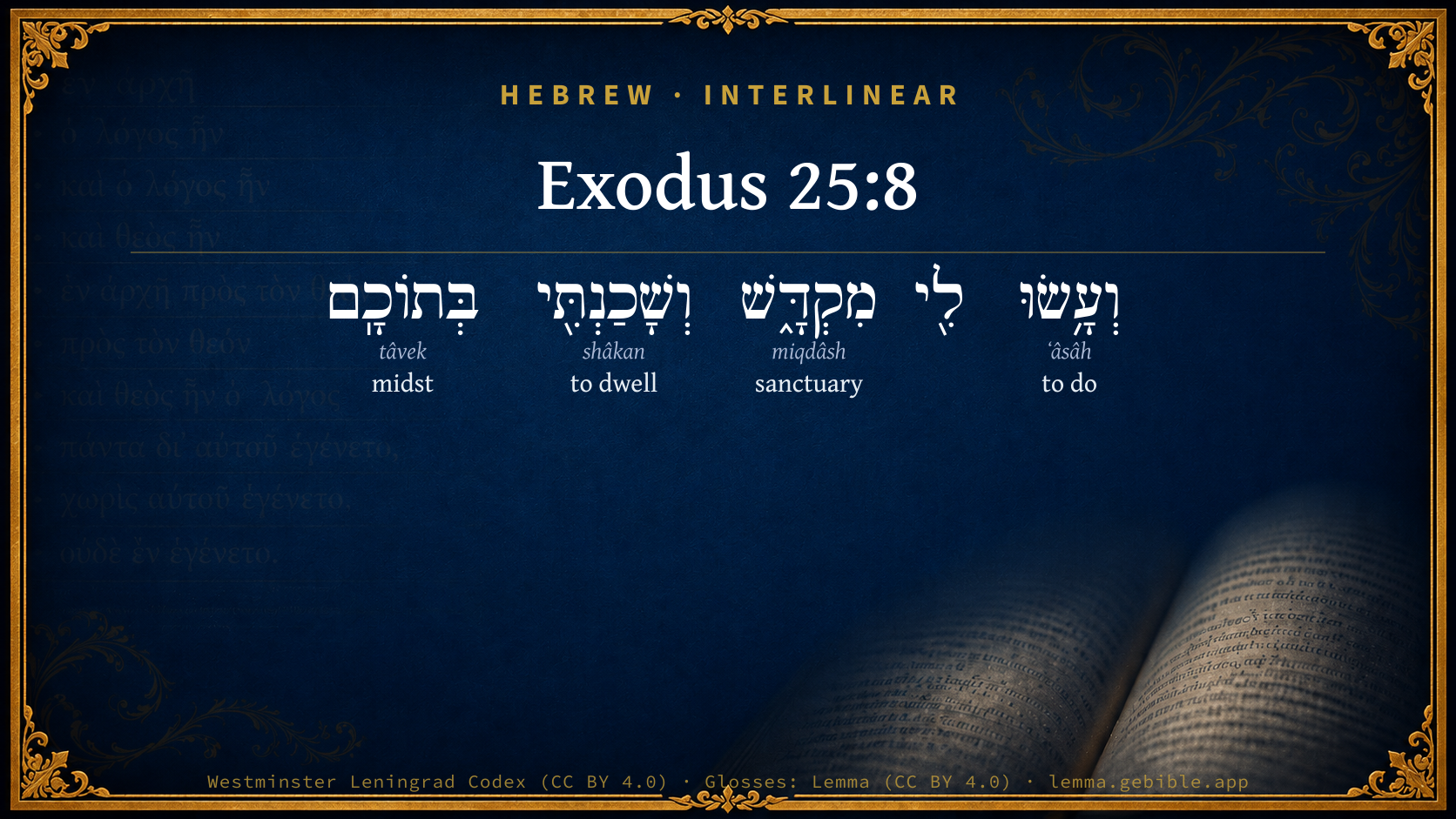
Hebrew (Westminster Leningrad Codex) Exodus 25:8 appears in the Hebrew Old Testament. The text above is from the Westminster Leningrad Codex. Each word links to its Strong’s number, a concise gloss, and parsing drawn from the Open Scriptures Hebrew Bible morphology. Click any word for its full Brown-Driver-Briggs (BDB) entry.
Download image
Cite this verse

Exodus 25:8 (World English Bible). Public Domain. Lemma interlinear Bible study tool, https://lemma.gebible.app/v/exodus/25/8.

Show BibTeX & RIS
BibTeX
RIS
English Translation
Let them make me a sanctuary, that I may dwell among them.
World English Bible · Public Domain
Download a study sheet

One document with this verse’s original text, its word-by-word gloss line, the meaning frame, cross-references with their text, attributed commentary, and full source and license credits — printable, and it pastes into notes with its structure intact.

This verse Autodidact and up

Study sheet (.html) Plain text (.txt)

A passage Seminary Student

Up to 50 verses in one chapter. A passage sheet keeps up to 6 commentary sources and 12 cross-references per verse, in the order this page ranks them, and says so on the sheet whenever that leaves anything out. Ask for a single verse and you get the Autodidact verse sheet above.

Everything on this page stays free to read, with no account — the sheet is a download of what is already on screen, not access to it.

Want to remove ads? Support Godless Engineer
Compare translations 3

The same verse in 3 English versions, stacked beneath the original-language interlinear above. Click any original word for its lexicon entry.

Each is an independent rendering of the whole verse — the interlinear is not word-aligned to these translations.

Highlighted words mark where these versions differ — a whole-verse word diff, not a word-by-word alignment.

  • World English Bible Public Domain
    Let them make me a sanctuary, that I may dwell among them.
  • King James Version Public Domain
    And let them make me a sanctuary; that I may dwell among them.
  • unfoldingWord Literal Text CC BY-SA 4.0
    And they shall make a sanctuary for me, and I shall live in their midst,

unfoldingWord Literal Text — © unfoldingWord, licensed CC BY-SA 4.0. Word-aligned USFM3 via Door43 (git.door43.org/unfoldingWord/en_ult).

Versions to compare (up to 4)

3 of 4 selected

Show all 18 translations

Every available English version of this verse, each an independent rendering of the whole verse.

  • World English Bible Public Domain
    Let them make me a sanctuary, that I may dwell among them.
  • Berean Standard Bible Public Domain
    And they are to make a sanctuary for Me, so that I may dwell among them.
  • Majority Standard Bible Public Domain
    And they are to make a sanctuary for Me, so that I may dwell among them.
  • King James Version Public Domain
    And let them make me a sanctuary; that I may dwell among them.
  • American Standard Version (1901) Public Domain
    And let them make me a sanctuary, that I may dwell among them.
  • Revised Version (1885) Public Domain
    And let them make me a sanctuary; that I may dwell among them.
  • Geneva Bible (1599) Public Domain
    Also they shall make me a Sanctuarie, that I may dwell among them.
  • Douay-Rheims (1899) Public Domain
    And they shall make me a sanctuary, and I will dwell in the midst of them:
  • Young's Literal Translation Public Domain
    `And they have made for Me a sanctuary, and I have tabernacled in their midst;
  • Literal Standard Version CC BY-SA 4.0
    And they have made a sanctuary for Me, and I have dwelt in their midst;
  • Unlocked Literal Bible CC BY-SA 4.0
    Let them make me a sanctuary so that I may live among them.
  • unfoldingWord Literal Text CC BY-SA 4.0
    And they shall make a sanctuary for me, and I shall live in their midst,
  • Darby Bible Public Domain
    And they shall make me a sanctuary, that I may dwell among them.
  • World Messianic Bible Public Domain
    Let them make me a sanctuary, that I may dwell among them.
  • Webster's Bible Public Domain
    And let them make me a sanctuary; that I may dwell among them.
  • Free Bible Version CC BY-SA 4.0
    They are to make me a sanctuary so I can live among them.
  • Bible in Basic English Public Domain
    And let them make me a holy place, so that I may be ever present among them.
  • JPS Tanakh (1917) Public Domain
    And let them make Me a sanctuary, that I may dwell among them.

Literal Standard Version (2020), Covenant Press — licensed CC BY-SA 4.0. Text via the HelloAO Bible API (eBible.org). Unlocked Literal Bible (unfoldingWord) — licensed CC BY-SA 4.0. Text via the HelloAO Bible API (eBible.org). unfoldingWord Literal Text — © unfoldingWord, licensed CC BY-SA 4.0. Word-aligned USFM3 via Door43 (git.door43.org/unfoldingWord/en_ult). Free Bible Version, Dr. Jonathan Gallagher — licensed CC BY-SA 4.0. Text via the HelloAO Bible API (eBible.org).

Word by word

More ways to search: Search by grammar → Find every occurrence → Compare this word →

Practice this passage: Drill this verse → Learn its vocabulary →

About this verse

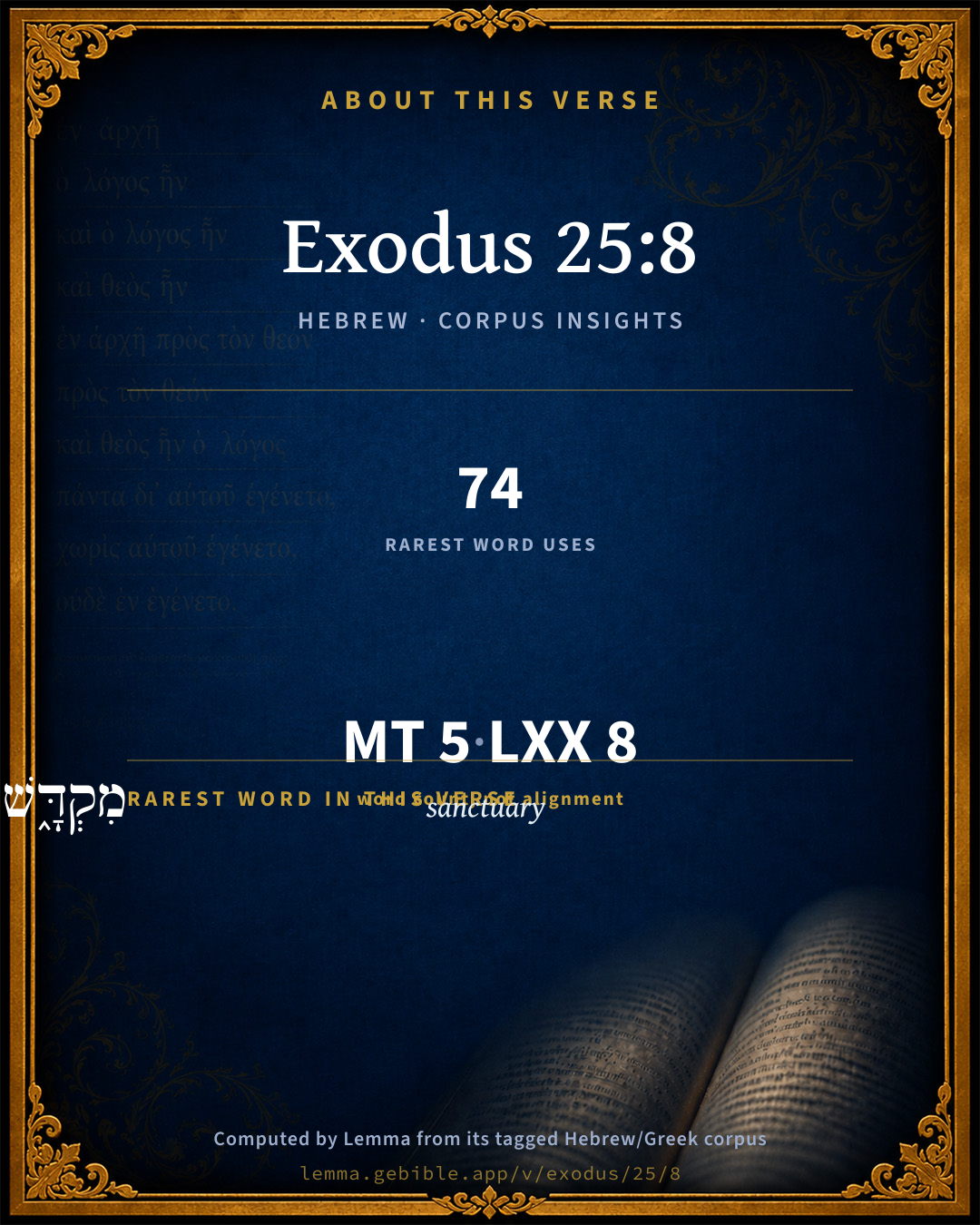
These counts appear in no published source. They are computed here, from the morphology-tagged text and Lemma’s own curated glosses. What Lemma adds →

5
words
4
distinct lemmas
Pentateuch
section

Grammatical profile

  • 2 verbs
  • 2 nouns
  • 1 preposition

Verb forms

  • וְעָ֥שׂוּ Qal · Sequential Perfect
  • וְשָׁכַנְתִּ֖י Qal · Sequential Perfect

Hebrew & Septuagint length

In English translation the verse runs 12 words from the Hebrew and 13 from the Septuagint (LXX English) — closely comparable.

A rough comparison of the two English renderings, which tokenize alike — not a word-level alignment.

Word counts can differ between the Hebrew and the Greek without any difference in meaning — e.g. the Hebrew direct-object marker אֵת has no separate Greek word, and Greek often adds the article ὁ.

In the original languages it is 5 Hebrew tokens and 8 Greek tokens — but the two are counted differently (Hebrew bundles its prefixes and suffixes into one token; the Greek is in lemma form), so that isn’t a like-for-like length.

Cross-references

13

Topical passages linked to Exodus 25:8 in the Treasury of Scripture Knowledge — connected by theme and wording, ordered by reader-vote popularity; previews shown in the World English Bible.

  • 2 Corinthians 6:16 What agreement has a temple of God with idols? For you are a temple of the living God. Even as God said, "I will dwell in them, and walk in them; and I will be their God, and they will be my people."
  • 1 Kings 6:13 I will dwell among the children of Israel, and will not forsake my people Israel.
  • Revelation 21:3 I heard a loud voice out of heaven saying, "Behold, God's dwelling is with people, and he will dwell with them, and they will be his people, and God himself will be with them as their God.
  • Exodus 29:45 I will dwell among the children of Israel, and will be their God.
  • Hebrews 9:1–2 Now indeed even the first covenant had ordinances of divine service, and an earthly sanctuary.
  • Zechariah 2:10 Sing and rejoice, daughter of Zion; for, behold, I come, and I will dwell in the midst of you,' says Yahweh.
  • Isaiah 12:6 Cry aloud and shout, you inhabitant of Zion; for great in the midst of you is the Holy One of Israel!"
  • Zechariah 8:3 Thus says Yahweh: "I have returned to Zion, and will dwell in the midst of Jerusalem. Jerusalem shall be called 'The City of Truth;' and the mountain of Yahweh of Hosts, 'The Holy Mountain.'"
  • Hebrews 3:6 but Christ is faithful as a Son over his house; whose house we are, if we hold fast our confidence and the glorying of our hope firm to the end.
  • Numbers 5:3 Both male and female shall you put out, outside of the camp shall you put them; that they not defile their camp, in the midst of which I dwell."
  • Exodus 15:2 Yah is my strength and song, He has become my salvation: This is my God, and I will praise him; My father's God, and I will exalt him.
  • Leviticus 4:6 The priest shall dip his finger in the blood, and sprinkle some of the blood seven times before Yahweh, before the veil of the sanctuary.
  • Leviticus 21:12 neither shall he go out of the sanctuary, nor profane the sanctuary of his God; for the crown of the anointing oil of his God is upon him. I am Yahweh.

Cross-references courtesy of OpenBible.info (CC BY 4.0).

Hebrew and Greek witnesses Masoretic Hebrew ↔ Greek Septuagint

The same verse in the two great witnesses to the Old Testament, shown verse-for-verse.

These are two independent witnesses, not word-aligned to each other, and the Septuagint is shown in lemma (dictionary) form.

Hebrew Exodus 25:8 Masoretic · Westminster Leningrad Codex

וְעָ֥שׂוּ לִ֖י מִקְדָּ֑שׁ וְשָׁכַנְתִּ֖י בְּתוֹכָֽם

Let them make me a sanctuary, that I may dwell among them.

World English Bible · Public Domain

Greek LXX Exodus 25:8 Septuagint · lemma form

καί ποιέω ἐγώ ἁγίασμα καί ὁράω ἐν σύ

And you shall make me a sanctuary, and I will appear among you.

LXX2012 (modern English Septuagint) · Public Domain

Hebrew: Westminster Leningrad Codex (CC BY 4.0). Greek: Septuagint (public domain); English from LXX2012 (modern English Septuagint) (Public Domain). How the Septuagint differs from the Hebrew →

Targum (Aramaic paraphrase)

2

The Targum is the ancient Jewish Aramaic paraphrase of the Hebrew Scriptures — an interpretive translation, not the Hebrew text itself. Onkelos (literal) and Pseudo-Jonathan (expansive) render the Torah, and Jonathan the Prophets. Coverage is partial: where no permissively-licensed English translation exists for a verse, only the Aramaic is shown. This is verse-level text, not a word-by-word alignment to the Hebrew.

  1. Targum Onkelos Torah (Genesis–Deuteronomy)
    וְיַעְבְּדוּן קֳדָמַי מִקְדְשָׁא וְאַשְׁרֵי שְׁכִנְתִּי בֵּינֵיהוֹן:

    (no public-domain English translation for this verse)

    Targum Onkelos — Aramaic: “Onkelos Genesis” (public domain); “Onkelos Exodus” (public domain); “Onkelos Leviticus” (public domain); “Onkelos Numbers” (public domain); “Onkelos Deuteronomy” (public domain). English: “Sefaria Community Translation” (CC0 1.0 (public-domain dedication)); “J.W. Etheridge. The Targums of Onkelos and Jonathan Ben Uzziel on the Pentateuch. London: Longmans, Green, 1862” (public domain). Text via Sefaria.

  2. Targum Pseudo-Jonathan Torah (Genesis–Deuteronomy)
    וְיַעַבְדוּן לִשְׁמִי מַקְדְּשָׁא וְאַשְׁרֵי שְׁכִינְתִּי בֵּינֵיהוֹן

    And they shall make a Sanctuary to My Name, that My Shekinah may dwell among them.

    Targum Pseudo-Jonathan — Aramaic: “Targum Jonathan on Genesis” (public domain); “Targum Jonathan on Exodus” (public domain); “Targum Jonathan on Leviticus” (public domain); “Targum Jonathan on Numbers” (public domain); “Targum Jonathan on Deuteronomy” (public domain). English: “The Targum of Jonathan ben Uzziel, trans. J. W. Etheridge, London, 1862” (public domain). Text via Sefaria.

Commentary

Notes on Exodus 25:8 from classic Christian and Jewish commentators (each source and its license shown beneath its notes). The classic Christian expositions comment on the surrounding passage and are grouped to its opening verse, so a note may address several verses; the Jewish commentaries on the Tanakh (Rashi and others) are per-verse, so they appear only where the commentator wrote on this verse.

Lemma curates 59 commentaries, every one of them public domain or Creative Commons licensed, each selected and text-cleaned for this edition rather than reprinted as found. About our sources →

Trapp's Complete Commentary

John Trapp

Exo 25:8 And let them make me a sanctuary; that I may dwell among them.

Ver. 8. That I may dwell among them.] "But will God in very deed dwell with men upon earth?" {2Ch 6:18} What can he do more to make them happy? As he in Plutarch said of the Scythians, that although they had no music nor vines among them, yet, as a better thing, they had gods: and as the philosopher, having little else in his house, yet could say of it, ενθα δε οι Yεοι εισιν, Here be gods: so may every good man boast of his house and of his heart, This is the habitation of the Most High. {Heb 3:6 2Co 6:16} As for the public assembly of saints, "This is the house of God, this is the gate of heaven." {Gen 28:17}

John Trapp, A Commentary or Exposition upon All the Books of the Old and New Testament (1647–1656) — public domain. Text from a community e-Sword module.

Joseph Benson's Commentary

Exo 25:8. A sanctuary — A place of solemn worship; that I may dwell among them. Not by my essence, which is every where; but by my grace and glorious operations.

Joseph Benson's Commentary on the Old and New Testaments (1811–1818) — public domain. Text from a community e-Sword module.

Tyndale Open Study Notes

Tyndale Open Resources

25:8 a holy sanctuary: If the people were to have a life-giving relationship with God, it was absolutely vital that they learn how utterly different God was from them (see study note on 3:5). • The purpose of this activity was so God could live among them.

Tyndale Open Study Notes — © Tyndale Open Resources, licensed CC BY-SA 4.0. Text via the HelloAO Bible API.

Geneva Bible (1599)

Geneva Bible translators

A place both to offer sacrifice, and to hear the Law.

Geneva Bible (1599) marginal notes — public domain. Text via Bolls.life.

Jamieson, Fausset & Brown

Robert Jamieson, A. R. Fausset & David Brown

a sanctuary; that I may dwell among them--In one sense the tabernacle was to be a palace, the royal residence of the King of Israel, in which He was to dwell among His people, receive their petitions, and issue His responses. But it was also to be a place of worship, in which God was to record His name and to enshrine the mystic symbols of His presence.

Jamieson, Fausset & Brown — Commentary Critical and Explanatory on the Whole Bible (1871) — public domain (CC PDM 1.0). Text via the HelloAO Bible API.

Adam Clarke's Commentary

Verse 8. Let them make me a sanctuary] מקדש mikdash, a holy place, such as God might dwell in; this was that part of the tabernacle that was called the most holy place, into which the high priest entered only once a year, on the great day of atonement.

That I may dwell among them.] "This," says Mr. Ainsworth, "was the main end of all; and to this all the particulars are to be referred, and by this they are to be opened. For this sanctuary, as Solomon's temple afterwards, was the place of prayer, and of the public service of God, Le 17:4-6; Mt 21:13; and it signified the Church which is the habitation of God through the Spirit, 2Co 6:16; Eph 2:19-22; Re 21:2-3; and was a visible sign of God's presence and protection, Le 26:11, Le 26:12; Eze 37:27-28; 1Kg 6:12-13; and of his leading them to his heavenly glory. For as the high priest entered into the tabernacle, and through the veil into the most holy place where God dwelt; so Christ entered into the holy of holies, and we also enter through the veil, that is to say his flesh. See the use made of this by the apostle, Heb 9:1-28; Heb 10:1-18. Thus the sanctuary is to be applied as a type,

1. To Christ's person, Heb 8:2; Heb 9:11-12; Joh 2:19-21.

2. To every Christian, 1Co 6:19.

3. To the Church; both particular, Heb 3:6; 1Ti 3:15; and universal, Heb 10:21: and it was because of the very extensive signification of this building, that the different things concerning this sanctuary are particularly set down by Moses, and so variously applied by the prophets and by the apostles." - See Ainsworth.

As the dwelling in this tabernacle was the highest proof of God's grace and mercy towards the Israelites, so it typified Christ's dwelling by faith in the hearts of believers, and thus giving them the highest and surest proof of their reconciliation to God, and of his love and favour to them; see Eph 1:22; Eph 3:17.

Adam Clarke's Commentary on the Bible (1810–1826) — public domain. Text from a community e-Sword/MySword module.

Ellicott's Commentary for English Readers

THE SANCTUARY AND ITS CONTENTS.

(8) Let them make me a sanctuary.—The enumeration of the gifts (Exo_25:3-7) has been subordinate to this. Hitherto Israel had had no place of worship, no structure dedicated to God. God now brings this state of things to an end, by requiring them to “make him a sanctuary.” In Egypt they had seen structures of vast size and extraordinary magnificence erected in every city for the worship of the Egyptian gods. They are now to have their own structure, their “holy place,” their “house of God.” As, however, they are still in a nomadic condition, without fixed abode, continually shifting their quarters, a building, in the ordinary sense of the word, would have been unsuitable. They must soon have quitted it or have foregone their hopes of Palestine. God therefore devised for them a structure in harmony with their condition—a “tent-temple”—modelled on the ordinary form of the better Oriental tents, but of the best materials and of an unusual size—yet still portable. It is this structure, with its contents and its adjuncts, which forms the main subject of the rest of the book of Exodus, and which is now minutely and elaborately described in six consecutive chapters (Exodus 25-30)

That I may dwell among them.—Compare Exo_29:42-46; Exo_40:34-38. Though God “dwelleth not in temples made with hands” (Act_7:48), is not confined to them, cannot be comprehended within them, yet since it pleases Him to manifest Himself especially in such abodes, He may be well said to “dwell there” in a peculiar manner. His dwelling with Israel was not purely spiritual. From time to time He manifested Himself sensibly in the Holy of Holies, where He dwelt continually, and might be consulted by the temporal ruler of the nation.

A Bible Commentary for English Readers, edited by Charles John Ellicott (1878–1897) — public domain. Text from a community e-Sword module.

The Cambridge Bible for Schools and Colleges

gen. ed. J. J. S. Perowne

8. sanctuary] about 12 times in H and P (as Lev_19:30; Lev_12:4); often in Ezek., of the Temple (as Eze_5:11, Eze_8:6, Eze_44:1; Eze_44:5, &c.), and occasionally besides (as ch. Exo_15:17, Jer_17:12, Psa_73:17).

that I may dwell in their midst] Cf. Exo_29:45 f., Num_5:3 : also Eze_43:7; Eze_43:9, Zec_2:10-11; Zec_8:3; and, in the ideal consummation, Rev_21:3. This is the essential aim and object of the Tent of Meeting as conceived by P. Cf. the next note but one. The verb is the one from which Shekinah, ‘that which dwelleth,’ the post-Bibl. term for the Presence or Manifestation of Jehovah, is derived: see the Jewish Encycl. or DB. s.v. It is very common in the Targums: thus Deu_1:42 is in Onk. ‘for my Shekinah is not among you.’ For the idea of Jehovah’s being, or ‘dwelling,’ ‘in the midst’ (בתוך) of His people see also Lev_15:31; Lev_16:16; Lev_22:32; Lev_26:11-12, Num_16:3; Num_18:20; Num_35:34 (all P or H).

The Cambridge Bible for Schools and Colleges (gen. ed. J. J. S. Perowne; Cambridge University Press, 1878–1918) — public domain. Text from a community e-Sword module.

John Gill's Exposition

And let them make me a sanctuary,.... An holy place to dwell in, and so called from his dwelling in it, as follows:

that I may dwell amongst them; in the midst of them, where the tabernacle was always placed; and there he dwelt as their King and their God, to whom they might have recourse on all occasions, and whom they should serve and worship; this sanctuary was to be made of many of the materials before mentioned by the Israelites, whom Moses should employ, and to whom he should give directions for the making it, according to the pattern showed him: and so the Jewish writers interpret "make me", or "to me", i.e. of mine, of mine holy things, things sanctified and separated to his use; and they bring this passage to prove that the workmen in the temple were to be paid only out of the holy things, or money given for the repair of it (h): this was a type of the human nature of Christ, the true sanctuary and tabernacle which God pitched and not man, and in which the fulness of the Godhead dwells bodily; and of the church of God, the temple of the living God, among whom he walks, and with whom he dwells, Heb 8:2.

(h) Maimon. & Bartenora in Misn. Temurah, c. 7. sect. 1.

John Gill's Exposition of the Whole Bible (1746–1763) — public domain (CC PDM 1.0). Text via the HelloAO Bible API.

Haydock's Catholic Bible Commentary

Sanctuary, or tabernacle, to serve as a portable temple. Such alone were probably used at that time. The high priest entered into this holy place once a year. (Calmet)

George Leo Haydock (1774–1849), Haydock's Catholic Family Bible and Commentary, 1859 edition — public domain. Excludes Psalms (Douay-Rheims chapter numbering differs from Protestant) and Deuterocanonical books (Catholic canon only).

Matthew Poole's English Annotations

A place of public and solemn worship,

that I may dwell among them; not by my essence, which is every where, but by my grace and glorious operations.

Matthew Poole's English Annotations on the Holy Bible (1683–1685) — public domain. Text from a community e-Sword/MySword module.

Whedon's Commentary on the Bible

Daniel D. Whedon

8. A sanctuary — This word, מקדשׁ, has occurred but once before this place, namely, in Moses’s song, (Exo_15:17,) where a general prophecy is made that the chosen people shall be established in the mountain of Jehovah’s inheritance, the sanctuary in which Jehovah purposed to dwell. This name applies to the entire structure about to be described, and designates it as the holy place where Jehovah would graciously dwell among his people, and reveal to them his holiness and his truth.

Daniel D. Whedon (gen. ed.), Commentary on the Old and New Testaments (1874–1909) — public domain. Text from a community e-Sword module.

The Pulpit Commentary

Vers. 8, 9. GENERAL DIRECTIONS. After the gifts which God will accept have been specified, and the spirit in which they are to be offered noted (ver. 2), God proceeds to unfold his purpose, and declare the object for which the gifts are needed. He will have a "sanctuary" constructed for him, a habitation in which he may "dwell." Now, it is certainly possible to conceive of a religion which should admit nothing in the nature of a temple or sanctuary; and there are even writers who tell us that a religion has actually existed without one (Heb 1:131, Strab. 15. pp, 1039-41) That God should "dwell" in a house, as a man does, is of course impossible; and the Hebrews were as deeply impressed with this truth as any other nation. (1Ki_8:27; 2Ch_2:6; Isa_56:1 Jer_23:24, etc.) But a religion without a temple was probably unknown in the days of Moses; and, with such a people as the Hebrews, it is inconceivable that religion could have maintained its ground for long without something of the kind. "It was," as Kalisch says, "above all things necessary to create a firm and visible centre of monotheism, to keep perpetually the idea of the one omnipotent God alive in the minds of the people, and so to exclude for ever a relapse into the pagan and idolatrous aberrations" (Comment on Exodus, p. 365). A sanctuary was therefore to be constructed; but, as the nation was in the peculiar position of being nomadic, without fixed abode, that is, and constantly on the move, the usual form of a permanent building was unsuitable under the circumstances. To meet the difficulty, a tent-temple was designed, which is called mishkan, "the dwelling," or "ohel, "the tent," which was simply an Oriental tent on a large scale, made of the best obtainable materials, and guarded by an enclosure. The details of the work are reserved for later mention. In the present passage two directions only are given:

1. A sanctuary is to be constructed; and

2. Both it, and all its vessels, are to be made after patterns which God wasabout to show to Moses. A sanctuary well expresses the Hebrew micdash, which is derived from cadash be holy." It is a name never given to the temples of the heathen deities. That I may dwell among them. Compare Exo_29:45; Num_35:34. There is a sense in which "God dwelleth not in temples made with hands". (Act_7:48 Act_17:24) i.e. , he is not comprehended in them, or confined to them; but there is another sense in which he may be truly said to dwell in them, viz., as manifesting himself in them either to the senses, or to the spirit. In the tabernacle he manifested himself sensibly. (Exo_40:34, Exo_40:35, Exo_40:38)

Ver. 8. Earthly sanctuaries typical of the heavenly dwelling-place.

Such habitations as God condescends to acknowledge for his in this earthly sphere, are, all of them, more or less types of the New Jerusalem, the eternal heavenly home. "The temple of God was opened in heaven," says St. John the Divine, "and there was seen in his temple the ark of his testament"; (Rev_11:19) and again, "After that I looked, and, behold, the temple of the tabernacle of the testimony in heaven was opened". (Rev_15:5) Note the following common features:

I THE CENTRAL CARDINAL FACT IN EACH AND ALL IS, THE MANIFEST PRESENCE OF GOD. Of the Tabernacle we are told a cloud covered the tent of the congregation, and the glory of the Lord filled the tabernacle. And Moses was not able to enter into the tent of the congregation, because the cloud abode thereon, and the glory of the Lord filled the tabernacle". (Exo_40:34, Exo_40:35) Christian churches have the promise," Lo, I am with you always, even unto the end of the world and again, "Where two or three are gathered together in my name, theream I in the midst of you." In the New Jerusalem "the city has no need of the sun, neither of the moon, to shine in it; for the glory of God doth lighten it, and the Lamb is the Light thereof". (Rev_21:23) And the saints "see his face". (Rev_22:4)

II THE SECOND LEADING FACT IS THE EXISTENCE IN EACH OF "MANY MANSIONS." An outer court, a porch, a holy place, and a holy of holies, are features manifestly common to the Hebrew tabernacle and temple with Christian churches. These give different degrees of access to God, and imply different degrees of fitness to contemplate him. In heaven there is a throne the throne of God and of the Lamb and round about the throne four and twenty seats for four and twenty elders to sit on; (Rev_4:4) and beyond these angels, (Rev_5:11) and martyrs; (Rev_7:14) and, last of all, "the nations of them that are saved". (Rev_21:24) And each individual of the "nations" finds his fitting place.

III IN ALL, THE OCCUPATION OF THOSE WHO HAVE FOUND ENTRANCE IS THE PRAISE AND WORSHIP OF GOD. "Enter into his courts with praise," says holy David, of the tabernacle (Psa_100:4) thankful unto him, and bless his name." "When ye come together,every one of you has a psalm," says St. Paul of a Christian Church. In heaven there is "a great voice of much people, saying, Alleluia: Salvation and glory, and honour, and power, unto the Lord our God, for true and righteous are his judgments and again they say, Alleluia: for the Lord God omnipotent reigneth; let us be glad and rejoice, and give honour to. (Rev_19:1-7)

IV IN ALL, THE WORSHIPPERS ENJOY A SACRED FEAST. Of the worship of the tabernacle sacrifice was an essential part; and a sacrificial feast, of which the offerer partook, always followed the sacrifice. In Christian worship upon earth, the crowning act is a heavenly banquet, to which the minister in Jesus" name invites all the faithful.

Hail sacred feast, which Jesus makes Rich banquet of his flesh and blood! Thrice happy he, who here partakes That sacred stream, that heavenly food.

In the New Jerusalem there is a "tree of life," which bears "twelve manner of fruits;" and they who enter in "have right to the tree of life", (Rev_22:2, Rev_22:14) and are "given to eat of the tree of life, which is in the midst of the paradise of God". (Rev_2:7) How far this is literal, how far allegorical, we shall scarcely know till we are translated to that celestial sphere, and become dwellers in that glorious city.

HOMILIES BY D. YOUNG

Vers. 8, 9. God"s dwelling-place among his people.

God announces to Israel that he is about to take up his abode in their midst, and that various offerings are to be used in the construction of a suitable dwelling-place. Observe here

I JEHOVAH"S CONDESCENDING REGARD FOR THE WANTS OF ISRAEL. This tabernacle with all its belongings was not constructed for any real need that Jehovah had of it. The people had to construct tents for themselves because they needed them, and the making of a tent for Jehovah was also in condescending compliance with their need. This thought is brought out still more clearly by the parallel reference to the incarnation in Joh_1:14, where it is said that the Word tabernacled among us. Something in the shape of an ever visible dwelling-place of God was given to the people, that thus they might comfort their hearts with the assurance that he was constantly near them, sympathising with them in their changing circumstances and requirements. The people had been compelled to go to Sinai, there to be impressed with the majesty of God and receive his commandments; but at Sinai they could not stay. With all its glories and revelations, it was but a halting place on the way to Canaan. God had indeed already given an assurance of his daily providence in the manna; but he now added a further sign than which none could be more expressive, none more illustrative of the desire of God to adapt himself to the spiritual blindness and infirmity of men. He took for himself a tent like the rest of the travellers through the wilderness. Where a dwelling place is we look for an inhabitant, and especially where it is manifestly kept in order and regularly attended to. If at any moment an Israelite was in doubt whether God was indeed with the people, here through the sight of the tabernacle was his readiest resource to expel all doubt. God"s own house with its services and attendants was continually before him to rebuke and remove his unbelief.

II THOUGH JEHOVAH CONDESCENDED TO DWELL IN A TENT, YET THAT TENT HAD TO BE A HOLY PLACE. The condescension was simply a condescension in circumstances. God himself remained the same. He who was holy and jealous, when removed to a distance from the people, amid the clouds and sounds of Sinai, was not the least altered as to his vigilant holiness by coming down to the apparent limitations of a tent.

Coarse and humble though the tent appears, there is an unspeakably glorious inhabitant within whose presence exalts and sanctifies the tent. God himself thus furnishes an illustration of the truth that those who humble themselves shall be exalted. He needs not to preserve his glory by extraneous and vulgar pomps. And just because this dwelling-place of God was a tent, the people needed to remember its function with peculiar carefulness. Though it was only a tent, it was God"s tent. A very mean tent, that in ordinary circumstances would excite no attention, would be carefully guarded if the king happened for a night to make his abode therein.

III THIS HOLINESS WAS MADE CONSPICUOUS BY THE CHARACTER AND FORM OF THE TABERNACLE AND ITS FURNITURE. Just imagine if, instead of prescribing an exact pattern for everything, God had left the people" to make any sort of structure they liked. In the first place there would hardly have been unanimity. Those who might have been very willing and united in the bestowal of raw material would at once have split asunder in attempting to settle how the material was to be used. Then, even if a majority had proceeded to action, they would probably have introduced something idolatrous, assuredly something that savoured rather of human error than Divine truth; and the error would have been none the less because those who committed it, committed it in a spirit of cordial devotion to what they believed was best. What an exposure is thus made of the plausible notion that if only men are in earnest, God will accept the will for the deed! As to the supply of the raw material, God stipulated for free will there perfect liberty either in giving or withholding. But the raw material once gathered, the freedom of the givers was at an end. God himself supplied the moulds in which the gifts were to flow. A dwelling-place for God must supply all his wants for the time being. He must have just exactly those ordinances of worship and those channels of Divine distribution which he deems best. God"s wants, as we see more and more from a careful study of the Scriptures, are not as man"s wants; and therefore we must wait humbly for him to reveal what it is impossible for man to conjecture. The materials for the tabernacle and the instruments thereof were human and earthly, but the patterns are Divine and heavenly. We know not into what beautiful, glorious, and serviceable forms man and his belongings may be wrought, if only he will humbly and attentively wait for directions from God above. These Israelites, when all was finished according to the pattern in the mount, had then something to show which would make an impression on men of the right sort in the outside world. Here was an answer to the question, "Where is now your God?" Visible he himself is not; but here is a dwelling-place not in anything constructed after art and man"s device, but entirely of Divine direction. All our institutions are nothing unless we can trace them to the inspiration and control of God. Y.

The Pulpit Commentary (1880–1919), ed. H.D.M. Spence-Jones & Joseph S. Exell — public domain. Text from a community e-Sword module.

John Wesley's Explanatory Notes

A sanctuary - A place of public and solemn worship; that I may dwell among them. Not by my essence, which is everywhere; but by my grace and glorious operations.

John Wesley, Explanatory Notes Upon the Whole Bible (1754–1765) — public domain. Text via the GEBible commentary corpus.

unfoldingWord translationNotes

Door43 World Missions Community

General Information:

Yahweh continues to tell Moses what the people must do.

sanctuary ... tabernacle

Here these words mean the same thing.

You must make it

Here "you" is plural and refers to Moses and the people of Israel. (See: Forms of You)

show you in the plans

"show you in the design" or "show you in the pattern." Here "you" is singular and refers to Moses. (See: Forms of You)

translationWords

sanctuary

life

tabernacle

unfoldingWord translationNotes — © Distant Shores Media and the Door43 World Missions Community, licensed CC BY-SA 4.0. Source: git.door43.org/Door43/en_tn.

Rashi

Rabbi Shlomo Yitzchaki (Rashi)

ועשו לי מקדש AND LET THEM MAKE ME A SANCTUARY — Let them make to the glory of My Name (cf. Rashi on v. 2) a place of holiness.

Rashi on the Tanakh — English translations: “The Judaica Press complete Tanach with Rashi, translated by A. J. Rosenberg” (CC BY 4.0); “Pentateuch with Rashi's commentary by M. Rosenbaum and A.M. Silbermann, 1929-1934” (public domain); “The Metsudah Tanach series, Lakewood, N.J” (CC BY 4.0); and “The Book of Joshua, Metsudah Publications, 1997” (CC BY 4.0). Text via Sefaria.

Sforno

Rabbi Ovadia Sforno

And so should you make [it]. Hashem’s presence would dwell among them only by means of the Tabernacle. This was a step down from what He had promised them before the sin of the Calf, “In every place that I permit My Name to be mentioned I will come to you and bless you” (20:21).

Sforno on the Tanakh — English translation: “Yalkut, Sifsei Chachomim Chumash, Metsudah Publications, 2009” (CC BY 4.0). Text via Sefaria.

Ibn Ezra

Rabbi Abraham ibn Ezra

They shall make a Sanctuary for Me. It was called a Sanctuary (literally “a place of holiness”) because it was the dwelling place of the Holy Name.

Ibn Ezra on the Tanakh — English translations: “Sefaria Community Translation” (CC0 1.0 (public-domain dedication)); “Yalkut, Sifsei Chachomim Chumash, Metsudah Publications, 2009” (CC BY 4.0); and “Commentary of Ibn Ezra on Isaiah - trans. by M. Friedlander, 1873” (public domain). Text via Sefaria.

Lesson kit

Teaching starters — assembled from the data on this page, not authored interpretation. Every prompt links to the verse data it draws on. Edit before teaching.

Exodus, in the Pentateuch, opens this verse with 5 words (4 distinct Hebrew lemmas). Its most distinctive word is miqdâsh (“sanctuary”). A historical commentator’s framing appears above. Read the whole chapter for the surrounding context.

Discussion questions

  1. What does “sanctuary” (miqdâsh) contribute to the verse as a whole?
  2. How does 2 Corinthians 6:16, which shares this passage’s theme, read alongside this verse?
  3. The translations on this page render this verse differently — a whole-verse word diff, not a word-by-word alignment. What might account for the different wordings?
  4. «וְעָ֥שׂוּ» is a Qal Sequential Perfect verb. How does that grammatical form shape the action described?
  5. Compare how Trapp's Complete Commentary and Joseph Benson's Commentary read this verse. Where do they agree or differ?

Things to notice

Reading settings

Reading text

Shown beneath each verse's original-language words.

Old Testament
Old Testament edition

Read the OT as the Masoretic Hebrew (MT) or the Greek Septuagint (LXX).

English shown for the Greek Septuagint (in the Hebrew ↔ Greek comparison).

Comparing translations? Open the Compare panel on any verse page to stack up to four side by side.