
Deuteronomy 5:4

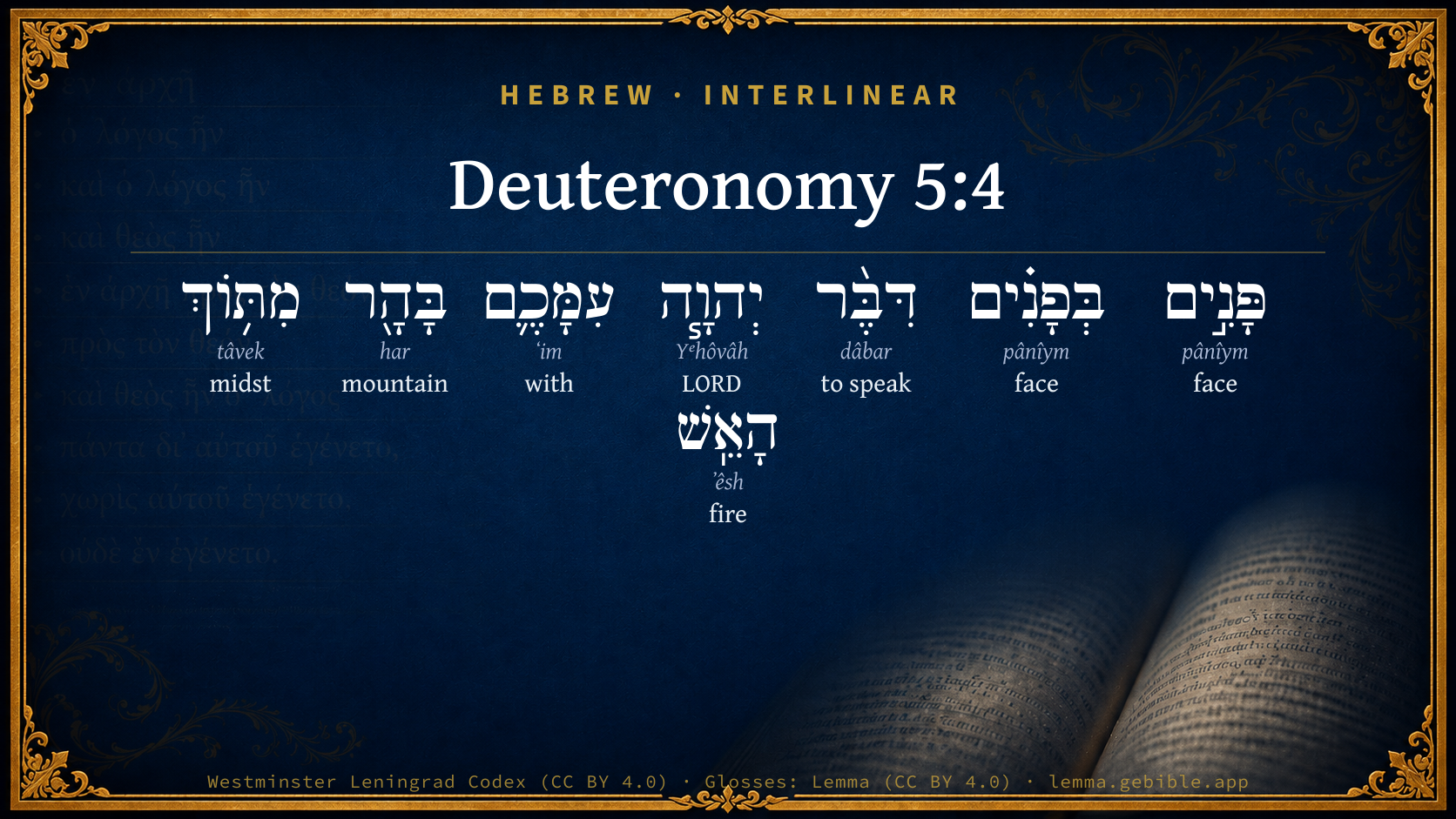
Hebrew (Westminster Leningrad Codex) Deuteronomy 5:4 appears in the Hebrew Old Testament. The text above is from the Westminster Leningrad Codex. Each word links to its Strong’s number, a concise gloss, and parsing drawn from the Open Scriptures Hebrew Bible morphology. Click any word for its full Brown-Driver-Briggs (BDB) entry.
Download image
Cite this verse

Deuteronomy 5:4 (World English Bible). Public Domain. Lemma interlinear Bible study tool, https://lemma.gebible.app/v/deuteronomy/5/4.

Show BibTeX & RIS
BibTeX
RIS
English Translation
Yahweh spoke with you face to face on the mountain out of the midst of the fire,
World English Bible · Public Domain
Download a study sheet

One document with this verse’s original text, its word-by-word gloss line, the meaning frame, cross-references with their text, attributed commentary, and full source and license credits — printable, and it pastes into notes with its structure intact.

This verse Autodidact and up

Study sheet (.html) Plain text (.txt)

A passage Seminary Student

Up to 50 verses in one chapter. A passage sheet keeps up to 6 commentary sources and 12 cross-references per verse, in the order this page ranks them, and says so on the sheet whenever that leaves anything out. Ask for a single verse and you get the Autodidact verse sheet above.

Everything on this page stays free to read, with no account — the sheet is a download of what is already on screen, not access to it.

Want to remove ads? Support Godless Engineer
Compare translations 3

The same verse in 3 English versions, stacked beneath the original-language interlinear above. Click any original word for its lexicon entry.

Each is an independent rendering of the whole verse — the interlinear is not word-aligned to these translations.

Highlighted words mark where these versions differ — a whole-verse word diff, not a word-by-word alignment.

  • World English Bible Public Domain
    Yahweh spoke with you face to face on the mountain out of the midst of the fire,
  • King James Version Public Domain
    The LORD talked with you face to face in the mount out of the midst of the fire,
  • unfoldingWord Literal Text CC BY-SA 4.0
    Yahweh spoke with you face to face on the mountain, from the midst of the fire,

unfoldingWord Literal Text — © unfoldingWord, licensed CC BY-SA 4.0. Word-aligned USFM3 via Door43 (git.door43.org/unfoldingWord/en_ult).

Versions to compare (up to 4)

3 of 4 selected

Show all 18 translations

Every available English version of this verse, each an independent rendering of the whole verse.

  • World English Bible Public Domain
    Yahweh spoke with you face to face on the mountain out of the midst of the fire,
  • Berean Standard Bible Public Domain
    The LORD spoke with you face to face out of the fire on the mountain.
  • Majority Standard Bible Public Domain
    The LORD spoke with you face to face out of the fire on the mountain.
  • King James Version Public Domain
    The LORD talked with you face to face in the mount out of the midst of the fire,
  • American Standard Version (1901) Public Domain
    Jehovah spake with you face to face in the mount out of the midst of the fire,
  • Revised Version (1885) Public Domain
    The LORD spake with you face to face in the mount out of the midst of the fire,
  • Geneva Bible (1599) Public Domain
    The Lord talked with you face to face in the Mount, out of the middes of the fire.
  • Douay-Rheims (1899) Public Domain
    He spoke to us face to face in the mount out of the midst of fire.
  • Young's Literal Translation Public Domain
    Face to face hath Jehovah spoken with you, in the mount, out of the midst of the fire;
  • Literal Standard Version CC BY-SA 4.0
    YHWH has spoken with you face to face on the mountain, out of the midst of the fire;
  • Unlocked Literal Bible CC BY-SA 4.0
    Yahweh spoke with you face to face on the mount out of the middle of the fire
  • unfoldingWord Literal Text CC BY-SA 4.0
    Yahweh spoke with you face to face on the mountain, from the midst of the fire,
  • Darby Bible Public Domain
    Face to face on the mountain from the midst of the fire Jehovah spoke with you
  • World Messianic Bible Public Domain
    The LORD spoke with you face to face on the mountain out of the middle of the fire,
  • Webster's Bible Public Domain
    The LORD talked with you face to face on the mount, from the midst of the fire,
  • Free Bible Version CC BY-SA 4.0
    The Lord talked with you person to person from the fire on the mountain.
  • Bible in Basic English Public Domain
    The word of the Lord came to you face to face on the mountain, out of the heart of the fire,
  • JPS Tanakh (1917) Public Domain
    The LORD spoke with you face to face in the mount out of the midst of the fire —

Literal Standard Version (2020), Covenant Press — licensed CC BY-SA 4.0. Text via the HelloAO Bible API (eBible.org). Unlocked Literal Bible (unfoldingWord) — licensed CC BY-SA 4.0. Text via the HelloAO Bible API (eBible.org). unfoldingWord Literal Text — © unfoldingWord, licensed CC BY-SA 4.0. Word-aligned USFM3 via Door43 (git.door43.org/unfoldingWord/en_ult). Free Bible Version, Dr. Jonathan Gallagher — licensed CC BY-SA 4.0. Text via the HelloAO Bible API (eBible.org).

Word by word

More ways to search: Search by grammar → Find every occurrence → Compare this word →

Practice this passage: Drill this verse → Learn its vocabulary →

About this verse

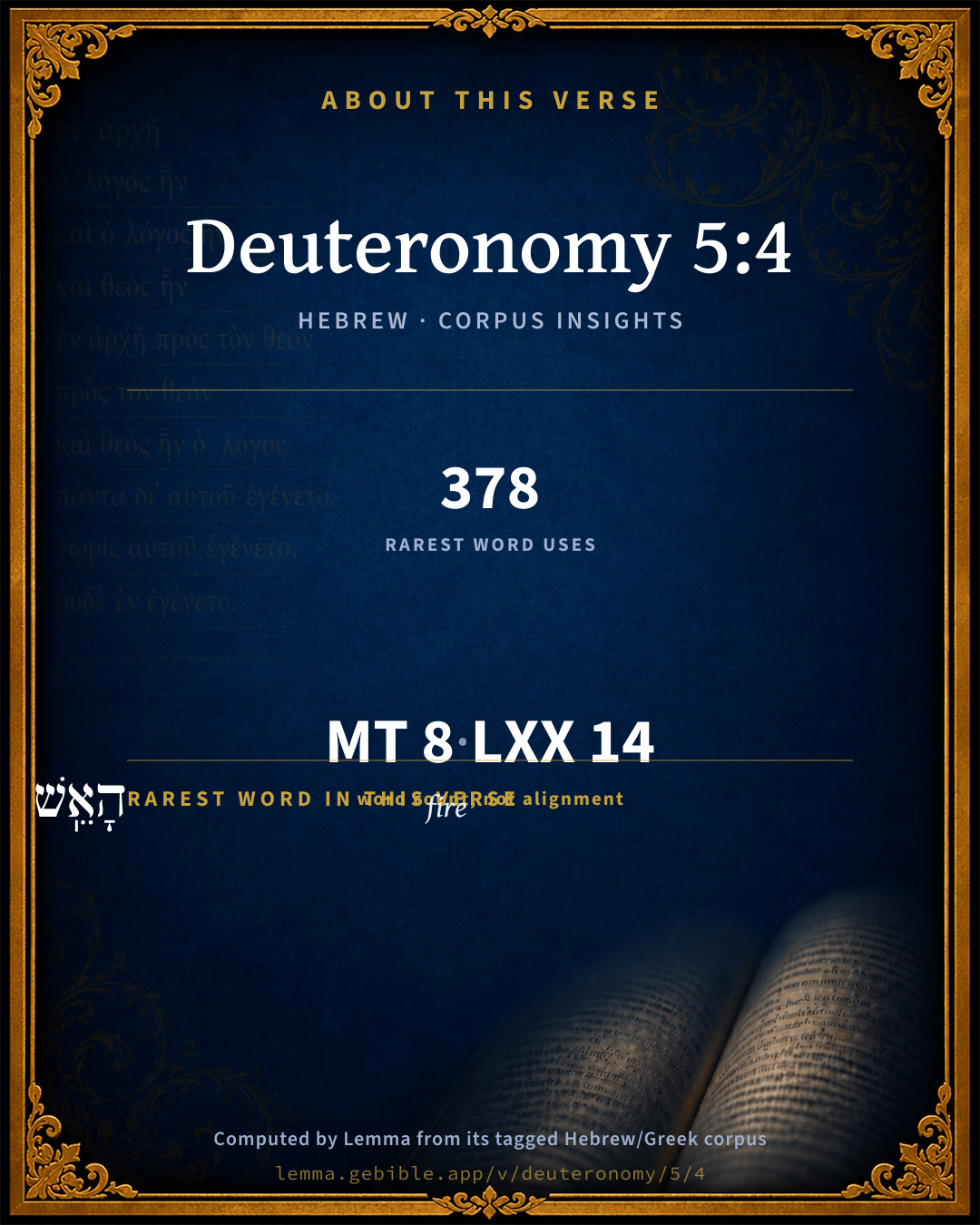
These counts appear in no published source. They are computed here, from the morphology-tagged text and Lemma’s own curated glosses. What Lemma adds →

8
words
7
distinct lemmas
Pentateuch
section

Grammatical profile

  • 1 verb
  • 6 nouns
  • 1 preposition

Verb forms

  • דִּבֶּ֨ר Piel · Perfect

Repetition

A word recurs within this verse — often emphatic in Hebrew:

  • פָּנִ֣ים face H6440 ×2

Hebrew & Septuagint length

In English translation the verse runs 17 words from the Hebrew and 18 from the Septuagint (LXX English) — closely comparable.

A rough comparison of the two English renderings, which tokenize alike — not a word-level alignment.

Word counts can differ between the Hebrew and the Greek without any difference in meaning — e.g. the Hebrew direct-object marker אֵת has no separate Greek word, and Greek often adds the article ὁ.

In the original languages it is 8 Hebrew tokens and 14 Greek tokens — but the two are counted differently (Hebrew bundles its prefixes and suffixes into one token; the Greek is in lemma form), so that isn’t a like-for-like length.

Cross-references

10

Topical passages linked to Deuteronomy 5:4 in the Treasury of Scripture Knowledge — connected by theme and wording, ordered by reader-vote popularity; previews shown in the World English Bible.

  • Exodus 19:18–19 Mount Sinai, the whole of it, smoked, because Yahweh descended on it in fire; and its smoke ascended like the smoke of a furnace, and the whole mountain quaked greatly.
  • Deuteronomy 34:10 There has not arisen a prophet since in Israel like Moses, whom Yahweh knew face to face,
  • Exodus 19:9 Yahweh said to Moses, "Behold, I come to you in a thick cloud, that the people may hear when I speak with you, and may also believe you forever." Moses told the words of the people to Yahweh.
  • Deuteronomy 4:33 Did ever a people hear the voice of God speaking out of the midst of the fire, as you have heard, and live?
  • Deuteronomy 4:36 Out of heaven he made you to hear his voice, that he might instruct you: and on earth he made you to see his great fire; and you heard his words out of the midst of the fire.
  • Exodus 20:18–22 All the people perceived the thunderings, the lightnings, the sound of the trumpet, and the mountain smoking. When the people saw it, they trembled, and stayed at a distance.
  • Exodus 33:11 Yahweh spoke to Moses face to face, as a man speaks to his friend. He turned again into the camp, but his servant Joshua, the son of Nun, a young man, didn't depart out of the Tent.
  • Numbers 12:8 with him will I speak mouth to mouth, even manifestly, and not in dark speeches; and the form of Yahweh shall he see: why then were you not afraid to speak against my servant, against Moses?
  • Numbers 14:14 and they will tell it to the inhabitants of this land. They have heard that you Yahweh are in the midst of this people; for you Yahweh are seen face to face, and your cloud stands over them, and you go before them, in a pillar of cloud by day, and in a pillar of fire by night.
  • Deuteronomy 5:24–26 and you said, Behold, Yahweh our God has shown us his glory and his greatness, and we have heard his voice out of the midst of the fire: we have seen this day that God does speak with man, and he lives.

Cross-references courtesy of OpenBible.info (CC BY 4.0).

Hebrew and Greek witnesses Masoretic Hebrew ↔ Greek Septuagint

The same verse in the two great witnesses to the Old Testament, shown verse-for-verse.

These are two independent witnesses, not word-aligned to each other, and the Septuagint is shown in lemma (dictionary) form.

Hebrew Deuteronomy 5:4 Masoretic · Westminster Leningrad Codex

פָּנִ֣ים בְּפָנִ֗ים דִּבֶּ֨ר יְהוָ֧ה עִמָּכֶ֛ם בָּהָ֖ר מִתּ֥וֹךְ הָאֵֽשׁ

Yahweh spoke with you face to face on the mountain out of the midst of the fire,

World English Bible · Public Domain

Greek LXX Deuteronomy 5:4 Septuagint · lemma form

πρόσωπον κατά πρόσωπον λαλέω κύριος πρός σύ ἐν ὁ ὄρος ἐκ μέσος ὁ πῦρ

The Lord spoke to you face to face in the mountain out of the midst of the fire.

LXX2012 (modern English Septuagint) · Public Domain

On this verse, Haydock's Catholic Bible Commentary discusses the Septuagint’s reading. Read the note in Commentary ↓

Hebrew: Westminster Leningrad Codex (CC BY 4.0). Greek: Septuagint (public domain); English from LXX2012 (modern English Septuagint) (Public Domain). How the Septuagint differs from the Hebrew →

Targum (Aramaic paraphrase)

2

The Targum is the ancient Jewish Aramaic paraphrase of the Hebrew Scriptures — an interpretive translation, not the Hebrew text itself. Onkelos (literal) and Pseudo-Jonathan (expansive) render the Torah, and Jonathan the Prophets. Coverage is partial: where no permissively-licensed English translation exists for a verse, only the Aramaic is shown. This is verse-level text, not a word-by-word alignment to the Hebrew.

  1. Targum Onkelos Torah (Genesis–Deuteronomy)
    מַמְלָל עִם מַמְלָל מַלִיל יְיָ עִמְכוֹן בְּטוּרָא מִגוֹ אֶשָׁתָא

    (no public-domain English translation for this verse)

    Targum Onkelos — Aramaic: “Onkelos Genesis” (public domain); “Onkelos Exodus” (public domain); “Onkelos Leviticus” (public domain); “Onkelos Numbers” (public domain); “Onkelos Deuteronomy” (public domain). English: “Sefaria Community Translation” (CC0 1.0 (public-domain dedication)); “J.W. Etheridge. The Targums of Onkelos and Jonathan Ben Uzziel on the Pentateuch. London: Longmans, Green, 1862” (public domain). Text via Sefaria.

  2. Targum Pseudo-Jonathan Torah (Genesis–Deuteronomy)
    מַמְלֵיל קֳבֵיל מַמְלֵיל מַלֵיל יְיָ עִמְכוֹן בְּטַוְורָא מִגוֹ אֵשָׁתָא

    Word to word did the Lord speak with you at the mountain from the midst of the fire.

    Targum Pseudo-Jonathan — Aramaic: “Targum Jonathan on Genesis” (public domain); “Targum Jonathan on Exodus” (public domain); “Targum Jonathan on Leviticus” (public domain); “Targum Jonathan on Numbers” (public domain); “Targum Jonathan on Deuteronomy” (public domain). English: “The Targum of Jonathan ben Uzziel, trans. J. W. Etheridge, London, 1862” (public domain). Text via Sefaria.

Commentary

Notes on Deuteronomy 5:4 from classic Christian and Jewish commentators (each source and its license shown beneath its notes). The classic Christian expositions comment on the surrounding passage and are grouped to its opening verse, so a note may address several verses; the Jewish commentaries on the Tanakh (Rashi and others) are per-verse, so they appear only where the commentator wrote on this verse.

Lemma curates 59 commentaries, every one of them public domain or Creative Commons licensed, each selected and text-cleaned for this edition rather than reprinted as found. About our sources →

The Cambridge Bible for Schools and Colleges

gen. ed. J. J. S. Perowne

4. face to face] i.e. person with person, without the intervention of another. The metaphor is hardly an instance of the tendency of D’s style to hyperbole2[120]. For although all that the people perceived was a voice, or sound, of words (Deu_4:12), this came at first directly to the whole people, and it was because they feared the effect of its directness that they begged Moses to mediate (Deu_5:22-27). But if not a hyperbole the phrase face to face needs qualification—it was only with Moses that God talked (morally speaking) face to face (Deu_34:10, Exo_33:11); and so a qualification is given immediately in parenthesis in the next verse.

[120] It is, however, an interesting illustration of how an O.T. writer (like so many of the prophets), while forbidding strenuously the representation of the Deity in any material form, does not hesitate to use anthropomorphisms in describing His appearances to men. Ch. Deu_4:12; Deu_4:15 emphasise that Israel saw no manner of form in the Mount; while Deu_5:4 now asserts that God spake face to face with the people. What is denied in fact, so as to exclude every excuse for plastic representations of the Deity, is allowed in metaphor.

out of the midst of the fire] So in Deu_4:12 (but without the phrase preceding in the mount), 15, 33, 36; and Deu_5:22; Deu_5:24, Deu_9:10, Deu_10:4.

The Cambridge Bible for Schools and Colleges (gen. ed. J. J. S. Perowne; Cambridge University Press, 1878–1918) — public domain. Text from a community e-Sword module.

Trapp's Complete Commentary

John Trapp

Deu 5:4 The LORD talked with you face to face in the mount out of the midst of the fire,

Ver. 4. Face to face,] i.e., Openly, and immediately, by himself, and not by a messenger or mediator. Prosper’s conceit was, that the Israelites were called Iudaei, because they received ius Dei.

John Trapp, A Commentary or Exposition upon All the Books of the Old and New Testament (1647–1656) — public domain. Text from a community e-Sword module.

Joseph Benson's Commentary

Deu 5:4. The Lord talked with you face to face — Personally and immediately, and not by the mouth or ministry of Moses; plainly and certainly, as when two men speak face to face; freely and familiarly, so as not to overwhelm and confound you. It may also signify that they beheld a conspicuous symbol of the divine presence, and heard a divine voice speaking from thence clearly and distinctly.

Joseph Benson's Commentary on the Old and New Testaments (1811–1818) — public domain. Text from a community e-Sword module.

Geneva Bible (1599)

Geneva Bible translators

So plainly that ye need not to doubt thereof.

Geneva Bible (1599) marginal notes — public domain. Text via Bolls.life.

Jamieson, Fausset & Brown

Robert Jamieson, A. R. Fausset & David Brown

The Lord talked with you face to face in the mount--not in a visible and corporeal form, of which there was no trace (Deu 4:12, Deu 4:15), but freely, familiarly, and in such a manner that no doubt could be entertained of His presence.

Jamieson, Fausset & Brown — Commentary Critical and Explanatory on the Whole Bible (1871) — public domain (CC PDM 1.0). Text via the HelloAO Bible API.

Ellicott's Commentary for English Readers

(4) The Lord talked with you face to face.—Yet they saw no manner of similitude (Deu_4:12), i.e., no visible form: but the very words of God reached their ears. So in Exo_20:22, “Ye have seen that I have talked with you from heaven.”

A Bible Commentary for English Readers, edited by Charles John Ellicott (1878–1897) — public domain. Text from a community e-Sword module.

John Gill's Exposition

I stood between the Lord and you at that time,.... Between the Word of the Lord and you, as the Targums of Onkelos and Jonathan; that is, about that time, not at the exact precise time the ten commandments were delivered, for these were spoken immediately to the people; but when the ceremonial law was given, which was ordained by angels, in the hand of a mediator, Gal 3:19, and which was at the request of the people as follows, terrified by the appearance of the fire out of which the moral law was delivered:

to show you the word of the Lord; not the decalogue, that they heard with their own ears, but the other laws which were afterwards given, that were of the ceremonial and judicial kind:

for ye were afraid by reason of the fire, and went not up into the mount; lest they should be consumed by it: and indeed bounds were set about the mount, and they were charged not to break through:

saying; this word is in connection with the preceding verse, the Lord's talking out of the midst of the fire, when he said what follows.

John Gill's Exposition of the Whole Bible (1746–1763) — public domain (CC PDM 1.0). Text via the HelloAO Bible API.

Haydock's Catholic Bible Commentary

To us. Hebrew and Septuagint, "to you." --- Face to face, in such a manner that no doubt could be entertained of his presence. (St. Augustine) --- God addressed the decalogue to all the people, who saw no similitude. But to Moses he delivered the rest of his ordinances, with as much familiarity and condescension as one friend would use in speaking to another, Exodus xxxiii. 2. (Calmet)

George Leo Haydock (1774–1849), Haydock's Catholic Family Bible and Commentary, 1859 edition — public domain. Excludes Psalms (Douay-Rheims chapter numbering differs from Protestant) and Deuterocanonical books (Catholic canon only).

Matthew Poole's English Annotations

Not in a visible shape, which was utterly denied, Deu 4:12,15; but personally and immediately, not by the mouth or ministry of Moses; plainly and certainly, as when two men talk face to face; freely and familiarly, so as not to overwhelm and confound you. Compare Exo 33:11; Num 12:8.

Matthew Poole's English Annotations on the Holy Bible (1683–1685) — public domain. Text from a community e-Sword/MySword module.

Whedon's Commentary on the Bible

Daniel D. Whedon

4. The Lord talked — Jehovah, in person, addressed the “ten words,” or commandments, to the people. Other precepts were given through Moses.

Daniel D. Whedon (gen. ed.), Commentary on the Old and New Testaments (1874–1909) — public domain. Text from a community e-Sword module.

The Pulpit Commentary

Vers. 4, 5. The Lord talked with you face to face. God spoke to them immediately, in their presence and to their face, from the mount, as one person might to another. There is a slight difference in form between the phrase here and that in Exo_33:11 and Deu_34:10, where it is used in reference to Moses, but it is so slight ( instead of that no difference of meaning can be elicited. God spake directly to the people, as he did to Moses, only Moses was admitted to closer communion with him than the people were. This difference is sufficiently indicated in ver. 5, where the mediatory function of Moses, in the promulgation of the Law and the making of the covenant, is described as necessitated by the fear of the people, and their not going up into the mount (cf. Exo_19:19, etc.) This is referred to more fully afterwards (ver. 23, etc.). I stood between the Lord and you; i.e. acted as mediator; LXX, eiJsthkein ajnason. (cf. Gal_3:19)

The Pulpit Commentary (1880–1919), ed. H.D.M. Spence-Jones & Joseph S. Exell — public domain. Text from a community e-Sword module.

John Wesley's Explanatory Notes

Face to face - Personally and immediately, not by the mouth or ministry of Moses; plainly and certainly, as when two men talk face to face; freely and familiarly, so as not to overwhelm and confound you.

John Wesley, Explanatory Notes Upon the Whole Bible (1754–1765) — public domain. Text via the GEBible commentary corpus.

unfoldingWord translationNotes

Door43 World Missions Community

General Information:

Moses continues speaking to the people of Israel.

face to face

Use your language's idiom for two people who are close to each other and looking at each other when they are speaking to each other. (See: Idiom)

on the mount

"on the mountain"

at that time

Moses is referring to an event that happened about 40 years earlier.

out of the house of slavery

Here the metonym "house of slavery" refers to Egypt where the people of Israel had been slaves. AT: "out of the place where you were slaves" (See: Metonymy)

translationWords

Yahweh

face

fire

reveal

word

fear

Egypt

house

servant

unfoldingWord translationNotes — © Distant Shores Media and the Door43 World Missions Community, licensed CC BY-SA 4.0. Source: git.door43.org/Door43/en_tn.

Rashi

Rabbi Shlomo Yitzchaki (Rashi)

פנים בפנים FACE TO FACE — R. Berechia said: Thus did Moses, in effect, say: Do not think that I am misleading you with something which does not exist at all, as an agent does acting between the vendor and the purchaser; behold, the seller Himself is speaking to you (God who transmitted the Torah to you) (cf. Pesikta Rabbati 21: Pesachim Rabbah פ' י' הדברות קמייתא‎).

Rashi on the Tanakh — English translations: “The Judaica Press complete Tanach with Rashi, translated by A. J. Rosenberg” (CC BY 4.0); “Pentateuch with Rashi's commentary by M. Rosenbaum and A.M. Silbermann, 1929-1934” (public domain); “The Metsudah Tanach series, Lakewood, N.J” (CC BY 4.0); and “The Book of Joshua, Metsudah Publications, 1997” (CC BY 4.0). Text via Sefaria.

Sforno

Rabbi Ovadia Sforno

Face to face. Not in a dream or a night vision, but while you were in full control of your senses.

Sforno on the Tanakh — English translation: “Yalkut, Sifsei Chachomim Chumash, Metsudah Publications, 2009” (CC BY 4.0). Text via Sefaria.

Lesson kit

Teaching starters — assembled from the data on this page, not authored interpretation. Every prompt links to the verse data it draws on. Edit before teaching.

Deuteronomy, in the Pentateuch, opens this verse with 8 words (7 distinct Hebrew lemmas). Its most distinctive word is ʼêsh (“fire”). A historical commentator’s framing appears above. Read the whole chapter for the surrounding context.

Discussion questions

  1. How does “fire” (ʼêsh) shape what this verse is saying?
  2. Exodus 19:18–19 shares this passage’s theme. How do the two illuminate each other?
  3. “face” occurs 2× in this one verse. What is the effect of the repetition?
  4. These translations render this verse differently. What is at stake in choosing one wording over another?
  5. The verb «דִּבֶּ֨ר» is Piel Perfect. How does its form color the action?
  6. Reading how The Cambridge Bible for Schools and Colleges and Trapp's Complete Commentary read this verse, where do the two commentators agree and where do they part?

Things to notice

Reading settings

Reading text

Shown beneath each verse's original-language words.

Old Testament
Old Testament edition

Read the OT as the Masoretic Hebrew (MT) or the Greek Septuagint (LXX).

English shown for the Greek Septuagint (in the Hebrew ↔ Greek comparison).

Comparing translations? Open the Compare panel on any verse page to stack up to four side by side.