Deuteronomy 23:11

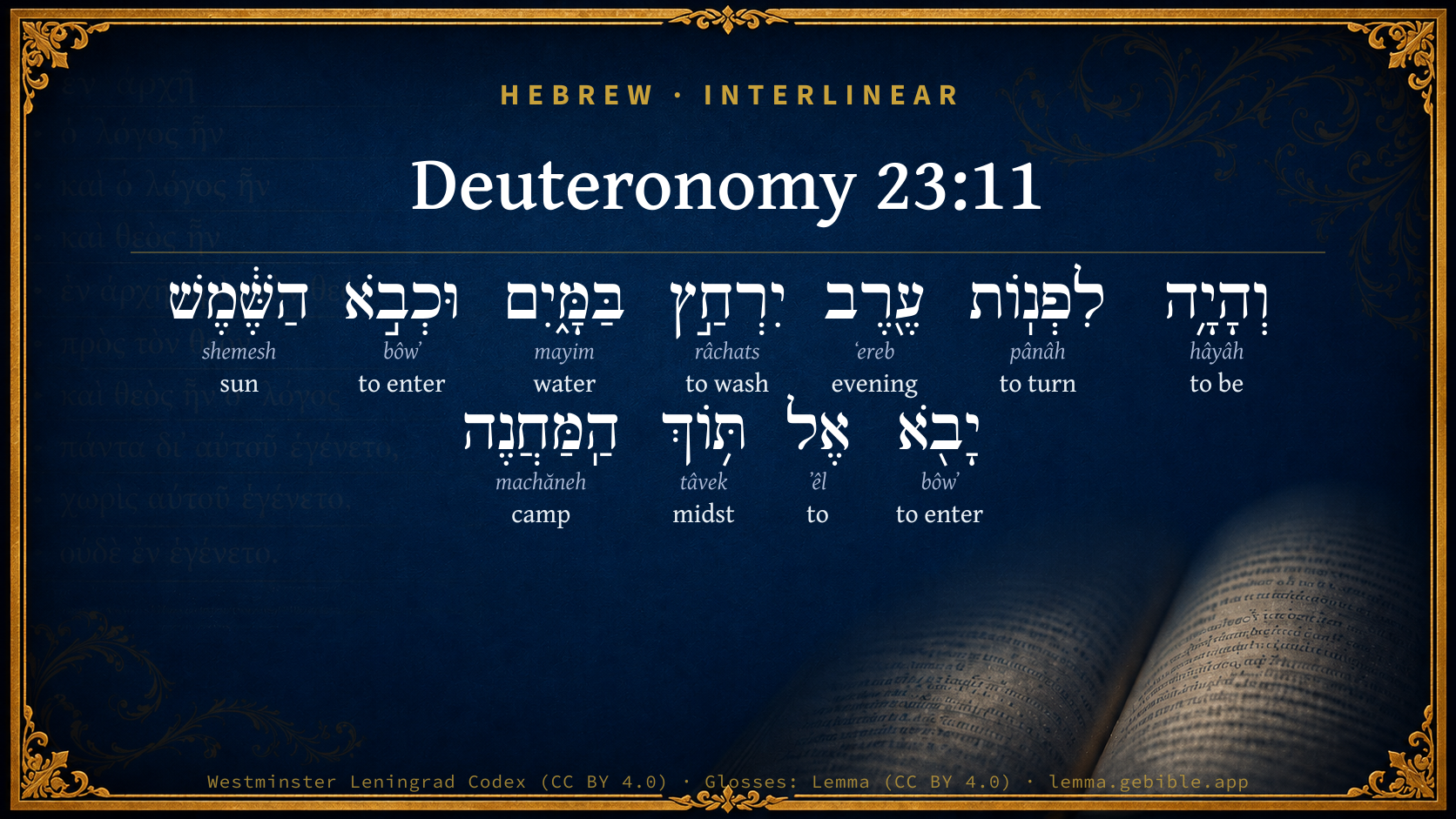
Hebrew (Westminster Leningrad Codex) Deuteronomy 23:11 appears in the Hebrew Old Testament. The text above is from the Westminster Leningrad Codex. Each word links to its Strong’s number, a concise gloss, and parsing drawn from the Open Scriptures Hebrew Bible morphology. Click any word for its full Brown-Driver-Briggs (BDB) entry.
Download image
Cite this verse

Deuteronomy 23:11 (World English Bible). Public Domain. Lemma interlinear Bible study tool, https://lemma.gebible.app/v/deuteronomy/23/11.

Show BibTeX & RIS
BibTeX
RIS
English Translation
but it shall be, when evening comes on, he shall bathe himself in water; and when the sun is down, he shall come within the camp.
World English Bible · Public Domain
Download a study sheet

One document with this verse’s original text, its word-by-word gloss line, the meaning frame, cross-references with their text, attributed commentary, and full source and license credits — printable, and it pastes into notes with its structure intact.

This verse Autodidact and up

Study sheet (.html) Plain text (.txt)

A passage Seminary Student

Up to 50 verses in one chapter. A passage sheet keeps up to 6 commentary sources and 12 cross-references per verse, in the order this page ranks them, and says so on the sheet whenever that leaves anything out. Ask for a single verse and you get the Autodidact verse sheet above.

Everything on this page stays free to read, with no account — the sheet is a download of what is already on screen, not access to it.

Want to remove ads? Support Godless Engineer
Compare translations 3

The same verse in 3 English versions, stacked beneath the original-language interlinear above. Click any original word for its lexicon entry.

Each is an independent rendering of the whole verse — the interlinear is not word-aligned to these translations.

Highlighted words mark where these versions differ — a whole-verse word diff, not a word-by-word alignment.

  • World English Bible Public Domain
    but it shall be, when evening comes on, he shall bathe himself in water; and when the sun is down, he shall come within the camp.
  • King James Version Public Domain
    But it shall be, when evening cometh on, he shall wash himself with water: and when the sun is down, he shall come into the camp again.
  • unfoldingWord Literal Text CC BY-SA 4.0
    And it will happen, turning evening, he shall bathe himself in water, and as the sun goes, he shall go in to the middle of the camp.

unfoldingWord Literal Text — © unfoldingWord, licensed CC BY-SA 4.0. Word-aligned USFM3 via Door43 (git.door43.org/unfoldingWord/en_ult).

Versions to compare (up to 4)

3 of 4 selected

Show all 18 translations

Every available English version of this verse, each an independent rendering of the whole verse.

  • World English Bible Public Domain
    but it shall be, when evening comes on, he shall bathe himself in water; and when the sun is down, he shall come within the camp.
  • Berean Standard Bible Public Domain
    When evening approaches, he must wash with water, and when the sun sets he may return to the camp.
  • Majority Standard Bible Public Domain
    When evening approaches, he must wash with water, and when the sun sets he may return to the camp.
  • King James Version Public Domain
    But it shall be, when evening cometh on, he shall wash himself with water: and when the sun is down, he shall come into the camp again.
  • American Standard Version (1901) Public Domain
    but it shall be, when evening cometh on, he shall bathe himself in water; and when the sun is down, he shall come within the camp.
  • Revised Version (1885) Public Domain
    but it shall be, when evening cometh on, he shall bathe himself in water: and when the sun is down, he shall come within the camp.
  • Geneva Bible (1599) Public Domain
    But at euen he shall wash him selfe with water, and when the sunne is downe, he shall enter into the hoste.
  • Douay-Rheims (1899) Public Domain
    And shall not return, before he be washed with water in the evening: and after sunset he shall return into the camp.
  • Young's Literal Translation Public Domain
    and it hath been, at the turning of the evening, he doth bathe with water, and at the going in of the sun he doth come in unto the midst of the camp.
  • Literal Standard Version CC BY-SA 4.0
    and it has been, at the turning of the evening, he bathes with water, and at the going in of the sun he comes into the midst of the camp.
  • Unlocked Literal Bible CC BY-SA 4.0
    When evening comes, he must bathe himself in water; when the sun goes down, he will come back inside the camp.
  • unfoldingWord Literal Text CC BY-SA 4.0
    And it will happen, turning evening, he shall bathe himself in water, and as the sun goes, he shall go in to the middle of the camp.
  • Darby Bible Public Domain
    and it shall be, towards evening, he shall bathe in water: and at the going down of the sun he may come inside the camp.
  • World Messianic Bible Public Domain
    but it shall be, when evening comes, he shall bathe himself in water. When the sun is down, he shall come within the camp.
  • Webster's Bible Public Domain
    But it shall be, when evening cometh on, he shall wash himself with water: and when the sun is down, he shall come into the camp again.
  • Free Bible Version CC BY-SA 4.0
    Towards the end of the day he must wash himself with water, and at sunset he may return to the camp.
  • Bible in Basic English Public Domain
    But when evening comes near, let him take a bath: and after sundown he may come back to the tents.
  • JPS Tanakh (1917) Public Domain
    (23-12) But it shall be, when evening cometh on, he shall bathe himself in water; and when the sun is down, he may come within the camp.

Literal Standard Version (2020), Covenant Press — licensed CC BY-SA 4.0. Text via the HelloAO Bible API (eBible.org). Unlocked Literal Bible (unfoldingWord) — licensed CC BY-SA 4.0. Text via the HelloAO Bible API (eBible.org). unfoldingWord Literal Text — © unfoldingWord, licensed CC BY-SA 4.0. Word-aligned USFM3 via Door43 (git.door43.org/unfoldingWord/en_ult). Free Bible Version, Dr. Jonathan Gallagher — licensed CC BY-SA 4.0. Text via the HelloAO Bible API (eBible.org).

Word by word

More ways to search: Search by grammar → Find every occurrence → Compare this word →

Practice this passage: Drill this verse → Learn its vocabulary →

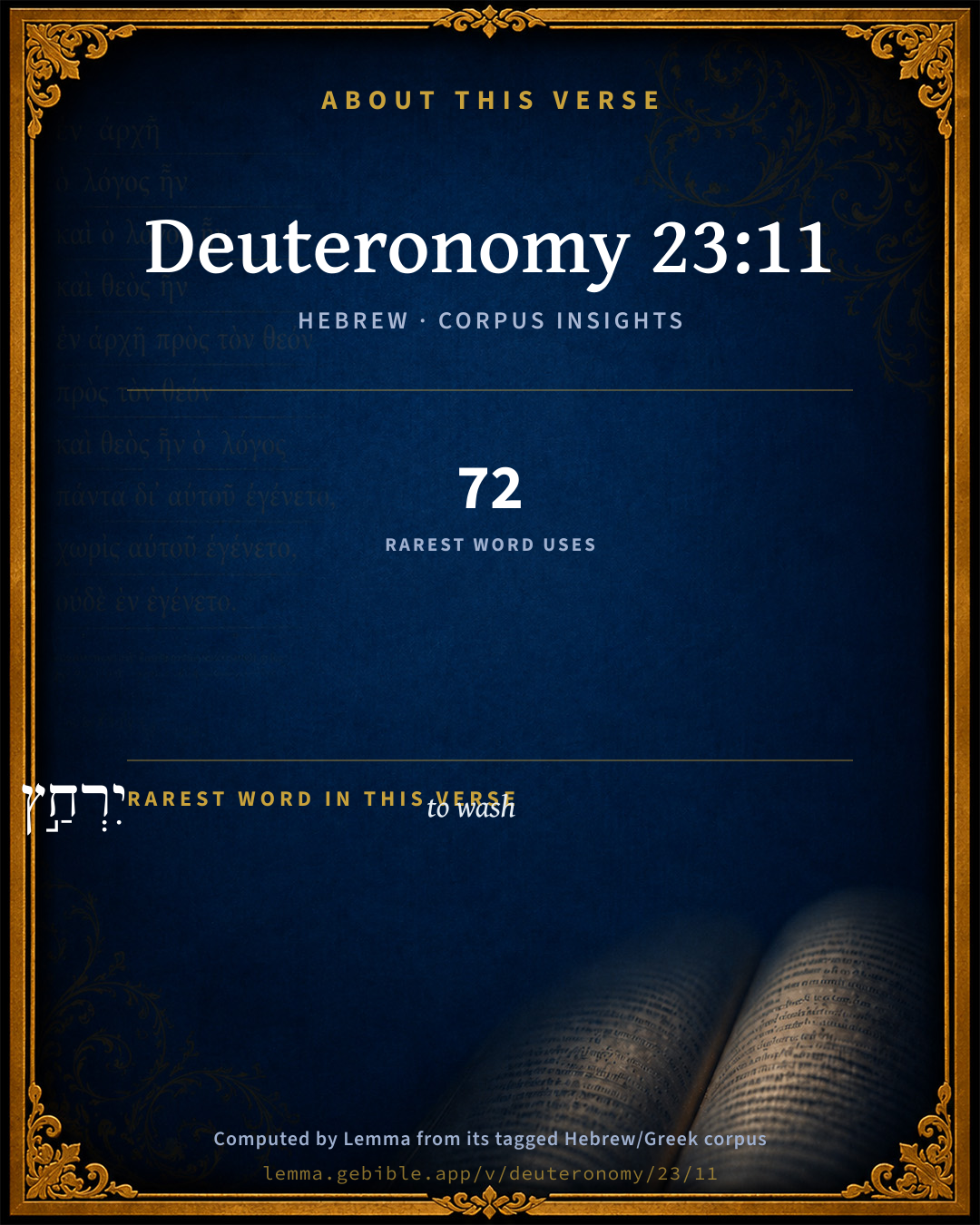
יִרְחַ֣ץ
râchats
H7364
“to wash”
Verb, Qal, Imperfect, 3rd Person, Masculine, Singular
Part of Speech
Verb
Stem
Qal
Form
Imperfect
Person
3rd Person
Gender
Masculine
Number
Singular
Full BDB Definition

Origin: a primitive root

TWOT: 2150

to wash, wash off, wash away, bathe - (Qal) - to wash, wash off, wash away - to wash, bathe (oneself) - (Pual) to be washed - (Hithpael) to wash oneself
  1. וְהָיָ֥ה hâyâh H1961 “and · to be” Conjunction + Verb, Qal, Sequential Perfect, 3rd Person, Masculine, Singular
  2. לִפְנֽוֹת pânâh H6437 “to turn” Preposition + Verb, Qal, Infinitive Construct
  3. עֶ֖רֶב ʻereb H6153 “evening” Noun, Common, Masculine, Singular, Absolute
  4. בַּמָּ֑יִם mayim H4325 “in/at the · water(s)” Preposition, Determined + Noun, Common, Masculine, Plural, Absolute
  5. וּכְבֹ֣א bôwʼ H935 “and · like/as · to enter” Conjunction + Preposition + Verb, Qal, Infinitive Construct
  6. הַשֶּׁ֔מֶשׁ shemesh H8121 “the · sun” Particle, Definite Article + Noun, Common, Both, Singular, Absolute
  7. יָבֹ֖א bôwʼ H935 “to enter” Verb, Qal, Imperfect, 3rd Person, Masculine, Singular
  8. אֶל ʼêl H413 “to” Preposition
  9. תּ֥וֹךְ tâvek H8432 “midst of” Noun, Common, Masculine, Singular, Construct
  10. הַֽמַּחֲנֶה machăneh H4264 “the · camp” Particle, Definite Article + Noun, Common, Both, Singular, Absolute

About this verse

These counts appear in no published source. They are computed here, from the morphology-tagged text and Lemma’s own curated glosses. What Lemma adds →

11
words
10
distinct lemmas
Pentateuch
section

Grammatical profile

  • 5 verbs
  • 5 nouns
  • 1 preposition

Verb forms

  • וְהָיָ֥ה Qal · Sequential Perfect
  • לִפְנֽוֹת Qal · Infinitive Construct
  • יִרְחַ֣ץ Qal · Imperfect
  • וּכְבֹ֣א Qal · Infinitive Construct
  • יָבֹ֖א Qal · Imperfect

Repetition

A word recurs within this verse — often emphatic in Hebrew:

  • וּכְבֹ֣א to enter H935 ×2

Hebrew & Septuagint length

In English translation the verse runs 26 words from the Hebrew and 28 from the Septuagint (LXX English) — closely comparable.

A rough comparison of the two English renderings, which tokenize alike — not a word-level alignment.

Word counts can differ between the Hebrew and the Greek without any difference in meaning — e.g. the Hebrew direct-object marker אֵת has no separate Greek word, and Greek often adds the article ὁ.

Cross-references

17

Topical passages linked to Deuteronomy 23:11 in the Treasury of Scripture Knowledge — connected by theme and wording, ordered by reader-vote popularity; previews shown in the World English Bible.

  • Leviticus 14:9 It shall be on the seventh day, that he shall shave all his hair off his head and his beard and his eyebrows, even all his hair he shall shave off. He shall wash his clothes, and he shall bathe his body in water, then he shall be clean.
  • Leviticus 15:5 Whoever touches his bed shall wash his clothes, and bathe himself in water, and be unclean until the evening.
  • Luke 11:38–39 When the Pharisee saw it, he marveled that he had not first washed himself before dinner.
  • Ephesians 5:26–27 that he might sanctify it, having cleansed it by the washing of water with the word,
  • Hebrews 10:22 let's draw near with a true heart in fullness of faith, having our hearts sprinkled from an evil conscience, and having our body washed with pure water,
  • Leviticus 11:25 Whoever carries any part of their carcass shall wash his clothes, and be unclean until the evening.
  • Leviticus 15:11 "'Whoever he who has the discharge touches, without having rinsed his hands in water, he shall wash his clothes, and bathe himself in water, and be unclean until the evening.
  • Leviticus 15:13 "'When he who has a discharge is cleansed of his discharge, then he shall count to himself seven days for his cleansing, and wash his clothes; and he shall bathe his flesh in running water, and shall be clean.
  • Leviticus 15:17–23 Every garment, and every skin, whereon the semen is, shall be washed with water, and be unclean until the evening.
  • Leviticus 22:6 the person that touches any such shall be unclean until the evening, and shall not eat of the holy things, unless he bathe his body in water.
  • Psalms 51:2 Wash me thoroughly from my iniquity. Cleanse me from my sin.
  • Psalms 51:7 Purify me with hyssop, and I will be clean. Wash me, and I will be whiter than snow.
  • Ezekiel 36:25 I will sprinkle clean water on you, and you shall be clean: from all your filthiness, and from all your idols, will I cleanse you.
  • Matthew 3:11 I indeed baptize you in water for repentance, but he who comes after me is mightier than I, whose shoes I am not worthy to carry. He will baptize you in the Holy Spirit.
  • Hebrews 9:9–10 which is a symbol of the present age, where gifts and sacrifices are offered that are incapable, concerning the conscience, of making the worshipper perfect;
  • 1 Peter 3:21 This is a symbol of baptism, which now saves you-- not the putting away of the filth of the flesh, but the answer of a good conscience toward God, through the resurrection of Jesus Christ,
  • Revelation 1:5 and from Jesus Christ, the faithful witness, the firstborn of the dead, and the ruler of the kings of the earth. To him who loves us, and washed us from our sins by his blood;

Cross-references courtesy of OpenBible.info (CC BY 4.0).

Hebrew and Greek witnesses Masoretic Hebrew ↔ Greek Septuagint

The same verse in the two great witnesses to the Old Testament, shown verse-for-verse.

These are two independent witnesses, not word-aligned to each other, and the Septuagint is shown in lemma (dictionary) form.

Hebrew Deuteronomy 23:11 Masoretic · Westminster Leningrad Codex

וְהָיָ֥ה לִפְנֽוֹת עֶ֖רֶב יִרְחַ֣ץ בַּמָּ֑יִם וּכְבֹ֣א הַשֶּׁ֔מֶשׁ יָבֹ֖א אֶל תּ֥וֹךְ הַֽמַּחֲנֶה

but it shall be, when evening comes on, he shall bathe himself in water; and when the sun is down, he shall come within the camp.

World English Bible · Public Domain

Greek LXX Deuteronomy 23:11 Septuagint · lemma form

ἐάν εἰμί ἐν σύ ἄνθρωπος ὅς οὐ εἰμί καθαρός ἐκ ῥύσις αὐτός νύξ καί ἐκἔρχομαι ἔξω ὁ παρεμβολή καί οὐ εἰςἔρχομαι εἰς ὁ παρεμβολή

And it shall come to pass toward evening he shall wash his body with water, and when the sun has gone down, he shall go into the camp.

LXX2012 (modern English Septuagint) · Public Domain

Hebrew: Westminster Leningrad Codex (CC BY 4.0). Greek: Septuagint (public domain); English from LXX2012 (modern English Septuagint) (Public Domain). How the Septuagint differs from the Hebrew →

Targum (Aramaic paraphrase)

2

The Targum is the ancient Jewish Aramaic paraphrase of the Hebrew Scriptures — an interpretive translation, not the Hebrew text itself. Onkelos (literal) and Pseudo-Jonathan (expansive) render the Torah, and Jonathan the Prophets. Coverage is partial: where no permissively-licensed English translation exists for a verse, only the Aramaic is shown. This is verse-level text, not a word-by-word alignment to the Hebrew.

  1. Targum Onkelos Torah (Genesis–Deuteronomy)
    אֲרֵי יְהֵי בָךְ גְבַר דִי לָא יְהֵּי דְכֵי מִקְרֵהּ לֵילְיָא וְיִפּוֹק לְמִבָּרָא לְמַשְׁרִיתָא לָא יֵעוּל לְגוֹ מַשְׁרִיתָא

    (no public-domain English translation for this verse)

    Targum Onkelos — Aramaic: “Onkelos Genesis” (public domain); “Onkelos Exodus” (public domain); “Onkelos Leviticus” (public domain); “Onkelos Numbers” (public domain); “Onkelos Deuteronomy” (public domain). English: “Sefaria Community Translation” (CC0 1.0 (public-domain dedication)); “J.W. Etheridge. The Targums of Onkelos and Jonathan Ben Uzziel on the Pentateuch. London: Longmans, Green, 1862” (public domain). Text via Sefaria.

  2. Targum Pseudo-Jonathan Torah (Genesis–Deuteronomy)
    אֲרוּם יְהֵי בָךְ גְּבַר דְּלָא יְהֵי דְכֵי מִקִּרְיוּת הִרְהוּר לֵילְיָא וְיִפּוֹק לְמִבָּרָא לְמַשְׁרִיתָא לָא יֵיעוֹל לְמִצּוּעַ מַשְׁרִיתָא

    Should there be a man among you who is unclean from accidents of the night, let him go without the camp, and come not among the tents.

    Targum Pseudo-Jonathan — Aramaic: “Targum Jonathan on Genesis” (public domain); “Targum Jonathan on Exodus” (public domain); “Targum Jonathan on Leviticus” (public domain); “Targum Jonathan on Numbers” (public domain); “Targum Jonathan on Deuteronomy” (public domain). English: “The Targum of Jonathan ben Uzziel, trans. J. W. Etheridge, London, 1862” (public domain). Text via Sefaria.

Commentary

Notes on Deuteronomy 23:11 from classic Christian and Jewish commentators (each source and its license shown beneath its notes). The classic Christian expositions comment on the surrounding passage and are grouped to its opening verse, so a note may address several verses; the Jewish commentaries on the Tanakh (Rashi and others) are per-verse, so they appear only where the commentator wrote on this verse.

Lemma curates 59 commentaries, every one of them public domain or Creative Commons licensed, each selected and text-cleaned for this edition rather than reprinted as found. About our sources →

Trapp's Complete Commentary

John Trapp

Deu 23:11 But it shall be, when evening cometh on, he shall wash [himself] with water: and when the sun is down, he shall come into the camp [again].

Ver. 11. He shall wash himself with water.] See Lev 15:1-33 {See Trapp on "Lev 15:2"} &c. The Turks at this day pertinaciously and superstitiously retain this ceremony. Before prayers they wash both face and hands, sometimes the head and other parts. Yea, some report of them, that every time they make water, or other unclean exercise of nature, they wash, little regarding who stands by. If a dog do but chance to touch their hands, they wash presently, &c. {a}

{a} Blunt’s Voyage.

John Trapp, A Commentary or Exposition upon All the Books of the Old and New Testament (1647–1656) — public domain. Text from a community e-Sword module.

John Gill's Exposition

But it shall be, when evening cometh on,.... When the day declines, and it is near sun setting:

he shall wash himself with water; dip himself all over in water, not only wash his garments but his flesh:

and when the sun is down he shall come into the camp again; and take his place and rank in the army. Now if all this was necessary on account of ceremonial uncleanness, which as much as possible was to be avoided, how much more careful were they to be of moral uncleanness, as fornication, adultery, and all sorts of debauchery and lewdness? and yet nothing more frequent among those that are of the military order; it would be well if there was no occasion for the reproach Maimonides (q) casts upon the camps of the Heathens, among whom, no doubt, he means Christians, if not principally; when he observes that these orders were given, that this might be deeply fixed in the mind of every one, that their camp ought to be holy as the sanctuary of God, and not like the camps of the Gentiles, in which abound corruptions of all kinds, transgressions, rapines, thefts, and other sins.

(q) Moreh Nevochim, par. 3. c. 41.

John Gill's Exposition of the Whole Bible (1746–1763) — public domain (CC PDM 1.0). Text via the HelloAO Bible API.

Haydock's Catholic Bible Commentary

Water of the fountain. (Menochius)

George Leo Haydock (1774–1849), Haydock's Catholic Family Bible and Commentary, 1859 edition — public domain. Excludes Psalms (Douay-Rheims chapter numbering differs from Protestant) and Deuterocanonical books (Catholic canon only).

Rashi

Rabbi Shlomo Yitzchaki (Rashi)

מקרה לילה [IF THERE BE AMONG YOU ANY MAN THAT IS NOT CLEAN BY REASON OF] UNCLEANNESS THAT CHANCETH HIM BY NIGHT — By night: Scripture speaks of what usually occurs (but the law applies also if the uncleanness happens at day time) (Sifrei Devarim 255:3).

ויצא אל מחוץ למחנה THEN HE SHALL GO ABROAD OUT OF THE CAMP — This is a command,

לא יבא אל תוך המחנה HE SHALL NOT COME WITHIN THE CAMP — This is a prohibition (Sifrei Devarim 255:4). He is forbidden to enter the “camp of the Levites”, and all the more so, the "camp of the Shechinah". (cf. Sifrei Devarim 255:5; Pesachim 68a and Rashi on Numbers 5:2).

Rashi on the Tanakh — English translations: “The Judaica Press complete Tanach with Rashi, translated by A. J. Rosenberg” (CC BY 4.0); “Pentateuch with Rashi's commentary by M. Rosenbaum and A.M. Silbermann, 1929-1934” (public domain); “The Metsudah Tanach series, Lakewood, N.J” (CC BY 4.0); and “The Book of Joshua, Metsudah Publications, 1997” (CC BY 4.0). Text via Sefaria.

Ramban (Nachmanides)

Rabbi Moshe ben Nachman (Ramban / Nachmanides)

And by way of the simple meaning of Scripture the verse warns that a man to whom a [nocturnal] pollution occurred, should leave the camp completely for the reason mentioned, that G-d walks among us to help us and the camp is holy, and that our hearts are to be intent towards the Holy One, blessed be He, hoping for His help and that we put not our trust in a human arm., 17:5. A similar reason is also for the command to cover excrement, for the entire camp is like the Sanctuary of G-d. From this law we deduce, concerning a place of prayer, that we must remove ourselves four cubits away from excrement [if it is behind us] or as far as the eye can see [if it is in front of us]. However, our Rabbis interpreted it: “Then shall he go abroad out of the camp, he shall not come within the camp — neither in the camp of the Levites, nor in the camp of the Divine Presence” when the ark of G-d was there with them. The covering of excrement also, in their opinion, is required when mentioning G-d’s Name in prayer or in the reading of the Sh’ma. If so, this too, is an admonition which he restated here with respect to an army in order that everything should not be as lawless as in the camps of the peoples. These commandments as well are then explanatory [of those mentioned before]. Now, the reason for covering excrement is not because excrement is like something unclean that defiles its location and breaks through and rises [like the impurity of the dead]. Rather it is because it is forbidden to see it during time of prayer when the heart cleaves to the Glorious Name, because ugly things give rise to ugliness in the soul and they confound the intent of the pure heart, but when it is hidden from the seeing eye there is no harm.

Ramban (Nachmanides) on the Tanakh — English translation: “Commentary on the Torah by Ramban (Nachmanides). Translated and annotated by Charles B. Chavel. New York, Shilo Pub. House, 1971-1976” (CC BY 4.0). Text via Sefaria.

Lesson kit

Teaching starters — assembled from the data on this page, not authored interpretation. Every prompt links to the verse data it draws on. Edit before teaching.

Deuteronomy, in the Pentateuch, opens this verse with 11 words (10 distinct Hebrew lemmas). Its most distinctive word is râchats (“to wash”). A historical commentator’s framing appears above. Read the whole chapter for the surrounding context.

Discussion questions

  1. What does “to wash” (râchats) contribute to the verse as a whole?
  2. Leviticus 14:9 shares this passage’s theme. How do the two illuminate each other?
  3. “to enter” occurs 2× in this one verse. What is the effect of the repetition?
  4. These translations render this verse differently. What is at stake in choosing one wording over another?
  5. The verb «וְהָיָ֥ה» is Qal Sequential Perfect. How does its form color the action?
  6. Reading how Trapp's Complete Commentary and John Gill's Exposition read this verse, where do the two commentators agree and where do they part?

Things to notice

Reading settings

Reading text

Shown beneath each verse's original-language words.

Old Testament
Old Testament edition

Read the OT as the Masoretic Hebrew (MT) or the Greek Septuagint (LXX).

English shown for the Greek Septuagint (in the Hebrew ↔ Greek comparison).

Comparing translations? Open the Compare panel on any verse page to stack up to four side by side.