2 Samuel 4:6

Hebrew (Westminster Leningrad Codex) 2 Samuel 4:6 appears in the Hebrew Old Testament. The text above is from the Westminster Leningrad Codex. Each word links to its Strong’s number, a concise gloss, and parsing drawn from the Open Scriptures Hebrew Bible morphology. Click any word for its full Brown-Driver-Briggs (BDB) entry.
Download image
Cite this verse

2 Samuel 4:6 (World English Bible). Public Domain. Lemma interlinear Bible study tool, https://lemma.gebible.app/v/2-samuel/4/6.

Show BibTeX & RIS
BibTeX
RIS
English Translation
They came there into the midst of the house, as though they would have fetched wheat; and they struck him in the body: and Rechab and Baanah his brother escaped.
World English Bible · Public Domain
Download a study sheet

One document with this verse’s original text, its word-by-word gloss line, the meaning frame, cross-references with their text, attributed commentary, and full source and license credits — printable, and it pastes into notes with its structure intact.

This verse Autodidact and up

Study sheet (.html) Plain text (.txt)

A passage Seminary Student

Up to 50 verses in one chapter. A passage sheet keeps up to 6 commentary sources and 12 cross-references per verse, in the order this page ranks them, and says so on the sheet whenever that leaves anything out. Ask for a single verse and you get the Autodidact verse sheet above.

Everything on this page stays free to read, with no account — the sheet is a download of what is already on screen, not access to it.

Want to remove ads? Support Godless Engineer
Compare translations 3

The same verse in 3 English versions, stacked beneath the original-language interlinear above. Click any original word for its lexicon entry.

Each is an independent rendering of the whole verse — the interlinear is not word-aligned to these translations.

Highlighted words mark where these versions differ — a whole-verse word diff, not a word-by-word alignment.

  • World English Bible Public Domain
    They came there into the midst of the house, as though they would have fetched wheat; and they struck him in the body: and Rechab and Baanah his brother escaped.
  • King James Version Public Domain
    And they came thither into the midst of the house, as though they would have fetched wheat; and they smote him under the fifth rib: and Rechab and Baanah his brother escaped.
  • unfoldingWord Literal Text CC BY-SA 4.0
    And behold, they came to the midst of the house, takers of wheat, and they struck him in the stomach. And Rechab and Baanah his brother escaped.

unfoldingWord Literal Text — © unfoldingWord, licensed CC BY-SA 4.0. Word-aligned USFM3 via Door43 (git.door43.org/unfoldingWord/en_ult).

Versions to compare (up to 4)

3 of 4 selected

Show all 18 translations

Every available English version of this verse, each an independent rendering of the whole verse.

  • World English Bible Public Domain
    They came there into the midst of the house, as though they would have fetched wheat; and they struck him in the body: and Rechab and Baanah his brother escaped.
  • Berean Standard Bible Public Domain
    They entered the interior of the house as if to get some wheat, and they stabbed him in the stomach. Then Rechab and his brother Baanah slipped away.
  • Majority Standard Bible Public Domain
    They entered the interior of the house as if to get some wheat, and they stabbed him in the stomach. Then Rechab and his brother Baanah slipped away.
  • King James Version Public Domain
    And they came thither into the midst of the house, as though they would have fetched wheat; and they smote him under the fifth rib: and Rechab and Baanah his brother escaped.
  • American Standard Version (1901) Public Domain
    And they came thither into the midst of the house, as though they would have fetched wheat; and they smote him in the body: and Rechab and Baanah his brother escaped.
  • Revised Version (1885) Public Domain
    And they came thither into the midst of the house, as though they would have fetched wheat; and they smote him in the belly: and Rechab and Baanah his brother escaped.
  • Geneva Bible (1599) Public Domain
    And beholde, Rechab and Baanah his brother came into the middes of the house as they would haue wheate, and they smote him vnder the fift ryb, and fled.
  • Douay-Rheims (1899) Public Domain
    And they entered into the house secretly taking ears of corn, and Rechab and Baana his brother stabbed him in the groin, and fled away.
  • Young's Literal Translation Public Domain
    and thither they have come, unto the midst of the house, taking wheat, and they smite him unto the fifth `rib', and Rechab and Baanah his brother have escaped;
  • Literal Standard Version CC BY-SA 4.0
    and they have come there, to the midst of the house, taking wheat, and they strike him to the fifth [rib], and Rechab and his brother Baanah have escaped;
  • Unlocked Literal Bible CC BY-SA 4.0
    The woman guarding the door had fallen asleep while sifting wheat, and Recab and Baanah walked in quietly and passed her.
  • unfoldingWord Literal Text CC BY-SA 4.0
    And behold, they came to the midst of the house, takers of wheat, and they struck him in the stomach. And Rechab and Baanah his brother escaped.
  • Darby Bible Public Domain
    And they came thither into the midst of the house, [as though] they would fetch wheat; and they smote him in the belly; and Rechab and Baanah his brother escaped.
  • World Messianic Bible Public Domain
    They came there into the middle of the house as though they would have fetched wheat, and they struck him in the body; and Rechab and Baanah his brother escaped.
  • Webster's Bible Public Domain
    And they came thither into the midst of the house, as though they would have fetched wheat; and they smote him under the fifth rib: and Rechab and Baanah his brother escaped.
  • Free Bible Version CC BY-SA 4.0
    The woman doorkeeper had been cleaning wheat, but she had grown tired and fallen asleep, so Rechab and Baanah were able to slip inside.
  • Bible in Basic English Public Domain
    And Rechab and his brother Baanah got in without being seen.
  • JPS Tanakh (1917) Public Domain
    And they came thither into the midst of the house, as though they would have fetched wheat; and they smote him in the groin; and Rechab and Baanah his brother escaped.

Literal Standard Version (2020), Covenant Press — licensed CC BY-SA 4.0. Text via the HelloAO Bible API (eBible.org). Unlocked Literal Bible (unfoldingWord) — licensed CC BY-SA 4.0. Text via the HelloAO Bible API (eBible.org). unfoldingWord Literal Text — © unfoldingWord, licensed CC BY-SA 4.0. Word-aligned USFM3 via Door43 (git.door43.org/unfoldingWord/en_ult). Free Bible Version, Dr. Jonathan Gallagher — licensed CC BY-SA 4.0. Text via the HelloAO Bible API (eBible.org).

Word by word

More ways to search: Search by grammar → Find every occurrence → Compare this word →

Practice this passage: Drill this verse → Learn its vocabulary →

הַחֹ֑מֶשׁ
chômesh
H2570
“the · belly”
Particle, Definite Article + Noun, Common, Masculine, Singular, Absolute
Part of Speech
Particle + Noun
Type
Common
Gender
Masculine
Number
Singular
State
Absolute
Full BDB Definition

Origin: from an unused root probably meaning, to be stout

TWOT: TWOT- 687a

belly, abdomen, fifth ribs
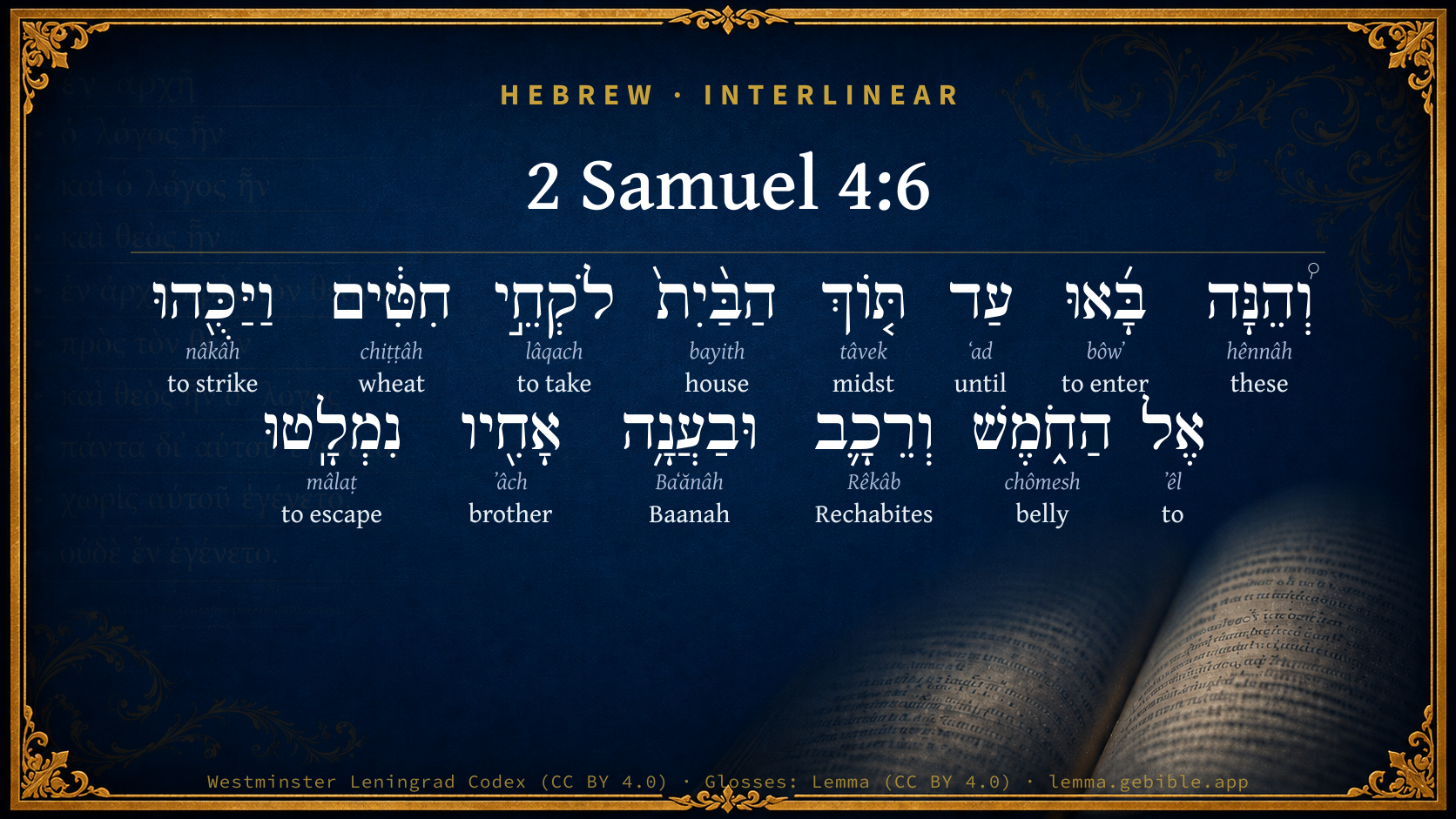
  1. וְ֠הֵנָּה hênnâh H2007 “and · these” Conjunction + Pronoun, Personal, 3rd Person, Feminine, Plural
  2. בָּ֜אוּ bôwʼ H935 “to enter” Verb, Qal, Perfect, 3rd Person, Common, Plural
  3. עַד ʻad H5704 “until” Preposition
  4. תּ֤וֹךְ tâvek H8432 “midst of” Noun, Common, Masculine, Singular, Construct
  5. הַבַּ֨יִת֙ bayith H1004 “the · house” Particle, Definite Article + Noun, Common, Masculine, Singular, Absolute
  6. לֹקְחֵ֣י lâqach H3947 “taking” Verb, Qal, Participle Active, Masculine, Plural, Construct
  7. חִטִּ֔ים chiṭṭâh H2406 “wheat” Noun, Common, Feminine, Plural, Absolute
  8. וַיַּכֻּ֖הוּ nâkâh H5221 “and · to strike · him” Conjunction + Verb, Hiphil, Sequential Imperfect, 3rd Person, Masculine, Plural + Suffix, Personal, 3rd Person, Masculine, Singular
  9. אֶל ʼêl H413 “to” Preposition
  10. וְרֵכָ֛ב Rêkâb H7394 “and · Rechabites” Conjunction + Noun, Proper
  11. וּבַעֲנָ֥ה Baʻănâh H1196 “and · Baanah” Conjunction + Noun, Proper
  12. אָחִ֖יו ʼâch H251 “brother · his” Noun, Common, Masculine, Singular, Construct + Suffix, Personal, 3rd Person, Masculine, Singular
  13. נִמְלָֽטוּ mâlaṭ H4422 “to escape” Verb, Niphal, Perfect, 3rd Person, Common, Plural

About this verse

These counts appear in no published source. They are computed here, from the morphology-tagged text and Lemma’s own curated glosses. What Lemma adds →

14
words
14
distinct lemmas
Historical
section

Notable vocabulary

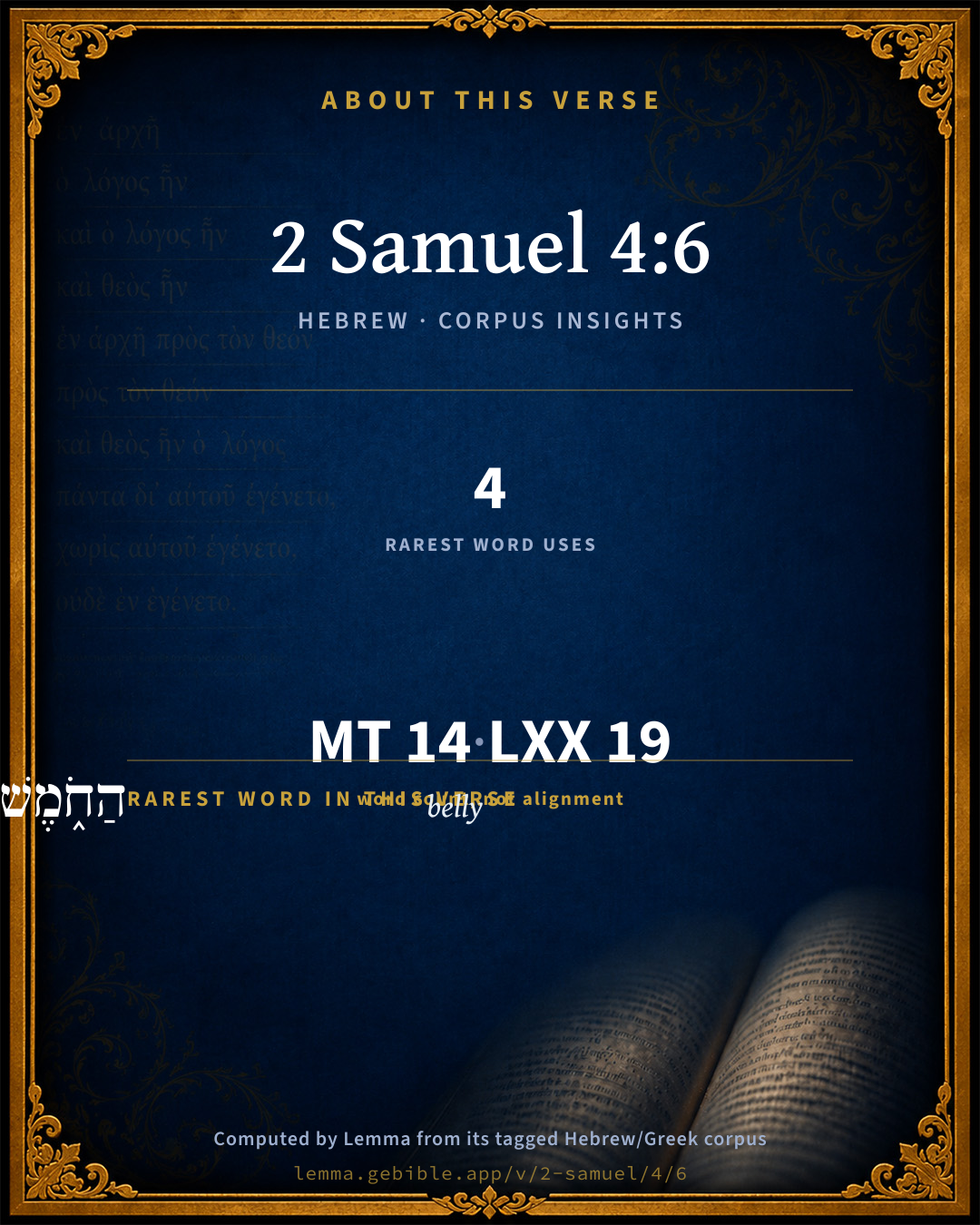
The rarest word here is הַחֹ֑מֶשׁ belly H2570 — appearing just 4 times in the whole Hebrew Bible.

Shared distinctive vocabulary

הַחֹ֑מֶשׁ belly H2570 occurs in 4 verses of the Hebrew Bible. Also found in:

Grammatical profile

  • 4 verbs
  • 7 nouns
  • 1 pronoun
  • 2 prepositions

Verb forms

  • בָּ֜אוּ Qal · Perfect
  • לֹקְחֵ֣י Qal · Participle Active
  • וַיַּכֻּ֖הוּ Hiphil · Sequential Imperfect
  • נִמְלָֽטוּ Niphal · Perfect

Hebrew & Septuagint length

In English translation the verse runs 30 words from the Hebrew and 25 from the Septuagint (LXX English) — closely comparable.

A rough comparison of the two English renderings, which tokenize alike — not a word-level alignment.

Word counts can differ between the Hebrew and the Greek without any difference in meaning — e.g. the Hebrew direct-object marker אֵת has no separate Greek word, and Greek often adds the article ὁ.

In the original languages it is 14 Hebrew tokens and 19 Greek tokens — but the two are counted differently (Hebrew bundles its prefixes and suffixes into one token; the Greek is in lemma form), so that isn’t a like-for-like length.

Cross-references

3

Topical passages linked to 2 Samuel 4:6 in the Treasury of Scripture Knowledge — connected by theme and wording, ordered by reader-vote popularity; previews shown in the World English Bible.

  • 2 Samuel 2:23 However he refused to turn aside: therefore Abner with the hinder end of the spear struck him in the body, so that the spear came out behind him; and he fell down there, and died in the same place: and it happened, that as many as came to the place where Asahel fell down and died stood still.
  • 2 Samuel 3:27 When Abner was returned to Hebron, Joab took him aside into the midst of the gate to speak with him quietly, and struck him there in the body, so that he died, for the blood of Asahel his brother.
  • 2 Samuel 20:10 But Amasa took no heed to the sword that was in Joab's hand: so he struck him therewith in the body, and shed out his bowels to the ground, and didn't strike him again; and he died. Joab and Abishai his brother pursued after Sheba the son of Bichri.

Cross-references courtesy of OpenBible.info (CC BY 4.0).

Hebrew and Greek witnesses Masoretic Hebrew ↔ Greek Septuagint

The same verse in the two great witnesses to the Old Testament, shown verse-for-verse.

These are two independent witnesses, not word-aligned to each other, and the Septuagint is shown in lemma (dictionary) form.

Hebrew 2 Samuel 4:6 Masoretic · Westminster Leningrad Codex

וְ֠הֵנָּה בָּ֜אוּ עַד תּ֤וֹךְ הַבַּ֨יִת֙ לֹקְחֵ֣י חִטִּ֔ים וַיַּכֻּ֖הוּ אֶל הַחֹ֑מֶשׁ וְרֵכָ֛ב וּבַעֲנָ֥ה אָחִ֖יו נִמְלָֽטוּ

They came there into the midst of the house, as though they would have fetched wheat; and they struck him in the body: and Rechab and Baanah his brother escaped.

World English Bible · Public Domain

Greek LXX 2 Samuel 4:6 Septuagint · lemma form

καί ἰδού ὁ θυρωρός ὁ οἶκος καθαίρω πυρός καί νυστάζω καί καταεὕδω καί ρεκχα καί βαανα ὁ ἀδελφός διαλανθάνω

And, behold, the porter of the house winnowed wheat, and he slumbered and slept: and the brothers Rechab and Baana went privily into the house:

LXX2012 (modern English Septuagint) · Public Domain

On this verse, Ellicott's Commentary for English Readers discusses the Septuagint’s reading. Read the note in Commentary ↓

Hebrew: Westminster Leningrad Codex (CC BY 4.0). Greek: Septuagint (public domain); English from LXX2012 (modern English Septuagint) (Public Domain). How the Septuagint differs from the Hebrew →

Targum (Aramaic paraphrase)

1

The Targum is the ancient Jewish Aramaic paraphrase of the Hebrew Scriptures — an interpretive translation, not the Hebrew text itself. Onkelos (literal) and Pseudo-Jonathan (expansive) render the Torah, and Jonathan the Prophets. Coverage is partial: where no permissively-licensed English translation exists for a verse, only the Aramaic is shown. This is verse-level text, not a word-by-word alignment to the Hebrew.

  1. Targum Jonathan Prophets (Joshua–Malachi)
    וְאִינוּן אֲתוֹ עַד גוֹ בֵיתָא כְּזַבְּנֵי חִטִין וּמְחוֹהִי בִּסְטַר יַרְכֵיהּ וְרֵכַב וּבַעֲנָה אֲחוֹהִי אִשְׁתֵּיזָבוּ:

    (no public-domain English translation for this verse)

    Targum Jonathan — Aramaic: “Mikraot Gedolot” (public domain). English: “Sefaria Community Translation” (CC0 1.0 (public-domain dedication)); “London "Chaldee Paraphrase," 1871” (public domain). Text via Sefaria.

Commentary

Notes on 2 Samuel 4:6 from classic Christian and Jewish commentators (each source and its license shown beneath its notes). The classic Christian expositions comment on the surrounding passage and are grouped to its opening verse, so a note may address several verses; the Jewish commentaries on the Tanakh (Rashi and others) are per-verse, so they appear only where the commentator wrote on this verse.

Lemma curates 59 commentaries, every one of them public domain or Creative Commons licensed, each selected and text-cleaned for this edition rather than reprinted as found. About our sources →

The Cambridge Bible for Schools and Colleges

gen. ed. J. J. S. Perowne

6. And they came, &c.] An explanation how it was possible for Rechab and Baanah to enter Ish-bosheth’s house unsuspected. They came, as they may have been accustomed to do, to procure wheat for their men from the king’s granary.

The Heb. however may be otherwise rendered, “And hither [some MSS. read “and behold”] there came wheat-fetchers into the midst of the house:” men whose business it was to draw the rations of wheat from the granary. If this is the right rendering, the meaning is that the murderers obtained entrance to the house by going in their company.

2Sa_4:7 appears at first sight to be a somewhat awkward repetition of 2Sa_4:6. But it is a peculiar feature of Hebrew historical writing to give a general account of a fact first, and then to repeat it with additional details. The murderers’ entrance into the house, their deed, and their escape are first briefly related: then the fact of their entrance is repeated as an introduction to the fuller details of the scene and manner of the murder, and the route by which the assassins escaped. Compare the double mention of Joab’s return to Hebron in ch. 2Sa_3:22-23; and of the national assembly at Hebron in ch. 2Sa_5:1; 2Sa_5:3; and note on ch. 2Sa_13:38.

The Sept. however has the following entirely different reading, which is found also in some MSS. of the Vulgate in addition to the rendering of the present Heb. text, but apparently was not retained by Jerome himself. “And behold the portress of the house was cleaning wheat, and she slumbered and slept; and the brothers Rechab and Baanah came unobserved into the house. Now Ish-bosheth was sleeping on the bed in his chamber: and they smote him,” &c. This also explains how the murderers entered unobserved. The female slave who watched the door (ἡ θυρωρός, cp. Joh_18:16, Act_12:13) had fallen asleep over her task of sifting[98] or picking the wheat, and there was no one to give the alarm. This reading gives a clear straightforward narrative, and certainly seems preferable to the repetitions of the present Hebrew text.

[98] Cp. Amo_9:9. An illustration of a Bethlehem woman sifting wheat is given in Neil’s Palestine Explored, p. 246. He says that it is a process constantly going on and forming a marked feature of Palestine life.

under the fifth rib] In the belly. See note on ch. 2Sa_2:23.

The Cambridge Bible for Schools and Colleges (gen. ed. J. J. S. Perowne; Cambridge University Press, 1878–1918) — public domain. Text from a community e-Sword module.

Trapp's Complete Commentary

John Trapp

2Sa 4:6 And they came thither into the midst of the house, [as though] they would have fetched wheat; and they smote him under the fifth [rib]: and Rechab and Baanah his brother escaped.

Ver. 6. As though they would have fetched wheat.] Either for their own pay, or for the use of their soldiers.

And they smote him under the fifth rib.] Where there is no bone to hinder; but the belly is soft, and fit for a deadly wound. To the doing of this villainous act, some think they might be encouraged by Joab’s impunity; so true is that political sentence, Bonis nocet qui malis parcit.

And Rechab and Baanah his brother escaped.] But though for a time they had escaped, yet vengeance suffered them not long to live. {Act 28:4} A tergo Nemesis.

John Trapp, A Commentary or Exposition upon All the Books of the Old and New Testament (1647–1656) — public domain. Text from a community e-Sword module.

Albert Barnes' Notes on the Bible

As though they would have fetched wheat - This is a very obscure passage, and the double repetition in 2Sa 4:6-7 of the murder of the king and of the escape of the assassin, is hard to account for. Rechab and Baanah came into the house under the pretence of getting grain, probably for the band which they commanded out of the king’s storehouse, and so contrived to get access into the king’s chamber; or, they found the wheat-carriers (the persons whose business it was to carry in grain for the king’s household) just going into the king’s house, and by joining them got into the midst of the house unnoticed. If the latter be the sense, the literal translation of the words would be: “And behold (or, and there) there came into the midst of the house the carriers of wheat, and they (i. e. Rechab and Baanah) smote him, etc.”

Albert Barnes' Notes on the Bible (1834–1885) — public domain. Text from a community e-Sword/MySword module.

Tyndale Open Study Notes

Tyndale Open Resources

4:6 Recab and Baanah believed they would gain David’s favor by committing this treacherous act.

Tyndale Open Study Notes — © Tyndale Open Resources, licensed CC BY-SA 4.0. Text via the HelloAO Bible API.

Geneva Bible (1599)

Geneva Bible translators

They disguised themselves as merchants, which came to buy wheat.

There is nothing so vile and dangerous, which the wicked will not enterprise in hope of lucre and favor.

Geneva Bible (1599) marginal notes — public domain. Text via Bolls.life.

Adam Clarke's Commentary

Verse 6. As though they would have fetched wheat] The king's stores were probably near his own dwelling; and these men were accustomed to go thither for provisions for themselves, their cattle, and their men. This supposition which is natural, renders unnecessary all the emendations of Houbigant and others.

As these men were accustomed to bring wheat from these stores, from which it appears there was an easy passage to the king's chamber, (especially if we consider this a summer-house, as it most probably was,) no man would suspect their present errand, as they were in the habit of going frequently to that place.

Adam Clarke's Commentary on the Bible (1810–1826) — public domain. Text from a community e-Sword/MySword module.

Ellicott's Commentary for English Readers

(6) As though they would have fetched wheat.—Literally, fetching wheat. The English version gives the sense, since the fetching wheat (probably for their soldiers) was a pretext to cover their purpose. The LXX. has here a curious addition: “And, behold, the portress of the house was cleansing wheat, and she slumbered and slept, and the brothers slipt through.” On “the fifth rib”= abdomen, see Note on 2Sa_2:23.

A Bible Commentary for English Readers, edited by Charles John Ellicott (1878–1897) — public domain. Text from a community e-Sword module.

John Gill's Exposition

For when they came into the house, he lay on his bed in his bedchamber,.... This is repeated to give a more particular account of the murder; though Abarbinel thinks they went in twice; when they went in first they smote him under the fifth rib, and made their escape; but fearing they had not left him dead, they returned, and did as follows:

and they smote him, and slew him; so that it was out of all doubt with them that he was dead:

and beheaded him; to make sure work of it:

and took his head; along with them, perhaps in one of the sacks they had to fetch wheat in, and so passed undiscovered, to carry to David, to curry favour with him:

and gat them away through the plain all night; through the plain of Jordan; all the way from Mahanaim to Hebron being for the most part a plain country till they came to Hebron, which was mountainous; the way from Mahanaim to Hebron was a space of sixty eight miles, according to Bunting (z).

(z) Travels, p. 145, 148.

John Gill's Exposition of the Whole Bible (1746–1763) — public domain (CC PDM 1.0). Text via the HelloAO Bible API.

Haydock's Catholic Bible Commentary

Corn. Soldiers were paid with corn, instead of money. They came, therefore, under this pretext; or they brought some as a present to the king, (Liranus) or pretended that they were come to purchase, (Menochius) or bringing a sample to sell; (Tirinus) ut emptores tritici. (Chaldean) Protestants, "as though they would have fetched wheat, and they smote him under the fifth rib."

George Leo Haydock (1774–1849), Haydock's Catholic Family Bible and Commentary, 1859 edition — public domain. Excludes Psalms (Douay-Rheims chapter numbering differs from Protestant) and Deuterocanonical books (Catholic canon only).

Matthew Poole's English Annotations

Into the midst of the house, or, into the house; for the midst is not always taken exactly, and mathematically, but for any part within, as Gen 48:16; Exo 8:22; Jos 3:17.

As though they would have fetched wheat; which was laid up in public granaries in the king’s house, and was fetched thence by the captains and commanders of the army for the pay of their soldiers, who in those ancient times were not paid in money, but in corn, as is well known. Upon this pretence they were admitted into the house, and so went from room to room, to the place where the king lay.

Rechab and Baanah escaped; which was not difficult to do, when the king was left alone; either because he desired to compose himself to rest or sleep; or because his guards, if he had any, were very small and negligent, now, at least, in his declining and forlorn condition.

Matthew Poole's English Annotations on the Holy Bible (1683–1685) — public domain. Text from a community e-Sword/MySword module.

Whedon's Commentary on the Bible

Daniel D. Whedon

6. The house — Some extensive structure at Mahanaim used for the royal palace, and the treasure-house of the royal stores.

As though they would have fetched wheat — From the royal granary. Being royal officers, they were probably accustomed to go to the king’s storehouse for grain. The Septuagint here has the following: “And behold the doorkeeper of the house was winnowing wheat, and he nodded and slept.”

The fifth rib — See note on 2Sa_2:23.

Daniel D. Whedon (gen. ed.), Commentary on the Old and New Testaments (1874–1909) — public domain. Text from a community e-Sword module.

The Pulpit Commentary

Vers. 6, 7. As though they would have fetched wheat. Not only is the narrative confused, but the versions offer extraordinary varieties of reading. The murder of Ishbosheth is fully described in ver. 7, and is there in its place, while it is out of place in ver. 6. And that the captains would themselves fetch wheat, instead of having it carried from the granary by their men; and that they would go through the king"s chamber to obtain it; are both improbable. The very act of going to get wheat at midday, when everybody was having his siesta, would itself be suspicious. The Syriac says nothing about wheat, but that these "wicked men took and smote him." The Vulgate and LXX lay the blame on the woman who kept the door, the narrative of the latter being as follows: "They entered into the house of Ishbosheth in the heat of the day, and he was asleep in his midday chamber And behold, the woman that kept the door of the house had been winnowing wheat, and she slumbered and slept. And the brothers Rechab and Baanah entered the house without being noticed, and Ishbosheth was asleep on his bed in his chamber, and they smote him," etc. There is, confessedly, considerable confusion in the text, but the versions do not altogether clear it up; and until we have better materials for forming a judgment, we must be content to wait. In ver. 5, instead of "who lay on a bed at noon," the Hebrew has "as he was taking his noonday rest." In ver. 7 the bed is the divan, or raised bank, which in an Oriental house runs along the wall, and is supplied with pieces of carpet, or cushions, on which to sit cross legged or recline. For sleep, the corners were the favourite places. Even the public rooms had these divans. But Ishbosheth had probably retired for his siesta into a private chamber, where the captains knew that he would be alone. The plain through which they fled was the Arabah, or Jordan valley, as in 2Sa_2:29.

The Pulpit Commentary (1880–1919), ed. H.D.M. Spence-Jones & Joseph S. Exell — public domain. Text from a community e-Sword module.

John Wesley's Explanatory Notes

Fetched wheat - Which was laid up in publick granaries in the king's house, and was fetched thence by the captains and commanders of the army for the pay of their soldiers, who, in those ancient times were not paid in money, but in corn. Upon this pretense they were admitted into the house, and so went from room to room, to the place where the king lay.

John Wesley, Explanatory Notes Upon the Whole Bible (1754–1765) — public domain. Text via the GEBible commentary corpus.

Rashi

Rabbi Shlomo Yitzchaki (Rashi)

They came into the interior of the house. Together with the traders, the wheat buyers.

Rashi on the Tanakh — English translations: “The Judaica Press complete Tanach with Rashi, translated by A. J. Rosenberg” (CC BY 4.0); “Pentateuch with Rashi's commentary by M. Rosenbaum and A.M. Silbermann, 1929-1934” (public domain); “The Metsudah Tanach series, Lakewood, N.J” (CC BY 4.0); and “The Book of Joshua, Metsudah Publications, 1997” (CC BY 4.0). Text via Sefaria.

Lesson kit

Teaching starters — assembled from the data on this page, not authored interpretation. Every prompt links to the verse data it draws on. Edit before teaching.

2 Samuel, in the Historical, opens this verse with 14 words (14 distinct Hebrew lemmas). Its most distinctive word is chômesh (“belly”). A historical commentator’s framing appears above. Read the whole chapter for the surrounding context.

Discussion questions

  1. The word chômesh carries the sense “belly.” How does it shape the verse?
  2. How does 2 Samuel 2:23, which shares the word «belly», read alongside this verse?
  3. The translations on this page render this verse differently — a whole-verse word diff, not a word-by-word alignment. What might account for the different wordings?
  4. «בָּ֜אוּ» is a Qal Perfect verb. How does that grammatical form shape the action described?
  5. Compare how The Cambridge Bible for Schools and Colleges and Trapp's Complete Commentary read this verse. Where do they agree or differ?

Things to notice

Reading settings

Reading text

Shown beneath each verse's original-language words.

Old Testament
Old Testament edition

Read the OT as the Masoretic Hebrew (MT) or the Greek Septuagint (LXX).

English shown for the Greek Septuagint (in the Hebrew ↔ Greek comparison).

Comparing translations? Open the Compare panel on any verse page to stack up to four side by side.