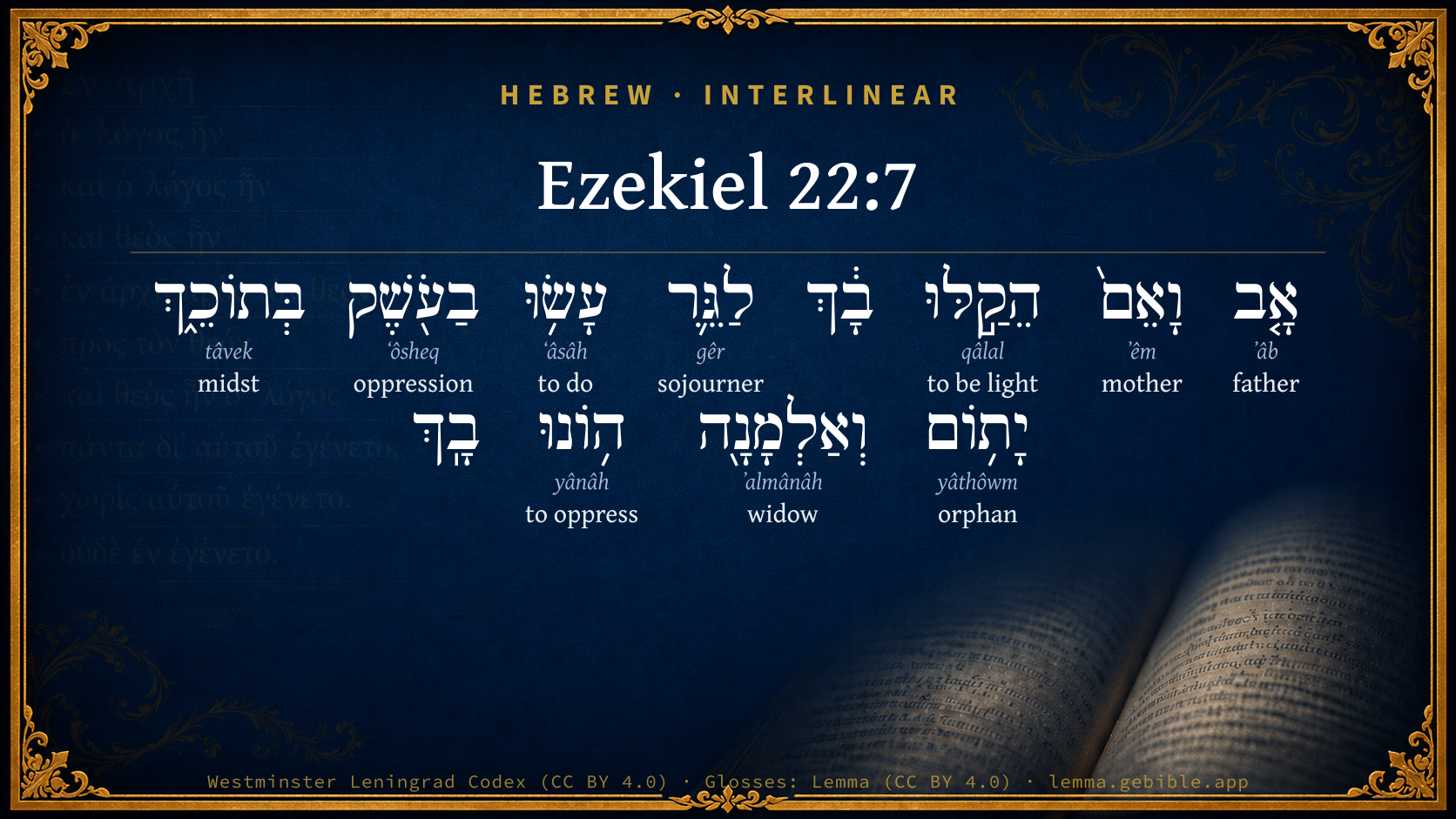
Ezekiel 22:7

Hebrew (Westminster Leningrad Codex) Ezekiel 22:7 appears in the Hebrew Old Testament. The text above is from the Westminster Leningrad Codex. Each word links to its Strong’s number, a concise gloss, and parsing drawn from the Open Scriptures Hebrew Bible morphology. Click any word for its full Brown-Driver-Briggs (BDB) entry.
Download image
Cite this verse

Ezekiel 22:7 (World English Bible). Public Domain. Lemma interlinear Bible study tool, https://lemma.gebible.app/v/ezekiel/22/7.

Show BibTeX & RIS
BibTeX
RIS
English Translation
In you have they set light by father and mother; in the midst of you have they dealt by oppression with the foreigner; in you have they wronged the fatherless and the widow.
World English Bible · Public Domain
Download a study sheet

One document with this verse’s original text, its word-by-word gloss line, the meaning frame, cross-references with their text, attributed commentary, and full source and license credits — printable, and it pastes into notes with its structure intact.

This verse Autodidact and up

Study sheet (.html) Plain text (.txt)

A passage Seminary Student

Up to 50 verses in one chapter. A passage sheet keeps up to 6 commentary sources and 12 cross-references per verse, in the order this page ranks them, and says so on the sheet whenever that leaves anything out. Ask for a single verse and you get the Autodidact verse sheet above.

Everything on this page stays free to read, with no account — the sheet is a download of what is already on screen, not access to it.

Want to remove ads? Support Godless Engineer
Compare translations 3

The same verse in 3 English versions, stacked beneath the original-language interlinear above. Click any original word for its lexicon entry.

Each is an independent rendering of the whole verse — the interlinear is not word-aligned to these translations.

Highlighted words mark where these versions differ — a whole-verse word diff, not a word-by-word alignment.

  • World English Bible Public Domain
    In you have they set light by father and mother; in the midst of you have they dealt by oppression with the foreigner; in you have they wronged the fatherless and the widow.
  • King James Version Public Domain
    In thee have they set light by father and mother: in the midst of thee have they dealt by oppression with the stranger: in thee have they vexed the fatherless and the widow.
  • unfoldingWord Literal Text CC BY-SA 4.0
    They have dishonored fathers and mothers within you, and they have performed oppression on the foreigners in your midst. They have mistreated the orphans and the widows within you.

unfoldingWord Literal Text — © unfoldingWord, licensed CC BY-SA 4.0. Word-aligned USFM3 via Door43 (git.door43.org/unfoldingWord/en_ult).

Versions to compare (up to 4)

3 of 4 selected

Show all 18 translations

Every available English version of this verse, each an independent rendering of the whole verse.

  • World English Bible Public Domain
    In you have they set light by father and mother; in the midst of you have they dealt by oppression with the foreigner; in you have they wronged the fatherless and the widow.
  • Berean Standard Bible Public Domain
    Father and mother are treated with contempt. Within your walls the foreign resident is exploited, the fatherless and the widow are oppressed.
  • Majority Standard Bible Public Domain
    Father and mother are treated with contempt. Within your walls the foreign resident is exploited, the fatherless and the widow are oppressed.
  • King James Version Public Domain
    In thee have they set light by father and mother: in the midst of thee have they dealt by oppression with the stranger: in thee have they vexed the fatherless and the widow.
  • American Standard Version (1901) Public Domain
    In thee have they set light by father and mother; in the midst of thee have they dealt by oppression with the sojourner; in thee have they wronged the fatherless and the widow.
  • Revised Version (1885) Public Domain
    In thee have they set light by father and mother; in the midst of thee, have they dealt by oppression with the stranger: in thee have they wronged the fatherless and the widow.
  • Geneva Bible (1599) Public Domain
    In thee haue they despised father and mother: in the middes of thee haue they oppressed the stranger: in thee haue they vexed the fatherlesse and the widowe.
  • Douay-Rheims (1899) Public Domain
    They have abused father and mother in thee, they have oppressed the stranger in the midst of thee, they have grieved the fatherless and widow in thee.
  • Young's Literal Translation Public Domain
    Father and mother made light of in thee, To a sojourner they dealt oppressively in thy midst, Fatherless and widow they oppressed in thee.
  • Literal Standard Version CC BY-SA 4.0
    They have made light of father and mother in you, || They dealt oppressively to a sojourner in your midst, || They oppressed fatherless and widow in you.
  • Unlocked Literal Bible CC BY-SA 4.0
    They have dishonored fathers and mothers within you, and they have performed oppression on the foreigners in your midst. They have mistreated the orphans and the widows within you.
  • unfoldingWord Literal Text CC BY-SA 4.0
    They have dishonored fathers and mothers within you, and they have performed oppression on the foreigners in your midst. They have mistreated the orphans and the widows within you.
  • Darby Bible Public Domain
    In thee have they made light of father and mother; in the midst of thee have they dealt by oppression with the stranger; in thee have they vexed the fatherless and the widow.
  • World Messianic Bible Public Domain
    In you have they treated father and mother with contempt. Among you they have oppressed the foreigner. In you they have wronged the fatherless and the widow.
  • Webster's Bible Public Domain
    In thee have they set light by father and mother: in the midst of thee have they dealt by oppression with the stranger: in thee have they oppressed the fatherless and the widow.
  • Free Bible Version CC BY-SA 4.0
    You despise your parents. You exploit the foreigners who live with you, and you mistreat orphans and widows.
  • Bible in Basic English Public Domain
    In you they have had no respect for father and mother; in you they have been cruel to the man from a strange land; in you they have done wrong to the child without a father and to the widow.
  • JPS Tanakh (1917) Public Domain
    In thee have they made light of father and mother; in the midst of thee have they dealt by oppression with the stranger; in thee have they wronged the fatherless and the widow.

Literal Standard Version (2020), Covenant Press — licensed CC BY-SA 4.0. Text via the HelloAO Bible API (eBible.org). Unlocked Literal Bible (unfoldingWord) — licensed CC BY-SA 4.0. Text via the HelloAO Bible API (eBible.org). unfoldingWord Literal Text — © unfoldingWord, licensed CC BY-SA 4.0. Word-aligned USFM3 via Door43 (git.door43.org/unfoldingWord/en_ult). Free Bible Version, Dr. Jonathan Gallagher — licensed CC BY-SA 4.0. Text via the HelloAO Bible API (eBible.org).

Word by word

More ways to search: Search by grammar → Find every occurrence → Compare this word →

Practice this passage: Drill this verse → Learn its vocabulary →

בַעֹ֖שֶׁק
ʻôsheq
H6233
“in/at the · oppression”
Preposition, Determined + Noun, Common, Masculine, Singular, Absolute
Part of Speech
Preposition + Noun
Type
Common
Gender
Masculine
Number
Singular
State
Absolute
Full BDB Definition

Origin: from H6231

TWOT: 1713a

oppression, extortion, injury - oppression - extortion - gain by extortion
  1. אָ֤ב ʼâb H1 “father” Noun, Common, Masculine, Singular, Absolute
  2. וָאֵם֙ ʼêm H517 “and · mother” Conjunction + Noun, Common, Feminine, Singular, Absolute
  3. הֵקַ֣לּוּ qâlal H7043 “to be light” Verb, Hiphil, Perfect, 3rd Person, Common, Plural
  4. לַגֵּ֛ר gêr H1616 “to/for the · sojourner” Preposition, Determined + Noun, Common, Masculine, Singular, Absolute
  5. עָשׂ֥וּ ʻâsâh H6213 “to do” Verb, Qal, Perfect, 3rd Person, Common, Plural
  6. בְּתוֹכֵ֑ךְ tâvek H8432 “in/at · midst · your” Preposition + Noun, Common, Masculine, Singular, Construct + Suffix, Personal, 2nd Person, Feminine, Singular
  7. יָת֥וֹם yâthôwm H3490 “orphan” Noun, Common, Masculine, Singular, Absolute
  8. וְאַלְמָנָ֖ה ʼalmânâh H490 “and · widow” Conjunction + Noun, Common, Feminine, Singular, Absolute
  9. ה֥וֹנוּ yânâh H3238 “to oppress” Verb, Hiphil, Perfect, 3rd Person, Common, Plural

About this verse

These counts appear in no published source. They are computed here, from the morphology-tagged text and Lemma’s own curated glosses. What Lemma adds →

12
words
10
distinct lemmas
Prophets
section

Notable vocabulary

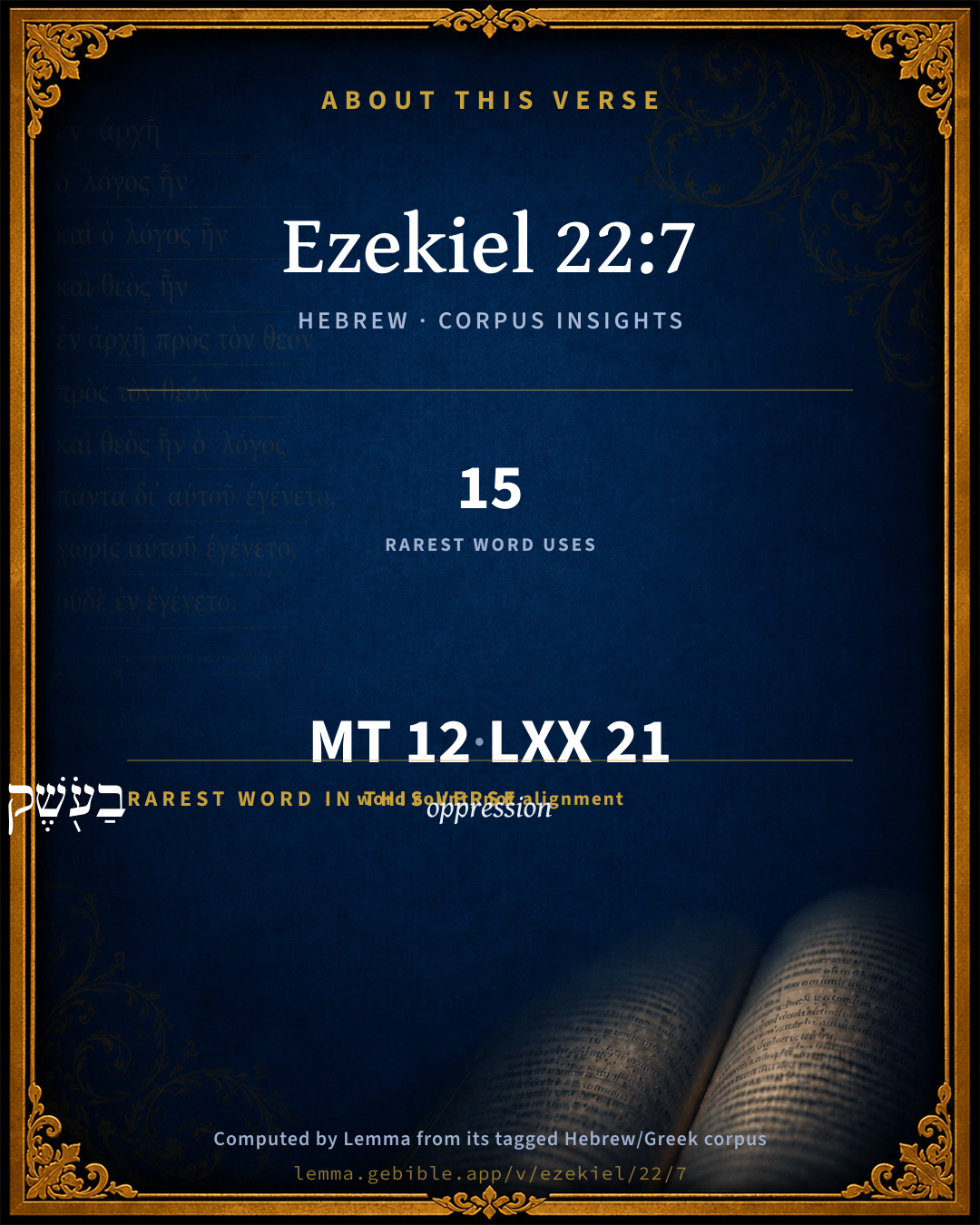
The rarest word here is בַעֹ֖שֶׁק oppression H6233 — appearing just 15 times in the whole Hebrew Bible.

Shared distinctive vocabulary

בַעֹ֖שֶׁק oppression H6233 occurs in 15 verses of the Hebrew Bible. Also found in:

Grammatical profile

  • 3 verbs
  • 7 nouns
  • 2 prepositions

Verb forms

  • הֵקַ֣לּוּ Hiphil · Perfect
  • עָשׂ֥וּ Qal · Perfect
  • ה֥וֹנוּ Hiphil · Perfect

Hebrew & Septuagint length

In English translation the verse runs 33 words from the Hebrew and 25 from the Septuagint (LXX English) — closely comparable.

A rough comparison of the two English renderings, which tokenize alike — not a word-level alignment.

Word counts can differ between the Hebrew and the Greek without any difference in meaning — e.g. the Hebrew direct-object marker אֵת has no separate Greek word, and Greek often adds the article ὁ.

In the original languages it is 12 Hebrew tokens and 21 Greek tokens — but the two are counted differently (Hebrew bundles its prefixes and suffixes into one token; the Greek is in lemma form), so that isn’t a like-for-like length.

Cross-references

18

Topical passages linked to Ezekiel 22:7 in the Treasury of Scripture Knowledge — connected by theme and wording, ordered by reader-vote popularity; previews shown in the World English Bible.

  • Deuteronomy 27:16 Cursed be he who sets light by his father or his mother. All the people shall say, Amen.
  • Exodus 22:21–22 "You shall not wrong an alien, neither shall you oppress him, for you were aliens in the land of Egypt.
  • Leviticus 20:9 "'For everyone who curses his father or his mother shall surely be put to death: he has cursed his father or his mother; his blood shall be upon him.
  • Jeremiah 7:6 if you don't oppress the foreigner, the fatherless, and the widow, and don't shed innocent blood in this place, neither walk after other gods to your own hurt:
  • Zechariah 7:10 Don't oppress the widow, nor the fatherless, the foreigner, nor the poor; and let none of you devise evil against his brother in your heart.'
  • Malachi 3:5 I will come near to you to judgment; and I will be a swift witness against the sorcerers, and against the adulterers, and against the perjurers, and against those who oppress the hireling in his wages, the widow, and the fatherless, and who deprive the foreigner of justice, and don't fear me," says Yahweh of Hosts.
  • Matthew 15:4–6 For God commanded, 'Honor your father and your mother,' and, 'He who speaks evil of father or mother, let him be put to death.'
  • Mark 7:10 For Moses said, 'Honor your father and your mother;' and, 'He who speaks evil of father or mother, let him be put to death.'
  • Exodus 20:12 "Honor your father and your mother, that your days may be long in the land which Yahweh your God gives you.
  • Exodus 21:17 "Anyone who curses his father or his mother shall surely be put to death.
  • Deuteronomy 5:16 "Honor your father and your mother, as Yahweh your God commanded you; that your days may be long, and that it may go well with you, in the land which Yahweh your God gives you.
  • Deuteronomy 27:19 Cursed be he who wrests the justice [due] to the foreigner, fatherless, and widow. All the people shall say, Amen.
  • Proverbs 20:20 Whoever curses his father or his mother, His lamp shall be put out in blackness of darkness.
  • Proverbs 22:22–23 Don't exploit the poor, because he is poor; And don't crush the needy in court;
  • Proverbs 30:11 There is a generation that curses their father, And doesn't bless their mother.
  • Proverbs 30:17 The eye that mocks at his father, And scorns obedience to his mother: The ravens of the valley shall pick it out, The young eagles shall eat it.
  • Ezekiel 18:12 has wronged the poor and needy, has taken by robbery, has not restored the pledge, and has lifted up his eyes to the idols, has committed abomination,
  • Ezekiel 22:29 The people of the land have used oppression, and exercised robbery; yes, they have vexed the poor and needy, and have oppressed the foreigner wrongfully.

Cross-references courtesy of OpenBible.info (CC BY 4.0).

Hebrew and Greek witnesses Masoretic Hebrew ↔ Greek Septuagint

The same verse in the two great witnesses to the Old Testament, shown verse-for-verse.

These are two independent witnesses, not word-aligned to each other, and the Septuagint is shown in lemma (dictionary) form.

Hebrew Ezekiel 22:7 Masoretic · Westminster Leningrad Codex

אָ֤ב וָאֵם֙ הֵקַ֣לּוּ בָ֔ךְ לַגֵּ֛ר עָשׂ֥וּ בַעֹ֖שֶׁק בְּתוֹכֵ֑ךְ יָת֥וֹם וְאַלְמָנָ֖ה ה֥וֹנוּ בָֽךְ

In you have they set light by father and mother; in the midst of you have they dealt by oppression with the foreigner; in you have they wronged the fatherless and the widow.

World English Bible · Public Domain

Greek LXX Ezekiel 22:7 Septuagint · lemma form

πατήρ καί μήτηρ κακαλογέω ἐν σύ καί πρός ὁ προσήλυτος ἀναστρέφω ἐν ἀδικία ἐν σύ ὀρφανός καί χήρα καταδυναστεύω ἐν σύ

In you they have reviled father and mother; and in you they have behaved unjustly toward the stranger: they have oppressed the orphan and widow.

LXX2012 (modern English Septuagint) · Public Domain

On this verse, John Gill's Exposition discusses the Septuagint’s reading. Read the note in Commentary ↓

Hebrew: Westminster Leningrad Codex (CC BY 4.0). Greek: Septuagint (public domain); English from LXX2012 (modern English Septuagint) (Public Domain). How the Septuagint differs from the Hebrew →

Targum (Aramaic paraphrase)

1

The Targum is the ancient Jewish Aramaic paraphrase of the Hebrew Scriptures — an interpretive translation, not the Hebrew text itself. Onkelos (literal) and Pseudo-Jonathan (expansive) render the Torah, and Jonathan the Prophets. Coverage is partial: where no permissively-licensed English translation exists for a verse, only the Aramaic is shown. This is verse-level text, not a word-by-word alignment to the Hebrew.

  1. Targum Jonathan Prophets (Joshua–Malachi)
    אַבָּא וְאִמָא אָקִילוּ בָךְ לְגִיוֹרָא אֲנִיסוּ אוֹנְסָא בְּגַוִיךְ יַתְמִין וְאַרְמְלָן אוֹנִיאוּ בִיךְ:

    (no public-domain English translation for this verse)

    Targum Jonathan — Aramaic: “Mikraot Gedolot” (public domain). English: “Sefaria Community Translation” (CC0 1.0 (public-domain dedication)); “London "Chaldee Paraphrase," 1871” (public domain). Text via Sefaria.

Commentary

Notes on Ezekiel 22:7 from classic Christian and Jewish commentators (each source and its license shown beneath its notes). The classic Christian expositions comment on the surrounding passage and are grouped to its opening verse, so a note may address several verses; the Jewish commentaries on the Tanakh (Rashi and others) are per-verse, so they appear only where the commentator wrote on this verse.

Lemma curates 59 commentaries, every one of them public domain or Creative Commons licensed, each selected and text-cleaned for this edition rather than reprinted as found. About our sources →

Jamieson, Fausset & Brown

Robert Jamieson, A. R. Fausset & David Brown

set light by--Children have made light of, disrespected, father . . . (Deu 27:16). At Eze 22:7-12 are enumerated the sins committed in violation of Moses' law.

Jamieson, Fausset & Brown — Commentary Critical and Explanatory on the Whole Bible (1871) — public domain (CC PDM 1.0). Text via the HelloAO Bible API.

Trapp's Complete Commentary

John Trapp

Eze 22:7 In thee have they set light by father and mother: in the midst of thee have they dealt by oppression with the stranger: in thee have they vexed the fatherless and the widow.

Ver. 7. In thee have they set light by father and mother.] Whom very heathens honoured as their θεοι εφεστιαι, household gods.

In the midst of thee, &c.] So Jerome complaineth of his country, In mea patria deus venter est, et in diem vivitur, that they were all belly gods, and had no goodness in them. So Bede complaineth of the ancient Britons immediately before their destruction by the Saxons. Bradford crieth out against the iniquity of the times in King Edward’s days. You all know, saith he in a certain letter of his, there was never more knowledge of God, and less godly living, and true serving of God. It was counted a foolish thing to serve God truly; and earnest prayer was not past upon. Preaching was but pastime; communion was counted too common; fasting was far out of use; alms was almost nothing. Malice, covetousness, and uncleanness was common everywhere, with swearing, drunkenness, and idleness. {a} &c.

{a} Acts and Mon.

John Trapp, A Commentary or Exposition upon All the Books of the Old and New Testament (1647–1656) — public domain. Text from a community e-Sword module.

Tyndale Open Study Notes

Tyndale Open Resources

22:7 Foreigners are forced to pay for protection: Cp. Exod 22:21; 23:9; Lev 19:33-34; Deut 10:18-19.

Tyndale Open Study Notes — © Tyndale Open Resources, licensed CC BY-SA 4.0. Text via the HelloAO Bible API.

Geneva Bible (1599)

Geneva Bible translators

He meaneth hereby that there was no kind of wickedness which was not committed in Jerusalem, and therefore the plagues of God should speedily come upon her.

Geneva Bible (1599) marginal notes — public domain. Text via Bolls.life.

Adam Clarke's Commentary

Verse 7. In thee have they set light] The children do not reverence their parents. Parental affection and filial respect do not exist among you. The stranger is not only not succoured, but he is oppressed. The widows and fatherless are vexed by wrongs and exactions.

Adam Clarke's Commentary on the Bible (1810–1826) — public domain. Text from a community e-Sword/MySword module.

Ellicott's Commentary for English Readers

(7) By father and mother.—Filial respect was one of the most frequently enjoined precepts of the law (see Lev_19:32; Lev_20:9, &c.). So the other sins mentioned in this and the following verses are transgressions of special Divine commands. “Dealt by oppression” is “dealt oppressively” (see Lev_19:10; Exo_22:21; Deu_24:14, &c.); for “the father less and widow” (Exo_22:22-24, &c.). The despising of holy things and the profanation of the sabbaths were the constant subject of the warnings of the law; tale-bearers are forbidden in Lev_19:16; the “eating upon the mountains” (which means joining in the idol sacrifices) is often reproved by this and the other prophets; and the sins of lewdness enumerated are all specifically forbidden in Leviticus 18, 20, as well as elsewhere; while the various sins arising from covetousness, mentioned in Eze_22:12, had been constantly denounced both by the law and in the warnings of the prophets. The expression “hast forgotten me” is at once the root of all these sins, and in itself the climax of all.

A Bible Commentary for English Readers, edited by Charles John Ellicott (1878–1897) — public domain. Text from a community e-Sword module.

The Cambridge Bible for Schools and Colleges

gen. ed. J. J. S. Perowne

7. “They” no more refers to the princes, but is said generally. On “father and mother” Exo_20:12; Deu_5:16; Deu_27:16. On “stranger” ch. Eze_18:18; Exo_22:21. On “fatherless,” Exo_22:22.

The Cambridge Bible for Schools and Colleges (gen. ed. J. J. S. Perowne; Cambridge University Press, 1878–1918) — public domain. Text from a community e-Sword module.

John Gill's Exposition

In thee have they set light by father and mother,.... Through whom they received their being from God; by whom they were brought into the world, brought up and educated; and to whom they owed great respect, honour, and obedience; but, on the contrary, they wanted affection to their persons, showed great disrespect to their commands, and treated them with irreverence and contempt; a sin of a very heinous nature, of the first magnitude; reckoned among the very Heathens as next to contempt of God, and disobedience to him; is directly contrary to a law of God, and threatened with a curse, and a severe punishment, Exo 20:12 by the connection of the words with the preceding, the princes of Israel seem intended; the children of the nobles, and the sons and daughters of the king; who, it might have been thought, by the character they bore, the station they were in, and the politeness of their education, would have behaved in another manner; and if this sin prevailed among them, no doubt it did among those of a lower class, who are always influenced by such examples:

in the midst of thee have they dealt by oppression with the stranger; the proselyte, as the Septuagint; him that was converted to me, as the Syriac version; which is an aggravation of the sin, that it was not merely a stranger that came about civil business, but one who came from foreign parts to worship the Lord at Jerusalem, as the Ethiopian eunuch did: now, to oppress such an one, either by private frauds, or by injustice in a court of judicature; to exact upon him for food or lodging; or circumvent and overreach him in trade and commerce; or distress him by vexatious lawsuits, when ignorant of the laws and customs of the country; at a distance from his friends, and in want of money, must be a very great evil; and yet even the princes themselves in Jerusalem were guilty of it:

in thee have they vexed the fatherless and the widow; that were weak and helpless, and had none to protect them, father and husband being dead; when, according to their first rank and station as princes, they ought to have been the defenders of them; but, instead of that, distressed, afflicted, and grieved them.

John Gill's Exposition of the Whole Bible (1746–1763) — public domain (CC PDM 1.0). Text via the HelloAO Bible API.

Matthew Poole's English Annotations

In thee; in Jerusalem.

Have they: it is plural, and agrees with princes, they whose better disposition, whose education and greatness, (beside the command of God,) should have advanced their venerable thoughts and deportment towards parents.

Set light by, have contemned, father and mother, though God threatens to curse such as do so, Deu 27:16.

They; the princes still, as the construction in the original carrieth it.

By oppression; by force and fraud, for the oppression here mentioned is made up of both; where either the fox or lion could apart, or else both joined, they have oppressed the stranger, expressly against God’s command, Exo 22:21.

They; still the same great men, and rulers, who should, as Isa 1:17, have defended, plead. ed for, relieved, and comforted the fatherless and widow, but contrariwise they oppress, disquiet, and make a prey of them.

Matthew Poole's English Annotations on the Holy Bible (1683–1685) — public domain. Text from a community e-Sword/MySword module.

Whedon's Commentary on the Bible

Daniel D. Whedon

7. The princes broke every commandment of the decalogue, and their example was followed by the people. (See Exo_20:13; Deu_28:16; Deu_28:19.)

Daniel D. Whedon (gen. ed.), Commentary on the Old and New Testaments (1874–1909) — public domain. Text from a community e-Sword module.

The Pulpit Commentary

We pass to sins of another kind. The fifth commandment was trampled underfoot as well as the sixth, and the blessing of continued national existence (Exo_20:12) was thereby forfeited. The widow and the orphan and the stranger (we note in that last word the width of Ezekiel"s sympathies) were oppressed. (compare the same grouping in Deu_27:16, Deu_27:19)

Ver. 7. Social sins.

The wickedness of Jerusalem was not confined to what might be called sins of religion idolatry, sabbath-breaking, profanation of sacred things, etc. It was witnessed in gross outrages of social rights. Failure in religion leads to failure in society. Social wrongs are sins in the sight of Heaven which God observes, condemns, and punishes.

I LOSS OF FILIAL REVERENCE. "They have set light by father and mother," The Hebrew Law attached great weight to the duty children owe to their parents. (Exo_20:12) The requirement to honor father and mother was "the first commandment with promise". (Eph_6:2) The breach of this law was a sin in the sight of God; so the prodigal son confessed that he had sinned against Heaven. (Luk_15:21) Christ condemned the mean devices by which some Jews in his day endeavored to escape from their filial duty. (Mat_15:4 Mat_15:6) In this respect, the East, which we often despise for its supposed corruption and barbarism, is in advance of the West. One of the most ominous portents among us is a growing levity in the treatment of parental claims. No doubt it is well that the old stiffness of the family relationship has broken down, and that there is more mutual confidence between parents and children than there was in the olden times. Parental tyranny is no more admirable than filial rebellion. The formal manners which separated the older generation from the younger were hurtful to both. But with a fuller recognition of the rights of the young, and a greater freedom of intercourse between the older and the younger members of a family, we are in danger of losing filial reverence one of the most sacred of duties. Well might King Lear exclaim

Sharper than a serpent"s tooth it is To have a thankless child!

II OPPRESSION OF THE STRANGER. Many and merciful were the regulations of the Jewish Law in favor of "the stranger that is within thy gates." In spite of the supposed Jewish exclusiveness a trait of late Judaism rather than of ancient Israelite manners the foreigner had a higher status in Jerusalem than was accorded by the liberal-minded Greeks at Athens to the Xenoi. Oppression of foreign residents was a sign of peculiar wickedness. The Jews were reminded that because they had been received as guests in Egypt and then betrayed by their hosts, they should feel peculiar sympathy with aliens. Let us Beware of selfish national exclusiveness. This is not patriotism; it is narrow-minded, selfish injustice and inhumanity. Observe some of the eases in which the sin of oppressing strangers may be committed.

1. Unkindness to foreign immigrants. England is the boasted shelter of the world"s refugees. May she never forfeit her good name from greedy jealousy! Missions to Italian peddlers, lodging-houses for Lascars, etc., claim Christian attention for the saving of the poor and friendless from cruel wrong.

2. Cruelty to foreigners abroad. England has vast relations with feeble inferior races. The great empire of India is entrusted to our care. In Africa we have peculiar influence. The abominations of the treatment of women in the former ease, and the evil of the traffic in drink and firearms in the latter case, are instances of gross oppression of strangers.

III VEXING THE FATHERLESS AND THE WIDOW. In the absence of a poor law, special attention was given to the provision for orphans and widows by private charity under the Jewish economy. But the rough justice of the East often failed to secure to the helpless even their own rights. Times of lawlessness were times when those poor persons suffered grievously. There is always a danger that the helpless should be trodden down in the fierce race of life. We cannot excuse such cruelty by quoting Adam Smith and Mill, as though the laws of political economy were sacred mandates or decrees of fate, instead of being simply generalizations of conduct prompted by self-interest. We are called to higher alms to sympathy and mutual helpfulness.

The Pulpit Commentary (1880–1919), ed. H.D.M. Spence-Jones & Joseph S. Exell — public domain. Text from a community e-Sword module.

John Wesley's Explanatory Notes

In thee - In Jerusalem.

John Wesley, Explanatory Notes Upon the Whole Bible (1754–1765) — public domain. Text via the GEBible commentary corpus.

Rashi

Rabbi Shlomo Yitzchaki (Rashi)

Father and mother are held light in you All the abominations in the section of (Lev. 19, 20) “You shall be holy,” about which they were warned, are enumerated here.

Rashi on the Tanakh — English translations: “The Judaica Press complete Tanach with Rashi, translated by A. J. Rosenberg” (CC BY 4.0); “Pentateuch with Rashi's commentary by M. Rosenbaum and A.M. Silbermann, 1929-1934” (public domain); “The Metsudah Tanach series, Lakewood, N.J” (CC BY 4.0); and “The Book of Joshua, Metsudah Publications, 1997” (CC BY 4.0). Text via Sefaria.

Lesson kit

Teaching starters — assembled from the data on this page, not authored interpretation. Every prompt links to the verse data it draws on. Edit before teaching.

Ezekiel, in the Prophets, opens this verse with 12 words (10 distinct Hebrew lemmas). Its most distinctive word is ʻôsheq (“oppression”). A historical commentator’s framing appears above. Read the whole chapter for the surrounding context.

Discussion questions

  1. The word ʻôsheq carries the sense “oppression.” How does it shape the verse?
  2. Leviticus 6:4 shares the word «oppression» with this verse. How do the two illuminate each other?
  3. The translations on this page render this verse differently — a whole-verse word diff, not a word-by-word alignment. What might account for the different wordings?
  4. The verb «הֵקַ֣לּוּ» is Hiphil Perfect. How does its form color the action?
  5. Reading how Jamieson, Fausset & Brown and Trapp's Complete Commentary read this verse, where do the two commentators agree and where do they part?

Things to notice

Reading settings

Reading text

Shown beneath each verse's original-language words.

Old Testament
Old Testament edition

Read the OT as the Masoretic Hebrew (MT) or the Greek Septuagint (LXX).

English shown for the Greek Septuagint (in the Hebrew ↔ Greek comparison).

Comparing translations? Open the Compare panel on any verse page to stack up to four side by side.