Ezekiel 19:6

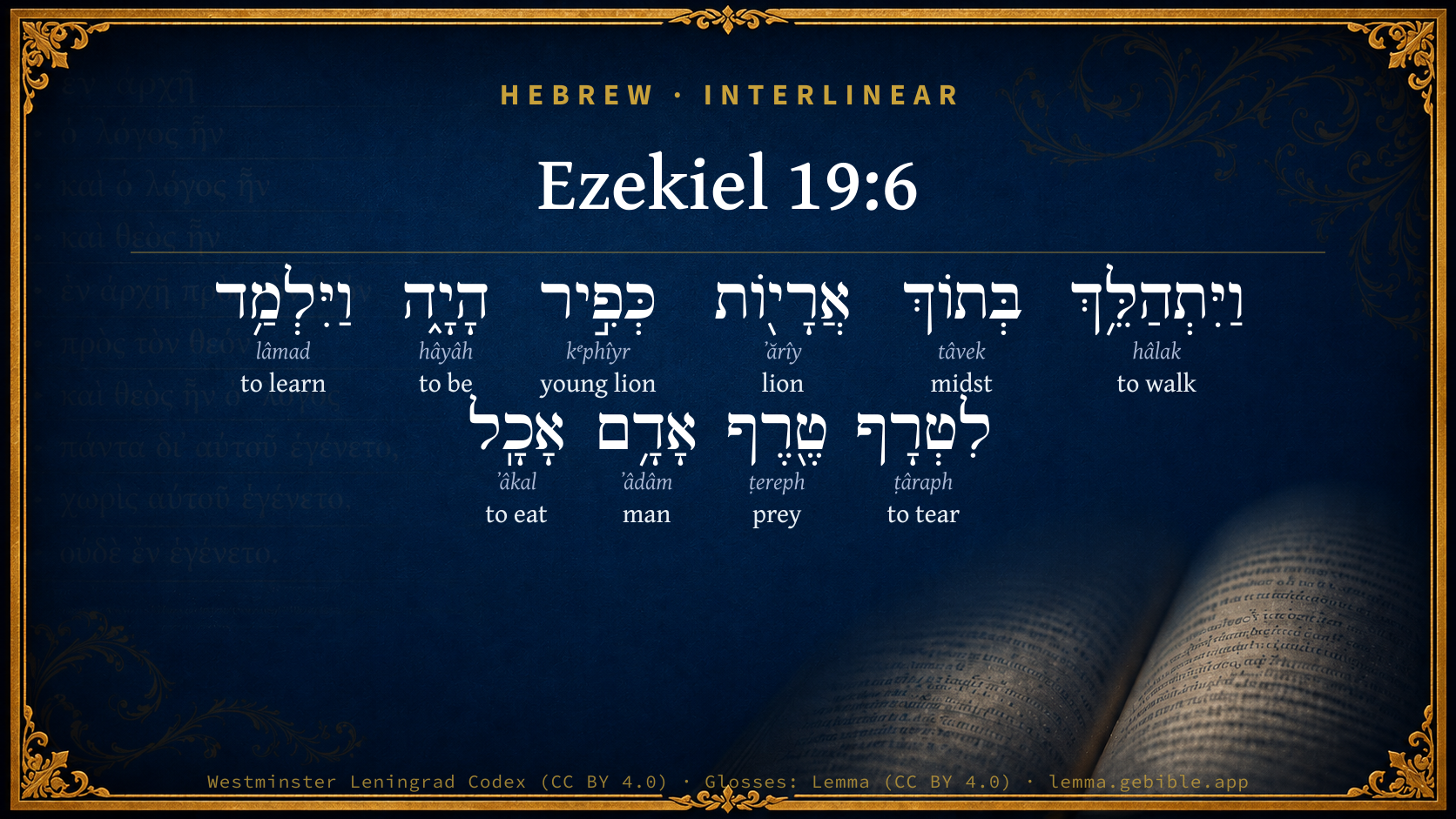
Hebrew (Westminster Leningrad Codex) Ezekiel 19:6 appears in the Hebrew Old Testament. The text above is from the Westminster Leningrad Codex. Each word links to its Strong’s number, a concise gloss, and parsing drawn from the Open Scriptures Hebrew Bible morphology. Click any word for its full Brown-Driver-Briggs (BDB) entry.
Download image
Cite this verse

Ezekiel 19:6 (World English Bible). Public Domain. Lemma interlinear Bible study tool, https://lemma.gebible.app/v/ezekiel/19/6.

Show BibTeX & RIS
BibTeX
RIS
English Translation
He went up and down among the lions; he became a young lion, and he learned to catch the prey; he devoured men.
World English Bible · Public Domain
Download a study sheet

One document with this verse’s original text, its word-by-word gloss line, the meaning frame, cross-references with their text, attributed commentary, and full source and license credits — printable, and it pastes into notes with its structure intact.

This verse Autodidact and up

Study sheet (.html) Plain text (.txt)

A passage Seminary Student

Up to 50 verses in one chapter. A passage sheet keeps up to 6 commentary sources and 12 cross-references per verse, in the order this page ranks them, and says so on the sheet whenever that leaves anything out. Ask for a single verse and you get the Autodidact verse sheet above.

Everything on this page stays free to read, with no account — the sheet is a download of what is already on screen, not access to it.

Want to remove ads? Support Godless Engineer
Compare translations 3

The same verse in 3 English versions, stacked beneath the original-language interlinear above. Click any original word for its lexicon entry.

Each is an independent rendering of the whole verse — the interlinear is not word-aligned to these translations.

Highlighted words mark where these versions differ — a whole-verse word diff, not a word-by-word alignment.

  • World English Bible Public Domain
    He went up and down among the lions; he became a young lion, and he learned to catch the prey; he devoured men.
  • King James Version Public Domain
    And he went up and down among the lions, he became a young lion, and learned to catch the prey, and devoured men.
  • unfoldingWord Literal Text CC BY-SA 4.0
    This young lion roamed about in the midst of lions. He was a young lion and learned to tear his victims; he devoured men.

unfoldingWord Literal Text — © unfoldingWord, licensed CC BY-SA 4.0. Word-aligned USFM3 via Door43 (git.door43.org/unfoldingWord/en_ult).

Versions to compare (up to 4)

3 of 4 selected

Show all 18 translations

Every available English version of this verse, each an independent rendering of the whole verse.

  • World English Bible Public Domain
    He went up and down among the lions; he became a young lion, and he learned to catch the prey; he devoured men.
  • Berean Standard Bible Public Domain
    He prowled among the lions, and became a young lion. After learning to tear his prey, he devoured men.
  • Majority Standard Bible Public Domain
    He prowled among the lions, and became a young lion. After learning to tear his prey, he devoured men.
  • King James Version Public Domain
    And he went up and down among the lions, he became a young lion, and learned to catch the prey, and devoured men.
  • American Standard Version (1901) Public Domain
    And he went up and down among the lions; he became a young lion, and he learned to catch the prey; he devoured men.
  • Revised Version (1885) Public Domain
    And he went up and down among the lions, he became a young lion: and he learned to catch the prey, he devoured men.
  • Geneva Bible (1599) Public Domain
    Which went among the lyons, and became a lyon, and learned to catch the praye, and he deuoured men.
  • Douay-Rheims (1899) Public Domain
    And he went up and down among the lions, and became a lion: and he learned to catch the prey, and to devour men.
  • Young's Literal Translation Public Domain
    And it goeth up and down in the midst of lions, A young lion it hath been, And it learneth to tear prey, man it hath devoured.
  • Literal Standard Version CC BY-SA 4.0
    And he goes up and down in the midst of lions, || He has been a young lion, || And he learns to tear prey, || He has devoured man.
  • Unlocked Literal Bible CC BY-SA 4.0
    This young lion roamed about in the midst of lions. He was a young lion and learned to tear his victims; he devoured men.
  • unfoldingWord Literal Text CC BY-SA 4.0
    This young lion roamed about in the midst of lions. He was a young lion and learned to tear his victims; he devoured men.
  • Darby Bible Public Domain
    And he went up and down among the lions; he became a young lion, and learned to catch the prey; he devoured men.
  • World Messianic Bible Public Domain
    He went up and down among the lions. He became a young lion. He learned to catch the prey. He devoured men.
  • Webster's Bible Public Domain
    And he went up and down among the lions, he became a young lion, and learned to catch the prey, and devoured men.
  • Free Bible Version CC BY-SA 4.0
    He went around with the other lions, and became strong. Once he had learned how to tear up his prey, he started eating people.
  • Bible in Basic English Public Domain
    And he went up and down among the lions and became a young lion, learning to go after beasts for his food; and he took men for his meat.
  • JPS Tanakh (1917) Public Domain
    And he went up and down among the lions, he became a young lion; and he learned to catch the prey, he devoured men.

Literal Standard Version (2020), Covenant Press — licensed CC BY-SA 4.0. Text via the HelloAO Bible API (eBible.org). Unlocked Literal Bible (unfoldingWord) — licensed CC BY-SA 4.0. Text via the HelloAO Bible API (eBible.org). unfoldingWord Literal Text — © unfoldingWord, licensed CC BY-SA 4.0. Word-aligned USFM3 via Door43 (git.door43.org/unfoldingWord/en_ult). Free Bible Version, Dr. Jonathan Gallagher — licensed CC BY-SA 4.0. Text via the HelloAO Bible API (eBible.org).

Word by word

More ways to search: Search by grammar → Find every occurrence → Compare this word →

Practice this passage: Drill this verse → Learn its vocabulary →

About this verse

These counts appear in no published source. They are computed here, from the morphology-tagged text and Lemma’s own curated glosses. What Lemma adds →

10
words
10
distinct lemmas
Prophets
section

Notable vocabulary

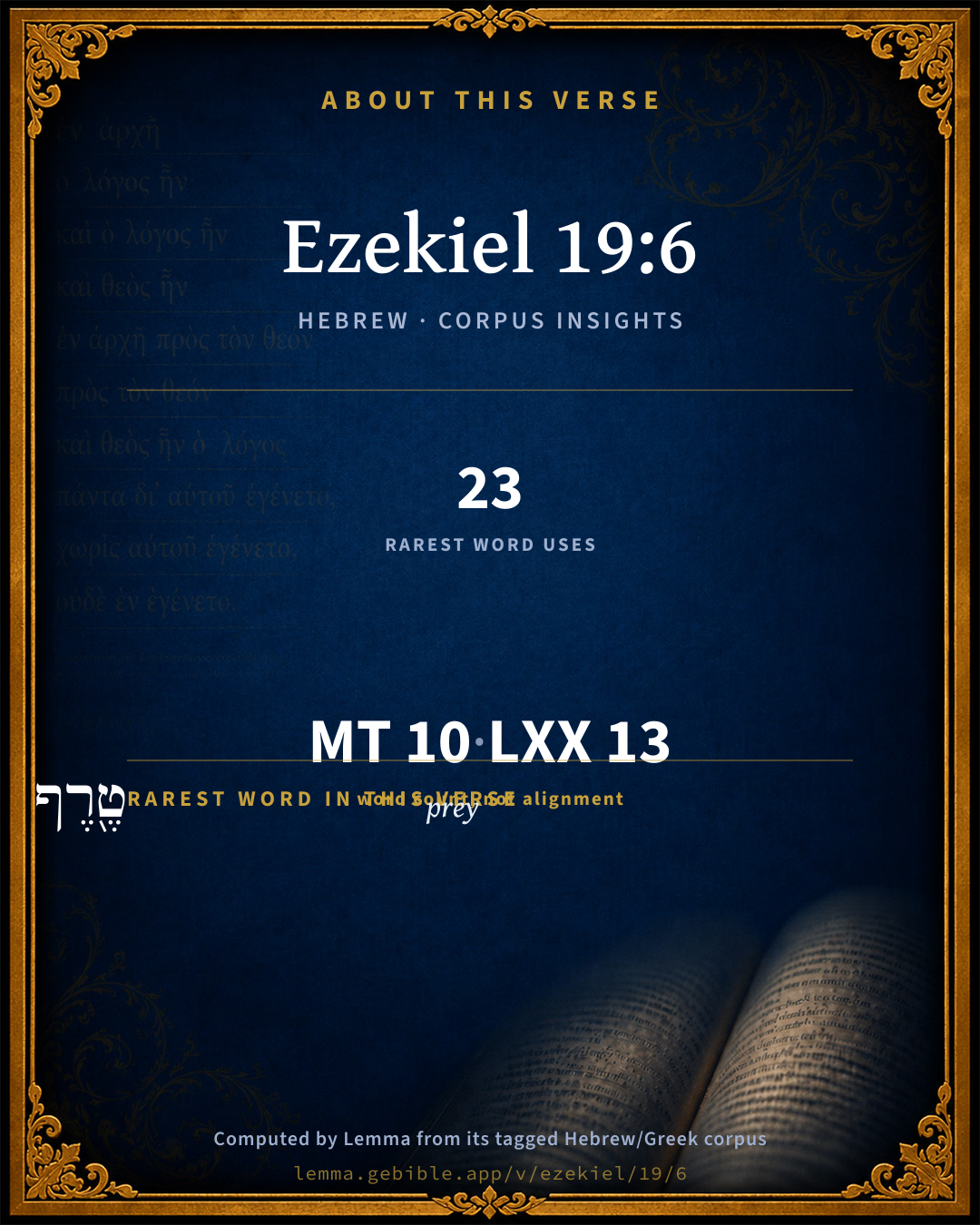
The rarest word here is טֶ֖רֶף prey H2964 — appearing just 23 times in the whole Hebrew Bible.

Shared distinctive vocabulary

טֶ֖רֶף prey H2964 occurs in 23 verses of the Hebrew Bible. Also found in:

Grammatical profile

  • 5 verbs
  • 5 nouns

Verb forms

  • וַיִּתְהַלֵּ֥ךְ Hithpael · Sequential Imperfect
  • הָיָ֑ה Qal · Perfect
  • וַיִּלְמַ֥ד Qal · Sequential Imperfect
  • לִטְרָף Qal · Infinitive Construct
  • אָכָֽל Qal · Perfect

Hebrew & Septuagint length

In English translation the verse runs 23 words from the Hebrew and 23 from the Septuagint (LXX English) — the same length.

A rough comparison of the two English renderings, which tokenize alike — not a word-level alignment.

Word counts can differ between the Hebrew and the Greek without any difference in meaning — e.g. the Hebrew direct-object marker אֵת has no separate Greek word, and Greek often adds the article ὁ.

In the original languages it is 10 Hebrew tokens and 13 Greek tokens — but the two are counted differently (Hebrew bundles its prefixes and suffixes into one token; the Greek is in lemma form), so that isn’t a like-for-like length.

Cross-references

7

Topical passages linked to Ezekiel 19:6 in the Treasury of Scripture Knowledge — connected by theme and wording, ordered by reader-vote popularity; previews shown in the World English Bible.

  • 2 Kings 24:1–7 In his days Nebuchadnezzar king of Babylon came up, and Jehoiakim became his servant three years: then he turned and rebelled against him.
  • 2 Kings 24:9 He did that which was evil in the sight of Yahweh, according to all that his father had done.
  • 2 Chronicles 36:5 Jehoiakim was Twenty-five years old when he began to reign; and he reigned eleven years in Jerusalem: and he did that which was evil in the sight of Yahweh his God.
  • 2 Chronicles 36:9 Jehoiachin was eight years old when he began to reign; and he reigned three months and ten days in Jerusalem: and he did that which was evil in the sight of Yahweh.
  • Jeremiah 22:13–17 Woe to him who builds his house by unrighteousness, and his chambers by injustice; who uses his neighbor's service without wages, and doesn't give him his hire;
  • Jeremiah 26:1–24 In the beginning of the reign of Jehoiakim the son of Josiah, king of Judah, came this word from Yahweh, saying,
  • Jeremiah 36:1–32 It happened in the fourth year of Jehoiakim the son of Josiah, king of Judah, that this word came to Jeremiah from Yahweh, saying,

Cross-references courtesy of OpenBible.info (CC BY 4.0).

Hebrew and Greek witnesses Masoretic Hebrew ↔ Greek Septuagint

The same verse in the two great witnesses to the Old Testament, shown verse-for-verse.

These are two independent witnesses, not word-aligned to each other, and the Septuagint is shown in lemma (dictionary) form.

Hebrew Ezekiel 19:6 Masoretic · Westminster Leningrad Codex

וַיִּתְהַלֵּ֥ךְ בְּתוֹךְ אֲרָי֖וֹת כְּפִ֣יר הָיָ֑ה וַיִּלְמַ֥ד לִטְרָף טֶ֖רֶף אָדָ֥ם אָכָֽל

He went up and down among the lions; he became a young lion, and he learned to catch the prey; he devoured men.

World English Bible · Public Domain

Greek LXX Ezekiel 19:6 Septuagint · lemma form

καί ἀναστρέφω ἐν μέσος λέων λέων γίγνομαι καί μανθάνω ἁρπάζω ἅρπαγμα ἄνθρωπος ἐσθίω

And he went up and down in the midst of lions, he became a lion, and learned to take prey, he devoured men.

LXX2012 (modern English Septuagint) · Public Domain

Hebrew: Westminster Leningrad Codex (CC BY 4.0). Greek: Septuagint (public domain); English from LXX2012 (modern English Septuagint) (Public Domain). How the Septuagint differs from the Hebrew →

Targum (Aramaic paraphrase)

1

The Targum is the ancient Jewish Aramaic paraphrase of the Hebrew Scriptures — an interpretive translation, not the Hebrew text itself. Onkelos (literal) and Pseudo-Jonathan (expansive) render the Torah, and Jonathan the Prophets. Coverage is partial: where no permissively-licensed English translation exists for a verse, only the Aramaic is shown. This is verse-level text, not a word-by-word alignment to the Hebrew.

  1. Targum Jonathan Prophets (Joshua–Malachi)
    וְהַלֵיךְ בְּגוֹ מַלְכַיָא מַלְכָּא הֲוָה וַאֲלֵיף לְמִקְטַל קְטוֹל אֱנָשָׁא קְטָל:

    (no public-domain English translation for this verse)

    Targum Jonathan — Aramaic: “Mikraot Gedolot” (public domain). English: “Sefaria Community Translation” (CC0 1.0 (public-domain dedication)); “London "Chaldee Paraphrase," 1871” (public domain). Text via Sefaria.

Commentary

Notes on Ezekiel 19:6 from classic Christian and Jewish commentators (each source and its license shown beneath its notes). The classic Christian expositions comment on the surrounding passage and are grouped to its opening verse, so a note may address several verses; the Jewish commentaries on the Tanakh (Rashi and others) are per-verse, so they appear only where the commentator wrote on this verse.

Lemma curates 59 commentaries, every one of them public domain or Creative Commons licensed, each selected and text-cleaned for this edition rather than reprinted as found. About our sources →

Trapp's Complete Commentary

John Trapp

Eze 19:6 And he went up and down among the lions, he became a young lion, and learned to catch the prey, [and] devoured men.

Ver. 6. He went up and down, &c.] Of whom he learned to king it, and to lionise it. See Eze 19:2-3.

Learned to catch the prey.] To pull his subjects, and to make havoc, as our Henry III did, who was therefore called Regni dilapidator. destroyer of the kingdom.

And devoured men.] As Eze 19:3; see Jer 20:17.

John Trapp, A Commentary or Exposition upon All the Books of the Old and New Testament (1647–1656) — public domain. Text from a community e-Sword module.

Geneva Bible (1599)

Geneva Bible translators

He slew of the prophets, and them that feared God, and ravished their wives.

Geneva Bible (1599) marginal notes — public domain. Text via Bolls.life.

Jamieson, Fausset & Brown

Robert Jamieson, A. R. Fausset & David Brown

went up and down among the lions--imitated the recklessness and tyranny of the surrounding kings (Jer 22:13-17).

catch . . . prey--to do evil, gratifying his lusts by oppression (Kg2 23:37).

Jamieson, Fausset & Brown — Commentary Critical and Explanatory on the Whole Bible (1871) — public domain (CC PDM 1.0). Text via the HelloAO Bible API.

Adam Clarke's Commentary

Verse 6. And he went up and down among the lions] He became a perfect heathen, and made Judea as idolatrous as any of the surrounding nations. He reigned eleven years, a monster of iniquity, 2Kg 23:30, &c.

Adam Clarke's Commentary on the Bible (1810–1826) — public domain. Text from a community e-Sword/MySword module.

John Calvin's Commentaries

Ezekiel confirms what I have already briefly touched on, that this second lion was no less savage and cruel than the former, of which he had spoken. As to the phrase, he walked among lions, it means that his government was tyrannical, since there was then such foul barbarity in those regions, that, kings were scarcely human in their conduct. Since, therefore, kings were then everywhere like lions, the Prophet says that Jehoiakim was not different from them, but in every sense their ally. He walked, therefore, he says, in the midst of lions, since he imitated their ferocity, which at length he expresses more clearly, that he became a lion, and was taught to seize his prey, so as to devour not only animals, but men, thus marking his extreme cruelty. He afterwards adds —

John Calvin's Commentaries (1540-1563) — public domain. Text from the Calvin Translation Society English edition (1840s-50s) via the Christian Classics Ethereal Library (ccel.org). Calvin's coverage is partial (roughly two-thirds of the Bible); uncommented books and verses are honest gaps, never fabricated. The 19th-century editor's footnotes and remarks are omitted so the notes are faithfully Calvin's own voice.

John Gill's Exposition

And he went up and down among the lions,.... The kings, as the Targum; kings of neighbouring nations, as Pharaoh king of Egypt, and Nebuchadnezzar king of Babylon; and sometimes he was subject to the one, and sometimes to the offer: and his going up and down among them may denote his continuance as a king; for whereas his brother reigned but three months, he reigned eleven years:

he became a young lion; an oppressive prince, a cruel and tyrannical king:

and learned to catch the prey, and devoured men; he was notorious for his acts of injustice and arbitrary power; for the detaining the wages of workmen, and for his oppression, violence, and rapine, and shedding of innocent blood, Jer 22:13.

John Gill's Exposition of the Whole Bible (1746–1763) — public domain (CC PDM 1.0). Text via the HelloAO Bible API.

Matthew Poole's English Annotations

He, Jehoiakim,

went up and down: it is said of him, because he continued eleven years on the throne, and so many years, as a lion, tore and devoured; whereas Jehoahaz was taken as soon almost as he first ventured out to hunt the prey.

Among the lions; carried it after the manners and usages of the heathen kings, those barbarous tyrants, with whom he entered leagues, as he saw good, and laid aside the law of God, which was to guide king and people.

Became a young lion; grew strong, fierce, ravenous, unsaltable: see Eze 19:3 where the rest is explained.

Devoured men; either his neighbours the Ammonites and Moabites, or he devoured his own subjects, impoverished and eat out their estates, spared not the prophets, or their prophecy, and Urijah he slew, Jer 26:23; what Jehoiakim was appears Jer 22:13-15,17.

Matthew Poole's English Annotations on the Holy Bible (1683–1685) — public domain. Text from a community e-Sword/MySword module.

John Wesley's Explanatory Notes

He - Jehoiachim. Went up - He continued eleven years on the throne; whereas Jehoahaz was taken as soon as he first ventured out. The lions - Heathen kings, with whom he entered into leagues. He became - Fierce, ravenous, unsatiable.

John Wesley, Explanatory Notes Upon the Whole Bible (1754–1765) — public domain. Text via the GEBible commentary corpus.

Lesson kit

Teaching starters — assembled from the data on this page, not authored interpretation. Every prompt links to the verse data it draws on. Edit before teaching.

Ezekiel, in the Prophets, opens this verse with 10 words (10 distinct Hebrew lemmas). Its most distinctive word is ṭereph (“prey”). A historical commentator’s framing appears above. Read the whole chapter for the surrounding context.

Discussion questions

  1. What does “prey” (ṭereph) contribute to the verse as a whole?
  2. How does Genesis 49:9, which shares the word «prey», read alongside this verse?
  3. The translations on this page render this verse differently — a whole-verse word diff, not a word-by-word alignment. What might account for the different wordings?
  4. «וַיִּתְהַלֵּ֥ךְ» is a Hithpael Sequential Imperfect verb. How does that grammatical form shape the action described?
  5. Compare how Trapp's Complete Commentary and Geneva Bible (1599) read this verse. Where do they agree or differ?

Things to notice

Reading settings

Reading text

Shown beneath each verse's original-language words.

Old Testament
Old Testament edition

Read the OT as the Masoretic Hebrew (MT) or the Greek Septuagint (LXX).

English shown for the Greek Septuagint (in the Hebrew ↔ Greek comparison).

Comparing translations? Open the Compare panel on any verse page to stack up to four side by side.