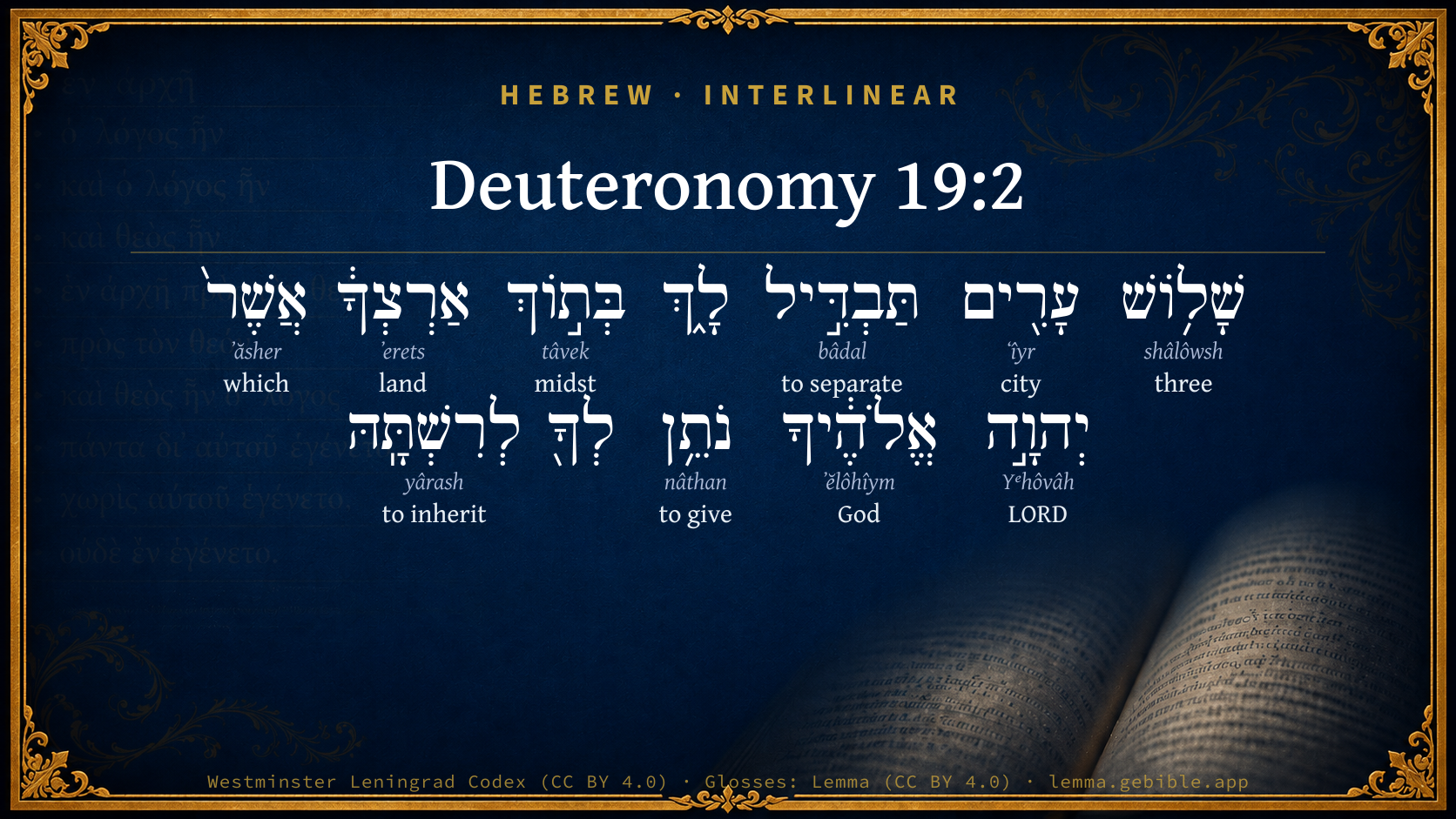
Deuteronomy 19:2

Hebrew (Westminster Leningrad Codex) Deuteronomy 19:2 appears in the Hebrew Old Testament. The text above is from the Westminster Leningrad Codex. Each word links to its Strong’s number, a concise gloss, and parsing drawn from the Open Scriptures Hebrew Bible morphology. Click any word for its full Brown-Driver-Briggs (BDB) entry.
Download image
Cite this verse

Deuteronomy 19:2 (World English Bible). Public Domain. Lemma interlinear Bible study tool, https://lemma.gebible.app/v/deuteronomy/19/2.

Show BibTeX & RIS
BibTeX
RIS
English Translation
you shall set apart three cities for you in the midst of your land, which Yahweh your God gives you to possess it.
World English Bible · Public Domain
Download a study sheet

One document with this verse’s original text, its word-by-word gloss line, the meaning frame, cross-references with their text, attributed commentary, and full source and license credits — printable, and it pastes into notes with its structure intact.

This verse Autodidact and up

Study sheet (.html) Plain text (.txt)

A passage Seminary Student

Up to 50 verses in one chapter. A passage sheet keeps up to 6 commentary sources and 12 cross-references per verse, in the order this page ranks them, and says so on the sheet whenever that leaves anything out. Ask for a single verse and you get the Autodidact verse sheet above.

Everything on this page stays free to read, with no account — the sheet is a download of what is already on screen, not access to it.

Want to remove ads? Support Godless Engineer
Compare translations 3

The same verse in 3 English versions, stacked beneath the original-language interlinear above. Click any original word for its lexicon entry.

Each is an independent rendering of the whole verse — the interlinear is not word-aligned to these translations.

Highlighted words mark where these versions differ — a whole-verse word diff, not a word-by-word alignment.

  • World English Bible Public Domain
    you shall set apart three cities for you in the midst of your land, which Yahweh your God gives you to possess it.
  • King James Version Public Domain
    Thou shalt separate three cities for thee in the midst of thy land, which the LORD thy God giveth thee to possess it.
  • unfoldingWord Literal Text CC BY-SA 4.0
    you shall select three cities for yourself in the midst of your land that Yahweh your God is giving to you to possess it.

unfoldingWord Literal Text — © unfoldingWord, licensed CC BY-SA 4.0. Word-aligned USFM3 via Door43 (git.door43.org/unfoldingWord/en_ult).

Versions to compare (up to 4)

3 of 4 selected

Show all 18 translations

Every available English version of this verse, each an independent rendering of the whole verse.

  • World English Bible Public Domain
    you shall set apart three cities for you in the midst of your land, which Yahweh your God gives you to possess it.
  • Berean Standard Bible Public Domain
    then you are to set apart for yourselves three cities within the land that the LORD your God is giving you to possess.
  • Majority Standard Bible Public Domain
    then you are to set apart for yourselves three cities within the land that the LORD your God is giving you to possess.
  • King James Version Public Domain
    Thou shalt separate three cities for thee in the midst of thy land, which the LORD thy God giveth thee to possess it.
  • American Standard Version (1901) Public Domain
    thou shalt set apart three cities for thee in the midst of thy land, which Jehovah thy God giveth thee to possess it.
  • Revised Version (1885) Public Domain
    thou shalt separate three cities for thee in the midst of thy land, which the LORD thy God giveth thee to possess it.
  • Geneva Bible (1599) Public Domain
    Thou shalt separate three cities for thee in the middes of thy lande which the Lord thy God giueth thee to possesse it.
  • Douay-Rheims (1899) Public Domain
    Thou shalt separate to thee three cities in the midst of the land, which the Lord will give thee in possession,
  • Young's Literal Translation Public Domain
    three cities thou dost separate for thee in the midst of thy land which Jehovah thy God is giving to thee to possess it.
  • Literal Standard Version CC BY-SA 4.0
    you separate three cities for yourself in the midst of your land which your God YHWH is giving to you to possess it.
  • Unlocked Literal Bible CC BY-SA 4.0
    you must select three cities for yourself in the middle of your land that Yahweh your God is giving you to possess.
  • unfoldingWord Literal Text CC BY-SA 4.0
    you shall select three cities for yourself in the midst of your land that Yahweh your God is giving to you to possess it.
  • Darby Bible Public Domain
    thou shalt separate three cities for thyself in the midst of thy land, which Jehovah thy God giveth thee to possess.
  • World Messianic Bible Public Domain
    you shall set apart three cities for yourselves in the middle of your land, which the LORD your God gives you to possess.
  • Webster's Bible Public Domain
    Thou shalt separate three cities for thee in the midst of thy land which the LORD thy God giveth thee to possess it.
  • Free Bible Version CC BY-SA 4.0
    then you are to choose three sanctuary towns in the country that the Lord your God is giving you to own.
  • Bible in Basic English Public Domain
    You are to have three towns marked out in the land which the Lord your God is giving you for your heritage.
  • JPS Tanakh (1917) Public Domain
    thou shalt separate three cities for thee in the midst of thy land, which the LORD thy GOD giveth thee to possess it.

Literal Standard Version (2020), Covenant Press — licensed CC BY-SA 4.0. Text via the HelloAO Bible API (eBible.org). Unlocked Literal Bible (unfoldingWord) — licensed CC BY-SA 4.0. Text via the HelloAO Bible API (eBible.org). unfoldingWord Literal Text — © unfoldingWord, licensed CC BY-SA 4.0. Word-aligned USFM3 via Door43 (git.door43.org/unfoldingWord/en_ult). Free Bible Version, Dr. Jonathan Gallagher — licensed CC BY-SA 4.0. Text via the HelloAO Bible API (eBible.org).

Word by word

More ways to search: Search by grammar → Find every occurrence → Compare this word →

Practice this passage: Drill this verse → Learn its vocabulary →

תַּבְדִּ֣יל
bâdal
H914
“to separate”
Verb, Hiphil, Imperfect, 2nd Person, Masculine, Singular
Part of Speech
Verb
Stem
Hiphil
Form
Imperfect
Person
2nd Person
Gender
Masculine
Number
Singular
Full BDB Definition

Origin: a primitive root

TWOT: 203

to divide, separate - (Hiphil) - to divide, separate, sever - to separate, set apart - to make a distinction, difference - to divide into parts - (Niphal) - to separate oneself from (reflexive of 1a2) - to withdraw from - to separate oneself unto - to be separated - to be excluded - to be set apart
  1. שָׁל֥וֹשׁ shâlôwsh H7969 “three” Adjective, Cardinal number, Feminine, Singular, Absolute
  2. עָרִ֖ים ʻîyr H5892 “cities” Noun, Common, Feminine, Plural, Absolute
  3. בְּת֣וֹךְ tâvek H8432 “in/at · midst of” Preposition + Noun, Common, Masculine, Singular, Construct
  4. אַרְצְךָ֔ ʼerets H776 “land · your” Noun, Common, Both, Singular, Construct + Suffix, Personal, 2nd Person, Masculine, Singular
  5. אֲשֶׁר֙ ʼăsher H834 “which” Particle, Relative
  6. יְהוָ֣ה Yᵉhôvâh H3068 “LORD” Noun, Proper
  7. אֱלֹהֶ֔יךָ ʼĕlôhîym H430 “God(s) · your” Noun, Common, Masculine, Plural, Construct + Suffix, Personal, 2nd Person, Masculine, Singular
  8. נֹתֵ֥ן nâthan H5414 “giving” Verb, Qal, Participle Active, Masculine, Singular, Absolute
  9. לְרִשְׁתָּֽהּ yârash H3423 “to inherit · her” Preposition + Verb, Qal, Infinitive Construct + Suffix, Personal, 3rd Person, Feminine, Singular

About this verse

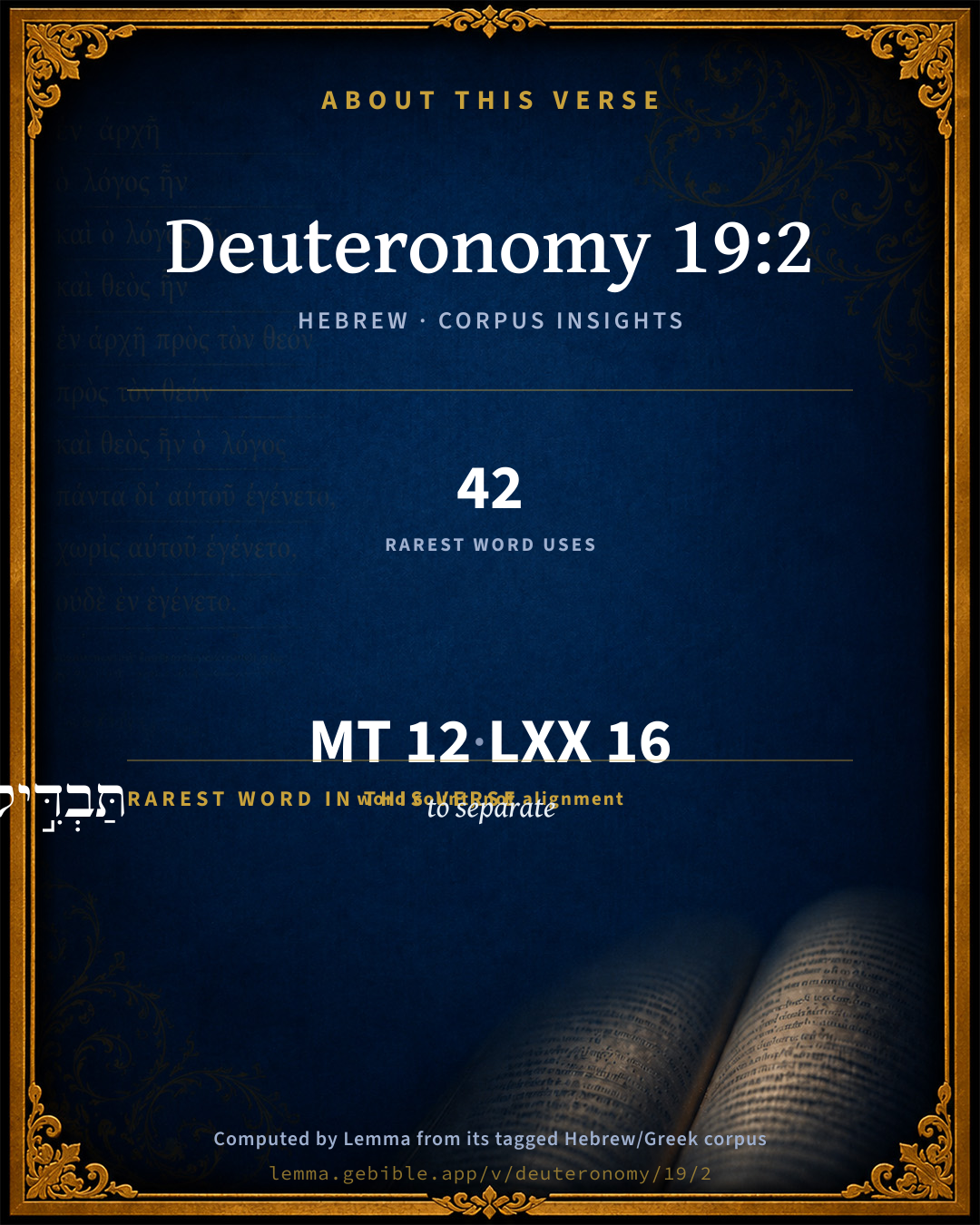
These counts appear in no published source. They are computed here, from the morphology-tagged text and Lemma’s own curated glosses. What Lemma adds →

12
words
10
distinct lemmas
Pentateuch
section

Shared distinctive vocabulary

תַּבְדִּ֣יל to separate H914 occurs in 40 verses of the Hebrew Bible. Also found in:

Grammatical profile

  • 3 verbs
  • 5 nouns
  • 1 adjective
  • 2 prepositions
  • 1 particle

Verb forms

  • תַּבְדִּ֣יל Hiphil · Imperfect
  • נֹתֵ֥ן Qal · Participle Active
  • לְרִשְׁתָּֽהּ Qal · Infinitive Construct

Hebrew & Septuagint length

In English translation the verse runs 23 words from the Hebrew and 20 from the Septuagint (LXX English) — closely comparable.

A rough comparison of the two English renderings, which tokenize alike — not a word-level alignment.

Word counts can differ between the Hebrew and the Greek without any difference in meaning — e.g. the Hebrew direct-object marker אֵת has no separate Greek word, and Greek often adds the article ὁ.

In the original languages it is 12 Hebrew tokens and 16 Greek tokens — but the two are counted differently (Hebrew bundles its prefixes and suffixes into one token; the Greek is in lemma form), so that isn’t a like-for-like length.

Cross-references

5

Topical passages linked to Deuteronomy 19:2 in the Treasury of Scripture Knowledge — connected by theme and wording, ordered by reader-vote popularity; previews shown in the World English Bible.

  • Exodus 21:13 but not if it is unintentional, but God allows it to happen: then I will appoint you a place where he shall flee.
  • Numbers 35:10–15 Speak to the children of Israel, and tell them, When you pass over the Jordan into the land of Canaan,
  • Deuteronomy 4:41–43 Then Moses set apart three cities beyond the Jordan toward the sunrise;
  • Joshua 20:2–7 Speak to the children of Israel, saying, Assign you the cities of refuge, of which I spoke to you by Moses,
  • Hebrews 6:18 that by two immutable things, in which it is impossible for God to lie, we may have a strong encouragement, who have fled for refuge to take hold of the hope set before us.

Cross-references courtesy of OpenBible.info (CC BY 4.0).

Hebrew and Greek witnesses Masoretic Hebrew ↔ Greek Septuagint

The same verse in the two great witnesses to the Old Testament, shown verse-for-verse.

These are two independent witnesses, not word-aligned to each other, and the Septuagint is shown in lemma (dictionary) form.

Hebrew Deuteronomy 19:2 Masoretic · Westminster Leningrad Codex

שָׁל֥וֹשׁ עָרִ֖ים תַּבְדִּ֣יל לָ֑ךְ בְּת֣וֹךְ אַרְצְךָ֔ אֲשֶׁר֙ יְהוָ֣ה אֱלֹהֶ֔יךָ נֹתֵ֥ן לְךָ֖ לְרִשְׁתָּֽהּ

you shall set apart three cities for you in the midst of your land, which Yahweh your God gives you to possess it.

World English Bible · Public Domain

Greek LXX Deuteronomy 19:2 Septuagint · lemma form

τρεῖς πόλις διαστέλλω σεαυτοῦ ἐν μέσος ὁ γῆ σύ ὅς κύριος ὁ θεός σύ δίδωμι σύ

you shall separate for yourself three cities in the midst of your land, which the Lord your God gives you.

LXX2012 (modern English Septuagint) · Public Domain

Hebrew: Westminster Leningrad Codex (CC BY 4.0). Greek: Septuagint (public domain); English from LXX2012 (modern English Septuagint) (Public Domain). How the Septuagint differs from the Hebrew →

Targum (Aramaic paraphrase)

2

The Targum is the ancient Jewish Aramaic paraphrase of the Hebrew Scriptures — an interpretive translation, not the Hebrew text itself. Onkelos (literal) and Pseudo-Jonathan (expansive) render the Torah, and Jonathan the Prophets. Coverage is partial: where no permissively-licensed English translation exists for a verse, only the Aramaic is shown. This is verse-level text, not a word-by-word alignment to the Hebrew.

  1. Targum Onkelos Torah (Genesis–Deuteronomy)
    תְּלַת קִרְוִין תַּפְרֵשׁ לָךְ בְּגוֹ אַרְעָךְ דִי יְיָ אֱלָהָךְ יָהֵב לָךְ לְמֵירְתַהּ

    (no public-domain English translation for this verse)

    Targum Onkelos — Aramaic: “Onkelos Genesis” (public domain); “Onkelos Exodus” (public domain); “Onkelos Leviticus” (public domain); “Onkelos Numbers” (public domain); “Onkelos Deuteronomy” (public domain). English: “Sefaria Community Translation” (CC0 1.0 (public-domain dedication)); “J.W. Etheridge. The Targums of Onkelos and Jonathan Ben Uzziel on the Pentateuch. London: Longmans, Green, 1862” (public domain). Text via Sefaria.

  2. Targum Pseudo-Jonathan Torah (Genesis–Deuteronomy)
    תְּלַת קִרְוִין תִּפְרְשׁוּן לְכוֹן בְּגוֹ אַרְעֲכוֹן דַיְיָ אֱלָהָכוֹן יָהֵיב לְכוֹן לְמֵירְתָהּ

    three cities shall you set apart within your land which the Lord your God giveth you to inherit.

    Targum Pseudo-Jonathan — Aramaic: “Targum Jonathan on Genesis” (public domain); “Targum Jonathan on Exodus” (public domain); “Targum Jonathan on Leviticus” (public domain); “Targum Jonathan on Numbers” (public domain); “Targum Jonathan on Deuteronomy” (public domain). English: “The Targum of Jonathan ben Uzziel, trans. J. W. Etheridge, London, 1862” (public domain). Text via Sefaria.

Commentary

Notes on Deuteronomy 19:2 from classic Christian and Jewish commentators (each source and its license shown beneath its notes). The classic Christian expositions comment on the surrounding passage and are grouped to its opening verse, so a note may address several verses; the Jewish commentaries on the Tanakh (Rashi and others) are per-verse, so they appear only where the commentator wrote on this verse.

Lemma curates 59 commentaries, every one of them public domain or Creative Commons licensed, each selected and text-cleaned for this edition rather than reprinted as found. About our sources →

Joseph Benson's Commentary

Deu 19:2. Thou shalt separate three cities for thee — There were to be six cities of refuge in all, but Moses had already appointed three on that side of Jordan where they now were. See Num 35:14-15;

Deu 4:41. In the midst of thy land — That is, in the midst of the several parts or districts of thy land, or within thy land; for had they been all three in the very heart of the country, the very intention of them would have been counteracted: which was, that they should be so conveniently placed in several parts of the country, that men might easily and speedily flee to them.

Joseph Benson's Commentary on the Old and New Testaments (1811–1818) — public domain. Text from a community e-Sword module.

Tyndale Open Study Notes

Tyndale Open Resources

19:2 The three cities were those in Canaan, west of the Jordan; there were three more in Transjordan (see Num 35:13-14; Josh 20:7).

Tyndale Open Study Notes — © Tyndale Open Resources, licensed CC BY-SA 4.0. Text via the HelloAO Bible API.

Adam Clarke's Commentary

Verse 2. Thou shalt separate three cities] See Clarke on Nu 35:11, &c.

Adam Clarke's Commentary on the Bible (1810–1826) — public domain. Text from a community e-Sword/MySword module.

The Cambridge Bible for Schools and Colleges

gen. ed. J. J. S. Perowne

2. separate] set apart, Deu_4:41.

The Cambridge Bible for Schools and Colleges (gen. ed. J. J. S. Perowne; Cambridge University Press, 1878–1918) — public domain. Text from a community e-Sword module.

John Gill's Exposition

Thou shalt separate three cities for thee in the midst of thy land,.... From the cities they took possession of and dwelt in; and indeed from the cities of the Levites, which were given to them to inhabit; three were before ordered to be separated from those inhabited by the tribes of Reuben and Gad, and the half tribe of Manasseh, Deu 4:41 but these were to be in the midst of the land of Canaan; see Jos 20:7,

which the Lord thy God giveth thee to possess it: which as it is often mentioned when this land is spoken of, so it carries in it a reason here why this order of the Lord's should be readily complied with, the whole land and all the cities of it being the gift of his to them.

John Gill's Exposition of the Whole Bible (1746–1763) — public domain (CC PDM 1.0). Text via the HelloAO Bible API.

Haydock's Catholic Bible Commentary

Cities. These were Hebron, Sichem, and Cades, on the west side of the Jordan, Josue xx. 7. Those on the east were already appointed, chap. iv. 41. Three others might also have been added, (ver. 8.; Calmet) in case the Hebrews had gotten full possession of the countries as far as the Euphrates. (Haydock) --- The cities of refuge were not above forty-five miles distant from each other, in the land of Chanaan. Those in Galaad were not so far off, as the territory was smaller. (Calmet)

George Leo Haydock (1774–1849), Haydock's Catholic Family Bible and Commentary, 1859 edition — public domain. Excludes Psalms (Douay-Rheims chapter numbering differs from Protestant) and Deuterocanonical books (Catholic canon only).

Matthew Poole's English Annotations

In the midst of thy land, to wit, beyond Jordan, as there were three already appointed on this side Jordan, Num 35:14. He saith, in the midst of the land, either for in the land, as in the midst of the city, Jer 52:25, is the same with that in the city, 2Ki 25:19, or to design the places, that they should be situated in the midst of the several parts of their land, to which they might conveniently and speedily flee from all the parts of the land.

Matthew Poole's English Annotations on the Holy Bible (1683–1685) — public domain. Text from a community e-Sword/MySword module.

John Wesley's Explanatory Notes

In the midst of the land - Namely, beyond Jordan, as there were three already appointed on this side Jordan: In the midst of the several parts of their land, to which they might speedily flee from all the parts of the land.

John Wesley, Explanatory Notes Upon the Whole Bible (1754–1765) — public domain. Text via the GEBible commentary corpus.

Lesson kit

Teaching starters — assembled from the data on this page, not authored interpretation. Every prompt links to the verse data it draws on. Edit before teaching.

Deuteronomy, in the Pentateuch, opens this verse with 12 words (10 distinct Hebrew lemmas). Its most distinctive word is bâdal (“to separate”). A historical commentator’s framing appears above. Read the whole chapter for the surrounding context.

Discussion questions

  1. What does “to separate” (bâdal) contribute to the verse as a whole?
  2. How does Genesis 1:4, which shares the word «to separate», read alongside this verse?
  3. These translations render this verse differently; the difference is in the English rendering, not the original. What questions does that raise?
  4. «תַּבְדִּ֣יל» is a Hiphil Imperfect verb. How does that grammatical form shape the action described?
  5. Compare how Joseph Benson's Commentary and Tyndale Open Study Notes read this verse. Where do they agree or differ?

Things to notice

Reading settings

Reading text

Shown beneath each verse's original-language words.

Old Testament
Old Testament edition

Read the OT as the Masoretic Hebrew (MT) or the Greek Septuagint (LXX).

English shown for the Greek Septuagint (in the Hebrew ↔ Greek comparison).

Comparing translations? Open the Compare panel on any verse page to stack up to four side by side.