
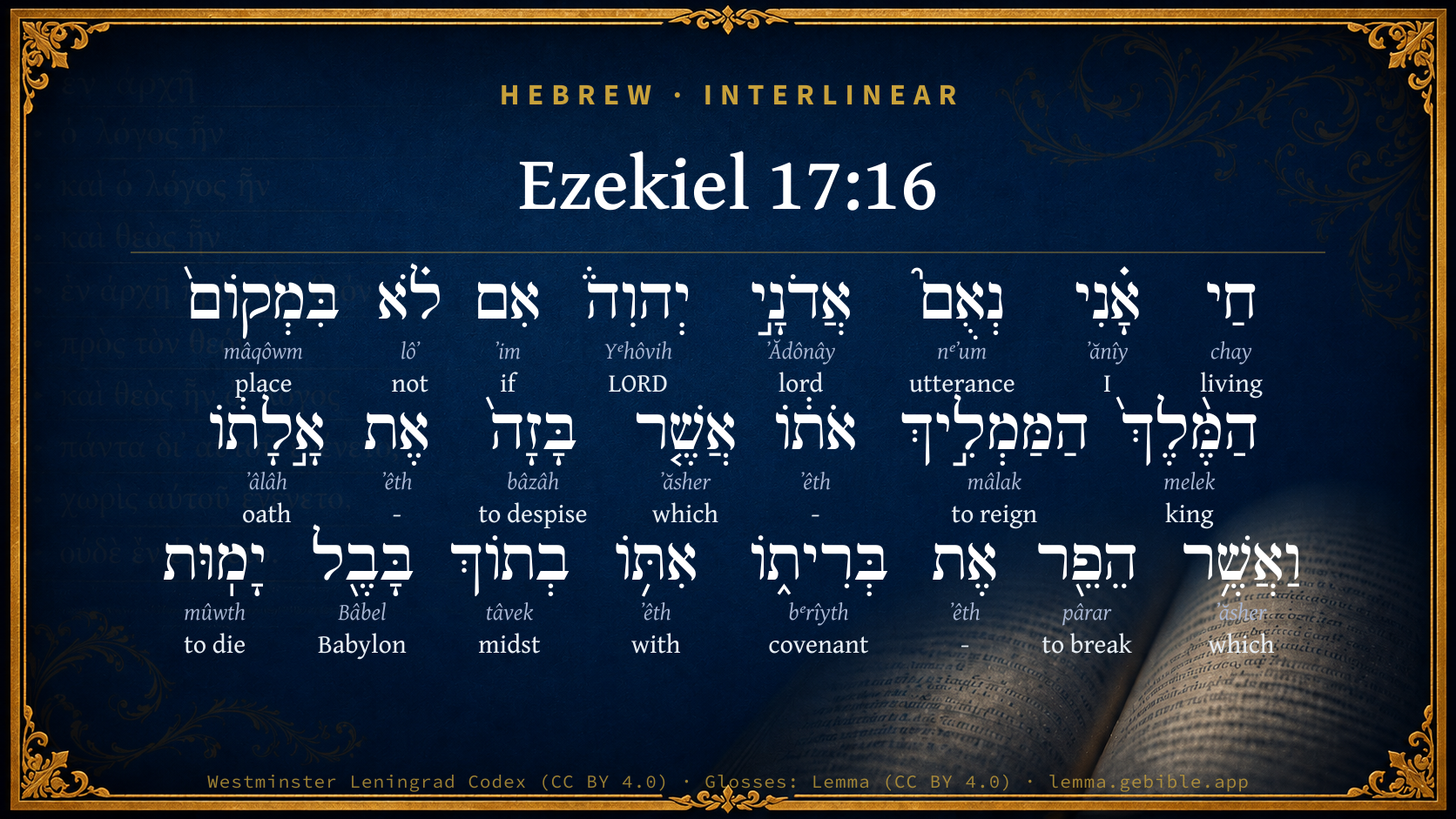
Ezekiel 17:16

Hebrew (Westminster Leningrad Codex) Ezekiel 17:16 appears in the Hebrew Old Testament. The text above is from the Westminster Leningrad Codex. Each word links to its Strong’s number, a concise gloss, and parsing drawn from the Open Scriptures Hebrew Bible morphology. Click any word for its full Brown-Driver-Briggs (BDB) entry.
Download image
Cite this verse

Ezekiel 17:16 (World English Bible). Public Domain. Lemma interlinear Bible study tool, https://lemma.gebible.app/v/ezekiel/17/16.

Show BibTeX & RIS
BibTeX
RIS
English Translation
As I live, says the Lord Yahweh, surely in the place where the king dwells who made him king, whose oath he despised, and whose covenant he broke, even with him in the midst of Babylon he shall die.
World English Bible · Public Domain
Download a study sheet

One document with this verse’s original text, its word-by-word gloss line, the meaning frame, cross-references with their text, attributed commentary, and full source and license credits — printable, and it pastes into notes with its structure intact.

This verse Autodidact and up

Study sheet (.html) Plain text (.txt)

A passage Seminary Student

Up to 50 verses in one chapter. A passage sheet keeps up to 6 commentary sources and 12 cross-references per verse, in the order this page ranks them, and says so on the sheet whenever that leaves anything out. Ask for a single verse and you get the Autodidact verse sheet above.

Everything on this page stays free to read, with no account — the sheet is a download of what is already on screen, not access to it.

Want to remove ads? Support Godless Engineer
Compare translations 3

The same verse in 3 English versions, stacked beneath the original-language interlinear above. Click any original word for its lexicon entry.

Each is an independent rendering of the whole verse — the interlinear is not word-aligned to these translations.

Highlighted words mark where these versions differ — a whole-verse word diff, not a word-by-word alignment.

  • World English Bible Public Domain
    As I live, says the Lord Yahweh, surely in the place where the king dwells who made him king, whose oath he despised, and whose covenant he broke, even with him in the midst of Babylon he shall die.
  • King James Version Public Domain
    As I live, saith the Lord GOD, surely in the place where the king dwelleth that made him king, whose oath he despised, and whose covenant he brake, even with him in the midst of Babylon he shall die.
  • unfoldingWord Literal Text CC BY-SA 4.0
    As I live!—this is the Lord Yahweh’s declaration—he will surely die in the land of the king who made him king, the king whose oath he despised, and whose covenant he broke. He will die in the middle of Babylon.

unfoldingWord Literal Text — © unfoldingWord, licensed CC BY-SA 4.0. Word-aligned USFM3 via Door43 (git.door43.org/unfoldingWord/en_ult).

Versions to compare (up to 4)

3 of 4 selected

Show all 18 translations

Every available English version of this verse, each an independent rendering of the whole verse.

  • World English Bible Public Domain
    As I live, says the Lord Yahweh, surely in the place where the king dwells who made him king, whose oath he despised, and whose covenant he broke, even with him in the midst of Babylon he shall die.
  • Berean Standard Bible Public Domain
    ‘As surely as I live,’ declares the Lord GOD, ‘he will die in Babylon, in the land of the king who enthroned him, whose oath he despised and whose covenant he broke.
  • Majority Standard Bible Public Domain
    ‘As surely as I live,’ declares the Lord GOD, ‘he will die in Babylon, in the land of the king who enthroned him, whose oath he despised and whose covenant he broke.
  • King James Version Public Domain
    As I live, saith the Lord GOD, surely in the place where the king dwelleth that made him king, whose oath he despised, and whose covenant he brake, even with him in the midst of Babylon he shall die.
  • American Standard Version (1901) Public Domain
    As I live, saith the Lord Jehovah, surely in the place where the king dwelleth that made him king, whose oath he despised, and whose covenant he brake, even with him in the midst of Babylon he shall die.
  • Revised Version (1885) Public Domain
    As I live, saith the Lord GOD, surely in the place where the king dwelleth that made him king, whose oath he despised, and whose covenant he brake, even with him in the midst of Babylon he shall die.
  • Geneva Bible (1599) Public Domain
    As I liue, saith the Lord God, he shall die in the middes of Babel, in the place of the King, that had made him King, whose othe he despised, and whose couenant made with him, he brake.
  • Douay-Rheims (1899) Public Domain
    As I live, saith the Lord God: In the place where the king dwelleth that made him king, whose oath he hath made void, and whose covenant he broke, even in the midst of Babylon shall he die.
  • Young's Literal Translation Public Domain
    I live -- an affirmation of the Lord Jehovah, Doth he not -- in the place of the king who is causing him to reign, Whose oath he hath despised, And whose covenant he hath broken, With him -- in the midst of Babylon -- die?
  • Literal Standard Version CC BY-SA 4.0
    [As] I live—a declaration of Lord YHWH, || Does he not—in the place of the king who is causing him to reign, || Whose oath he has despised, || And whose covenant he has broken—die with him in the midst of Babylon?
  • Unlocked Literal Bible CC BY-SA 4.0
    As I live!—this is the Lord Yahweh's declaration—he will surely die in the land of the king who made him king, the king whose oath he despised, and whose covenant he broke. He will die in the middle of Babylon.
  • unfoldingWord Literal Text CC BY-SA 4.0
    As I live!—this is the Lord Yahweh’s declaration—he will surely die in the land of the king who made him king, the king whose oath he despised, and whose covenant he broke. He will die in the middle of Babylon.
  • Darby Bible Public Domain
    [As] I live, saith the Lord Jehovah, verily in the place of the king that made him king, whose oath he despised, and whose covenant he broke, even with him, in the midst of Babylon, shall he die.
  • World Messianic Bible Public Domain
    “‘As I live,’ says the Lord GOD, ‘surely in the place where the king dwells who made him king, whose oath he despised, and whose covenant he broke, even with him in the middle of Babylon he will die.
  • Webster's Bible Public Domain
    As I live, saith the Lord GOD, surely in the place where the king dwelleth that made him king, whose oath he despised, and whose covenant he broke, even with him in the midst of Babylon he shall die.
  • Free Bible Version CC BY-SA 4.0
    As I live, declares the Lord God, ‘He is going to die in Babylon, in the country of the king who put him on the throne, whose oath he disregarded and whose agreement he broke.
  • Bible in Basic English Public Domain
    By my life, says the Lord, truly in the place of the king who made him king, whose oath he put on one side and let his agreement with him be broken, even in Babylon he will come to his death.
  • JPS Tanakh (1917) Public Domain
    As I live, saith the Lord GOD, surely in the place where the king dwelleth that made him king, whose oath he despised, and whose covenant he broke, even with him in the midst of Babylon he shall die.

Literal Standard Version (2020), Covenant Press — licensed CC BY-SA 4.0. Text via the HelloAO Bible API (eBible.org). Unlocked Literal Bible (unfoldingWord) — licensed CC BY-SA 4.0. Text via the HelloAO Bible API (eBible.org). unfoldingWord Literal Text — © unfoldingWord, licensed CC BY-SA 4.0. Word-aligned USFM3 via Door43 (git.door43.org/unfoldingWord/en_ult). Free Bible Version, Dr. Jonathan Gallagher — licensed CC BY-SA 4.0. Text via the HelloAO Bible API (eBible.org).

Word by word

More ways to search: Search by grammar → Find every occurrence → Compare this word →

Practice this passage: Drill this verse → Learn its vocabulary →

אָ֣לָת֔וֹ
ʼâlâh
H423
“oath · his”
Noun, Common, Feminine, Singular, Construct + Suffix, Personal, 3rd Person, Masculine, Singular
Part of Speech
Noun
Type
Common
Gender
Feminine
Number
Singular
State
Construct
Full BDB Definition

Origin: from H422

TWOT: 91a

oath - oath of covenant - curse - from God - from men - execration
  1. חַי chay H2416 “living” Adjective, Adjective, Masculine, Singular, Absolute
  2. אָ֗נִי ʼănîy H589 “I” Pronoun, Personal, 1st Person, Common, Singular
  3. נְאֻם֮ nᵉʼum H5002 “utterance of” Noun, Common, Masculine, Singular, Construct
  4. אֲדֹנָ֣י ʼĂdônây H136 “Lord · my” Noun, Common, Masculine, Plural, Construct + Suffix, Personal, 1st Person, Common, Singular
  5. יְהוִה֒ Yᵉhôvih H3069 “LORD” Noun, Proper
  6. אִם ʼim H518 “if” Conjunction
  7. לֹ֗א lôʼ H3808 “not” Particle, Negative
  8. בִּמְקוֹם֙ mâqôwm H4725 “in/at · place of” Preposition + Noun, Common, Masculine, Singular, Construct
  9. הַמֶּ֨לֶךְ֙ melek H4428 “the · king” Particle, Definite Article + Noun, Common, Masculine, Singular, Absolute
  10. הַמַּמְלִ֣יךְ mâlak H4427 “the · reigning” Particle, Definite Article + Verb, Hiphil, Participle Active, Masculine, Singular, Absolute
  11. אֹת֔וֹ ʼêth H853 “- · him” Particle, Direct Object + Suffix, Personal, 3rd Person, Masculine, Singular
  12. אֲשֶׁ֤ר ʼăsher H834 “which” Particle, Relative
  13. בָּזָה֙ bâzâh H959 “to despise” Verb, Qal, Perfect, 3rd Person, Masculine, Singular
  14. אֶת ʼêth H853 “-” Particle, Direct Object
  15. וַאֲשֶׁ֥ר ʼăsher H834 “and · which” Conjunction + Particle, Relative
  16. הֵפֵ֖ר pârar H6565 “to break” Verb, Hiphil, Perfect, 3rd Person, Masculine, Singular
  17. אֶת ʼêth H853 “-” Particle, Direct Object
  18. בְּרִית֑וֹ bᵉrîyth H1285 “covenant · his” Noun, Common, Feminine, Singular, Construct + Suffix, Personal, 3rd Person, Masculine, Singular
  19. אִתּ֥וֹ ʼêth H854 “with · him” Preposition + Suffix, Personal, 3rd Person, Masculine, Singular
  20. בְתוֹךְ tâvek H8432 “in/at · midst of” Preposition + Noun, Common, Masculine, Singular, Construct
  21. בָּבֶ֖ל Bâbel H894 “Babylon” Noun, Proper
  22. יָמֽוּת mûwth H4191 “to die” Verb, Qal, Imperfect, 3rd Person, Masculine, Singular

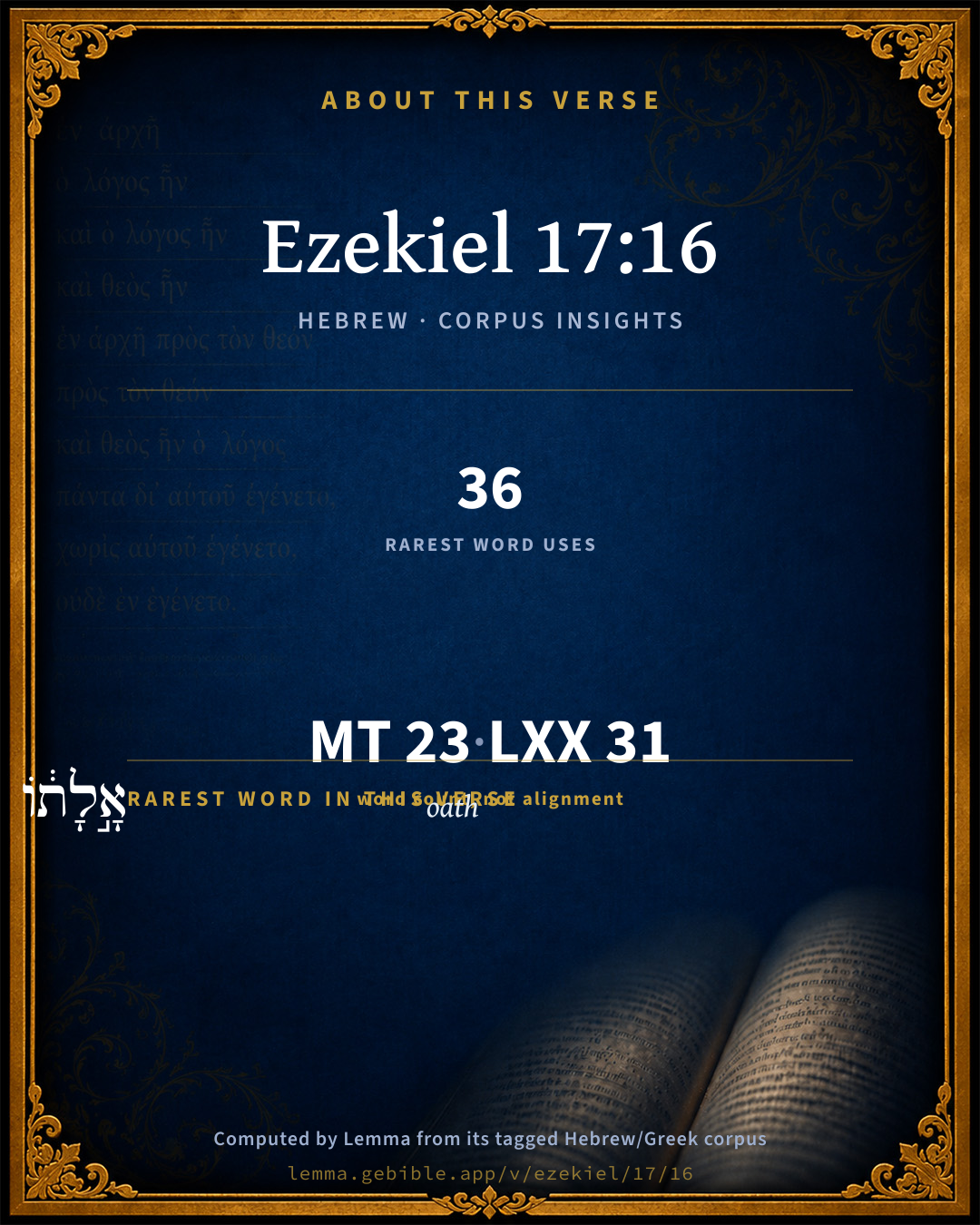
About this verse

These counts appear in no published source. They are computed here, from the morphology-tagged text and Lemma’s own curated glosses. What Lemma adds →

23
words
20
distinct lemmas
Prophets
section

Shared distinctive vocabulary

אָ֣לָת֔וֹ oath H423 occurs in 32 verses of the Hebrew Bible. Also found in:

Grammatical profile

  • 4 verbs
  • 9 nouns
  • 1 adjective
  • 1 pronoun
  • 1 preposition
  • 1 conjunction
  • 6 particles

Verb forms

  • הַמַּמְלִ֣יךְ Hiphil · Participle Active
  • בָּזָה֙ Qal · Perfect
  • הֵפֵ֖ר Hiphil · Perfect
  • יָמֽוּת Qal · Imperfect

Repetition

A word recurs within this verse — often emphatic in Hebrew:

  • אֲשֶׁ֤ר which H834 ×2

Hebrew & Septuagint length

In English translation the verse runs 39 words from the Hebrew and 37 from the Septuagint (LXX English) — closely comparable.

A rough comparison of the two English renderings, which tokenize alike — not a word-level alignment.

Word counts can differ between the Hebrew and the Greek without any difference in meaning — e.g. the Hebrew direct-object marker אֵת has no separate Greek word, and Greek often adds the article ὁ.

In the original languages it is 23 Hebrew tokens and 31 Greek tokens — but the two are counted differently (Hebrew bundles its prefixes and suffixes into one token; the Greek is in lemma form), so that isn’t a like-for-like length.

Cross-references

22

Topical passages linked to Ezekiel 17:16 in the Treasury of Scripture Knowledge — connected by theme and wording, ordered by reader-vote popularity; previews shown in the World English Bible.

  • Ezekiel 12:13 My net also will I spread on him, and he shall be taken in my snare; and I will bring him to Babylon to the land of the Chaldeans; yet shall he not see it, though he shall die there.
  • Jeremiah 52:11 He put out the eyes of Zedekiah; and the king of Babylon bound him in fetters, and carried him to Babylon, and put him in prison until the day of his death.
  • Exodus 8:2 If you refuse to let them go, behold, I will plague all your borders with frogs:
  • Exodus 20:7 "You shall not take the name of Yahweh your God in vain, for Yahweh will not hold him guiltless who takes his name in vain.
  • Numbers 30:2 When a man vows a vow to Yahweh, or swears an oath to bind his soul with a bond, he shall not break his word; he shall do according to all that proceeds out of his mouth.
  • Joshua 9:20 This we will do to them, and let them live; lest wrath be on us, because of the oath which we swore to them.
  • 2 Samuel 21:2 The king called the Gibeonites, and said to them (now the Gibeonites were not of the children of Israel, but of the remnant of the Amorites; and the children of Israel had sworn to them: and Saul sought to kill them in his zeal for the children of Israel and Judah);
  • 2 Kings 24:17 The king of Babylon made Mattaniah, [Jehoiachin's] father's brother, king is his place, and changed his name to Zedekiah.
  • Psalms 15:4 In whose eyes a vile man is despised, But who honors those who fear Yahweh; He who keeps an oath even when it hurts, and doesn't change;
  • Jeremiah 32:4–5 and Zedekiah king of Judah shall not escape out of the hand of the Chaldeans, but shall surely be delivered into the hand of the king of Babylon, and shall speak with him mouth to mouth, and his eyes shall see his eyes;
  • Jeremiah 39:7 Moreover he put out Zedekiah's eyes, and bound him in fetters, to carry him to Babylon.
  • Ezekiel 16:59 For thus says the Lord Yahweh: I will also deal with you as you have done, who have despised the oath in breaking the covenant.
  • Ezekiel 17:13 and he took of the seed royal, and made a covenant with him; he also brought him under an oath, and took away the mighty of the land;
  • Ezekiel 17:18–19 For he has despised the oath by breaking the covenant; and behold, he had given his hand, and yet has done all these things; he shall not escape.
  • Zechariah 5:3–4 Then he said to me, "This is the curse that goes out over the surface of the whole land; for everyone who steals shall be cut off according to it on the one side; and everyone who swears falsely shall be cut off according to it on the other side.
  • Jeremiah 34:3–5 and you shall not escape out of his hand, but shall surely be taken, and delivered into his hand; and your eyes shall see the eyes of the king of Babylon, and he shall speak with you mouth to mouth, and you shall go to Babylon.
  • Ezekiel 17:10 Yes, behold, being planted, shall it prosper? shall it not utterly wither, when the east wind touches it? it shall wither in the beds where it grew.
  • Hosea 10:4 They make promises, swearing falsely in making covenants. Therefore judgment springs up like poisonous weeds in the furrows of the field.
  • Malachi 3:5 I will come near to you to judgment; and I will be a swift witness against the sorcerers, and against the adulterers, and against the perjurers, and against those who oppress the hireling in his wages, the widow, and the fatherless, and who deprive the foreigner of justice, and don't fear me," says Yahweh of Hosts.
  • Romans 1:31 without understanding, covenant-breakers, without natural affection, unforgiving, unmerciful;
  • 1 Timothy 1:10 for the sexually immoral, for homosexuals, for slave-traders, for liars, for perjurers, and for any other thing contrary to the sound doctrine;
  • 2 Timothy 3:3 without natural affection, unforgiving, slanderers, without self-control, fierce, no lovers of good,

Cross-references courtesy of OpenBible.info (CC BY 4.0).

Hebrew and Greek witnesses Masoretic Hebrew ↔ Greek Septuagint

The same verse in the two great witnesses to the Old Testament, shown verse-for-verse.

These are two independent witnesses, not word-aligned to each other, and the Septuagint is shown in lemma (dictionary) form.

Hebrew Ezekiel 17:16 Masoretic · Westminster Leningrad Codex

חַי אָ֗נִי נְאֻם֮ אֲדֹנָ֣י יְהוִה֒ אִם לֹ֗א בִּמְקוֹם֙ הַמֶּ֨לֶךְ֙ הַמַּמְלִ֣יךְ אֹת֔וֹ אֲשֶׁ֤ר בָּזָה֙ אֶת אָ֣לָת֔וֹ וַאֲשֶׁ֥ר הֵפֵ֖ר אֶת בְּרִית֑וֹ אִתּ֥וֹ בְתוֹךְ בָּבֶ֖ל יָמֽוּת

As I live, says the Lord Yahweh, surely in the place where the king dwells who made him king, whose oath he despised, and whose covenant he broke, even with him in the midst of Babylon he shall die.

World English Bible · Public Domain

Greek LXX Ezekiel 17:16 Septuagint · lemma form

ζάω ἐγώ λέγω κύριος ἐάν μή ἐν ὅς τόπος ὁ βασιλεύς ὁ βασιλεύω αὐτός ὅς ἀτιμόω ὁ ἀρά ἐγώ καί ὅς παραβαίνω ὁ διαθήκη ἐγώ μετά αὐτός ἐν μέσος βαβυλών τελευτάω

As I live, says the Lord, verily in the place where the king is that made him king, who dishonored my oath, and who broke my covenant, shall he die with him in the midst of Babylon.

LXX2012 (modern English Septuagint) · Public Domain

Hebrew: Westminster Leningrad Codex (CC BY 4.0). Greek: Septuagint (public domain); English from LXX2012 (modern English Septuagint) (Public Domain). How the Septuagint differs from the Hebrew →

Targum (Aramaic paraphrase)

1

The Targum is the ancient Jewish Aramaic paraphrase of the Hebrew Scriptures — an interpretive translation, not the Hebrew text itself. Onkelos (literal) and Pseudo-Jonathan (expansive) render the Torah, and Jonathan the Prophets. Coverage is partial: where no permissively-licensed English translation exists for a verse, only the Aramaic is shown. This is verse-level text, not a word-by-word alignment to the Hebrew.

  1. Targum Jonathan Prophets (Joshua–Malachi)
    קַיֵם אֲנָא אֲמַר יְיָ אֱלֹהִים אִם לָא בְּאַתְרָא דְמַלְכָּא דְאַמְלִיךְ יָתֵיהּ דִבְסַר עַל מוֹמָתֵהּ וּדְאַשְׁנֵי יַת קְיָמֵיהּ עִמֵיהּ בְּגוֹ בָבֶל יְמוּת:

    (no public-domain English translation for this verse)

    Targum Jonathan — Aramaic: “Mikraot Gedolot” (public domain). English: “Sefaria Community Translation” (CC0 1.0 (public-domain dedication)); “London "Chaldee Paraphrase," 1871” (public domain). Text via Sefaria.

Commentary

Notes on Ezekiel 17:16 from classic Christian and Jewish commentators (each source and its license shown beneath its notes). The classic Christian expositions comment on the surrounding passage and are grouped to its opening verse, so a note may address several verses; the Jewish commentaries on the Tanakh (Rashi and others) are per-verse, so they appear only where the commentator wrote on this verse.

Lemma curates 59 commentaries, every one of them public domain or Creative Commons licensed, each selected and text-cleaned for this edition rather than reprinted as found. About our sources →

Trapp's Complete Commentary

John Trapp

Eze 17:16 [As] I live, saith the Lord GOD, surely in the place [where] the king [dwelleth] that made him king, whose oath he despised, and whose covenant he brake, [even] with him in the midst of Babylon he shall die.

Ver. 16. As I live.] So surely will I punish perjury and treachery. Histories are full of examples in this kind, and I have elsewhere recited some of them. That of Henry III of France, related by a reverend man, {a} deserves to be memorised: After great differences between him, the Cardinal, and Duke of Guise, he was reconciled unto them, confirmed the reconciliation with many oaths, took the sacrament upon it, and gave himself to the devil, body and soul, in case he meant or should attempt anything against them. Yet, saith the story, he caused the Duke to be killed in his own presence, and the Cardinal, his brother, the next day after. Here was breach of covenant; but did he prosper, escape, do such things, and have deliverance? No; within eight months after, he was slain by a friar in the midst of his army.

{a} Mr Greenhill.

John Trapp, A Commentary or Exposition upon All the Books of the Old and New Testament (1647–1656) — public domain. Text from a community e-Sword module.

Joseph Benson's Commentary

Eze 17:16-21. As I live, saith the Lord, &c. — This intimates how highly God resented the crime, and how sure and severe the punishment of it would be. He swears in his wrath, as he did, Psa 95:11. Observe, reader, as God’s promises are confirmed with an oath, for comfort to the saints, so are his threatenings, for terror to the wicked. Surely in the place where the king dwelleth — In Babylon, where Nebuchadnezzar dwells, who made him king, when he might have as easily made him a prisoner. Whose oath he despised — Made light of, and perfidiously violated. Even with him he shall die — Shall be a prisoner in Babylon the rest of his days, and shall die there. Neither shall Pharaoh make for him — See Jer 37:7. But the Hebrew, יעשׂה אותו במלחמה, may be properly rendered, as indeed it is by Bishop Newcome, Pharaoh shall not deal with him, namely, with Nebuchadnezzar, in war: or, shall not make war with him. Accordingly the Vulgate translates the clause, “Et non in exercitu grandi, neque in populo multo faciet contra eum Pharaoh prælium:” neither with a great army, nor with much people, shall Pharaoh fight a battle against him. By casting up, &c. — Or rather, When he hath cast up mounts, &c., that is, when Nebuchadnezzar has raised mounts and builded forts to annoy Jerusalem, and destroy its inhabitants, Pharaoh shall not bring any assistance to it. Seeing he despised, &c., when lo, he had given his hand — In token of entering into a mutual league and covenant. It was a ceremony used especially when an inferior made profession of his subjection to a superior. My covenant that he hath broken — God calls it his covenant, because it was entered into, or promised to be observed, by taking an oath in his name. Even it will I recompense upon his own head — I will punish it as it deserves, and it shall appear by the punishment that my hand doth execute it. And I will spread my net, &c. — See on Eze 12:13, where this clause occurs word for word. And will plead with him there — God is said to plead with men when he places their sins before their eyes, and convinces them of their disobedience by manifest tokens of his vengeance. And all his fugitives — All the companions of his flight; with all his bands shall fall by the sword — Every thing here denounced by the prophet against Zedekiah exactly came to pass, as the reader may see by comparing these threatenings with the account given Jer 52:8-11; 2Ki 25:5-7.

Joseph Benson's Commentary on the Old and New Testaments (1811–1818) — public domain. Text from a community e-Sword module.

Jamieson, Fausset & Brown

Robert Jamieson, A. R. Fausset & David Brown

in the place where the king dwelleth--righteous retribution. He brought on himself in the worst form the evil which, in a mild form, he had sought to deliver himself from by perjured treachery, namely, vassalage (Eze 12:13; Jer 32:5; Jer 34:3; Jer 52:11).

Jamieson, Fausset & Brown — Commentary Critical and Explanatory on the Whole Bible (1871) — public domain (CC PDM 1.0). Text via the HelloAO Bible API.

Adam Clarke's Commentary

Verse 16. In the midst of Babylon he shall die.] His eyes were put out; he was carried to Babylon, and never returned.

Adam Clarke's Commentary on the Bible (1810–1826) — public domain. Text from a community e-Sword/MySword module.

John Calvin's Commentaries

It now follows, As I live, says the Lord Jehovah, in the dwelling of the king who placed him on a throne, shall he die. Although the Prophet had sufficiently shown that Zedekiah could not escape the penalty of his revolt, yet God here again comes forward, and swears by himself, or by his life, that he would punish Zedekiah. Hence the great stupidity of the people appears, for God never acts falsely by his own name, or brings it forward in vain, but when necessity demands it, he swears by himself. And by his own example he prescribes to us, that we should not rush rashly upon an oath, but be sober in this respect. But God swears that Zedekiah should die on the spot, that is, at the capital of the king who put him on the throne; that is Babylon, where he died: and yet he did not see Babylon, because his eyes were put out at Riblath, as we saw elsewhere. (Jeremiah 39:7; Jeremiah 52:11.) But the Prophet simply denounces the penalty, that he should die in exile, and in the dwelling of the king who had placed him on his throne, and from whose covenant he had departed, and whose oath he had despised.

John Calvin's Commentaries (1540-1563) — public domain. Text from the Calvin Translation Society English edition (1840s-50s) via the Christian Classics Ethereal Library (ccel.org). Calvin's coverage is partial (roughly two-thirds of the Bible); uncommented books and verses are honest gaps, never fabricated. The 19th-century editor's footnotes and remarks are omitted so the notes are faithfully Calvin's own voice.

Ellicott's Commentary for English Readers

(16) In the place . . . he shall die.—The distinct prophecy of the death of Zedekiah at Babylon is here given in a form to bring out in the strongest light the fitness and justice of his punishment. It was to be in the place of the king to whom he owed his crown, and to whom he had given his fealty, yet against whom he had rebelled. The tense here changes to the future, because the events of this and the following verse were yet to be fulfilled.

A Bible Commentary for English Readers, edited by Charles John Ellicott (1878–1897) — public domain. Text from a community e-Sword module.

The Cambridge Bible for Schools and Colleges

gen. ed. J. J. S. Perowne

16. Zedekiah, being carried to Babylon, shall die there.

The Cambridge Bible for Schools and Colleges (gen. ed. J. J. S. Perowne; Cambridge University Press, 1878–1918) — public domain. Text from a community e-Sword module.

John Gill's Exposition

Seeing he despised the oath, by breaking the covenant,.... This is repeated again, to show the heinousness of the sin Zedekiah had been guilty of, and what was the cause of his ruin:

when, lo, he had given his hand; to the king of Babylon, to testify his hearty agreement with him, and that he might depend upon the oath and covenant being sacredly observed by him. This was a rite for custom frequently and early used in different nations, when covenants and agreements were entered into; we find it used in the times of Homer (z); and among the Romans. When Antoninus, Lepidus, and Octavius made peace, the historian says (a), they joined their hands together. Virgil (b) speaks of the same ceremony used by Anchises to Achaemenides, for confirmation of friendship. Though some understand this of his giving the hand to Pharaoh king of Egypt, and entering into an alliance with him, and broke the covenant and oath made to the king of Babylon; and so the Targum,

"and, lo, he stretched out his hand to Pharaoh:''

and hath done all these things; been guilty of such and so many crimes, as ingratitude, perjury, covenant breaking, and vain confidence:

he shall not escape; divine vengeance, just and proper punishment for his sins.

(z) ' , Iliad. 6. (a) Florus, Hist. Rom. Gest. l. 4. c. 5. (b) "Ipse pater dextram Anchises, haud malta moratur, Dat juveni atque animum praesenti pignore firmat". Aeneid. l. 3. prope finem.

John Gill's Exposition of the Whole Bible (1746–1763) — public domain (CC PDM 1.0). Text via the HelloAO Bible API.

Haydock's Catholic Bible Commentary

Die. He had sworn fidelity, and was justly punished, dying blind, and in prison, chap. xii. (Worthington)

George Leo Haydock (1774–1849), Haydock's Catholic Family Bible and Commentary, 1859 edition — public domain. Excludes Psalms (Douay-Rheims chapter numbering differs from Protestant) and Deuterocanonical books (Catholic canon only).

Matthew Poole's English Annotations

As sure as I am God, and live, I will punish this perjury: and here is a particular account of the punishment.

In the place; Babylon. The king; Nebuchadnezzar.

Made him king; Zedekiah.

Whose oath; the oath Nebuchadnezzar imposed.

He despised; contemptuously, without any just cause given; and therefore this perfidious prince could never expect more favour, but must in reason fear the greatest severities. Under this fear Zedekiah shall spend the rest of his days. He shall rather be always dying, for though he lived a natural life, yet it was in such sadness, it is more properly styled a dying; in blindness, under the memorial of the most afflictlye sight, the murder of his children, which was the last thing his eye ever beheld.

Matthew Poole's English Annotations on the Holy Bible (1683–1685) — public domain. Text from a community e-Sword/MySword module.

Whedon's Commentary on the Bible

Daniel D. Whedon

16. In the midst of Babylon he shall die — See Eze_19:9.

Daniel D. Whedon (gen. ed.), Commentary on the Old and New Testaments (1874–1909) — public domain. Text from a community e-Sword module.

The Pulpit Commentary

Ezekiel repeats the prediction of Eze_12:13. The prison in Babylon, under the eye of the king against whom he had rebelled; this was to be the outcome-of the alliance with Egypt. The prophecy was probably written when the hopes of Zedekiah and his counsellors were at their highest point, when the Chaldeans had, in fact. raised the siege in anticipation of the arrival of the Egyptian army. (Jer_37:5-11) Ezekiel, like Jeremiah (loc. cit.), declared that the relief would be but temporary.

The Pulpit Commentary (1880–1919), ed. H.D.M. Spence-Jones & Joseph S. Exell — public domain. Text from a community e-Sword module.

Lesson kit

Teaching starters — assembled from the data on this page, not authored interpretation. Every prompt links to the verse data it draws on. Edit before teaching.

Ezekiel, in the Prophets, opens this verse with 23 words (20 distinct Hebrew lemmas). Its most distinctive word is ʼâlâh (“oath”). A historical commentator’s framing appears above. Read the whole chapter for the surrounding context.

Discussion questions

  1. What does “oath” (ʼâlâh) contribute to the verse as a whole?
  2. Genesis 24:41 shares the word «oath» with this verse. How do the two illuminate each other?
  3. “which” occurs 2× in this one verse. What is the effect of the repetition?
  4. These translations render this verse differently. What is at stake in choosing one wording over another?
  5. The verb «הַמַּמְלִ֣יךְ» is Hiphil Participle Active. How does its form color the action?
  6. Reading how Trapp's Complete Commentary and Joseph Benson's Commentary read this verse, where do the two commentators agree and where do they part?

Things to notice

Reading settings

Reading text

Shown beneath each verse's original-language words.

Old Testament
Old Testament edition

Read the OT as the Masoretic Hebrew (MT) or the Greek Septuagint (LXX).

English shown for the Greek Septuagint (in the Hebrew ↔ Greek comparison).

Comparing translations? Open the Compare panel on any verse page to stack up to four side by side.