
1 Samuel 15:6

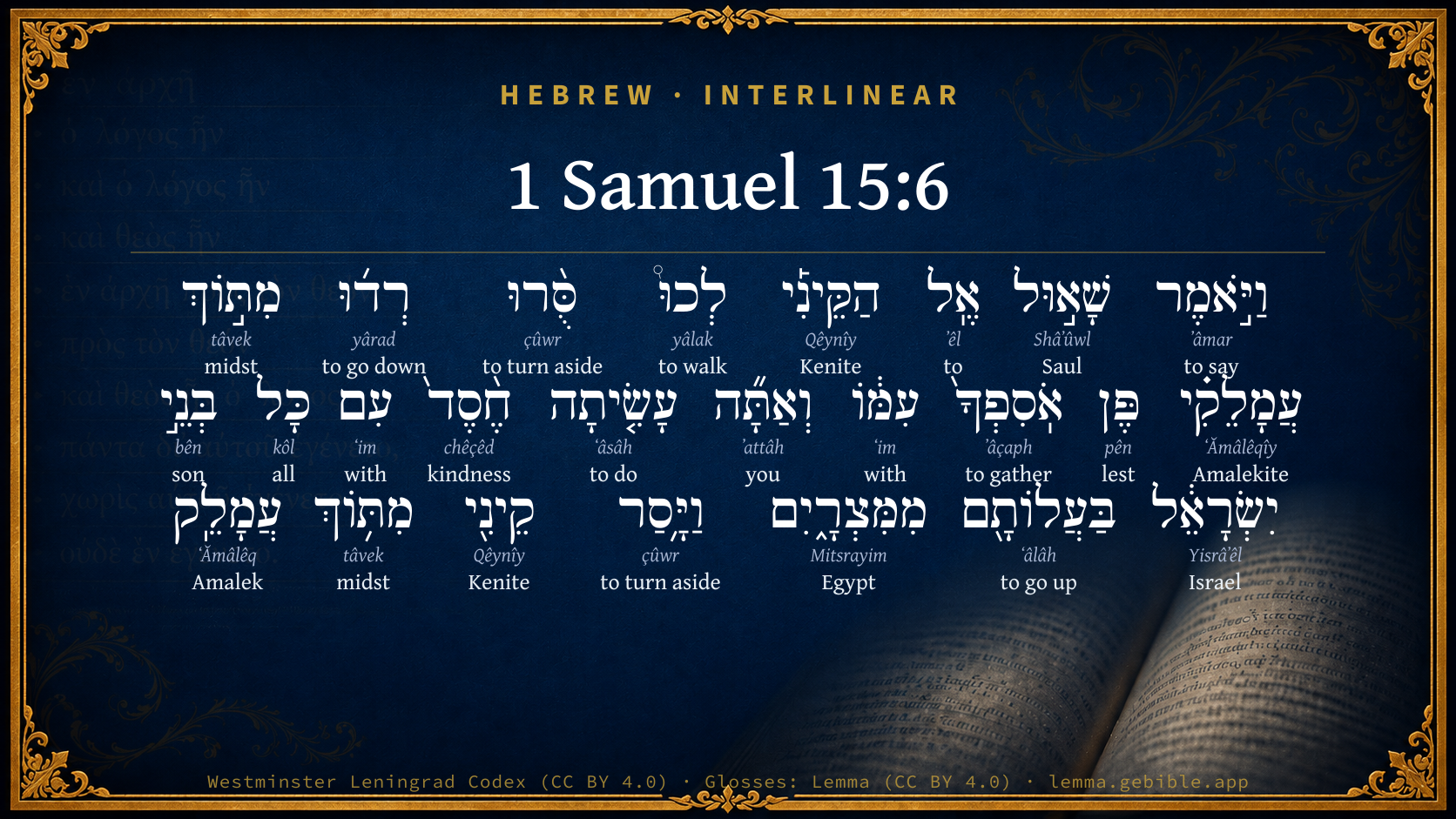
Hebrew (Westminster Leningrad Codex) 1 Samuel 15:6 appears in the Hebrew Old Testament. The text above is from the Westminster Leningrad Codex. Each word links to its Strong’s number, a concise gloss, and parsing drawn from the Open Scriptures Hebrew Bible morphology. Click any word for its full Brown-Driver-Briggs (BDB) entry.
Download image
Cite this verse

1 Samuel 15:6 (World English Bible). Public Domain. Lemma interlinear Bible study tool, https://lemma.gebible.app/v/1-samuel/15/6.

Show BibTeX & RIS
BibTeX
RIS
English Translation
Saul said to the Kenites, Go, depart, get you down from among the Amalekites, lest I destroy you with them; for you shown kindness to all the children of Israel, when they came up out of Egypt. So the Kenites departed from among the Amalekites.
World English Bible · Public Domain
Download a study sheet

One document with this verse’s original text, its word-by-word gloss line, the meaning frame, cross-references with their text, attributed commentary, and full source and license credits — printable, and it pastes into notes with its structure intact.

This verse Autodidact and up

Study sheet (.html) Plain text (.txt)

A passage Seminary Student

Up to 50 verses in one chapter. A passage sheet keeps up to 6 commentary sources and 12 cross-references per verse, in the order this page ranks them, and says so on the sheet whenever that leaves anything out. Ask for a single verse and you get the Autodidact verse sheet above.

Everything on this page stays free to read, with no account — the sheet is a download of what is already on screen, not access to it.

Want to remove ads? Support Godless Engineer
Compare translations 3

The same verse in 3 English versions, stacked beneath the original-language interlinear above. Click any original word for its lexicon entry.

Each is an independent rendering of the whole verse — the interlinear is not word-aligned to these translations.

Highlighted words mark where these versions differ — a whole-verse word diff, not a word-by-word alignment.

  • World English Bible Public Domain
    Saul said to the Kenites, Go, depart, get you down from among the Amalekites, lest I destroy you with them; for you shown kindness to all the children of Israel, when they came up out of Egypt. So the Kenites departed from among the Amalekites.
  • King James Version Public Domain
    And Saul said unto the Kenites, Go, depart, get you down from among the Amalekites, lest I destroy you with them: for ye showed kindness to all the children of Israel, when they came up out of Egypt. So the Kenites departed from among the Amalekites.
  • unfoldingWord Literal Text CC BY-SA 4.0
    And Saul said to the Kenite, “Go, depart, go down from the midst of the Amalekite, lest I remove you with him. For you, you did kindness with all of the sons of Israel in their coming up from Egypt.” And the Kenite departed from the midst of Amalek.

unfoldingWord Literal Text — © unfoldingWord, licensed CC BY-SA 4.0. Word-aligned USFM3 via Door43 (git.door43.org/unfoldingWord/en_ult).

Versions to compare (up to 4)

3 of 4 selected

Show all 18 translations

Every available English version of this verse, each an independent rendering of the whole verse.

  • World English Bible Public Domain
    Saul said to the Kenites, Go, depart, get you down from among the Amalekites, lest I destroy you with them; for you shown kindness to all the children of Israel, when they came up out of Egypt. So the Kenites departed from among the Amalekites.
  • Berean Standard Bible Public Domain
    And he warned the Kenites, “Since you showed kindness to all the Israelites when they came up out of Egypt, go on and get away from the Amalekites. Otherwise I will sweep you away with them.” So the Kenites moved away from the Amalekites.
  • Majority Standard Bible Public Domain
    And he warned the Kenites, “Since you showed kindness to all the Israelites when they came up out of Egypt, go on and get away from the Amalekites. Otherwise I will sweep you away with them.” So the Kenites moved away from the Amalekites.
  • King James Version Public Domain
    And Saul said unto the Kenites, Go, depart, get you down from among the Amalekites, lest I destroy you with them: for ye showed kindness to all the children of Israel, when they came up out of Egypt. So the Kenites departed from among the Amalekites.
  • American Standard Version (1901) Public Domain
    And Saul said unto the Kenites, Go, depart, get you down from among the Amalekites, lest I destroy you with them; for ye showed kindness to all the children of Israel, when they came up out of Egypt. So the Kenites departed from among the Amalekites.
  • Revised Version (1885) Public Domain
    And Saul said unto the Kenites, Go, depart, get you down from among the Amalekites, lest I destroy you with them: for ye shewed kindness to all the children of Israel, when they came up out of Egypt. So the Kenites departed from among the Amalekites.
  • Geneva Bible (1599) Public Domain
    And Saul said vnto the Kenites, Goe, depart, and get you downe from among the Amalekites, least I destroy you with them: for ye shewed mercie to all the children of Israel, when they came vp from Egypt: and the Kenites departed from among the Amalekites.
  • Douay-Rheims (1899) Public Domain
    And Saul said to the Cinite: Go, depart and get ye down from Amalec: lest I destroy thee with him. For thou hast shewn kindness to all the children of Israel, when they came up out of Egypt. And the Cinite departed from the midst of Amalec.
  • Young's Literal Translation Public Domain
    and Saul saith unto the Kenite, `Go, turn aside, go down from the midst of Amalek, lest I consume thee with it, and thou didst kindness with all the sons of Israel, in their going up out of Egypt;' and the Kenite turneth aside from the midst of Amalek.
  • Literal Standard Version CC BY-SA 4.0
    and Saul says to the Kenite, “Go, turn aside, go down from the midst of Amalek, lest I consume you with it, and you did kindness with all the sons of Israel, in their going up out of Egypt”; and the Kenite turns aside from the midst of Amalek.
  • Unlocked Literal Bible CC BY-SA 4.0
    Then Saul said to the Kenites, “Go, depart, come out from among the Amalekites, so I do not destroy you along with them. For you showed kindness to all the people of Israel, when they came from Egypt.” So the Kenites moved away from the Amalekites.
  • unfoldingWord Literal Text CC BY-SA 4.0
    And Saul said to the Kenite, “Go, depart, go down from the midst of the Amalekite, lest I remove you with him. For you, you did kindness with all of the sons of Israel in their coming up from Egypt.” And the Kenite departed from the midst of Amalek.
  • Darby Bible Public Domain
    And Saul said to the Kenites, Go, depart, and go down from among the Amalekites, lest I destroy you with them; for ye shewed kindness to all the children of Israel when they came up out of Egypt. And the Kenites departed from among the Amalekites.
  • World Messianic Bible Public Domain
    Saul said to the Kenites, “Go, depart, go down from among the Amalekites, lest I destroy you with them; for you showed kindness to all the children of Israel when they came up out of Egypt.” So the Kenites departed from among the Amalekites.
  • Webster's Bible Public Domain
    And Saul said to the Kenites, Go, depart, withdraw yourselves from among the Amalekites, lest I destroy you with them: for ye showed kindness to all the children of Israel when they came up from Egypt. So the Kenites departed from among the Amalekites.
  • Free Bible Version CC BY-SA 4.0
    Saul sent a message to warn the Kenites, “Move out of the area and leave the Amalekites so that I don't destroy you with them, because you showed kindness to all the people of Israel on their way from Egypt.” So the Kenites moved away and left the Amalekites.
  • Bible in Basic English Public Domain
    And Saul said to the Kenites, Go away, take yourselves out from among the Amalekites, or destruction will overtake you with them: for you were kind to the children of Israel when they came out of Egypt. So the Kenites went away from among the Amalekites.
  • JPS Tanakh (1917) Public Domain
    And Saul said unto the Kenites: 'Go, depart, get you down from among the Amalekites, lest I destroy you with them; for ye showed kindness to all the children of Israel, when they came up out of Egypt.' So the Kenites departed from among the Amalekites.

Literal Standard Version (2020), Covenant Press — licensed CC BY-SA 4.0. Text via the HelloAO Bible API (eBible.org). Unlocked Literal Bible (unfoldingWord) — licensed CC BY-SA 4.0. Text via the HelloAO Bible API (eBible.org). unfoldingWord Literal Text — © unfoldingWord, licensed CC BY-SA 4.0. Word-aligned USFM3 via Door43 (git.door43.org/unfoldingWord/en_ult). Free Bible Version, Dr. Jonathan Gallagher — licensed CC BY-SA 4.0. Text via the HelloAO Bible API (eBible.org).

Word by word

More ways to search: Search by grammar → Find every occurrence → Compare this word →

Practice this passage: Drill this verse → Learn its vocabulary →

עֲמָלֵקִ֗י
ʻĂmâlêqîy
H6003
“Amalekite”
Noun, Gentilic, Masculine, Singular, Absolute
Part of Speech
Noun
Type
Gentilic
Gender
Masculine
Number
Singular
State
Absolute
Full BDB Definition

Origin: from H6002

TWOT: None

Amalekite = see Amalek " people of lapping" - descendants of Amalek, the grandson of Esau
  1. וַיֹּ֣אמֶר ʼâmar H559 “and · to say” Conjunction + Verb, Qal, Sequential Imperfect, 3rd Person, Masculine, Singular
  2. שָׁא֣וּל Shâʼûwl H7586 “Saul” Noun, Proper
  3. אֶֽל ʼêl H413 “to” Preposition
  4. הַקֵּינִ֡י Qêynîy H7017 “the · Kenite” Particle, Definite Article + Noun, Gentilic, Masculine, Singular, Absolute
  5. לְכוּ֩ yâlak H3212 “walk” Verb, Qal, Imperative, 2nd Person, Masculine, Plural
  6. סֻּ֨רוּ çûwr H5493 “turn aside” Verb, Qal, Imperative, 2nd Person, Masculine, Plural
  7. רְד֜וּ yârad H3381 “go down” Verb, Qal, Imperative, 2nd Person, Masculine, Plural
  8. מִתּ֣וֹךְ tâvek H8432 “from · midst of” Preposition + Noun, Common, Masculine, Singular, Construct
  9. פֶּן pên H6435 “lest” Conjunction
  10. אֹֽסִפְךָ֙ ʼâçaph H622 “to gather · you” Verb, Qal, Imperfect, 1st Person, Common, Singular + Suffix, Personal, 2nd Person, Masculine, Singular
  11. עִמּ֔וֹ ʻim H5973 “with · him” Preposition + Suffix, Personal, 3rd Person, Masculine, Singular
  12. וְאַתָּ֞ה ʼattâh H859 “and · you” Conjunction + Pronoun, Personal, 2nd Person, Masculine, Singular
  13. עָשִׂ֤יתָה ʻâsâh H6213 “to do” Verb, Qal, Perfect, 2nd Person, Masculine, Singular
  14. חֶ֨סֶד֙ chêçêd H2617 “kindness” Noun, Common, Masculine, Singular, Absolute
  15. עִם ʻim H5973 “with” Preposition
  16. כָּל kôl H3605 “all of” Noun, Common, Masculine, Singular, Construct
  17. בְּנֵ֣י bên H1121 “sons of” Noun, Common, Masculine, Plural, Construct
  18. יִשְׂרָאֵ֔ל Yisrâʼêl H3478 “Israel” Noun, Proper
  19. בַּעֲלוֹתָ֖ם ʻâlâh H5927 “in/at · to go up · them” Preposition + Verb, Qal, Infinitive Construct + Suffix, Personal, 3rd Person, Masculine, Plural
  20. מִמִּצְרָ֑יִם Mitsrayim H4714 “from · Egypt” Preposition + Noun, Proper
  21. וַיָּ֥סַר çûwr H5493 “and · to turn aside” Conjunction + Verb, Qal, Sequential Imperfect, 3rd Person, Masculine, Singular
  22. קֵינִ֖י Qêynîy H7017 “Kenite” Noun, Gentilic, Masculine, Singular, Absolute
  23. מִתּ֥וֹךְ tâvek H8432 “from · midst of” Preposition + Noun, Common, Masculine, Singular, Construct
  24. עֲמָלֵֽק ʻĂmâlêq H6002 “Amalek” Noun, Proper

About this verse

These counts appear in no published source. They are computed here, from the morphology-tagged text and Lemma’s own curated glosses. What Lemma adds →

25
words
21
distinct lemmas
Historical
section

Notable vocabulary

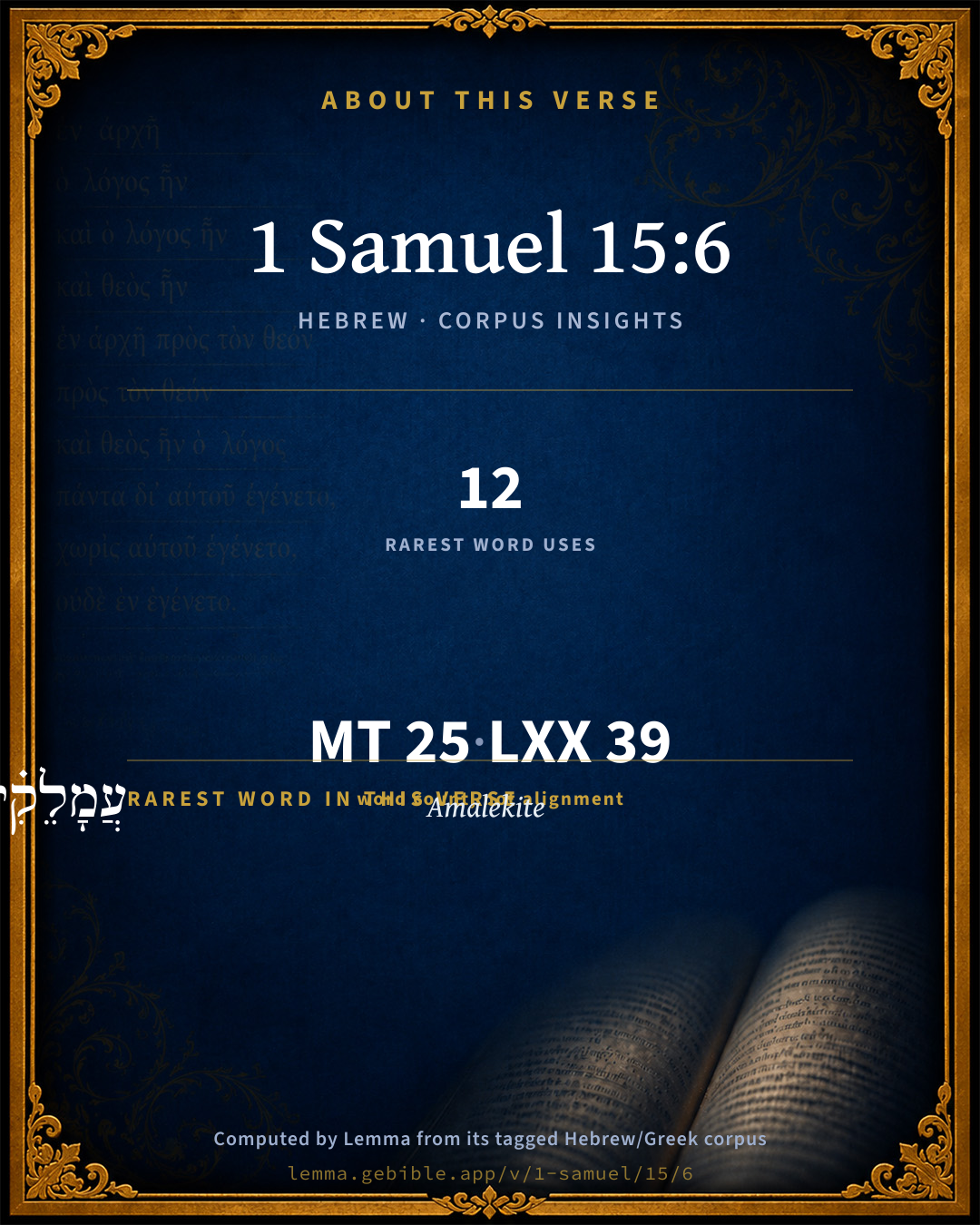
The rarest word here is עֲמָלֵקִ֗י Amalekite H6003 — appearing just 12 times in the whole Hebrew Bible.

Shared distinctive vocabulary

עֲמָלֵקִ֗י Amalekite H6003 occurs in 12 verses of the Hebrew Bible. Also found in:

Grammatical profile

  • 8 verbs
  • 12 nouns
  • 1 pronoun
  • 3 prepositions
  • 1 conjunction

Verb forms

  • וַיֹּ֣אמֶר Qal · Sequential Imperfect
  • לְכוּ֩ Qal · Imperative
  • סֻּ֨רוּ Qal · Imperative
  • רְד֜וּ Qal · Imperative
  • אֹֽסִפְךָ֙ Qal · Imperfect
  • עָשִׂ֤יתָה Qal · Perfect
  • בַּעֲלוֹתָ֖ם Qal · Infinitive Construct
  • וַיָּ֥סַר Qal · Sequential Imperfect

Repetition

Words recur within this verse — often emphatic in Hebrew:

  • הַקֵּינִ֡י Kenite H7017 ×2
  • סֻּ֨רוּ to turn aside H5493 ×2
  • מִתּ֣וֹךְ midst H8432 ×2
  • עִמּ֔וֹ with H5973 ×2

Hebrew & Septuagint length

In English translation the verse runs 45 words from the Hebrew and 47 from the Septuagint (LXX English) — closely comparable.

A rough comparison of the two English renderings, which tokenize alike — not a word-level alignment.

Word counts can differ between the Hebrew and the Greek without any difference in meaning — e.g. the Hebrew direct-object marker אֵת has no separate Greek word, and Greek often adds the article ὁ.

In the original languages it is 25 Hebrew tokens and 39 Greek tokens — but the two are counted differently (Hebrew bundles its prefixes and suffixes into one token; the Greek is in lemma form), so that isn’t a like-for-like length.

Cross-references

18

Topical passages linked to 1 Samuel 15:6 in the Treasury of Scripture Knowledge — connected by theme and wording, ordered by reader-vote popularity; previews shown in the World English Bible.

  • Judges 1:16 The children of the Kenite, Moses' brother-in-law, went up out of the city of palm trees with the children of Judah into the wilderness of Judah, which is in the south of Arad; and they went and lived with the people.
  • Numbers 10:29–32 Moses said to Hobab, the son of Reuel the Midianite, Moses' father-in-law, We are journeying to the place of which Yahweh said, I will give it you: come you with us, and we will do you good; for Yahweh has spoken good concerning Israel.
  • Exodus 18:19 Listen now to my voice. I will give you counsel, and God be with you. You represent the people before God, and bring the causes to God.
  • Numbers 24:21–22 He looked at the Kenite, and took up his parable, and said, Strong is your dwelling-place, Your nest is set in the rock.
  • Judges 4:11 Now Heber the Kenite had separated himself from the Kenites, even from the children of Hobab the brother-in-law of Moses, and had pitched his tent as far as the oak in Zaanannim, which is by Kedesh.
  • Exodus 18:9–10 Jethro rejoiced for all the goodness which Yahweh had done to Israel, in that he had delivered them out of the hand of the Egyptians.
  • Judges 5:24 Blessed above women shall Jael be, The wife of Heber the Kenite; Blessed shall she be above women in the tent.
  • 1 Samuel 27:10 Achish said, Against whom have you made a raid today? David said, Against the South of Judah, and against the South of the Jerahmeelites, and against the South of the Kenites.
  • Genesis 18:25 Be it far from you to do things like that, to kill the righteous with the wicked, that so the righteous should be as the wicked. May that be far from you. Shouldn't the Judge of all the earth do right?"
  • Genesis 19:12–16 The men said to Lot, "Do you have anybody else here? Sons-in-law, your sons, your daughters, and whoever you have in the city, bring them out of the place:
  • Numbers 16:26–27 He spoke to the congregation, saying, Depart, I pray you, from the tents of these wicked men, and touch nothing of theirs, lest you be consumed in all their sins.
  • Numbers 16:34 All Israel that were round about them fled at the cry of them; for they said, Lest the earth swallow us up.
  • 1 Chronicles 2:55 The families of scribes who lived at Jabez: the Tirathites, the Shimeathites, the Sucathites. These are the Kenites who came of Hammath, the father of the house of Rechab.
  • Proverbs 9:6 Leave your simple ways, and live. Walk in the way of understanding."
  • Acts 2:40 With many other words he testified, and exhorted them, saying, "Save yourselves from this crooked generation!"
  • 2 Corinthians 6:17 Therefore, "'Come out from among them, And be separate,' says the Lord, 'Touch no unclean thing. I will receive you.
  • 2 Timothy 1:16 May the Lord grant mercy to the house of Onesiphorus, for he often refreshed me, and was not ashamed of my chain,
  • Revelation 18:14 The fruits which your soul lusted after have been lost to you, and all things that were dainty and sumptuous have perished from you, and you will find them no more at all.

Cross-references courtesy of OpenBible.info (CC BY 4.0).

Hebrew and Greek witnesses Masoretic Hebrew ↔ Greek Septuagint

The same verse in the two great witnesses to the Old Testament, shown verse-for-verse.

These are two independent witnesses, not word-aligned to each other, and the Septuagint is shown in lemma (dictionary) form.

Hebrew 1 Samuel 15:6 Masoretic · Westminster Leningrad Codex

וַיֹּ֣אמֶר שָׁא֣וּל אֶֽל הַקֵּינִ֡י לְכוּ֩ סֻּ֨רוּ רְד֜וּ מִתּ֣וֹךְ עֲמָלֵקִ֗י פֶּן אֹֽסִפְךָ֙ עִמּ֔וֹ וְאַתָּ֞ה עָשִׂ֤יתָה חֶ֨סֶד֙ עִם כָּל בְּנֵ֣י יִשְׂרָאֵ֔ל בַּעֲלוֹתָ֖ם מִמִּצְרָ֑יִם וַיָּ֥סַר קֵינִ֖י מִתּ֥וֹךְ עֲמָלֵֽק

Saul said to the Kenites, Go, depart, get you down from among the Amalekites, lest I destroy you with them; for you shown kindness to all the children of Israel, when they came up out of Egypt. So the Kenites departed from among the Amalekites.

World English Bible · Public Domain

Greek LXX 1 Samuel 15:6 Septuagint · lemma form

καί εἶπον σαούλ πρός ὁ κιναῖος ἀποἔρχομαι καί ἐκκλίνω ἐκ μέσος ὁ αμαληκίτος μή προςτίθημι σύ μετά αὐτός καί σύ ποιέω ἔλεος μετά ὁ υἱός ἰσραήλ ἐν ὁ ἀναβαίνω αὐτός ἐκ αἴγυπτος καί ἐκκλίνω ὁ κιναῖος ἐκ μέσος αμαληκ

And Saul said to the Kinite, Go, and depart out of the midst of the Amalekites, lest I put you with them; for you dealt mercifully with the children of Israel when they went up out of Egypt. So the Kinite departed from the midst of Amalec.

LXX2012 (modern English Septuagint) · Public Domain

Hebrew: Westminster Leningrad Codex (CC BY 4.0). Greek: Septuagint (public domain); English from LXX2012 (modern English Septuagint) (Public Domain). How the Septuagint differs from the Hebrew →

Targum (Aramaic paraphrase)

1

The Targum is the ancient Jewish Aramaic paraphrase of the Hebrew Scriptures — an interpretive translation, not the Hebrew text itself. Onkelos (literal) and Pseudo-Jonathan (expansive) render the Torah, and Jonathan the Prophets. Coverage is partial: where no permissively-licensed English translation exists for a verse, only the Aramaic is shown. This is verse-level text, not a word-by-word alignment to the Hebrew.

  1. Targum Jonathan Prophets (Joshua–Malachi)
    וַאֲמַר שָׁאוּל לְשַׁלְמָאָה אֲזֵיל זוּר אִתְפְּרַשׁ מִגוֹ עֲמַלְקָאָה דִלְמָא אֱשֵׁיצִינָךְ עִמֵיהּ וְאַתְּ עֲבַדְתְּ טִיבוּ עִם כָּל בְּנֵי יִשְׂרָאֵל בְּמִיסַקְהוֹן מִמִצְרָיִם וְאִיתְפְּרַשׁ שַׁלְמָאָה מִגוֹ עֲמַלְקָאָה:

    (no public-domain English translation for this verse)

    Targum Jonathan — Aramaic: “Mikraot Gedolot” (public domain). English: “Sefaria Community Translation” (CC0 1.0 (public-domain dedication)); “London "Chaldee Paraphrase," 1871” (public domain). Text via Sefaria.

Commentary

Notes on 1 Samuel 15:6 from classic Christian and Jewish commentators (each source and its license shown beneath its notes). The classic Christian expositions comment on the surrounding passage and are grouped to its opening verse, so a note may address several verses; the Jewish commentaries on the Tanakh (Rashi and others) are per-verse, so they appear only where the commentator wrote on this verse.

Lemma curates 59 commentaries, every one of them public domain or Creative Commons licensed, each selected and text-cleaned for this edition rather than reprinted as found. About our sources →

Trapp's Complete Commentary

John Trapp

1Sa 15:6 And Saul said unto the Kenites, Go, depart, get you down from among the Amalekites, lest I destroy you with them: for ye shewed kindness to all the children of Israel, when they came up out of Egypt. So the Kenites departed from among the Amalekites.

Ver. 6. And Saul said unto the Kenites.] Who were the posterity of Jethro, {Jdg 1:16} who, though he went not with Israel, yet some of his children did, and were helpful. They dwelt at this time in the borders of Amalek, but in tents, as did their issue, the Rechabites, - they are therefore warned to move their habitations, lest they should perish with ill neighbours, {Zec 9:2} Hamath lying nigh to Damascus, partook of its punishment. See 2Co 6:17 Rev 18:4).

Go, depart, get you dawn,] Congeries asyndetos celeritatis index: pack away with all speed. And when the Kenites pack up their fardles {little bundles}, it is time to expect judgment, Migremus hinc is a sad foretoken.

So the Kenites departed.] This they could soon do, as being Scenites, dwellers in tents.

John Trapp, A Commentary or Exposition upon All the Books of the Old and New Testament (1647–1656) — public domain. Text from a community e-Sword module.

Joseph Benson's Commentary

1Sa 15:6. Saul said unto the Kenites — A people descended from, or nearly related to, Jethro, who anciently dwelt in rocks near the Amalekites, (Num 24:21,) and afterward some of them dwelt in Judah, (Jdg 1:16,) whence it is probable they removed (which, dwelling in tents, they could easily do) and retired to their old habitation, because of the wars and troubles wherewith Judah was annoyed. Ye showed kindness — Some of your progenitors did so, and, for their sakes, all of you shall be spared and kindly treated. You were not guilty of that sin for which Amalek is now to be destroyed. When destroying judgments are abroad, God takes care to separate the precious from the vile. It is then especially dangerous to be found in the company of God’s enemies. The Jews have a saying, Wo to a wicked man and to his neighbour.

Joseph Benson's Commentary on the Old and New Testaments (1811–1818) — public domain. Text from a community e-Sword module.

Tyndale Open Study Notes

Tyndale Open Resources

15:6 The Kenites were nomadic metalworkers and descendants of Moses’ father-in-law (Judg 1:16). • you showed kindness: See Exod 18; Num 10:29-32.

Tyndale Open Study Notes — © Tyndale Open Resources, licensed CC BY-SA 4.0. Text via the HelloAO Bible API.

Geneva Bible (1599)

Geneva Bible translators

For Jethro came to visit them, and gave them good counsel, Exod. 18:19.

Which were the posterity of Jethro Moses’ father-in-law.

Geneva Bible (1599) marginal notes — public domain. Text via Bolls.life.

Jamieson, Fausset & Brown

Robert Jamieson, A. R. Fausset & David Brown

Kenites--(See on Jdg 1:16). In consequence, probably, of the unsettled state of Judah, they seem to have returned to their old desert tracts. Though now intermingled with the Amalekites, they were not implicated in the offenses of that wicked race; but for the sake of their ancestors, between whom and those of Israel there had been a league of amity, a timely warning was afforded them to remove from the scene of danger.

Jamieson, Fausset & Brown — Commentary Critical and Explanatory on the Whole Bible (1871) — public domain (CC PDM 1.0). Text via the HelloAO Bible API.

Adam Clarke's Commentary

Verse 6. Said unto the Kenites] The Kenites were an ancient people. Jethro, the father-in-law of Moses, was a Kenite. Hobab his son (if the same person be not meant) was guide to the Hebrews through the wilderness. They had a portion of the promised land, near to the city Arad. See Jdg 1:16; and for more particulars concerning them and the Amalekites, see the notes on Nu 26:20-21.

Adam Clarke's Commentary on the Bible (1810–1826) — public domain. Text from a community e-Sword/MySword module.

Ellicott's Commentary for English Readers

(6) And Saul said unto the Kenites.—The Kenites, like the Amalekites, were a nomad race of Arabs, but seem to have been ever friendly to the Israelites. This kindly feeling sprang up soon after the departure from Egypt, and was, no doubt, in the first instance owing to the fact of Hobab, the father-in-law of Moses, belonging to this people.

A Bible Commentary for English Readers, edited by Charles John Ellicott (1878–1897) — public domain. Text from a community e-Sword module.

The Cambridge Bible for Schools and Colleges

gen. ed. J. J. S. Perowne

6. the Kenites] This tribe, as may be inferred from the fact that Jethro, Moses’ father-in-law, the priest of Midian (Exo_3:1), is called a Kenite in Jdg_1:16, was an offshoot from the Midianites. The services done to Israel by Jethro and his son Hobab (Exodus 18; Num_10:29-32) led to a firm alliance. The Kenites accompanied the Israelites on their march as far as Jericho (Jdg_1:16), and then went and dwelt among the Amalekites in the desert to the south of Judah. They are mentioned again in 1Sa_27:10, 1Sa_30:29, as the friends of Israel. Famous among the Kenites was Jael, whose husband Heber had migrated into northern Palestine (Jdg_4:11); and the Rechabites who belonged to this tribe (1Ch_2:55) long preserved the nomad habits of their ancestors (Jer_35:7-10).

The Cambridge Bible for Schools and Colleges (gen. ed. J. J. S. Perowne; Cambridge University Press, 1878–1918) — public domain. Text from a community e-Sword module.

John Gill's Exposition

And Saul said unto the Kenites,.... Who were of the posterity of Jethro the father-in-law of Moses, or related to him; why Josephus (x) calls them the nation of the Sicimites, who dwelt in the midst of the land of Midian, I know not:

go, depart, get ye down from among the Amalekites; for though some of these people came with Israel into the land of Canaan, and were first at Jericho, and then came into the wilderness of Judah, Jdg 1:16 and were in other tribes also; yet as they removed from place to place, and from country to country, for the convenience of their flocks and herds, they dwelling in tents, might come into the country of Amalek and pitch there, and as they chose to dwell in rocks, and the caverns of them, to be near their flocks and herds in the valleys, they are called upon to get down from thence, see Num 24:21.

lest I destroy you with them; they dwelling among the Amalekites, might perish with them; and especially as the Amalekites, upon their being routed, would naturally flee to the rocks, hills, and mountains, where these people had their tents, they would be in the greater danger of being destroyed with them, unless they removed:

for ye showed kindness to all the children of Israel when they came up out of Egypt; as Jethro, by the advice he gave to Moses to appoint proper officers in Israel, and Hobab, by being eyes to the people, in conducting them through the wilderness, and accompanying them to the land of Canaan:

so the Kenites departed from among the Amalekites; took the advice of Saul, and removed and pitched their tents, elsewhere.

(x) Ut supra, (Antiqu. l. 6. c. 7.) sect. 3.

John Gill's Exposition of the Whole Bible (1746–1763) — public domain (CC PDM 1.0). Text via the HelloAO Bible API.

Haydock's Catholic Bible Commentary

Egypt. See Judges i. 16., Exodus xviii. 12., and Numbers x. 31., and xxiv. 21. Saul gave private instructions to the Cinite, who had been settled at Arad, and had mixed with Amalec, to depart. (Calmet)

George Leo Haydock (1774–1849), Haydock's Catholic Family Bible and Commentary, 1859 edition — public domain. Excludes Psalms (Douay-Rheims chapter numbering differs from Protestant) and Deuterocanonical books (Catholic canon only).

Matthew Poole's English Annotations

The Kenites; a people descending from or nearly related unto Jethro, who anciently dwelt in rocks near the Amalekites, Num 24:21, and afterwards some of them dwelt in Judah, Jdg 1:16, whence it is probable they removed, (which, dwelling in tents, they could easily do,) and retired to their old habitation, because of the wars and troubles wherewith Judah was annoyed.

Ye showed kindness; some of your progenitors did so, Exo 18:12; Num 10:31, and for their sakes all of you shall fare the better. You were not guilty of that sin for which Amalek is now to be destroyed.

Matthew Poole's English Annotations on the Holy Bible (1683–1685) — public domain. Text from a community e-Sword/MySword module.

Whedon's Commentary on the Bible

Daniel D. Whedon

6. The Kenites — The descendants of Jethro, Moses’ father in law, who is called a Kenite in Jdg_1:16. For the kindness shown to the Israelites by this ancestor of the Kenites, see Exodus 18.

Daniel D. Whedon (gen. ed.), Commentary on the Old and New Testaments (1874–1909) — public domain. Text from a community e-Sword module.

The Pulpit Commentary

Saul said unto the Kenites. Not while he was lying in ambush in the torrent bed, but after smiting Ir-Amalek. The Kenites were always friendly to the Israelites, but seem, like the Amalekites, to have been a Bedouin nation, ever wandering about without a settled home. In Abraham"s time they were a powerful people, (Gen_15:19) but, for some reason or other, broke up into small tribes, some, as those here spoken of, choosing the wilderness of Judah for their home, (Jud_1:16) others living far to the north in Naphtali, (Jud_1:4:11, 17) others among the rocks of Arabia Petraea. Of these last we know but little, but the rest continued to be on friendly terms with David. (1Sa_30:29)

The Pulpit Commentary (1880–1919), ed. H.D.M. Spence-Jones & Joseph S. Exell — public domain. Text from a community e-Sword module.

John Wesley's Explanatory Notes

Kenites - A people descending from, or nearly related to Jethro, who anciently dwelt in rocks near the Amalekites, Num. xxiv, 21, and afterwards some of them dwelt in Judah, Judg. i, 16, whence it is probable they removed, (which, dwelling in tents, they could easily do) and retired to their old habitation, because of the wars and troubles wherewith Judah was annoyed. Shewed kindness - Some of your progenitors did so, and for their sakes all of you shall fare the better. You were not guilty of that sin for which Amalek is now to be destroyed. When destroying judgments are abroad God takes care to separate the precious from the vile. It is then especially dangerous to be found in the company of God's enemies. The Jews have a saying, Woe to a wicked man, and to his neighbour.

John Wesley, Explanatory Notes Upon the Whole Bible (1754–1765) — public domain. Text via the GEBible commentary corpus.

unfoldingWord translationNotes

Door43 World Missions Community

Kenites

a nomad people group that had always been friendly to the nation of Israel (See: How to Translate Names)

Havilah ... Shur

These are the names of places. (See: How to Translate Names)

translationWords

Amalek

people group

Egypt

unfoldingWord translationNotes — © Distant Shores Media and the Door43 World Missions Community, licensed CC BY-SA 4.0. Source: git.door43.org/Door43/en_tn.

Rashi

Rabbi Shlomo Yitzchaki (Rashi)

To the Kenites. Who were Yisro's descendants, who were residing in the wilderness of Yehudah, in the south of Arod, who went to Ya'aveitz to learn Torah, Arod being Amoleik. The Canaanite king of Arod was Amoleik, for it is stated [about him]; "who lived in the South," and, "Amoleik dwells in the southern part of the land."

To all the Bnei Yisroel. Who partook from his [Yisro's] meal, Moshe, Aharon and all the elders of Yisroel. It is considered as though he acted kindly with all the Bnei Yisroel.

Rashi on the Tanakh — English translations: “The Judaica Press complete Tanach with Rashi, translated by A. J. Rosenberg” (CC BY 4.0); “Pentateuch with Rashi's commentary by M. Rosenbaum and A.M. Silbermann, 1929-1934” (public domain); “The Metsudah Tanach series, Lakewood, N.J” (CC BY 4.0); and “The Book of Joshua, Metsudah Publications, 1997” (CC BY 4.0). Text via Sefaria.

Lesson kit

Teaching starters — assembled from the data on this page, not authored interpretation. Every prompt links to the verse data it draws on. Edit before teaching.

1 Samuel, in the Historical, opens this verse with 25 words (21 distinct Hebrew lemmas). Its most distinctive word is ʻĂmâlêqîy (“Amalekite”). A historical commentator’s framing appears above. Read the whole chapter for the surrounding context.

Discussion questions

  1. What does “Amalekite” (ʻĂmâlêqîy) contribute to the verse as a whole?
  2. Genesis 14:7 shares the word «Amalekite» with this verse. How do the two illuminate each other?
  3. “Kenite” occurs 2× in this one verse. What is the effect of the repetition?
  4. The translations on this page render this verse differently — a whole-verse word diff, not a word-by-word alignment. What might account for the different wordings?
  5. The verb «וַיֹּ֣אמֶר» is Qal Sequential Imperfect. How does its form color the action?
  6. Reading how Trapp's Complete Commentary and Joseph Benson's Commentary read this verse, where do the two commentators agree and where do they part?

Things to notice

Reading settings

Reading text

Shown beneath each verse's original-language words.

Old Testament
Old Testament edition

Read the OT as the Masoretic Hebrew (MT) or the Greek Septuagint (LXX).

English shown for the Greek Septuagint (in the Hebrew ↔ Greek comparison).

Comparing translations? Open the Compare panel on any verse page to stack up to four side by side.