
Leviticus 25:33

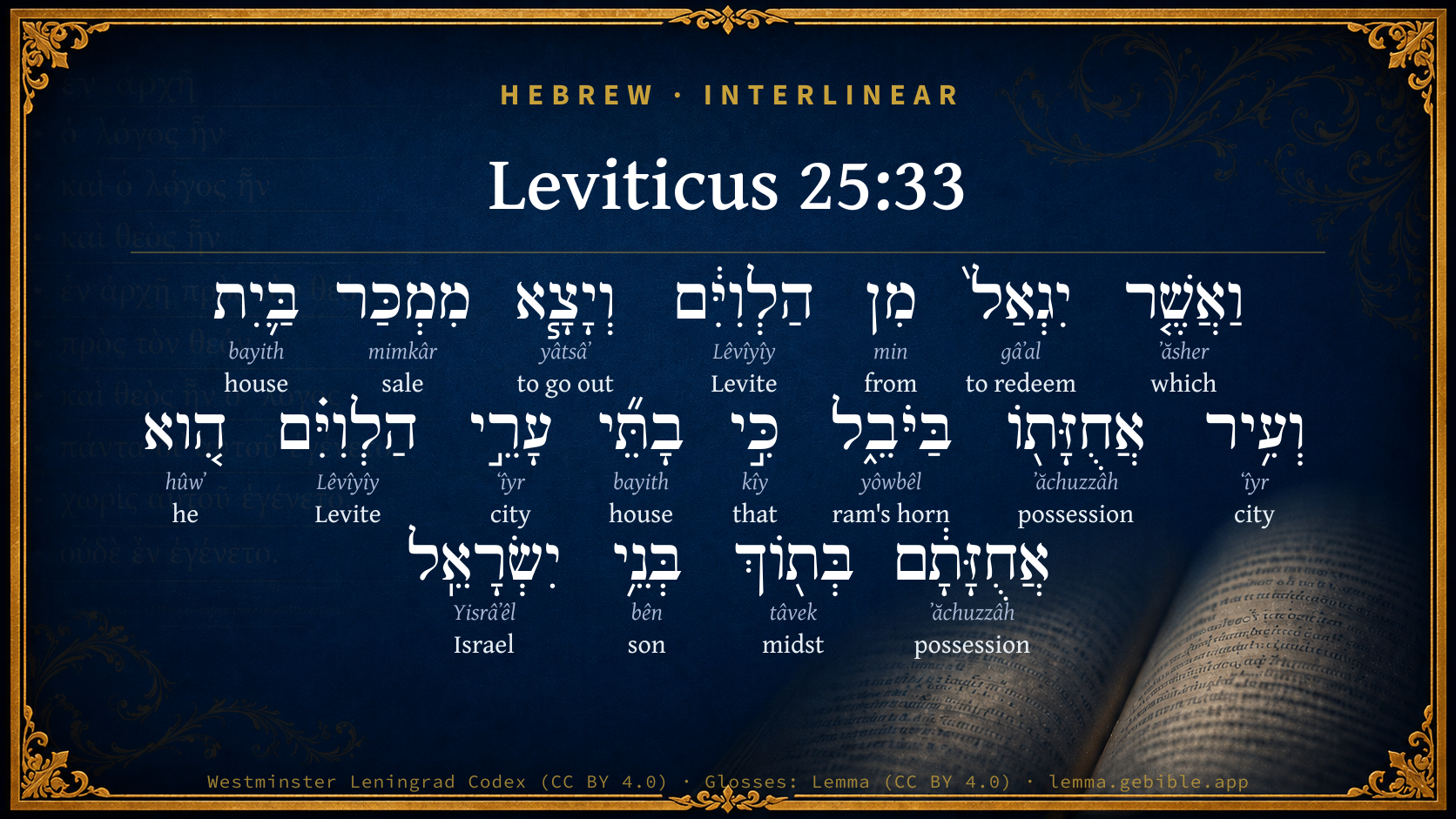
Hebrew (Westminster Leningrad Codex) Leviticus 25:33 appears in the Hebrew Old Testament. The text above is from the Westminster Leningrad Codex. Each word links to its Strong’s number, a concise gloss, and parsing drawn from the Open Scriptures Hebrew Bible morphology. Click any word for its full Brown-Driver-Briggs (BDB) entry.
Download image
Cite this verse

Leviticus 25:33 (World English Bible). Public Domain. Lemma interlinear Bible study tool, https://lemma.gebible.app/v/leviticus/25/33.

Show BibTeX & RIS
BibTeX
RIS
English Translation
The Levites may redeem the house that was sold, and the city of his possession, and it shall be released in the Jubilee; for the houses of the cities of the Levites are their possession among the children of Israel.
World English Bible · Public Domain
Download a study sheet

One document with this verse’s original text, its word-by-word gloss line, the meaning frame, cross-references with their text, attributed commentary, and full source and license credits — printable, and it pastes into notes with its structure intact.

This verse Autodidact and up

Study sheet (.html) Plain text (.txt)

A passage Seminary Student

Up to 50 verses in one chapter. A passage sheet keeps up to 6 commentary sources and 12 cross-references per verse, in the order this page ranks them, and says so on the sheet whenever that leaves anything out. Ask for a single verse and you get the Autodidact verse sheet above.

Everything on this page stays free to read, with no account — the sheet is a download of what is already on screen, not access to it.

Want to remove ads? Support Godless Engineer
Compare translations 3

The same verse in 3 English versions, stacked beneath the original-language interlinear above. Click any original word for its lexicon entry.

Each is an independent rendering of the whole verse — the interlinear is not word-aligned to these translations.

Highlighted words mark where these versions differ — a whole-verse word diff, not a word-by-word alignment.

  • World English Bible Public Domain
    The Levites may redeem the house that was sold, and the city of his possession, and it shall be released in the Jubilee; for the houses of the cities of the Levites are their possession among the children of Israel.
  • King James Version Public Domain
    And if a man purchase of the Levites, then the house that was sold, and the city of his possession, shall go out in the year of jubilee: for the houses of the cities of the Levites are their possession among the children of Israel.
  • unfoldingWord Literal Text CC BY-SA 4.0
    And whatever one from the Levites may redeem, and it shall go out in the Jubilee: the sale of house and city of his possession, for the houses of the cities of the Levites, it their possession in the midst of the sons of Israel.

unfoldingWord Literal Text — © unfoldingWord, licensed CC BY-SA 4.0. Word-aligned USFM3 via Door43 (git.door43.org/unfoldingWord/en_ult).

Versions to compare (up to 4)

3 of 4 selected

Show all 18 translations

Every available English version of this verse, each an independent rendering of the whole verse.

  • World English Bible Public Domain
    The Levites may redeem the house that was sold, and the city of his possession, and it shall be released in the Jubilee; for the houses of the cities of the Levites are their possession among the children of Israel.
  • Berean Standard Bible Public Domain
    So whatever belongs to the Levites may be redeemed—a house sold in a city they possess—and must be released in the Jubilee, because the houses in the cities of the Levites are their possession among the Israelites.
  • Majority Standard Bible Public Domain
    So whatever belongs to the Levites may be redeemed—a house sold in a city they possess—and must be released in the Jubilee, because the houses in the cities of the Levites are their possession among the Israelites.
  • King James Version Public Domain
    And if a man purchase of the Levites, then the house that was sold, and the city of his possession, shall go out in the year of jubilee: for the houses of the cities of the Levites are their possession among the children of Israel.
  • American Standard Version (1901) Public Domain
    And if one of the Levites redeem, then the house that was sold, and the city of his possession, shall go out in the jubilee; for the houses of the cities of the Levites are their possession among the children of Israel.
  • Revised Version (1885) Public Domain
    And if one of the Levites redeem, then the house that was sold, and the city of his possession, shall go out in the jubile: for the houses of the cities of the Levites are their possession among the children of Israel.
  • Geneva Bible (1599) Public Domain
    And if a man purchase of the Leuites, the house that was solde, and the citie of their possession shall goe out in the Iubile: for the houses of the cities of the Leuites are their possession among the children of Israel.
  • Douay-Rheims (1899) Public Domain
    If they be not redeemed, in the jubilee they shall all return to the owners, because the houses of the cities of the Levites are for their possessions among the children of Israel.
  • Young's Literal Translation Public Domain
    as to him who redeemeth from the Levites, both the sale of a house and the city of his possession have gone out in the jubilee, for the houses of the cities of the Levites are their possession in the midst of the sons of Israel.
  • Literal Standard Version CC BY-SA 4.0
    as for him who redeems from the Levites, then the sale of a house (and [in] the city of his possession) has gone out in the Jubilee, for the houses of the cities of the Levites are their possession in the midst of the sons of Israel.
  • Unlocked Literal Bible CC BY-SA 4.0
    If one of the Levites does not redeem a house he sold, then the house that was sold in the city where it is located must be returned in the year of Jubilee, for the houses of the cities of the Levites are their property among the people of Israel.
  • unfoldingWord Literal Text CC BY-SA 4.0
    And whatever one from the Levites may redeem, and it shall go out in the Jubilee: the sale of house and city of his possession, for the houses of the cities of the Levites, it their possession in the midst of the sons of Israel.
  • Darby Bible Public Domain
    And if any one redeem from one of the Levites, then the house that was sold, in the city of his possession, shall go out in the jubilee; for the houses of the cities of the Levites are their possession among the children of Israel.
  • World Messianic Bible Public Domain
    The Levites may redeem the house that was sold, and the city of his possession, and it shall be released in the Jubilee; for the houses of the cities of the Levites are their possession among the children of Israel.
  • Webster's Bible Public Domain
    And if a man shall purchase of the Levites, then the house that was sold, and the city of his possession shall go out in the year of jubilee; for the houses of the cities of the Levites are their possession among the children of Israel.
  • Free Bible Version CC BY-SA 4.0
    Whatever the Levites own can be bought back, even houses sold in their towns, and must be returned in the Jubilee. That's because the houses in the towns of the Levites are what they were given to own as their share among the Israelites.
  • Bible in Basic English Public Domain
    And if a Levite does not give money to get back his property, his house in the town which was exchanged for money will come back to him in the year of Jubilee. For the houses of the towns of the Levites are their property among the children of Israel.
  • JPS Tanakh (1917) Public Domain
    And if a man purchase of the Levites, then the house that was sold in the city of his possession, shall go out in the jubilee; for the houses of the cities of the Levites are their possession among the children of Israel.

Literal Standard Version (2020), Covenant Press — licensed CC BY-SA 4.0. Text via the HelloAO Bible API (eBible.org). Unlocked Literal Bible (unfoldingWord) — licensed CC BY-SA 4.0. Text via the HelloAO Bible API (eBible.org). unfoldingWord Literal Text — © unfoldingWord, licensed CC BY-SA 4.0. Word-aligned USFM3 via Door43 (git.door43.org/unfoldingWord/en_ult). Free Bible Version, Dr. Jonathan Gallagher — licensed CC BY-SA 4.0. Text via the HelloAO Bible API (eBible.org).

Word by word

More ways to search: Search by grammar → Find every occurrence → Compare this word →

Practice this passage: Drill this verse → Learn its vocabulary →

מִמְכַּר
mimkâr
H4465
“sale of”
Noun, Common, Masculine, Singular, Construct
Part of Speech
Noun
Type
Common
Gender
Masculine
Number
Singular
State
Construct
Full BDB Definition

Origin: from H4376

TWOT: 1194b

sale, ware, thing sold
  1. וַאֲשֶׁ֤ר ʼăsher H834 “and · which” Conjunction + Particle, Relative
  2. יִגְאַל֙ gâʼal H1350 “to redeem” Verb, Qal, Imperfect, 3rd Person, Masculine, Singular
  3. מִן min H4480 “from” Preposition
  4. הַלְוִיִּ֔ם Lêvîyîy H3881 “the · Levites” Particle, Definite Article + Noun, Gentilic, Masculine, Plural, Absolute
  5. וְיָצָ֧א yâtsâʼ H3318 “and · to go out” Conjunction + Verb, Qal, Sequential Perfect, 3rd Person, Masculine, Singular
  6. בַּ֛יִת bayith H1004 “house” Noun, Common, Masculine, Singular, Absolute
  7. וְעִ֥יר ʻîyr H5892 “and · city of” Conjunction + Noun, Common, Feminine, Singular, Construct
  8. אֲחֻזָּת֖וֹ ʼăchuzzâh H272 “possession · his” Noun, Common, Feminine, Singular, Construct + Suffix, Personal, 3rd Person, Masculine, Singular
  9. בַּיֹּבֵ֑ל yôwbêl H3104 “in/at the · ram's horn” Preposition, Determined + Noun, Common, Masculine, Singular, Absolute
  10. כִּ֣י kîy H3588 “that” Conjunction
  11. בָתֵּ֞י bayith H1004 “houses of” Noun, Common, Masculine, Plural, Construct
  12. עָרֵ֣י ʻîyr H5892 “cities of” Noun, Common, Feminine, Plural, Construct
  13. הַלְוִיִּ֗ם Lêvîyîy H3881 “the · Levites” Particle, Definite Article + Noun, Gentilic, Masculine, Plural, Absolute
  14. הִ֚וא hûwʼ H1931 “he” Pronoun, Personal, 3rd Person, Feminine, Singular
  15. אֲחֻזָּתָ֔ם ʼăchuzzâh H272 “possession · their” Noun, Common, Feminine, Singular, Construct + Suffix, Personal, 3rd Person, Masculine, Plural
  16. בְּת֖וֹךְ tâvek H8432 “in/at · midst of” Preposition + Noun, Common, Masculine, Singular, Construct
  17. בְּנֵ֥י bên H1121 “sons of” Noun, Common, Masculine, Plural, Construct
  18. יִשְׂרָאֵֽל Yisrâʼêl H3478 “Israel” Noun, Proper

About this verse

These counts appear in no published source. They are computed here, from the morphology-tagged text and Lemma’s own curated glosses. What Lemma adds →

19
words
15
distinct lemmas
Pentateuch
section

Notable vocabulary

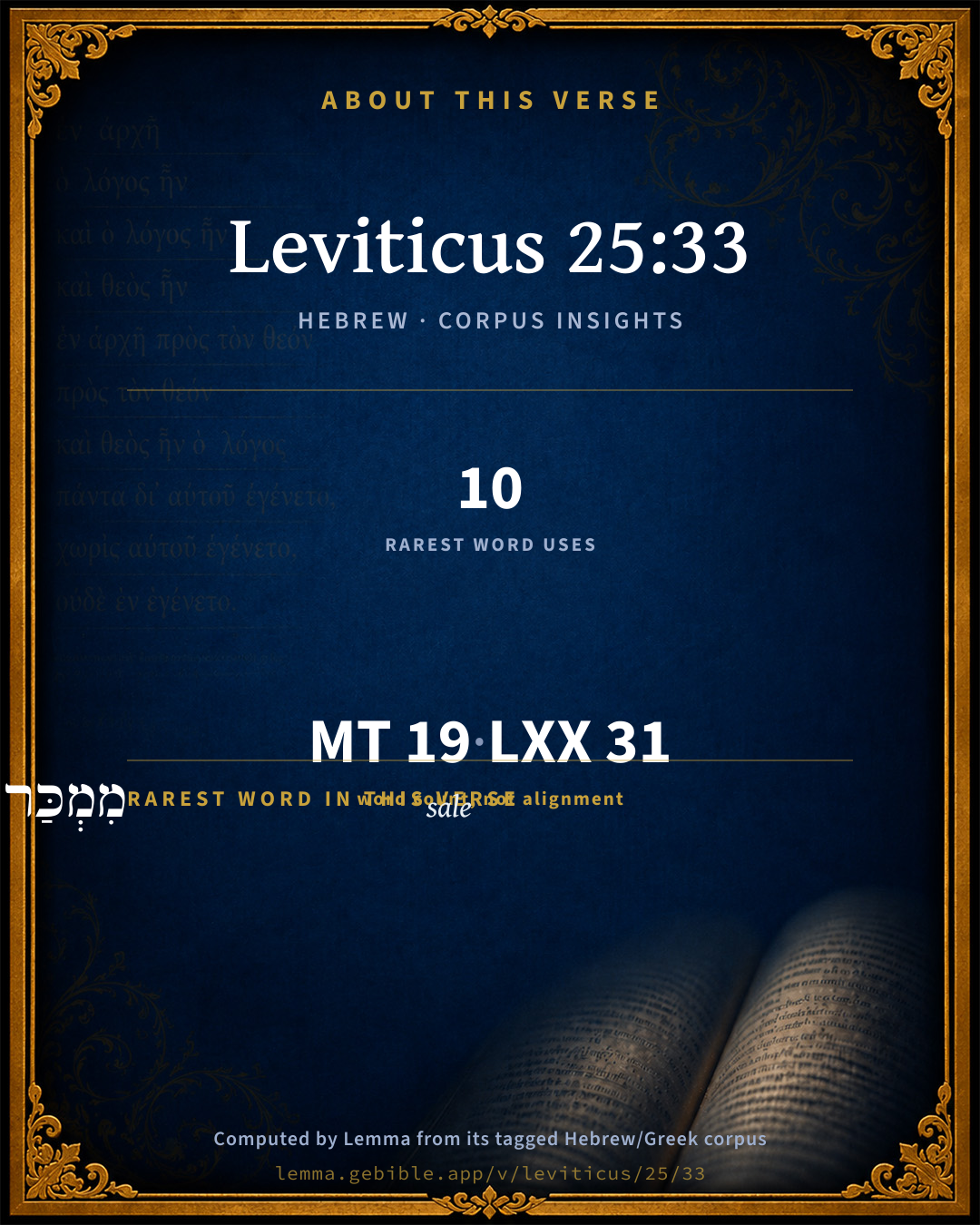
The rarest word here is מִמְכַּר sale H4465 — appearing just 10 times in the whole Hebrew Bible.

Shared distinctive vocabulary

מִמְכַּר sale H4465 occurs in 10 verses of the Hebrew Bible. Also found in:

Grammatical profile

  • 2 verbs
  • 13 nouns
  • 1 pronoun
  • 1 preposition
  • 1 conjunction
  • 1 particle

Verb forms

  • יִגְאַל֙ Qal · Imperfect
  • וְיָצָ֧א Qal · Sequential Perfect

Repetition

Words recur within this verse — often emphatic in Hebrew:

  • הַלְוִיִּ֔ם Levite H3881 ×2
  • בַּ֛יִת house H1004 ×2
  • וְעִ֥יר city H5892 ×2
  • אֲחֻזָּת֖וֹ possession H272 ×2

Hebrew & Septuagint length

In English translation the verse runs 40 words from the Hebrew and 46 from the Septuagint (LXX English) — closely comparable.

A rough comparison of the two English renderings, which tokenize alike — not a word-level alignment.

Word counts can differ between the Hebrew and the Greek without any difference in meaning — e.g. the Hebrew direct-object marker אֵת has no separate Greek word, and Greek often adds the article ὁ.

In the original languages it is 19 Hebrew tokens and 31 Greek tokens — but the two are counted differently (Hebrew bundles its prefixes and suffixes into one token; the Greek is in lemma form), so that isn’t a like-for-like length.

Cross-references

2

Topical passages linked to Leviticus 25:33 in the Treasury of Scripture Knowledge — connected by theme and wording, ordered by reader-vote popularity; previews shown in the World English Bible.

  • Numbers 18:20–24 Yahweh said to Aaron, You shall have no inheritance in their land, neither shall you have any portion among them: I am your portion and your inheritance among the children of Israel.
  • Deuteronomy 18:1–2 The priests the Levites, [even] all the tribe of Levi, shall have no portion nor inheritance with Israel: they shall eat the offerings of Yahweh made by fire, and his inheritance.

Cross-references courtesy of OpenBible.info (CC BY 4.0).

Hebrew and Greek witnesses Masoretic Hebrew ↔ Greek Septuagint

The same verse in the two great witnesses to the Old Testament, shown verse-for-verse.

These are two independent witnesses, not word-aligned to each other, and the Septuagint is shown in lemma (dictionary) form.

Hebrew Leviticus 25:33 Masoretic · Westminster Leningrad Codex

וַאֲשֶׁ֤ר יִגְאַל֙ מִן הַלְוִיִּ֔ם וְיָצָ֧א מִמְכַּר בַּ֛יִת וְעִ֥יר אֲחֻזָּת֖וֹ בַּיֹּבֵ֑ל כִּ֣י בָתֵּ֞י עָרֵ֣י הַלְוִיִּ֗ם הִ֚וא אֲחֻזָּתָ֔ם בְּת֖וֹךְ בְּנֵ֥י יִשְׂרָאֵֽל

The Levites may redeem the house that was sold, and the city of his possession, and it shall be released in the Jubilee; for the houses of the cities of the Levites are their possession among the children of Israel.

World English Bible · Public Domain

Greek LXX Leviticus 25:33 Septuagint · lemma form

καί ὅς ἄν λυτρόω παρά ὁ λευίτης καί ἐκἔρχομαι ὁ διάπρασις αὐτός οἰκία πόλις κατάσχεσις αὐτός ἐν ὁ ἄφεσις ὅτι οἰκία ὁ πόλις ὁ λευίτης κατάσχεσις αὐτός ἐν μέσος υἱός ἰσραήλ

And if any one shall redeem a house of the Levites, then shall their sale of the houses of their possession go out in the release; because the houses of the cities of the Levites are their possession in the midst of the children of Israel.

LXX2012 (modern English Septuagint) · Public Domain

On this verse, The Cambridge Bible for Schools and Colleges discusses the Septuagint’s reading. Read the note in Commentary ↓

Hebrew: Westminster Leningrad Codex (CC BY 4.0). Greek: Septuagint (public domain); English from LXX2012 (modern English Septuagint) (Public Domain). How the Septuagint differs from the Hebrew →

Targum (Aramaic paraphrase)

2

The Targum is the ancient Jewish Aramaic paraphrase of the Hebrew Scriptures — an interpretive translation, not the Hebrew text itself. Onkelos (literal) and Pseudo-Jonathan (expansive) render the Torah, and Jonathan the Prophets. Coverage is partial: where no permissively-licensed English translation exists for a verse, only the Aramaic is shown. This is verse-level text, not a word-by-word alignment to the Hebrew.

  1. Targum Onkelos Torah (Genesis–Deuteronomy)
    וְדִי יִפְרוֹק מִן לֵיוָאֵי וְיִפּוֹק זְבִין בֵּיתָא וְקַרְתָּא אַחֲסַנְתֵּהּ בְּיוֹבֵלָא אֲרֵי בָתֵּי קִרְוֵי לֵיוָאֵי הִיא אַחְסַנְתְּהוֹן בְּגוֹ בְּנֵי יִשְׂרָאֵל

    (no public-domain English translation for this verse)

    Targum Onkelos — Aramaic: “Onkelos Genesis” (public domain); “Onkelos Exodus” (public domain); “Onkelos Leviticus” (public domain); “Onkelos Numbers” (public domain); “Onkelos Deuteronomy” (public domain). English: “Sefaria Community Translation” (CC0 1.0 (public-domain dedication)); “J.W. Etheridge. The Targums of Onkelos and Jonathan Ben Uzziel on the Pentateuch. London: Longmans, Green, 1862” (public domain). Text via Sefaria.

  2. Targum Pseudo-Jonathan Torah (Genesis–Deuteronomy)
    וּמַאן דְיִפְרוֹק מִן לֵיוָאֵי וְיִפּוֹק זְבִינֵי בֵּיתָא וְקִירְוֵי אַחְסַנְתְּהוֹן בְּיוֹבְלָא אֲרוּם בָּתֵּי קִירְוֵי לֵיוָאֵי הִיא אַחְסַנְתְּהוֹן בְּגוֹ בְּנֵי יִשְרָאֵל

    And when one hath purchased of the Levites the house that was sold in the cities of their possession, it shall go out at the Jubela; for the houses of the Levites are their inheritance among the children of Israel.

    Targum Pseudo-Jonathan — Aramaic: “Targum Jonathan on Genesis” (public domain); “Targum Jonathan on Exodus” (public domain); “Targum Jonathan on Leviticus” (public domain); “Targum Jonathan on Numbers” (public domain); “Targum Jonathan on Deuteronomy” (public domain). English: “The Targum of Jonathan ben Uzziel, trans. J. W. Etheridge, London, 1862” (public domain). Text via Sefaria.

Commentary

Notes on Leviticus 25:33 from classic Christian and Jewish commentators (each source and its license shown beneath its notes). The classic Christian expositions comment on the surrounding passage and are grouped to its opening verse, so a note may address several verses; the Jewish commentaries on the Tanakh (Rashi and others) are per-verse, so they appear only where the commentator wrote on this verse.

Lemma curates 59 commentaries, every one of them public domain or Creative Commons licensed, each selected and text-cleaned for this edition rather than reprinted as found. About our sources →

Trapp's Complete Commentary

John Trapp

Lev 25:33 And if a man purchase of the Levites, then the house that was sold, and the city of his possession, shall go out in [the year of] jubile: for the houses of the cities of the Levites [are] their possession among the children of Israel.

Ver. 33. See previous verse.

John Trapp, A Commentary or Exposition upon All the Books of the Old and New Testament (1647–1656) — public domain. Text from a community e-Sword module.

Ellicott's Commentary for English Readers

(33) And if a man purchase of the Levites.—Better, And if one of the Levites redeem it, that is, even if a Levite redeemed the house which his brother Levite was obliged to sell through poverty, the general law of house property is not to obtain even among the Levites themselves. They are to treat each other according to the law of landed property.

Then the house that was sold, and the city of his possession, shall go out.—Better, then the house that was sold in the city of his possession shall go out, that is, in the year of jubile the house is to revert to the vendor just as if it were landed property. Thus, for instance, the house of the Levite A, which he, out of poverty, was obliged to sell to the non-Levite B, and which was redeemed from him by a Levite C, reverts in the jubile year from the Levite C to the original Levitical proprietor A. It is, however, more than probable that the negative particle has dropped out of the text, and that the passage as it originally stood was, “And if one of the Levites doth not redeem it.” That is, if he does not act the part of the nearest of kin, then the house reverts in the year of jubile to the original Levitical owner, just as landed property. The Vulg. has still the negative particle.

For the houses of the cities of the Levites are their possession.—As these houses were all which the Levites possessed, they were as important to them as the land was to the other tribes, hence they were to be treated legally in the same way as the soil.

A Bible Commentary for English Readers, edited by Charles John Ellicott (1878–1897) — public domain. Text from a community e-Sword module.

The Cambridge Bible for Schools and Colleges

gen. ed. J. J. S. Perowne

33. if one of the Levites redeem] The Heb. presents great difficulty as it stands. If we take the rendering in the text, it is unsuitable, because in the case there supposed, viz. that one Levite redeems the house of another, obviously the statement that the house shall ‘go out’ (i.e. return to its original owner) in the Jubile adds nothing to the law as to Levites, set forth in Lev_25:32. But if we take R.V. mg. (so LXX.), if a man redeem from the Levites, this purchase on the part of a non-Levite had no connexion with the Jubile law, as not being the purchasing back of a possession on the part of one of the family of the original owner. It seems best therefore to suppose that the ‘not’ which the Vulg. supplies (see R.V. mg.) has dropped out of the original text. The sense will then be, If one of the Levites does not redeem, then the house which he has sold will at any rate return into his possession at the Jubile.

and the city of his possession] The expression is a somewhat awkward one. The intention seems to be to provide that this rule shall operate only as regards houses within the cities set apart for the Levites (Num_35:2; Jos_21:2-40), and not elsewhere.

The Cambridge Bible for Schools and Colleges (gen. ed. J. J. S. Perowne; Cambridge University Press, 1878–1918) — public domain. Text from a community e-Sword module.

John Gill's Exposition

And if a man purchase of the Levites,.... An house or city, as Jarchi, and which the following clause confirms, that is, if a common Israelite made such a purchase, then it was redeemable, but if a Levite purchased of a Levite, then, as the same writer observes, it was absolutely irredeemable:

then the house that was sold, and the city of his possession, shall go out in the year of jubilee; to the original owner of it, as fields and houses in villages sold by the Israelites

for the houses of the cities of the Levites are their possession among the children of Israel; and their only possession, and therefore if those, when sold, were irredeemable, they would entirely be without any; and hence care is taken they should not; so Jarchi observes, that the Levites had no possession of fields and vineyards, only cities to dwell in, and their suburbs; wherefore cities were to them instead of fields, and their redemption was as that of fields, that so their inheritance might not be broken off from them.

John Gill's Exposition of the Whole Bible (1746–1763) — public domain (CC PDM 1.0). Text via the HelloAO Bible API.

Haydock's Catholic Bible Commentary

Owners. The Levites had no other possessions, but these cities and 2000 cubits of land around them. The priests might buy of one another, Jeremias xxxi. 7.

George Leo Haydock (1774–1849), Haydock's Catholic Family Bible and Commentary, 1859 edition — public domain. Excludes Psalms (Douay-Rheims chapter numbering differs from Protestant) and Deuterocanonical books (Catholic canon only).

Matthew Poole's English Annotations

Or thus, But he that shall redeem it shall be or must be of the Levites, i.e. no person of another tribe, though by marriage near akin to the selling Levite, shall redeem it, but Levites only, and any of them shall have the same power to redeem it, which in other tribes only the nearest kindred have; and, in case none of them redeem it, yet the house that was sold, and the city of his possession, i.e. his share or interest in the city of his possession, shall go out and return to the Levites without any redemption.

Matthew Poole's English Annotations on the Holy Bible (1683–1685) — public domain. Text from a community e-Sword/MySword module.

Whedon's Commentary on the Bible

Daniel D. Whedon

33. And if a man purchase of the Levites — The Hebrew is “redeem” instead of “purchase.” Ewald, with others, inserts a negative from the Vulgate, which makes better sense — “si redemptae non fuerint, in jubilaeo revertentur ad dominos.” If the houses shall not have been redeemed, they shall revert to their owners in the jubilee.

Daniel D. Whedon (gen. ed.), Commentary on the Old and New Testaments (1874–1909) — public domain. Text from a community e-Sword module.

unfoldingWord translationNotes

Door43 World Missions Community

the house that was sold in the city where it is located must be returned

This can be stated in active form. AT: "the one who bought the house in the city where it is located must return it" (See: Active or Passive)

the year of Jubilee

"the year of restoration" or "the year to return land and free slaves"

their property among the people of Israel

The land of Canaan was divided up among the people of Israel, but of that land, the Levites were only given 48 cities with the fields around them. AT: "their part of the land that the Israelites possessed" or "their property in the land of Israel"

But the fields around their cities may not be sold

This can be stated in active form. AT: "But the Levites must not sell the fields around their cities" (See: Active or Passive)

translationWords

people group

Israel

unfoldingWord translationNotes — © Distant Shores Media and the Door43 World Missions Community, licensed CC BY-SA 4.0. Source: git.door43.org/Door43/en_tn.

Rashi

Rabbi Shlomo Yitzchaki (Rashi)

‎הלוים‎ מן‎ואשר יגאל ‏ ‎‎‎ ‎— This means, and if any one buys a house or a city from them, then that house that has been sold or the city that was sold shall go out in the Jubilee and shall return unto the Levite who has sold it, and not be irredeemable as are other houses in “cities that have a wall” viz., those of Israelites. According to this explanation, יגאל has here the meaning of a “sale”. Another explanation is (taking יגאל here in its usual meaning of “redeeming”): Because it is stated in the previous verse: “the Levites shall have the right of redemption at any time”, I might think that Scripture is speaking only of an ordinary Israelite purchaser who bought a house in a city of the Levites, but when a Levite bought a house from another Levite it shall be irredeemable! Scripture therefore states “[the Levites shall have the right redemption at any time]”, ואשר יגאל מן הלוים, “also if one who redeems does so from the Levites — i. e. that also one (a Levite) who redeems a house from the possession of another Levite shall have the right to do so at any time (Sifra, Behar, Chapter 6 6).

ויצא ממכר בית THEN THE HOUSE THAT WAS SOLD… SHALL GO OUT [IN THE JUBILEE] — According to the second explanation of ‎'ואשר יגאל וכו‎‎ given above, this contains another command and is not a continuation of the words that precede. They mean: “but if he (the vendor) did not redeem it” then it shall go out in the Jubilee and shall not become irredeemable at the end of the first year as is the case with the house of an Israelite.

כי בתי ערי הלוים הוא אחזתם FOR THE HOUSES OF THE CITIES OF THE LEVITES ARE THEIR POSSESSION —They had no separate property of fields and vineyards, only cities to dwell therein together with the open land surrounding them; these, therefore, in their case took the place of the fields possessed by the Israelites and should thus be redeemable just like fields, in order that their inheritance should not be alienated from them.

Rashi on the Tanakh — English translations: “The Judaica Press complete Tanach with Rashi, translated by A. J. Rosenberg” (CC BY 4.0); “Pentateuch with Rashi's commentary by M. Rosenbaum and A.M. Silbermann, 1929-1934” (public domain); “The Metsudah Tanach series, Lakewood, N.J” (CC BY 4.0); and “The Book of Joshua, Metsudah Publications, 1997” (CC BY 4.0). Text via Sefaria.

Ramban (Nachmanides)

Rabbi Moshe ben Nachman (Ramban / Nachmanides)

AND IF ONE OF THE LEVITES REDEEM. The plain meaning of this verse appears to be as follows: He had stated [in the previous verse], the Levites have a perpetual right of redemption, to redeem immediately [even before the period of two years after the sale of the fields, which an Israelite must wait before he is allowed to redeem], and to redeem at any time [a house in a walled city, even after the expiration of a year since the sale, after which time an Israelite cannot redeem]. But He did not explain with reference to them [the Levites] whether their relatives [also] have the right of redemption, nor whether the Jubilee applies to them. Therefore He stated again, And if one of the Levites redeem, be the redeemer the seller himself or his relative a Levite, then the house that was sold, and the city of his possession, shall go out in the Jubilee from the hand of the purchaser. He should redeem it on this understanding, that he shall reckon the years of the sale thereof and restore the overplus, meaning to say that the Jubilee does apply to them [the Levites], and the manner of their redemption shall be as He said of the Israelites, and he shall reckon the years of the sale thereof etc. And our Rabbis have said that the verse speaks of a Levite who buys from a Levite. According to their word, the interpretation of the verse appears to me to be as follows: It was the custom in former times in Israel that when a man had to sell his field, the person who had precedence in his inheritance [i.e., who was the nearest relative who could inherit] would come and buy it, and it was this that was called “redemption,” as it is said, Buy thee my field that is in Anathoth, for the right of redemption is thine to buy it, and so also is it explained there in the matter of Boaz. And it appears to me that they administered a law of precedence for him, just as our Rabbis enacted for us the law of [the prerogative of] the neighbor, and [if other people wanted to buy it], they would acquire [the right of possession] from the “first redeemer” by the [symbolic act of] acquisition of a scarf, as did Boaz.. See Ramban on Exodus 28:41. Thus Scripture is stating here that when a Levite redeems the inheritance of a Levite, that is to say, when he buys it from him as is the law of redemption, then that [land] acquired shall go out in the Jubilee. It thus teaches that the Jubilee applies to them [the Levites] in the case of “redemption” just as in the case of any other sale [among Israelites]. Scripture did not have to mention this law in the case of a plain sale [i.e., to say that if a Levite sold his field to a non-Levite, who is not his near relative, that it goes back to its original owner, the Levite, in the Jubilee], for they [Levites] are part of all Israel [and it is self-understood that the same laws apply to them]; except that He strengthened their legal right [by giving them, as explained above], a perpetual [privilege of] redemption. This law of “redemption” applies also to Israelites [i.e., that if they bought from Levites, the Levites have an unrestricted right of redemption forever]. Scripture, however, mentioned it with reference to the Levites, in order that one should not say that the [forty-eight] cities were only given to the whole tribe of Levi [and not to any particular person], and that therefore [fields which a Levite had sold] go back from an Israelite [in the Jubilee, i.e., if the purchaser was an Israelite he must give them back], but they do not go back from a Levite [i.e., if the purchaser was a Levite he does not have to give them back, since they remain anyway in the hands of the Levitical tribe], and certainly [we might think that] from a near kinsman [i.e., a Levite] whom we have made liable to buy [the field of his poor brother-Levite, those fields surely do not go back in the Jubilee]; therefore He said that this redemption too goes back in the Jubilee, and from the [law stated in connection with the] Levite we deduce [that the same law applies] to the Israelites. It is possible also that the Levites are not permitted to sell of their cities in any transaction [i.e., whether a field or house] to an Israelite, and therefore all their purchases are termed redemption [because only other Levites, who are their kinsmen, can buy from them].

Ramban (Nachmanides) on the Tanakh — English translation: “Commentary on the Torah by Ramban (Nachmanides). Translated and annotated by Charles B. Chavel. New York, Shilo Pub. House, 1971-1976” (CC BY 4.0). Text via Sefaria.

Lesson kit

Teaching starters — assembled from the data on this page, not authored interpretation. Every prompt links to the verse data it draws on. Edit before teaching.

Leviticus, in the Pentateuch, opens this verse with 19 words (15 distinct Hebrew lemmas). Its most distinctive word is mimkâr (“sale”). A historical commentator’s framing appears above. Read the whole chapter for the surrounding context.

Discussion questions

  1. The word mimkâr carries the sense “sale.” How does it shape the verse?
  2. How does Leviticus 25:14, which shares the word «sale», read alongside this verse?
  3. What does the repetition of “Levite” (2× in this one verse) do in this verse?
  4. These translations render this verse differently. What is at stake in choosing one wording over another?
  5. «יִגְאַל֙» is a Qal Imperfect verb. How does that grammatical form shape the action described?
  6. Compare how Trapp's Complete Commentary and Ellicott's Commentary for English Readers read this verse. Where do they agree or differ?

Things to notice

Reading settings

Reading text

Shown beneath each verse's original-language words.

Old Testament
Old Testament edition

Read the OT as the Masoretic Hebrew (MT) or the Greek Septuagint (LXX).

English shown for the Greek Septuagint (in the Hebrew ↔ Greek comparison).

Comparing translations? Open the Compare panel on any verse page to stack up to four side by side.