
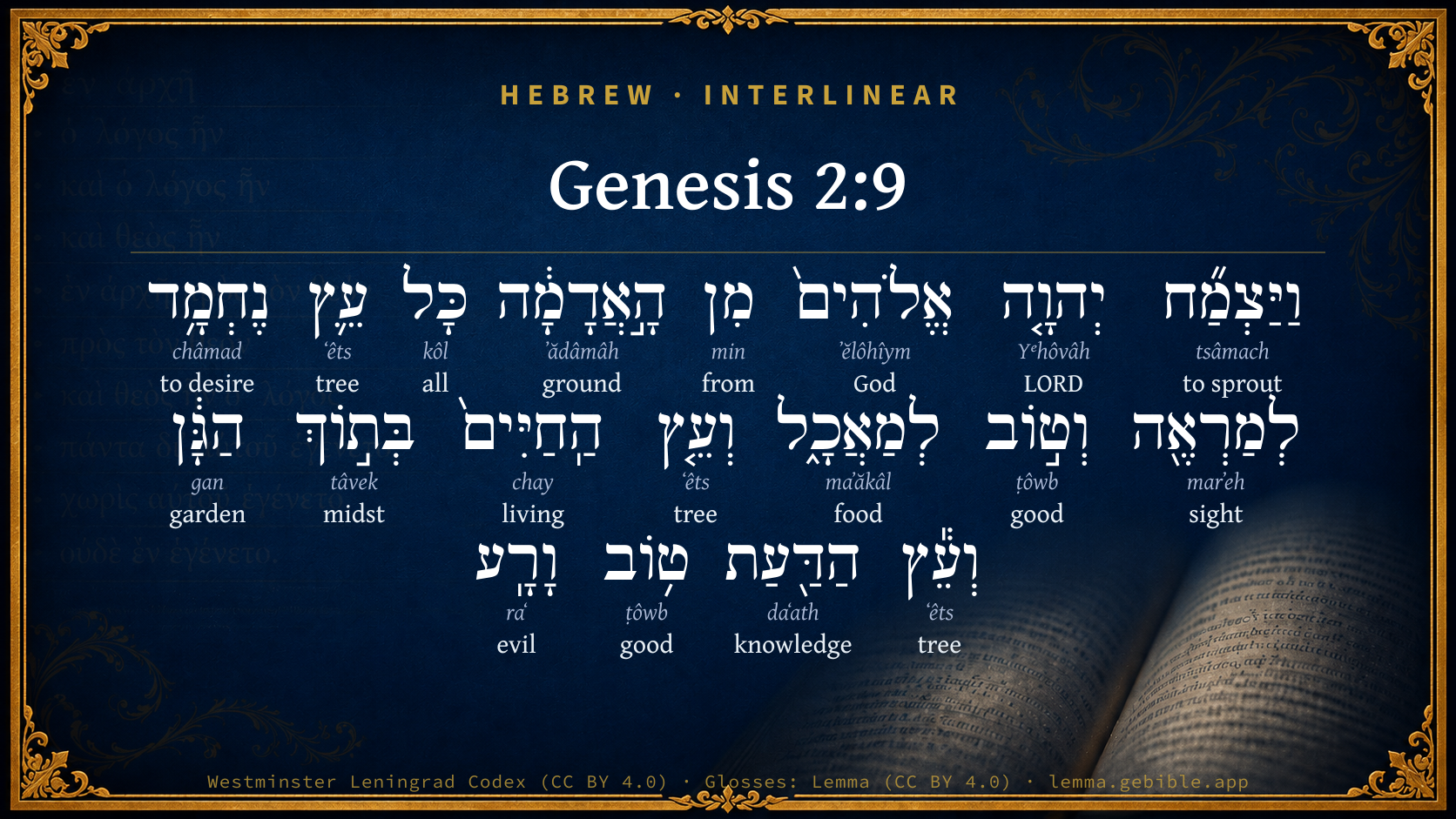
Genesis 2:9

Hebrew (Westminster Leningrad Codex) Genesis 2:9 appears in the Hebrew Old Testament. The text above is from the Westminster Leningrad Codex. Each word links to its Strong’s number, a concise gloss, and parsing drawn from the Open Scriptures Hebrew Bible morphology. Click any word for its full Brown-Driver-Briggs (BDB) entry.
Download image
Cite this verse

Genesis 2:9 (World English Bible). Public Domain. Lemma interlinear Bible study tool, https://lemma.gebible.app/v/genesis/2/9.

Show BibTeX & RIS
BibTeX
RIS
English Translation
Out of the ground Yahweh God made every tree to grow that is pleasant to the sight, and good for food; the tree of life also in the midst of the garden, and the tree of the knowledge of good and evil.
World English Bible · Public Domain
Highlights
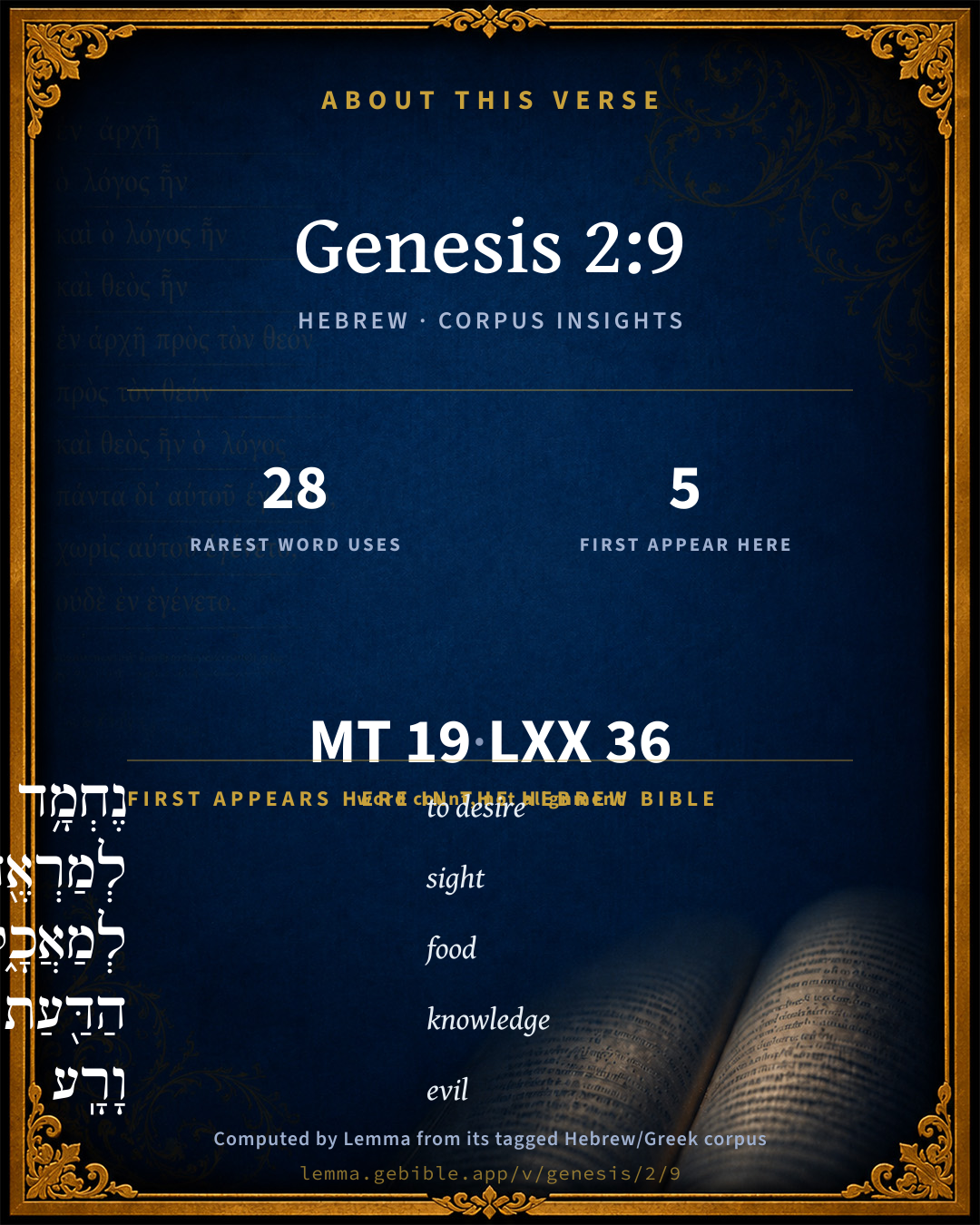
  • 5 first appearances in the Hebrew Bible
Full analysis ↓
Download a study sheet

One document with this verse’s original text, its word-by-word gloss line, the meaning frame, cross-references with their text, attributed commentary, and full source and license credits — printable, and it pastes into notes with its structure intact.

This verse Autodidact and up

Study sheet (.html) Plain text (.txt)

A passage Seminary Student

Up to 50 verses in one chapter. A passage sheet keeps up to 6 commentary sources and 12 cross-references per verse, in the order this page ranks them, and says so on the sheet whenever that leaves anything out. Ask for a single verse and you get the Autodidact verse sheet above.

Everything on this page stays free to read, with no account — the sheet is a download of what is already on screen, not access to it.

Want to remove ads? Support Godless Engineer
Compare translations 3

The same verse in 3 English versions, stacked beneath the original-language interlinear above. Click any original word for its lexicon entry.

Each is an independent rendering of the whole verse — the interlinear is not word-aligned to these translations.

Highlighted words mark where these versions differ — a whole-verse word diff, not a word-by-word alignment.

  • World English Bible Public Domain
    Out of the ground Yahweh God made every tree to grow that is pleasant to the sight, and good for food; the tree of life also in the midst of the garden, and the tree of the knowledge of good and evil.
  • King James Version Public Domain
    And out of the ground made the LORD God to grow every tree that is pleasant to the sight, and good for food; the tree of life also in the midst of the garden, and the tree of knowledge of good and evil.
  • unfoldingWord Literal Text CC BY-SA 4.0
    And Yahweh God had made to grow from the ground every tree is pleasant to the sight and good for food, and the tree of life in the middle of the garden, and the tree of the knowledge of good and evil.

unfoldingWord Literal Text — © unfoldingWord, licensed CC BY-SA 4.0. Word-aligned USFM3 via Door43 (git.door43.org/unfoldingWord/en_ult).

Versions to compare (up to 4)

3 of 4 selected

Show all 18 translations

Every available English version of this verse, each an independent rendering of the whole verse.

  • World English Bible Public Domain
    Out of the ground Yahweh God made every tree to grow that is pleasant to the sight, and good for food; the tree of life also in the midst of the garden, and the tree of the knowledge of good and evil.
  • Berean Standard Bible Public Domain
    Out of the ground the LORD God gave growth to every tree that is pleasing to the eye and good for food. And in the middle of the garden were the tree of life and the tree of the knowledge of good and evil.
  • Majority Standard Bible Public Domain
    Out of the ground the LORD God gave growth to every tree that is pleasing to the eye and good for food. And in the middle of the garden were the tree of life and the tree of the knowledge of good and evil.
  • King James Version Public Domain
    And out of the ground made the LORD God to grow every tree that is pleasant to the sight, and good for food; the tree of life also in the midst of the garden, and the tree of knowledge of good and evil.
  • American Standard Version (1901) Public Domain
    And out of the ground made Jehovah God to grow every tree that is pleasant to the sight, and good for food; the tree of life also in the midst of the garden, and the tree of the knowledge of good and evil.
  • Revised Version (1885) Public Domain
    And out of the ground made the LORD God to grow every tree that is pleasant to the sight, and good for food; the tree of life also in the midst of the garden, and the tree of the knowledge of good and evil.
  • Geneva Bible (1599) Public Domain
    (For out of the ground made the Lord God to grow euery tree pleasant to the sight, and good for meate: the tree of life also in the mids of the garden, and the tree of knowledge of good and of euill.
  • Douay-Rheims (1899) Public Domain
    And the Lord God brought forth of the ground all manner of trees, fair to behold, and pleasant to eat of: the tree of life also in the midst of paradise: and the tree of knowledge of good and evil.
  • Young's Literal Translation Public Domain
    and Jehovah God causeth to sprout from the ground every tree desirable for appearance, and good for food, and the tree of life in the midst of the garden, and the tree of knowledge of good and evil.
  • Literal Standard Version CC BY-SA 4.0
    and YHWH God causes to sprout from the ground every tree desirable for appearance, and good for food, and the Tree of Life in the midst of the garden, and the Tree of the Knowledge of Good and Evil.
  • Unlocked Literal Bible CC BY-SA 4.0
    Out of the ground Yahweh God made every tree to grow that is pleasant to the sight and good for food. This included the tree of life that was in the midst of the garden, and the tree of the knowledge of good and evil.
  • unfoldingWord Literal Text CC BY-SA 4.0
    And Yahweh God had made to grow from the ground every tree is pleasant to the sight and good for food, and the tree of life in the middle of the garden, and the tree of the knowledge of good and evil.
  • Darby Bible Public Domain
    And out of the ground Jehovah Elohim made every tree grow that is pleasant to the sight, and good for food; and the tree of life, in the midst of the garden, and the tree of the knowledge of good and evil.
  • World Messianic Bible Public Domain
    Out of the ground the LORD God made every tree to grow that is pleasant to the sight, and good for food, including the tree of life in the middle of the garden and the tree of the knowledge of good and evil.
  • Webster's Bible Public Domain
    And out of the ground made the LORD God to grow every tree that is pleasant to the sight, and good for food; the tree of life also in the midst of the garden, and the tree of knowledge of good and evil.
  • Free Bible Version CC BY-SA 4.0
    The Lord God made all kinds of trees grow in the garden, beautiful trees and trees producing fruit that's good to eat. The tree of life was in the middle of the garden, along with the tree of the knowledge of good and evil.
  • Bible in Basic English Public Domain
    And out of the earth the Lord made every tree to come, delighting the eye and good for food; and in the middle of the garden, the tree of life and the tree of the knowledge of good and evil.
  • JPS Tanakh (1917) Public Domain
    And out of the ground made the LORD God to grow every tree that is pleasant to the sight, and good for food; the tree of life also in the midst of the garden, and the tree of the knowledge of good and evil.

Literal Standard Version (2020), Covenant Press — licensed CC BY-SA 4.0. Text via the HelloAO Bible API (eBible.org). Unlocked Literal Bible (unfoldingWord) — licensed CC BY-SA 4.0. Text via the HelloAO Bible API (eBible.org). unfoldingWord Literal Text — © unfoldingWord, licensed CC BY-SA 4.0. Word-aligned USFM3 via Door43 (git.door43.org/unfoldingWord/en_ult). Free Bible Version, Dr. Jonathan Gallagher — licensed CC BY-SA 4.0. Text via the HelloAO Bible API (eBible.org).

Word by word

More ways to search: Search by grammar → Find every occurrence → Compare this word →

Practice this passage: Drill this verse → Learn its vocabulary →

נֶחְמָ֥ד
châmad
H2530
“desiring”
Verb, Niphal, Participle Active, Masculine, Singular, Absolute
Part of Speech
Verb
Stem
Niphal
Form
Participle Active
Gender
Masculine
Number
Singular
State
Absolute
Full BDB Definition

Origin: a primitive root

TWOT: 673

to desire, covet, take pleasure in, delight in (verb) - (Qal) to desire - (Niphal) to be desirable - (Piel) to delight greatly, desire greatly - desirableness, preciousness (noun feminine)
  1. וַיַּצְמַ֞ח tsâmach H6779 “and · to sprout” Conjunction + Verb, Hiphil, Sequential Imperfect, 3rd Person, Masculine, Singular
  2. יְהוָ֤ה Yᵉhôvâh H3068 “LORD” Noun, Proper
  3. אֱלֹהִים֙ ʼĕlôhîym H430 “God(s)” Noun, Common, Masculine, Plural, Absolute
  4. מִן min H4480 “from” Preposition
  5. הָ֣אֲדָמָ֔ה ʼădâmâh H127 “the · ground” Particle, Definite Article + Noun, Common, Feminine, Singular, Absolute
  6. כָּל kôl H3605 “all of” Noun, Common, Masculine, Singular, Construct
  7. עֵ֛ץ ʻêts H6086 “tree” Noun, Common, Masculine, Singular, Absolute
  8. לְמַרְאֶ֖ה marʼeh H4758 “to/for · sight” Preposition + Noun, Common, Masculine, Singular, Absolute
  9. וְט֣וֹב ṭôwb H2896 “and · good” Conjunction + Adjective, Adjective, Masculine, Singular, Absolute
  10. לְמַאֲכָ֑ל maʼăkâl H3978 “to/for · food” Preposition + Noun, Common, Masculine, Singular, Absolute
  11. וְעֵ֤ץ ʻêts H6086 “and · tree of” Conjunction + Noun, Common, Masculine, Singular, Construct
  12. הַֽחַיִּים֙ chay H2416 “the · living things” Particle, Definite Article + Noun, Common, Masculine, Plural, Absolute
  13. בְּת֣וֹךְ tâvek H8432 “in/at · midst of” Preposition + Noun, Common, Masculine, Singular, Construct
  14. הַגָּ֔ן gan H1588 “the · garden” Particle, Definite Article + Noun, Common, Both, Singular, Absolute
  15. וְעֵ֕ץ ʻêts H6086 “and · tree of” Conjunction + Noun, Common, Masculine, Singular, Construct
  16. הַדַּ֖עַת daʻath H1847 “the · knowledge” Particle, Definite Article + Noun, Common, Feminine, Singular, Absolute
  17. ט֥וֹב ṭôwb H2896 “good” Adjective, Adjective, Masculine, Singular, Absolute
  18. וָרָֽע raʻ H7451 “and · evil” Conjunction + Adjective, Adjective, Masculine, Singular, Absolute

About this verse

These counts appear in no published source. They are computed here, from the morphology-tagged text and Lemma’s own curated glosses. What Lemma adds →

19
words
16
distinct lemmas
Pentateuch
section

First appearance in Scripture

These words make their first canonical appearance in the Hebrew Bible here:

  • נֶחְמָ֥ד to desire H2530
  • לְמַרְאֶ֖ה sight H4758
  • לְמַאֲכָ֑ל food H3978
  • הַדַּ֖עַת knowledge H1847
  • וָרָֽע evil H7451

Shared distinctive vocabulary

נֶחְמָ֥ד to desire H2530 occurs in 27 verses of the Hebrew Bible. Also found in:

Grammatical profile

  • 2 verbs
  • 13 nouns
  • 3 adjectives
  • 1 preposition

Verb forms

  • וַיַּצְמַ֞ח Hiphil · Sequential Imperfect
  • נֶחְמָ֥ד Niphal · Participle Active

Repetition

Words recur within this verse — often emphatic in Hebrew:

  • עֵ֛ץ tree H6086 ×3
  • וְט֣וֹב good H2896 ×2

Hebrew & Septuagint length

In English translation the verse runs 42 words from the Hebrew and 43 from the Septuagint (LXX English) — closely comparable.

A rough comparison of the two English renderings, which tokenize alike — not a word-level alignment.

Word counts can differ between the Hebrew and the Greek without any difference in meaning — e.g. the Hebrew direct-object marker אֵת has no separate Greek word, and Greek often adds the article ὁ.

In the original languages it is 19 Hebrew tokens and 36 Greek tokens — but the two are counted differently (Hebrew bundles its prefixes and suffixes into one token; the Greek is in lemma form), so that isn’t a like-for-like length.

Cross-references

17

Topical passages linked to Genesis 2:9 in the Treasury of Scripture Knowledge — connected by theme and wording, ordered by reader-vote popularity; previews shown in the World English Bible.

  • Genesis 3:22 Yahweh God said, "Behold, the man has become like one of us, knowing good and evil. Now, lest he put forth his hand, and also take of the tree of life, and eat, and live forever..."
  • Revelation 2:7 He who has an ear, let him hear what the Spirit says to the assemblies. To him who overcomes I will give to eat of the tree of life, which is in the Paradise of my God.
  • Revelation 22:14 Blessed are those who do his commandments, that they may have the right to the tree of life, and may enter in by the gates into the city.
  • Revelation 22:2 in the middle of its street. On this side of the river and on that was the tree of life, bearing twelve kinds of fruits, yielding its fruit every month. The leaves of the tree were for the healing of the nations.
  • Proverbs 11:30 The fruit of the righteous is a tree of life. He who is wise wins souls.
  • Ezekiel 47:12 By the river on the bank of it, on this side and on that side, shall grow every tree for food, whose leaf shall not wither, neither shall the fruit of it fail: it shall bring forth new fruit every month, because the waters of it issue out of the sanctuary; and the fruit of it shall be for food, and the leaf of it for healing.
  • Proverbs 3:18 She is a tree of life to those who lay hold of her. Happy is everyone who retains her.
  • Genesis 2:17 but of the tree of the knowledge of good and evil, you shall not eat of it: for in the day that you eat of it you will surely die."
  • Genesis 3:3 but of the fruit of the tree which is in the midst of the garden, God has said, 'You shall not eat of it, neither shall you touch it, lest you die.'"
  • Ezekiel 31:8–9 The cedars in the garden of God could not hide it; the fir trees were not like its boughs, and the plane trees were not as its branches; nor was any tree in the garden of God like it in its beauty.
  • Ezekiel 31:16 I made the nations to shake at the sound of his fall, when I cast him down to Sheol with those who descend into the pit; and all the trees of Eden, the choice and best of Lebanon, all that drink water, were comforted in the lower parts of the earth.
  • Isaiah 44:25 who frustrates the signs of the liars, and makes diviners mad; who turns wise men backward, and makes their knowledge foolish;
  • Isaiah 47:10 For you have trusted in your wickedness; you have said, None sees me; your wisdom and your knowledge, it has perverted you, and you have said in your heart, I am, and there is none else besides me.
  • Ezekiel 31:18 To whom are you thus like in glory and in greatness among the trees of Eden? yet shall you be brought down with the trees of Eden to the lower parts of the earth: you shall lie in the midst of the uncircumcised, with those who are slain by the sword. This is Pharaoh and all his multitude, says the Lord Yahweh.
  • 1 Corinthians 8:1 Now concerning things sacrificed to idols: We know that we all have knowledge. Knowledge puffs up, but love builds up.
  • Deuteronomy 6:25 It shall be righteousness to us, if we observe to do all this commandment before Yahweh our God, as he has commanded us.

Cross-references courtesy of OpenBible.info (CC BY 4.0).

Hebrew and Greek witnesses Masoretic Hebrew ↔ Greek Septuagint

The same verse in the two great witnesses to the Old Testament, shown verse-for-verse.

These are two independent witnesses, not word-aligned to each other, and the Septuagint is shown in lemma (dictionary) form.

Hebrew Genesis 2:9 Masoretic · Westminster Leningrad Codex

וַיַּצְמַ֞ח יְהוָ֤ה אֱלֹהִים֙ מִן הָ֣אֲדָמָ֔ה כָּל עֵ֛ץ נֶחְמָ֥ד לְמַרְאֶ֖ה וְט֣וֹב לְמַאֲכָ֑ל וְעֵ֤ץ הַֽחַיִּים֙ בְּת֣וֹךְ הַגָּ֔ן וְעֵ֕ץ הַדַּ֖עַת ט֥וֹב וָרָֽע

Out of the ground Yahweh God made every tree to grow that is pleasant to the sight, and good for food; the tree of life also in the midst of the garden, and the tree of the knowledge of good and evil.

World English Bible · Public Domain

Greek LXX Genesis 2:9 Septuagint · lemma form

καί ἐκ ἀνατέλλω ὁ θεός ἔτι ἐκ ὁ γῆ πᾶς ξύλον ὡραῖος εἰς ὅρασις καί καλός εἰς βρῶσις καί ὁ ξύλον ὁ ζωή ἐν μέσος ὁ παράδεισος καί ὁ ξύλον ὁ οἶδα γνωστός καλός καί πονηρός

And God made to spring up also out of the earth every tree beautiful to the eye and good for food, and the tree of life in the midst of the garden, and the tree of learning the knowledge of good and evil.

LXX2012 (modern English Septuagint) · Public Domain

Hebrew: Westminster Leningrad Codex (CC BY 4.0). Greek: Septuagint (public domain); English from LXX2012 (modern English Septuagint) (Public Domain). How the Septuagint differs from the Hebrew →

Targum (Aramaic paraphrase)

2

The Targum is the ancient Jewish Aramaic paraphrase of the Hebrew Scriptures — an interpretive translation, not the Hebrew text itself. Onkelos (literal) and Pseudo-Jonathan (expansive) render the Torah, and Jonathan the Prophets. Coverage is partial: where no permissively-licensed English translation exists for a verse, only the Aramaic is shown. This is verse-level text, not a word-by-word alignment to the Hebrew.

  1. Targum Onkelos Torah (Genesis–Deuteronomy)
    וְאַצְמַח יְיָ אֱלֹהִים מִן אַרְעָא כָּל אִילַן דִּמְרַגֵּג לְמֶחֱזֵי וְטַב לְמֵיכַל וְאִילַן חַיָּא בִּמְצִיעוּת גִּינְתָא וְאִילַן דְּאָכְלִין פֵּירוֹהִי חַכִּימִין בֵּין טַב לְבִישׁ

    (no public-domain English translation for this verse)

    Targum Onkelos — Aramaic: “Onkelos Genesis” (public domain); “Onkelos Exodus” (public domain); “Onkelos Leviticus” (public domain); “Onkelos Numbers” (public domain); “Onkelos Deuteronomy” (public domain). English: “Sefaria Community Translation” (CC0 1.0 (public-domain dedication)); “J.W. Etheridge. The Targums of Onkelos and Jonathan Ben Uzziel on the Pentateuch. London: Longmans, Green, 1862” (public domain). Text via Sefaria.

  2. Targum Pseudo-Jonathan Torah (Genesis–Deuteronomy)
    וְרַבֵּי יְיָ אֱלהִים מִן אַדְמָתָא כָּל אִילַן דִמְרַגֵג לְמֵיחֲמֵי וְטַב לְמֵיכָל וְאִילָן חַיָיא בִּמְצִיעוּת גִינוּנִיתָא רוּמֵיהּ מַהֲלֵךְ חֲמֵש מְאָה שְׁנִין וְאִילַן דְאָכְלֵי פֵירוֹהִי יַדְעִין בֵּין טַב לְבִישׁ

    And the Lord God made to grow from the ground every tree that was desirable to behold and good to eat, and the tree of life in the midst of the garden, whose height was a journey of five hundred years, and the tree of whose fruit they who ate would distinguish between good and evil.

    Targum Pseudo-Jonathan — Aramaic: “Targum Jonathan on Genesis” (public domain); “Targum Jonathan on Exodus” (public domain); “Targum Jonathan on Leviticus” (public domain); “Targum Jonathan on Numbers” (public domain); “Targum Jonathan on Deuteronomy” (public domain). English: “The Targum of Jonathan ben Uzziel, trans. J. W. Etheridge, London, 1862” (public domain). Text via Sefaria.

Commentary

Notes on Genesis 2:9 from classic Christian and Jewish commentators (each source and its license shown beneath its notes). The classic Christian expositions comment on the surrounding passage and are grouped to its opening verse, so a note may address several verses; the Jewish commentaries on the Tanakh (Rashi and others) are per-verse, so they appear only where the commentator wrote on this verse.

Lemma curates 59 commentaries, every one of them public domain or Creative Commons licensed, each selected and text-cleaned for this edition rather than reprinted as found. About our sources →

Trapp's Complete Commentary

John Trapp

Gen 2:9 And out of the ground made the LORD God to grow every tree that is pleasant to the sight, and good for food; the tree of life also in the midst of the garden, and the tree of knowledge of good and evil.

Ver. 9. Every tree, &c.] The Hebrews think that the world was created in September, because the fruits were then ripe and ready. Eπεχω

The tree of life also.] A symbolical tree; by the eating of the fruit whereof Adam should have had Gaius’s prosperity, "his body should have been in health, as his soul prospered," {3Jn 1:2}

The tree of knowledge of good and evil.] So called, not because itself either knew, or could cause man to know; but from the event; God forewarning our first parents, that they should know by woeful experience, unless they abstained, what was the worth of good, by the want of it; and what the presence of evil, by the sense of it. In like sort the waters of Meribah, and Kibroth Hattaavah, or the graves of lust, received their names from that which happened in those places.

John Trapp, A Commentary or Exposition upon All the Books of the Old and New Testament (1647–1656) — public domain. Text from a community e-Sword module.

Joseph Benson's Commentary

Gen 2:9. Every tree pleasant to the sight — That was calculated to render this garden the most beautiful place on earth; and good for food — That is, agreeable to the taste and useful to the body. So that both man’s mind and body were gratified and enriched. The tree of life also — So called, it seems, not only because it was intended to be a sign to Adam, assuring him of the continuance of life and happiness, on condition of his persevering in obedience; but also because God had given to the fruit of it a singular virtue for the support of nature, the prolongation of life, and the prevention of all diseases, infirmities, and decays through age, as appears, Gen 3:22. The tree of knowledge, &c. — So called, not because its fruit had any virtue to beget useful knowledge, but because by it God would try Adam’s obedience, and by eating of it man would know the good which he had lost, and the evil into which he had fallen by his disobedience.

Joseph Benson's Commentary on the Old and New Testaments (1811–1818) — public domain. Text from a community e-Sword module.

Tyndale Open Study Notes

Tyndale Open Resources

2:9 Beauty and bounty characterized humanity’s original environment (cp. 13:10). • The tree of life represented God’s presence and provision. The one who ate of it would have everlasting life (3:22), which made it a rich image for later Israelite and Christian reflection (Prov 3:18; 11:30; 13:12; Rev 2:7; 22:2, 14, 19). The candlestick in Israel’s Tabernacle may have been a stylized representation of it (Exod 25:31-35). • Eating the fruit of the tree of the knowledge of good and evil enabled humanity’s capacity for wisdom (Gen 3:6) and moral discernment (3:5, 22; cp. Deut 1:39, “innocent”). Eating from it represented a human grasp for autonomy and wisdom that were God’s alone (cp. Prov 30:1-4). Humans sidestepped God’s revelation as the means of moral discernment, flaunting their independence rather than submitting to God’s will (cp. Prov 1:7). Choosing human wisdom over God’s instruction brings death and destruction (see Ps 19:7-9; Ezek 28:6, 15-17).

Tyndale Open Study Notes — © Tyndale Open Resources, licensed CC BY-SA 4.0. Text via the HelloAO Bible API.

Geneva Bible (1599)

Geneva Bible translators

That is, of miserable experience, which came by disobeying God.

Which was a sign of the life received of God.

Geneva Bible (1599) marginal notes — public domain. Text via Bolls.life.

Jamieson, Fausset & Brown

Robert Jamieson, A. R. Fausset & David Brown

tree of life--so called from its symbolic character as a sign and seal of immortal life. Its prominent position where it must have been an object of daily observation and interest, was admirably fitted to keep man habitually in mind of God and futurity.

tree of the knowledge of good and evil--so called because it was a test of obedience by which our first parents were to be tried, whether they would be good or bad, obey God or break His commands.

Jamieson, Fausset & Brown — Commentary Critical and Explanatory on the Whole Bible (1871) — public domain (CC PDM 1.0). Text via the HelloAO Bible API.

Adam Clarke's Commentary

Verse 9. Every tree that is pleasant to the sight, c.] If we take up these expressions literally, they may bear the following interpretation: the tree pleasant to the sight may mean every beautiful tree or plant which for shape, colour, or fragrance, delights the senses, such as flowering shrubs, c.

And good for food] All fruit-bearing trees, whether of the pulpy fruits, as apples, &c., or of the kernel or nut kind, such as dates, and nuts of different sorts, together with all esculent vegetables.

The tree of life] חיים chaiyim of lives, or life-giving tree, every medicinal tree, herb, and plant, whose healing virtues are of great consequence to man in his present state, when through sin diseases of various kinds have seized on the human frame, and have commenced that process of dissolution which is to reduce the body to its primitive dust.

Yet by the use of these trees of life - those different vegetable medicines, the health of the body may be preserved for a time, and death kept at a distance. Though the exposition given here may be a general meaning for these general terms, yet it is likely that this tree of life which was placed in the midst of the garden was intended as an emblem of that life which man should ever live, provided he continued in obedience to his Maker. And probably the use of this tree was intended as the means of preserving the body of man in a state of continual vital energy, and an antidote against death. This seems strongly indicated from Ge 3:22.

And the tree of knowledge of good and evil.] Considering this also in a merely literal point of view, it may mean any tree or plant which possessed the property of increasing the knowledge of what was in nature, as the esculent vegetables had of increasing bodily vigour and that there are some ailments which from their physical influence have a tendency to strengthen the understanding and invigorate the rational faculty more than others, has been supposed by the wisest and best of men; yet here much more seems intended, but what is very difficult to be ascertained. Some very eminent men have contended that the passage should be understood allegorically! and that the tree of the knowledge of good and evil means simply that prudence, which is a mixture of knowledge, care, caution, and judgment, which was prescribed to regulate the whole of man's conduct. And it is certain that to know good and evil, in different parts of Scripture, means such knowledge and discretion as leads a man to understand what is fit and unfit, what is not proper to be done and what should be performed. But how could the acquisition of such a faculty be a sin? Or can we suppose that such a faculty could be wanting when man was in a state of perfection? To this it may be answered: The prohibition was intended to exercise this faculty in man that it should constantly teach him this moral lesson, that there were some things fit and others unfit to be done, and that in reference to this point the tree itself should be both a constant teacher and monitor. The eating of its fruit would not have increased this moral faculty, but the prohibition was intended to exercise the faculty he already possessed. There is certainly nothing unreasonable in this explanation, and viewed in this light the passage loses much of its obscurity. Vitringa, in his dissertation De arbore prudentiae in Paradiso, ejusque mysterio, strongly contends for this interpretation. See Clarke on Ge 3:6.

Adam Clarke's Commentary on the Bible (1810–1826) — public domain. Text from a community e-Sword/MySword module.

John Calvin's Commentaries

9 And out of the ground made the Lord God to grow The production here spoken of belongs to the third day of the creation. But Moses expressly declares the place to have been richly replenished with every kind of fruitful trees, that there might be a full and happy abundance of all things. This was purposely done by the Lord, to the end that the cupidity of man might have the less excuse if, instead of being contented with such remarkable affluence, sweetness, and variety, it should (as really happened) precipitate itself against the commandment of God. The Holy Spirit also designedly relates by Moses the greatness of Adam’s happiness, in order that his vile intemperance might the more clearly appear, which such superfluity was unable to restrain from breaking forth upon the forbidden fruit. And certainly it was shameful ingratitude, that he could not rest in a state so happy and desirable: truly, that was more than brutal lust which bounty so great was not able to satisfy. No corner of the earth was then barren, nor was there even any which was not exceedingly rich and fertile: but that benediction of God, which was elsewhere comparatively moderate, had in this place poured itself wonderfully forth. For not only was there an abundant supply of food, but with it was added sweetness for the gratification of the palate, and beauty to feast the eyes. Therefore, from such benignant indulgence, it is more than sufficiently evident, how inexplicable had been the cupidity of man.

The tree of life also It is uncertain whether he means only two individual trees, or two kinds of trees. Either opinion is probable, but the point is by no means worthy of contention; since it is of little or no concern to us, which of the two is maintained. There is more importance in the epithets, which were applied to each tree from its effect, and that not by the will of man but of God. He gave the tree of life its name, not because it could confer on man that life with which he had been previously endued, but in order that it might be a symbol and memorial of the life which he had received from God. For we know it to be by no means unusual that God should give to us the attestation of his grace by external symbols. He does not indeed transfer his power into outward signs; but by them he stretches out his hand to us, because, without assistance, we cannot ascend to him. He intended, therefore, that man, as often as he tasted the fruit of that tree, should remember whence he received his life, in order that he might acknowledge that he lives not by his own power, but by the kindness of God alone; and that life is not (as they commonly speak) an intrinsic good, but proceeds from God. Finally, in that tree there was a visible testimony to the declaration, that ‘in God we are, and live, and move.’ But if Adams hitherto innocent, and of an upright nature, had need of monitory signs to lead him to the knowledge of divine grace, how much more necessary are signs now, in this great imbecility of our nature, since we have fallen from the true light? Yet I am not dissatisfied with what has been handed down by some of the fathers, as Augustine and Eucherius, that the tree of life was a figure of Christ, inasmuch as he is the Eternal Word of God: it could not indeed be otherwise a symbol of life, than by representing him in figure. For we must maintain what is declared in the first chapter of John (John 1:1-3,) that the life of all things was included in the Word, but especially the life of men, which is conjoined with reason and intelligence. Wherefore, by this sign, Adam was admonished, that he could claim nothing for himself as if it were his own, in order that he might depend wholly upon the Son of God, and might not seek life anywhere but in him. But if he, at the time when he possessed life in safety, had it only as deposited in the word of God, and could not otherwise retain it, than by acknowledging that it was received from Him, whence may we recover it, after it has been lost? Let us know, therefore, that when we have departed from Christ, nothing remains for us but death.

I know that certain writers restrict the meaning of the expression here used to corporeal life. They suppose such a power of quickening the body to have been in the tree, that it should never languish through age; but I say, they omit what is the chief thing in life, namely, the grace of intelligence; for we must always consider for what end man was formed, and what rule of living was prescribed to him. Certainly, for him to live, was not simply to have a body fresh and lively, but also to excel in the endowments of the soul.

Concerning the tree of knowledge of good and evil, we must hold, that it was prohibited to man, not because God would have him to stray like a sheep, without judgment and without choice; but that he might not seek to be wiser than became him, nor by trusting to his own understanding, cast off the yoke of God, and constitute himself an arbiter and judge of good and evil. His sin proceeded from an evil conscience; whence it follows, that a judgment had been given him, by which he might discriminate between virtues and vices. Nor could what Moses relates be otherwise true, namely, that he was created in the image of God; since the image of God comprises in itself the knowledge of him who is the chief good. Thoroughly insane, therefore, and monsters of men are the libertines, who pretend that we are restored to a state of innocence, when each is carried away by his own lust without judgment. We now understand what is meant by abstaining from the tree of the knowledge of good and evil; namely, that Adam might not, in attempting one thing or another, rely upon his own prudence; but that, cleaving to God alone, he might become wise only by his obedience. Knowledge is here, therefore, taken disparagingly, in a bad sense, for that wretched experience which man, when he departed from the only fountain of perfect wisdom, began to acquire for himself. And this is the origin of freewill, that Adam wished to be independent, and dared to try what he was able to do.

John Calvin's Commentaries (1540-1563) — public domain. Text from the Calvin Translation Society English edition (1840s-50s) via the Christian Classics Ethereal Library (ccel.org). Calvin's coverage is partial (roughly two-thirds of the Bible); uncommented books and verses are honest gaps, never fabricated. The 19th-century editor's footnotes and remarks are omitted so the notes are faithfully Calvin's own voice.

Ellicott's Commentary for English Readers

(9) Every tree that is pleasant to the sight, and good for food.—It has often been noticed that while the ancients do not seem to have had much taste for the beauty of the landscape, they greatly admired large and umbrageous trees. This feeling seems like a reminiscence of the joy of our first parents when they found themselves in a happy garden, surrounded by trees, the beauty of which is even more commended than the fact placed second, that they supplied wholesome and nutritious food. Two trees in the centre of the garden had marvellous qualities; for “the tree of life” ad the power of so renewing man’s physical energies that his body, though formed of the dust of the ground, and therefore naturally mortal, would, by its continual use, live on for ever. The other, “the tree of knowledge of good and evil,” must have acquired this name after the fall. As long as Adam and Eve were in their original innocence they had no knowledge of evil, nor could any mere mental development bestow it upon them. They must either feel it in themselves, or see it in others, before they could know it. We conclude, then, that this was the tree to which God’s command, that they should not eat of it (comp. Gen_3:3), was attached; and only by the breach of that command would man attain to this higher knowledge, with all the solemn responsibilities attached to it. Besides this each tree had a symbolic meaning, and especially the tree of life (Rev_2:7; Rev_22:2). The Chaldean legends have preserved the memory of this latter tree, and depict it as the Asclepias acida, whence the soma juice is prepared.

A Bible Commentary for English Readers, edited by Charles John Ellicott (1878–1897) — public domain. Text from a community e-Sword module.

The Cambridge Bible for Schools and Colleges

gen. ed. J. J. S. Perowne

9. And out of the ground, &c.] The characteristic feature of the “garden,” or “enclosure,” is not its flowers, but its trees. This evident, also, from the traditional belief as to the Garden, which is reproduced in Eze_31:8-9. To the Oriental, the large well-grown tree was an especial object of reverence (“pleasant to the sight”): and man was to live on the fruit of the trees (“good for food”). It is implied that the trees of the “garden,” like the man who is put into it, were from the first fully grown.

the tree of life] There are two wonder-working trees in the “garden.” One is called “the tree of life,” whose fruit imparts immortality to those who eat it (cf. Gen_3:22-24): the other is called the “tree of the knowledge of good and evil,” whose fruit conveys moral discernment. These gifts of knowledge and of immortality are the special prerogatives of Jehovah (Gen_3:5; Gen_3:22).

The mention of the two trees in this verse comes in a little abruptly. “The tree of life” is spoken of as “in the midst of the garden”; “the tree of knowledge” is then mentioned, but without any description of its position. In Gen_2:17 the Lord God forbids the man to eat of “the tree of knowledge”; but does not mention “the tree of life.” In Gen_3:3 the woman refers to “the tree which is in the midst of the garden,” as if there was only one tree that had been forbidden to them, and Gen_2:5 shews it is “the tree of knowledge.” It is probable that we have the trace of some little confusion between two Hebrew traditions about the sacred trees. The mention of “the tree of life” has here, and in Gen_3:22; Gen_3:24, been added to that of “the tree of knowledge.” At any rate, in this verse, “the tree of life” is given the place belonging to “the tree of knowledge” which is “in the midst of the garden.” The story of the Temptation and the Fall turns on the tradition, according to which there was one tree, that “of the knowledge of good and evil,” “in the midst of the garden.” The expression “tree of life” was used as a common metaphor of health and fruitfulness in Hebrew language, cf. Pro_3:18, “She (Wisdom) is a tree of life”; Gen_11:30, “the fruit of the righteous is a tree of life.”

the tree of the knowledge of good and evil] What is signified by this is doubtful. Some say it is the knowledge which infancy lacks and experience acquires, cf. Deu_1:39, “Your children which this day have no knowledge of good or of evil.” Judging by the context we should rather identify it with moral judgement: the fruit produces the exercise of conscience, which is accompanied by the realization of evil, though not necessarily by the forfeiture of innocence. See Special Note on Gen_3:24.

Palms as sacred trees are frequent objects of representation in Assyrian and Babylonian art.

On the possible connexion of “the tree of the knowledge of good and evil” with the date palm, see Barton’s Semitic Origins, pp. 93–95.

The Cambridge Bible for Schools and Colleges (gen. ed. J. J. S. Perowne; Cambridge University Press, 1878–1918) — public domain. Text from a community e-Sword module.

John Gill's Exposition

And out of the ground made the Lord God to grow every tree that is pleasant to the sight, and good for food,.... That is, out of the ground of the garden of Eden; and this was done on the third day, when the whole earth brought forth grass, herbs, and trees: but a peculiar spot of ground was fixed on for man, and stocked with trees of all sorts for his use, not only to bear fruit, which would be suitable and agreeable food for him, but others also, which would yield him delight to look at; such as the tall cedars for their loftiness, spreading branches and green leaves, with many others; so that not only there were trees to gratify the senses of tasting and smelling, but that of sight; and such a sightly goodly tree to look at was the tree of knowledge, Gen 3:6. These trees may be an emblem of the saints, the trees of righteousness, the planting of the Lord, and made to grow by him through the influence of his Spirit and grace; and whom he plants in his gardens, the churches, and transplants into the heavenly paradise, and are often compared to palm trees, cedars, olive trees, pomegranates, &c.

the tree of life also in the midst of the garden; set there as in the most excellent place, where it might be most conspicuous, and to be come at; for before Adam sinned, as there was no prohibition of his eating of it, so there was no obstruction to it; and as he had a grant to eat of it, with the other trees, it was designed for his use, to support and maintain his natural life, which would have been continued, had he persisted in his obedience and state of innocence, and very probably by means of this chiefly: hence the son of Sirach calls it the tree of immortality,"The knowledge of the commandments of the Lord is the doctrine of life: and they that do things that please him shall receive the fruit of the tree of immortality.'' (Sirach 19:19)and it might be also a sign, token, and symbol to him of his dependence on God; that he received his life from him; and that this was preserved by his blessing and providence, and not by his own power and skill; and that this would be continued, provided he transgressed not the divine law: and it seems to have a further respect, even to eternal life; by Christ; for though it might not be a symbol of that life to Adam in his state of innocence, yet it became so after his fall: hence Christ is sometimes signified by the tree of life, Pro 3:18 who is not only the author of natural and spiritual life, but the giver of eternal life; the promise of it is in him, and the blessing itself; he has made way for it by his obedience, sufferings, and death, and is the way unto it; it is in his gift, and he bestows it on all his people, and it will lie greatly in the enjoyment of him. The situation of this tree in the midst of the garden well agrees with him who is in the midst of his church and people, Rev 1:13 stands open, is in sight, and is accessible to them all now, who may come to him, and partake of the fruits and blessings of his grace, which are many, constant, and durable, Rev 22:2 and who will be seen and enjoyed by all, to all eternity:

and the tree of knowledge of good and evil; so called, either with respect to God, who by it tried man, when he had made him, whether he would be good or evil; but this he foreknew: rather therefore with respect to man, not that the eating the fruit of it could really give him such knowledge, nor did he need it; for by the law of nature inscribed on his heart, he knew the difference between good and evil, and that what God commanded was good, and what he forbid was evil: but either it had its name from the virtue Satan ascribed to it, Gen 3:5 or from the sad event following on man's eating the fruit of it, whereby he became experimentally sensible of the difference between good and evil, between obedience and disobedience to the will of God; he found by sad experience what good he had lost, or might have enjoyed, and what evil he had brought on himself and his posterity, he might have avoided. What this tree was is not certain; there are various conjectures about it, and nothing else can be come at concerning it. Some take it to be the fig tree, as Jarchi, and some in Aben Ezra on Gen 3:6 because fig leaves were at hand, and immediately made use of on eating the fruit of it; some the vine, and particularly the black grape, as in the book of Zohar (d); others, as Baal Hatturim on Gen 1:29 the pome citron, or citron apple tree (e); others, the common apple, as the author of the old Nizzechon (f), and which is the vulgar notion; evil and an apple being called by the same Latin word "malum": in the Talmud (g), some say it was the vine, some the fig tree, and others wheat (h): the Mahometans say it was a tree, called by the Africans by the name of Musa (i).

(d) In Exod. fol. 59. 4. & in Numb. fol. 53. 3. So in Bereshit Rabba, sect. 12. fol. 155. 2. (e) Vid. Caphtor Uperah, fol. 49. 1. & 60. 2. & 63. 2. (f) P. 147. Ed. Wagenseil. (g) T. Bab. Beracot, fol. 40. 1. & Sanhedrin, fol. 70. 1. 2. So in Tzeror Hammor, fol. 15. 2. Tikkune Zohar correct. 24. fol. 68. (h) Vid. Bartenora in Misn. Roshhashanah, c. 1. sect. 2. (i) Leo. African. Desriptio Africae, c. 9. p. 772.

John Gill's Exposition of the Whole Bible (1746–1763) — public domain (CC PDM 1.0). Text via the HelloAO Bible API.

Haydock's Catholic Bible Commentary

The tree of life. So called, because it had that quality, that by eating of the fruit of it, man would have been preserved in a constant state of health, vigour, and strength, and would not have died at all. The tree of knowledge. To which the deceitful serpent falsely attributed the power of imparting a superior kind of knowledge beyond that which God was pleased to give. (Challoner) --- Of what species these two wonderful trees were, the learned are not agreed. The tree of knowledge, could not communicate any wisdom to man; but, by eating of its forbidden fruit, Adam dearly purchased the knowledge of evil, to which he was before a stranger. Some say it was the fig-tree, others an apple-tree, Canticle of Canticles viii. 5. But it probably agreed with no species of trees with which we are acquainted, nor was there perhaps any of the same kind in paradise. (Tirinus)

George Leo Haydock (1774–1849), Haydock's Catholic Family Bible and Commentary, 1859 edition — public domain. Excludes Psalms (Douay-Rheims chapter numbering differs from Protestant) and Deuterocanonical books (Catholic canon only).

Matthew Poole's English Annotations

The tree of life; so called, either symbolically, and sacramentally, because it was a sign and seal of that life which man had received from God, and of his continual enjoyment of it upon condition of his obedience; or, effectively, because God had planted in it a singular virtue for the support of nature, prolongation of life, and the prevention of all diseases, infirmities, and decays through age.

In the midst of the garden, or, within the garden, as Tyrus said to be in the midst of the seas, Eze 28:2, though it was but just within it.

The tree of knowledge of good and evil; so called with respect, either,

1. To God, who thereby would prove and make known man’s good or evil, his obedience and happiness, or his rebellion and misery; or rather,

2. To man, who by the use of it would know, to his cost, how great and good things he did enjoy, and might have kept by his obedience, and how evil and bitter the fruits of his disobedience were to himself and all his posterity. So it seems to be an ironical denomination: q.d. You thirsted after more knowledge, which also the devil promised you; and you have got what you desired, more knowledge, even dear-bought experience.

Matthew Poole's English Annotations on the Holy Bible (1683–1685) — public domain. Text from a community e-Sword/MySword module.

Whedon's Commentary on the Bible

Daniel D. Whedon

9. Out of the ground… every tree — These growths of the garden may be regarded as special creations; a part of the special work of fitting up the garden for man: or they may be understood as a general statement made without reference to time. The context makes the former supposition the more probable one.

The tree of life — A tree of special value and significance, the eating of whose fruit perpetuated life forever. Gen_3:22. Prof. Warren cites the singular agreement of many ancient religions in associating their paradise-tree with the axis of the world, and observes: “If the garden of Eden was precisely at the North Pole, it is plain that a goodly tree standing in the centre of that garden would have had a visible and obvious cosmical significance, which could by no possibility belong to any other. — Paradise Found, p. 263.

In the midst of the garden — As if it were to be the most conspicuous object there, and a constant prophecy to man that he was made for immortality. Comp. Rev_2:7; Rev_22:2.

And the tree of knowledge of good and evil — The notion that the tree of life and the tree of knowledge were identical is not the most natural meaning of this language. This tree, says Jacobus, “was so-called not merely as a test for proving man, and showing whether he would choose the good or the evil; nor merely because by eating it he would come to know both good and evil, and the evil so that he would know the good in the new light of contrast with the evil. Both these are involved. But it was set also as a symbol of the divine knowledge to which man should not aspire, but to which he should submit his own judgment and knowledge. The positive prohibition was to be a standing discipline of the human reason, and a standing symbol of the limitation of religious thought.”

These two trees being named in immediate connexion with the other trees of the garden, are to be understood literally of two particular trees, and not allegorically, as if they were merely symbols. See more on Gen_2:17; Gen_3:7.

Daniel D. Whedon (gen. ed.), Commentary on the Old and New Testaments (1874–1909) — public domain. Text from a community e-Sword module.

The Pulpit Commentary

And out of the ground made the Lord God (Jehovah Elohim) to grow every tree that is pleasant to the sight literally, lovely to see; i.e. beautiful in form and colorand good for food. In the preparation of man"s pristine abode respect was had to ornamentation as well as utility. Every species of vegetation that could minister to his corporeal necessities was provided. Flowers, trees, and shrubs regaled his senses with their fragrance, pleased his eye with their exquisite forms and enchanting colors, and gratified his palate with their luscious fruits. Hence the garden of the Lord became the highest ideal of earthly excellence. (Isa_51:3) In particular it was distinguished by the presence of two trees, which occupied a central position among its multifarious productions. The tree of life also in the midst of the garden, and the tree of knowledge of good and evil. That these were not two separate trees, but only one tree distinguished by different names, has been maintained, though with no weightier reason than the statement of Eve in Gen_3:3. The opinion of Witsius, Luther, Kennicott, and Hengstenberg, that classes of trees, and not individual trees, are meant by the phrases "tree of life" and "tree of knowledge," is precluded by the language of Jehovah Elohim in Gen_2:17 and on Gen_3:24. As regards their significance, consistency requires that they should both be explained on the same principle. This, accordingly, disposes of the idea that the tree of life (literally, the tree of the lives: of xu thv zwhv, Rev_2:7 Rev_20:1-9) is simply a Hebraism for a living tree, as by no sort of ingenuity can the tree of knowledge be transformed into a knowing tree. It likewise militates against the notion that the two trees were styled from the peculiar effects of their fruits, the one conferring physical immortality on Adam"s body (Scotus, Aquinas, Fairbairn, Kalisch, Luther), and the other imparting moral and intellectual intuitions to his soul (Josephus, Kalisch). But even if the life-giving properties of the one tree could be demonstrated from. Gen_3:24, proof would still be required with regard to the other, that the mere physical processes of manducation and digestion could be followed by results so immaterial as those of "rousing the slumbering intellect, teaching reason to reflect, and enabling the judgment to distinguish between moral good and moral evil" (Kalisch) Besides, if this was the immediate effect of eating the forbidden fruit, it is difficult to perceive either why it should have been prohibited to our first parents at all, it being "for their good to have their wits sharpened" (Willet); or in what respect they suffered loss through listening to the tempter, and did not rather gain (Rabbi Moses); or wherein, being destitute of both intellectual and moral discernment, they could be regarded as either guilty of transgression or responsible for obedience. Incapacity to know good and evil may be a characteristic of unconscious childhood and unreflecting (Deu_1:39; Isa_7:15; Jon_4:11) or of debilitated age, (2Sa_19:36) but is not conceivable in the case of one who was created in God"s image, invested with world-dominion, and himself constituted the subject of moral government. Unless, therefore, with ancient Gnostics and modem Hegelians, we view the entire story of the probation as an allegorical representation of the necessary intellectual and ethical development of human nature, we must believe that Adam was acquainted with the idea of moral distinctions from the first. Hence the conclusion seems to force itself upon our minds that the first man was possessed of both immortality and knowledge irrespective altogether of the trees, and that the tree character which belonged to these trees was symbolical or sacramental, suggestive of the conditions under which he was placed in Eden. "Arbori autem vitae nomen indidit, non quod vitam homini conferrer, qua jam ante praeditus erat; sod ut symbolum ac memoriale esset vitae divinitus acceptae" (Calvin). For a further exposition of the exact significance of these trees see below on vers. 16, 17.

HOMILIES BY J.F. MONTGOMERY

Vers. 9, 10.

The tree of life and the water of life.

These two features of Eden claim special attention.

I THEIR RECURRRNCE IN SCRIPTURE. They link the paradise of unfallen man to that of redeemed man. Actual channels of life and blessing, they were also figures of that salvation which the history of the world was gradually to unfold. But sin came, and death; present possession was lost. What remained was the promise of a Savior. We pass over much of preparation for his coming: the selection of a people; the care of God for his vineyard; the ordinances and services foreshadowing the gospel. Then a time of trouble: Jerusalem a desolation; the people in captivity; the temple destroyed; the ark gone; sacrifices at an end. "Where is now thy God?" Where thy hope? Such the state of the world when a vision given to Ezekiel, (Eze_47:1-12) reproducing the imagery of Eden, but adapted to the need of fallen man. Again we have the stream; now specially to heal. Its source the mercy-seat (comp. Eze_43:1-7 Eze_47:1; Rev_22:1) And the trees; not different from the tree of life; (Eze_47:12: "It shall bring forth new fruit varied manifestations of grace; for food and for medicine. But observe, the vision is of a coming dispensation. Again a space. Our Savior"s earthly ministry over. The Church is struggling on. The work committed to weak hands; the treasure in earthen vessels. But before the volume of revelation closed, the same symbols are shown in vision to St. John. (Rev_22:1, Rev_22:2) The "river of water of life" (cf. "living water,", (Joh_4:10) and the tree whose fruit and leaves are for food and healing. Meanwhile our Lord had said, "Blessed are they which do hunger and thirst after righteousness." A link to connect this with Genesis 2. is Rev_2:7 (cf. also. Rev_12:11) And again, the word used for "tree" in all these passages is that used for the cross in Gal_3:13 and 1Pe_2:24.

II THEIR SPIRITUAL SIGNIFICANCE. The tree with its fruit and leaves are the manifestation of Christ to the soul to sinners pardon, to the weak support and guidance, to saints communion. And the stream is the gospel (the four-parted river in Eden has been likened to the four Gospels), spreading throughout the world, bringing healing, light, and life; enabling men to rejoice in hope. But mark, the drops of which that stream is composed are living men. The gospel spreads from heart to heart, and from lip to lip (cf. Joh_7:38) Forming part of that healing flood are preachers of the gospel in every place and way; and thinkers contending for the faith; and men mighty in prayer; and those whose loving, useful lives set forth Christ; and the sick silently preaching patience; and the child in his little ministry. There is helping work for all. The Lord hath need of all. To each one the question comes, Art thou part of that stream? Hast thou realized the stream of mercy, the gift of salvation for thine own need? And cans, thou look at the many still unhealed and be content to do nothing? Thou couldst not cause the stream to flow; but it is thine to press the "living water" upon others, to help to save others Art thou doing this? Is there not within the circle of thy daily life some one in grief whom Christian sympathy may help, some anxious one whom a word of faith may strengthen, some undecided one who may be influenced? There is thy work. Let the reality of Christ"s gift and his charge to thee so fill thy heart that real longing may lead to earnest prayer; then a way will be opened. M.

The Pulpit Commentary (1880–1919), ed. H.D.M. Spence-Jones & Joseph S. Exell — public domain. Text from a community e-Sword module.

unfoldingWord translationNotes

Door43 World Missions Community

the tree of life

"the tree that gives people life"

life

Here this means "eternal life" or life that does not end.

the tree of the knowledge of good and evil

"the tree that gives people the ability to understand both good and evil" or "the tree that makes people who eat its fruit able to know good things and bad things"

good and evil

This is a figure of speech that refers to both extremes and everything in between. AT: "everything, including both good and evil" (See: Merism)

in the midst of the garden

"in the middle of the garden." The two trees may not have been in the exact center of the garden.

A river went out of Eden to water the garden

The garden was in Eden. The river continued to flow outside of Eden. "A river flowed through Eden to water the garden"

translationWords

Yahweh

good

life

Eden

unfoldingWord translationNotes — © Distant Shores Media and the Door43 World Missions Community, licensed CC BY-SA 4.0. Source: git.door43.org/Door43/en_tn.

Rashi

Rabbi Shlomo Yitzchaki (Rashi)

ויצמח AND HE CAUSED TO GROW — The verse speaks here only with reference to the garden (Genesis Rabbah 13:1)

בתוך הגן IN THE MIDST OF THE GARDEN — means in the very centre of the garden.

Rashi on the Tanakh — English translations: “The Judaica Press complete Tanach with Rashi, translated by A. J. Rosenberg” (CC BY 4.0); “Pentateuch with Rashi's commentary by M. Rosenbaum and A.M. Silbermann, 1929-1934” (public domain); “The Metsudah Tanach series, Lakewood, N.J” (CC BY 4.0); and “The Book of Joshua, Metsudah Publications, 1997” (CC BY 4.0). Text via Sefaria.

Ramban (Nachmanides)

Rabbi Moshe ben Nachman (Ramban / Nachmanides)

AND THE TREE OF LIFE IN THE MIDST OF THE GARDEN AND THE TREE OF KNOWLEDGE OF GOOD AND EVIL. Since Scripture says, And the tree of life in the midst of the garden, and does not say “in the garden,” and, moreover, since it says, But of the fruit of the tree which is in the midst of the garden, G-d hath said: ‘Ye shall not eat of it,’ and does not mention it or refer to it by another name, we must say, according to the simple meaning of Scripture, that it was a known place in the garden which was “in the midst” thereof. This is why Onkelos translated: “in the middle of the garden.” Thus according to Onkelos the tree of life and the tree of knowledge were both in the middle of the garden. And if so, we must say that in the middle of the garden there was the likeness of an enclosed garden-bed made which contained these two trees. This “middle” means near its middle for with respect to the exact middle, they have already said that no one knows the true central point except G-d alone.And the tree of life. This was a tree the fruit of which gave those who ate it long life.And the tree of the knowledge of good and evil. The commentators have said that the fruit thereof caused those who ate it to have a desire for sexual intercourse, and therefore Adam and Eve covered their nakedness after they ate of it [the fruit]. They quote a similar expression [where “good and evil” refers to such desire], the saying of Barzilai the Gileadite: Can I distinguish between good and bad? — meaning that this sexual desire was already removed from him. But in my opinion this interpretation is not correct since the serpent said, And ye shall be as ‘Elohim,’ knowing good and evil. here means angels, who have no such desire (R’dak). And if you will say that the serpent lied to her, now [Scripture itself attests to the truth of his statement in the verse], And the Eternal G-d said, ‘Behold man has become like one of us knowing good and evil.’ And the Rabbis have already said: “Three stated the truth and perished from the world, and these are: the serpent, the spies, and Doeg the Edomite., was true. Now since sexual desire is not spoken of in connection with the angels, the expression knowing good and evil cannot refer to such desire.The proper interpretation appears to me to be that man’s original nature was such that he did whatever was proper for him to do naturally, just as the heavens and all their hosts do, “faithful workers whose work is truth, and who do not change from their prescribed course,” and in whose deeds there is no love or hatred. Now it was the fruit of this tree that gave rise to will and desire, that those who ate it should choose a thing or its opposite, for good or for evil. This is why it was called ‘etz hada’ath’ (the tree of the knowledge) of good and evil, for da’ath in our language is used to express will. Thus in the language of the Rabbis: “They have taught this only with regards to one sheda’ato (whose will) is to return;” and “his will is to clear” [the produce in the store-room in his house before Passover]., In that case too he must search for leaven which lies under the produce even more than 30 days before Passover. And in the language of Scripture, Eternal, what is man ‘vateida’ehu,’ meaning that “Thou shouldst desire and want him;” yedaticha beshem,. meaning “I have chosen thee of all people.” Similarly, Barzilai’s expression, Ha’eda (Can I distinguish) between good and bad, means that he lost the power of thought, no longer choosing a thing or loathing it, and he would eat without feeling taste and hear singing without enjoying it.Now at that time sexual intercourse between Adam and his wife was not a matter of desire; instead, at the time of begetting offspring they came together and propagated. Therefore all the limbs were, in their eyes, as the face and hands, and they were not ashamed of them. But after he ate of the fruit of the tree of knowledge, he possessed the power of choice; he could now willingly do evil or good to himself or to others. This, on the one hand, is a godlike attribute; but as far as man is concerned, it is bad because through it, he has a will and desire. It is possible that Scripture intended to allude to this matter when it said, That G-d made man upright, but they have sought out many inventions. The “uprightness” is that man should keep to one right path, and the “seeking out of many inventions” is man’s search for deeds which change according to his choice. Now when the Holy One, blessed be He, commanded Adam concerning the tree, that he should not eat of its fruit, He did not inform him that it has this quality. He told him without any qualification, But of the fruit of the tree which is in the midst of the garden, that is to say, the one that is known by its central position, thou shalt not eat thereof. And this was what the woman said to the serpent. And the verse which states, But of the tree of the knowledge of good and evil, thou shalt not eat of it, mentions it to us by its true name.

Ramban (Nachmanides) on the Tanakh — English translation: “Commentary on the Torah by Ramban (Nachmanides). Translated and annotated by Charles B. Chavel. New York, Shilo Pub. House, 1971-1976” (CC BY 4.0). Text via Sefaria.

Radak

Rabbi David Kimhi (Radak)

ויצמח, after having mentioned the existence of the garden in the previous verse, it is clear that the words מן האדמה at the beginning of the verse, refer to the soil of Gan Eden. Our verse informs us inter alia that G’d had not planted any non fruit-bearing trees in Gan Eden. All of them were distinguished from the trees in other parts of the earth by their excellence. This is why the Torah added the words נחמד למראה וטוב למאכל, the fruit of every tree in this garden was delicious. The word למראה, refers to the external appearance of the trees, whereas the words טוב למאכל refer to the quality of their fruit. Seeing that Adam did not have much time to enjoy any of this, unless he ate some between the time he repented and was expelled (3,24), Adam’s sons did not get to taste the fruit of the garden at all, and Gan Eden in its entirety has been stored up by G’d for use by the Jewish people in the times after the Mashiach has come. At that time, everyone will be able to experience at first hand what Adam had lost by having eaten from the tree of knowledge. At that time they will all know G’d and the reason why they have been created. This is what the sages had in mind when they spoke of the יין המשומר בענביו מששת ימי בראשית, that in those days we will taste “the wine which has been stored up within its grapes ever since the six days of creation.” This represents the most enjoyable product of Gan Eden. We must not forget that such stories as the one of Gan Eden have meaning both as literal peshat, but also have a hidden meaning which is subject to understanding by people probing the text of the Torah more deeply ועץ החיים בתוך הגן ועץ הדעת טוב ורע, the word בתוך, normally translated as “within,” or “among,” here means literally “in the middle.” (Targum Onkelos) The reason it was dead in the center is that if you want to protect something carefully you place it in the center where it is surrounded, i.e. protected, from all sides equally. Man’s heart, lung, liver, his most precious organs, are surrounded by all manner of protective bone, flesh, and other tissue. These all act like a wall protecting the interior organs from injury. The explanation of the words “ועץ החיים,” is: “G’d had also made a tree of life grow in the center of the garden.” The normal function of this tree, i.e. its fruit, is to reinforce the vital organs and parts of the human being. Anyone eating from the fruit of this tree regularly would enjoy very long life. According to the aggadah, which deals with the hidden meaning of this text, (compare Genesis 3,22, פירוש הנסתר) anyone eating of this tree would live forever. According to Bereshit Rabbah 15,6 Rabbi Yehudah bar IIai is quoted as saying that this tree travels a distance of 500 years, and all the waters dating back to the days of creation split beneath it when it approaches. [this distance of 500 “years” is a standard expression in the Midrash for the length and breadth of the earth, i.e. this tree’s roots spanned the entire globe. It is therefore a euphemism for one’s whole lifetime, also meaning that every living creature anywhere on earth benefits from this tree. Ed.] Rabbi Yitzchok, in the name of Rabbi Yehudah bar Ilai, adds that not only the trunk and the roots influence all creatures on earth, but also the branches and foliage of that tree. According to this Midrash, the middle of the garden, i.e. the two trees named, could effect man’s life both spiritually and physically in an extraordinary degree. It is possible to understand the verse as meaning that these two trees stood very close to one another. It is also possible to understand the word הדעת, as not being in a construct mode, [as opposed to הדעה which is definitely not in the construct mode, Ed.] so that the Torah meant that the knowledge to be gained from this tree by eating its fruit could be both beneficial and harmful.

Radak on the Tanakh — English translations: “Sefaria Community Translation” (CC0 1.0 (public-domain dedication)); “Eliyahu Munk, HaChut Hameshulash” (CC BY 4.0); “Rabbi Mike Feuer, Jerusalem Anthology” (CC BY 4.0); and “R. David Kimhi on the first book of Psalms, Translated by R.G. Finch, London, 1919” (public domain). Text via Sefaria.

Lesson kit

Teaching starters — assembled from the data on this page, not authored interpretation. Every prompt links to the verse data it draws on. Edit before teaching.

Genesis, in the Pentateuch, opens this verse with 19 words (16 distinct Hebrew lemmas). Its most distinctive word is châmad (“to desire”). A historical commentator’s framing appears above. Read the whole chapter for the surrounding context.

Discussion questions

  1. How does “to desire” (châmad) shape what this verse is saying?
  2. 5 words make their first appearance in Scripture here. What does this debut establish?
  3. How does Genesis 3:6, which shares the word «to desire», read alongside this verse?
  4. What does the repetition of “tree” (3× in this one verse) do in this verse?
  5. These translations render this verse differently; the difference is in the English rendering, not the original. What questions does that raise?
  6. «וַיַּצְמַ֞ח» is a Hiphil Sequential Imperfect verb. How does that grammatical form shape the action described?
  7. Compare how Trapp's Complete Commentary and Joseph Benson's Commentary read this verse. Where do they agree or differ?

Things to notice

Reading settings

Reading text

Shown beneath each verse's original-language words.

Old Testament
Old Testament edition

Read the OT as the Masoretic Hebrew (MT) or the Greek Septuagint (LXX).

English shown for the Greek Septuagint (in the Hebrew ↔ Greek comparison).

Comparing translations? Open the Compare panel on any verse page to stack up to four side by side.