
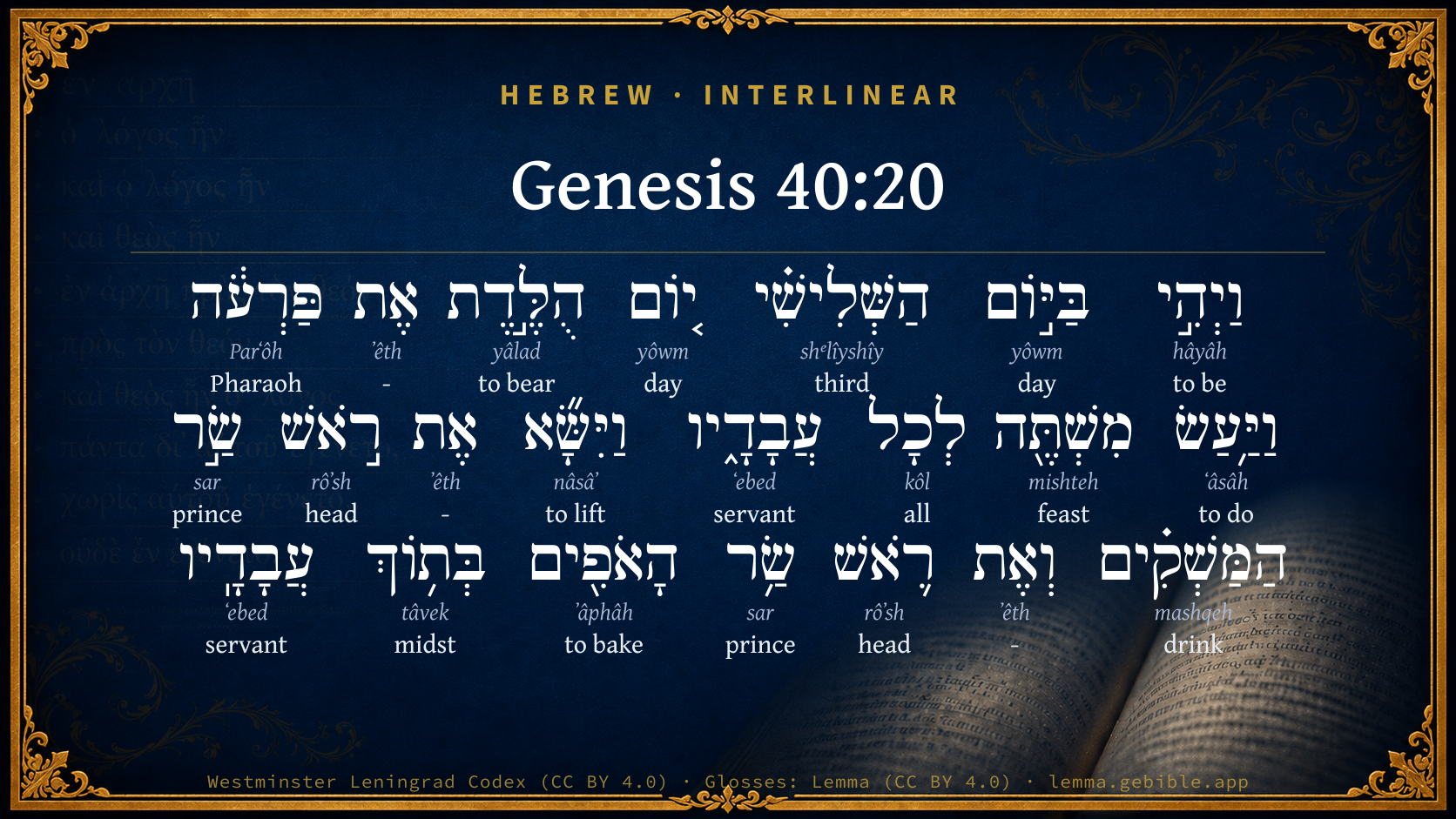
Genesis 40:20

Hebrew (Westminster Leningrad Codex) Genesis 40:20 appears in the Hebrew Old Testament. The text above is from the Westminster Leningrad Codex. Each word links to its Strong’s number, a concise gloss, and parsing drawn from the Open Scriptures Hebrew Bible morphology. Click any word for its full Brown-Driver-Briggs (BDB) entry.
Download image
Cite this verse

Genesis 40:20 (World English Bible). Public Domain. Lemma interlinear Bible study tool, https://lemma.gebible.app/v/genesis/40/20.

Show BibTeX & RIS
BibTeX
RIS
English Translation
It happened the third day, which was Pharaoh's birthday, that he made a feast for all his servants, and he lifted up the head of the chief cupbearer and the head of the chief baker among his servants.
World English Bible · Public Domain
Download a study sheet

One document with this verse’s original text, its word-by-word gloss line, the meaning frame, cross-references with their text, attributed commentary, and full source and license credits — printable, and it pastes into notes with its structure intact.

This verse Autodidact and up

Study sheet (.html) Plain text (.txt)

A passage Seminary Student

Up to 50 verses in one chapter. A passage sheet keeps up to 6 commentary sources and 12 cross-references per verse, in the order this page ranks them, and says so on the sheet whenever that leaves anything out. Ask for a single verse and you get the Autodidact verse sheet above.

Everything on this page stays free to read, with no account — the sheet is a download of what is already on screen, not access to it.

Want to remove ads? Support Godless Engineer
Compare translations 3

The same verse in 3 English versions, stacked beneath the original-language interlinear above. Click any original word for its lexicon entry.

Each is an independent rendering of the whole verse — the interlinear is not word-aligned to these translations.

Highlighted words mark where these versions differ — a whole-verse word diff, not a word-by-word alignment.

  • World English Bible Public Domain
    It happened the third day, which was Pharaoh's birthday, that he made a feast for all his servants, and he lifted up the head of the chief cupbearer and the head of the chief baker among his servants.
  • King James Version Public Domain
    And it came to pass the third day, which was Pharaoh's birthday, that he made a feast unto all his servants: and he lifted up the head of the chief butler and of the chief baker among his servants.
  • unfoldingWord Literal Text CC BY-SA 4.0
    Then it happened on the third day, the day Pharaoh was born, that he made a feast for all his servants. And he lifted up the head of the chief of the cupbearers and the head of the chief of the bakers in the presence of his servants.

unfoldingWord Literal Text — © unfoldingWord, licensed CC BY-SA 4.0. Word-aligned USFM3 via Door43 (git.door43.org/unfoldingWord/en_ult).

Versions to compare (up to 4)

3 of 4 selected

Show all 18 translations

Every available English version of this verse, each an independent rendering of the whole verse.

  • World English Bible Public Domain
    It happened the third day, which was Pharaoh's birthday, that he made a feast for all his servants, and he lifted up the head of the chief cupbearer and the head of the chief baker among his servants.
  • Berean Standard Bible Public Domain
    On the third day, which was Pharaoh’s birthday, he held a feast for all his officials, and in their presence he lifted up the heads of the chief cupbearer and the chief baker.
  • Majority Standard Bible Public Domain
    On the third day, which was Pharaoh’s birthday, he held a feast for all his officials, and in their presence he lifted up the heads of the chief cupbearer and the chief baker.
  • King James Version Public Domain
    And it came to pass the third day, which was Pharaoh's birthday, that he made a feast unto all his servants: and he lifted up the head of the chief butler and of the chief baker among his servants.
  • American Standard Version (1901) Public Domain
    And it came to pass the third day, which was Pharaoh's birthday, that he made a feast unto all his servants: and he lifted up the head of the chief butler and the head of the chief baker among his servants.
  • Revised Version (1885) Public Domain
    And it came to pass the third day, which was Pharaoh’s birthday, that he made a feast unto all his servants: and he lifted up the head of the chief butler and the head of the chief baker among his servants.
  • Geneva Bible (1599) Public Domain
    And so the third day, which was Pharaohs birthday, hee made a feast vnto all his seruants: and hee lifted vp the head of the chiefe butler, and the head of the chiefe baker among his seruants.
  • Douay-Rheims (1899) Public Domain
    Joseph answered: This is the interpretation of the dream: The three baskets are yet three days:
  • Young's Literal Translation Public Domain
    And it cometh to pass, on the third day, Pharaoh's birthday, that he maketh a banquet to all his servants, and lifteth up the head of the chief of the butlers, and the head of the chief of the bakers among his servants,
  • Literal Standard Version CC BY-SA 4.0
    And it comes to pass, on the third day, Pharaoh’s birthday, that he makes a banquet to all his servants, and lifts up the head of the chief of the butlers, and the head of the chief of the bakers among his servants,
  • Unlocked Literal Bible CC BY-SA 4.0
    It came about on the third day that it was Pharaoh's birthday. He made a feast for all his servants. He lifted up the head of the chief of the cupbearers and the head of the chief of the bakers, among his servants.
  • unfoldingWord Literal Text CC BY-SA 4.0
    Then it happened on the third day, the day Pharaoh was born, that he made a feast for all his servants. And he lifted up the head of the chief of the cupbearers and the head of the chief of the bakers in the presence of his servants.
  • Darby Bible Public Domain
    And it came to pass the third day -- Pharaoh's birthday -- that he made a feast to all his bondmen. And he lifted up the head of the chief of the cup-bearers, and the head of the chief of the bakers among his bondmen.
  • World Messianic Bible Public Domain
    On the third day, which was Pharaoh’s birthday, he made a feast for all his servants, and he lifted up the head of the chief cup bearer and the head of the chief baker among his servants.
  • Webster's Bible Public Domain
    And it came to pass the third day, which was Pharaoh's birth-day, that he made a feast to all his servants: and he lifted up the head of the chief butler and of the chief baker among his servants.
  • Free Bible Version CC BY-SA 4.0
    Three days later it happened to be Pharaoh's birthday, and he arranged a banquet for all his officials. He had the chief cupbearer and the chief baker released from prison and brought there before his officials.
  • Bible in Basic English Public Domain
    Now the third day was Pharaoh's birthday, and he gave a feast for all his servants; and he gave honour to the chief wine-servant and the chief bread-maker among the others.
  • JPS Tanakh (1917) Public Domain
    And it came to pass the third day, which was Pharaoh's birthday, that he made a feast unto all his servants; and he lifted up the head of the chief butler and the head of the chief baker among his servants.

Literal Standard Version (2020), Covenant Press — licensed CC BY-SA 4.0. Text via the HelloAO Bible API (eBible.org). Unlocked Literal Bible (unfoldingWord) — licensed CC BY-SA 4.0. Text via the HelloAO Bible API (eBible.org). unfoldingWord Literal Text — © unfoldingWord, licensed CC BY-SA 4.0. Word-aligned USFM3 via Door43 (git.door43.org/unfoldingWord/en_ult). Free Bible Version, Dr. Jonathan Gallagher — licensed CC BY-SA 4.0. Text via the HelloAO Bible API (eBible.org).

Word by word

More ways to search: Search by grammar → Find every occurrence → Compare this word →

Practice this passage: Drill this verse → Learn its vocabulary →

הַמַּשְׁקִ֗ים
mashqeh
H4945
“the · drinks”
Particle, Definite Article + Noun, Common, Masculine, Plural, Absolute
Part of Speech
Particle + Noun
Type
Common
Gender
Masculine
Number
Plural
State
Absolute
Full BDB Definition

Origin: from H8248

TWOT: 2452c

irrigation, drink - irrigation - drink, drinking vessels - butlership (office of butler) - butler, cup-bearer
  1. וַיְהִ֣י hâyâh H1961 “and · to be” Conjunction + Verb, Qal, Sequential Imperfect, 3rd Person, Masculine, Singular
  2. בַּיּ֣וֹם yôwm H3117 “in/at the · day” Preposition, Determined + Noun, Common, Masculine, Singular, Absolute
  3. הַשְּׁלִישִׁ֗י shᵉlîyshîy H7992 “the · third” Particle, Definite Article + Adjective, Ordinal number, Masculine, Singular, Absolute
  4. י֚וֹם yôwm H3117 “day of” Noun, Common, Masculine, Singular, Construct
  5. הֻלֶּ֣דֶת yâlad H3205 “to bear” Verb, Hophal, Infinitive Construct
  6. אֶת ʼêth H853 “-” Particle, Direct Object
  7. פַּרְעֹ֔ה Parʻôh H6547 “Pharaoh” Noun, Proper
  8. וַיַּ֥עַשׂ ʻâsâh H6213 “and · to do” Conjunction + Verb, Qal, Sequential Imperfect, 3rd Person, Masculine, Singular
  9. מִשְׁתֶּ֖ה mishteh H4960 “feast” Noun, Common, Masculine, Singular, Absolute
  10. לְכָל kôl H3605 “to/for · all of” Preposition + Noun, Common, Masculine, Singular, Construct
  11. עֲבָדָ֑יו ʻebed H5650 “servants · his” Noun, Common, Masculine, Plural, Construct + Suffix, Personal, 3rd Person, Masculine, Singular
  12. וַיִּשָּׂ֞א nâsâʼ H5375 “and · to lift” Conjunction + Verb, Qal, Sequential Imperfect, 3rd Person, Masculine, Singular
  13. אֶת ʼêth H853 “-” Particle, Direct Object
  14. רֹ֣אשׁ rôʼsh H7218 “head of” Noun, Common, Masculine, Singular, Construct
  15. שַׂ֣ר sar H8269 “prince of” Noun, Common, Masculine, Singular, Construct
  16. וְאֶת ʼêth H853 “and · -” Conjunction + Particle, Direct Object
  17. רֹ֛אשׁ rôʼsh H7218 “head of” Noun, Common, Masculine, Singular, Construct
  18. שַׂ֥ר sar H8269 “prince of” Noun, Common, Masculine, Singular, Construct
  19. הָאֹפִ֖ים ʼâphâh H644 “the · baking” Particle, Definite Article + Verb, Qal, Participle Active, Masculine, Plural, Absolute
  20. בְּת֥וֹךְ tâvek H8432 “in/at · midst of” Preposition + Noun, Common, Masculine, Singular, Construct
  21. עֲבָדָֽיו ʻebed H5650 “servants · his” Noun, Common, Masculine, Plural, Construct + Suffix, Personal, 3rd Person, Masculine, Singular

About this verse

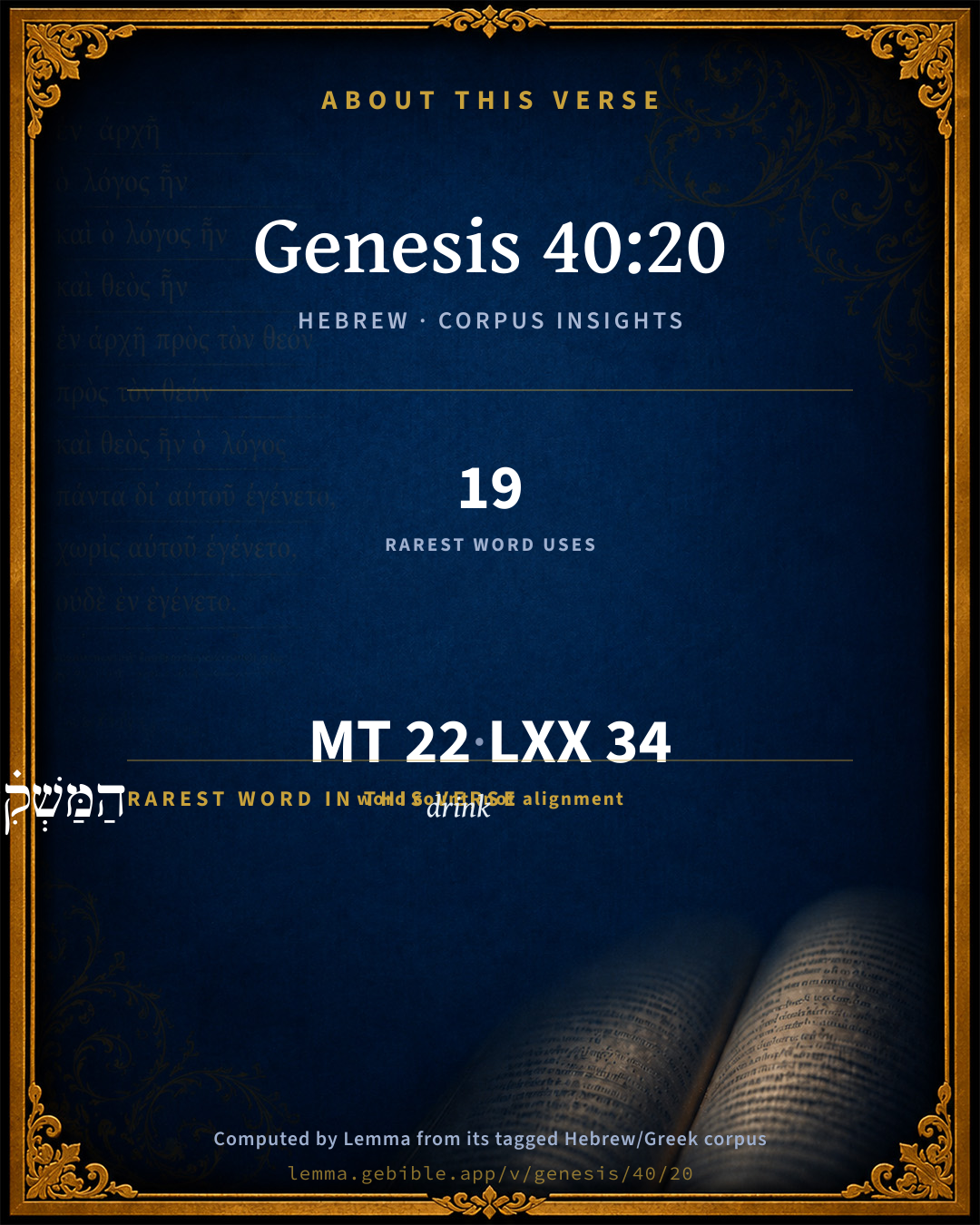
These counts appear in no published source. They are computed here, from the morphology-tagged text and Lemma’s own curated glosses. What Lemma adds →

22
words
16
distinct lemmas
Pentateuch
section

Notable vocabulary

The rarest word here is הַמַּשְׁקִ֗ים drink H4945 — appearing just 19 times in the whole Hebrew Bible.

Shared distinctive vocabulary

הַמַּשְׁקִ֗ים drink H4945 occurs in 18 verses of the Hebrew Bible. Also found in:

Grammatical profile

  • 5 verbs
  • 13 nouns
  • 1 adjective
  • 3 particles

Verb forms

  • וַיְהִ֣י Qal · Sequential Imperfect
  • הֻלֶּ֣דֶת Hophal · Infinitive Construct
  • וַיַּ֥עַשׂ Qal · Sequential Imperfect
  • וַיִּשָּׂ֞א Qal · Sequential Imperfect
  • הָאֹפִ֖ים Qal · Participle Active

Repetition

Words recur within this verse — often emphatic in Hebrew:

  • בַּיּ֣וֹם day H3117 ×2
  • עֲבָדָ֑יו servant H5650 ×2
  • רֹ֣אשׁ head H7218 ×2
  • שַׂ֣ר prince H8269 ×2

Hebrew & Septuagint length

In English translation the verse runs 38 words from the Hebrew and 43 from the Septuagint (LXX English) — closely comparable.

A rough comparison of the two English renderings, which tokenize alike — not a word-level alignment.

Word counts can differ between the Hebrew and the Greek without any difference in meaning — e.g. the Hebrew direct-object marker אֵת has no separate Greek word, and Greek often adds the article ὁ.

In the original languages it is 22 Hebrew tokens and 34 Greek tokens — but the two are counted differently (Hebrew bundles its prefixes and suffixes into one token; the Greek is in lemma form), so that isn’t a like-for-like length.

Cross-references

11

Topical passages linked to Genesis 40:20 in the Treasury of Scripture Knowledge — connected by theme and wording, ordered by reader-vote popularity; previews shown in the World English Bible.

  • Genesis 40:13 Within three more days, Pharaoh will lift up your head, and restore you to your office. You will give Pharaoh's cup into his hand, the way you did when you were his cupbearer.
  • Genesis 40:19 Within three more days, Pharaoh will lift up your head from off you, and will hang you on a tree; and the birds will eat your flesh from off you."
  • Matthew 14:6 But when Herod's birthday came, the daughter of Herodias danced among them and pleased Herod.
  • Mark 6:21 Then a convenient day came, that Herod on his birthday made a supper for his nobles, the high officers, and the chief men of Galilee.
  • Genesis 21:8 The child grew, and was weaned. Abraham made a great feast on the day that Isaac was weaned.
  • 2 Kings 25:27 It happened in the seven and thirtieth year of the captivity of Jehoiachin king of Judah, in the twelfth month, on the seven and twentieth day of the month, that Evilmerodach king of Babylon, in the year that he began to reign, did lift up the head of Jehoiachin king of Judah out of prison;
  • Esther 1:3 in the third year of his reign, he made a feast to all his princes and his servants; the power of Persia and Media, the nobles and princes of the provinces, being before him;
  • Job 3:1 After this Job opened his mouth, and cursed the day of his birth.
  • Matthew 18:23–25 Therefore the Kingdom of Heaven is like a certain king, who wanted to reconcile accounts with his servants.
  • Matthew 25:19 "Now after a long time the lord of those servants came, and reconciled accounts with them.
  • Luke 16:1–2 He also said to his disciples, "There was a certain rich man who had a manager. An accusation was made to him that this man was wasting his possessions.

Cross-references courtesy of OpenBible.info (CC BY 4.0).

Hebrew and Greek witnesses Masoretic Hebrew ↔ Greek Septuagint

The same verse in the two great witnesses to the Old Testament, shown verse-for-verse.

These are two independent witnesses, not word-aligned to each other, and the Septuagint is shown in lemma (dictionary) form.

Hebrew Genesis 40:20 Masoretic · Westminster Leningrad Codex

וַיְהִ֣י בַּיּ֣וֹם הַשְּׁלִישִׁ֗י י֚וֹם הֻלֶּ֣דֶת אֶת פַּרְעֹ֔ה וַיַּ֥עַשׂ מִשְׁתֶּ֖ה לְכָל עֲבָדָ֑יו וַיִּשָּׂ֞א אֶת רֹ֣אשׁ שַׂ֣ר הַמַּשְׁקִ֗ים וְאֶת רֹ֛אשׁ שַׂ֥ר הָאֹפִ֖ים בְּת֥וֹךְ עֲבָדָֽיו

It happened the third day, which was Pharaoh's birthday, that he made a feast for all his servants, and he lifted up the head of the chief cupbearer and the head of the chief baker among his servants.

World English Bible · Public Domain

Greek LXX Genesis 40:20 Septuagint · lemma form

γίγνομαι δέ ἐν ὁ ἡμέρα ὁ τρίτος ἡμέρα γένεσις εἰμί φαραώ καί ποιέω πότος πᾶς ὁ παῖς αὐτός καί μιμνήσκω ὁ ἀρχή ὁ ἀρχιοινοχόος καί ὁ ἀρχή ὁ ἀρχισιτοποιός ἐν μέσος ὁ παῖς αὐτός

And it came to pass on the third day that it was Pharao's birth-day, and he made a banquet for all his servants, and he remembered the office of the cupbearer and the office of the baker in the midst of his servants.

LXX2012 (modern English Septuagint) · Public Domain

Hebrew: Westminster Leningrad Codex (CC BY 4.0). Greek: Septuagint (public domain); English from LXX2012 (modern English Septuagint) (Public Domain). How the Septuagint differs from the Hebrew →

Targum (Aramaic paraphrase)

2

The Targum is the ancient Jewish Aramaic paraphrase of the Hebrew Scriptures — an interpretive translation, not the Hebrew text itself. Onkelos (literal) and Pseudo-Jonathan (expansive) render the Torah, and Jonathan the Prophets. Coverage is partial: where no permissively-licensed English translation exists for a verse, only the Aramaic is shown. This is verse-level text, not a word-by-word alignment to the Hebrew.

  1. Targum Onkelos Torah (Genesis–Deuteronomy)
    וַהֲוָה בְּיוֹמָא תְלִיתָאָה יוֹמָא בֵּית וַלְדָא דְפַרְעֹה וַעֲבַד מִשְׁתְּיָא לְכָל עַבְדּוֹהִי וְאִדְכַּר יָת רֵישׁ רַב שָׁקֵי וְיָת רֵישׁ רַב נַחְתּוֹמֵי בְּגוֹ עַבְדּוֹהִי

    (no public-domain English translation for this verse)

    Targum Onkelos — Aramaic: “Onkelos Genesis” (public domain); “Onkelos Exodus” (public domain); “Onkelos Leviticus” (public domain); “Onkelos Numbers” (public domain); “Onkelos Deuteronomy” (public domain). English: “Sefaria Community Translation” (CC0 1.0 (public-domain dedication)); “J.W. Etheridge. The Targums of Onkelos and Jonathan Ben Uzziel on the Pentateuch. London: Longmans, Green, 1862” (public domain). Text via Sefaria.

  2. Targum Pseudo-Jonathan Torah (Genesis–Deuteronomy)
    וַהֲוָה בְּיוֹם תְּלִיתָאֵי יוֹם גְנוּסָא דְפַרְעה וְעָבַד שֵׁירוּ לְכָל עַבְדוֹי וְרוֹמַם יַת רֵישׁ רַב מְזוֹגַיָא וְיַת רֵישׁ רַב נַחְתּוֹמַיָא בְּגוֹ עַבְדוֹי

    And it was on the third day, the nativity of Pharoh that he made a feast to all his servants. And he lifted up the head of the chief butler, and the head of the chief baker, in the midst of his servants.

    Targum Pseudo-Jonathan — Aramaic: “Targum Jonathan on Genesis” (public domain); “Targum Jonathan on Exodus” (public domain); “Targum Jonathan on Leviticus” (public domain); “Targum Jonathan on Numbers” (public domain); “Targum Jonathan on Deuteronomy” (public domain). English: “The Targum of Jonathan ben Uzziel, trans. J. W. Etheridge, London, 1862” (public domain). Text via Sefaria.

Commentary

Notes on Genesis 40:20 from classic Christian and Jewish commentators (each source and its license shown beneath its notes). The classic Christian expositions comment on the surrounding passage and are grouped to its opening verse, so a note may address several verses; the Jewish commentaries on the Tanakh (Rashi and others) are per-verse, so they appear only where the commentator wrote on this verse.

Lemma curates 59 commentaries, every one of them public domain or Creative Commons licensed, each selected and text-cleaned for this edition rather than reprinted as found. About our sources →

Trapp's Complete Commentary

John Trapp

Gen 40:20 And it came to pass the third day, [which was] Pharaoh’s birthday, that he made a feast unto all his servants: and he lifted up the head of the chief butler and of the chief baker among his servants.

Ver. 20. Which was Pharaoh’s birthday.] An ancient and commendable custom, to keep banquets on birthdays; in honour of God, our Sospitator, for his mercy in our creation, education, preservation, &c.

John Trapp, A Commentary or Exposition upon All the Books of the Old and New Testament (1647–1656) — public domain. Text from a community e-Sword module.

The Biblical Illustrator

Joseph S. Exell

Gen_40:20

The third day, which was Pharaohs birthday

Birthdays

I.

WE SHOULD MAKE IT A DAY OF THANKSGIVING. The birth of a human soul is a wondrous miracle, and for weal or woe is an event which will be felt through all eternity. Surely, such is a special season of praise. And thanksgiving is mainly united to joy. Pharaoh rejoiced and instituted a feast. We can show our thanksgiving in no better way than in a practical method of doing good to our fellows and dependents, and causing them to rejoice with us.

II. WE SHOULD MAKE IT A DAY OF RECTIFICATION. Pharaoh, with his little light, did so. The chief butler had been falsely accused, and the chief baker justly. The one he restored to his proper position, and the other was put to death. We all of us make mistakes, we form many harsh judgments, we misinterpret the feelings and actions of others, we shape our course wrongly. Surely, it is well then to make reparation for the past, and to put our lives on a new footing, and to make this part straight.

III. WE SHOULD MAKE IT A TIME FOR HUMILIATION AND PRAYER. It is true that God made us, but what have our lives been worth? What have they been worth to Him? Have we fulfilled the glorious objects for which we are created? And this humiliation should lead to prayer--prayer for Divine guidance and help, prayer for forgiveness and pardon.

IV. WE SHOULD MAKE IT A DAY OF REFLECTION AND RESOLUTION. There is a time to be born, says the wise man, but There is also a time to die. The one must necessarily remind us of the other. The season is indeed full of solemn thoughts. Can we bless the day we were born, or is it to us only the beginning of a long and terrible curse? (Homilist.)

.

The Biblical Illustrator, edited by Joseph S. Exell (c. 1880s–1900s) — public domain. Text from a community e-Sword module.

Joseph Benson's Commentary

Gen 40:20. He lifted up the head — Of these servants; took an account of them, examined their cases, and, either according to the merit of their cause, or through caprice, disposed of them as is here mentioned.

Joseph Benson's Commentary on the Old and New Testaments (1811–1818) — public domain. Text from a community e-Sword module.

Tyndale Open Study Notes

Tyndale Open Resources

40:20-22 The interpretations Joseph gave the prisoners proved true. The death of the chief baker speaks of the harsh realities of life in ancient Egypt, with a king whose word was his land’s highest law.

Tyndale Open Study Notes — © Tyndale Open Resources, licensed CC BY-SA 4.0. Text via the HelloAO Bible API.

Geneva Bible (1599)

Geneva Bible translators

Which was an occasion to appoint his officers, and so to examine them that were in prison.

Geneva Bible (1599) marginal notes — public domain. Text via Bolls.life.

Matthew Henry's Commentary

Here is, 1. The verifying of Joseph's interpretation of the dreams, on the very day prefixed. The chief butler and baker were both advanced, one to his office, the other to the gallows, and both at the three days' end. Note, Very great changes, both for the better and for the worse, often happen in a very little time, so sudden are the revolutions of the wheel of nature. The occasion of giving judgement severally upon their case was the solemnizing of Pharaoh's birthday, on which, all his servants being obliged by custom to attend him, these two came to be enquired after, and the cause of their commitment looked into. The solemnizing of the birthday of princes has been an ancient piece of respect done them; and if it be not abused, as Jeroboam's was (Hos 7:5), and Herod's (Mar 6:21), is a usage innocent enough: and we may all profitably take notice of our birthdays, with thankfulness for the mercies of our birth, sorrow for the sinfulness of it, and an expectation of the day of our death as better than the day of our birth. On Pharaoh's birthday he lifted up the head of these two prisoners, that is, arraigned and tried them (when Naboth was tried he was set on high among the people, Kg1 21:9), and he restored the chief butler, and hanged the chief baker. If the butler was innocent and the baker guilty, we must own the equity of Providence in clearing up the innocency of the innocent, and making the sin of the guilty to find him out. If both were either equally innocent or equally guilty, it is an instance of the arbitrariness of such great princes as pride themselves in that power which Nebuchadnezzar set up for (Dan 5:19, whom he would he slew, and whom he would he kept alive), forgetting that there is a higher than they, to whom they are accountable. 2. The disappointing of Joseph's expectation from the chief butler: He remembered not Joseph, but forgot him, Gen 40:23. (1.) See here an instance of base ingratitude; Joseph had deserved well at his hands, had ministered to him, sympathized with him, helped him to a favourable interpretation of his dream, had recommended himself to him as an extraordinary person upon all accounts; and yet he forgot him. We must not think it strange if in this world we have hatred shown us for our love, and slights for our respects. (2.) See how apt those that are themselves at ease are to forget others in distress. Perhaps it is in allusion to this story that the prophet speaks of those that drink wine in bowls, and are not grieved for the affliction of Joseph, Amo 6:6. Let us learn hence to cease from man. Joseph perhaps depended too much upon his interest in the chief butler, and promised himself too much from him; he learned by his disappointment to trust in God only. We cannot expect too little from man nor too much from God.

Some observe the resemblance between Joseph and Christ in this story. Joseph's fellow-sufferers were like the two thieves that were crucified with Christ - the one saved, the other condemned. (It is Dr. Lightfoot's remark, from Mr. Broughton.) One of these, when Joseph said to him, Remember me when it shall be well with thee, forget him; but one of those, when he said to Christ, Remember me when thou comest into thy kingdom, was not forgotten. We justly blame the chief butler's ingratitude to Joseph, yet we conduct ourselves much more disingenuously towards the Lord Jesus. Joseph had but foretold the chief butler's enlargement, but Christ wrought out ours, mediated with the King of kings for us; yet we forget him, though often reminded of him, though we have promised never to forget him: thus ill do we requite him, like foolish people and unwise.

Matthew Henry's Commentary on the Whole Bible (1708–1710) — public domain (CC PDM 1.0). Text via the HelloAO Bible API.

Jamieson, Fausset & Brown

Robert Jamieson, A. R. Fausset & David Brown

it came to pass the third day, which was Pharaoh's birthday--This was a holiday season, celebrated at court with great magnificence and honored by a free pardon to prisoners. Accordingly, the issue happened to the butler and baker, as Joseph had foretold. Doubtless, he felt it painful to communicate such dismal tidings to the baker; but he could not help announcing what God had revealed to him; and it was for the honor of the true God that he should speak plainly.

Jamieson, Fausset & Brown — Commentary Critical and Explanatory on the Whole Bible (1871) — public domain (CC PDM 1.0). Text via the HelloAO Bible API.

Adam Clarke's Commentary

Verse 20. Pharaoh's birthday] The distinguishing a birthday by a feast appears from this place to have been a very ancient custom. It probably had its origin from a correct notion of the immortality of the soul, as the commencement of life must appear of great consequence to that person who believed he was to live for ever. St. Matthew (Mt 14:6) mentions Herod's keeping his birthday; and examples of this kind are frequent to the present time in most nations.

Lifted up the head of the chief butler, c.] By lifting up the head, probably no more is meant than bringing them to trial, tantamount to what was done by Jezebel and the nobles of Israel to Naboth: Set Naboth on high among the people and set two men, sons of Belial, to bear witness against him, c. 1Kg 21:9, c. The issue of the trial was, the baker alone was found guilty and hanged and the butler, being acquitted, was restored to his office.

Adam Clarke's Commentary on the Bible (1810–1826) — public domain. Text from a community e-Sword/MySword module.

Ellicott's Commentary for English Readers

(20) He lifted up the head.—From its use in this verse some have supposed that the phrase must mean “to put them on their trial,” or “take account of them” (whence the margin reckon). More probably the words are used to point out the exact fulfilment of Joseph’s interpretation of their dreams.

A Bible Commentary for English Readers, edited by Charles John Ellicott (1878–1897) — public domain. Text from a community e-Sword module.

The Cambridge Bible for Schools and Colleges

gen. ed. J. J. S. Perowne

20–23. The Fulfilment

20. Pharaoh’s birthday] Cf. Mat_14:6; Mar_6:21. Proclamations of amnesty on royal birthdays have been universal. They can be illustrated from the royal proclamations preserved in Egyptian inscriptions.

The title “Pharaoh” (= Egypt. Pr‘ô, “Great House”) is constantly used without a personal surname before the 22nd Dynasty (945–745 b.c.).

The Cambridge Bible for Schools and Colleges (gen. ed. J. J. S. Perowne; Cambridge University Press, 1878–1918) — public domain. Text from a community e-Sword module.

John Gill's Exposition

And it came to pass the third day, which was Pharaoh's birthday,.... The third day from the time the dreams were told, and the interpretation of them given, was the birthday of Pharaoh; either the day in which a son of his was born, or in which he himself was born, as Ben Melech observes; but the latter is more probable, since the former could not with propriety be called Pharaoh's birthday; and this might be either the day of his natural birth, or of his political birth, the time of his accession to the throne, which with the Romans was called "natalis imperii", and was observed with feasting and rejoicing (c), as well as the former, both among them and other nations: it is most likely this was Pharaoh's natural birthday, which was observed among the Egyptians as birthdays were among the Persians (d), and as Herod's was at his court in the days of Christ, Mat 14:6; and as is usual in our times in most countries:

that he made a feast unto all his servants; his ministers of state, his courtiers, and all in his palace:

and he lifted up the head of his chief butler and of his chief baker,

among his servants; that is, among his servants, when their names were called over; or at this festival, these two were taken notice of, as being charged with crimes, and their cases were looked into and examined, and their heads were lifted up in a different sense: they were both lifted out of prison, but the one was lifted up to his former post and place in Pharaoh's court, and the other was lifted up to a gallows or gibbet, as follows; though perhaps this lifting of them both may only signify the trial of them, when they were set on high to be seen by the judge and all the court, see Kg1 21:9.

(c) Plin. Ep. l. 1. ep. 61. Herodot. Calliope, sive, l. 9. c. 109. (d) Herodot. Clio, sive, l. 1. c. 133.

John Gill's Exposition of the Whole Bible (1746–1763) — public domain (CC PDM 1.0). Text via the HelloAO Bible API.

Haydock's Catholic Bible Commentary

Birth-day. This was a common practice among the pagans. (St. Matthew xiv. 6; 2 Machabees vi. 7.) (Calmet)

George Leo Haydock (1774–1849), Haydock's Catholic Family Bible and Commentary, 1859 edition — public domain. Excludes Psalms (Douay-Rheims chapter numbering differs from Protestant) and Deuterocanonical books (Catholic canon only).

Matthew Poole's English Annotations

Pharaoh’s birthday. Birth-days by persons of eminency then were, and since have usually been, celebrated with feasting and rejoicing.

Matthew Poole's English Annotations on the Holy Bible (1683–1685) — public domain. Text from a community e-Sword/MySword module.

The Pulpit Commentary

And it came to pass (literally, and it was, as Joseph had predicted) the third day (literally, in, or on, the third day), which was Pharaoh"s birthday, literally, the day of Pharaohs being born, the inf. hophal being construed with an accusative (vide Gesenius, "Grammar," 143)that he made a feast a mishteh, i.e. a drinking or banquet (Gen_19:3) unto all his servants . "The birthdays of the kings of Egypt were considered holy, and were celebrated with great joy and rejoicing. All business was suspended, and the people generally took part in the festivities" (Thoruley Smith, "Joseph and his Times," p. 62; vide Herod., 1:133: JHmerhn deWn malista ejkeinhn timan nomizousi th ekastov ejgeneto; and cf. (Mat_14:6; Mar_6:21) And he lifted up the head here the one phrase applies equally, though in different senses, to both. A similar expression occurs in the annals of Assur-nasir-pal (Sardanapalus), column 2. line 43: "Their heads on the high places of the mountain I lifted up" ("Records of the Past," vol. 3. p. 54)of the chief butler and of the chief baker among his servants literally, in their midst, as a public example.

The Pulpit Commentary (1880–1919), ed. H.D.M. Spence-Jones & Joseph S. Exell — public domain. Text from a community e-Sword module.

John Wesley's Explanatory Notes

He lifted up the head of these two prisoners-That is, arraigned and tried them; and he restored the chief butler, and hanged the chief baker.

John Wesley, Explanatory Notes Upon the Whole Bible (1754–1765) — public domain. Text via the GEBible commentary corpus.

Keil & Delitzsch

C. F. Keil & F. Delitzsch

Joseph's interpretations were fulfilled three days afterwards, on the king's birth-day. הלּדת יום: the day of being born; the inf. Hoph. is construed as a passive with the accus. obj., as in Gen 4:18, etc. Pharaoh gave his servants a feast, and lifted up the heads of both the prisoners, but in very different ways. The cup-bearer was pardoned, and reinstated in his office; the baker, on the other hand, was executed.

Keil & Delitzsch — Biblical Commentary on the Old Testament (1861–1891) — public domain (CC PDM 1.0). Text via the HelloAO Bible API. (Old Testament only.)

Kretzmann's Popular Commentary

Paul E. Kretzmann

The Dreams come true

v. 20. And it came to pass the third day, which was Pharaoh’s birthday, that he made a feast unto all his servants, it being the custom of the ancient kings to celebrate these occasions with a great show of pomp; and he lifted up the head of the chief butler and of the chief baker among his servants, he caused them both to be fetched out of the prison, but his object in doing so differed widely.

v. 21. And he restored the chief butler unto his butlership again; and he gave the cup into Pharaoh’s hand, he was reinstated in his former office;

v. 22. but he hanged the chief baker, as Joseph had interpreted to them.

v. 23. Yet did not the chief butler remember Joseph, but forgat him. In the happiness attending his deliverance from prison he forgot the humble Hebrew of the prison, for such is the way of the world. Also in this story Joseph is a type of Christ, who, like the Hebrew young man of old, was reckoned with the transgressors and had to go down into the greatest depths of disgrace and humility.

Paul E. Kretzmann, Popular Commentary of the Bible (1921–1924) — public domain. Text from a community e-Sword module.

unfoldingWord translationNotes

Door43 World Missions Community

It came about on the third day that

"Afterward, on the third day." The phrase "it came about" is used here to mark a new event in the story. (See: Introduction of a New Event)

He made a feast

"He had a feast"

the chief of the cupbearers

This was the leading person who prepared and served drinks to the king. See how these were translated in Genesis 40:2.

the chief of the bakers

This refers to the leading person who made food for the king. See how this was translated in Genesis 40:2.

He restored the chief of the cupbearers to his responsibility

The chief of the cupbearer's "responsibility" refers to his job as chief of the cupbearers. AT: "He gave the chief of the cupbearers his job back" (See: Metonymy)

But he hanged the chief of the bakers

Pharaoh did not personally hang the baker, rather he commanded for him to be hanged. AT: "But he commanded for the chief of the bakers to be hanged" or "But he commanded his guards to hang the chief of the bakers" (See: Metonymy)

just as Joseph had interpreted to them

This refers to when Joseph interpreted their dreams. AT: "just as Joseph had said would happen when he interpreted the two men's dreams" (See: Assumed Knowledge and Implicit Information)

translationWords

feast

servant

hang

unfoldingWord translationNotes — © Distant Shores Media and the Door43 World Missions Community, licensed CC BY-SA 4.0. Source: git.door43.org/Door43/en_tn.

Rashi

Rabbi Shlomo Yitzchaki (Rashi)

יום הלדת את פרעה HIS (PHARAOH’S) BIRTHDAY. It is called (Avodah Zarah 10a) “The birthday festival”. The causative passive form (הלדת) is used because the infant is born only by the assistance of others, for the midwife delivers the woman. On this account a midwife is called מילדת a Piel form “one who brings to birth”. This passive form occurs similarly (Ezekiel 16:4) “And as for thy nativity, in the day thou wast born (הולדת אתך)”. A similar passive form is used in (Leviticus 13:55) “after the plague (הכבס) is washed away”, because the washing is done by others).

‘וישא את ראש וגו means he counted them amongst his other servants — because he counted those who might serve him at his feast — and he remembered these amongst them. The phrase is similar to (Numbers 1.2) “שא את ראש” which signifies counting.

Rashi on the Tanakh — English translations: “The Judaica Press complete Tanach with Rashi, translated by A. J. Rosenberg” (CC BY 4.0); “Pentateuch with Rashi's commentary by M. Rosenbaum and A.M. Silbermann, 1929-1934” (public domain); “The Metsudah Tanach series, Lakewood, N.J” (CC BY 4.0); and “The Book of Joshua, Metsudah Publications, 1997” (CC BY 4.0). Text via Sefaria.

Radak

Rabbi David Kimhi (Radak)

יום הולדת את פרעה, some commentators say that the day referred to was the anniversary of the day Pharaoh had been born, and that he had been in the habit of celebrating this day annually with a banquet. As to the meaning of the word את, which seems difficult to fit into this explanation, one could cite other examples where the word את appears without apparent need, such as Numbers 26,55 יחלק את הארץ, or in Ezekiel 16,4 ביום הולדת אותך “on the day you were born,” where הולדך would have been perfectly adequate.

Radak on the Tanakh — English translations: “Sefaria Community Translation” (CC0 1.0 (public-domain dedication)); “Eliyahu Munk, HaChut Hameshulash” (CC BY 4.0); “Rabbi Mike Feuer, Jerusalem Anthology” (CC BY 4.0); and “R. David Kimhi on the first book of Psalms, Translated by R.G. Finch, London, 1919” (public domain). Text via Sefaria.

Lesson kit

Teaching starters — assembled from the data on this page, not authored interpretation. Every prompt links to the verse data it draws on. Edit before teaching.

Genesis, in the Pentateuch, opens this verse with 22 words (16 distinct Hebrew lemmas). Its most distinctive word is mashqeh (“drink”). A historical commentator’s framing appears above. Read the whole chapter for the surrounding context.

Discussion questions

  1. The word mashqeh carries the sense “drink.” How does it shape the verse?
  2. Genesis 13:10 shares the word «drink» with this verse. How do the two illuminate each other?
  3. “day” occurs 2× in this one verse. What is the effect of the repetition?
  4. The translations on this page render this verse differently — a whole-verse word diff, not a word-by-word alignment. What might account for the different wordings?
  5. The verb «וַיְהִ֣י» is Qal Sequential Imperfect. How does its form color the action?
  6. Reading how Trapp's Complete Commentary and The Biblical Illustrator read this verse, where do the two commentators agree and where do they part?

Things to notice

Reading settings

Reading text

Shown beneath each verse's original-language words.

Old Testament
Old Testament edition

Read the OT as the Masoretic Hebrew (MT) or the Greek Septuagint (LXX).

English shown for the Greek Septuagint (in the Hebrew ↔ Greek comparison).

Comparing translations? Open the Compare panel on any verse page to stack up to four side by side.