
Ezekiel 48:15

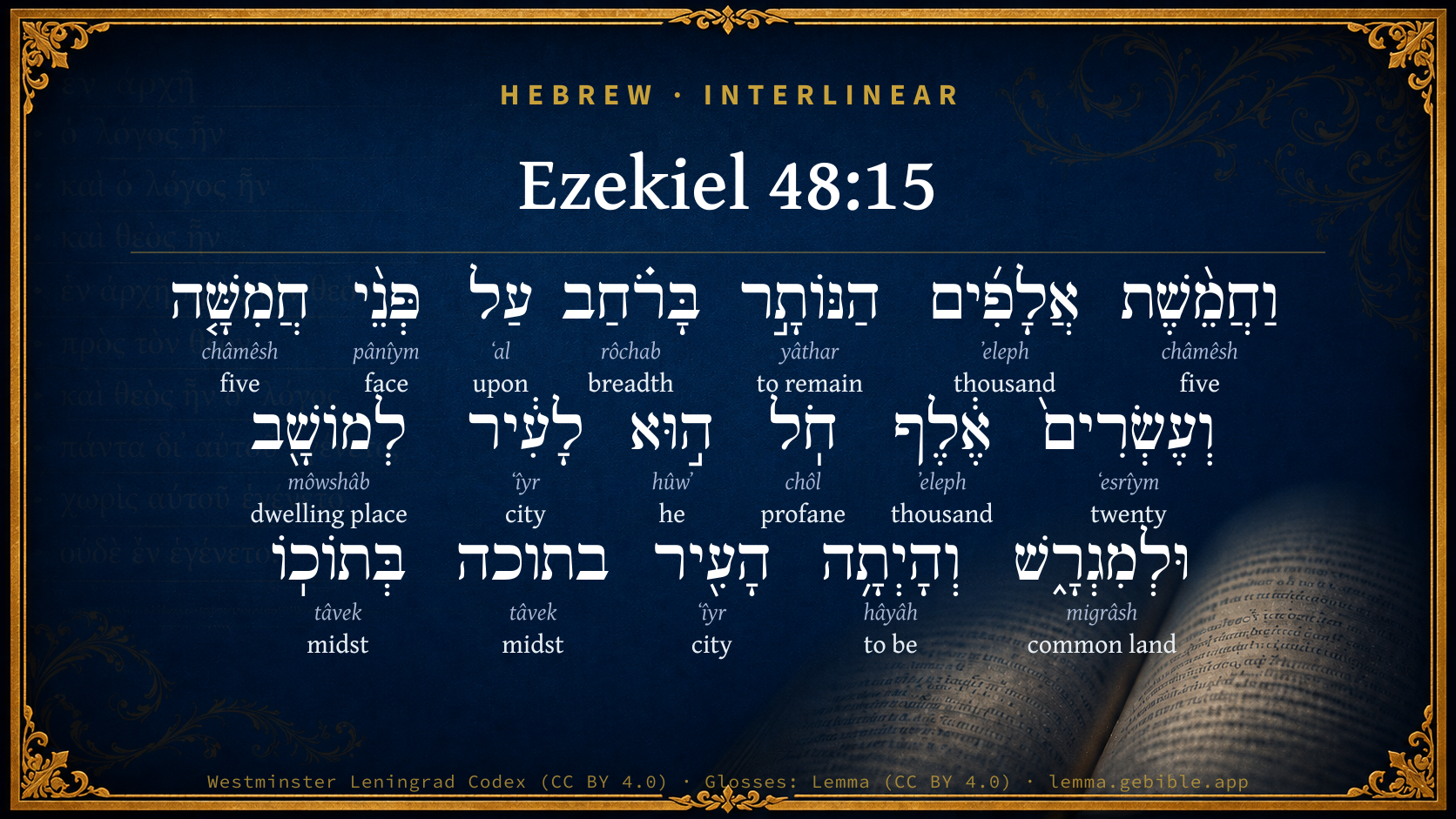
Hebrew (Westminster Leningrad Codex) Ezekiel 48:15 appears in the Hebrew Old Testament. The text above is from the Westminster Leningrad Codex. Each word links to its Strong’s number, a concise gloss, and parsing drawn from the Open Scriptures Hebrew Bible morphology. Click any word for its full Brown-Driver-Briggs (BDB) entry.
Download image
Cite this verse

Ezekiel 48:15 (World English Bible). Public Domain. Lemma interlinear Bible study tool, https://lemma.gebible.app/v/ezekiel/48/15.

Show BibTeX & RIS
BibTeX
RIS
English Translation
The five thousand that are left in the breadth, in front of the twenty-five thousand, shall be for common use, for the city, for dwelling and for suburbs; and the city shall be in the midst of it.
World English Bible · Public Domain
Download a study sheet

One document with this verse’s original text, its word-by-word gloss line, the meaning frame, cross-references with their text, attributed commentary, and full source and license credits — printable, and it pastes into notes with its structure intact.

This verse Autodidact and up

Study sheet (.html) Plain text (.txt)

A passage Seminary Student

Up to 50 verses in one chapter. A passage sheet keeps up to 6 commentary sources and 12 cross-references per verse, in the order this page ranks them, and says so on the sheet whenever that leaves anything out. Ask for a single verse and you get the Autodidact verse sheet above.

Everything on this page stays free to read, with no account — the sheet is a download of what is already on screen, not access to it.

Want to remove ads? Support Godless Engineer
Compare translations 3

The same verse in 3 English versions, stacked beneath the original-language interlinear above. Click any original word for its lexicon entry.

Each is an independent rendering of the whole verse — the interlinear is not word-aligned to these translations.

Highlighted words mark where these versions differ — a whole-verse word diff, not a word-by-word alignment.

  • World English Bible Public Domain
    The five thousand that are left in the breadth, in front of the twenty-five thousand, shall be for common use, for the city, for dwelling and for suburbs; and the city shall be in the midst of it.
  • King James Version Public Domain
    And the five thousand, that are left in the breadth over against the five and twenty thousand, shall be a profane place for the city, for dwelling, and for suburbs: and the city shall be in the midst thereof.
  • unfoldingWord Literal Text CC BY-SA 4.0
    The remaining land, five thousand cubits in width and twenty-five thousand cubits in length, will be for the collective use of the city, the houses, and the pastureland; the city will be in its midst.

unfoldingWord Literal Text — © unfoldingWord, licensed CC BY-SA 4.0. Word-aligned USFM3 via Door43 (git.door43.org/unfoldingWord/en_ult).

Versions to compare (up to 4)

3 of 4 selected

Show all 18 translations

Every available English version of this verse, each an independent rendering of the whole verse.

  • World English Bible Public Domain
    The five thousand that are left in the breadth, in front of the twenty-five thousand, shall be for common use, for the city, for dwelling and for suburbs; and the city shall be in the midst of it.
  • Berean Standard Bible Public Domain
    The remaining area, 5,000 cubits wide and 25,000 cubits long, will be for common use by the city, for houses, and for pastureland. The city will be in the center of it
  • Majority Standard Bible Public Domain
    The remaining area, 5,000 cubits wide and 25,000 cubits long, will be for common use by the city, for houses, and for pastureland. The city will be in the center of it
  • King James Version Public Domain
    And the five thousand, that are left in the breadth over against the five and twenty thousand, shall be a profane place for the city, for dwelling, and for suburbs: and the city shall be in the midst thereof.
  • American Standard Version (1901) Public Domain
    And the five thousand that are left in the breadth, in front of the five and twenty thousand, shall be for common use, for the city, for dwelling and for suburbs; and the city shall be in the midst thereof.
  • Revised Version (1885) Public Domain
    And the five thousand that are left in the breadth, in front of the five and twenty thousand, shall be for common use, for the city, for dwelling and for suburbs: and the city shall be in the midst thereof.
  • Geneva Bible (1599) Public Domain
    And the fiue thousand that are left in the breadth ouer against the fiue and twentie thousande, shall be a prophane place for the citie, for housing, and for suburbes, and the citie shalbe in the middes thereof.
  • Douay-Rheims (1899) Public Domain
    But the five thousand that remain in the breadth over against the five and twenty thousand, shall be a profane place for the city for dwelling, and for suburbs: and the city shall be in the midst thereof.
  • Young's Literal Translation Public Domain
    And the five thousand that is left in the breadth, on the front of the five and twenty thousand, is common -- for the city, for dwelling, and for suburb, and the city hath been in its midst.
  • Literal Standard Version CC BY-SA 4.0
    And the five thousand that is left in the breadth, on the front of the twenty-five thousand, is common—for the city, for dwelling, and for outskirt, and the city has been in its midst.
  • Unlocked Literal Bible CC BY-SA 4.0
    The remaining land, five thousand cubits in width and twenty-five thousand cubits in length, will be for the collective use of the city, the houses, and the pastureland; the city will be in its midst.
  • unfoldingWord Literal Text CC BY-SA 4.0
    The remaining land, five thousand cubits in width and twenty-five thousand cubits in length, will be for the collective use of the city, the houses, and the pastureland; the city will be in its midst.
  • Darby Bible Public Domain
    And the five thousand that are left in the breadth over against the five and twenty thousand, shall be a common [place] for the city, for dwellings and for suburbs: and the city shall be in the midst of it.
  • World Messianic Bible Public Domain
    “The five thousand cubits that are left in the width, in front of the twenty-five thousand, shall be for common use, for the city, for dwelling and for pasture lands; and the city shall be in the middle of it.
  • Webster's Bible Public Domain
    And the five thousand, that are left in the breadth over against the five and twenty thousand, shall be a profane place for the city, for dwelling, and for suburbs, and the city shall be in the midst of it.
  • Free Bible Version CC BY-SA 4.0
    The remainder, 5,000 cubits by 25,000 cubits, is for ordinary use by the city for houses and pastureland. The city will be in the middle of it,
  • Bible in Basic English Public Domain
    And the other five thousand, measured from side to side, in front of the twenty-five thousand, is to be for common use, for the town, for living in and for a free space: and the town will be in the middle of it.
  • JPS Tanakh (1917) Public Domain
    And the five thousand that are left in the breadth, in front of the five and twenty thousand, shall be for common use, for the city, for dwelling and for open land; and the city shall be in the midst thereof.

Literal Standard Version (2020), Covenant Press — licensed CC BY-SA 4.0. Text via the HelloAO Bible API (eBible.org). Unlocked Literal Bible (unfoldingWord) — licensed CC BY-SA 4.0. Text via the HelloAO Bible API (eBible.org). unfoldingWord Literal Text — © unfoldingWord, licensed CC BY-SA 4.0. Word-aligned USFM3 via Door43 (git.door43.org/unfoldingWord/en_ult). Free Bible Version, Dr. Jonathan Gallagher — licensed CC BY-SA 4.0. Text via the HelloAO Bible API (eBible.org).

Word by word

More ways to search: Search by grammar → Find every occurrence → Compare this word →

Practice this passage: Drill this verse → Learn its vocabulary →

חֹֽל
chôl
H2455
“profane”
Noun, Common, Masculine, Singular, Absolute
Part of Speech
Noun
Type
Common
Gender
Masculine
Number
Singular
State
Absolute
Full BDB Definition

Origin: from H2490

TWOT: 623a , 661a

profaneness, commonness, unholy, profane, common, sand
  1. וַחֲמֵ֨שֶׁת châmêsh H2568 “and · five” Conjunction + Adjective, Cardinal number, Masculine, Singular, Construct
  2. אֲלָפִ֜ים ʼeleph H505 “thousand” Adjective, Cardinal number, Both, Plural, Absolute
  3. הַנּוֹתָ֣ר yâthar H3498 “the · remaining” Particle, Definite Article + Verb, Niphal, Participle Active, Masculine, Singular, Absolute
  4. בָּרֹ֗חַב rôchab H7341 “in/at the · breadth” Preposition, Determined + Noun, Common, Masculine, Singular, Absolute
  5. עַל ʻal H5921 “upon” Preposition
  6. פְּנֵ֨י pânîym H6440 “face(s) of” Noun, Common, Both, Plural, Construct
  7. חֲמִשָּׁ֤ה châmêsh H2568 “five” Adjective, Cardinal number, Masculine, Singular, Absolute
  8. וְעֶשְׂרִים֙ ʻesrîym H6242 “and · twenty” Conjunction + Adjective, Cardinal number, Both, Plural, Absolute
  9. אֶ֔לֶף ʼeleph H505 “thousand” Adjective, Cardinal number, Both, Singular, Absolute
  10. ה֣וּא hûwʼ H1931 “he” Pronoun, Personal, 3rd Person, Masculine, Singular
  11. לָעִ֔יר ʻîyr H5892 “to/for the · city” Preposition, Determined + Noun, Common, Feminine, Singular, Absolute
  12. לְמוֹשָׁ֖ב môwshâb H4186 “to/for · dwelling place” Preposition + Noun, Common, Masculine, Singular, Absolute
  13. וּלְמִגְרָ֑שׁ migrâsh H4054 “and · to/for · common land” Conjunction + Preposition + Noun, Common, Masculine, Singular, Absolute
  14. וְהָיְתָ֥ה hâyâh H1961 “and · to be” Conjunction + Verb, Qal, Sequential Perfect, 3rd Person, Feminine, Singular
  15. הָעִ֖יר ʻîyr H5892 “the · city” Particle, Definite Article + Noun, Common, Feminine, Singular, Absolute
  16. בתוכה tâvek H8432 “in/at · midst · her” Preposition + Noun, Common, Masculine, Singular, Construct + Suffix, Personal, 3rd Person, Feminine, Singular
  17. בְּתוֹכֽוֹ tâvek H8432 “in/at · midst · his” Preposition + Noun, Common, Masculine, Singular, Construct + Suffix, Personal, 3rd Person, Masculine, Singular

About this verse

These counts appear in no published source. They are computed here, from the morphology-tagged text and Lemma’s own curated glosses. What Lemma adds →

18
words
14
distinct lemmas
Prophets
section

Notable vocabulary

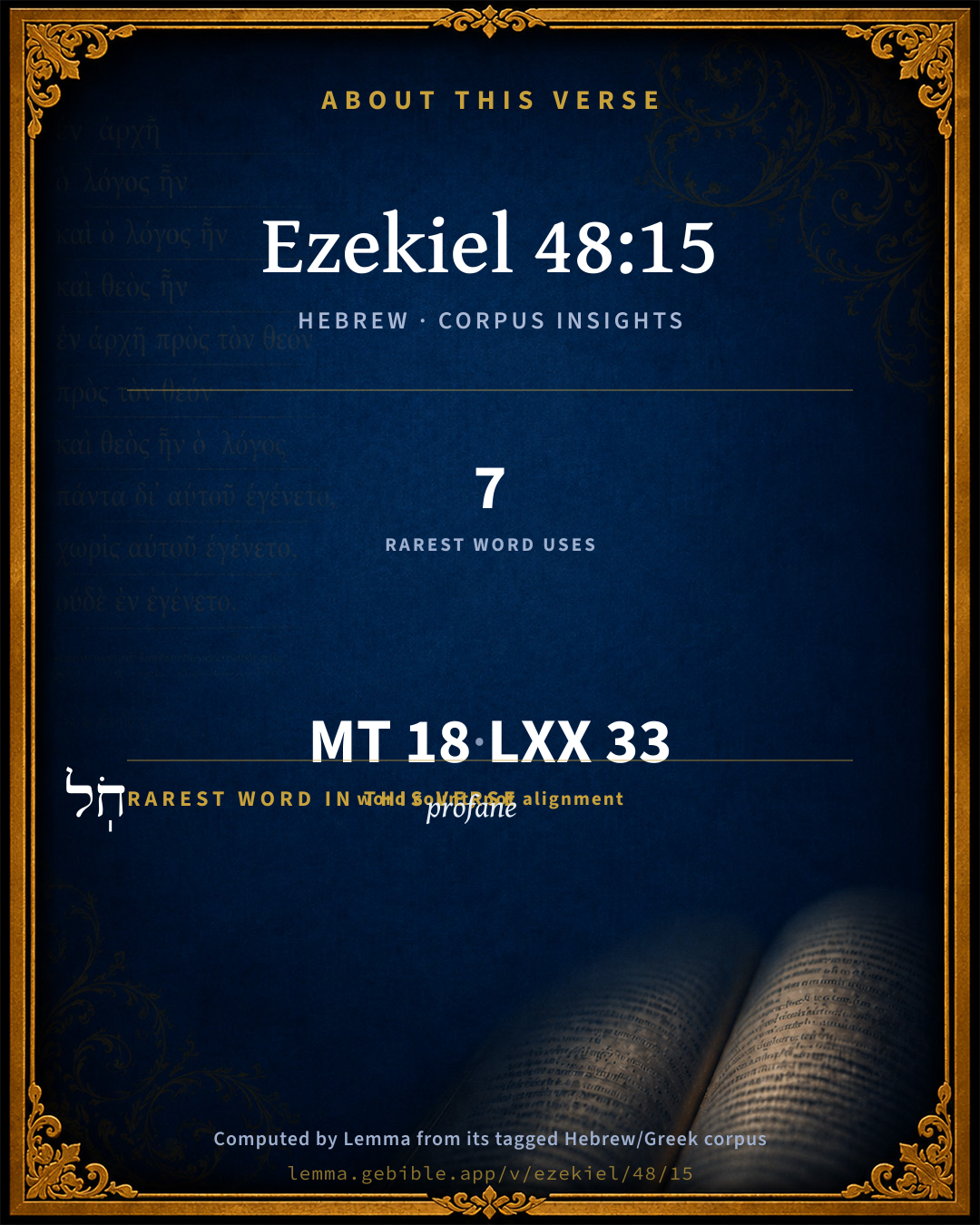
The rarest word here is חֹֽל profane H2455 — appearing just 7 times in the whole Hebrew Bible.

Shared distinctive vocabulary

חֹֽל profane H2455 occurs in 7 verses of the Hebrew Bible. Also found in:

Grammatical profile

  • 2 verbs
  • 9 nouns
  • 5 adjectives
  • 1 pronoun
  • 1 preposition

Verb forms

  • הַנּוֹתָ֣ר Niphal · Participle Active
  • וְהָיְתָ֥ה Qal · Sequential Perfect

Repetition

Words recur within this verse — often emphatic in Hebrew:

  • וַחֲמֵ֨שֶׁת five H2568 ×2
  • אֲלָפִ֜ים thousand H505 ×2
  • לָעִ֔יר city H5892 ×2
  • בתוכה midst H8432 ×2

Hebrew & Septuagint length

In English translation the verse runs 38 words from the Hebrew and 41 from the Septuagint (LXX English) — closely comparable.

A rough comparison of the two English renderings, which tokenize alike — not a word-level alignment.

Word counts can differ between the Hebrew and the Greek without any difference in meaning — e.g. the Hebrew direct-object marker אֵת has no separate Greek word, and Greek often adds the article ὁ.

In the original languages it is 18 Hebrew tokens and 33 Greek tokens — but the two are counted differently (Hebrew bundles its prefixes and suffixes into one token; the Greek is in lemma form), so that isn’t a like-for-like length.

Cross-references

5

Topical passages linked to Ezekiel 48:15 in the Treasury of Scripture Knowledge — connected by theme and wording, ordered by reader-vote popularity; previews shown in the World English Bible.

  • Ezekiel 42:20 He measured it on the four sides: it had a wall round about, the length five hundred, and the breadth five hundred, to make a separation between that which was holy and that which was common.
  • Ezekiel 45:6 You shall appoint the possession of the city five thousand broad, and twenty-five thousand long, side by side with the offering of the holy portion: it shall be for the whole house of Israel.
  • Ezekiel 22:26 Her priests have done violence to my law, and have profaned my holy things: they have made no distinction between the holy and the common, neither have they caused men to discern between the unclean and the clean, and have hid their eyes from my Sabbaths, and I am profaned among them.
  • Ezekiel 44:23 They shall teach my people the difference between the holy and the common, and cause them to discern between the unclean and the clean.
  • 1 Timothy 3:15 but if I wait long, that you may know how men ought to behave themselves in the house of God, which is the assembly of the living God, the pillar and ground of the truth.

Cross-references courtesy of OpenBible.info (CC BY 4.0).

Hebrew and Greek witnesses Masoretic Hebrew ↔ Greek Septuagint

The same verse in the two great witnesses to the Old Testament, shown verse-for-verse.

These are two independent witnesses, not word-aligned to each other, and the Septuagint is shown in lemma (dictionary) form.

Hebrew Ezekiel 48:15 Masoretic · Westminster Leningrad Codex

וַחֲמֵ֨שֶׁת אֲלָפִ֜ים הַנּוֹתָ֣ר בָּרֹ֗חַב עַל פְּנֵ֨י חֲמִשָּׁ֤ה וְעֶשְׂרִים֙ אֶ֔לֶף חֹֽל ה֣וּא לָעִ֔יר לְמוֹשָׁ֖ב וּלְמִגְרָ֑שׁ וְהָיְתָ֥ה הָעִ֖יר בתוכה בְּתוֹכֽוֹ

The five thousand that are left in the breadth, in front of the twenty-five thousand, shall be for common use, for the city, for dwelling and for suburbs; and the city shall be in the midst of it.

World English Bible · Public Domain

Greek LXX Ezekiel 48:15 Septuagint · lemma form

ὁ δέ πέντε χιλιάς ὁ περισσός ἐπί ὁ πλατύς ἐπί ὁ πέντε καί εἴκοσι χιλιάς προτείχισμα εἰμί ὁ πόλις εἰς ὁ κατοικία καί εἰς διάστημα αὐτός καί εἰμί ὁ πόλις ἐν μέσος αὐτός

But concerning the five thousand that remain in the breadth in the five and twenty thousand, they shall be a suburb to the city for dwelling, and for a space before it: and the city shall be in the midst thereof.

LXX2012 (modern English Septuagint) · Public Domain

Hebrew: Westminster Leningrad Codex (CC BY 4.0). Greek: Septuagint (public domain); English from LXX2012 (modern English Septuagint) (Public Domain). How the Septuagint differs from the Hebrew →

Targum (Aramaic paraphrase)

1

The Targum is the ancient Jewish Aramaic paraphrase of the Hebrew Scriptures — an interpretive translation, not the Hebrew text itself. Onkelos (literal) and Pseudo-Jonathan (expansive) render the Torah, and Jonathan the Prophets. Coverage is partial: where no permissively-licensed English translation exists for a verse, only the Aramaic is shown. This is verse-level text, not a word-by-word alignment to the Hebrew.

  1. Targum Jonathan Prophets (Joshua–Malachi)
    וְחַמְשָׁא אַלְפִין דְאִשְׁתָּאֲרוּ בְּפוּתְיָא עַל אַפֵּי עַסְרִין וְחַמְשָׁא אַלְפִין חוֹלָא הוּא לְקַרְתָּא לְמוֹתַב וּלְרֶוַח וִיהֵי כֵיבַשׁ קַרְתָּא בְּגַוֵיהּ:

    (no public-domain English translation for this verse)

    Targum Jonathan — Aramaic: “Mikraot Gedolot” (public domain). English: “Sefaria Community Translation” (CC0 1.0 (public-domain dedication)); “London "Chaldee Paraphrase," 1871” (public domain). Text via Sefaria.

Commentary

Notes on Ezekiel 48:15 from classic Christian and Jewish commentators (each source and its license shown beneath its notes). The classic Christian expositions comment on the surrounding passage and are grouped to its opening verse, so a note may address several verses; the Jewish commentaries on the Tanakh (Rashi and others) are per-verse, so they appear only where the commentator wrote on this verse.

Lemma curates 59 commentaries, every one of them public domain or Creative Commons licensed, each selected and text-cleaned for this edition rather than reprinted as found. About our sources →

Trapp's Complete Commentary

John Trapp

Eze 48:15 And the five thousand, that are left in the breadth over against the five and twenty thousand, shall be a profane [place] for the city, for dwelling, and for suburbs: and the city shall be in the midst thereof.

Ver. 15. Shall be a profane place,] i.e., A common place; and so all Israel were profane in a sense - sc., as compared to the priests and Levites, those consecrated persons. Symmachus and Theodotion render it λαικον. See Deu 20:6.

And the city shall be in the midst thereof.] Ten miles at least distant from the temple, some say many more; to show, say they, what a long way he must go that would attain to eternal life. He must get above the world, howsoever, who would serve God acceptably.

John Trapp, A Commentary or Exposition upon All the Books of the Old and New Testament (1647–1656) — public domain. Text from a community e-Sword module.

Joseph Benson's Commentary

Eze 48:15-17. And the five thousand that are left in the breadth over against [or beside, see Eze 48:13] the five and twenty thousand — This five thousand, added to the twenty-five thousand in length, and two ten thousands in breadth, mentioned Eze 48:10, makes up a square of twenty- five thousand every way: see Eze 48:20. Shall be a profane place for the city, &c. — It is called a profane place comparatively, because it was not so holy as the temple and the sanctuary. And the city, shall be in the midst thereof — A square piece of ground, of four thousand five hundred cubits on every side, shall be taken out of the middle of the twenty-five thousand cubits in length, for the area of the city. The north side four thousand five hundred, &c. — It shall be an equilateral square, every side being exactly of the same measure, consisting in all of eighteen thousand measures, as is expressed Eze 48:35. According to Josephus, Bell. Jud., 5:43, Jerusalem was thirty-three stadia in circuit, which the square here described does not greatly exceed. And the suburbs shall be toward the north two hundred and fifty — The city and suburbs together making a square of five thousand.

Joseph Benson's Commentary on the Old and New Testaments (1811–1818) — public domain. Text from a community e-Sword module.

Tyndale Open Study Notes

Tyndale Open Resources

48:15-20 To the south was a narrower strip for public use where the city was located. The overall shape of the central area was thus a square. The city was a visible symbol and focus of unity for the twelve tribes, and home to residents from the various tribes.

Tyndale Open Study Notes — © Tyndale Open Resources, licensed CC BY-SA 4.0. Text via the HelloAO Bible API.

Jamieson, Fausset & Brown

Robert Jamieson, A. R. Fausset & David Brown

The five thousand rods, apportioned to the city out of the twenty-five thousand square, are to be laid off in a square of four thousand five hundred, with the two hundred fifty all around for suburbs.

profane--that is, not strictly sacred as the sacerdotal portions, but applied to secular uses.

Jamieson, Fausset & Brown — Commentary Critical and Explanatory on the Whole Bible (1871) — public domain (CC PDM 1.0). Text via the HelloAO Bible API.

Adam Clarke's Commentary

Verse 15. And the five thousand that are left] The territory of the Levites was twenty-five thousand square cubits, Eze 48:20, But their city was only four thousand five hundred square cubits, see Eze 48:13; Eze 48:16; there remained, therefore, ten thousand cubits square to be divided, of which five thousand cubits in breadth, by twenty-five thousand in length, on the east and west sides, were reserved for a sort of second city; or for suburbs where laymen might dwell who were employed by those priests and Levites who lodged in the temple and in the city, Eze 48:18. And another space of one thousand cubits in breadth, by twenty-five thousand in length, which extended only from north to south, was for fields and gardens appointed for the support of those lay servants. On which we may remark, there was no cultivated land between the portion of the Levites and that of the prince, but only on the east and west sides. See Eze 45:6, and the map FF. See Clarke on Eze 48:35.

Adam Clarke's Commentary on the Bible (1810–1826) — public domain. Text from a community e-Sword/MySword module.

Ellicott's Commentary for English Readers

(15) The five thousand that are left.—The two strips of territory for the Levites and the priests, each 10,000 reeds wide, being deducted from the whole width of the oblation, leaves a strip of 5,000 wide and 25,000 long which is here apportioned to the city and its suburbs. It is called “profane” in contrast to the “holy” possession of the Levites (Eze_48:14), and the “most holy” of the priests (Eze_48:12), though it was still a part of the oblation.

A Bible Commentary for English Readers, edited by Charles John Ellicott (1878–1897) — public domain. Text from a community e-Sword module.

The Cambridge Bible for Schools and Colleges

gen. ed. J. J. S. Perowne

15–20. The portion of the oblation assignable to the city.—The remaining 5000 in breadth (N. to S.) shall belong to the city, with the same length as the portions of the priests and Levites, viz. 25,000, as it is said “over against (i.e. in length) the 25,000.” On “suburbs,” cf. Eze_45:2—they are the free place round the city.

The Cambridge Bible for Schools and Colleges (gen. ed. J. J. S. Perowne; Cambridge University Press, 1878–1918) — public domain. Text from a community e-Sword module.

John Gill's Exposition

And they that serve the city shall serve it out of all the tribes of Israel. Whether they be civil magistrates, or ministers of the word, they shall be of Israel, and be Israelites indeed; and shall be taken out of the several tribes; some out of one tribe, and some out of another; all shall have the honour, as well as the labour, of serving the church and interest of Christ; yea, all true Israelites shall contribute as much as in them lies to the service of it.

And they that serve the city shall serve it out of all the tribes of Israel. Whether they be civil magistrates, or ministers of the word, they shall be of Israel, and be Israelites indeed; and shall be taken out of the several tribes; some out of one tribe, and some out of another; all shall have the honour, as well as the labour, of serving the church and interest of Christ; yea, all true Israelites shall contribute as much as in them lies to the service of it.

Ezekiel 48:20

eze 48:20

eze 48:20

eze 48:20All the oblation shall be five and twenty thousand by five and twenty thousand,.... Or, "every oblation" (w); everyone of the oblations; that for the priests and the sanctuary; that for the Levites, and that for the city, its suburbs, and the maintenance of those that served the city; each were a square of five and twenty thousand reeds:

ye shall offer the holy oblation foursquare, with the possession of the city; taking in the possession of the city, or what that possessed, the oblation of land for that, and its suburbs, and for produce to support those that served it, should be a foursquare of the above dimensions.

(w) "omnis oblatio", Pagninus, Montanus.

John Gill's Exposition of the Whole Bible (1746–1763) — public domain (CC PDM 1.0). Text via the HelloAO Bible API.

Albert Barnes' Notes on the Bible

The five thousand ... - The remainder of the square of 25,000 reeds from north to south.

Profane - For common use, as distinguished from that which is holy unto the Lord.

Albert Barnes' Notes on the Bible (1834–1885) — public domain. Text from a community e-Sword/MySword module.

Haydock's Catholic Bible Commentary

Profane, where servants of the priests may reside. (Calmet) --- On the north and south, (Haydock) 1000 cubits broad and 25,000 long were left for fields, gardens, &c. (Calmet)

George Leo Haydock (1774–1849), Haydock's Catholic Family Bible and Commentary, 1859 edition — public domain. Excludes Psalms (Douay-Rheims chapter numbering differs from Protestant) and Deuterocanonical books (Catholic canon only).

Matthew Poole's English Annotations

In the breadth over against; or running along by the side.

The five and twenty thousand; assigned to the Levites.

A profane place; a common, not consecrated place, in which the city should be built, a place for all services, as men shall need. Now as that is counted holy which is set apart only for the service of God, so that common or profane that is for common uses.

For dwelling; houses within the walls.

For suburbs; streets and dwellings, or gardens without the walls.

The city; Jerusalem.

In the midst thereof; of this common place, which is called here profane; so that ten thousand are left at each end.

Matthew Poole's English Annotations on the Holy Bible (1683–1685) — public domain. Text from a community e-Sword/MySword module.

Whedon's Commentary on the Bible

Daniel D. Whedon

15-19. “The five thousand [cubits] that are left in the breadth, in front of the five and twenty thousand, shall be for common use.” In the midst of this reserve (see chart, page 235) is the city, which occupies a square of four thousand five hundred sacred cubits of seven handbreadths each (note Eze_40:5), which, counting eighteen inches to the ordinary cubit, would make the circuit of the city about six miles, which is something more than double that of the city of Jerusalem to-day. The suburbs of the city reach out two hundred and fifty cubits further on each side (about one hundred and forty-five yards). “The rest of the length, alongside of the sacred reservation, ten thousand cubits on the east and ten thousand cubits on the west shall belong to the city, and its produce shall be the food of the inhabitants of the city; the inhabitants of the city shall come from all the tribes of Israel” (Eze_48:18-19, Toy). According to the R.V., the produce from these outside strips of land is for them that “labor in the city,” and Eze_48:19 reads, “And they that labor in the city out of all the tribes of Israel shall till it.” In either case the verse does not refer to a lower caste or class of workmen, but merely to those engaged in ordinary employments as distinguished from the priests and Levites previously mentioned.

Daniel D. Whedon (gen. ed.), Commentary on the Old and New Testaments (1874–1909) — public domain. Text from a community e-Sword module.

The Pulpit Commentary

Vers. 15-19 In the same way the portion for the city receives detailed exposition.

Verse 15 gives four particulars.

(1) The city portion should consist of the five thousand reeds" breadth of the entire terumah remaining after the deduction of the priests" and Levites" portions.

(2) It should lie over against (ynePAl); in front of, and therefore parallel with, the five and twenty thousand cubit-lengths of which these were composed.

(3) In character it should be a profane place, i.e. a place devoted to common use as opposed to consecrated ground (comp. Lev_10:10) and designed for the city, i.e. for dwelling, and for suburbs, i.e. for the erection of houses, and for an open space or precinct (vrgmi) around the city, similar to that around the sanctuary. (see Eze_45:2) Among the Romans "a space of ground was left free from buildings, both within and without the walls, which was called pomaerium, and was likewise held sacred" (see Adam"s "Roman Antiquities," p. 62).

(4) The city should stand in the midst thereof, as the sanctuary in the midst of the priests" portion (ver. 10).

A profane place.

We are not to suppose that this place was devoted, to evil uses. It was simply distinguished from the holy place of the temple. There were degrees of holiness all the land holy when compared with heathen countries; Jerusalem especially the holy city; the temple the holy site in Jerusalem; and the holy place and the holy of holies the most sacred center of the whole circle of sanctity. By comparison with the temple area the rest of the city of Jerusalem was called "profane

I GOD PROVIDES FOR THE EVERYDAY LIFE OF HIS PEOPLE. The so-called "profane place" was carefully mapped out, and ample provision was made for the life of the people in it. The laity was not ignored when the priesthood was provided for. It was never expected that the people would spend all their days in the temple, nor that they would need no comfort for their life in the world. God is not now only concerned with our attending to religious services at church. The greater part of life must be occupied with secular pursuits. These pursuits can be followed according to the call of God, and in occupying ourselves with them we may well expect that he will give the necessary supplies, guiding our energies, and ultimately blessing our toil if it is in accordance with his mind and will.

II IT IS POSSIBLE TO LIVE A HOLY LIFE AMIDST THINGS CALLED PROFANE. The priests might be guilty of spiritual profanity while busily engaged in temple service; the laity might be truly occupied with a holy ministry, though on ground that was named profane. It is not necessary to be consecrated to the priesthood nor to enter a monastery in order to live "the religious life." The work of the busy world must be carried on, and it would be simply disastrous if all who were inspired with pure and lofty aims were to withdraw from its many necessary occupations. Not only would the service of life be neglected for want of men and women to employ themselves in it, but what work was accomplished by others would be degraded in character. This would just amount to handing the world and all its concerns over to the powers of wickedness. Christians are called upon to take the exactly opposite course, and so to be "the salt of the earth". (Mat_5:13)

III ADVERSE EXTERNAL CIRCUMSTANCES DO NOT PREVENT SPIRITUALITY OF LIFE. The secularity of a man"s occupations does not prevent him from being a Christian of the very highest type. The supposed profaneness of his circumstances cannot be accepted as an excuse for godless, sinful living. Nothing would be really profane if the heart were true and spiritual; for "to the pure all things are pure." It is sometimes supposed that it would be more easy for a man to live a religious life if he were a minister of religion. But then the temptation of professionalism would come in, and the business spirit endanger the sacredness of the most spiritual things, whereas when religion is wholly sought after for its spiritual use it is less in danger of sinking into a mere form. But the whole question turns on the spirituality of the character and conduct rather than on the form of the occupations of daily duty.

The Pulpit Commentary (1880–1919), ed. H.D.M. Spence-Jones & Joseph S. Exell — public domain. Text from a community e-Sword module.

John Wesley's Explanatory Notes

A profane place - A common, not consecrated place.

John Wesley, Explanatory Notes Upon the Whole Bible (1754–1765) — public domain. Text via the GEBible commentary corpus.

unfoldingWord translationNotes

Door43 World Missions Community

five thousand cubits ... twenty-five thousand cubits

"5000 cubits ... 25,000 cubits." Each long cubit was about 54 centimeters. See how you translated this in Ezekiel 40:5. AT: "almost 2.3 kilometers ... about 13.5 kilometers" (See: Numbers and Biblical Distance)

will be for the collective use of the city

"will be an area that all the people of the city will share and use"

4,500 cubits

"four thousand five hundred cubits." Each long cubit was about 54 centimeters. See how you translated this in Ezekiel 40:5. AT: "about 2.4 kilometers" (See: Numbers and Biblical Distance)

the houses, and the pastureland

"as a place for houses and for an open space"

unfoldingWord translationNotes — © Distant Shores Media and the Door43 World Missions Community, licensed CC BY-SA 4.0. Source: git.door43.org/Door43/en_tn.

Rashi

Rabbi Shlomo Yitzchaki (Rashi)

And the 5,000 that remain in the width of the strips of the great separation which was 25,000 [in] width and its length was the same as that of any portions from the eastern side to the western side. From that he set apart two strips from its center, 25,000 long and 20,000 wide; and 5,000 were left over in its width. Those 5,000 of the width shall be for the residential area of the city, their length facing the 25,000 length of the offering for the Levites.

is non-holy [These 5,000 rods of land] are not holy like the “offering” of the strips of the priests and the Levites. It is non-holy as compared to them, and they shall be for the city for dwellings of Israelites and for an open space around the city.

it its midst in the middle of that strip.

Rashi on the Tanakh — English translations: “The Judaica Press complete Tanach with Rashi, translated by A. J. Rosenberg” (CC BY 4.0); “Pentateuch with Rashi's commentary by M. Rosenbaum and A.M. Silbermann, 1929-1934” (public domain); “The Metsudah Tanach series, Lakewood, N.J” (CC BY 4.0); and “The Book of Joshua, Metsudah Publications, 1997” (CC BY 4.0). Text via Sefaria.

Lesson kit

Teaching starters — assembled from the data on this page, not authored interpretation. Every prompt links to the verse data it draws on. Edit before teaching.

Ezekiel, in the Prophets, opens this verse with 18 words (14 distinct Hebrew lemmas). Its most distinctive word is chôl (“profane”). A historical commentator’s framing appears above. Read the whole chapter for the surrounding context.

Discussion questions

  1. How does “profane” (chôl) shape what this verse is saying?
  2. How does Leviticus 10:10, which shares the word «profane», read alongside this verse?
  3. What does the repetition of “five” (2× in this one verse) do in this verse?
  4. The translations on this page render this verse differently — a whole-verse word diff, not a word-by-word alignment. What might account for the different wordings?
  5. «הַנּוֹתָ֣ר» is a Niphal Participle Active verb. How does that grammatical form shape the action described?
  6. Compare how Trapp's Complete Commentary and Joseph Benson's Commentary read this verse. Where do they agree or differ?

Things to notice

Reading settings

Reading text

Shown beneath each verse's original-language words.

Old Testament
Old Testament edition

Read the OT as the Masoretic Hebrew (MT) or the Greek Septuagint (LXX).

English shown for the Greek Septuagint (in the Hebrew ↔ Greek comparison).

Comparing translations? Open the Compare panel on any verse page to stack up to four side by side.