
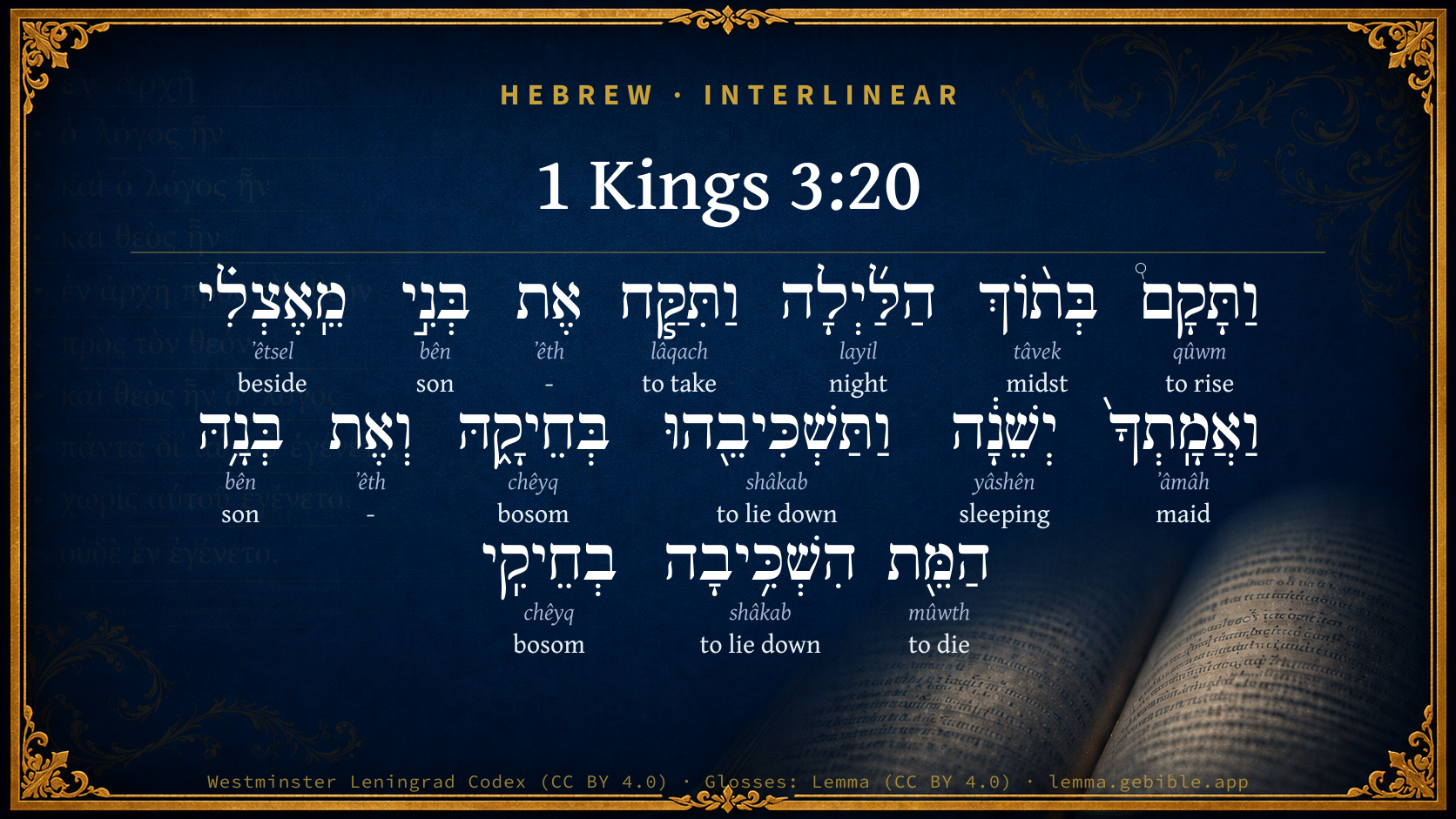
1 Kings 3:20

Hebrew (Westminster Leningrad Codex) 1 Kings 3:20 appears in the Hebrew Old Testament. The text above is from the Westminster Leningrad Codex. Each word links to its Strong’s number, a concise gloss, and parsing drawn from the Open Scriptures Hebrew Bible morphology. Click any word for its full Brown-Driver-Briggs (BDB) entry.
Download image
Cite this verse

1 Kings 3:20 (World English Bible). Public Domain. Lemma interlinear Bible study tool, https://lemma.gebible.app/v/1-kings/3/20.

Show BibTeX & RIS
BibTeX
RIS
English Translation
She arose at midnight, and took my son from beside me, while your handmaid slept, and laid it in her bosom, and laid her dead child in my bosom.
World English Bible · Public Domain
Download a study sheet

One document with this verse’s original text, its word-by-word gloss line, the meaning frame, cross-references with their text, attributed commentary, and full source and license credits — printable, and it pastes into notes with its structure intact.

This verse Autodidact and up

Study sheet (.html) Plain text (.txt)

A passage Seminary Student

Up to 50 verses in one chapter. A passage sheet keeps up to 6 commentary sources and 12 cross-references per verse, in the order this page ranks them, and says so on the sheet whenever that leaves anything out. Ask for a single verse and you get the Autodidact verse sheet above.

Everything on this page stays free to read, with no account — the sheet is a download of what is already on screen, not access to it.

Want to remove ads? Support Godless Engineer
Compare translations 3

The same verse in 3 English versions, stacked beneath the original-language interlinear above. Click any original word for its lexicon entry.

Each is an independent rendering of the whole verse — the interlinear is not word-aligned to these translations.

Highlighted words mark where these versions differ — a whole-verse word diff, not a word-by-word alignment.

  • World English Bible Public Domain
    She arose at midnight, and took my son from beside me, while your handmaid slept, and laid it in her bosom, and laid her dead child in my bosom.
  • King James Version Public Domain
    And she arose at midnight, and took my son from beside me, while thine handmaid slept, and laid it in her bosom, and laid her dead child in my bosom.
  • unfoldingWord Literal Text CC BY-SA 4.0
    And she arose in the middle of the night, and she took my son from my side, and your female servant was asleep. And she laid him in her bosom. And her son, the one having died, she laid in my bosom.

unfoldingWord Literal Text — © unfoldingWord, licensed CC BY-SA 4.0. Word-aligned USFM3 via Door43 (git.door43.org/unfoldingWord/en_ult).

Versions to compare (up to 4)

3 of 4 selected

Show all 18 translations

Every available English version of this verse, each an independent rendering of the whole verse.

  • World English Bible Public Domain
    She arose at midnight, and took my son from beside me, while your handmaid slept, and laid it in her bosom, and laid her dead child in my bosom.
  • Berean Standard Bible Public Domain
    So she got up in the middle of the night and took my son from my side while I was asleep. She laid him in her bosom and put her dead son at my bosom.
  • Majority Standard Bible Public Domain
    So she got up in the middle of the night and took my son from my side while I was asleep. She laid him in her bosom and put her dead son at my bosom.
  • King James Version Public Domain
    And she arose at midnight, and took my son from beside me, while thine handmaid slept, and laid it in her bosom, and laid her dead child in my bosom.
  • American Standard Version (1901) Public Domain
    And she arose at midnight, and took my son from beside me, while thy handmaid slept, and laid it in her bosom, and laid her dead child in my bosom.
  • Revised Version (1885) Public Domain
    And she arose at midnight, and took my son from beside me, while thine handmaid slept, and laid it in her bosom, and laid her dead child in my bosom.
  • Geneva Bible (1599) Public Domain
    And she rose at midnight, and tooke my sonne from my side, while thine handmaide slept, and layde him in her bosome, and layde her dead sonne in my bosome.
  • Douay-Rheims (1899) Public Domain
    And rising in the dead time of the night, she took my child from my side, while I thy handmaid was asleep, and laid it in her bosom: and laid her dead child in my bosom.
  • Young's Literal Translation Public Domain
    and she riseth in the middle of the night, and taketh my son from beside me -- and thy handmaid is asleep -- and layeth it in her bosom, and her dead son she hath laid in my bosom;
  • Literal Standard Version CC BY-SA 4.0
    and she rises in the middle of the night, and takes my son from beside me—and your handmaid is asleep—and lays him in her bosom, and she has laid her dead son in my bosom;
  • Unlocked Literal Bible CC BY-SA 4.0
    So she arose at midnight and took my son from beside me, while your servant slept, and laid him at her breast, and laid her dead son at my breast.
  • unfoldingWord Literal Text CC BY-SA 4.0
    And she arose in the middle of the night, and she took my son from my side, and your female servant was asleep. And she laid him in her bosom. And her son, the one having died, she laid in my bosom.
  • Darby Bible Public Domain
    And she arose at midnight, and took my son from beside me, while thy handmaid slept, and laid it in her bosom, and laid her dead son in my bosom.
  • World Messianic Bible Public Domain
    She arose at midnight, and took my son from beside me while your servant slept, and laid it in her bosom, and laid her dead child in my bosom.
  • Webster's Bible Public Domain
    And she arose at midnight, and took my son from beside me, while thy handmaid slept, and laid it in her bosom, and laid her dead child in my bosom.
  • Free Bible Version CC BY-SA 4.0
    She got up in the middle of the night and took my son from beside me while I was sleeping. She lay him close beside her to cuddle him, and she lay her dead son close beside me.
  • Bible in Basic English Public Domain
    And she got up in the middle of the night and took my son from my side while your servant was sleeping; and she took it in her arms and put her dead child in my arms.
  • JPS Tanakh (1917) Public Domain
    And she arose at midnight, and took my son from beside me, while thy handmaid slept, and laid it in her bosom, and laid her dead child in my bosom.

Literal Standard Version (2020), Covenant Press — licensed CC BY-SA 4.0. Text via the HelloAO Bible API (eBible.org). Unlocked Literal Bible (unfoldingWord) — licensed CC BY-SA 4.0. Text via the HelloAO Bible API (eBible.org). unfoldingWord Literal Text — © unfoldingWord, licensed CC BY-SA 4.0. Word-aligned USFM3 via Door43 (git.door43.org/unfoldingWord/en_ult). Free Bible Version, Dr. Jonathan Gallagher — licensed CC BY-SA 4.0. Text via the HelloAO Bible API (eBible.org).

Word by word

More ways to search: Search by grammar → Find every occurrence → Compare this word →

Practice this passage: Drill this verse → Learn its vocabulary →

יְשֵׁנָ֔ה
yâshên
H3463
“sleeping”
Adjective, Adjective, Feminine, Singular, Absolute
Part of Speech
Adjective
Type
Adjective
Gender
Feminine
Number
Singular
State
Absolute
Full BDB Definition

Origin: from H3462

TWOT: 928a

sleeping
  1. וַתָּקָם֩ qûwm H6965 “and · to rise” Conjunction + Verb, Qal, Sequential Imperfect, 3rd Person, Feminine, Singular
  2. בְּת֨וֹךְ tâvek H8432 “in/at · midst of” Preposition + Noun, Common, Masculine, Singular, Construct
  3. הַלַּ֜יְלָה layil H3915 “the · night” Particle, Definite Article + Noun, Common, Masculine, Singular, Absolute
  4. וַתִּקַּ֧ח lâqach H3947 “and · to take” Conjunction + Verb, Qal, Sequential Imperfect, 3rd Person, Feminine, Singular
  5. אֶת ʼêth H853 “-” Particle, Direct Object
  6. בְּנִ֣י bên H1121 “son · my” Noun, Common, Masculine, Singular, Construct + Suffix, Personal, 1st Person, Common, Singular
  7. מֵֽאֶצְלִ֗י ʼêtsel H681 “from · beside · me” Preposition + Preposition + Suffix, Personal, 1st Person, Common, Singular
  8. וַאֲמָֽתְךָ֙ ʼâmâh H519 “and · maid · your” Conjunction + Noun, Common, Feminine, Singular, Construct + Suffix, Personal, 2nd Person, Masculine, Singular
  9. וַתַּשְׁכִּיבֵ֖הוּ shâkab H7901 “and · to lie down · him” Conjunction + Verb, Hiphil, Sequential Imperfect, 3rd Person, Feminine, Singular + Suffix, Personal, 3rd Person, Masculine, Singular
  10. בְּחֵיקָ֑הּ chêyq H2436 “in/at · bosom · her” Preposition + Noun, Common, Masculine, Singular, Construct + Suffix, Personal, 3rd Person, Feminine, Singular
  11. וְאֶת ʼêth H853 “and · -” Conjunction + Particle, Direct Object
  12. בְּנָ֥הּ bên H1121 “son · her” Noun, Common, Masculine, Singular, Construct + Suffix, Personal, 3rd Person, Feminine, Singular
  13. הַמֵּ֖ת mûwth H4191 “the · dying” Particle, Definite Article + Verb, Qal, Participle Active, Masculine, Singular, Absolute
  14. הִשְׁכִּ֥יבָה shâkab H7901 “to lie down” Verb, Hiphil, Perfect, 3rd Person, Feminine, Singular
  15. בְחֵיקִֽי chêyq H2436 “in/at · bosom · my” Preposition + Noun, Common, Masculine, Singular, Construct + Suffix, Personal, 1st Person, Common, Singular

About this verse

These counts appear in no published source. They are computed here, from the morphology-tagged text and Lemma’s own curated glosses. What Lemma adds →

16
words
12
distinct lemmas
Historical
section

Notable vocabulary

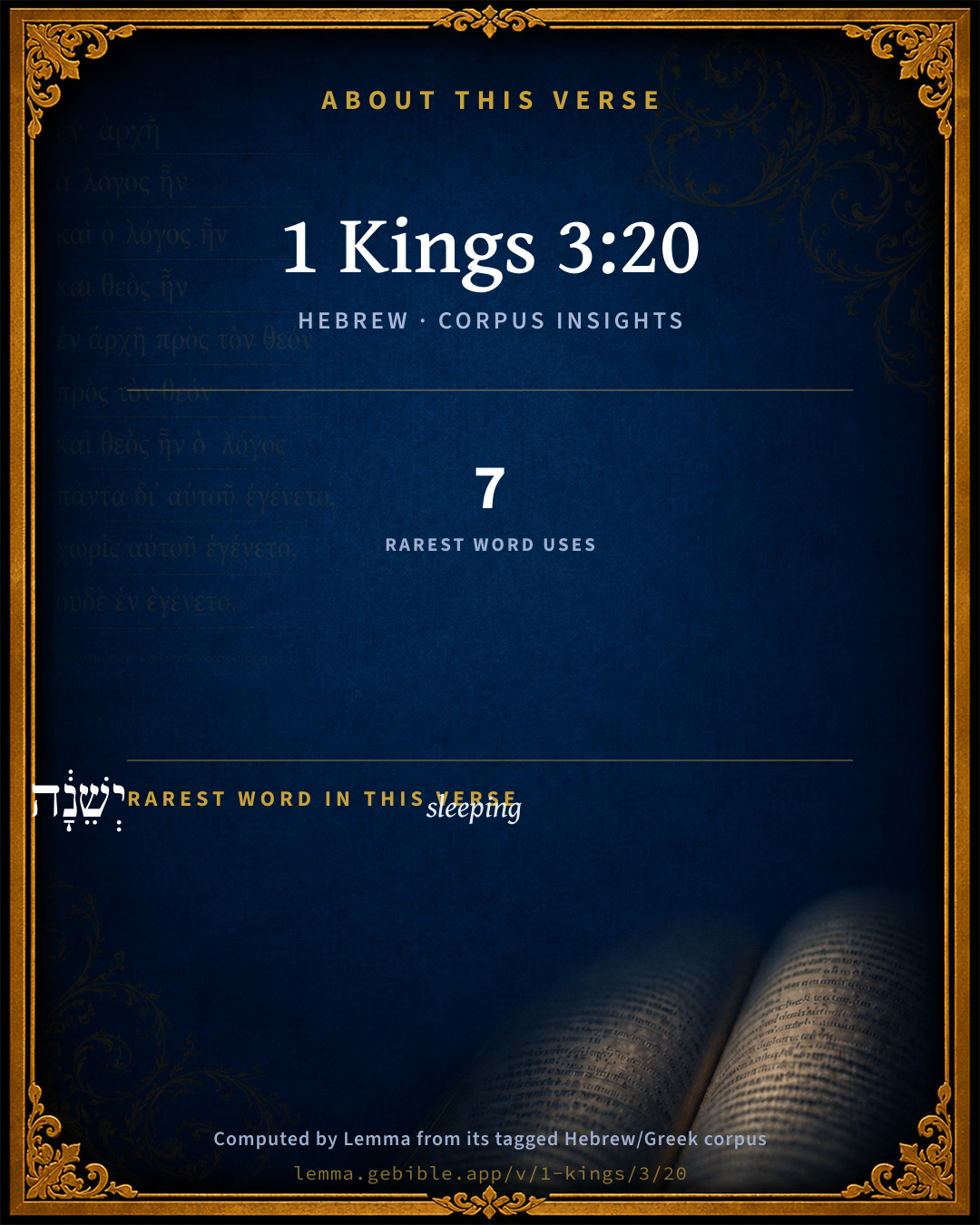
The rarest word here is יְשֵׁנָ֔ה sleeping H3463 — appearing just 7 times in the whole Hebrew Bible.

Shared distinctive vocabulary

יְשֵׁנָ֔ה sleeping H3463 occurs in 7 verses of the Hebrew Bible. Also found in:

Grammatical profile

  • 5 verbs
  • 7 nouns
  • 1 adjective
  • 1 preposition
  • 2 particles

Verb forms

  • וַתָּקָם֩ Qal · Sequential Imperfect
  • וַתִּקַּ֧ח Qal · Sequential Imperfect
  • וַתַּשְׁכִּיבֵ֖הוּ Hiphil · Sequential Imperfect
  • הַמֵּ֖ת Qal · Participle Active
  • הִשְׁכִּ֥יבָה Hiphil · Perfect

Repetition

Words recur within this verse — often emphatic in Hebrew:

  • בְּנִ֣י son H1121 ×2
  • וַתַּשְׁכִּיבֵ֖הוּ to lie down H7901 ×2
  • בְּחֵיקָ֑הּ bosom H2436 ×2

Hebrew & Septuagint length

In English translation the verse runs 29 words from the Hebrew and 30 from the Septuagint (LXX English) — closely comparable.

A rough comparison of the two English renderings, which tokenize alike — not a word-level alignment.

Word counts can differ between the Hebrew and the Greek without any difference in meaning — e.g. the Hebrew direct-object marker אֵת has no separate Greek word, and Greek often adds the article ὁ.

Cross-references

4

Topical passages linked to 1 Kings 3:20 in the Treasury of Scripture Knowledge — connected by theme and wording, ordered by reader-vote popularity; previews shown in the World English Bible.

  • John 3:20 For everyone who does evil hates the light, and doesn't come to the light, lest his works would be exposed.
  • Matthew 13:25 but while people slept, his enemy came and sowed darnel also among the wheat, and went away.
  • Job 24:13–17 "These are of those who rebel against the light; They don't know the ways of it, Nor abide in the paths of it.
  • Psalms 139:11 If I say, "Surely the darkness will overwhelm me; The light around me will be night;"

Cross-references courtesy of OpenBible.info (CC BY 4.0).

Hebrew and Greek witnesses Masoretic Hebrew ↔ Greek Septuagint

The same verse in the two great witnesses to the Old Testament, shown verse-for-verse.

These are two independent witnesses, not word-aligned to each other, and the Septuagint is shown in lemma (dictionary) form.

Hebrew 1 Kings 3:20 Masoretic · Westminster Leningrad Codex

וַתָּקָם֩ בְּת֨וֹךְ הַלַּ֜יְלָה וַתִּקַּ֧ח אֶת בְּנִ֣י מֵֽאֶצְלִ֗י וַאֲמָֽתְךָ֙ יְשֵׁנָ֔ה וַתַּשְׁכִּיבֵ֖הוּ בְּחֵיקָ֑הּ וְאֶת בְּנָ֥הּ הַמֵּ֖ת הִשְׁכִּ֥יבָה בְחֵיקִֽי

She arose at midnight, and took my son from beside me, while your handmaid slept, and laid it in her bosom, and laid her dead child in my bosom.

World English Bible · Public Domain

Greek LXX 1 Kings 3:20 Septuagint · lemma form

καί ἀναἵστημι μέσος ὁ νύξ καί λαμβάνω ὁ υἱός ἐγώ ἐκ ὁ ἀγκάλη ἐγώ καί κοιμίζω αὐτός ἐν ὁ κόλπος αὐτός καί ὁ υἱός αὐτός ὁ θνήσκω κοιμίζω ἐν ὁ κόλπος ἐγώ

and she arose in the middle of the night, and took my son from my arms, and laid him in her bosom, and laid her dead son in my bosom.

LXX2012 (modern English Septuagint) · Public Domain

Hebrew: Westminster Leningrad Codex (CC BY 4.0). Greek: Septuagint (public domain); English from LXX2012 (modern English Septuagint) (Public Domain). How the Septuagint differs from the Hebrew →

Targum (Aramaic paraphrase)

1

The Targum is the ancient Jewish Aramaic paraphrase of the Hebrew Scriptures — an interpretive translation, not the Hebrew text itself. Onkelos (literal) and Pseudo-Jonathan (expansive) render the Torah, and Jonathan the Prophets. Coverage is partial: where no permissively-licensed English translation exists for a verse, only the Aramaic is shown. This is verse-level text, not a word-by-word alignment to the Hebrew.

  1. Targum Jonathan Prophets (Joshua–Malachi)
    וְקָמַת בְּגוֹ לֵילָא וּנְסִיבַת יַת בְּרִי מִלְוָתִי וְאַמְתָךְ דָמְכָא וְאַשְׁכֵּיבְתֵּיהּ לְוָתָה וְיַת בְּרָהּ מֵיתָא אַשְׁכֵּיבַת לְוָתִי:

    (no public-domain English translation for this verse)

    Targum Jonathan — Aramaic: “Mikraot Gedolot” (public domain). English: “Sefaria Community Translation” (CC0 1.0 (public-domain dedication)); “London "Chaldee Paraphrase," 1871” (public domain). Text via Sefaria.

Commentary

Notes on 1 Kings 3:20 from classic Christian and Jewish commentators (each source and its license shown beneath its notes). The classic Christian expositions comment on the surrounding passage and are grouped to its opening verse, so a note may address several verses; the Jewish commentaries on the Tanakh (Rashi and others) are per-verse, so they appear only where the commentator wrote on this verse.

Lemma curates 59 commentaries, every one of them public domain or Creative Commons licensed, each selected and text-cleaned for this edition rather than reprinted as found. About our sources →

Trapp's Complete Commentary

John Trapp

1Ki 3:20 And she arose at midnight, and took my son from beside me, while thine handmaid slept, and laid it in her bosom, and laid her dead child in my bosom.

Ver. 20. While thine handmaid slept.] But how could she certainly tell what was done when she was asleep? The proofs in this cause alleged were so weak and unsatisfactory, that it was thought the wit of man could not determine it. But "a divine sentence was in the mouth of the king: his lips transgressed not in judgment." {Pro 16:10}

And laid her dead child in my bosom.] This was Qυχρον παραγκαλισμα, a cold bosomful, as one calleth a bad wife. And another complaineth of some in these days, that, harlot-like, they take their dead and putrid fancies, and lay them in the bosom of the Scripture, as of a mother, while they go about to give unto it, and not to receive from it the sense; wresting it to their own destruction.

John Trapp, A Commentary or Exposition upon All the Books of the Old and New Testament (1647–1656) — public domain. Text from a community e-Sword module.

Geneva Bible (1599)

Geneva Bible translators

She stole the quick child away, because she might both avoid the shame and punishment.

Geneva Bible (1599) marginal notes — public domain. Text via Bolls.life.

The Cambridge Bible for Schools and Colleges

gen. ed. J. J. S. Perowne

20. and laid it in her bosom] It is not easy to account for the action of this woman. We need not however suppose her to have been possessed of very fine feelings, as indeed her after-behaviour shews. But it is somewhat more than unnatural to adopt such a scheme as this described here at a moment’s notice. It may be that she was chiefly moved by anxiety to preserve her own health, which would be imperilled through the sudden loss of the babe which she was meant to nurse.

The Cambridge Bible for Schools and Colleges (gen. ed. J. J. S. Perowne; Cambridge University Press, 1878–1918) — public domain. Text from a community e-Sword module.

John Gill's Exposition

And when I rose in the morning to give my child suck,.... As she used to do:

behold, it was dead; her own child, as she thought at first:

but when I had considered it in the morning; it was towards morning, or just at break of day, when she arose to suckle it, and found it dead: but when it was broad day, and the light of the morning was increased, she more narrowly viewed it, and by its features, or some marks she had observed;

behold, it was not my son which I did bear: she was fully satisfied it was not her own child, but another.

John Gill's Exposition of the Whole Bible (1746–1763) — public domain (CC PDM 1.0). Text via the HelloAO Bible API.

Matthew Poole's English Annotations

She arose at midnight, when I was asleep, as she reasonably and truly concluded.

Took my son from beside me; either because she really desired the comfort of a child, to be educated by her, and owned as hers; or because she would not be thought guilty of the child’s death, for which she knew not how severely Solomon would punish her.

While thine handmaid slept; as she might well know, because had she been awake, she had discovered and prevented her design.

Matthew Poole's English Annotations on the Holy Bible (1683–1685) — public domain. Text from a community e-Sword/MySword module.

The Pulpit Commentary

And she arose at midnight (rather, in the middle, i.e. , dead of the night. The sleeper could not know it was midnight), and took my son from beside me, while thine handmaid slept, and laid it in her bosom, and laid her dead child in my besom.

The Pulpit Commentary (1880–1919), ed. H.D.M. Spence-Jones & Joseph S. Exell — public domain. Text from a community e-Sword module.

Lesson kit

Teaching starters — assembled from the data on this page, not authored interpretation. Every prompt links to the verse data it draws on. Edit before teaching.

1 Kings, in the Historical, opens this verse with 16 words (12 distinct Hebrew lemmas). Its most distinctive word is yâshên (“sleeping”). A historical commentator’s framing appears above. Read the whole chapter for the surrounding context.

Discussion questions

  1. How does “sleeping” (yâshên) shape what this verse is saying?
  2. 1 Samuel 26:7 shares the word «sleeping» with this verse. How do the two illuminate each other?
  3. “son” occurs 2× in this one verse. What is the effect of the repetition?
  4. These translations render this verse differently. What is at stake in choosing one wording over another?
  5. The verb «וַתָּקָם֩» is Qal Sequential Imperfect. How does its form color the action?
  6. Reading how Trapp's Complete Commentary and Geneva Bible (1599) read this verse, where do the two commentators agree and where do they part?

Things to notice

Reading settings

Reading text

Shown beneath each verse's original-language words.

Old Testament
Old Testament edition

Read the OT as the Masoretic Hebrew (MT) or the Greek Septuagint (LXX).

English shown for the Greek Septuagint (in the Hebrew ↔ Greek comparison).

Comparing translations? Open the Compare panel on any verse page to stack up to four side by side.