
2 Samuel 20:12

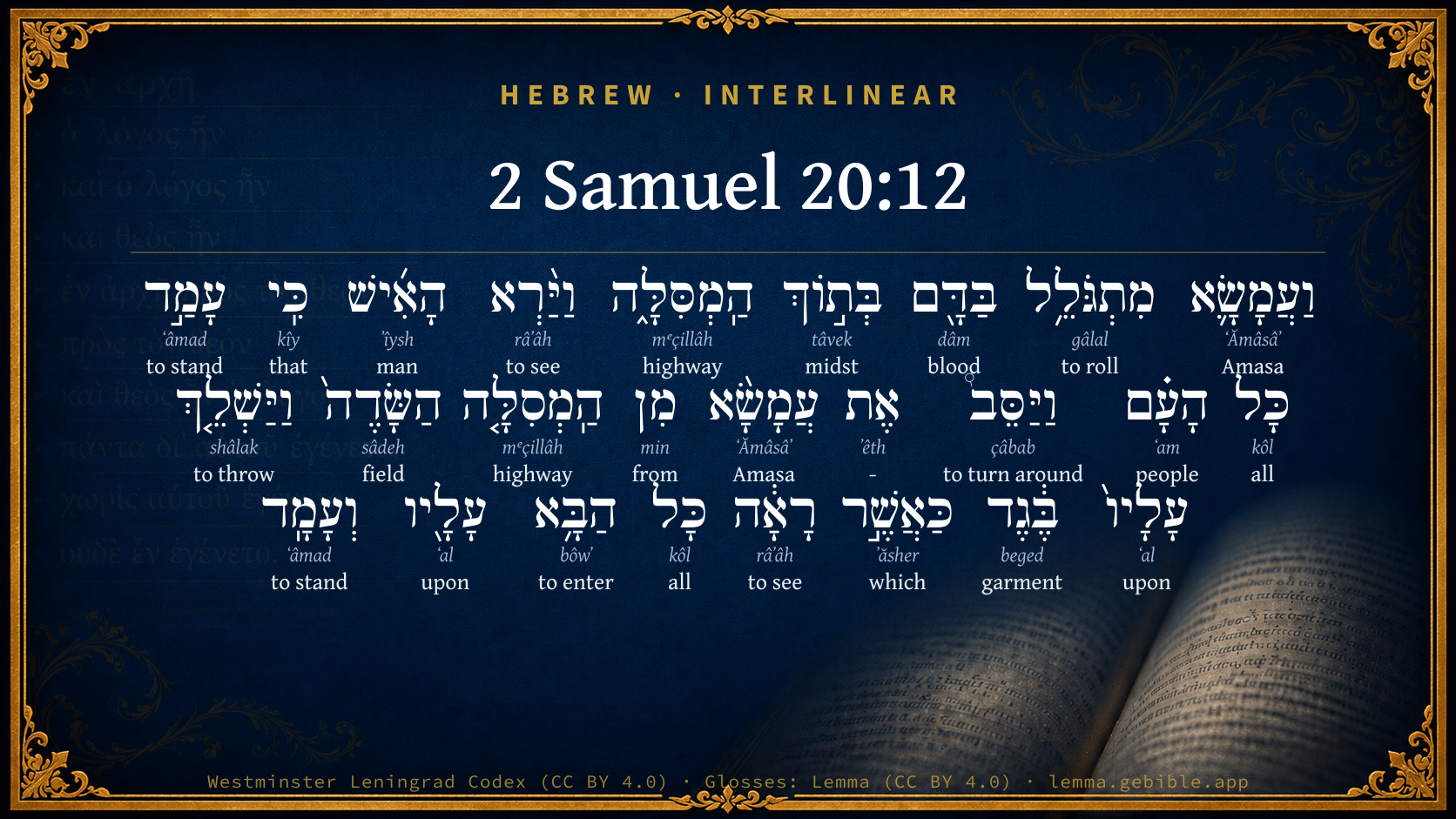
Hebrew (Westminster Leningrad Codex) 2 Samuel 20:12 appears in the Hebrew Old Testament. The text above is from the Westminster Leningrad Codex. Each word links to its Strong’s number, a concise gloss, and parsing drawn from the Open Scriptures Hebrew Bible morphology. Click any word for its full Brown-Driver-Briggs (BDB) entry.
Download image
Cite this verse

2 Samuel 20:12 (World English Bible). Public Domain. Lemma interlinear Bible study tool, https://lemma.gebible.app/v/2-samuel/20/12.

Show BibTeX & RIS
BibTeX
RIS
English Translation
Amasa lay wallowing in his blood in the midst of the highway. When the man saw that all the people stood still, he carried Amasa out of the highway into the field, and cast a garment over him, when he saw that everyone who came by him stood still.
World English Bible · Public Domain
Download a study sheet

One document with this verse’s original text, its word-by-word gloss line, the meaning frame, cross-references with their text, attributed commentary, and full source and license credits — printable, and it pastes into notes with its structure intact.

This verse Autodidact and up

Study sheet (.html) Plain text (.txt)

A passage Seminary Student

Up to 50 verses in one chapter. A passage sheet keeps up to 6 commentary sources and 12 cross-references per verse, in the order this page ranks them, and says so on the sheet whenever that leaves anything out. Ask for a single verse and you get the Autodidact verse sheet above.

Everything on this page stays free to read, with no account — the sheet is a download of what is already on screen, not access to it.

Want to remove ads? Support Godless Engineer
Compare translations 3

The same verse in 3 English versions, stacked beneath the original-language interlinear above. Click any original word for its lexicon entry.

Each is an independent rendering of the whole verse — the interlinear is not word-aligned to these translations.

Highlighted words mark where these versions differ — a whole-verse word diff, not a word-by-word alignment.

  • World English Bible Public Domain
    Amasa lay wallowing in his blood in the midst of the highway. When the man saw that all the people stood still, he carried Amasa out of the highway into the field, and cast a garment over him, when he saw that everyone who came by him stood still.
  • King James Version Public Domain
    And Amasa wallowed in blood in the midst of the highway. And when the man saw that all the people stood still, he removed Amasa out of the highway into the field, and cast a cloth upon him, when he saw that every one that came by him stood still.
  • unfoldingWord Literal Text CC BY-SA 4.0
    Now Amasa was rolling himself in blood in the midst of the road. And the man saw that all of the people stood. So he removed Amasa from the road a field, and he threw a garment over him, because he saw everyone coming to him, that he stood.

unfoldingWord Literal Text — © unfoldingWord, licensed CC BY-SA 4.0. Word-aligned USFM3 via Door43 (git.door43.org/unfoldingWord/en_ult).

Versions to compare (up to 4)

3 of 4 selected

Show all 18 translations

Every available English version of this verse, each an independent rendering of the whole verse.

  • World English Bible Public Domain
    Amasa lay wallowing in his blood in the midst of the highway. When the man saw that all the people stood still, he carried Amasa out of the highway into the field, and cast a garment over him, when he saw that everyone who came by him stood still.
  • Berean Standard Bible Public Domain
    But Amasa wallowed in his blood in the middle of the road, and when the man saw that all the troops were stopping there, he dragged the body off the road into a field and threw a garment over it.
  • Majority Standard Bible Public Domain
    But Amasa wallowed in his blood in the middle of the road, and when the man saw that all the troops were stopping there, he dragged the body off the road into a field and threw a garment over it.
  • King James Version Public Domain
    And Amasa wallowed in blood in the midst of the highway. And when the man saw that all the people stood still, he removed Amasa out of the highway into the field, and cast a cloth upon him, when he saw that every one that came by him stood still.
  • American Standard Version (1901) Public Domain
    And Amasa lay wallowing in his blood in the midst of the highway. And when the man saw that all the people stood still, he carried Amasa out of the highway into the field, and cast a garment over him, when he saw that every one that came by him stood still.
  • Revised Version (1885) Public Domain
    And Amasa lay wallowing in his blood in the midst of the highway. And when the man saw that all the people stood still, he carried Amasa out of the highway into the field, and cast a garment over him, when he saw that every one that came by him stood still.
  • Geneva Bible (1599) Public Domain
    And Amasa wallowed in blood in the mids of the way: and when the man sawe that all the people stood still, he remooued Amasa out of the way into the fielde, and cast a cloth vpon him, because he saw that euery one that came by him, stoode still.
  • Douay-Rheims (1899) Public Domain
    And Amasa imbrued with blood, lay in the midst of the way. A certain man saw this that all the people stood still to look upon him, so he removed Amasa out of the highway into the field, and covered him with a garment, that they who passed might not stop on his account.
  • Young's Literal Translation Public Domain
    And Amasa is rolling himself in blood, in the midst of the highway, and the man seeth that all the people have stood still, and he bringeth round Amasa out of the highway to the field, and casteth over him a garment, when he hath seen that every one who hath come by him -- hath stood still.
  • Literal Standard Version CC BY-SA 4.0
    And Amasa is rolling himself in blood, in the midst of the highway, and the man sees that all the people have stood still, and he brings around Amasa out of the highway to the field, and casts a garment over him when he has seen that everyone who has come by him has stood still.
  • Unlocked Literal Bible CC BY-SA 4.0
    Amasa lay wallowing in his blood in the middle of the road. When the man saw that all the people stood still, he carried Amasa off of the road and into a field. He threw a garment over him because he saw that everyone who came by him stood still.
  • unfoldingWord Literal Text CC BY-SA 4.0
    Now Amasa was rolling himself in blood in the midst of the road. And the man saw that all of the people stood. So he removed Amasa from the road a field, and he threw a garment over him, because he saw everyone coming to him, that he stood.
  • Darby Bible Public Domain
    Now Amasa wallowed in blood in the midst of the highway. And when the man saw that all the people stood still, he removed Amasa out of the highway into the field, and cast a cloth upon him, when he saw that every one that came by stood still.
  • World Messianic Bible Public Domain
    Amasa lay wallowing in his blood in the middle of the highway. When the man saw that all the people stood still, he carried Amasa out of the highway into the field, and cast a garment over him when he saw that everyone who came by him stood still.
  • Webster's Bible Public Domain
    And Amasa wallowed in blood in the midst of the highway. And when the man saw that all the people stood still, he removed Amasa out of the highway into the field, and cast a cloth upon him, when he saw that every one that came by him stood still.
  • Free Bible Version CC BY-SA 4.0
    But Amasa was there, lying in his blood in the middle of the main road. When the man saw that everybody was stopping to look, he pulled the body off the road into a field and threw a cloth over it.
  • Bible in Basic English Public Domain
    And Amasa was stretched out in a pool of blood in the middle of the highway. And when the man saw that all the people were stopping, he took Amasa out of the highway and put him in a field, with a cloth over him, when he saw that everyone who went by came to a stop.
  • JPS Tanakh (1917) Public Domain
    And Amasa lay wallowing in his blood in the midst of the highway. And when the man saw that all the people stood still, he carried Amasa out of the highway into the field, and cast a garment over him, when he saw that every one that came by him stood still.

Literal Standard Version (2020), Covenant Press — licensed CC BY-SA 4.0. Text via the HelloAO Bible API (eBible.org). Unlocked Literal Bible (unfoldingWord) — licensed CC BY-SA 4.0. Text via the HelloAO Bible API (eBible.org). unfoldingWord Literal Text — © unfoldingWord, licensed CC BY-SA 4.0. Word-aligned USFM3 via Door43 (git.door43.org/unfoldingWord/en_ult). Free Bible Version, Dr. Jonathan Gallagher — licensed CC BY-SA 4.0. Text via the HelloAO Bible API (eBible.org).

Word by word

More ways to search: Search by grammar → Find every occurrence → Compare this word →

Practice this passage: Drill this verse → Learn its vocabulary →

וַעֲמָשָׂ֛א
ʻĂmâsâʼ
H6021
“and · Amasa”
Conjunction + Noun, Proper
Part of Speech
Conjunction + Noun
Type
Proper
Full BDB Definition

Origin: from H6006

TWOT: None

Amasa = "burden" - son of Ithra or Jether by Abigail the sister of David and general of the army of Absalom - son of Hadlai and a prince of Ephraim in the reign of king Ahaz
  1. מִתְגֹּלֵ֥ל gâlal H1556 “rolling” Verb, Hithpolel, Participle Active, Masculine, Singular, Absolute
  2. בַּדָּ֖ם dâm H1818 “in/at the · blood” Preposition, Determined + Noun, Common, Masculine, Singular, Absolute
  3. בְּת֣וֹךְ tâvek H8432 “in/at · midst of” Preposition + Noun, Common, Masculine, Singular, Construct
  4. הַֽמְסִּלָּ֑ה mᵉçillâh H4546 “the · highway” Particle, Definite Article + Noun, Common, Feminine, Singular, Absolute
  5. וַיַּ֨רְא râʼâh H7200 “and · to see” Conjunction + Verb, Qal, Sequential Imperfect, 3rd Person, Masculine, Singular
  6. הָאִ֜ישׁ ʼîysh H376 “the · man” Particle, Definite Article + Noun, Common, Masculine, Singular, Absolute
  7. כִּֽי kîy H3588 “that” Conjunction
  8. עָמַ֣ד ʻâmad H5975 “to stand” Verb, Qal, Perfect, 3rd Person, Masculine, Singular
  9. כָּל kôl H3605 “all of” Noun, Common, Masculine, Singular, Construct
  10. הָעָ֗ם ʻam H5971 “the · people” Particle, Definite Article + Noun, Common, Masculine, Singular, Absolute
  11. וַיַּסֵּב֩ çâbab H5437 “and · to turn around” Conjunction + Verb, Hiphil, Sequential Imperfect, 3rd Person, Masculine, Singular
  12. אֶת ʼêth H853 “-” Particle, Direct Object
  13. עֲמָשָׂ֨א ʻĂmâsâʼ H6021 “Amasa” Noun, Proper
  14. מִן min H4480 “from” Preposition
  15. הַֽמְסִלָּ֤ה mᵉçillâh H4546 “the · highway” Particle, Definite Article + Noun, Common, Feminine, Singular, Absolute
  16. הַשָּׂדֶה֙ sâdeh H7704 “the · field” Particle, Definite Article + Noun, Common, Masculine, Singular, Absolute
  17. וַיַּשְׁלֵ֤ךְ shâlak H7993 “and · to throw” Conjunction + Verb, Hiphil, Sequential Imperfect, 3rd Person, Masculine, Singular
  18. עָלָיו֙ ʻal H5921 “upon · him” Preposition + Suffix, Personal, 3rd Person, Masculine, Singular
  19. בֶּ֔גֶד beged H899 “garment” Noun, Common, Masculine, Singular, Absolute
  20. כַּאֲשֶׁ֣ר ʼăsher H834 “like/as · which” Preposition + Particle, Relative
  21. רָאָ֔ה râʼâh H7200 “to see” Verb, Qal, Perfect, 3rd Person, Masculine, Singular
  22. כָּל kôl H3605 “all of” Noun, Common, Masculine, Singular, Construct
  23. הַבָּ֥א bôwʼ H935 “the · entering” Particle, Definite Article + Verb, Qal, Participle Active, Masculine, Singular, Absolute
  24. עָלָ֖יו ʻal H5921 “upon · him” Preposition + Suffix, Personal, 3rd Person, Masculine, Singular
  25. וְעָמָֽד ʻâmad H5975 “and · to stand” Conjunction + Verb, Qal, Perfect, 3rd Person, Masculine, Singular

About this verse

These counts appear in no published source. They are computed here, from the morphology-tagged text and Lemma’s own curated glosses. What Lemma adds →

26
words
20
distinct lemmas
Historical
section

Notable vocabulary

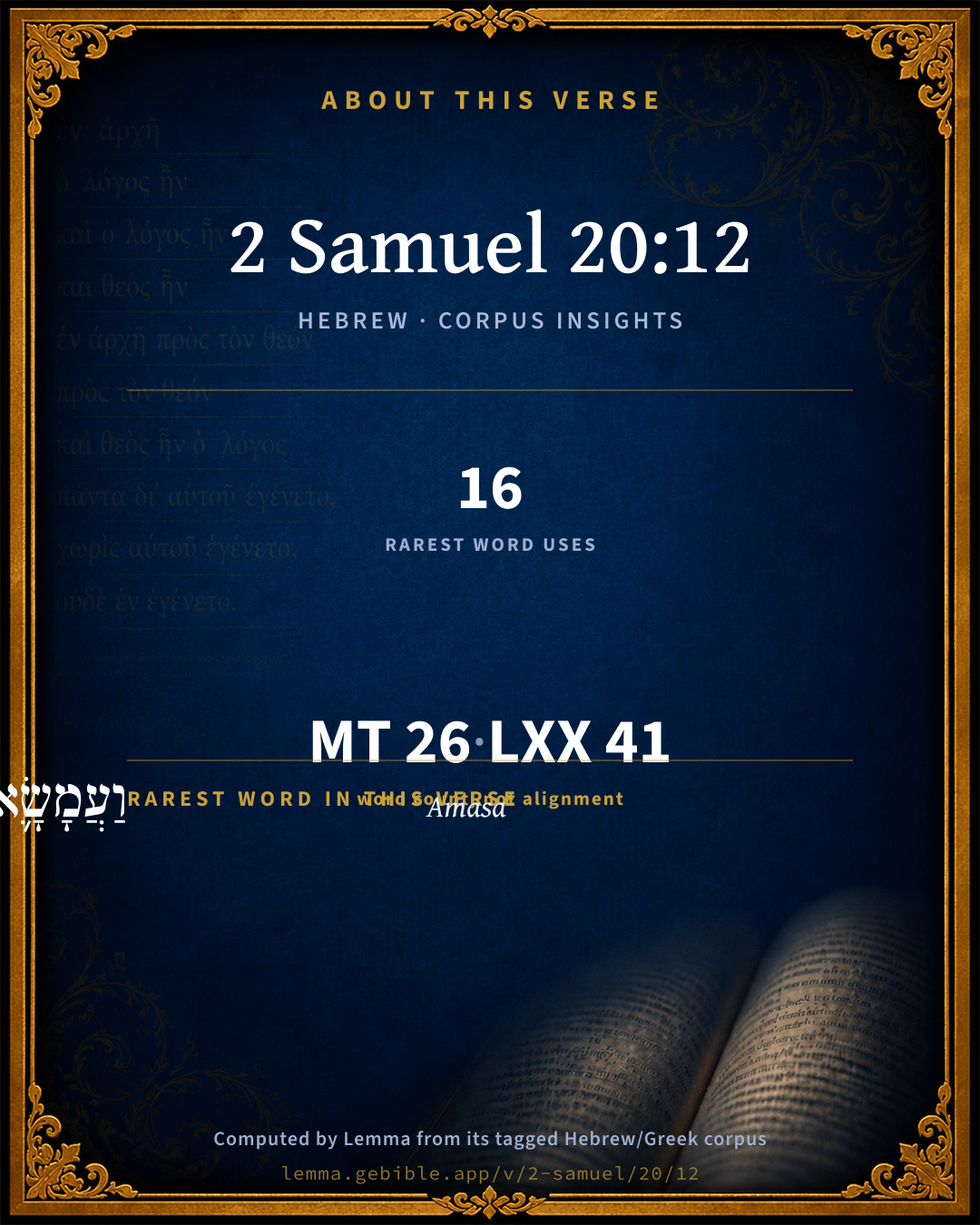
The rarest word here is וַעֲמָשָׂ֛א Amasa H6021 — appearing just 16 times in the whole Hebrew Bible.

Shared distinctive vocabulary

וַעֲמָשָׂ֛א Amasa H6021 occurs in 12 verses of the Hebrew Bible. Also found in:

Grammatical profile

  • 8 verbs
  • 12 nouns
  • 3 prepositions
  • 1 conjunction
  • 2 particles

Verb forms

  • מִתְגֹּלֵ֥ל Hithpolel · Participle Active
  • וַיַּ֨רְא Qal · Sequential Imperfect
  • עָמַ֣ד Qal · Perfect
  • וַיַּסֵּב֩ Hiphil · Sequential Imperfect
  • וַיַּשְׁלֵ֤ךְ Hiphil · Sequential Imperfect
  • רָאָ֔ה Qal · Perfect
  • הַבָּ֥א Qal · Participle Active
  • וְעָמָֽד Qal · Perfect

Repetition

Words recur within this verse — often emphatic in Hebrew:

  • וַעֲמָשָׂ֛א Amasa H6021 ×2
  • הַֽמְסִּלָּ֑ה highway H4546 ×2
  • וַיַּ֨רְא to see H7200 ×2
  • עָמַ֣ד to stand H5975 ×2
  • כָּל all H3605 ×2
  • עָלָיו֙ upon H5921 ×2

Hebrew & Septuagint length

In English translation the verse runs 49 words from the Hebrew and 51 from the Septuagint (LXX English) — closely comparable.

A rough comparison of the two English renderings, which tokenize alike — not a word-level alignment.

Word counts can differ between the Hebrew and the Greek without any difference in meaning — e.g. the Hebrew direct-object marker אֵת has no separate Greek word, and Greek often adds the article ὁ.

In the original languages it is 26 Hebrew tokens and 41 Greek tokens — but the two are counted differently (Hebrew bundles its prefixes and suffixes into one token; the Greek is in lemma form), so that isn’t a like-for-like length.

Cross-references

4

Topical passages linked to 2 Samuel 20:12 in the Treasury of Scripture Knowledge — connected by theme and wording, ordered by reader-vote popularity; previews shown in the World English Bible.

  • Psalms 9:16 Yahweh has made himself known. He has executed judgment. The wicked is snared by the work of his own hands. Meditation. Selah.
  • Proverbs 24:21–22 My son, fear Yahweh and the king. Don't join those who are rebellious:
  • 2 Samuel 17:25 Absalom set Amasa over the host instead of Joab. Now Amasa was the son of a man, whose name was Ithra the Israelite, who went in to Abigail the daughter of Nahash, sister to Zeruiah, Joab's mother.
  • Psalms 55:23 But you, God, will bring them down into the pit of destruction. Bloodthirsty and deceitful men shall not live out half their days, But I will trust in you.

Cross-references courtesy of OpenBible.info (CC BY 4.0).

Hebrew and Greek witnesses Masoretic Hebrew ↔ Greek Septuagint

The same verse in the two great witnesses to the Old Testament, shown verse-for-verse.

These are two independent witnesses, not word-aligned to each other, and the Septuagint is shown in lemma (dictionary) form.

Hebrew 2 Samuel 20:12 Masoretic · Westminster Leningrad Codex

וַעֲמָשָׂ֛א מִתְגֹּלֵ֥ל בַּדָּ֖ם בְּת֣וֹךְ הַֽמְסִּלָּ֑ה וַיַּ֨רְא הָאִ֜ישׁ כִּֽי עָמַ֣ד כָּל הָעָ֗ם וַיַּסֵּב֩ אֶת עֲמָשָׂ֨א מִן הַֽמְסִלָּ֤ה הַשָּׂדֶה֙ וַיַּשְׁלֵ֤ךְ עָלָיו֙ בֶּ֔גֶד כַּאֲשֶׁ֣ר רָאָ֔ה כָּל הַבָּ֥א עָלָ֖יו וְעָמָֽד

Amasa lay wallowing in his blood in the midst of the highway. When the man saw that all the people stood still, he carried Amasa out of the highway into the field, and cast a garment over him, when he saw that everyone who came by him stood still.

World English Bible · Public Domain

Greek LXX 2 Samuel 20:12 Septuagint · lemma form

καί αμεσσαϊ φύρω ἐν ὁ αἷμα ἐν μέσος ὁ τρίβος καί ὁράω ὁ ἀνήρ ὅτι ἵστημι πᾶς ὁ λαός καί ἀποστρέφω ὁ αμεσσαϊ ἐκ ὁ τρίβος εἰς ἀγρός καί ἐπιῥίπτω ἐπί αὐτός ἱμάτιον καθότι ὁράω πᾶς ὁ ἔρχομαι ἐπί αὐτός ἵστημι

And Amessai was weltering in blood in the midst of the way. And a man saw that all the people stood still; and he removed Amessai out of the path into a field, and he cast a garment upon him, because he saw every one that came to him standing still.

LXX2012 (modern English Septuagint) · Public Domain

Hebrew: Westminster Leningrad Codex (CC BY 4.0). Greek: Septuagint (public domain); English from LXX2012 (modern English Septuagint) (Public Domain). How the Septuagint differs from the Hebrew →

Targum (Aramaic paraphrase)

1

The Targum is the ancient Jewish Aramaic paraphrase of the Hebrew Scriptures — an interpretive translation, not the Hebrew text itself. Onkelos (literal) and Pseudo-Jonathan (expansive) render the Torah, and Jonathan the Prophets. Coverage is partial: where no permissively-licensed English translation exists for a verse, only the Aramaic is shown. This is verse-level text, not a word-by-word alignment to the Hebrew.

  1. Targum Jonathan Prophets (Joshua–Malachi)
    וַעֲמָשָׂא מִטְרַף בִּדְמָא בְּגוֹ כַבְשָׁא וַחֲזָא גַבְרָא אֲרֵי קָם כָּל עַמָא וְאַסְחַר יַת עֲמָשָׂא מִן כַּבְשָׁא לְחַקְלָא וּרְמָא עֲלוֹהִי לְבוּשָׁא כַּד חֲזָא כָּל דַאֲתֵי עֲלוֹהִי וְקָאִים:

    (no public-domain English translation for this verse)

    Targum Jonathan — Aramaic: “Mikraot Gedolot” (public domain). English: “Sefaria Community Translation” (CC0 1.0 (public-domain dedication)); “London "Chaldee Paraphrase," 1871” (public domain). Text via Sefaria.

Commentary

Notes on 2 Samuel 20:12 from classic Christian and Jewish commentators (each source and its license shown beneath its notes). The classic Christian expositions comment on the surrounding passage and are grouped to its opening verse, so a note may address several verses; the Jewish commentaries on the Tanakh (Rashi and others) are per-verse, so they appear only where the commentator wrote on this verse.

Lemma curates 59 commentaries, every one of them public domain or Creative Commons licensed, each selected and text-cleaned for this edition rather than reprinted as found. About our sources →

Trapp's Complete Commentary

John Trapp

2Sa 20:12 And Amasa wallowed in blood in the midst of the highway. And when the man saw that all the people stood still, he removed Amasa out of the highway into the field, and cast a cloth upon him, when he saw that every one that came by him stood still.

Ver. 12. And Amasa wallowed in blood.] Beating himself, and sprunting in the last pangs of death. Thus God punished him for his rebellion against his uncle, though David had both pardoned and preferred him.

John Trapp, A Commentary or Exposition upon All the Books of the Old and New Testament (1647–1656) — public domain. Text from a community e-Sword module.

The Biblical Illustrator

Joseph S. Exell

2Sa_20:12

And when the man maw that all the people stood still.

Horror at sight of a slaughtered man

What unutterable, illimitable pity it seems that our horror at the corpse of a slaughtered man should not have been made just so much stronger as to render war impossible! It looks as if human nature has been within half an inch of escaping that Upas tree of all evils (Chas. Buxton.)

The Biblical Illustrator, edited by Joseph S. Exell (c. 1880s–1900s) — public domain. Text from a community e-Sword module.

Adam Clarke's Commentary

Verse 12. Amasa wallowed in blood] It is very likely that Amasa did not immediately die; I have known instances of persons living several hours after their bowels had been shed out.

Adam Clarke's Commentary on the Bible (1810–1826) — public domain. Text from a community e-Sword/MySword module.

Ellicott's Commentary for English Readers

(12) The people stood still.—These were probably the very people whom Amasa had just been gathering from Judah and Benjamin. Whoever they may have been, they were naturally overcome and paralysed for the moment at the sight of the great leader whom the king had just promoted wallowing in his blood. Joab’s warrior, seeing the effect of their consternation, removed and concealed the body, and the pursuit then went on.

A Bible Commentary for English Readers, edited by Charles John Ellicott (1878–1897) — public domain. Text from a community e-Sword module.

The Cambridge Bible for Schools and Colleges

gen. ed. J. J. S. Perowne

12. all the people] Here and in 2Sa_20:13, the troops which Amasa had been mustering.

The Cambridge Bible for Schools and Colleges (gen. ed. J. J. S. Perowne; Cambridge University Press, 1878–1918) — public domain. Text from a community e-Sword module.

John Gill's Exposition

And Amasa wallowed in blood in the midst of the highway,.... By which it seems, that though the wound was mortal, and of which he died, that as yet there was life in him, and through the pain he was in, and the pangs of death on him, he rolled himself about in his own blood in the high road, where the fact was committed:

and when the man saw that all the people stood still; gazing at the shocking sight, and could not be prevailed upon to go on:

he removed Amasa out of the highway into the field; which was adjoining to it:

and cast a cloth upon him; that the body might not be seen:

when he saw that everyone that came by him stood still; and so retarded the people in their march, to prevent which he took the above method, and it was a very prudent one.

John Gill's Exposition of the Whole Bible (1746–1763) — public domain (CC PDM 1.0). Text via the HelloAO Bible API.

Albert Barnes' Notes on the Bible

All the people ... - i. e., the levies which Amanda had been leading to Jerusalem; they were irresolute as to what they should do, and the stoppage at Amasa’s body very nearly led to their refusing to follow Joab. But upon the prompt removal and hiding of the body they passed on and followed Joab, their old captain.

Albert Barnes' Notes on the Bible (1834–1885) — public domain. Text from a community e-Sword/MySword module.

Haydock's Catholic Bible Commentary

A certain. Hebrew, "the man" stationed by Joab, near the body, to inform those who passed, that he had been justly slain. Josephus, ([Antiquities?] vii. 10,) who observes, that this crime of Joab proceeded from envy, and was less deserving of excuse than the murder of Abner. (Haydock)

George Leo Haydock (1774–1849), Haydock's Catholic Family Bible and Commentary, 1859 edition — public domain. Excludes Psalms (Douay-Rheims chapter numbering differs from Protestant) and Deuterocanonical books (Catholic canon only).

Matthew Poole's English Annotations

Wallowed, Heb. rolled himself, being in the pangs of death; yet having so much life left as to move himself a little, though not to raise himself up from his place.

In blood; in his own blood, which was shed there.

All the people, to wit, the soldiers which were upon their march.

Stood still; wondering at the spectacle, and inquiring into the author and occasion of it.

He removed Amasa out of the highway into the field; perceiving that it both incensed them against Joab, and hindered the king’s present service.

Matthew Poole's English Annotations on the Holy Bible (1683–1685) — public domain. Text from a community e-Sword/MySword module.

Whedon's Commentary on the Bible

Daniel D. Whedon

12. Stood still — Horror-stricken at the ghastly sight, as formerly at the sight of the murdered Asahel, (2Sa_2:23;) and probably many were in doubt as to who was now their captain.

Daniel D. Whedon (gen. ed.), Commentary on the Old and New Testaments (1874–1909) — public domain. Text from a community e-Sword module.

The Pulpit Commentary

He removed Amasa. The admonition to move on failed; for the sight was terrible and tragic, and all as they came along stopped to see what had happened, and inquire the cause. (comp. 2Sa_2:23) The man, therefore, had the corpse carried out of the way, and threw over it a cloth, really a coat the loose upper mantle worn over the tunic (see note on beged,. (1Sa_19:13) Whereupon the people renewed their march, most of them not knowing what had occurred, and the rest urged to it by the warning voice of Joab"s servitor.

The Pulpit Commentary (1880–1919), ed. H.D.M. Spence-Jones & Joseph S. Exell — public domain. Text from a community e-Sword module.

John Wesley's Explanatory Notes

Stood still - Wondering at the spectacle, and enquiring into the author and occasion of it. Removed - Perceiving, that it both incensed them against Joab and hindered the king's service. Cast a cloth upon him - But the covering of blood with a cloth cannot stop its cry to God for vengeance.

John Wesley, Explanatory Notes Upon the Whole Bible (1754–1765) — public domain. Text via the GEBible commentary corpus.

Rashi

Rabbi Shlomo Yitzchaki (Rashi)

When he saw that all who passed by it remained there. When the man saw that everyone who passed by it would remain there.

Rashi on the Tanakh — English translations: “The Judaica Press complete Tanach with Rashi, translated by A. J. Rosenberg” (CC BY 4.0); “Pentateuch with Rashi's commentary by M. Rosenbaum and A.M. Silbermann, 1929-1934” (public domain); “The Metsudah Tanach series, Lakewood, N.J” (CC BY 4.0); and “The Book of Joshua, Metsudah Publications, 1997” (CC BY 4.0). Text via Sefaria.

Lesson kit

Teaching starters — assembled from the data on this page, not authored interpretation. Every prompt links to the verse data it draws on. Edit before teaching.

2 Samuel, in the Historical, opens this verse with 26 words (20 distinct Hebrew lemmas). Its most distinctive word is ʻĂmâsâʼ (“Amasa”). A historical commentator’s framing appears above. Read the whole chapter for the surrounding context.

Discussion questions

  1. How does “Amasa” (ʻĂmâsâʼ) shape what this verse is saying?
  2. 2 Samuel 17:25 shares the word «Amasa» with this verse. How do the two illuminate each other?
  3. “Amasa” occurs 2× in this one verse. What is the effect of the repetition?
  4. The translations on this page render this verse differently — a whole-verse word diff, not a word-by-word alignment. What might account for the different wordings?
  5. The verb «מִתְגֹּלֵ֥ל» is Hithpolel Participle Active. How does its form color the action?
  6. Reading how Trapp's Complete Commentary and The Biblical Illustrator read this verse, where do the two commentators agree and where do they part?

Things to notice

Reading settings

Reading text

Shown beneath each verse's original-language words.

Old Testament
Old Testament edition

Read the OT as the Masoretic Hebrew (MT) or the Greek Septuagint (LXX).

English shown for the Greek Septuagint (in the Hebrew ↔ Greek comparison).

Comparing translations? Open the Compare panel on any verse page to stack up to four side by side.