
Numbers 17:6

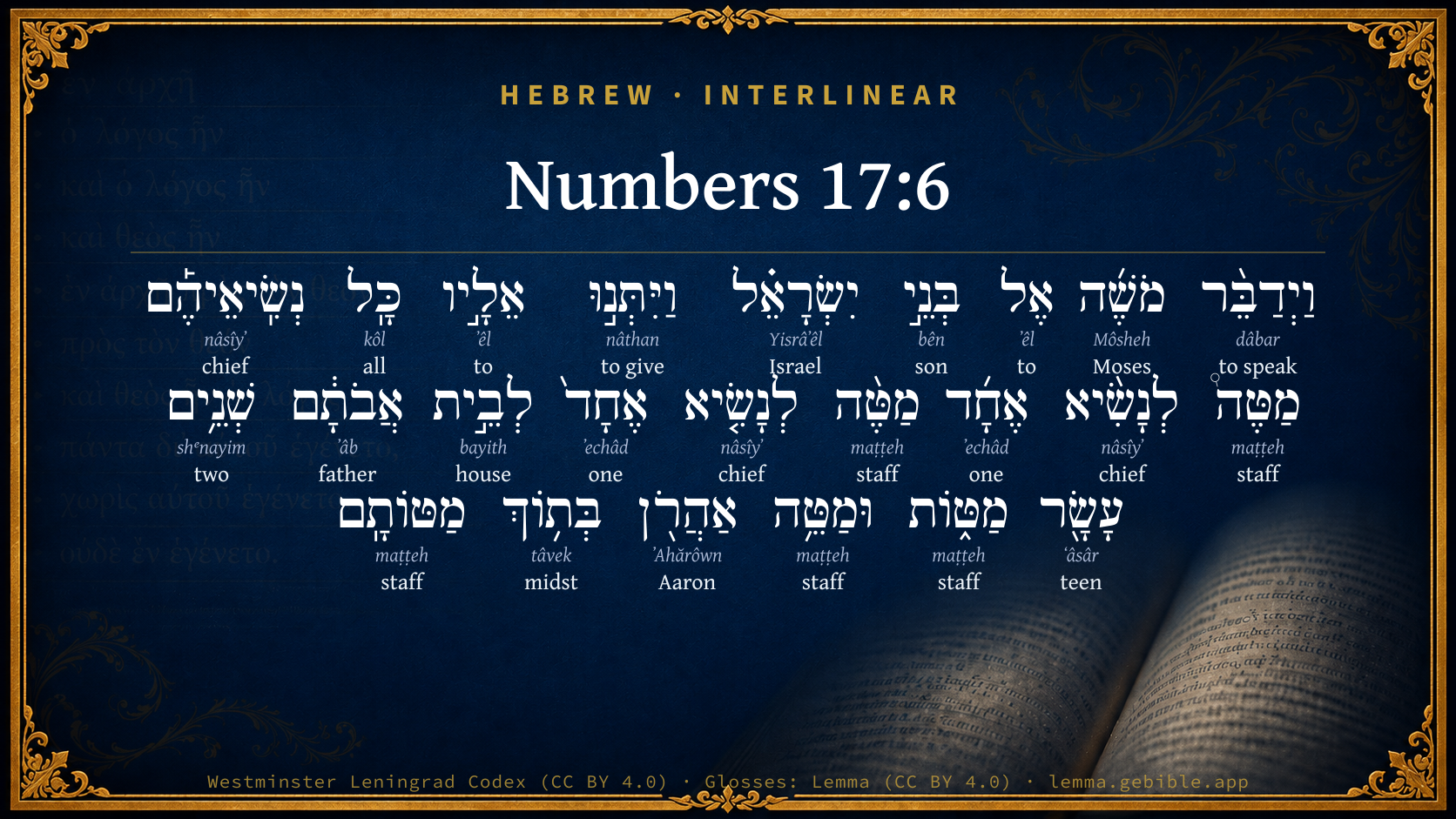
Hebrew (Westminster Leningrad Codex) Numbers 17:6 appears in the Hebrew Old Testament. The text above is from the Westminster Leningrad Codex. Each word links to its Strong’s number, a concise gloss, and parsing drawn from the Open Scriptures Hebrew Bible morphology. Click any word for its full Brown-Driver-Briggs (BDB) entry.
Download image
Cite this verse

Numbers 17:6 (World English Bible). Public Domain. Lemma interlinear Bible study tool, https://lemma.gebible.app/v/numbers/17/6.

Show BibTeX & RIS
BibTeX
RIS
English Translation
Moses spoke to the children of Israel; and all their princes gave him rods, for each prince one, according to their fathers' houses, even twelve rods: and the rod of Aaron was among their rods.
World English Bible · Public Domain
Download a study sheet

One document with this verse’s original text, its word-by-word gloss line, the meaning frame, cross-references with their text, attributed commentary, and full source and license credits — printable, and it pastes into notes with its structure intact.

This verse Autodidact and up

Study sheet (.html) Plain text (.txt)

A passage Seminary Student

Up to 50 verses in one chapter. A passage sheet keeps up to 6 commentary sources and 12 cross-references per verse, in the order this page ranks them, and says so on the sheet whenever that leaves anything out. Ask for a single verse and you get the Autodidact verse sheet above.

Everything on this page stays free to read, with no account — the sheet is a download of what is already on screen, not access to it.

Want to remove ads? Support Godless Engineer
Compare translations 3

The same verse in 3 English versions, stacked beneath the original-language interlinear above. Click any original word for its lexicon entry.

Each is an independent rendering of the whole verse — the interlinear is not word-aligned to these translations.

Highlighted words mark where these versions differ — a whole-verse word diff, not a word-by-word alignment.

  • World English Bible Public Domain
    Moses spoke to the children of Israel; and all their princes gave him rods, for each prince one, according to their fathers' houses, even twelve rods: and the rod of Aaron was among their rods.
  • King James Version Public Domain
    And Moses spake unto the children of Israel, and every one of their princes gave him a rod apiece, for each prince one, according to their fathers' houses, even twelve rods: and the rod of Aaron was among their rods.
  • unfoldingWord Literal Text CC BY-SA 4.0
    And Moses spoke to the sons of Israel, and all their leaders gave to him a staff for one leader, a staff for one leader, for the house of their fathers, 12 staffs. And the staff of Aaron in the midst of their staffs.

unfoldingWord Literal Text — © unfoldingWord, licensed CC BY-SA 4.0. Word-aligned USFM3 via Door43 (git.door43.org/unfoldingWord/en_ult).

Versions to compare (up to 4)

3 of 4 selected

Show all 18 translations

Every available English version of this verse, each an independent rendering of the whole verse.

  • World English Bible Public Domain
    Moses spoke to the children of Israel; and all their princes gave him rods, for each prince one, according to their fathers' houses, even twelve rods: and the rod of Aaron was among their rods.
  • Berean Standard Bible Public Domain
    So Moses spoke to the Israelites, and each of their leaders gave him a staff—one for each of the leaders of their tribes, twelve staffs in all. And Aaron’s staff was among them.
  • Majority Standard Bible Public Domain
    So Moses spoke to the Israelites, and each of their leaders gave him a staff—one for each of the leaders of their tribes, twelve staffs in all. And Aaron’s staff was among them.
  • King James Version Public Domain
    And Moses spake unto the children of Israel, and every one of their princes gave him a rod apiece, for each prince one, according to their fathers' houses, even twelve rods: and the rod of Aaron was among their rods.
  • American Standard Version (1901) Public Domain
    And Moses spake unto the children of Israel; and all their princes gave him rods, for each prince one, according to their fathers' houses, even twelve rods: and the rod of Aaron was among their rods.
  • Revised Version (1885) Public Domain
    And Moses spake unto the children of Israel, and all their princes gave him rods, for each prince one, according to their fathers’ houses, even twelve rods: and the rod of Aaron was among their rods.
  • Geneva Bible (1599) Public Domain
    Then Moses spake vnto the children of Israel, and al their princes gaue him a rod, one rod for euery Prince, according to the houses of their fathers, euen twelue rods, and the rod of Aaron was among their roddes.
  • Douay-Rheims (1899) Public Domain
    And Moses spoke to the children of Israel: and all the princes gave him rods one for every tribe: and there were twelve rods besides the rod of Aaron.
  • Young's Literal Translation Public Domain
    And Moses speaketh unto the sons of Israel, and all their princes give unto him one rod for a prince, one rod for a prince, for their fathers' house, twelve rods, and the rod of Aaron `is' in the midst of their rods;
  • Literal Standard Version CC BY-SA 4.0
    And Moses speaks to the sons of Israel, and all their princes give to him one rod for a prince, one rod for a prince, for their fathers’ house—twelve rods; and the rod of Aaron [is] in the midst of their rods;
  • Unlocked Literal Bible CC BY-SA 4.0
    So Moses spoke to the people of Israel. All the tribal leaders gave him staffs, one staff from each leader, selected from each of the ancestral tribes, twelve staffs in all. Aaron's staff was among them.
  • unfoldingWord Literal Text CC BY-SA 4.0
    And Moses spoke to the sons of Israel, and all their leaders gave to him a staff for one leader, a staff for one leader, for the house of their fathers, 12 staffs. And the staff of Aaron in the midst of their staffs.
  • Darby Bible Public Domain
    And Moses spoke to the children of Israel, and all their princes gave him a staff, one staff for each prince according to their fathers' houses, twelve staves, and the staff of Aaron was among their staves.
  • World Messianic Bible Public Domain
    Moses spoke to the children of Israel; and all their princes gave him rods, for each prince one, according to their fathers’ houses, a total of twelve rods. Aaron’s rod was among their rods.
  • Webster's Bible Public Domain
    And Moses spoke to the children of Israel, and every one of their princes gave him a rod apiece, for each prince one, according to their fathers' houses, even twelve rods: and the rod of Aaron was among their rods.
  • Free Bible Version CC BY-SA 4.0
    Moses explained this to the Israelites, and each of their leaders gave him a walking stick, one for each of the leaders of their tribes. So there were twelve walking sticks including the one belonging to Aaron.
  • Bible in Basic English Public Domain
    So Moses gave these orders to the children of Israel, and all their chiefs gave him rods, one for the head of every family, making twelve rods: and Aaron's rod was among them.
  • JPS Tanakh (1917) Public Domain
    (17-21) And Moses spoke unto the children of Israel; and all their princes gave him rods, for each prince one, according to their fathers' houses, even twelve rods; and the rod of Aaron was among their rods.

Literal Standard Version (2020), Covenant Press — licensed CC BY-SA 4.0. Text via the HelloAO Bible API (eBible.org). Unlocked Literal Bible (unfoldingWord) — licensed CC BY-SA 4.0. Text via the HelloAO Bible API (eBible.org). unfoldingWord Literal Text — © unfoldingWord, licensed CC BY-SA 4.0. Word-aligned USFM3 via Door43 (git.door43.org/unfoldingWord/en_ult). Free Bible Version, Dr. Jonathan Gallagher — licensed CC BY-SA 4.0. Text via the HelloAO Bible API (eBible.org).

Word by word

More ways to search: Search by grammar → Find every occurrence → Compare this word →

Practice this passage: Drill this verse → Learn its vocabulary →

נְשִֽׂיאֵיהֶ֡ם
nâsîyʼ
H5387
“chiefs · their”
Noun, Common, Masculine, Plural, Construct + Suffix, Personal, 3rd Person, Masculine, Plural
Part of Speech
Noun
Type
Common
Gender
Masculine
Number
Plural
State
Construct
Full BDB Definition

Origin: from H5375

TWOT: 1421b , 1421c

one lifted up, chief, prince, captain, leader - rising mist, vapour
  1. וַיְדַבֵּ֨ר dâbar H1696 “and · to speak” Conjunction + Verb, Piel, Sequential Imperfect, 3rd Person, Masculine, Singular
  2. מֹשֶׁ֜ה Môsheh H4872 “Moses” Noun, Proper
  3. אֶל ʼêl H413 “to” Preposition
  4. בְּנֵ֣י bên H1121 “sons of” Noun, Common, Masculine, Plural, Construct
  5. יִשְׂרָאֵ֗ל Yisrâʼêl H3478 “Israel” Noun, Proper
  6. וַיִּתְּנ֣וּ nâthan H5414 “and · to give” Conjunction + Verb, Qal, Sequential Imperfect, 3rd Person, Masculine, Plural
  7. אֵלָ֣יו ʼêl H413 “to · him” Preposition + Suffix, Personal, 3rd Person, Masculine, Singular
  8. כָּֽל kôl H3605 “all of” Noun, Common, Masculine, Singular, Construct
  9. מַטֶּה֩ maṭṭeh H4294 “staff” Noun, Common, Masculine, Singular, Absolute
  10. לְנָשִׂ֨יא nâsîyʼ H5387 “to/for · chief” Preposition + Noun, Common, Masculine, Singular, Absolute
  11. אֶחָ֜ד ʼechâd H259 “one” Adjective, Cardinal number, Masculine, Singular, Absolute
  12. מַטֶּ֨ה maṭṭeh H4294 “staff” Noun, Common, Masculine, Singular, Absolute
  13. לְנָשִׂ֤יא nâsîyʼ H5387 “to/for · chief” Preposition + Noun, Common, Masculine, Singular, Absolute
  14. אֶחָד֙ ʼechâd H259 “one” Adjective, Cardinal number, Masculine, Singular, Absolute
  15. לְבֵ֣ית bayith H1004 “to/for · house of” Preposition + Noun, Common, Masculine, Singular, Construct
  16. אֲבֹתָ֔ם ʼâb H1 “fathers · their” Noun, Common, Masculine, Plural, Construct + Suffix, Personal, 3rd Person, Masculine, Plural
  17. שְׁנֵ֥ים shᵉnayim H8147 “two” Adjective, Cardinal number, Masculine, Dual, Absolute
  18. עָשָׂ֖ר ʻâsâr H6240 “teen” Adjective, Cardinal number, Masculine, Singular, Absolute
  19. מַטּ֑וֹת maṭṭeh H4294 “staffs” Noun, Common, Masculine, Plural, Absolute
  20. וּמַטֵּ֥ה maṭṭeh H4294 “and · staff of” Conjunction + Noun, Common, Masculine, Singular, Construct
  21. אַהֲרֹ֖ן ʼAhărôwn H175 “Aaron” Noun, Proper
  22. בְּת֥וֹךְ tâvek H8432 “in/at · midst of” Preposition + Noun, Common, Masculine, Singular, Construct
  23. מַטּוֹתָֽם maṭṭeh H4294 “staffs · their” Noun, Common, Masculine, Plural, Construct + Suffix, Personal, 3rd Person, Masculine, Plural

About this verse

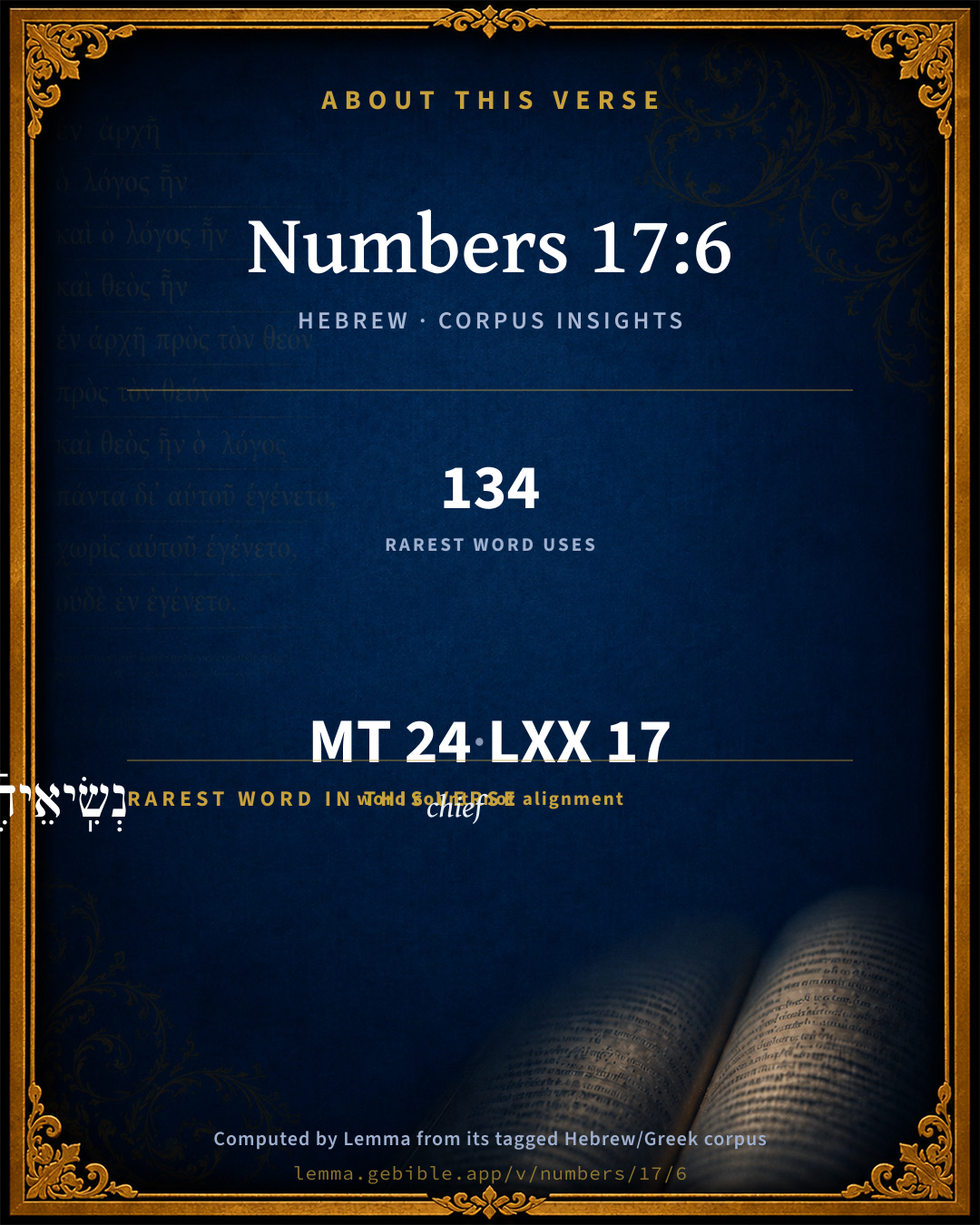
These counts appear in no published source. They are computed here, from the morphology-tagged text and Lemma’s own curated glosses. What Lemma adds →

24
words
16
distinct lemmas
Pentateuch
section

Grammatical profile

  • 2 verbs
  • 16 nouns
  • 4 adjectives
  • 2 prepositions

Verb forms

  • וַיְדַבֵּ֨ר Piel · Sequential Imperfect
  • וַיִּתְּנ֣וּ Qal · Sequential Imperfect

Repetition

Words recur within this verse — often emphatic in Hebrew:

  • מַטֶּה֩ staff H4294 ×5
  • נְשִֽׂיאֵיהֶ֡ם chief H5387 ×3
  • אֶחָ֜ד one H259 ×2
  • אֶל to H413 ×2

Hebrew & Septuagint length

In English translation the verse runs 35 words from the Hebrew and 43 from the Septuagint (LXX English) — closely comparable.

A rough comparison of the two English renderings, which tokenize alike — not a word-level alignment.

Word counts can differ between the Hebrew and the Greek without any difference in meaning — e.g. the Hebrew direct-object marker אֵת has no separate Greek word, and Greek often adds the article ὁ.

In the original languages it is 24 Hebrew tokens and 17 Greek tokens — but the two are counted differently (Hebrew bundles its prefixes and suffixes into one token; the Greek is in lemma form), so that isn’t a like-for-like length.

Hebrew and Greek witnesses Masoretic Hebrew ↔ Greek Septuagint

The same verse in the two great witnesses to the Old Testament, shown verse-for-verse.

These are two independent witnesses, not word-aligned to each other, and the Septuagint is shown in lemma (dictionary) form.

Hebrew Numbers 17:6 Masoretic · Westminster Leningrad Codex

וַיְדַבֵּ֨ר מֹשֶׁ֜ה אֶל בְּנֵ֣י יִשְׂרָאֵ֗ל וַיִּתְּנ֣וּ אֵלָ֣יו כָּֽל נְשִֽׂיאֵיהֶ֡ם מַטֶּה֩ לְנָשִׂ֨יא אֶחָ֜ד מַטֶּ֨ה לְנָשִׂ֤יא אֶחָד֙ לְבֵ֣ית אֲבֹתָ֔ם שְׁנֵ֥ים עָשָׂ֖ר מַטּ֑וֹת וּמַטֵּ֥ה אַהֲרֹ֖ן בְּת֥וֹךְ מַטּוֹתָֽם

Moses spoke to the children of Israel; and all their princes gave him rods, for each prince one, according to their fathers' houses, even twelve rods: and the rod of Aaron was among their rods.

World English Bible · Public Domain

Greek LXX Numbers 17:6 Septuagint · lemma form

καί γογγύζω ὁ υἱός ἰσραήλ ὁ ἐπαύριον ἐπί μωυσῆς καί ἀαρών λέγω σύ ἀποκτείνω ὁ λαός κύριος

And Moses spoke to the children of Israel, and all their chiefs gave him a rod each, for one chief a rod, according to the house of their families, twelve rods; and the rod of Aaron was in the midst of the rods.

LXX2012 (modern English Septuagint) · Public Domain

Hebrew: Westminster Leningrad Codex (CC BY 4.0). Greek: Septuagint (public domain); English from LXX2012 (modern English Septuagint) (Public Domain). How the Septuagint differs from the Hebrew →

Targum (Aramaic paraphrase)

2

The Targum is the ancient Jewish Aramaic paraphrase of the Hebrew Scriptures — an interpretive translation, not the Hebrew text itself. Onkelos (literal) and Pseudo-Jonathan (expansive) render the Torah, and Jonathan the Prophets. Coverage is partial: where no permissively-licensed English translation exists for a verse, only the Aramaic is shown. This is verse-level text, not a word-by-word alignment to the Hebrew.

  1. Targum Onkelos Torah (Genesis–Deuteronomy)
    וְאִתְרַעֲמוּ כָּל כְּנִשְׁתָּא דִבְנֵי יִשְׂרָאֵל מִיוֹמָא דְבַתְרוֹהִי עַל משֶׁה וְעַל אַהֲרֹן לְמֵימָר אַתּוּן גְרַמְתּוּן דְמִית עַמָא דַיְיָ

    (no public-domain English translation for this verse)

    Targum Onkelos — Aramaic: “Onkelos Genesis” (public domain); “Onkelos Exodus” (public domain); “Onkelos Leviticus” (public domain); “Onkelos Numbers” (public domain); “Onkelos Deuteronomy” (public domain). English: “Sefaria Community Translation” (CC0 1.0 (public-domain dedication)); “J.W. Etheridge. The Targums of Onkelos and Jonathan Ben Uzziel on the Pentateuch. London: Longmans, Green, 1862” (public domain). Text via Sefaria.

  2. Targum Pseudo-Jonathan Torah (Genesis–Deuteronomy)
    וְאִתְרַעֲמוּ כָּל כְּנִישְׁתָּא דִבְנֵי יִשְרָאֵל בְּיוֹמָא הָדֵין עַל משֶׁה וְעַל אַהֲרן לְמֵימָר אַתּוּן גְרַמְתּוּן דִין מוֹתָא עַל עַמָא דַיְיָ

    But on the following day the whole congregation murmured against Mosheh and Aharon, saying: You have been the occasion of the judgment of death against the people of the Lord.

    Targum Pseudo-Jonathan — Aramaic: “Targum Jonathan on Genesis” (public domain); “Targum Jonathan on Exodus” (public domain); “Targum Jonathan on Leviticus” (public domain); “Targum Jonathan on Numbers” (public domain); “Targum Jonathan on Deuteronomy” (public domain). English: “The Targum of Jonathan ben Uzziel, trans. J. W. Etheridge, London, 1862” (public domain). Text via Sefaria.

Commentary

Notes on Numbers 17:6 from classic Christian and Jewish commentators (each source and its license shown beneath its notes). The classic Christian expositions comment on the surrounding passage and are grouped to its opening verse, so a note may address several verses; the Jewish commentaries on the Tanakh (Rashi and others) are per-verse, so they appear only where the commentator wrote on this verse.

Lemma curates 59 commentaries, every one of them public domain or Creative Commons licensed, each selected and text-cleaned for this edition rather than reprinted as found. About our sources →

Joseph Benson's Commentary

Num 17:6. The rod of Aaron was among their rods — Was laid up with the rest, being either one of the twelve, as the Hebrews affirm, or the thirteenth, as others think.

Joseph Benson's Commentary on the Old and New Testaments (1811–1818) — public domain. Text from a community e-Sword module.

Geneva Bible (1599)

Geneva Bible translators

Though Joseph’s tribe was divided into two in the distribution of the land, yet here it is but one and Levi maketh a tribe.

Geneva Bible (1599) marginal notes — public domain. Text via Bolls.life.

Jamieson, Fausset & Brown

Robert Jamieson, A. R. Fausset & David Brown

the rod of Aaron was among their rods--either one of the twelve, or, as many suppose, a thirteenth in the midst (Heb 9:4). The rods were of dry sticks or wands, probably old, as transmitted from one head of the family to a succeeding.

Jamieson, Fausset & Brown — Commentary Critical and Explanatory on the Whole Bible (1871) — public domain (CC PDM 1.0). Text via the HelloAO Bible API.

The Cambridge Bible for Schools and Colleges

gen. ed. J. J. S. Perowne

6. the staff of Aaron was in the midst of their staves] We are perhaps to think of the thirteen staves as stuck into the ground and standing erect, Aaron’s staff being the middle one.

The Cambridge Bible for Schools and Colleges (gen. ed. J. J. S. Perowne; Cambridge University Press, 1878–1918) — public domain. Text from a community e-Sword module.

John Gill's Exposition

And Moses spake unto the children of Israel,.... What the Lord had bid him say unto them concerning the rods, which they hearkened unto and observed:

and everyone of their princes gave him a rod apiece, for each prince one; every prince of the several tribes, and so a rod for every tribe, as well as for each prince:

according to their father's houses, even twelve rods; there being twelve tribes named after their fathers, or the patriarchs, the twelve sons of Jacob; and Joseph having two tribes which sprung from him, called after his two sons Ephraim and Manasseh, there were twelve rods besides that of Aaron; and so the Vulgate Latin version renders the words with the next clause,"and there were twelve rods besides the rod of Aaron;''in all thirteen; though the Jews say there were but twelve with it, allowing but one rod for Joseph, under whom were comprehended Ephraim and Manasseh, and reckoning the tribe of Levi one of the twelve so Aben Ezra observes, that the rod of Levi was among the twelve and Joseph had but one rod:

and the rod of Aaron was among their rods: in the middle of them, and was so placed, as Jarchi thinks, that it might not be said, because it was put on the side of the Shechinah or divine Majesty, therefore it budded; but being in the middle of them there could be no difference in that respect.

John Gill's Exposition of the Whole Bible (1746–1763) — public domain (CC PDM 1.0). Text via the HelloAO Bible API.

Albert Barnes' Notes on the Bible

The whole number of rods was twelve exclusive of Aaron’s, as the Vulgate expressly states.

Albert Barnes' Notes on the Bible (1834–1885) — public domain. Text from a community e-Sword/MySword module.

Haydock's Catholic Bible Commentary

Besides, &c. Hebrew and the other versions, "the rod of Aaron was in the midst of their rods." Whence some infer, that there were only 12 rods. But Origen, (hom. 9,) and most others, allow 13, as the tribe of Joseph was divided into those of Ephraim and Manasses; (Calmet) each of whom had a proper representative or prince. See chap. ii. 18, 20; x. 22; xiii. 9, 12. The tribe of Levi is generally placed by itself. If there were only 12 rods, whether would the name of Elisama, or that of Gamaliel, designate the tribe of Joseph? Who was properly the prince of that udivided tribe? (Haydock)

George Leo Haydock (1774–1849), Haydock's Catholic Family Bible and Commentary, 1859 edition — public domain. Excludes Psalms (Douay-Rheims chapter numbering differs from Protestant) and Deuterocanonical books (Catholic canon only).

Matthew Poole's English Annotations

i.e. Was laid up with the rest, being either one of the twelve, as the Hebrews affirm, or the thirteenth, as others think.

Matthew Poole's English Annotations on the Holy Bible (1683–1685) — public domain. Text from a community e-Sword/MySword module.

The Pulpit Commentary

And the rod of Aaron was among the rods. As there was no prince from whom this rod could have come, and as there were twelve rods without it, this must mean that Moses did not keep Aaron"s rod separate (which might have caused suspicion), but let it be seen amongst the others.

The Pulpit Commentary (1880–1919), ed. H.D.M. Spence-Jones & Joseph S. Exell — public domain. Text from a community e-Sword module.

John Wesley's Explanatory Notes

Among their rods - Was laid up with the rest, being either one of the twelve, as the Hebrew affirm, or the thirteenth, as others think.

John Wesley, Explanatory Notes Upon the Whole Bible (1754–1765) — public domain. Text via the GEBible commentary corpus.

Kretzmann's Popular Commentary

Paul E. Kretzmann

The Miraculous Budding of Aaron’s Rod

v. 6. And Moses spake unto the children of Israel, and every one of their princes gave him a rod apiece, for each prince one, according to their fathers’ houses, even twelve rods; and the rod of Aaron was among their rods. All this was thus done in the view of all the princes to preclude all possibility of fraud and to make the test fair in every respect.

v. 7. And Moses laid up the rods before the Lord in the Tabernacle of Witness, this name of the Sanctuary being singularly appropriate here, for God intended to bear witness to His servant.

v. 8. And it came to pass that on the morrow Moses went into the Tabernacle of Witness; for he, as God’s representative, had charge of the test; and, behold, the rod of Aaron for the house of Levi was budded, and brought forth buds, and bloomed blossoms, and yielded almonds. In one night, therefore, had been brought about what ordinarily takes weeks and months, for the buds developed into shoots, brought forth blossoms, and developed into the mature fruit.

v. 9. And Moses brought out all the rods from before the Lord unto all the children of Israel, for they were to be convinced by personal inspection ; and they looked, and took every man his rod. Here was an overwhelming proof of God’s direct interposition, and the Lord, in the most unmistakable manner, designated Aaron as His servant in the office of the high priest. The priesthood of Aaron was to remain in power until the coming of the true and eternal High Priest, Jesus Christ.

v. 10. And the Lord said unto Moses, Bring- Aaron’s rod again before the testimony, to be kept for a token against the rebels, against the children of rebellion, against any persons that were filled with dissatisfied notions and with false ambitions over against the chosen priest of the Lord; and thou shall quite take away their murmurings from Me that they die not. Even in this instance the Lord had the welfare of His people in mind, in guarding against their own foolishness.

v. 11. And Moses did so; as the Lord commanded him, so did he. The rod of Aaron with which the Lord had performed a miracle was kept in the Ark of the Covenant, Heb 9:4.

v. 12. And the children of Israel spake unto Moses, saying, Behold, we die, we perish, we all perish. This new miracle had filled them with such awe that they were filled with the terror of death.

v. 13. Whosoever cometh anything (in any way) near unto the Tabernacle of the Lord shall die, as the result of Korah’s rebellion had plainly shown; shall we be consumed with dying? In their present state of mind they felt that there was no grace and mercy with the Lord any more. This excessive fear of death, although not a fruit of faith, still served to keep the people in submission to the will of the Lord. The rod of Aaron which budded is a type of the eternal priesthood of Christ, who is able to save those that come unto God by Him, seeing He ever liveth to make intercession for them, Heb 7:24-25.

Paul E. Kretzmann, Popular Commentary of the Bible (1921–1924) — public domain. Text from a community e-Sword module.

unfoldingWord translationNotes

Door43 World Missions Community

selected from each of the ancestral tribes

This can be stated in active form. AT: "whom Moses selected from each of the ancestor's tribes" (See: Active or Passive)

the tent of the covenant decrees

The phrase "the covenant decrees" refers to the box that held the tablets that the covenant decrees were written on. AT: "the tent of the covenant box" or "the tent that the covenant decrees are in" (See: Synecdoche)

translationWords

tent

unfoldingWord translationNotes — © Distant Shores Media and the Door43 World Missions Community, licensed CC BY-SA 4.0. Source: git.door43.org/Door43/en_tn.

Ramban (Nachmanides)

Rabbi Moshe ben Nachman (Ramban / Nachmanides)

YE HAVE KILLED THE PEOPLE OF THE ETERNAL.’ Onkelos rendered it: “You have caused the death of the people of the Eternal.” Thus he interprets the verse [to mean that] the people accused Moses and Aaron that because they advised Korach and his company to offer up strange incense to G-d of their own accord, those who offered it up were burnt, since G-d had not told Moses to offer up this incense, nor did he tell Israel to do so in the name of G-d; thus they of their own accord proposed this matter as a result of which the people died — when they could have [just as well] given another sign or miracle, through the rod, or [through] some other [harmless] test.And Rabbi Abraham ibn Ezra said [that the verse means that the people said]: “What proof is this that the tribe of Levi has been chosen, and that Aaron was chosen to be the High Priest? It is possible that by your prayer or by some [secret] wisdom which you possess you burnt those that offered the incense.” [All this is the language of Ibn Ezra]. And so indeed it appears, that they did not yet believe [in the Divine selection of the tribe of Levi], for when He stated afterwards, Speak unto the children of Israel, and take of them rods, one for each fathers’ house; And it shall come to pass, that the man whom I shall choose, his rod shall bud, and I will make to cease from Me the murmurings etc., Verse 20. — this proves that the people did not [yet] believe, as a result of the fire, that the Levites were chosen [for service in the Sanctuary] and that the firstborn had been exchanged for them, but they thought that Moses and Aaron had caused the fire [of their own accord]. Or [it may be that the people thought] that the punishment came because they burnt the incense with strange fire which He had not commanded them, and [that Aaron was saved because] Aaron’s incense was the [daily] incense of the morning [commanded by G-d], as I have explained. [According to this interpretation] the complaint [of the people] was only about [those two hundred and fifty men who offered the incense and who were consumed by] the fire, Verse 35. but not about those men [Korach, Dathan, and Abiram] who were swallowed up by the earth, Verse 32. for G-d had said to Moses, Get you up from about the dwelling of Korach, Dathan, and Abiram, Verse 24. and this alluded to the opening of the mouth of the earth. Moses had told this to Israel in the name of G-d. Furthermore, Dathan and Abiram were guilty to a greater extent [in this incident than the two hundred and fifty others], since they mocked the messengers of G-d, and despised His words, and scoffed at His prophets. [Hence the people did not complain about the punishment meted out to Korach, Dathan, and Abiram, but only about the fire that consumed the two hundred and fifty men who offered up the incense.] The correct interpretation appears to me to be that the people now believed in the priesthood of Aaron [that he and his descendants were chosen by G-d to serve as priests], since a fire had already come forth from before the Eternal and consumed his offerings, but they wanted the firstborn to minister in the Tabernacle instead of the Levites, and they did not like the exchange [for the Levites] which they had done to them, but they wanted all the tribes [through their firstborn] to have a share in the Service of the House of G-d. Thus they complained: “You have killed them, for you advised them that they should offer up incense like priests, when they were only fit to do the service of the Levites, but not to act as priests who offer up the incense.” This is the meaning of the expression, and, behold, the rod of Aaron for the house of Levi was budded [thus showing that the people’s complaint was because of the appointment of the tribe of Levi to minister in the Tabernacle, and now it was confirmed that they were indeed chosen instead of the firstborn of all the tribes].

Ramban (Nachmanides) on the Tanakh — English translation: “Commentary on the Torah by Ramban (Nachmanides). Translated and annotated by Charles B. Chavel. New York, Shilo Pub. House, 1971-1976” (CC BY 4.0). Text via Sefaria.

Lesson kit

Teaching starters — assembled from the data on this page, not authored interpretation. Every prompt links to the verse data it draws on. Edit before teaching.

Numbers, in the Pentateuch, opens this verse with 24 words (16 distinct Hebrew lemmas). Its most distinctive word is nâsîyʼ (“chief”). A historical commentator’s framing appears above. Read the whole chapter for the surrounding context.

Discussion questions

  1. How does “chief” (nâsîyʼ) shape what this verse is saying?
  2. “staff” occurs 5× in this one verse. What is the effect of the repetition?
  3. These translations render this verse differently. What is at stake in choosing one wording over another?
  4. The verb «וַיְדַבֵּ֨ר» is Piel Sequential Imperfect. How does its form color the action?
  5. Reading how Joseph Benson's Commentary and Geneva Bible (1599) read this verse, where do the two commentators agree and where do they part?

Things to notice

Reading settings

Reading text

Shown beneath each verse's original-language words.

Old Testament
Old Testament edition

Read the OT as the Masoretic Hebrew (MT) or the Greek Septuagint (LXX).

English shown for the Greek Septuagint (in the Hebrew ↔ Greek comparison).

Comparing translations? Open the Compare panel on any verse page to stack up to four side by side.