
Ezekiel 24:11

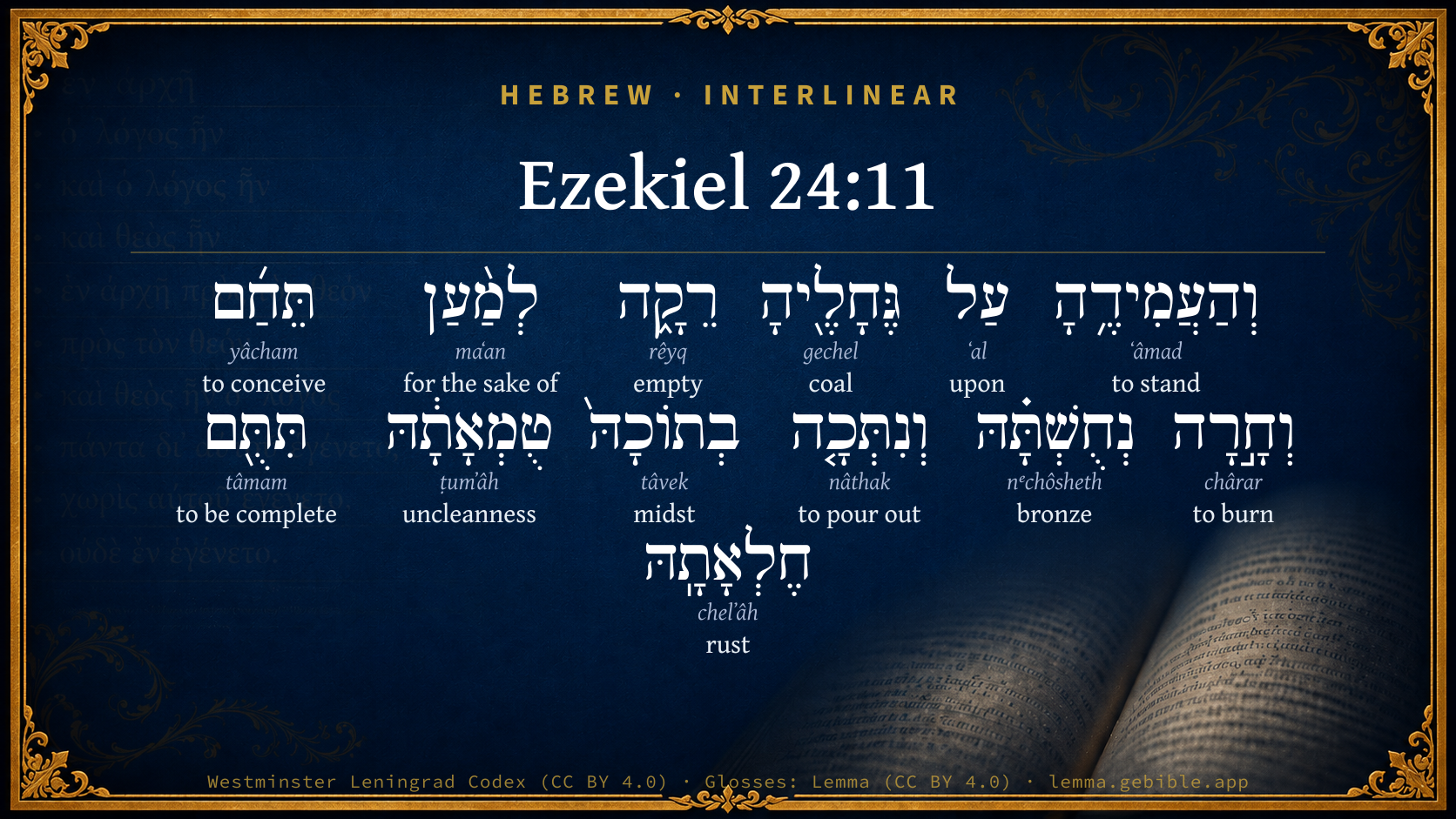
Hebrew (Westminster Leningrad Codex) Ezekiel 24:11 appears in the Hebrew Old Testament. The text above is from the Westminster Leningrad Codex. Each word links to its Strong’s number, a concise gloss, and parsing drawn from the Open Scriptures Hebrew Bible morphology. Click any word for its full Brown-Driver-Briggs (BDB) entry.
Download image
Cite this verse

Ezekiel 24:11 (World English Bible). Public Domain. Lemma interlinear Bible study tool, https://lemma.gebible.app/v/ezekiel/24/11.

Show BibTeX & RIS
BibTeX
RIS
English Translation
Then set it empty on the coals of it, that it may be hot, and the brass of it may burn, and that the filthiness of it may be molten in it, that the rust of it may be consumed.
World English Bible · Public Domain
Download a study sheet

One document with this verse’s original text, its word-by-word gloss line, the meaning frame, cross-references with their text, attributed commentary, and full source and license credits — printable, and it pastes into notes with its structure intact.

This verse Autodidact and up

Study sheet (.html) Plain text (.txt)

A passage Seminary Student

Up to 50 verses in one chapter. A passage sheet keeps up to 6 commentary sources and 12 cross-references per verse, in the order this page ranks them, and says so on the sheet whenever that leaves anything out. Ask for a single verse and you get the Autodidact verse sheet above.

Everything on this page stays free to read, with no account — the sheet is a download of what is already on screen, not access to it.

Want to remove ads? Support Godless Engineer
Compare translations 3

The same verse in 3 English versions, stacked beneath the original-language interlinear above. Click any original word for its lexicon entry.

Each is an independent rendering of the whole verse — the interlinear is not word-aligned to these translations.

Highlighted words mark where these versions differ — a whole-verse word diff, not a word-by-word alignment.

  • World English Bible Public Domain
    Then set it empty on the coals of it, that it may be hot, and the brass of it may burn, and that the filthiness of it may be molten in it, that the rust of it may be consumed.
  • King James Version Public Domain
    Then set it empty upon the coals thereof, that the brass of it may be hot, and may burn, and that the filthiness of it may be molten in it, that the scum of it may be consumed.
  • unfoldingWord Literal Text CC BY-SA 4.0
    Then set the pot on its coals empty, in order to heat and scorch its bronze, so its uncleanness within it will be melted, its corrosion consumed.’

unfoldingWord Literal Text — © unfoldingWord, licensed CC BY-SA 4.0. Word-aligned USFM3 via Door43 (git.door43.org/unfoldingWord/en_ult).

Versions to compare (up to 4)

3 of 4 selected

Show all 18 translations

Every available English version of this verse, each an independent rendering of the whole verse.

  • World English Bible Public Domain
    Then set it empty on the coals of it, that it may be hot, and the brass of it may burn, and that the filthiness of it may be molten in it, that the rust of it may be consumed.
  • Berean Standard Bible Public Domain
    Set the empty pot on its coals until it becomes hot and its copper glows. Then its impurity will melt within; its rust will be consumed.
  • Majority Standard Bible Public Domain
    Set the empty pot on its coals until it becomes hot and its copper glows. Then its impurity will melt within; its rust will be consumed.
  • King James Version Public Domain
    Then set it empty upon the coals thereof, that the brass of it may be hot, and may burn, and that the filthiness of it may be molten in it, that the scum of it may be consumed.
  • American Standard Version (1901) Public Domain
    Then set it empty upon the coals thereof, that it may be hot, and the brass thereof may burn, and that the filthiness of it may be molten in it, that the rust of it may be consumed.
  • Revised Version (1885) Public Domain
    Then set it empty upon the coals thereof, that it may be hot, and the brass thereof may burn, and that the filthiness of it may be molten in it, that the rust of it may be consumed.
  • Geneva Bible (1599) Public Domain
    Then set it emptie vpon the coles thereof, that the brasse of it may be hot, and may burne, and that the filthinesse of it may be molten in it, and that the skomme of it may be consumed.
  • Douay-Rheims (1899) Public Domain
    Then set it empty upon burning coals, that it may be hot, and the brass thereof may be melted: and let the filth of it be melted in the midst thereof, and let the rust of it be consumed.
  • Young's Literal Translation Public Domain
    And cause it to stand on its coals empty, So that its brass is hot and burning, Melted hath been in its midst its uncleanness, Consumed is its scum.
  • Literal Standard Version CC BY-SA 4.0
    And cause it to stand empty on its coals, || So that its bronze is hot and burning, || Its uncleanness has been melted in its midst, || Its scum is consumed.
  • Unlocked Literal Bible CC BY-SA 4.0
    Then set the pot on its coals empty, in order to heat and scorch its bronze, so its uncleanness within it will be melted, its corrosion consumed.'
  • unfoldingWord Literal Text CC BY-SA 4.0
    Then set the pot on its coals empty, in order to heat and scorch its bronze, so its uncleanness within it will be melted, its corrosion consumed.’
  • Darby Bible Public Domain
    Then set it empty upon its coals, that it may be hot, and the brass of it may burn, and that its filthiness may be molten in it, [and] that its rust may be consumed.
  • World Messianic Bible Public Domain
    Then set it empty on its coals, that it may be hot, and its bronze may burn, and that its filthiness may be molten in it, that its rust may be consumed.
  • Webster's Bible Public Domain
    Then set it empty upon its coals, that the brass of it may be hot, and may burn, and that the filthiness of it may be melted in it, that the scum of it may be consumed.
  • Free Bible Version CC BY-SA 4.0
    Then put the empty pot back on the burning coals until it's hot and the copper metal glows. This will melt the dirt inside it and get rid of the rust.
  • Bible in Basic English Public Domain
    And I will put her on the coals so that she may be heated and her brass burned, so that what is unclean in her may become soft and her waste be completely taken away.
  • JPS Tanakh (1917) Public Domain
    then will I set it empty upon the coals thereof, that it may be hot, and the bottom thereof may burn, and that the impurity of it may be molten in it, that the filth of it may be consumed.

Literal Standard Version (2020), Covenant Press — licensed CC BY-SA 4.0. Text via the HelloAO Bible API (eBible.org). Unlocked Literal Bible (unfoldingWord) — licensed CC BY-SA 4.0. Text via the HelloAO Bible API (eBible.org). unfoldingWord Literal Text — © unfoldingWord, licensed CC BY-SA 4.0. Word-aligned USFM3 via Door43 (git.door43.org/unfoldingWord/en_ult). Free Bible Version, Dr. Jonathan Gallagher — licensed CC BY-SA 4.0. Text via the HelloAO Bible API (eBible.org).

Word by word

More ways to search: Search by grammar → Find every occurrence → Compare this word →

Practice this passage: Drill this verse → Learn its vocabulary →

חֶלְאָתָֽהּ
chelʼâh
H2457
“rust · her”
Noun, Common, Feminine, Singular, Construct + Suffix, Personal, 3rd Person, Feminine, Singular
Part of Speech
Noun
Type
Common
Gender
Feminine
Number
Singular
State
Construct
Full BDB Definition

Origin: from H2456

TWOT: 649a

rust, scum
  1. וְהַעֲמִידֶ֥הָ ʻâmad H5975 “and · stand · her” Conjunction + Verb, Hiphil, Imperative, 2nd Person, Masculine, Singular + Suffix, Personal, 3rd Person, Feminine, Singular
  2. עַל ʻal H5921 “upon” Preposition
  3. גֶּחָלֶ֖יהָ gechel H1513 “coals · her” Noun, Common, Both, Plural, Construct + Suffix, Personal, 3rd Person, Feminine, Singular
  4. רֵקָ֑ה rêyq H7386 “empty” Adjective, Adjective, Feminine, Singular, Absolute
  5. לְמַ֨עַן maʻan H4616 “for the sake of” Preposition
  6. תֵּחַ֜ם yâcham H3179 “to conceive” Verb, Qal, Imperfect, 3rd Person, Feminine, Singular
  7. וְחָ֣רָה chârar H2787 “and · to burn” Conjunction + Verb, Qal, Sequential Perfect, 3rd Person, Feminine, Singular
  8. נְחֻשְׁתָּ֗הּ nᵉchôsheth H5178 “bronze · her” Noun, Common, Feminine, Singular, Construct + Suffix, Personal, 3rd Person, Feminine, Singular
  9. וְנִתְּכָ֤ה nâthak H5413 “and · to pour out” Conjunction + Verb, Niphal, Sequential Perfect, 3rd Person, Feminine, Singular
  10. בְתוֹכָהּ֙ tâvek H8432 “in/at · midst · her” Preposition + Noun, Common, Masculine, Singular, Construct + Suffix, Personal, 3rd Person, Feminine, Singular
  11. טֻמְאָתָ֔הּ ṭumʼâh H2932 “uncleanness · her” Noun, Common, Feminine, Singular, Construct + Suffix, Personal, 3rd Person, Feminine, Singular
  12. תִּתֻּ֖ם tâmam H8552 “to be complete” Verb, Qal, Imperfect, 3rd Person, Feminine, Singular

About this verse

These counts appear in no published source. They are computed here, from the morphology-tagged text and Lemma’s own curated glosses. What Lemma adds →

13
words
13
distinct lemmas
Prophets
section

Notable vocabulary

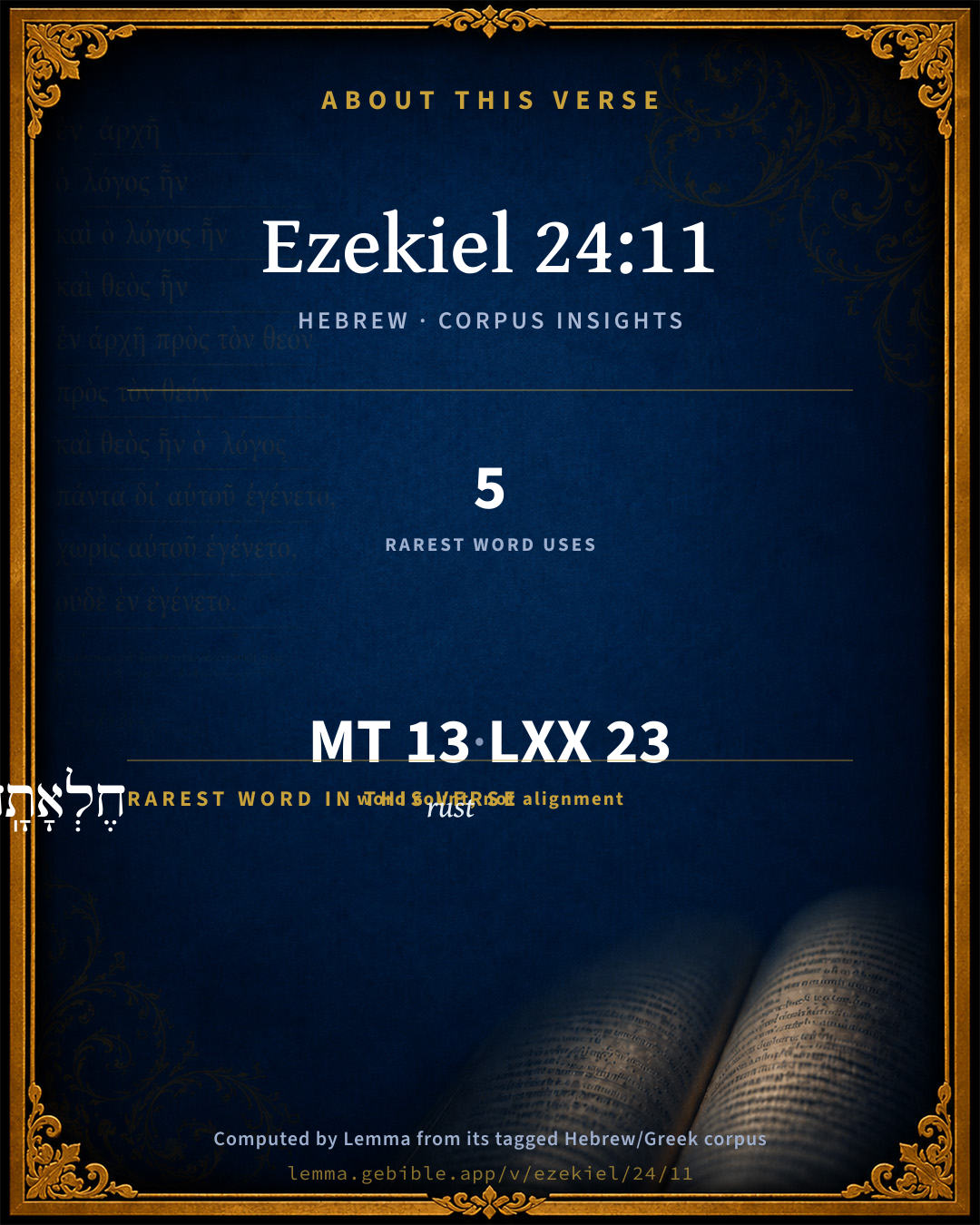
The rarest word here is חֶלְאָתָֽהּ rust H2457 — appearing just 5 times in the whole Hebrew Bible.

Shared distinctive vocabulary

חֶלְאָתָֽהּ rust H2457 occurs in 3 verses of the Hebrew Bible. Also found in:

Grammatical profile

  • 5 verbs
  • 5 nouns
  • 1 adjective
  • 2 prepositions

Verb forms

  • וְהַעֲמִידֶ֥הָ Hiphil · Imperative
  • תֵּחַ֜ם Qal · Imperfect
  • וְחָ֣רָה Qal · Sequential Perfect
  • וְנִתְּכָ֤ה Niphal · Sequential Perfect
  • תִּתֻּ֖ם Qal · Imperfect

Hebrew & Septuagint length

In English translation the verse runs 40 words from the Hebrew and 30 from the Septuagint (LXX English) — closely comparable.

A rough comparison of the two English renderings, which tokenize alike — not a word-level alignment.

Word counts can differ between the Hebrew and the Greek without any difference in meaning — e.g. the Hebrew direct-object marker אֵת has no separate Greek word, and Greek often adds the article ὁ.

In the original languages it is 13 Hebrew tokens and 23 Greek tokens — but the two are counted differently (Hebrew bundles its prefixes and suffixes into one token; the Greek is in lemma form), so that isn’t a like-for-like length.

Cross-references

20

Topical passages linked to Ezekiel 24:11 in the Treasury of Scripture Knowledge — connected by theme and wording, ordered by reader-vote popularity; previews shown in the World English Bible.

  • Jeremiah 21:10 For I have set my face on this city for evil, and not for good, says Yahweh: it shall be given into the hand of the king of Babylon, and he shall burn it with fire.
  • Isaiah 1:25 And I will turn my hand on you, Thoroughly purge away your dross, And will take away all your tin.
  • Malachi 4:1 "For, behold, the day comes, it burns as a furnace; and all the proud, and all who work wickedness, will be stubble; and the day that comes will burn them up," says Yahweh of Hosts, "that it shall leave them neither root nor branch.
  • Isaiah 4:4 when the Lord shall have washed away the filth of the daughters of Zion, and shall have purged the blood of Jerusalem from its midst, by the spirit of justice, and by the spirit of burning.
  • Isaiah 27:9 Therefore by this shall the iniquity of Jacob be forgiven, and this is all the fruit of taking away his sin: that he makes all the stones of the altar as chalk stones that are beaten in sunder, [so that] the Asherim and the sun-images shall rise no more.
  • Jeremiah 32:29 and the Chaldeans, who fight against this city, shall come and set this city on fire, and burn it, with the houses, on whose roofs they have offered incense to Baal, and poured out drink-offerings to other gods, to provoke me to anger.
  • Jeremiah 37:10 For though you had struck the whole army of the Chaldeans who fight against you, and there remained but wounded men among them, yes would they rise up every man in his tent, and burn this city with fire.
  • Jeremiah 38:18 But if you will not go forth to the king of Babylon's princes, then shall this city be given into the hand of the Chaldeans, and they shall burn it with fire, and you shall not escape out of their hand.
  • Jeremiah 39:8 The Chaldeans burned the king's house, and the houses of the people, with fire, and broke down the walls of Jerusalem.
  • Jeremiah 52:13 and he burned the house of Yahweh, and the king's house; and all the houses of Jerusalem, even every great house, burned he with fire.
  • Ezekiel 20:38 and I will purge out from among you the rebels, and those who disobey against me; I will bring them forth out of the land where they sojourn, but they shall not enter into the land of Israel: and you shall know that I am Yahweh.
  • Ezekiel 22:15–23 I will scatter you among the nations, and disperse you through the countries; and I will consume your filthiness out of you.
  • Ezekiel 23:26–27 They shall also strip you of your clothes, and take away your beautiful jewels.
  • Ezekiel 23:47–48 The company shall stone them with stones, and dispatch them with their swords; they shall kill their sons and their daughters, and burn up their houses with fire.
  • Ezekiel 36:25 I will sprinkle clean water on you, and you shall be clean: from all your filthiness, and from all your idols, will I cleanse you.
  • Micah 5:11–14 I will cut off the cities of your land, And will tear down all your strongholds.
  • Zechariah 13:1–2 "In that day there will be a spring opened to the house of David and to the inhabitants of Jerusalem, for sin and for uncleanness.
  • Matthew 3:12 His winnowing fork is in his hand, and he will thoroughly cleanse his threshing floor. He will gather his wheat into the barn, but the chaff he will burn up with unquenchable fire."
  • 1 Corinthians 3:12–13 But if anyone builds on the foundation with gold, silver, costly stones, wood, hay, or stubble;
  • Zechariah 13:8–9 It shall happen that in all the land," says Yahweh, Two parts in it will be cut off and die; But the third will be left in it.

Cross-references courtesy of OpenBible.info (CC BY 4.0).

Hebrew and Greek witnesses Masoretic Hebrew ↔ Greek Septuagint

The same verse in the two great witnesses to the Old Testament, shown verse-for-verse.

These are two independent witnesses, not word-aligned to each other, and the Septuagint is shown in lemma (dictionary) form.

Hebrew Ezekiel 24:11 Masoretic · Westminster Leningrad Codex

וְהַעֲמִידֶ֥הָ עַל גֶּחָלֶ֖יהָ רֵקָ֑ה לְמַ֨עַן תֵּחַ֜ם וְחָ֣רָה נְחֻשְׁתָּ֗הּ וְנִתְּכָ֤ה בְתוֹכָהּ֙ טֻמְאָתָ֔הּ תִּתֻּ֖ם חֶלְאָתָֽהּ

Then set it empty on the coals of it, that it may be hot, and the brass of it may burn, and that the filthiness of it may be molten in it, that the rust of it may be consumed.

World English Bible · Public Domain

Greek LXX Ezekiel 24:11 Septuagint · lemma form

καί ἵστημι ἐπί ὁ ἄνθραξ ὅπως προςκαίω καί θερμαίνω ὁ χαλκός αὐτός καί τήκω ἐν μέσος ἀκαθαρσία αὐτός καί ἐκλείπω ὁ ἰός αὐτός

and that it may stand upon the coals, that her brass may be thoroughly heated, and be melted in the midst of her filthiness, and her scum may be consumed,

LXX2012 (modern English Septuagint) · Public Domain

Hebrew: Westminster Leningrad Codex (CC BY 4.0). Greek: Septuagint (public domain); English from LXX2012 (modern English Septuagint) (Public Domain). How the Septuagint differs from the Hebrew →

Targum (Aramaic paraphrase)

1

The Targum is the ancient Jewish Aramaic paraphrase of the Hebrew Scriptures — an interpretive translation, not the Hebrew text itself. Onkelos (literal) and Pseudo-Jonathan (expansive) render the Torah, and Jonathan the Prophets. Coverage is partial: where no permissively-licensed English translation exists for a verse, only the Aramaic is shown. This is verse-level text, not a word-by-word alignment to the Hebrew.

  1. Targum Jonathan Prophets (Joshua–Malachi)
    וְאַשְׁאַר אַרְעָא צַדְיָא בְּדִיל דְיִצְדוּן וִיסוּפוּן תַּרְעֵי קִרְוָהָא וְיִתְמְסוּן בְּגַוָהּ עָבְדֵי סְאוֹבְתָּהּ וִיסוּפוּן חוֹבָהָא:

    (no public-domain English translation for this verse)

    Targum Jonathan — Aramaic: “Mikraot Gedolot” (public domain). English: “Sefaria Community Translation” (CC0 1.0 (public-domain dedication)); “London "Chaldee Paraphrase," 1871” (public domain). Text via Sefaria.

Commentary

Notes on Ezekiel 24:11 from classic Christian and Jewish commentators (each source and its license shown beneath its notes). The classic Christian expositions comment on the surrounding passage and are grouped to its opening verse, so a note may address several verses; the Jewish commentaries on the Tanakh (Rashi and others) are per-verse, so they appear only where the commentator wrote on this verse.

Lemma curates 59 commentaries, every one of them public domain or Creative Commons licensed, each selected and text-cleaned for this edition rather than reprinted as found. About our sources →

Ellicott's Commentary for English Readers

(11) Set it empty upon the coals.—Keeping up the strong figure of the parable, after all the inhabitants have passed under judgment the city itself is to be purged by fire. It is unnecessary here to think of heat as removing the rust (scum) from the cauldron; the prophet’s mind is not upon any physical effect, but upon the methods of purifying defiled metallic vessels under the law (see Num_31:23). It was a symbolical rather than a material purification, and in the present case involved the actual destruction of the city itself. In Eze_24:11-14, the obduracy of the people is set forth in strong language, together with the completeness of the coming judgment in contrast to the in-effectiveness of all former efforts for their reformation (Eze_24:13); and, finally, the adaptation of the punishment to the sin (Eze_24:14). The word translated “lies” in Eze_24:12 means pains or labour. Translate, The labour is in vain; her rust does not go out of her, even her rust with fire. In Eze_24:13 “lewdness” would be better rendered abomination.

A Bible Commentary for English Readers, edited by Charles John Ellicott (1878–1897) — public domain. Text from a community e-Sword module.

Trapp's Complete Commentary

John Trapp

Eze 24:11 Then set it empty upon the coals thereof, that the brass of it may be hot, and may burn, and [that] the filthiness of it may be molten in it, [that] the scum of it may be consumed.

Ver. 11. That the brass of it may be hot, and may burn.] This Gregory {a} fitly applieth to Rome, taken and wasted by the Lombards. This city, ever since it was Papal - and then it first began to be so - was never besieged, but it was taken by the enemy.

{a} Iam vacua ardet Roma: iam enim et ipsa olla consumitur, in qua prius carnes et ossa consumebantur. - Hom. 18 in Ezek.

John Trapp, A Commentary or Exposition upon All the Books of the Old and New Testament (1647–1656) — public domain. Text from a community e-Sword module.

Geneva Bible (1599)

Geneva Bible translators

Or, bottom.

Geneva Bible (1599) marginal notes — public domain. Text via Bolls.life.

Jamieson, Fausset & Brown

Robert Jamieson, A. R. Fausset & David Brown

set it empty . . . that . . . brass . . . may burn, . . . that . . . scum . . . may be consumed--Even the consumption of the contents is not enough; the caldron itself which is infected by the poisonous scum must be destroyed, that is, the city itself must be destroyed, not merely the inhabitants, just as the very house infected with leprosy was to be destroyed (Lev 14:34-45).

Jamieson, Fausset & Brown — Commentary Critical and Explanatory on the Whole Bible (1871) — public domain (CC PDM 1.0). Text via the HelloAO Bible API.

The Cambridge Bible for Schools and Colleges

gen. ed. J. J. S. Perowne

11. scum of it] Rust. When the contents of the caldron have been seethed and emptied out of it—the siege and dispersion—the caldron itself shall be set empty upon the coals that its filth and rust may be molten and consumed—a figure for the purifying judgments continued long after the destruction of the city.

The Cambridge Bible for Schools and Colleges (gen. ed. J. J. S. Perowne; Cambridge University Press, 1878–1918) — public domain. Text from a community e-Sword module.

John Gill's Exposition

Then set it empty upon the coals thereof,.... The city, when emptied of its inhabitants and substance, like a pot that is boiled over, and all in it boiled away, or taken out; burn it with fire, as the city of Jerusalem when taken and plundered was:

that the brass of it may be hot, and burn; as brass will when set on coals: or, "the bottom of it" (w); so Ben Melech observes, from the Misnah, that the lower part or bottom of a pot, cauldron, or furnace, is called the brass of it; and so the sense is, make the fire burn so fierce as to burn the bottom of the pot; or the canker and rust of it, which the following words explain:

and that the filthiness of it may be molten in it, that the scum of it may be consumed; the abominable wickedness of this people; since they were not reformed and brought to repentance for it by the admonitions and instructions given them, and by the chastisements and corrections laid upon them, they with their sins should be consumed in this terrible manner. The Targum is,

"I will leave the land desolate, that they may become desolate; and that the gates of her city may be consumed; and that those that work uncleanness in the midst of her may melt away, and her sins be consumed.''

(w) "fundum ejus", Pagninus, Vatablus.

John Gill's Exposition of the Whole Bible (1746–1763) — public domain (CC PDM 1.0). Text via the HelloAO Bible API.

Matthew Poole's English Annotations

Set it, the hieroglyphic pot, empty; the water, flesh, bones, all consumed, i.e. the citizens all wasted with sword, famine, or pestilence, the city left as an empty, overboiled pot.

Upon the coals thereof; signifying the burning of the city itself, after the emptying of its inhabitants.

That the brass of it; perhaps he alludes to the impudence of their sins, in that the city is likened to a pot of brass.

May be hot; God’s judgments would increase upon them, as heat doth in a pot set on coals.

And may burn; which is the highest degree; so should these miseries increase.

That the filthiness, type of the sinfulness, the unreformed sinfulness of the city, may be molten in it; that their wickedness may be taken away with their persons and city: they should have been purged by gentler meltings which God used; since they were not, nor would be purified, now they shall be melted to the utter destruction of them.

The scum: see Eze 24:6.

Matthew Poole's English Annotations on the Holy Bible (1683–1685) — public domain. Text from a community e-Sword/MySword module.

The Pulpit Commentary

Then set it empty upon the coals, etc. The empty cauldron is, of course, the city bereaved of its inhabitants. The fire must go on till the rust is consumed. There is, however, in spite of the seemingly terrible hopelessness of the sentence, a gleam of hope, as there had been in Eze_16:42. When the punishment had done its full work, then Jehovah might cause his fury to rest (Ver. 13). Till then he declares, through the prophet, there will be no mitigation of the punishment. The word has gone forth, and there will be no change of purpose.

The Pulpit Commentary (1880–1919), ed. H.D.M. Spence-Jones & Joseph S. Exell — public domain. Text from a community e-Sword module.

John Wesley's Explanatory Notes

The filthiness - A type of the unreformed sinfulness of the city. Molten - That their wickedness may be taken away with their persons, and city.

John Wesley, Explanatory Notes Upon the Whole Bible (1754–1765) — public domain. Text via the GEBible commentary corpus.

unfoldingWord translationNotes

Door43 World Missions Community

General Information:

Yahweh continues telling a parable to Ezekiel about a cooking pot that represents Jerusalem. This parable continues through Ezekiel 24:14. (See: Parables)

scorch

to burn the surface of something

so its uncleanness within it will be melted, its corrosion consumed

This can be stated in active form. AT: "to melt the uncleanness within it and to consume its corrosion" (See: Active or Passive)

uncleanness

A person whom God considers spiritually unacceptable or defiled is spoken of as if the person were physically unclean. (See: Metaphor)

corrosion

rust

consumed

burned away

She has become weary

Here the word "she" refers to the cooking pot. This is the cooking pot that is metaphorical for Jerusalem. AT: "Jerusalem has become tired" (See: Metaphor)

toil

difficult labor

but her corrosion has not gone out of her by the fire

The phrase "has not gone out of her" is an idiom. AT: "but the fire did not burn away her corrosion" (See: Idiom)

translationWords

bronze

clean

unfoldingWord translationNotes — © Distant Shores Media and the Door43 World Missions Community, licensed CC BY-SA 4.0. Source: git.door43.org/Door43/en_tn.

Rashi

Rabbi Shlomo Yitzchaki (Rashi)

its filth shall be consumed [Heb. תִּתֻּם.] Its filth will end and be absorbed into its base. סִיר is [a pot] made of copper.

Rashi on the Tanakh — English translations: “The Judaica Press complete Tanach with Rashi, translated by A. J. Rosenberg” (CC BY 4.0); “Pentateuch with Rashi's commentary by M. Rosenbaum and A.M. Silbermann, 1929-1934” (public domain); “The Metsudah Tanach series, Lakewood, N.J” (CC BY 4.0); and “The Book of Joshua, Metsudah Publications, 1997” (CC BY 4.0). Text via Sefaria.

Lesson kit

Teaching starters — assembled from the data on this page, not authored interpretation. Every prompt links to the verse data it draws on. Edit before teaching.

Ezekiel, in the Prophets, opens this verse with 13 words (13 distinct Hebrew lemmas). Its most distinctive word is chelʼâh (“rust”). A historical commentator’s framing appears above. Read the whole chapter for the surrounding context.

Discussion questions

  1. What does “rust” (chelʼâh) contribute to the verse as a whole?
  2. How does Ezekiel 24:6, which shares the word «rust», read alongside this verse?
  3. The translations on this page render this verse differently — a whole-verse word diff, not a word-by-word alignment. What might account for the different wordings?
  4. «וְהַעֲמִידֶ֥הָ» is a Hiphil Imperative verb. How does that grammatical form shape the action described?
  5. Compare how Ellicott's Commentary for English Readers and Trapp's Complete Commentary read this verse. Where do they agree or differ?

Things to notice

Reading settings

Reading text

Shown beneath each verse's original-language words.

Old Testament
Old Testament edition

Read the OT as the Masoretic Hebrew (MT) or the Greek Septuagint (LXX).

English shown for the Greek Septuagint (in the Hebrew ↔ Greek comparison).

Comparing translations? Open the Compare panel on any verse page to stack up to four side by side.