
Exodus 33:11

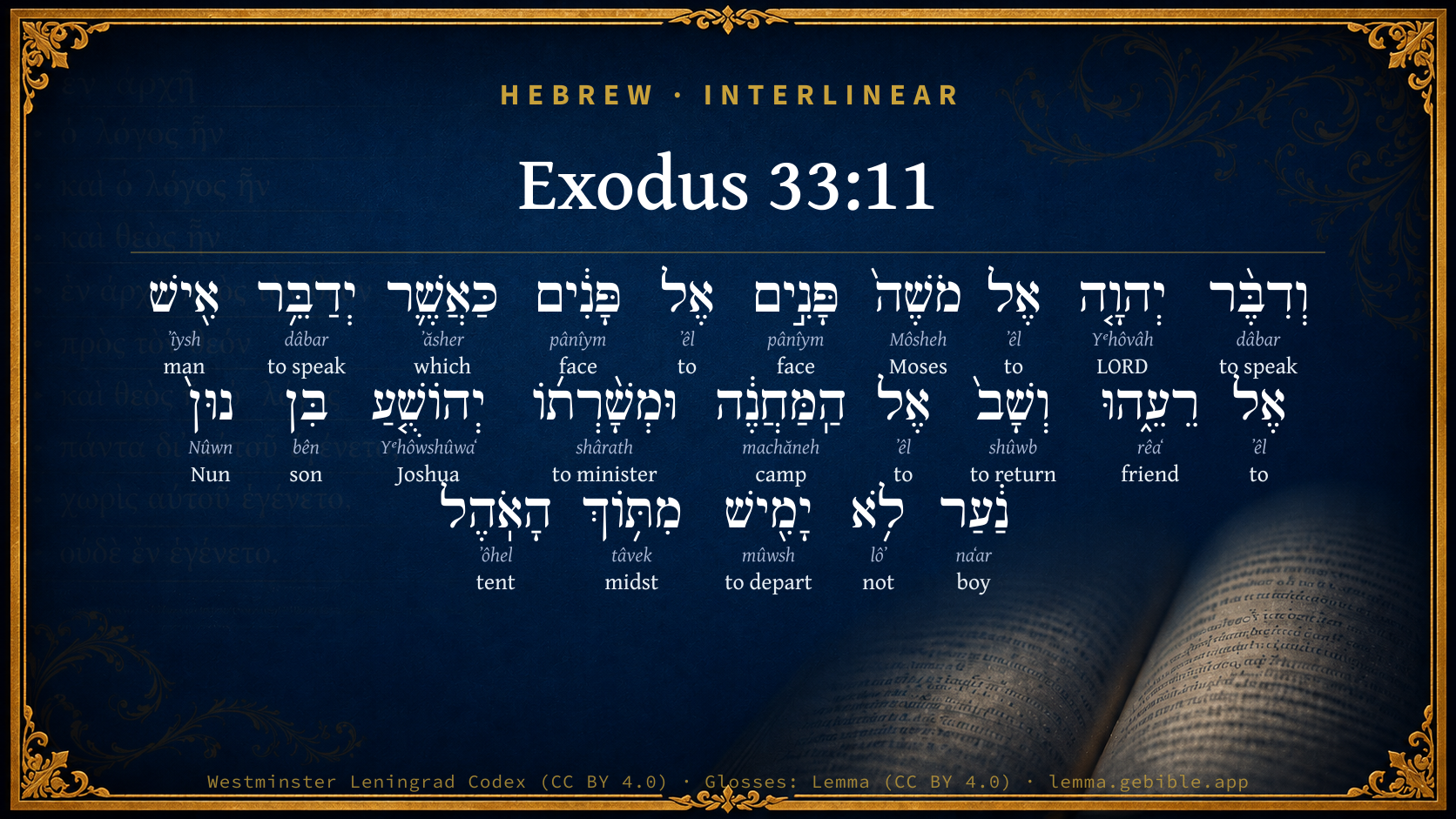
Hebrew (Westminster Leningrad Codex) Exodus 33:11 appears in the Hebrew Old Testament. The text above is from the Westminster Leningrad Codex. Each word links to its Strong’s number, a concise gloss, and parsing drawn from the Open Scriptures Hebrew Bible morphology. Click any word for its full Brown-Driver-Briggs (BDB) entry.
Download image
Cite this verse

Exodus 33:11 (World English Bible). Public Domain. Lemma interlinear Bible study tool, https://lemma.gebible.app/v/exodus/33/11.

Show BibTeX & RIS
BibTeX
RIS
English Translation
Yahweh spoke to Moses face to face, as a man speaks to his friend. He turned again into the camp, but his servant Joshua, the son of Nun, a young man, didn't depart out of the Tent.
World English Bible · Public Domain
Highlights
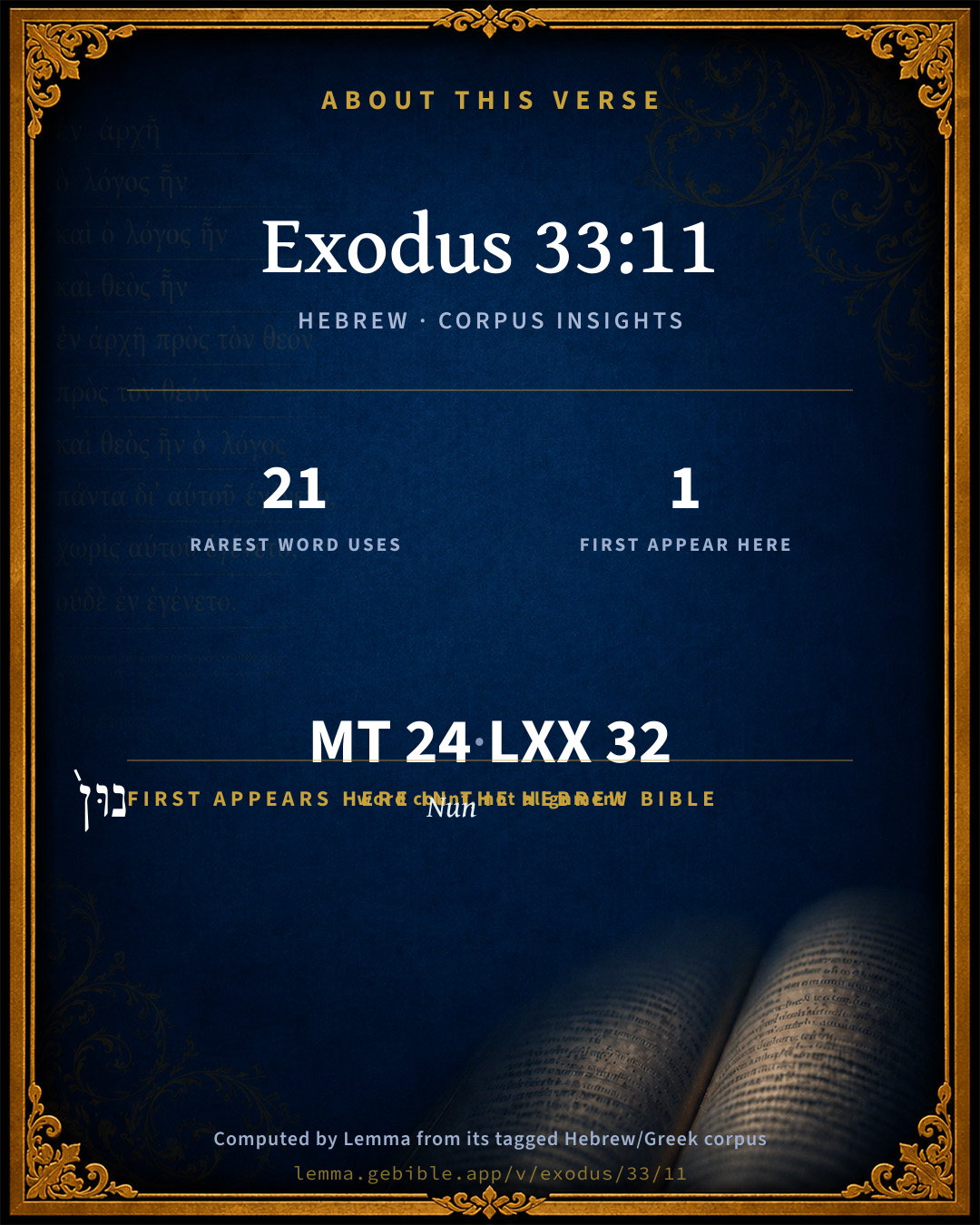
  • 1 first appearance in the Hebrew Bible
Full analysis ↓
Download a study sheet

One document with this verse’s original text, its word-by-word gloss line, the meaning frame, cross-references with their text, attributed commentary, and full source and license credits — printable, and it pastes into notes with its structure intact.

This verse Autodidact and up

Study sheet (.html) Plain text (.txt)

A passage Seminary Student

Up to 50 verses in one chapter. A passage sheet keeps up to 6 commentary sources and 12 cross-references per verse, in the order this page ranks them, and says so on the sheet whenever that leaves anything out. Ask for a single verse and you get the Autodidact verse sheet above.

Everything on this page stays free to read, with no account — the sheet is a download of what is already on screen, not access to it.

Want to remove ads? Support Godless Engineer
Compare translations 3

The same verse in 3 English versions, stacked beneath the original-language interlinear above. Click any original word for its lexicon entry.

Each is an independent rendering of the whole verse — the interlinear is not word-aligned to these translations.

Highlighted words mark where these versions differ — a whole-verse word diff, not a word-by-word alignment.

  • World English Bible Public Domain
    Yahweh spoke to Moses face to face, as a man speaks to his friend. He turned again into the camp, but his servant Joshua, the son of Nun, a young man, didn't depart out of the Tent.
  • King James Version Public Domain
    And the LORD spake unto Moses face to face, as a man speaketh unto his friend. And he turned again into the camp: but his servant Joshua, the son of Nun, a young man, departed not out of the tabernacle.
  • unfoldingWord Literal Text CC BY-SA 4.0
    And Yahweh would speak to Moses face to face, as a man speaks to his friend. Then Moses would return to the camp, but his servant Joshua son of Nun, a young man, would not withdraw from the midst of the tent.

unfoldingWord Literal Text — © unfoldingWord, licensed CC BY-SA 4.0. Word-aligned USFM3 via Door43 (git.door43.org/unfoldingWord/en_ult).

Versions to compare (up to 4)

3 of 4 selected

Show all 18 translations

Every available English version of this verse, each an independent rendering of the whole verse.

  • World English Bible Public Domain
    Yahweh spoke to Moses face to face, as a man speaks to his friend. He turned again into the camp, but his servant Joshua, the son of Nun, a young man, didn't depart out of the Tent.
  • Berean Standard Bible Public Domain
    Thus the LORD would speak to Moses face to face, as a man speaks to his friend. Then Moses would return to the camp, but his young assistant Joshua son of Nun would not leave the tent.
  • Majority Standard Bible Public Domain
    Thus the LORD would speak to Moses face to face, as a man speaks to his friend. Then Moses would return to the camp, but his young assistant Joshua son of Nun would not leave the tent.
  • King James Version Public Domain
    And the LORD spake unto Moses face to face, as a man speaketh unto his friend. And he turned again into the camp: but his servant Joshua, the son of Nun, a young man, departed not out of the tabernacle.
  • American Standard Version (1901) Public Domain
    And Jehovah spake unto Moses face to face, as a man speaketh unto his friend. And he turned again into the camp: but his minister Joshua, the son of Nun, a young man, departed not out of the Tent.
  • Revised Version (1885) Public Domain
    And the LORD spake unto Moses face to face, as a man speaketh unto his friend. And he turned again into the camp: but his minister Joshua, the son of Nun, a young man, departed not out of the Tent.
  • Geneva Bible (1599) Public Domain
    And the Lord spake vnto Moses, face to face, as a man speaketh vnto his friende. After he turned againe into the hoste, but his seruant Ioshua the sonne of Nun a yong man, departed not out of the Tabernacle.
  • Douay-Rheims (1899) Public Domain
    And the Lord spoke to Moses face to face, as a man is wont to speak to his friend. And when he returned into the camp, his servant Josue the son of Nun, a young man, departed not from the tabernacle.
  • Young's Literal Translation Public Domain
    And Jehovah hath spoken unto Moses face unto face, as a man speaketh unto his friend; and he hath turned back unto the camp, and his minister Joshua, son of Nun, a youth, departeth not out of the tent.
  • Literal Standard Version CC BY-SA 4.0
    And YHWH has spoken to Moses face to face, as a man speaks to his friend; and he has turned back to the camp, and his minister Joshua, son of Nun, a youth, does not depart out of the tent.
  • Unlocked Literal Bible CC BY-SA 4.0
    Yahweh would speak to Moses face to face, as a man speaks to his friend. Then Moses would return to the camp, but his servant Joshua son of Nun, a young man, would stay in the tent.
  • unfoldingWord Literal Text CC BY-SA 4.0
    And Yahweh would speak to Moses face to face, as a man speaks to his friend. Then Moses would return to the camp, but his servant Joshua son of Nun, a young man, would not withdraw from the midst of the tent.
  • Darby Bible Public Domain
    And Jehovah spoke with Moses face to face, as a man speaks with his friend. And he returned to the camp; but his attendant, Joshua the son of Nun, a young man, departed not from within the tent.
  • World Messianic Bible Public Domain
    The LORD spoke to Moses face to face, as a man speaks to his friend. He turned again into the camp, but his servant Joshua, the son of Nun, a young man, didn’t depart from the Tent.
  • Webster's Bible Public Domain
    And the LORD spoke to Moses face to face, as a man speaketh to his friend. And he turned again into the camp; but his servant Joshua the son of Nun, a young man, departed not out of the tabernacle.
  • Free Bible Version CC BY-SA 4.0
    Moses would speak to the Lord face to face as you would talk to a friend, and then return to the camp. However, his young assistant Joshua, son of Nun, stayed in the Tent.
  • Bible in Basic English Public Domain
    And the Lord had talk with Moses face to face, as a man may have talk with his friend. And when Moses came back to the tents, his servant, the young man Joshua, the son of Nun, did not come away from the Tent.
  • JPS Tanakh (1917) Public Domain
    And the LORD spoke unto Moses face to face, as a man speaketh unto his friend. And he would return into the camp; but his minister Joshua, the son of Nun, a young man, departed not out of the Tent.

Literal Standard Version (2020), Covenant Press — licensed CC BY-SA 4.0. Text via the HelloAO Bible API (eBible.org). Unlocked Literal Bible (unfoldingWord) — licensed CC BY-SA 4.0. Text via the HelloAO Bible API (eBible.org). unfoldingWord Literal Text — © unfoldingWord, licensed CC BY-SA 4.0. Word-aligned USFM3 via Door43 (git.door43.org/unfoldingWord/en_ult). Free Bible Version, Dr. Jonathan Gallagher — licensed CC BY-SA 4.0. Text via the HelloAO Bible API (eBible.org).

Word by word

More ways to search: Search by grammar → Find every occurrence → Compare this word →

Practice this passage: Drill this verse → Learn its vocabulary →

יָמִ֖ישׁ
mûwsh
H4185
“to depart”
Verb, Qal, Imperfect, 3rd Person, Masculine, Singular
Part of Speech
Verb
Stem
Qal
Form
Imperfect
Person
3rd Person
Gender
Masculine
Number
Singular
Full BDB Definition

Origin: a primitive root [perhaps rather the same as H4184 through the idea of receding by contact]

TWOT: 1167

to depart, remove - (Qal) - to depart - to remove - to be removed (of inanimate objects) - (Hiphil) to remove, depart
  1. וְדִבֶּ֨ר dâbar H1696 “and · to speak” Conjunction + Verb, Piel, Sequential Perfect, 3rd Person, Masculine, Singular
  2. יְהוָ֤ה Yᵉhôvâh H3068 “LORD” Noun, Proper
  3. אֶל ʼêl H413 “to” Preposition
  4. מֹשֶׁה֙ Môsheh H4872 “Moses” Noun, Proper
  5. פָּנִ֣ים pânîym H6440 “face(s)” Noun, Common, Both, Plural, Absolute
  6. אֶל ʼêl H413 “to” Preposition
  7. פָּנִ֔ים pânîym H6440 “face(s)” Noun, Common, Both, Plural, Absolute
  8. כַּאֲשֶׁ֛ר ʼăsher H834 “like/as · which” Preposition + Particle, Relative
  9. יְדַבֵּ֥ר dâbar H1696 “to speak” Verb, Piel, Imperfect, 3rd Person, Masculine, Singular
  10. אִ֖ישׁ ʼîysh H376 “man” Noun, Common, Masculine, Singular, Absolute
  11. אֶל ʼêl H413 “to” Preposition
  12. רֵעֵ֑הוּ rêaʻ H7453 “friend · his” Noun, Common, Masculine, Singular, Construct + Suffix, Personal, 3rd Person, Masculine, Singular
  13. וְשָׁב֙ shûwb H7725 “and · to return” Conjunction + Verb, Qal, Sequential Perfect, 3rd Person, Masculine, Singular
  14. אֶל ʼêl H413 “to” Preposition
  15. הַֽמַּחֲנֶ֔ה machăneh H4264 “the · camp” Particle, Definite Article + Noun, Common, Both, Singular, Absolute
  16. וּמְשָׁ֨רְת֜וֹ shârath H8334 “and · ministering · him” Conjunction + Verb, Piel, Participle Active, Masculine, Singular, Construct + Suffix, Personal, 3rd Person, Masculine, Singular
  17. יְהוֹשֻׁ֤עַ Yᵉhôwshûwaʻ H3091 “Joshua” Noun, Proper
  18. בִּן bên H1121 “son of” Noun, Common, Masculine, Singular, Construct
  19. נוּן֙ Nûwn H5126 “Nun” Noun, Proper
  20. נַ֔עַר naʻar H5288 “boy” Noun, Common, Masculine, Singular, Absolute
  21. לֹ֥א lôʼ H3808 “not” Particle, Negative
  22. מִתּ֥וֹךְ tâvek H8432 “from · midst of” Preposition + Noun, Common, Masculine, Singular, Construct
  23. הָאֹֽהֶל ʼôhel H168 “the · tent” Particle, Definite Article + Noun, Common, Masculine, Singular, Absolute

About this verse

These counts appear in no published source. They are computed here, from the morphology-tagged text and Lemma’s own curated glosses. What Lemma adds →

24
words
19
distinct lemmas
Pentateuch
section

Notable vocabulary

The rarest word here is יָמִ֖ישׁ to depart H4185 — appearing just 21 times in the whole Hebrew Bible.

First appearance in Scripture

This word makes its first canonical appearance in the Hebrew Bible here:

Shared distinctive vocabulary

יָמִ֖ישׁ to depart H4185 occurs in 19 verses of the Hebrew Bible. Also found in:

Grammatical profile

  • 5 verbs
  • 13 nouns
  • 4 prepositions
  • 2 particles

Verb forms

  • וְדִבֶּ֨ר Piel · Sequential Perfect
  • יְדַבֵּ֥ר Piel · Imperfect
  • וְשָׁב֙ Qal · Sequential Perfect
  • וּמְשָׁ֨רְת֜וֹ Piel · Participle Active
  • יָמִ֖ישׁ Qal · Imperfect

Repetition

Words recur within this verse — often emphatic in Hebrew:

  • וְדִבֶּ֨ר to speak H1696 ×2
  • פָּנִ֣ים face H6440 ×2
  • אֶל to H413 ×4

Hebrew & Septuagint length

In English translation the verse runs 37 words from the Hebrew and 40 from the Septuagint (LXX English) — closely comparable.

A rough comparison of the two English renderings, which tokenize alike — not a word-level alignment.

Word counts can differ between the Hebrew and the Greek without any difference in meaning — e.g. the Hebrew direct-object marker אֵת has no separate Greek word, and Greek often adds the article ὁ.

In the original languages it is 24 Hebrew tokens and 32 Greek tokens — but the two are counted differently (Hebrew bundles its prefixes and suffixes into one token; the Greek is in lemma form), so that isn’t a like-for-like length.

Cross-references

15

Topical passages linked to Exodus 33:11 in the Treasury of Scripture Knowledge — connected by theme and wording, ordered by reader-vote popularity; previews shown in the World English Bible.

  • Numbers 12:8 with him will I speak mouth to mouth, even manifestly, and not in dark speeches; and the form of Yahweh shall he see: why then were you not afraid to speak against my servant, against Moses?
  • Deuteronomy 34:10 There has not arisen a prophet since in Israel like Moses, whom Yahweh knew face to face,
  • Exodus 24:13 Moses rose up with Joshua, his servant, and Moses went up onto God's Mountain.
  • Exodus 33:9 It happened, when Moses entered into the Tent, that the pillar of cloud descended, stood at the door of the Tent, and spoke with Moses.
  • Genesis 32:30 Jacob called the name of the place Peniel: for, he said, "I have seen God face to face, and my life is preserved."
  • Deuteronomy 5:4 Yahweh spoke with you face to face on the mountain out of the midst of the fire,
  • John 15:14–15 You are my friends, if you do whatever I command you.
  • John 11:11 He said these things, and after that, he said to them, "Our friend, Lazarus, has fallen asleep, but I am going so that I may awake him out of sleep."
  • James 2:23 and the Scripture was fulfilled which says, "Abraham believed God, and it was accounted to him as righteousness;" and he was called the friend of God.
  • John 3:29 He who has the bride is the bridegroom; but the friend of the bridegroom, who stands and hears him, rejoices greatly because of the bridegroom's voice. This, my joy, therefore is made full.
  • Exodus 32:17 When Joshua heard the noise of the people as they shouted, he said to Moses, "There is the noise of war in the camp."
  • 2 Chronicles 20:7 Did not you, our God, drive out the inhabitants of this land before your people Israel, and give it to the seed of Abraham your friend forever?
  • Job 16:21 That he would maintain the right of a man with God, Of a son of man with his neighbor!
  • Isaiah 42:8 I am Yahweh, that is my name; and my glory will I not give to another, neither my praise to engraved images.
  • Exodus 17:9 Moses said to Joshua, "Choose men for us, and go out, fight with Amalek. Tomorrow I will stand on the top of the hill with God's rod in my hand."

Cross-references courtesy of OpenBible.info (CC BY 4.0).

Hebrew and Greek witnesses Masoretic Hebrew ↔ Greek Septuagint

The same verse in the two great witnesses to the Old Testament, shown verse-for-verse.

These are two independent witnesses, not word-aligned to each other, and the Septuagint is shown in lemma (dictionary) form.

Hebrew Exodus 33:11 Masoretic · Westminster Leningrad Codex

וְדִבֶּ֨ר יְהוָ֤ה אֶל מֹשֶׁה֙ פָּנִ֣ים אֶל פָּנִ֔ים כַּאֲשֶׁ֛ר יְדַבֵּ֥ר אִ֖ישׁ אֶל רֵעֵ֑הוּ וְשָׁב֙ אֶל הַֽמַּחֲנֶ֔ה וּמְשָׁ֨רְת֜וֹ יְהוֹשֻׁ֤עַ בִּן נוּן֙ נַ֔עַר לֹ֥א יָמִ֖ישׁ מִתּ֥וֹךְ הָאֹֽהֶל

Yahweh spoke to Moses face to face, as a man speaks to his friend. He turned again into the camp, but his servant Joshua, the son of Nun, a young man, didn't depart out of the Tent.

World English Bible · Public Domain

Greek LXX Exodus 33:11 Septuagint · lemma form

καί λαλέω κύριος πρός μωυσῆς ἐνώπιος ἐνώπιος ὡς εἰ τις λαλέω πρός ὁ ἑαυτοῦ φίλος καί ἀπολύω εἰς ὁ παρεμβολή ὁ δέ θεράπων ἰησοῦς υἱός ναυη νέος οὐ ἐκπορεύομαι ἐκ ὁ σκηνή

And the Lord spoke to Moses face to face, as if one should speak to his friend; and he retired into the camp: but his servant Joshua the son of Naue, a young man, departed not forth from the tabernacle.

LXX2012 (modern English Septuagint) · Public Domain

Hebrew: Westminster Leningrad Codex (CC BY 4.0). Greek: Septuagint (public domain); English from LXX2012 (modern English Septuagint) (Public Domain). How the Septuagint differs from the Hebrew →

Targum (Aramaic paraphrase)

2

The Targum is the ancient Jewish Aramaic paraphrase of the Hebrew Scriptures — an interpretive translation, not the Hebrew text itself. Onkelos (literal) and Pseudo-Jonathan (expansive) render the Torah, and Jonathan the Prophets. Coverage is partial: where no permissively-licensed English translation exists for a verse, only the Aramaic is shown. This is verse-level text, not a word-by-word alignment to the Hebrew.

  1. Targum Onkelos Torah (Genesis–Deuteronomy)
    וּמִתְמַלֵל יְיָ עִם משֶׁה מַמְלַל עִם מַמְלַל כְּמָא דִמְמַלֵל גְבַר עִם חַבְרֵהּ וְתָב לְמַשְׁרִיתָא וּמְשׁוּמְשָׁנֵהּ יְהוֹשֻׁעַ בַּר נוּן עוּלֵימָא לָא עֲדֵי מִגוֹ מַשְׁכְּנָא:

    (no public-domain English translation for this verse)

    Targum Onkelos — Aramaic: “Onkelos Genesis” (public domain); “Onkelos Exodus” (public domain); “Onkelos Leviticus” (public domain); “Onkelos Numbers” (public domain); “Onkelos Deuteronomy” (public domain). English: “Sefaria Community Translation” (CC0 1.0 (public-domain dedication)); “J.W. Etheridge. The Targums of Onkelos and Jonathan Ben Uzziel on the Pentateuch. London: Longmans, Green, 1862” (public domain). Text via Sefaria.

  2. Targum Pseudo-Jonathan Torah (Genesis–Deuteronomy)
    וּמִתְמַלֵּיל יְיָ עִם משֶׁה מַמְלֵל קְבֵל מַמְלֵל קַל דִּבּוּרָא הֲוָה שָׁמַע בְּרַם זִיו אַפִּין לָא הֲוָה חָמֵי הֵיכְמָא דִמְמַלֵּיל גְּבַר עִם חַבְרֵיהּ וּמִן בָּתַר דְּאִסְתַּלֵּק קַל דִּבּוּרָא תָּאִיב לְמַשְׁרִיתָא וּמִתְנֵי פִּתְגָמַיָא לִכְנִישְׁתְּהוֹן דְּיִשְרָאֵל בְּרַם מְשׁוּמְשָׁנֵיהּ יְהוֹשֻׁעַ בַּר נוּן הֲוָה טְלֵי לָא הֲוַת זֵייעַ מִגּוֹ מַשְׁכְּנֵיהּ

    And the Lord spake with Mosheh word for word,- the voice of the Word (dibbura) was heard, but the Majesty of the Presence was not seen,- in the way that a man converseth with his companion: and after the speaking voice had ascended, he returned to the camp, and delivered the word to the congregation of Israel. But his minister, Jehoshua bar Nun, a young man, removed not from the tabernacle.

    Targum Pseudo-Jonathan — Aramaic: “Targum Jonathan on Genesis” (public domain); “Targum Jonathan on Exodus” (public domain); “Targum Jonathan on Leviticus” (public domain); “Targum Jonathan on Numbers” (public domain); “Targum Jonathan on Deuteronomy” (public domain). English: “The Targum of Jonathan ben Uzziel, trans. J. W. Etheridge, London, 1862” (public domain). Text via Sefaria.

Commentary

Notes on Exodus 33:11 from classic Christian and Jewish commentators (each source and its license shown beneath its notes). The classic Christian expositions comment on the surrounding passage and are grouped to its opening verse, so a note may address several verses; the Jewish commentaries on the Tanakh (Rashi and others) are per-verse, so they appear only where the commentator wrote on this verse.

Lemma curates 59 commentaries, every one of them public domain or Creative Commons licensed, each selected and text-cleaned for this edition rather than reprinted as found. About our sources →

Trapp's Complete Commentary

John Trapp

Exo 33:11 And the LORD spake unto Moses face to face, as a man speaketh unto his friend. And he turned again into the camp: but his servant Joshua, the son of Nun, a young man, departed not out of the tabernacle.

Ver. 11. Face to face.] Friendly and familiarly, as Num 12:8. And perhaps in human shape, as he spake with Abraham his friend. Gen 18:16-33

John Trapp, A Commentary or Exposition upon All the Books of the Old and New Testament (1647–1656) — public domain. Text from a community e-Sword module.

Joseph Benson's Commentary

Exo 33:11. The Lord spake unto Moses face to face — Or, mouth to mouth, as in Num 12:8. Not that God hath a face or mouth, or that Moses could behold it; which is denied, Exo 33:20; but the sense is, he spoke with him freely, familiarly, and immediately, and not as he did to other prophets, in dreams, or visions, or by an angel. As a man speaketh unto his friend —Which intimates not only that God revealed himself to Moses with greater clearness than to any other of the prophets, but also with greater expressions of particular kindness than to any other. He spake not as a prince to a subject, but as a man to his friend, whom he loves, and with whom he takes sweet counsel. And he turned again into the camp — To tell the people what hopes he had of bringing this business to a good issue. But his servant Joshua departed not out of the tabernacle — Probably Joshua abode there to assist and direct those who resorted thither to seek God in Moses’s absence. And he seems to have been appointed to this work rather than Aaron, or any other of the elders, because they had, one way or other, been guilty of the late idolatry, and God would hereby punish them with a temporary suspension from his service and their office.

Joseph Benson's Commentary on the Old and New Testaments (1811–1818) — public domain. Text from a community e-Sword module.

Tyndale Open Study Notes

Tyndale Open Resources

33:11 Just as Joshua had previously gained experience as a military leader (see 17:9-13), he was now gaining experience as a spiritual leader (see also 24:13). Here he may have remained behind to guard the tent, a function the Levites would later fulfill with the Tabernacle (1 Chr 26).

Tyndale Open Study Notes — © Tyndale Open Resources, licensed CC BY-SA 4.0. Text via the HelloAO Bible API.

Geneva Bible (1599)

Geneva Bible translators

Most plainly and familiarly of all others, Num. 12:7,8; Deut. 34:10.

Geneva Bible (1599) marginal notes — public domain. Text via Bolls.life.

Adam Clarke's Commentary

Verse 11. The Lord spake unto Moses face to face] That there was no personal appearance here we may readily conceive; and that the communications made by God to Moses were not by visions, ecstacies, dreams, inward inspirations, or the mediation of angels, is sufficiently evident: we may therefore consider the passage as implying that familiarity and confidence with which the Divine Being treated his servant, and that he spake with him by articulate sounds in his own language, though no shape or similitude was then to be seen.

Joshua, the son of Nun, a young man] There is a difficulty here. Joshua certainly was not a young man in the literal sense of the word; "but he was called so," says Mr. Ainsworth, "In respect of his service, not of his years; for he was now above fifty years old, as may be gathered from Jos 24:29. But because ministry and service are usually by the younger sort, all servants are called young men, Ge 14:24." See also Ge 22:3, and Ge 41:12. Perhaps the word נער naar, here translated young man, means a single person, one unmarried.

Adam Clarke's Commentary on the Bible (1810–1826) — public domain. Text from a community e-Sword/MySword module.

Ellicott's Commentary for English Readers

(11) Face to face.—Comp. Num_12:8; Deu_34:10. This is clearly spoken of as a privilege peculiar to Moses; but in what exactly the peculiarity consisted is not apparent. Some special closeness of approach is no doubt meant—some nearness such as had been enjoyed by no mortal previously. In later times, Isaiah (Isa_6:1-5) and Ezekiel (Eze_1:28) were perhaps equally favoured.

His servant Joshua.—Comp. Exo_24:13, where Joshua is called Moses’ “minister,” the word employed in the Hebrew being the same.

A Bible Commentary for English Readers, edited by Charles John Ellicott (1878–1897) — public domain. Text from a community e-Sword module.

The Cambridge Bible for Schools and Colleges

gen. ed. J. J. S. Perowne

11. would speak unto Moses face to face] not from the distant heaven, or with the comparative indistinctness of a vision or a dream (Num_12:8), but ‘face to face’ (so Deu_34:10; cf. Deu_5:4), or ‘mouth to mouth’ (Nu. l.c.), like one friend speaking to another. Moses would then return into the camp; but his minister (Exo_24:13), Joshua, remained permanently in charge of the Tent (cf. Samuel, 1Sa_3:3; 1Sa_3:15).

The Cambridge Bible for Schools and Colleges (gen. ed. J. J. S. Perowne; Cambridge University Press, 1878–1918) — public domain. Text from a community e-Sword module.

John Gill's Exposition

And the Lord spake unto Moses face to face,.... Not by an angel, but he himself in person; not by a dream or vision, but apparently, in real visible appearance; not in dark speeches, but clearly in plain words, easy to be understood; and not by a voice from heaven at a distance, but mouth to mouth, being very near, as when on the mount, and now at the door of the tabernacle:

as a man speaketh unto his friend; freely, familiarly, plainly, cordially, openly, without any reserve or show of authority, or causing dread and fear; for he also spake to the children of Israel "face to face", but then it was out of the fire in a terrible manner which they could not bear, Deu 5:4.

and he turned again into the camp; to acquaint the people, the heads and elders of them, what discourse he had with God, what success he had met with on their behalf, and how the Lord stood affected to them, or what was his will concerning them:

but his servant Joshua, the son of Nun, a young man, departed not out of the tabernacle; who is here described by his name, Joshua; by his descent, the son of Nun; by his relation to Moses, a servant of his, who waited on him wherever he went, when upon the mount and now at the tabernacle; and by his age, a young man, as he was in comparison of Moses, and is so called chiefly because he was his servant, it being usual to call servants young men, of whatsoever age; for Joshua, strictly speaking, could not be a young man in years; he was the general of the army at the battle with Amalek; and, according to Aben Ezra, was now fifty six years of age, which he collects from his living to the age of one hundred and ten years; now to fifty six add the forty years in the wilderness, seven years, in which he subdued the land of Canaan, and seven more in dividing it, as say their wise men, the sum is one hundred an ten years: and it not being easy to account for it, that Moses should depart alone, unaccompanied by Joshua, who always attended him, and no sufficient reason is given why he should stay behind in the tabernacle; as for private devotion, which this was not a place for; or for judging the causes of the people in the absence of Moses, which we never find he did or to guard the tabernacle, to be a watchman in it, or even at the head of a watch over it, which, as it seemed unnecessary, so was an employment too mean for him; the words therefore may be rendered as they are by some, and the rather, as there is an accent which makes a considerable stop on the word translated a "young man" (w), "and he turned again to the camp", and "his servant Joshua, the son of Nun, a young man"; that is, along with him; they both returned to the camp, and then it follows, "he", i.e. the Lord, "departed not out of the tabernacle", but continued there; to whom Moses afterwards returned and had the following discourse: a learned man (x) thinks that the grand tabernacle is here meant, yet unfinished, though not the final erection of it; and that here is a dislocation in the history, and supposes that Moses having been forty days absent, found upon his return a good progress made in the work of the tabernacle, and the ornaments and utensils belonging thereunto: and as soon as the wood work of the tabernacle was finished, he ordered it to be put together; but because the tabernacle had neither a door to it, nor were the hangings of the outer court finished, therefore Joshua the servant of Moses, the son of Nun, a young man, departed not out of the tabernacle, but remained there to preserve it from being polluted: but it is a mistake of his that the tabernacle had not a door to it, and it is strange he should make it, when it is twice mentioned in the preceding verses; and since the pillar of cloud and the Lord in it were there, no man durst draw near to pollute it, so that there was no need of Joshua's being there to preserve it; and besides, it was after this Moses went up to the mount and stayed another forty days and forty nights, see Exo 34:4.

(w) So Junius & Tremellius, Piscator, Rivet. (x) Clayton's Chronology of the Hebrew Bible, p. 343.

John Gill's Exposition of the Whole Bible (1746–1763) — public domain (CC PDM 1.0). Text via the HelloAO Bible API.

Albert Barnes' Notes on the Bible

Face to face - See Exo 33:20 note.

Albert Barnes' Notes on the Bible (1834–1885) — public domain. Text from a community e-Sword/MySword module.

Haydock's Catholic Bible Commentary

Face to face. That is, in a most familiar manner. Though, as we learn from this very chapter, Moses could not see the face of the Lord. (Challoner) --- The angel assumed a human form, (Menochius) which Moses knew could not fully display the majesty of God; and hence he begs to see his face, or his glory, (ver. 13, 18,) which God declares is impossible for any mortal to do, ver. 20. (Haydock) --- He addresses him, however, with unusual condescension, and speaks to him without any ambiguity, "without any medium," as the Arabic expresses it. Other prophets were instructed by visions, and were filled with terror, Daniel x. 8. --- Young man, though 50 years old, and the general who defeated the Amalecites, chap. xvii. 13. Puer means a servant also, in which capacity Josue waited on Moses, and was alone allowed to be present with him in the tabernacle. He did not sleep there, (Calmet) but guarded it from all profanation. Some say he was still called young, because he was unmarried; in which sense the Chaldean styles him hullema, which corresponds with the Hebrew halma, a virgin. (Serarius) (Tirinus)

George Leo Haydock (1774–1849), Haydock's Catholic Family Bible and Commentary, 1859 edition — public domain. Excludes Psalms (Douay-Rheims chapter numbering differs from Protestant) and Deuterocanonical books (Catholic canon only).

Matthew Poole's English Annotations

Face to face, or, mouth to mouth, as Num 12:8. Not that God hath face or mouth, or that Moses could behold it, which is denied, Exo 33:20. But the sense is, he spake with him freely and familiarly, and immediately, not by an angel in a dream or vision, as he did to other prophets. See Deu 34:10.

Joshua abode in the tabernacle, either to keep it from injury or inconvenience; for as it was set up by man’s help, so it needed man’s care to preserve it; or to assist and direct those who resorted thither to seek God in Moses’s absence. And Joshua seems to be appointed for this work rather than Aaron, or any other of the elders, because they had one way or other been guilty of the late idolatry, and God would hereby punish them with a temporary suspension from his service, and their office.

Matthew Poole's English Annotations on the Holy Bible (1683–1685) — public domain. Text from a community e-Sword/MySword module.

The Pulpit Commentary

The Lord spake unto Moses face to face. As one present not as one at a distance to mouth," as we read in Num_12:8 but not under any visible form (see vers. 20, 23, and compare. (Deu_4:12, Deu_4:15) He turned again. After each conference, Moses returned to the camp, where, no doubt, he had put up for himself another tent, and where his presence was needed He left, however, his personal attendant ("minister"), Joshua, to watch and guard the sacred structure during his absence. It is remarkable that the trust was committed to Joshua, rather than to Aaron, or any of the Levites. Probably.the reason of this was, that Joshua alone had had no paw in the idolatry of the calf. (Exo_32:17)

The Pulpit Commentary (1880–1919), ed. H.D.M. Spence-Jones & Joseph S. Exell — public domain. Text from a community e-Sword module.

John Wesley's Explanatory Notes

And the Lord spake to Moses face to face as a man speaketh to his friend - Which intimates not only that God revealed himself to Moses with greater clearness than to any other of the prophets, but also with greater expressions of particular kindness than to any other. He spake not as a prince to a subject, but as a man to his friend, whom he loves, and with whom he takes sweet counsel. And he turned again into the camp - To tell the people what hopes he had of bringing this business to a good issue. But because he intended speedily to return to the tabernacle, he left Joshua there.

John Wesley, Explanatory Notes Upon the Whole Bible (1754–1765) — public domain. Text via the GEBible commentary corpus.

Rashi

Rabbi Shlomo Yitzchaki (Rashi)

ודבר ה׳ אל משה פנים אל פנים AND THE LORD SPAKE UNTO MOSES FACE TO FACE — Here too (as in v. 9) in spite of the fact that the text states “face to face” the Targum is: ומתמלל עם משה‎.

ושב אל המחנה.( AND HE RETURNED INTO THE CAMP — After God had conversed with him, Moses used to return to the camp and teach the elders what he had learned. This Moses practised from the day of Atonement until the Tabernacle was set up, but no longer. For on the seventeenth of Tammuz the tablets were broken, on the eighteenth he burnt the calf and punished the of fenders, on the nineteenth he ascended the mountain, as it is said (Exodus 32:30) “And it came to pass on the morrow (the day after he had punished the wrongdoers; cf. vv. 26—29), that Moses said unto the people”, [Ye have sinned a great sin and now I will go up to the Lord]”. There he spent forty days and sought mercy for the people, as it is said, (Deuteronomy 9:18) “And I threw myself down before the Lord [as at the first, forty days and forty nights]”. These terminated on the last day of Ab (there were 11 days from the 19th to the 29th of Tammuz therefore 29 days in Ab complete the forty) and he then returned to the people. On the first day of the New Moon of Ellul it was said to him, (Exodus 34:2) “And be ready in the morning] and go up in the morning unto mount Sinai” — to receive the second tablets. He again spent there the forty days of which it is stated, (Deuteronomy 10:10) “[And I stayed in the mountain, according to the first, days, [forty days and forty nights]”. The words כימים הראשונים, “like the first days”, cannot refer to the number of days for this is stated immediately afterwards; they are to be joined with עמדתי — I stayed in the same state as on the first days: How were the first forty days passed? In God’s good-will (because the Israelites had not yet sinned)! So, too, the last forty days were passed in God’s good-will — from which you must admit that the intervening forty days were passed in God’s anger. On the tenth of Tishri God became reconciled with Israel in joy and perfect affection and said to Moses: “I have forgiven!” and handed him over the second tablets, whereupon Moses went down and began to command them concerning the work of the Tabernacle (cf. Midrash Tanchuma, Ki Tisa 31; Seder Olam 6; Rashi on Exodus 18:13, Deuteronomy 9:18 and also Taanit 36b). They were occupied in its construction until the first of Nisan and from the time when it was set up God did not converse with him any more except from the tent of meeting.

ושב אל המחנה AND HE RETURNED TO THE CAMP — The translation in the Targum is: וְתָיִב למשריתא (a participle) “and he used to return to the camp”, because (as explained above) it denotes continuous action. Similarly, he translates all the verbs occuring in this section by participles: וראה כל העם he renders by ונצבו;וחזן by והביטו;וקימין by והשתחוו;ומסתכלין by וסגדין. The Midrash explains ודבר ה' אל משה thus: And the Lord spake to Moses that he should return to the camp. He said to him: I am angry and you are angry; if this is to remain so, who will attract them to Me again? (cf. Midrash Tanchuma, Ki Tisa 27 and Berakhot 63b).

Rashi on the Tanakh — English translations: “The Judaica Press complete Tanach with Rashi, translated by A. J. Rosenberg” (CC BY 4.0); “Pentateuch with Rashi's commentary by M. Rosenbaum and A.M. Silbermann, 1929-1934” (public domain); “The Metsudah Tanach series, Lakewood, N.J” (CC BY 4.0); and “The Book of Joshua, Metsudah Publications, 1997” (CC BY 4.0). Text via Sefaria.

Ramban (Nachmanides)

Rabbi Moshe ben Nachman (Ramban / Nachmanides)

AND HIS MINISTER JOSHUA, ‘BIN’ (THE SON OF) NUN, ‘NA’AR’ (A LAD). Rabbi Abraham ibn Ezra wrote: “Joshua lived a hundred and ten years, and the Sages say that it took him seven years to conquer the Land [of Israel] and seven years to apportion it amongst the tribes. If so, he was now fifty-six years old, (lad)! and how does Scripture call him na’ar (lad)? We must therefore say that this is the meaning thereof: and his minister Joshua the son of Nun rendered him such service as can be given only by a youthful attendant.”In my opinion it is the way of the Sacred Language to call any attendant [regardless of age] na’ar, for the person of high office is called ish (man), and [with respect to him] his attendant is called na’ar. Thus: Gehazi ‘na’aro’ (his attendant); Let ‘ha’ne’arim’ (the attendants), I pray thee, arise and play before us. Similarly, and ten ‘ne’arim’ (attendants) that bore Joab’s armor, 18:15. and Joab [David’s commander-in-chief] would surely only turn over his armor to valiant men who stood near him! And it is also written, And Joshua said unto the two ‘men’ that had spied out the land, and yet it is written there, and ‘ha’ne’arim’ the spies went in etc!, Verse 23. [Thus we must say that the] term [ha’ne’arim] is used because they were servants of the congregation, acting for them as spies. There are many similar instances. So also, the ‘na’arei’ of the king that ministered unto him, [the second half of the phrase being in apposition,] explaining that they were the servants who attended the king personally, and not the attendants of the court. And if so, our verse is stating: and his minister Joshua the son of Nun was always in attendance, and never departed out of the tent.

The reason for the form ‘bin’ Nun [instead of ‘ben’ Nun] is that the vowel chirik comes sometimes in place of the segal [which would have made it “ben Nun”]. Similar cases are: The words of Agur ‘bin’ (the son of) Jakeh;. ‘she’bin lailah hayah’ (which came up in a night) ‘u’bin lailah avad’ (and perished in a night);. ‘im bin hakoth harasha’ (if the wicked man deserve to be beaten). — a person deserving to be beaten, because he hit his friend.” So clearly explained in Ibn Ezra ibid.Yet despite all this I wonder! Why [of all the times that Joshua the son of Nun is cited in the Scriptures] is the name of this righteous man not once mentioned properly [i.e., ‘ben’ Nun]? Therefore I think that they used to call him in this way as a mark of honor, since he was the greatest of the disciples of Moses our teacher, and so they called him binun, meaning “the understanding one,” since there was none so discreet and wise as he. Or it may be that the meaning of it is: “Joshua, whom understanding begot;” they thus used the term nun as in the expression, may his name ‘yinon’ (be continued) as long as the sun.

Ramban (Nachmanides) on the Tanakh — English translation: “Commentary on the Torah by Ramban (Nachmanides). Translated and annotated by Charles B. Chavel. New York, Shilo Pub. House, 1971-1976” (CC BY 4.0). Text via Sefaria.

Sforno

Rabbi Ovadia Sforno

Face to face. Unlike other prophets, Moshe was able to remain standing and retained the use of his faculties while he was receiving prophecy.

Just as a man speaks to his friend. Moshe’s prophecies were clear rather than shrouded in riddles like those of other prophets.

Sforno on the Tanakh — English translation: “Yalkut, Sifsei Chachomim Chumash, Metsudah Publications, 2009” (CC BY 4.0). Text via Sefaria.

Lesson kit

Teaching starters — assembled from the data on this page, not authored interpretation. Every prompt links to the verse data it draws on. Edit before teaching.

Exodus, in the Pentateuch, opens this verse with 24 words (19 distinct Hebrew lemmas). Its most distinctive word is mûwsh (“to depart”). A historical commentator’s framing appears above. Read the whole chapter for the surrounding context.

Discussion questions

  1. The word mûwsh carries the sense “to depart.” How does it shape the verse?
  2. The word “Nun” first appears here in Scripture. What is being introduced at this debut?
  3. Exodus 13:22 shares the word «to depart» with this verse. How do the two illuminate each other?
  4. “to speak” occurs 2× in this one verse. What is the effect of the repetition?
  5. The translations on this page render this verse differently — a whole-verse word diff, not a word-by-word alignment. What might account for the different wordings?
  6. The verb «וְדִבֶּ֨ר» is Piel Sequential Perfect. How does its form color the action?
  7. Reading how Trapp's Complete Commentary and Joseph Benson's Commentary read this verse, where do the two commentators agree and where do they part?

Things to notice

Reading settings

Reading text

Shown beneath each verse's original-language words.

Old Testament
Old Testament edition

Read the OT as the Masoretic Hebrew (MT) or the Greek Septuagint (LXX).

English shown for the Greek Septuagint (in the Hebrew ↔ Greek comparison).

Comparing translations? Open the Compare panel on any verse page to stack up to four side by side.