
2 Kings 6:20

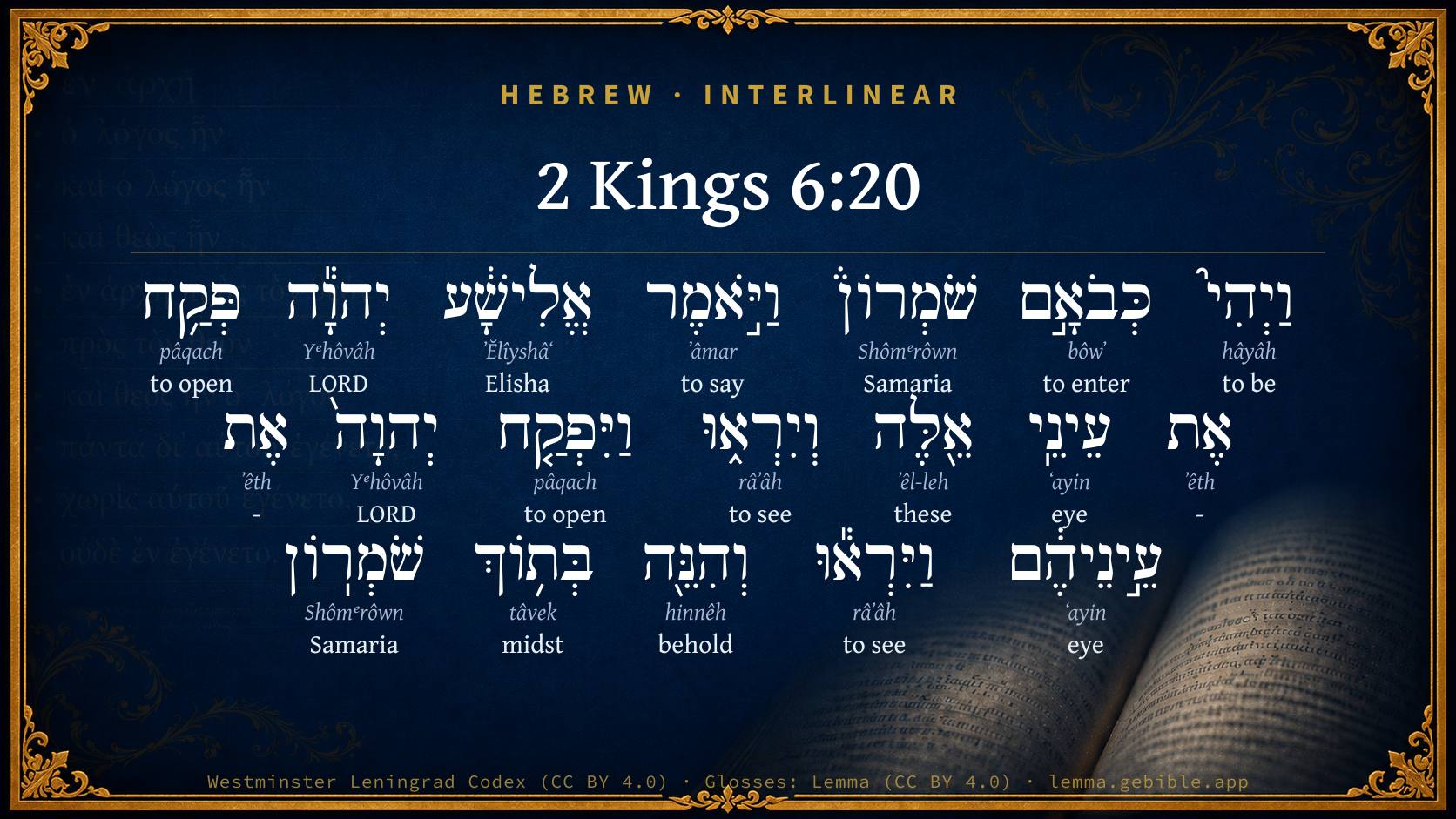
Hebrew (Westminster Leningrad Codex) 2 Kings 6:20 appears in the Hebrew Old Testament. The text above is from the Westminster Leningrad Codex. Each word links to its Strong’s number, a concise gloss, and parsing drawn from the Open Scriptures Hebrew Bible morphology. Click any word for its full Brown-Driver-Briggs (BDB) entry.
Download image
Cite this verse

2 Kings 6:20 (World English Bible). Public Domain. Lemma interlinear Bible study tool, https://lemma.gebible.app/v/2-kings/6/20.

Show BibTeX & RIS
BibTeX
RIS
English Translation
It happened, when they were come into Samaria, that Elisha said, Yahweh, open the eyes of these men, that they may see. Yahweh opened their eyes, and they saw; and, behold, they were in the midst of Samaria.
World English Bible · Public Domain
Download a study sheet

One document with this verse’s original text, its word-by-word gloss line, the meaning frame, cross-references with their text, attributed commentary, and full source and license credits — printable, and it pastes into notes with its structure intact.

This verse Autodidact and up

Study sheet (.html) Plain text (.txt)

A passage Seminary Student

Up to 50 verses in one chapter. A passage sheet keeps up to 6 commentary sources and 12 cross-references per verse, in the order this page ranks them, and says so on the sheet whenever that leaves anything out. Ask for a single verse and you get the Autodidact verse sheet above.

Everything on this page stays free to read, with no account — the sheet is a download of what is already on screen, not access to it.

Want to remove ads? Support Godless Engineer
Compare translations 3

The same verse in 3 English versions, stacked beneath the original-language interlinear above. Click any original word for its lexicon entry.

Each is an independent rendering of the whole verse — the interlinear is not word-aligned to these translations.

Highlighted words mark where these versions differ — a whole-verse word diff, not a word-by-word alignment.

  • World English Bible Public Domain
    It happened, when they were come into Samaria, that Elisha said, Yahweh, open the eyes of these men, that they may see. Yahweh opened their eyes, and they saw; and, behold, they were in the midst of Samaria.
  • King James Version Public Domain
    And it came to pass, when they were come into Samaria, that Elisha said, LORD, open the eyes of these men, that they may see. And the LORD opened their eyes, and they saw; and, behold, they were in the midst of Samaria.
  • unfoldingWord Literal Text CC BY-SA 4.0
    And it happened when they entered Samaria that Elisha said, “Yahweh, open the eyes of these, that they may see.” And Yahweh opened their eyes, and they saw, and behold, in the midst of Samaria.

unfoldingWord Literal Text — © unfoldingWord, licensed CC BY-SA 4.0. Word-aligned USFM3 via Door43 (git.door43.org/unfoldingWord/en_ult).

Versions to compare (up to 4)

3 of 4 selected

Show all 18 translations

Every available English version of this verse, each an independent rendering of the whole verse.

  • World English Bible Public Domain
    It happened, when they were come into Samaria, that Elisha said, Yahweh, open the eyes of these men, that they may see. Yahweh opened their eyes, and they saw; and, behold, they were in the midst of Samaria.
  • Berean Standard Bible Public Domain
    When they had entered Samaria, Elisha said, “O LORD, open the eyes of these men that they may see.” Then the LORD opened their eyes, and they looked around and discovered that they were in Samaria.
  • Majority Standard Bible Public Domain
    When they had entered Samaria, Elisha said, “O LORD, open the eyes of these men that they may see.” Then the LORD opened their eyes, and they looked around and discovered that they were in Samaria.
  • King James Version Public Domain
    And it came to pass, when they were come into Samaria, that Elisha said, LORD, open the eyes of these men, that they may see. And the LORD opened their eyes, and they saw; and, behold, they were in the midst of Samaria.
  • American Standard Version (1901) Public Domain
    And it came to pass, when they were come into Samaria, that Elisha said, Jehovah, open the eyes of these men, that they may see. And Jehovah opened their eyes, and they saw; and, behold, they were in the midst of Samaria.
  • Revised Version (1885) Public Domain
    And it came to pass, when they were come into Samaria, that Elisha said, LORD, open the eyes of these men, that they may see. And the LORD opened their eyes, and they saw; and, behold, they were in the midst of Samaria.
  • Geneva Bible (1599) Public Domain
    And when they were come to Samaria, Elisha saide, Lord, open their eyes that they may see. And the Lord opened their eyes, and they saw, and beholde, they were in the mids of Samaria.
  • Douay-Rheims (1899) Public Domain
    And when they were come into Samaria, Eliseus said: Lord, open the eyes of these men, that they may see. And the Lord opened their eyes, and they saw themselves to be in the midst of Samaria.
  • Young's Literal Translation Public Domain
    And it cometh to pass, at their coming in to Samaria, that Elisha saith, `Jehovah, open the eyes of these, and they see;' and Jehovah openeth their eyes, and they see, and lo, in the midst of Samaria!
  • Literal Standard Version CC BY-SA 4.0
    And it comes to pass, at their coming to Samaria, that Elisha says, “YHWH, open the eyes of these, and they see”; and YHWH opens their eyes, and they see, and behold, [they are] in the midst of Samaria!
  • Unlocked Literal Bible CC BY-SA 4.0
    It came about that when they had come into Samaria, Elisha said, “Yahweh, open the eyes of these men that they may see.” Yahweh opened their eyes and they saw, and behold, they were in the middle of the city of Samaria.
  • unfoldingWord Literal Text CC BY-SA 4.0
    And it happened when they entered Samaria that Elisha said, “Yahweh, open the eyes of these, that they may see.” And Yahweh opened their eyes, and they saw, and behold, in the midst of Samaria.
  • Darby Bible Public Domain
    And it came to pass when they entered into Samaria, that Elisha said, Jehovah, open the eyes of these [men] that they may see. And Jehovah opened their eyes, and they saw, and behold, they were in the midst of Samaria.
  • World Messianic Bible Public Domain
    When they had come into Samaria, Elisha said, “LORD, open these men’s eyes, that they may see.” The LORD opened their eyes, and they saw; and behold, they were in the middle of Samaria.
  • Webster's Bible Public Domain
    And it came to pass, when they had come into Samaria, that Elisha said, LORD, open the eyes of these men, that they may see. And the LORD opened their eyes, and they saw; and behold, they were in the midst of Samaria.
  • Free Bible Version CC BY-SA 4.0
    After they had entered Samaria, Elisha prayed, “Lord, open the eyes of these men so they can see.” The Lord opened their eyes, and they looked around and saw that they were in Samaria.
  • Bible in Basic English Public Domain
    And when they had come into Samaria, Elisha said, Lord, let the eyes of these men be open so that they may see. And the Lord made their eyes open, and they saw that they were in the middle of Samaria.
  • JPS Tanakh (1917) Public Domain
    And it came to pass, when they were come into Samaria, that Elisha said: 'LORD, open the eyes of these men, that they may see.' And the LORD opened their eyes, and they saw; and, behold, they were in the midst of Samaria.

Literal Standard Version (2020), Covenant Press — licensed CC BY-SA 4.0. Text via the HelloAO Bible API (eBible.org). Unlocked Literal Bible (unfoldingWord) — licensed CC BY-SA 4.0. Text via the HelloAO Bible API (eBible.org). unfoldingWord Literal Text — © unfoldingWord, licensed CC BY-SA 4.0. Word-aligned USFM3 via Door43 (git.door43.org/unfoldingWord/en_ult). Free Bible Version, Dr. Jonathan Gallagher — licensed CC BY-SA 4.0. Text via the HelloAO Bible API (eBible.org).

Word by word

More ways to search: Search by grammar → Find every occurrence → Compare this word →

Practice this passage: Drill this verse → Learn its vocabulary →

פְּקַ֥ח
pâqach
H6491
“open”
Verb, Qal, Imperative, 2nd Person, Masculine, Singular
Part of Speech
Verb
Stem
Qal
Form
Imperative
Person
2nd Person
Gender
Masculine
Number
Singular
Full BDB Definition

Origin: a primitive root

TWOT: 1803

to open (the eyes) - (Qal) - to open (the eyes) - to open (the ears) - (Niphal) to be opened
  1. וַיְהִי֮ hâyâh H1961 “and · to be” Conjunction + Verb, Qal, Sequential Imperfect, 3rd Person, Masculine, Singular
  2. כְּבֹאָ֣ם bôwʼ H935 “like/as · to enter · them” Preposition + Verb, Qal, Infinitive Construct + Suffix, Personal, 3rd Person, Masculine, Plural
  3. שֹׁמְרוֹן֒ Shômᵉrôwn H8111 “Samaria” Noun, Proper
  4. וַיֹּ֣אמֶר ʼâmar H559 “and · to say” Conjunction + Verb, Qal, Sequential Imperfect, 3rd Person, Masculine, Singular
  5. אֱלִישָׁ֔ע ʼĔlîyshâʻ H477 “Elisha” Noun, Proper
  6. יְהוָ֕ה Yᵉhôvâh H3068 “LORD” Noun, Proper
  7. אֶת ʼêth H853 “-” Particle, Direct Object
  8. עֵינֵֽי ʻayin H5869 “eyes of” Noun, Common, Both, Dual, Construct
  9. אֵ֖לֶּה ʼêl-leh H428 “these” Pronoun, Demonstrative, Common, Plural
  10. וְיִרְא֑וּ râʼâh H7200 “and · to see” Conjunction + Verb, Qal, Jussive, 3rd Person, Masculine, Plural
  11. וַיִּפְקַ֤ח pâqach H6491 “and · to open” Conjunction + Verb, Qal, Sequential Imperfect, 3rd Person, Masculine, Singular
  12. יְהוָה֙ Yᵉhôvâh H3068 “LORD” Noun, Proper
  13. אֶת ʼêth H853 “-” Particle, Direct Object
  14. עֵ֣ינֵיהֶ֔ם ʻayin H5869 “eyes · their” Noun, Common, Both, Dual, Construct + Suffix, Personal, 3rd Person, Masculine, Plural
  15. וַיִּרְא֕וּ râʼâh H7200 “and · to see” Conjunction + Verb, Qal, Sequential Imperfect, 3rd Person, Masculine, Plural
  16. וְהִנֵּ֖ה hinnêh H2009 “and · behold” Conjunction + Particle, Demonstrative
  17. בְּת֥וֹךְ tâvek H8432 “in/at · midst of” Preposition + Noun, Common, Masculine, Singular, Construct
  18. שֹׁמְרֽוֹן Shômᵉrôwn H8111 “Samaria” Noun, Proper

About this verse

These counts appear in no published source. They are computed here, from the morphology-tagged text and Lemma’s own curated glosses. What Lemma adds →

19
words
13
distinct lemmas
Historical
section

Notable vocabulary

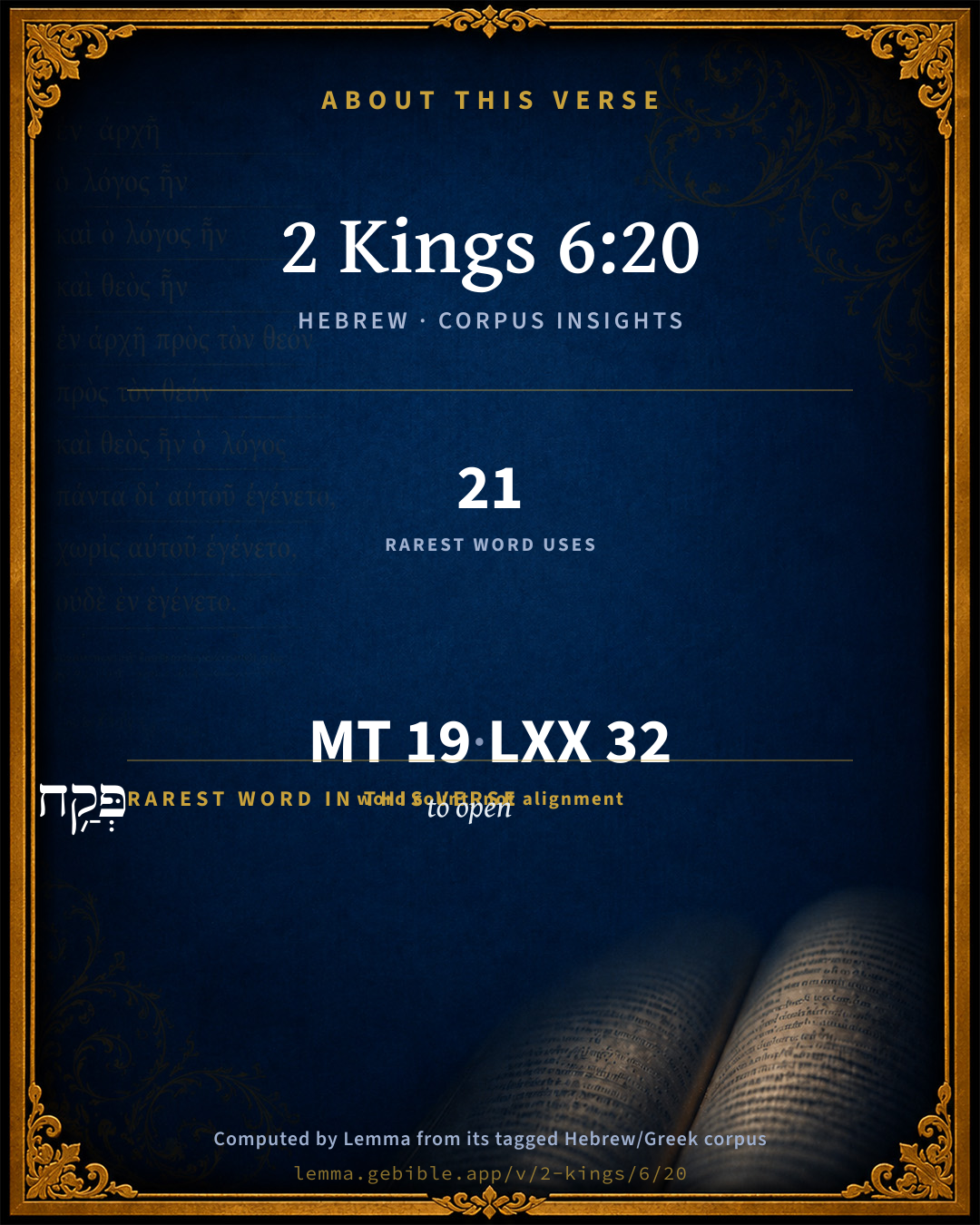
The rarest word here is פְּקַ֥ח to open H6491 — appearing just 21 times in the whole Hebrew Bible.

Shared distinctive vocabulary

פְּקַ֥ח to open H6491 occurs in 18 verses of the Hebrew Bible. Also found in:

Grammatical profile

  • 7 verbs
  • 8 nouns
  • 1 pronoun
  • 3 particles

Verb forms

  • וַיְהִי֮ Qal · Sequential Imperfect
  • כְּבֹאָ֣ם Qal · Infinitive Construct
  • וַיֹּ֣אמֶר Qal · Sequential Imperfect
  • פְּקַ֥ח Qal · Imperative
  • וְיִרְא֑וּ Qal · Jussive
  • וַיִּפְקַ֤ח Qal · Sequential Imperfect
  • וַיִּרְא֕וּ Qal · Sequential Imperfect

Repetition

Words recur within this verse — often emphatic in Hebrew:

  • שֹׁמְרוֹן֒ Samaria H8111 ×2
  • יְהוָ֕ה LORD H3068 ×2
  • פְּקַ֥ח to open H6491 ×2
  • עֵינֵֽי eye H5869 ×2
  • וְיִרְא֑וּ to see H7200 ×2

Hebrew & Septuagint length

In English translation the verse runs 38 words from the Hebrew and 43 from the Septuagint (LXX English) — closely comparable.

A rough comparison of the two English renderings, which tokenize alike — not a word-level alignment.

Word counts can differ between the Hebrew and the Greek without any difference in meaning — e.g. the Hebrew direct-object marker אֵת has no separate Greek word, and Greek often adds the article ὁ.

In the original languages it is 19 Hebrew tokens and 32 Greek tokens — but the two are counted differently (Hebrew bundles its prefixes and suffixes into one token; the Greek is in lemma form), so that isn’t a like-for-like length.

Cross-references

4

Topical passages linked to 2 Kings 6:20 in the Treasury of Scripture Knowledge — connected by theme and wording, ordered by reader-vote popularity; previews shown in the World English Bible.

  • 2 Kings 6:17 Elisha prayed, and said, Yahweh, Please open his eyes, that he may see. Yahweh opened the eyes of the young man; and he saw: and, behold, the mountain was full of horses and chariots of fire round about Elisha.
  • Judges 20:40–42 But when the cloud began to arise up out of the city in a pillar of smoke, the Benjamites looked behind them; and, behold, the whole of the city went up in smoke to the sky.
  • Luke 16:23 In Hades, he lifted up his eyes, being in torment, and saw Abraham far off, and Lazarus at his bosom.
  • Luke 24:31 Their eyes were opened, and they recognized him, and he vanished out of their sight.

Cross-references courtesy of OpenBible.info (CC BY 4.0).

Hebrew and Greek witnesses Masoretic Hebrew ↔ Greek Septuagint

The same verse in the two great witnesses to the Old Testament, shown verse-for-verse.

These are two independent witnesses, not word-aligned to each other, and the Septuagint is shown in lemma (dictionary) form.

Hebrew 2 Kings 6:20 Masoretic · Westminster Leningrad Codex

וַיְהִי֮ כְּבֹאָ֣ם שֹׁמְרוֹן֒ וַיֹּ֣אמֶר אֱלִישָׁ֔ע יְהוָ֕ה פְּקַ֥ח אֶת עֵינֵֽי אֵ֖לֶּה וְיִרְא֑וּ וַיִּפְקַ֤ח יְהוָה֙ אֶת עֵ֣ינֵיהֶ֔ם וַיִּרְא֕וּ וְהִנֵּ֖ה בְּת֥וֹךְ שֹׁמְרֽוֹן

It happened, when they were come into Samaria, that Elisha said, Yahweh, open the eyes of these men, that they may see. Yahweh opened their eyes, and they saw; and, behold, they were in the midst of Samaria.

World English Bible · Public Domain

Greek LXX 2 Kings 6:20 Septuagint · lemma form

καί γίγνομαι ὡς εἰςἔρχομαι εἰς σαμαρεία καί εἶπον ελισαιε ἀναοἴγω δή κύριος ὁ ὀφθαλμός αὐτός καί ὁράω καί δια ἀναοἴγω κύριος ὁ ὀφθαλμός αὐτός καί ὁράω καί ἰδού εἰμί ἐν μέσος σαμαρεία

And it came to pass when they entered into Samaria, that Elisaie said, Open, I pray you, O Lord, their eyes, and let them see. And the Lord opened their eyes, and they saw; and, behold, they were in the midst of Samaria.

LXX2012 (modern English Septuagint) · Public Domain

Hebrew: Westminster Leningrad Codex (CC BY 4.0). Greek: Septuagint (public domain); English from LXX2012 (modern English Septuagint) (Public Domain). How the Septuagint differs from the Hebrew →

Targum (Aramaic paraphrase)

1

The Targum is the ancient Jewish Aramaic paraphrase of the Hebrew Scriptures — an interpretive translation, not the Hebrew text itself. Onkelos (literal) and Pseudo-Jonathan (expansive) render the Torah, and Jonathan the Prophets. Coverage is partial: where no permissively-licensed English translation exists for a verse, only the Aramaic is shown. This is verse-level text, not a word-by-word alignment to the Hebrew.

  1. Targum Jonathan Prophets (Joshua–Malachi)
    וַהֲוָה כְּמֵיעַלְהוֹן לְשֹׁמְרוֹן וַאֲמַר אֱלִישָׁע יְיָ גְלֵי יַת עֵינֵי אִלֵין וְיֶחֱזוּן וּגְלָא יְיָ יַת עֵינֵיהוֹן וַחֲזוֹ וְהָא בְּגוֹ שֹׁמְרוֹן:

    (no public-domain English translation for this verse)

    Targum Jonathan — Aramaic: “Mikraot Gedolot” (public domain). English: “Sefaria Community Translation” (CC0 1.0 (public-domain dedication)); “London "Chaldee Paraphrase," 1871” (public domain). Text via Sefaria.

Commentary

Notes on 2 Kings 6:20 from classic Christian and Jewish commentators (each source and its license shown beneath its notes). The classic Christian expositions comment on the surrounding passage and are grouped to its opening verse, so a note may address several verses; the Jewish commentaries on the Tanakh (Rashi and others) are per-verse, so they appear only where the commentator wrote on this verse.

Lemma curates 59 commentaries, every one of them public domain or Creative Commons licensed, each selected and text-cleaned for this edition rather than reprinted as found. About our sources →

Trapp's Complete Commentary

John Trapp

2Ki 6:20 And it came to pass, when they were come into Samaria, that Elisha said, LORD, open the eyes of these [men], that they may see. And the LORD opened their eyes, and they saw; and, behold, [they were] in the midst of Samaria.

Ver. 20. They were in the midst of Samaria.] Where they were "almost in all evil in the midst of the congregation and assembly," as he saith in Pro 5:14. See Ecc 9:12.

John Trapp, A Commentary or Exposition upon All the Books of the Old and New Testament (1647–1656) — public domain. Text from a community e-Sword module.

Joseph Benson's Commentary

2Ki 6:20. The Lord opened their eyes, and behold, they were in the midst of Samaria — To their great astonishment and terror, no doubt, there being a standing force there sufficient to cut them all off, or make them prisoners of war. Thus when God has opened the eyes of those whom Satan had blinded, and deluded to their ruin, they see themselves in the midst of their enemies, captives to Satan, and in danger of hell, although before they thought their condition good. And thus, when the enemies of God and his church, like this Syrian host encompassing Elijah and Dothan, fancy themselves ready to triumph, they will, to their amazement and confusion, find themselves conquered and triumphed over.

Joseph Benson's Commentary on the Old and New Testaments (1811–1818) — public domain. Text from a community e-Sword module.

Adam Clarke's Commentary

Verse 20. Open the eyes of these men] Take away their confusion of vision, that they may discern things as they are, and distinguish where they are.

Adam Clarke's Commentary on the Bible (1810–1826) — public domain. Text from a community e-Sword/MySword module.

Ellicott's Commentary for English Readers

(20) Behold, they were in the midst of Samaria.—Michaelis wonders how such a host could be led into the city without putting themselves on their guard. He overlooks the supernatural bewilderment which had fallen upon them. When their eyes were opened, and they realised their whereabouts, dismay and astonishment would paralyse their energies.

A Bible Commentary for English Readers, edited by Charles John Ellicott (1878–1897) — public domain. Text from a community e-Sword module.

The Cambridge Bible for Schools and Colleges

gen. ed. J. J. S. Perowne

20. open the eyes of these men] i.e. give them again the true perception of what is round about them. The prayer has been twice used by Elisha in this narrative, but for two different kinds of illumination. His servant was enabled to look beyond material surroundings and to recognise that there is a spiritual world in close proximity to the natural, that God and His ministers are not far from every one of us. To these Syrian soldiers natural sight was restored, after their eyes had been for a time holden (cf. Luk_24:16) that they might be brought into the power of the king of Israel. God has brought the enemy of His prophet into a snare.

behold, they were in the midst of Samaria] Apparently, as Josephus says, brought where the king of Israel, with his troops, might fall upon them, and slay them, had it been permitted. At once they would see that they were prisoners, instead of making a prisoner; and their minds would be as full of the expectation of death, as Jehoram’s was of eagerness to kill them.

The Cambridge Bible for Schools and Colleges (gen. ed. J. J. S. Perowne; Cambridge University Press, 1878–1918) — public domain. Text from a community e-Sword module.

John Gill's Exposition

And he answered, thou shalt not smite them,.... For they were not his, but the prophet's captives, or rather the Lord's:

wouldest thou smite those whom thou hast taken captive with thy sword and with thy bow? when soldiers are made prisoners of war, it is contrary to humanity, to the laws of nature and nations, to kill them in cold blood, and much more those who were taken not by his sword and bow, but by the power and providence of God:

set bread and water before them, that they may eat and drink, and go to their master; the king of Syria, and report the miracles wrought, and the good usage they met with, when in the hand of an enemy, fed and let go; which would be more to the glory of the God of Israel, and more agreeable to the character of a king of Israel, reckoned merciful, and more serviceable to the civil good of the land of Israel, as well as more to the honour of the prophet and true religion, see Rom 12:20.

John Gill's Exposition of the Whole Bible (1746–1763) — public domain (CC PDM 1.0). Text via the HelloAO Bible API.

Whedon's Commentary on the Bible

Daniel D. Whedon

20. The Lord opened their eyes — To them, long blinded and groping in darkness, and led through an enemy’s country they knew not whither, it was a relief to see once more.

Daniel D. Whedon (gen. ed.), Commentary on the Old and New Testaments (1874–1909) — public domain. Text from a community e-Sword module.

The Pulpit Commentary

And it came to pass, when they were come into Samaria, that Elisha said, Lord, open the eyes of these men, that they may see. And the Lord opened their eyes, and they saw; and, behold, they were in the midst of Samaria. Their delusion was disputed they returned to their proper senses, and, seeing the size and strength of the town, recognized the fact that they were in Samaria, their enemy"s capital, and so were helpless.

The Pulpit Commentary (1880–1919), ed. H.D.M. Spence-Jones & Joseph S. Exell — public domain. Text from a community e-Sword module.

unfoldingWord translationNotes

Door43 World Missions Community

It came about that

"It happened that" or "Then,"

open the eyes of these men that they may see

Elisha is asking Yahweh to cause the men to see clearly again. AT: "allow these men to see" (See: Idiom)

Yahweh opened their eyes and they saw

Yahweh allowed the men to see clearly again. AT: "Yahweh took away their blindness" or "Yahweh allowed them to see clearly" (See: Idiom)

behold

The word "behold" here shows that the Arameans were surprised by what they saw.

when he saw them

"when he saw the Aramean soldiers"

My father

The king is speaking to Elisha the prophet and calling him "father" to show respect.

should I kill them? Should I kill them?

Here the king of Israel is referring to his army as himself. AT: "Should I order my army to kill these enemy soldiers?" (See: Metonymy)

translationWords

Elisha

unfoldingWord translationNotes — © Distant Shores Media and the Door43 World Missions Community, licensed CC BY-SA 4.0. Source: git.door43.org/Door43/en_tn.

Lesson kit

Teaching starters — assembled from the data on this page, not authored interpretation. Every prompt links to the verse data it draws on. Edit before teaching.

2 Kings, in the Historical, opens this verse with 19 words (13 distinct Hebrew lemmas). Its most distinctive word is pâqach (“to open”). A historical commentator’s framing appears above. Read the whole chapter for the surrounding context.

Discussion questions

  1. How does “to open” (pâqach) shape what this verse is saying?
  2. Genesis 3:5 shares the word «to open» with this verse. How do the two illuminate each other?
  3. “Samaria” occurs 2× in this one verse. What is the effect of the repetition?
  4. The translations on this page render this verse differently — a whole-verse word diff, not a word-by-word alignment. What might account for the different wordings?
  5. The verb «וַיְהִי֮» is Qal Sequential Imperfect. How does its form color the action?
  6. Reading how Trapp's Complete Commentary and Joseph Benson's Commentary read this verse, where do the two commentators agree and where do they part?

Things to notice

Reading settings

Reading text

Shown beneath each verse's original-language words.

Old Testament
Old Testament edition

Read the OT as the Masoretic Hebrew (MT) or the Greek Septuagint (LXX).

English shown for the Greek Septuagint (in the Hebrew ↔ Greek comparison).

Comparing translations? Open the Compare panel on any verse page to stack up to four side by side.