Exodus 14:16

Hebrew (Westminster Leningrad Codex) Exodus 14:16 appears in the Hebrew Old Testament. The text above is from the Westminster Leningrad Codex. Each word links to its Strong’s number, a concise gloss, and parsing drawn from the Open Scriptures Hebrew Bible morphology. Click any word for its full Brown-Driver-Briggs (BDB) entry.
Download image
Cite this verse

Exodus 14:16 (World English Bible). Public Domain. Lemma interlinear Bible study tool, https://lemma.gebible.app/v/exodus/14/16.

Show BibTeX & RIS
BibTeX
RIS
English Translation
Lift up your rod, and stretch out your hand over the sea, and divide it: and the children of Israel shall go into the midst of the sea on dry ground.
World English Bible · Public Domain
Download a study sheet

One document with this verse’s original text, its word-by-word gloss line, the meaning frame, cross-references with their text, attributed commentary, and full source and license credits — printable, and it pastes into notes with its structure intact.

This verse Autodidact and up

Study sheet (.html) Plain text (.txt)

A passage Seminary Student

Up to 50 verses in one chapter. A passage sheet keeps up to 6 commentary sources and 12 cross-references per verse, in the order this page ranks them, and says so on the sheet whenever that leaves anything out. Ask for a single verse and you get the Autodidact verse sheet above.

Everything on this page stays free to read, with no account — the sheet is a download of what is already on screen, not access to it.

Want to remove ads? Support Godless Engineer
Compare translations 3

The same verse in 3 English versions, stacked beneath the original-language interlinear above. Click any original word for its lexicon entry.

Each is an independent rendering of the whole verse — the interlinear is not word-aligned to these translations.

Highlighted words mark where these versions differ — a whole-verse word diff, not a word-by-word alignment.

  • World English Bible Public Domain
    Lift up your rod, and stretch out your hand over the sea, and divide it: and the children of Israel shall go into the midst of the sea on dry ground.
  • King James Version Public Domain
    But lift thou up thy rod, and stretch out thine hand over the sea, and divide it: and the children of Israel shall go on dry ground through the midst of the sea.
  • unfoldingWord Literal Text CC BY-SA 4.0
    As for you, raise your staff and reach out your hand over the sea and split it. And the sons of Israel will enter into the midst of the sea on dry ground.

unfoldingWord Literal Text — © unfoldingWord, licensed CC BY-SA 4.0. Word-aligned USFM3 via Door43 (git.door43.org/unfoldingWord/en_ult).

Versions to compare (up to 4)

3 of 4 selected

Show all 18 translations

Every available English version of this verse, each an independent rendering of the whole verse.

  • World English Bible Public Domain
    Lift up your rod, and stretch out your hand over the sea, and divide it: and the children of Israel shall go into the midst of the sea on dry ground.
  • Berean Standard Bible Public Domain
    And as for you, lift up your staff and stretch out your hand over the sea and divide it, so that the Israelites can go through the sea on dry ground.
  • Majority Standard Bible Public Domain
    And as for you, lift up your staff and stretch out your hand over the sea and divide it, so that the Israelites can go through the sea on dry ground.
  • King James Version Public Domain
    But lift thou up thy rod, and stretch out thine hand over the sea, and divide it: and the children of Israel shall go on dry ground through the midst of the sea.
  • American Standard Version (1901) Public Domain
    And lift thou up thy rod, and stretch out thy hand over the sea, and divide it: and the children of Israel shall go into the midst of the sea on dry ground.
  • Revised Version (1885) Public Domain
    And lift thou up thy rod, and stretch out thine hand over the sea, and divide it: and the children of Israel shall go into the midst of the sea on dry ground.
  • Geneva Bible (1599) Public Domain
    And lift thou vp thy rod, and stretche out thine hand vpon the Sea and deuide it, and let the children of Israel goe on drie ground thorow the middes of the Sea.
  • Douay-Rheims (1899) Public Domain
    But lift thou up thy rod, and stretch forth thy hand over the sea, and divide it: that the children of Israel may go through the midst of the sea on dry ground.
  • Young's Literal Translation Public Domain
    and thou, lift up thy rod, and stretch out thy hand towards the sea, and cleave it, and the sons of Israel go into the midst of the sea on dry land.
  • Literal Standard Version CC BY-SA 4.0
    and you, lift up your rod, and stretch out your hand toward the sea, and cleave it, and the sons of Israel go into the midst of the sea on dry land.
  • Unlocked Literal Bible CC BY-SA 4.0
    Lift up your staff, reach out with your hand over the sea and divide it in two, so that the people of Israel may go through the sea on dry ground.
  • unfoldingWord Literal Text CC BY-SA 4.0
    As for you, raise your staff and reach out your hand over the sea and split it. And the sons of Israel will enter into the midst of the sea on dry ground.
  • Darby Bible Public Domain
    And thou, lift thy staff, and stretch out thy hand over the sea, and divide it; and the children of Israel shall go on dry [ground] through the midst of the sea.
  • World Messianic Bible Public Domain
    Lift up your rod, and stretch out your hand over the sea and divide it. Then the children of Israel shall go into the middle of the sea on dry ground.
  • Webster's Bible Public Domain
    But lift thou thy rod, and stretch out thy hand over the sea, and divide it; and the children of Israel shall go on dry ground through the midst of the sea.
  • Free Bible Version CC BY-SA 4.0
    You are to pick up your walking stick and hold it out in your hand over the sea. Divide it so the Israelites can walk through the sea on dry ground.
  • Bible in Basic English Public Domain
    And let your rod be lifted up and your hand stretched out over the sea, and it will be parted in two; and the children of Israel will go through on dry land.
  • JPS Tanakh (1917) Public Domain
    And lift thou up thy rod, and stretch out thy hand over the sea, and divide it; and the children of Israel shall go into the midst of the sea on dry ground.

Literal Standard Version (2020), Covenant Press — licensed CC BY-SA 4.0. Text via the HelloAO Bible API (eBible.org). Unlocked Literal Bible (unfoldingWord) — licensed CC BY-SA 4.0. Text via the HelloAO Bible API (eBible.org). unfoldingWord Literal Text — © unfoldingWord, licensed CC BY-SA 4.0. Word-aligned USFM3 via Door43 (git.door43.org/unfoldingWord/en_ult). Free Bible Version, Dr. Jonathan Gallagher — licensed CC BY-SA 4.0. Text via the HelloAO Bible API (eBible.org).

Word by word

More ways to search: Search by grammar → Find every occurrence → Compare this word →

Practice this passage: Drill this verse → Learn its vocabulary →

בַּיַּבָּשָֽׁה
yabbâshâh
H3004
“in/at the · dry land”
Preposition, Determined + Noun, Common, Feminine, Singular, Absolute
Part of Speech
Preposition + Noun
Type
Common
Gender
Feminine
Number
Singular
State
Absolute
Full BDB Definition

Origin: from H3001

TWOT: 837b

dry land, dry ground
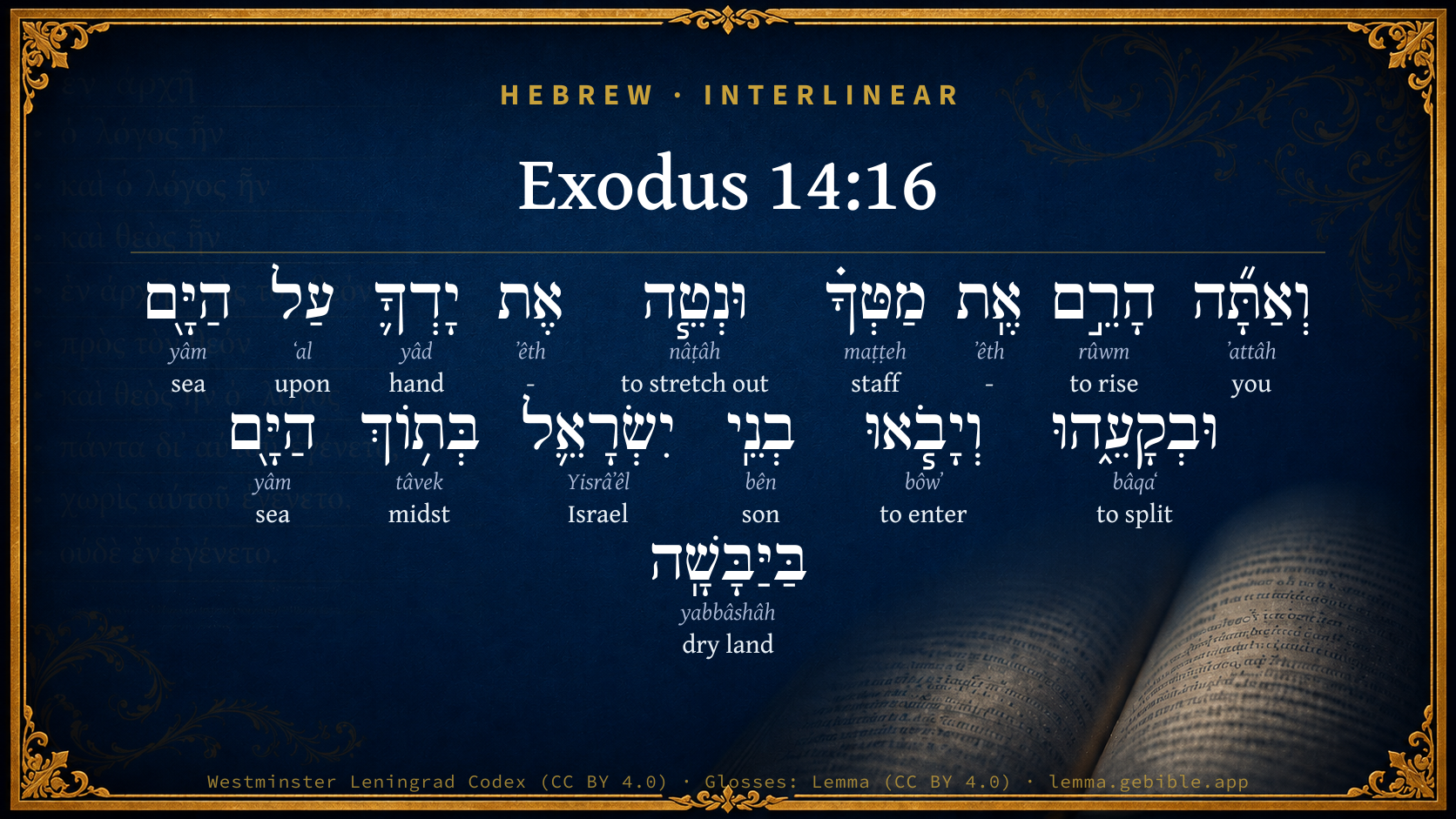
  1. וְאַתָּ֞ה ʼattâh H859 “and · you” Conjunction + Pronoun, Personal, 2nd Person, Masculine, Singular
  2. הָרֵ֣ם rûwm H7311 “rise” Verb, Hiphil, Imperative, 2nd Person, Masculine, Singular
  3. אֶֽת ʼêth H853 “-” Particle, Direct Object
  4. מַטְּךָ֗ maṭṭeh H4294 “staff · your” Noun, Common, Masculine, Singular, Construct + Suffix, Personal, 2nd Person, Masculine, Singular
  5. וּנְטֵ֧ה nâṭâh H5186 “and · stretch out” Conjunction + Verb, Qal, Imperative, 2nd Person, Masculine, Singular
  6. אֶת ʼêth H853 “-” Particle, Direct Object
  7. יָדְךָ֛ yâd H3027 “hand · your” Noun, Common, Both, Singular, Construct + Suffix, Personal, 2nd Person, Masculine, Singular
  8. עַל ʻal H5921 “upon” Preposition
  9. הַיָּ֖ם yâm H3220 “the · sea” Particle, Definite Article + Noun, Common, Masculine, Singular, Absolute
  10. וּבְקָעֵ֑הוּ bâqaʻ H1234 “and · split · him” Conjunction + Verb, Qal, Imperative, 2nd Person, Masculine, Singular + Suffix, Personal, 3rd Person, Masculine, Singular
  11. וְיָבֹ֧אוּ bôwʼ H935 “and · to enter” Conjunction + Verb, Qal, Imperfect, 3rd Person, Masculine, Plural
  12. בְנֵֽי bên H1121 “sons of” Noun, Common, Masculine, Plural, Construct
  13. יִשְׂרָאֵ֛ל Yisrâʼêl H3478 “Israel” Noun, Proper
  14. בְּת֥וֹךְ tâvek H8432 “in/at · midst of” Preposition + Noun, Common, Masculine, Singular, Construct
  15. הַיָּ֖ם yâm H3220 “the · sea” Particle, Definite Article + Noun, Common, Masculine, Singular, Absolute

About this verse

These counts appear in no published source. They are computed here, from the morphology-tagged text and Lemma’s own curated glosses. What Lemma adds →

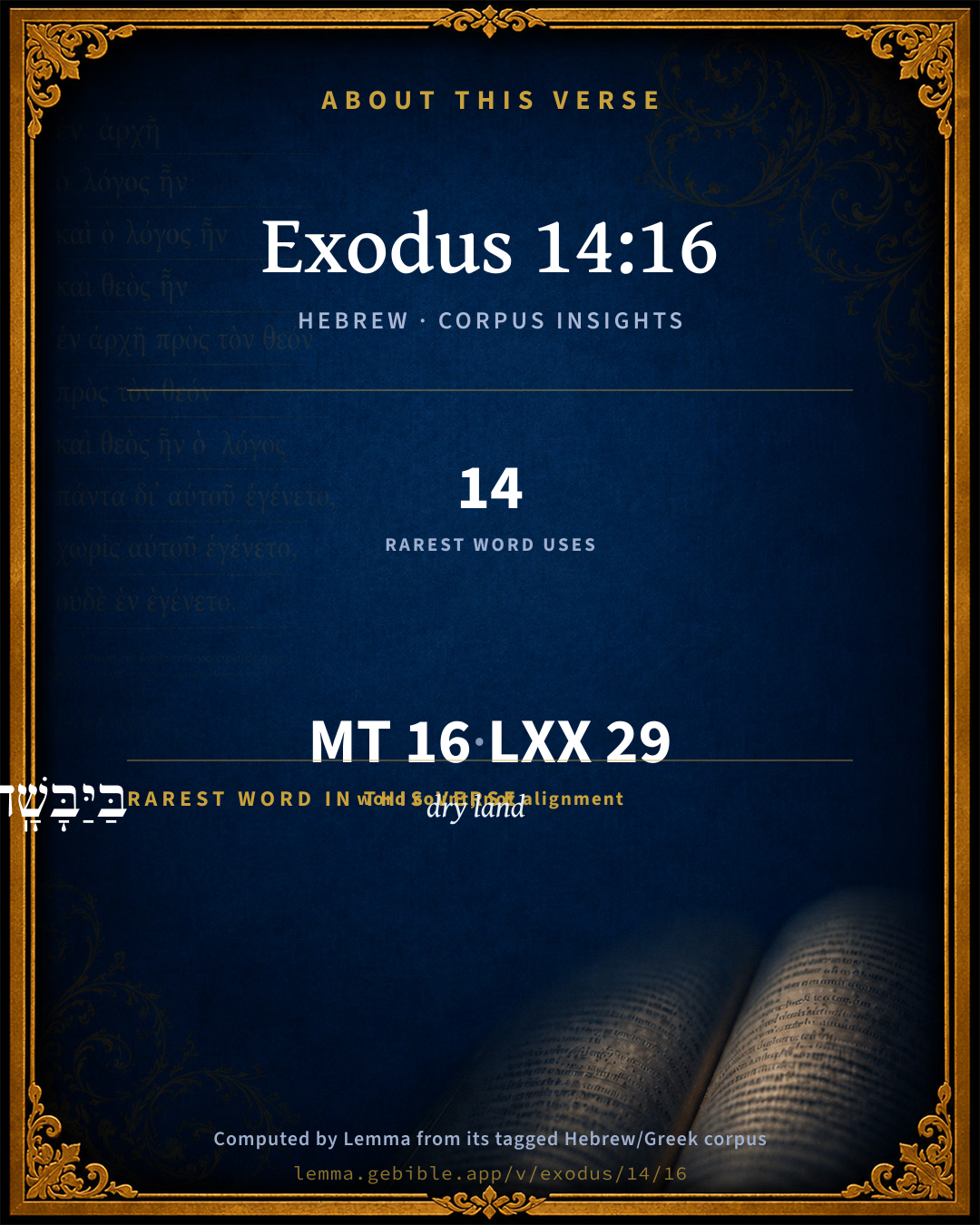
16
words
14
distinct lemmas
Pentateuch
section

Notable vocabulary

The rarest word here is בַּיַּבָּשָֽׁה dry land H3004 — appearing just 14 times in the whole Hebrew Bible.

Shared distinctive vocabulary

בַּיַּבָּשָֽׁה dry land H3004 occurs in 14 verses of the Hebrew Bible. Also found in:

Grammatical profile

  • 4 verbs
  • 8 nouns
  • 1 pronoun
  • 1 preposition
  • 2 particles

Verb forms

  • הָרֵ֣ם Hiphil · Imperative
  • וּנְטֵ֧ה Qal · Imperative
  • וּבְקָעֵ֑הוּ Qal · Imperative
  • וְיָבֹ֧אוּ Qal · Imperfect

Repetition

A word recurs within this verse — often emphatic in Hebrew:

  • הַיָּ֖ם sea H3220 ×2

Hebrew & Septuagint length

In English translation the verse runs 31 words from the Hebrew and 35 from the Septuagint (LXX English) — closely comparable.

A rough comparison of the two English renderings, which tokenize alike — not a word-level alignment.

Word counts can differ between the Hebrew and the Greek without any difference in meaning — e.g. the Hebrew direct-object marker אֵת has no separate Greek word, and Greek often adds the article ὁ.

In the original languages it is 16 Hebrew tokens and 29 Greek tokens — but the two are counted differently (Hebrew bundles its prefixes and suffixes into one token; the Greek is in lemma form), so that isn’t a like-for-like length.

Cross-references

10

Topical passages linked to Exodus 14:16 in the Treasury of Scripture Knowledge — connected by theme and wording, ordered by reader-vote popularity; previews shown in the World English Bible.

  • Exodus 7:19 Yahweh said to Moses, "Tell Aaron, 'Take your rod, and stretch out your hand over the waters of Egypt, over their rivers, over their streams, and over their pools, and over all their ponds of water, that they may become blood; and there shall be blood throughout all the land of Egypt, both in vessels of wood and in vessels of stone.'"
  • Exodus 4:2 Yahweh said to him, "What is that in your hand?" He said, "A rod."
  • Exodus 4:17 You shall take this rod in your hand, with which you shall do the signs."
  • Exodus 4:20 Moses took his wife and his sons, and set them on a donkey, and he returned to the land of Egypt. Moses took God's rod in his hand.
  • Exodus 7:9 "When Pharaoh speaks to you, saying, 'Perform a miracle!' then you shall tell Aaron, 'Take your rod, and cast it down before Pharaoh, that it become a serpent.'"
  • Exodus 14:26 Yahweh said to Moses, "Stretch out your hand over the sea, that the waters may come again on the Egyptians, on their chariots, and on their horsemen."
  • Isaiah 10:26 Yahweh of Hosts will stir up against him a scourge, as in the slaughter of Midian at the rock of Oreb: and his rod will be over the sea, and he will lift it up after the manner of Egypt.
  • Exodus 14:21–22 Moses stretched out his hand over the sea, and Yahweh caused the sea to go back by a strong east wind all the night, and made the sea dry land, and the waters were divided.
  • Numbers 20:8–9 Take the rod, and assemble the congregation, you, and Aaron your brother, and speak you to the rock before their eyes, that it give forth its water; and you shall bring forth to them water out of the rock; so you shall give the congregation and their cattle drink.
  • Numbers 20:11 Moses lifted up his hand, and struck the rock with his rod twice: and water came forth abundantly, and the congregation drank, and their cattle.

Cross-references courtesy of OpenBible.info (CC BY 4.0).

Hebrew and Greek witnesses Masoretic Hebrew ↔ Greek Septuagint

The same verse in the two great witnesses to the Old Testament, shown verse-for-verse.

These are two independent witnesses, not word-aligned to each other, and the Septuagint is shown in lemma (dictionary) form.

Hebrew Exodus 14:16 Masoretic · Westminster Leningrad Codex

וְאַתָּ֞ה הָרֵ֣ם אֶֽת מַטְּךָ֗ וּנְטֵ֧ה אֶת יָדְךָ֛ עַל הַיָּ֖ם וּבְקָעֵ֑הוּ וְיָבֹ֧אוּ בְנֵֽי יִשְׂרָאֵ֛ל בְּת֥וֹךְ הַיָּ֖ם בַּיַּבָּשָֽׁה

Lift up your rod, and stretch out your hand over the sea, and divide it: and the children of Israel shall go into the midst of the sea on dry ground.

World English Bible · Public Domain

Greek LXX Exodus 14:16 Septuagint · lemma form

καί σύ ἐπιαἴρω ὁ ῥάβδος σύ καί ἐκτείνω ὁ χείρ σύ ἐπί ὁ θάλασσα καί ῥήγνυμι αὐτός καί εἰςἔρχομαι ὁ υἱός ἰσραήλ εἰς μέσος ὁ θάλασσα κατά ὁ ξηρός

And do you lift up your rod, and stretch forth your hand over the sea, and divide it, and let the children of Israel enter into the midst of the sea on the dry land.

LXX2012 (modern English Septuagint) · Public Domain

Hebrew: Westminster Leningrad Codex (CC BY 4.0). Greek: Septuagint (public domain); English from LXX2012 (modern English Septuagint) (Public Domain). How the Septuagint differs from the Hebrew →

Targum (Aramaic paraphrase)

2

The Targum is the ancient Jewish Aramaic paraphrase of the Hebrew Scriptures — an interpretive translation, not the Hebrew text itself. Onkelos (literal) and Pseudo-Jonathan (expansive) render the Torah, and Jonathan the Prophets. Coverage is partial: where no permissively-licensed English translation exists for a verse, only the Aramaic is shown. This is verse-level text, not a word-by-word alignment to the Hebrew.

  1. Targum Onkelos Torah (Genesis–Deuteronomy)
    וְאַתְּ טוֹל יָת חֻטְרָךְ וַאֲרֵים יָת יְדָךְ עַל יַמָא וּבְזָעוֹהִי וְיֵעֲלוּן בְּנֵי יִשְׂרָאֵל בְּגוֹ יַמָא בְּיַבֶּשְׁתָּא:

    (no public-domain English translation for this verse)

    Targum Onkelos — Aramaic: “Onkelos Genesis” (public domain); “Onkelos Exodus” (public domain); “Onkelos Leviticus” (public domain); “Onkelos Numbers” (public domain); “Onkelos Deuteronomy” (public domain). English: “Sefaria Community Translation” (CC0 1.0 (public-domain dedication)); “J.W. Etheridge. The Targums of Onkelos and Jonathan Ben Uzziel on the Pentateuch. London: Longmans, Green, 1862” (public domain). Text via Sefaria.

  2. Targum Pseudo-Jonathan Torah (Genesis–Deuteronomy)
    וְאַנְתְּ אֲרוּם יַת חוּטְרָךְ וְאַרְכִין יַת יְדָךְ בֵּיהּ עַל יַמָא וּבַזְעֵיהּ וְעָלוּן בְּנֵי יִשְרָאֵל בְּגוֹ יַמָּא בְּיַבֶּשְׁתָּא

    and thou, lift up thy rod, and stretch forth thy hand with it over the sea, and divide it: and the sons of Israel shall go through the midst of the sea upon the ground.

    Targum Pseudo-Jonathan — Aramaic: “Targum Jonathan on Genesis” (public domain); “Targum Jonathan on Exodus” (public domain); “Targum Jonathan on Leviticus” (public domain); “Targum Jonathan on Numbers” (public domain); “Targum Jonathan on Deuteronomy” (public domain). English: “The Targum of Jonathan ben Uzziel, trans. J. W. Etheridge, London, 1862” (public domain). Text via Sefaria.

Commentary

Notes on Exodus 14:16 from classic Christian and Jewish commentators (each source and its license shown beneath its notes). The classic Christian expositions comment on the surrounding passage and are grouped to its opening verse, so a note may address several verses; the Jewish commentaries on the Tanakh (Rashi and others) are per-verse, so they appear only where the commentator wrote on this verse.

Lemma curates 59 commentaries, every one of them public domain or Creative Commons licensed, each selected and text-cleaned for this edition rather than reprinted as found. About our sources →

Trapp's Complete Commentary

John Trapp

Exo 14:16 But lift thou up thy rod, and stretch out thine hand over the sea, and divide it: and the children of Israel shall go on dry [ground] through the midst of the sea.

Ver. 16. But lift thou up thy rod.] This rod God makes use of, fo: the greater manifestation of his own power, and the gracing of his servant Moses.

John Trapp, A Commentary or Exposition upon All the Books of the Old and New Testament (1647–1656) — public domain. Text from a community e-Sword module.

The Biblical Illustrator

Joseph S. Exell

Exo_14:16

Through the midst of the sea.

The Red Sea

I. Gods deliverance of Israel.

II. Judgment on Gods enemies, as well as a deliverance of His friends.

III. Gods separation of Israel for his service.

IV. The unity of Gods redeemed ones. (E. N. Packard.)

The Red Sea

I. Protection at the Red Sea.

1. The nature of the protection.

2. The all-sufficiency of the protection.

II. Deliverance through the Red Sea.

1. Its means, A blending of the human and the Divine.

2. Its method.

(1) Obedience a condition of deliverance.

(2) Nothing can harm the obedient soul (Exo_14:29).

III. The enemy destroyed in the Red Sea.

1. The superinducing cause. The daring persistency of Pharaoh brought him and his hosts into danger. So even with sinners. Thou hast destroyed thyself.

2. God left Pharaoh and his hosts to themselves in the peril.

3. God caused the waters to return to their normal state.

(1) If we stand in the way of danger, we have no one to blame but ourselves for the consequences.

(2) Every sinner places himself in the way of peril.

Lessons:

1. Pharaoh undertook what no one has ever succeeded in--to fight against God.

2. Moses placed himself and Israel in a relation to God, in which no one has ever failed. (D. C. Hughes, M. A.)

The passage of the Red Sea

1. Israel leaves Egypt for the purpose of proceeding to Canaan, the promised land. A figure of an awakened soul, drawn to God, which takes the firm and noble resolution to renounce all sin, and serve God, seeking first the kingdom of God and His righteousness.

2. The fiery and cloudy pillar is the secret but powerful attraction of the Father to the Son, which the soul follows, and by which it is faithfully and correctly guided. Here the individual is brought to the salutary means of grace, or they to him, in such a manner that he is afterwards obliged to confess, that if a single, and often inconsiderable, circumstance of his life had been otherwise, his whole course would have assumed another form.

3. The pursuing Pharaoh is a figure of the law in its strict and insatiate requirements, as well as of Satan and the powers of darkness. The latter soon perceives when any one is desirous of escaping from him, and consequently opposes him in every way. Some he torments with blasphemous, others with unbelieving thoughts, etc.

4. The utterly helpless condition of the children of Israel represents the oppressive weakness felt by the awakened soul.

5. But the Red Sea, which threatened destruction to the Israelites, proved of the greatest benefit to them. And this very feeling of sin, misery, and inability, which causes an awakened person so much uneasiness, turns to his greatest advantage. For it serves, like the blindness of the man born blind, and the death of Lazarus, to promote the Divine glory that Christ may be honoured by it.

6. The way by which Israel was delivered was one which was most miraculously opened; a way apparently dangerous and terrific, and hidden from the Egyptians. This may be also said of the way by which the Lord leads His people to life. For how wonderful is the way of salvation through the birth, sufferings, death, and resurrection of Christ!

7. A strong east wind arose, and dried the sea; and a rushing, like the sound of a mighty wind, was the signal to the holy apostles of the approach of the Holy Spirit. When He blows upon man, all flesh is as grass, and all the goodliness thereof as the flower of the field. He it is that quickens.

8. The cloud, which overshadowed the people of Israel, protecting them from the pursuing foe, descending upon them as a refreshing dew, and serving by its radiance instead of a lamp, may be regarded as an emblem of the Redeemers blissful mediation between God and man. From it drops a refreshing dew upon the troubled heart, and a healing balm for the wounded conscience, yea, a peace of God which passeth understanding.

9. Lastly, the divided sea is a type of baptism, and consequently of all that which is requisite to purify the soul from sin. The Red Sea of the Redeemers blood is the abyss into which the sins of believers are so deeply plunged, that, if sought for, they can never be found; the sea which swallows up, overwhelms, and drowns Satan, with all his host, and the old man, and quickens in us a new man, who after God is created in righteousness and true holiness. This precious blood of Christ, who offered Himself to God by the Holy Spirit, is that which alone perfectly cleanses our consciences from dead works, to serve the living God. (G. D. Krummacher.)

The Red Sea

Regarding this passage of the Red Sea as typical of some events in the pilgrim-life of every Christian, let us say--

I. We are not delivered at the beginning of the life of faith from all the old enemies of the house of bondage.

II. The hour when old enemies return may reveal the fact that no accumulation of confidence in god has been gained by the experience of past deliverances. To most men the great events of life seem to be disconnected. They bear no relation one to another. If Fremonts Peak and Pikes Peak and the Spanish Peaks stood apart, connected by no mountain-ridge, no great results would come from them upon soil or climate. They would not determine the rain-fall or fix the trend of the rivers. But, linked together by lofty mountain-chains, they become part of the vast water-shed of a continent, fixed the length and course of the rivers and causing the humid atmosphere and fertile soil on one side, the dry air and arid wastes upon the other. So the great facts of Divine Providence, isolated and separate one from another, have no determinative influence over life. But linked together they make its moral atmosphere.

III. Some old enemies of the soul may be utterly destroyed. Evil companionships abandoned, etc.

IV. The providential way of deliverance is often mysterious.

V. Deliverance came to Israel not by human achievement, but by the power of God. The most solemn hours of life are not times of great endeavour and of high achievement. They are times when we are called to Stand still, and see the salvation of the Lord. Such an hour is that when we begin the life of faith, not a time of achievement when, by mental struggle and spiritual travail, we win the favour of God. It is rather the time of self-surrender, when unreservedly we commit our ways to the Lord, that He may work for us, and in us, His redeeming work. (W. G. Sperry.)

The Biblical Illustrator, edited by Joseph S. Exell (c. 1880s–1900s) — public domain. Text from a community e-Sword module.

Adam Clarke's Commentary

Verse 16. Lift thou up thy rod] Neither Moses nor his rod could be any effective instrument in a work which could be accomplished only by the omnipotence of God; but it was necessary that he should appear in it, in order that he might have credit in the sight of the Israelites, and that they might see that God had chosen him to be the instrument of their deliverance.

Adam Clarke's Commentary on the Bible (1810–1826) — public domain. Text from a community e-Sword/MySword module.

The Cambridge Bible for Schools and Colleges

gen. ed. J. J. S. Perowne

16. And thou (emph.), lift up thy rod] For the rod in Moses’ hand, as a mark of E, see on Exo_4:17, and p. 56.

divide] So v. 21. Cf. Isa_63:12, Neh_9:11, Psa_78:13.

The Cambridge Bible for Schools and Colleges (gen. ed. J. J. S. Perowne; Cambridge University Press, 1878–1918) — public domain. Text from a community e-Sword module.

John Gill's Exposition

But lift thou up thy rod, and stretch out thine hand over the sea, and divide it,.... Even the same rod with which so many wonders had been done in Egypt; and Artapanus, the Heathen, says (x), that Moses being bid by a divine voice to smite the sea with his rod, he hearkened to it, and touched the water with it, and so it divided, as it is said it did, Exo 14:21.

and the children of Israel shall go on dry ground through the midst of the sea; and so they did, Exo 14:22.

(x) Apud Euseb. Praepar. Evangel. l. 9. c. 27. p. 436.

John Gill's Exposition of the Whole Bible (1746–1763) — public domain (CC PDM 1.0). Text via the HelloAO Bible API.

Matthew Poole's English Annotations

Divide it, i.e. do thou command it in my name to divide itself hither and thither, and I will divide it.

Matthew Poole's English Annotations on the Holy Bible (1683–1685) — public domain. Text from a community e-Sword/MySword module.

Whedon's Commentary on the Bible

Daniel D. Whedon

16. Lift thou up thy rod… divide it — Prayer is thus said to effect what God effects in answer to prayer when it is inspired by him. The rod was but the symbol of the divine-human power.

Daniel D. Whedon (gen. ed.), Commentary on the Old and New Testaments (1874–1909) — public domain. Text from a community e-Sword module.

Lesson kit

Teaching starters — assembled from the data on this page, not authored interpretation. Every prompt links to the verse data it draws on. Edit before teaching.

Exodus, in the Pentateuch, opens this verse with 16 words (14 distinct Hebrew lemmas). Its most distinctive word is yabbâshâh (“dry land”). A historical commentator’s framing appears above. Read the whole chapter for the surrounding context.

Discussion questions

  1. How does “dry land” (yabbâshâh) shape what this verse is saying?
  2. Genesis 1:9 shares the word «dry land» with this verse. How do the two illuminate each other?
  3. “sea” occurs 2× in this one verse. What is the effect of the repetition?
  4. These translations render this verse differently; the difference is in the English rendering, not the original. What questions does that raise?
  5. The verb «הָרֵ֣ם» is Hiphil Imperative. How does its form color the action?
  6. Reading how Trapp's Complete Commentary and The Biblical Illustrator read this verse, where do the two commentators agree and where do they part?

Things to notice

Reading settings

Reading text

Shown beneath each verse's original-language words.

Old Testament
Old Testament edition

Read the OT as the Masoretic Hebrew (MT) or the Greek Septuagint (LXX).

English shown for the Greek Septuagint (in the Hebrew ↔ Greek comparison).

Comparing translations? Open the Compare panel on any verse page to stack up to four side by side.