
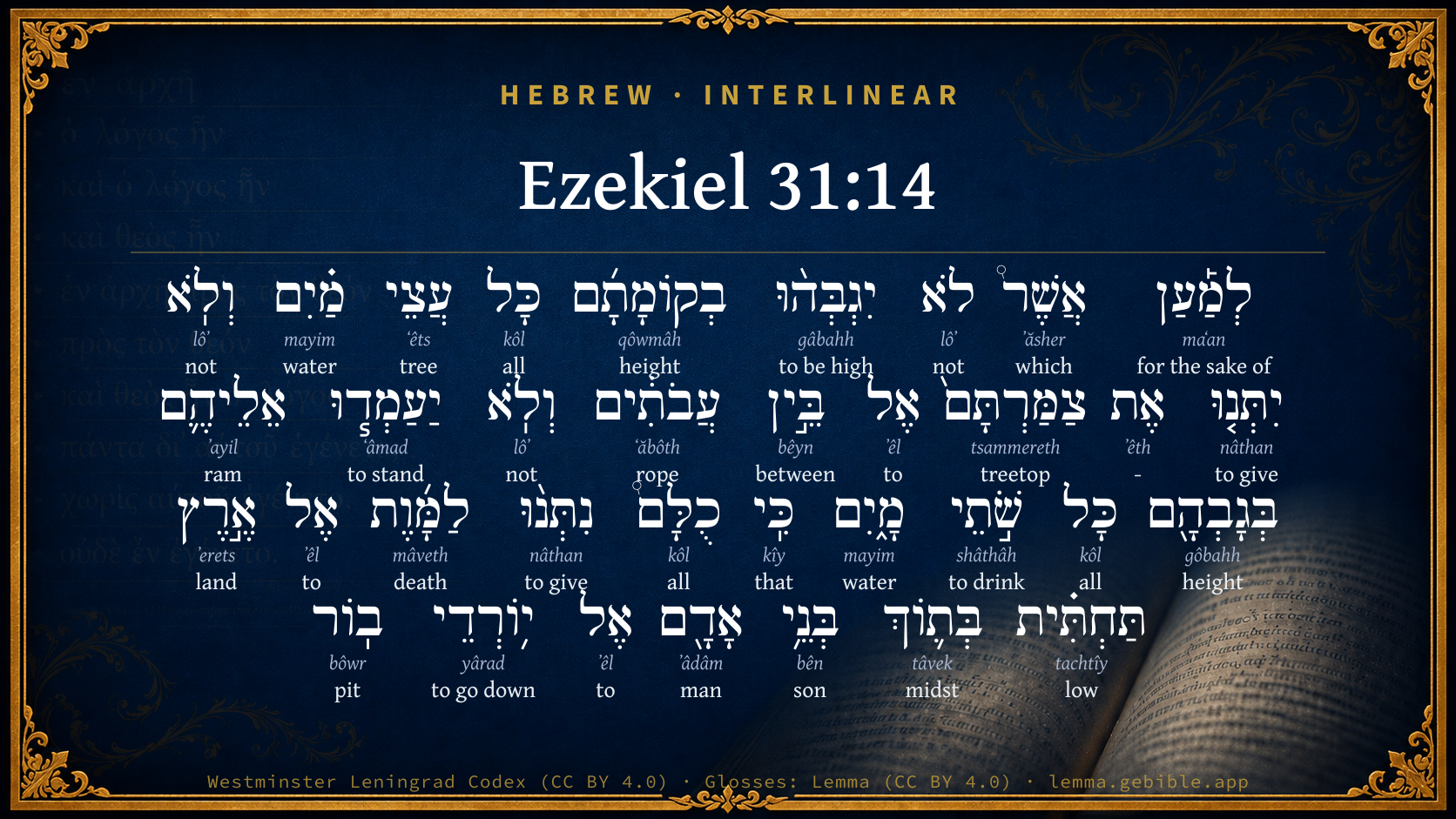
Ezekiel 31:14

Hebrew (Westminster Leningrad Codex) Ezekiel 31:14 appears in the Hebrew Old Testament. The text above is from the Westminster Leningrad Codex. Each word links to its Strong’s number, a concise gloss, and parsing drawn from the Open Scriptures Hebrew Bible morphology. Click any word for its full Brown-Driver-Briggs (BDB) entry.
Download image
Cite this verse

Ezekiel 31:14 (World English Bible). Public Domain. Lemma interlinear Bible study tool, https://lemma.gebible.app/v/ezekiel/31/14.

Show BibTeX & RIS
BibTeX
RIS
English Translation
to the end that none of all the trees by the waters exalt themselves in their stature, neither set their top among the thick boughs, nor that their mighty ones stand up on their height, [even] all who drink water: for they are all delivered to death, to the lower parts of the earth, in the midst of the children of men, with those who go down to the pit.
World English Bible · Public Domain
Download a study sheet

One document with this verse’s original text, its word-by-word gloss line, the meaning frame, cross-references with their text, attributed commentary, and full source and license credits — printable, and it pastes into notes with its structure intact.

This verse Autodidact and up

Study sheet (.html) Plain text (.txt)

A passage Seminary Student

Up to 50 verses in one chapter. A passage sheet keeps up to 6 commentary sources and 12 cross-references per verse, in the order this page ranks them, and says so on the sheet whenever that leaves anything out. Ask for a single verse and you get the Autodidact verse sheet above.

Everything on this page stays free to read, with no account — the sheet is a download of what is already on screen, not access to it.

Want to remove ads? Support Godless Engineer
Compare translations 3

The same verse in 3 English versions, stacked beneath the original-language interlinear above. Click any original word for its lexicon entry.

Each is an independent rendering of the whole verse — the interlinear is not word-aligned to these translations.

Highlighted words mark where these versions differ — a whole-verse word diff, not a word-by-word alignment.

  • World English Bible Public Domain
    to the end that none of all the trees by the waters exalt themselves in their stature, neither set their top among the thick boughs, nor that their mighty ones stand up on their height, [even] all who drink water: for they are all delivered to death, to the lower parts of the earth, in the midst of the children of men, with those who go down to the pit.
  • King James Version Public Domain
    To the end that none of all the trees by the waters exalt themselves for their height, neither shoot up their top among the thick boughs, neither their trees stand up in their height, all that drink water: for they are all delivered unto death, to the nether parts of the earth, in the midst of the children of men, with them that go down to the pit.
  • unfoldingWord Literal Text CC BY-SA 4.0
    This happened so that no other trees that grow by the waters will lift up their foliage to the height of the tallest trees, and that no other trees that grow beside the waters will reach up to that height. All of them have been assigned to death, to the earth below, among the children of humanity, with those that go down to the pit.

unfoldingWord Literal Text — © unfoldingWord, licensed CC BY-SA 4.0. Word-aligned USFM3 via Door43 (git.door43.org/unfoldingWord/en_ult).

Versions to compare (up to 4)

3 of 4 selected

Show all 18 translations

Every available English version of this verse, each an independent rendering of the whole verse.

  • World English Bible Public Domain
    to the end that none of all the trees by the waters exalt themselves in their stature, neither set their top among the thick boughs, nor that their mighty ones stand up on their height, [even] all who drink water: for they are all delivered to death, to the lower parts of the earth, in the midst of the children of men, with those who go down to the pit.
  • Berean Standard Bible Public Domain
    This happened so that no other trees by the waters would become great in height and set their tops among the clouds, and no other well-watered trees would reach them in height. For they have all been consigned to death, to the depths of the earth, among the mortals who descend to the Pit.’
  • Majority Standard Bible Public Domain
    This happened so that no other trees by the waters would become great in height and set their tops among the clouds, and no other well-watered trees would reach them in height. For they have all been consigned to death, to the depths of the earth, among the mortals who descend to the Pit.’
  • King James Version Public Domain
    To the end that none of all the trees by the waters exalt themselves for their height, neither shoot up their top among the thick boughs, neither their trees stand up in their height, all that drink water: for they are all delivered unto death, to the nether parts of the earth, in the midst of the children of men, with them that go down to the pit.
  • American Standard Version (1901) Public Domain
    to the end that none of all the trees by the waters exalt themselves in their stature, neither set their top among the thick boughs, nor that their mighty ones stand up on their height, `even' all that drink water: for they are all delivered unto death, to the nether parts of the earth, in the midst of the children of men, with them that go down to the pit.
  • Revised Version (1885) Public Domain
    to the end that none of all the trees by the waters exalt themselves in their stature, neither set their top among the thick boughs, nor that their mighty ones stand up in their height, even all that drink water: for they are all delivered unto death, to the nether parts of the earth, in the midst of the children of men, with them that go down to the pit.
  • Geneva Bible (1599) Public Domain
    So that none of all the trees by the waters shalbe exalted by their height, neither shall shoote vp their toppe among the thicke boughes, neither shall their leaues stand vp in their height, which drinke so much water: for they are all deliuered vnto death in the nether partes of the earth in the middes of the children of men among them that goe downe to the pit.
  • Douay-Rheims (1899) Public Domain
    For which cause none of the trees by the waters shall exalt themselves for their height: nor shoot up their tops among the thick branches and leaves, neither shall any of them that are watered stand up in their height: for they are all delivered unto death to the lowest parts of the earth, in the midst of the children of men, with them that go down into the pit.
  • Young's Literal Translation Public Domain
    In order that none of the trees of the waters May become haughty because of their stature, Nor give their foliage between thickets, Nor any drinking waters stand up unto them in their haughtiness, For all of them are given up to death, Unto the earth -- the lower part, In the midst of the sons of men, Unto those going down to the pit.
  • Literal Standard Version CC BY-SA 4.0
    In order that none of the trees of the waters || May become haughty because of their stature, || Nor give their foliage between thickets, || Nor any drinking waters stand up to them in their haughtiness, || For all of them are given up to death, || To the lower earth, || In the midst of the sons of men, || To those going down to the pit.
  • Unlocked Literal Bible CC BY-SA 4.0
    This happened so that no other trees that grow by the waters will lift up their foliage to the height of the tallest trees, and that no other trees that grow beside the waters will reach up to that height. All of them have been assigned to death, to the earth below, among the children of humanity, with those that go down to the pit.
  • unfoldingWord Literal Text CC BY-SA 4.0
    This happened so that no other trees that grow by the waters will lift up their foliage to the height of the tallest trees, and that no other trees that grow beside the waters will reach up to that height. All of them have been assigned to death, to the earth below, among the children of humanity, with those that go down to the pit.
  • Darby Bible Public Domain
    to the end that none of all the trees by the waters exalt themselves in their stature, nor set their top amidst the thick boughs, and that none of them that drink water stand up in his height by himself; for they are all given over unto death in the lower parts of the earth, in the midst of the children of men, with them that go down to the pit.
  • World Messianic Bible Public Domain
    to the end that none of all the trees by the waters exalt themselves in their stature, and don’t set their top among the thick boughs. Their mighty ones don’t stand up on their height, even all who drink water; for they are all delivered to death, to the lower parts of the earth, among the children of men, with those who go down to the pit.’
  • Webster's Bible Public Domain
    To the end that none of all the trees by the waters exalt themselves for their hight, neither shoot up their top among the thick boughs, neither their trees stand up in their hight, all that drink water: for they are all delivered to death, to the nether parts of the earth, in the midst of the children of men, with them that go down to the pit.
  • Free Bible Version CC BY-SA 4.0
    This was in order that no other trees growing by the water would grow up so high and have their tops reach the clouds. This was so that no other trees, however much water they had, would be as tall as them, For they all will die and go down into earth, just like human beings who go down into the grave.
  • Bible in Basic English Public Domain
    In order that no trees by the waters may be lifted up in their growth, putting their tops among the clouds; and that no trees which are watered may take their place on high: for they are all given up to death, to the lowest parts of the earth among the children of men, with those who go down to the underworld.
  • JPS Tanakh (1917) Public Domain
    to the end that none of all the trees by the waters exalt themselves in their stature, neither set their top among the thick boughs, nor that their mighty ones stand up in their height, even all that drink water; for they are all delivered unto death, to the nether parts of the earth, in the midst of the children of men, with them that go down to the pit.

Literal Standard Version (2020), Covenant Press — licensed CC BY-SA 4.0. Text via the HelloAO Bible API (eBible.org). Unlocked Literal Bible (unfoldingWord) — licensed CC BY-SA 4.0. Text via the HelloAO Bible API (eBible.org). unfoldingWord Literal Text — © unfoldingWord, licensed CC BY-SA 4.0. Word-aligned USFM3 via Door43 (git.door43.org/unfoldingWord/en_ult). Free Bible Version, Dr. Jonathan Gallagher — licensed CC BY-SA 4.0. Text via the HelloAO Bible API (eBible.org).

Word by word

More ways to search: Search by grammar → Find every occurrence → Compare this word →

Practice this passage: Drill this verse → Learn its vocabulary →

צַמַּרְתָּם֙
tsammereth
H6788
“treetop · their”
Noun, Common, Feminine, Singular, Construct + Suffix, Personal, 3rd Person, Masculine, Plural
Part of Speech
Noun
Type
Common
Gender
Feminine
Number
Singular
State
Construct
Full BDB Definition

Origin: from the same as H6785

TWOT: 1931b

treetop
  1. לְמַ֡עַן maʻan H4616 “for the sake of” Preposition
  2. אֲשֶׁר֩ ʼăsher H834 “which” Particle, Relative
  3. לֹא lôʼ H3808 “not” Particle, Negative
  4. יִגְבְּה֨וּ gâbahh H1361 “to be high” Verb, Qal, Imperfect, 3rd Person, Masculine, Plural
  5. בְקוֹמָתָ֜ם qôwmâh H6967 “in/at · height · their” Preposition + Noun, Common, Feminine, Singular, Construct + Suffix, Personal, 3rd Person, Masculine, Plural
  6. כָּל kôl H3605 “all of” Noun, Common, Masculine, Singular, Construct
  7. עֲצֵי ʻêts H6086 “trees of” Noun, Common, Masculine, Plural, Construct
  8. מַ֗יִם mayim H4325 “water(s)” Noun, Common, Masculine, Plural, Absolute
  9. וְלֹֽא lôʼ H3808 “and · not” Conjunction + Particle, Negative
  10. יִתְּנ֤וּ nâthan H5414 “to give” Verb, Qal, Imperfect, 3rd Person, Masculine, Plural
  11. אֶת ʼêth H853 “-” Particle, Direct Object
  12. אֶל ʼêl H413 “to” Preposition
  13. בֵּ֣ין bêyn H996 “between” Preposition
  14. עֲבֹתִ֔ים ʻăbôth H5688 “ropes” Noun, Common, Both, Plural, Absolute
  15. וְלֹֽא lôʼ H3808 “and · not” Conjunction + Particle, Negative
  16. יַעַמְד֧וּ ʻâmad H5975 “to stand” Verb, Qal, Imperfect, 3rd Person, Masculine, Plural
  17. אֵלֵיהֶ֛ם ʼayil H352 “rams · their” Noun, Common, Masculine, Plural, Construct + Suffix, Personal, 3rd Person, Masculine, Plural
  18. בְּגָבְהָ֖ם gôbahh H1363 “in/at · height · their” Preposition + Noun, Common, Masculine, Singular, Construct + Suffix, Personal, 3rd Person, Masculine, Plural
  19. כָּל kôl H3605 “all of” Noun, Common, Masculine, Singular, Construct
  20. שֹׁ֣תֵי shâthâh H8354 “drinking” Verb, Qal, Participle Active, Masculine, Plural, Construct
  21. מָ֑יִם mayim H4325 “water(s)” Noun, Common, Masculine, Plural, Absolute
  22. כִּֽי kîy H3588 “that” Conjunction
  23. כֻלָּם֩ kôl H3605 “all · their” Noun, Common, Masculine, Singular, Construct + Suffix, Personal, 3rd Person, Masculine, Plural
  24. נִתְּנ֨וּ nâthan H5414 “to give” Verb, Niphal, Perfect, 3rd Person, Common, Plural
  25. לַמָּ֜וֶת mâveth H4194 “to/for the · death” Preposition, Determined + Noun, Common, Masculine, Singular, Absolute
  26. אֶל ʼêl H413 “to” Preposition
  27. אֶ֣רֶץ ʼerets H776 “land” Noun, Common, Both, Singular, Absolute
  28. תַּחְתִּ֗ית tachtîy H8482 “low” Adjective, Adjective, Feminine, Singular, Absolute
  29. בְּת֛וֹךְ tâvek H8432 “in/at · midst of” Preposition + Noun, Common, Masculine, Singular, Construct
  30. בְּנֵ֥י bên H1121 “sons of” Noun, Common, Masculine, Plural, Construct
  31. אָדָ֖ם ʼâdâm H120 “man” Noun, Common, Masculine, Singular, Absolute
  32. אֶל ʼêl H413 “to” Preposition
  33. י֥וֹרְדֵי yârad H3381 “going down” Verb, Qal, Participle Active, Masculine, Plural, Construct
  34. בֽוֹר bôwr H953 “pit” Noun, Common, Masculine, Singular, Absolute

About this verse

These counts appear in no published source. They are computed here, from the morphology-tagged text and Lemma’s own curated glosses. What Lemma adds →

35
words
27
distinct lemmas
Prophets
section

Notable vocabulary

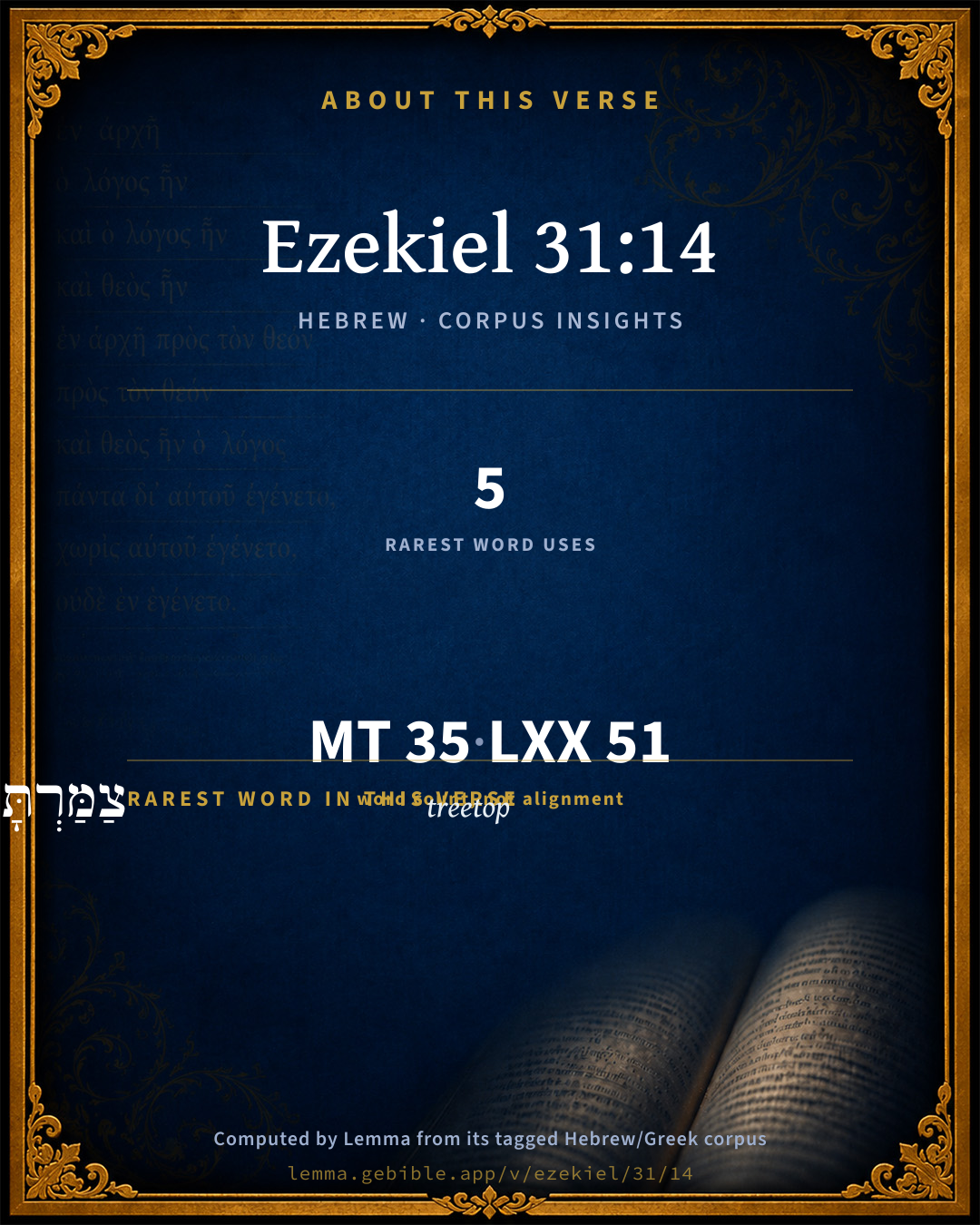
The rarest word here is צַמַּרְתָּם֙ treetop H6788 — appearing just 5 times in the whole Hebrew Bible.

Shared distinctive vocabulary

צַמַּרְתָּם֙ treetop H6788 occurs in 5 verses of the Hebrew Bible. Also found in:

Grammatical profile

  • 6 verbs
  • 17 nouns
  • 1 adjective
  • 5 prepositions
  • 1 conjunction
  • 5 particles

Verb forms

  • יִגְבְּה֨וּ Qal · Imperfect
  • יִתְּנ֤וּ Qal · Imperfect
  • יַעַמְד֧וּ Qal · Imperfect
  • שֹׁ֣תֵי Qal · Participle Active
  • נִתְּנ֨וּ Niphal · Perfect
  • י֥וֹרְדֵי Qal · Participle Active

Repetition

Words recur within this verse — often emphatic in Hebrew:

  • כָּל all H3605 ×3
  • מַ֗יִם water H4325 ×2
  • יִתְּנ֤וּ to give H5414 ×2
  • לֹא not H3808 ×3
  • אֶל to H413 ×3

Hebrew & Septuagint length

In English translation the verse runs 70 words from the Hebrew and 71 from the Septuagint (LXX English) — closely comparable.

A rough comparison of the two English renderings, which tokenize alike — not a word-level alignment.

Word counts can differ between the Hebrew and the Greek without any difference in meaning — e.g. the Hebrew direct-object marker אֵת has no separate Greek word, and Greek often adds the article ὁ.

In the original languages it is 35 Hebrew tokens and 51 Greek tokens — but the two are counted differently (Hebrew bundles its prefixes and suffixes into one token; the Greek is in lemma form), so that isn’t a like-for-like length.

Cross-references

13

Topical passages linked to Ezekiel 31:14 in the Treasury of Scripture Knowledge — connected by theme and wording, ordered by reader-vote popularity; previews shown in the World English Bible.

  • Nehemiah 13:18 Didn't your fathers do thus, and did not our God bring all this evil on us, and on this city? yet you bring more wrath on Israel by profaning the Sabbath.
  • Psalms 63:9–10 But those who seek my soul, to destroy it, Shall go into the lower parts of the earth.
  • Psalms 82:7 Nevertheless you shall die like men, And fall like one of the rulers."
  • Ezekiel 26:20 then will I bring you down with those who descend into the pit, to the people of old time, and will make you to dwell in the lower parts of the earth, in the places that are desolate of old, with those who go down to the pit, that you be not inhabited; and I will set glory in the land of the living:
  • 1 Corinthians 10:11 Now all these things happened to them by way of example, and they were written for our admonition, on whom the ends of the ages have come.
  • 2 Peter 2:6 and turning the cities of Sodom and Gomorrah into ashes, condemned them to destruction, having made them an example to those who would live ungodly;
  • Deuteronomy 13:11 All Israel shall hear, and fear, and shall not do any more such wickedness as this is in the midst of you.
  • Deuteronomy 21:21 All the men of his city shall stone him to death with stones: so shall you put away the evil from the midst of you; and all Israel shall hear, and fear.
  • Ezekiel 31:18 To whom are you thus like in glory and in greatness among the trees of Eden? yet shall you be brought down with the trees of Eden to the lower parts of the earth: you shall lie in the midst of the uncircumcised, with those who are slain by the sword. This is Pharaoh and all his multitude, says the Lord Yahweh.
  • Ezekiel 32:18–32 Son of man, wail for the multitude of Egypt, and cast them down, even her, and the daughters of the famous nations, to the lower parts of the earth, with those who go down into the pit.
  • Daniel 4:32 and you shall be driven from men; and they dwelling shall be with the animals of the field; you shall be made to eat grass as oxen; and seven times shall pass over you; until you know that the Most High rules in the kingdom of men, and gives it to whoever he will.
  • Daniel 5:22–23 You his son, Belshazzar, have not humbled your heart, though you knew all this,
  • Hebrews 9:27 Inasmuch as it is appointed for men to die once, and after this, judgment,

Cross-references courtesy of OpenBible.info (CC BY 4.0).

Hebrew and Greek witnesses Masoretic Hebrew ↔ Greek Septuagint

The same verse in the two great witnesses to the Old Testament, shown verse-for-verse.

These are two independent witnesses, not word-aligned to each other, and the Septuagint is shown in lemma (dictionary) form.

Hebrew Ezekiel 31:14 Masoretic · Westminster Leningrad Codex

לְמַ֡עַן אֲשֶׁר֩ לֹא יִגְבְּה֨וּ בְקוֹמָתָ֜ם כָּל עֲצֵי מַ֗יִם וְלֹֽא יִתְּנ֤וּ אֶת צַמַּרְתָּם֙ אֶל בֵּ֣ין עֲבֹתִ֔ים וְלֹֽא יַעַמְד֧וּ אֵלֵיהֶ֛ם בְּגָבְהָ֖ם כָּל שֹׁ֣תֵי מָ֑יִם כִּֽי כֻלָּם֩ נִתְּנ֨וּ לַמָּ֜וֶת אֶל אֶ֣רֶץ תַּחְתִּ֗ית בְּת֛וֹךְ בְּנֵ֥י אָדָ֖ם אֶל י֥וֹרְדֵי בֽוֹר

to the end that none of all the trees by the waters exalt themselves in their stature, neither set their top among the thick boughs, nor that their mighty ones stand up on their height, [even] all who drink water: for they are all delivered to death, to the lower parts of the earth, in the midst of the children of men, with those who go down to the pit.

World English Bible · Public Domain

Greek LXX Ezekiel 31:14 Septuagint · lemma form

ὅπως μή ὑψόω ἐν ὁ μέγεθος αὐτός πᾶς ὁ ξύλον ὁ ἐν ὁ ὕδωρ καί οὐ δίδωμι ὁ ἀρχή αὐτός εἰς μέσος νεφέλη καί οὐ ἵστημι ἐν ὁ ὕψος αὐτός πρός αὐτός πᾶς ὁ πίνω ὕδωρ πᾶς δίδωμι εἰς θάνατος εἰς γῆ βάθος ἐν μέσος υἱός ἄνθρωπος πρός καταβαίνω εἰς βόθρος

in order that none of the trees by the water should exalt themselves by reason of their size: whereas they set their top in the midst of the clouds, yet they continued not in their high state in their place, all that drank water, all were consigned to death, to the depth of the earth, in the midst of the children of men, with them that go down to the pit.

LXX2012 (modern English Septuagint) · Public Domain

Hebrew: Westminster Leningrad Codex (CC BY 4.0). Greek: Septuagint (public domain); English from LXX2012 (modern English Septuagint) (Public Domain). How the Septuagint differs from the Hebrew →

Targum (Aramaic paraphrase)

1

The Targum is the ancient Jewish Aramaic paraphrase of the Hebrew Scriptures — an interpretive translation, not the Hebrew text itself. Onkelos (literal) and Pseudo-Jonathan (expansive) render the Torah, and Jonathan the Prophets. Coverage is partial: where no permissively-licensed English translation exists for a verse, only the Aramaic is shown. This is verse-level text, not a word-by-word alignment to the Hebrew.

  1. Targum Jonathan Prophets (Joshua–Malachi)
    בְּדִיל דְלָא יְרָאמוּן בְּתוּקְפֵיהוֹן כָּל מַלְכֵי קֶדֶם וְלָא יִתְּנוּן יַת מַרְוַתְהוֹן עַל מַלְכְּוָתָא וְלָא יִתְרַבְרְבוּן לְהוֹן בְּתוּקְפֵיהוֹן כָּל עַבְדֵי מַלְכוּ אֲרֵי כּוּלְהוֹן אִתְמְסָרוּ לְמוֹתָא לְאַרְעָא אַרְעִיתָא בְּגוֹ בְנֵי אֱנָשָׁא עִם נָחֲתֵי גוֹב בֵּית אַבְדָנָא:

    (no public-domain English translation for this verse)

    Targum Jonathan — Aramaic: “Mikraot Gedolot” (public domain). English: “Sefaria Community Translation” (CC0 1.0 (public-domain dedication)); “London "Chaldee Paraphrase," 1871” (public domain). Text via Sefaria.

Commentary

Notes on Ezekiel 31:14 from classic Christian and Jewish commentators (each source and its license shown beneath its notes). The classic Christian expositions comment on the surrounding passage and are grouped to its opening verse, so a note may address several verses; the Jewish commentaries on the Tanakh (Rashi and others) are per-verse, so they appear only where the commentator wrote on this verse.

Lemma curates 59 commentaries, every one of them public domain or Creative Commons licensed, each selected and text-cleaned for this edition rather than reprinted as found. About our sources →

Trapp's Complete Commentary

John Trapp

Eze 31:14 To the end that none of all the trees by the waters exalt themselves for their height, neither shoot up their top among the thick boughs, neither their trees stand up in their height, all that drink water: for they are all delivered unto death, to the nether parts of the earth, in the midst of the children of men, with them that go down to the pit.

Ver. 14. To the end that none of all the trees.] This is the use men should make of God’s heavy judgments upon others. This man’s father Sennacherib had a statue set up in Egypt, saith Herodotus, {a} with this inscription, Let him that looketh upon my misery learn to be modest and to fear God.

Neither their trees stand up in their height.] Neque stent in seipsis; neither stand in themselves, because of their height. Magna repente ruunt: in te stas et non stets, said the oracle to Augustine, Thou standest on thine own bottom, thou wilt surely down.

For they are all delivered uuto death.] Without difference, pell mell, lords and lowlies together; as the poet also singeth,

“ Sub tua purpurei veniunt vestigia reges,

Deposito luxu, turba cum paupere mixti;

Omnia mors aequat. ” - Claudian.

{a} Lib. ii.

John Trapp, A Commentary or Exposition upon All the Books of the Old and New Testament (1647–1656) — public domain. Text from a community e-Sword module.

Jamieson, Fausset & Brown

Robert Jamieson, A. R. Fausset & David Brown

trees by the waters--that is, that are plentifully supplied by the waters: nations abounding in resources.

stand up in their height--that is, trust in their height: stand upon it as their ground of confidence. FAIRBAIRN points the Hebrew differently, so as for "their trees," to translate, "(And that none that drink water may stand) on themselves, (because of their greatness)." But the usual reading is better, as Assyria and the confederate states throughout are compared to strong trees. The clause, "All that drink water," marks the ground of the trees' confidence "in their height," namely, that they have ample sources of supply. MAURER, retaining the same Hebrew, translates, "that neither their terebinth trees may stand up in their height, nor all (the other trees) that drink water."

to . . . nether . . . earth . . . pit-- (Eze 32:18; Psa 82:7).

Jamieson, Fausset & Brown — Commentary Critical and Explanatory on the Whole Bible (1871) — public domain (CC PDM 1.0). Text via the HelloAO Bible API.

Adam Clarke's Commentary

Verse 14. To the end that none of all the trees] Let this ruin, fallen upon Egypt, teach all the nations that shall hear of it to be humble, because, however elevated, God can soon bring them down; and pride and arrogance, either in states or individuals, have the peculiar abhorrence of God. Pride does not suit the sons of men; it made devils of angels, and makes fiends of men.

Adam Clarke's Commentary on the Bible (1810–1826) — public domain. Text from a community e-Sword/MySword module.

Ellicott's Commentary for English Readers

(14) Stand up in their height.—The original is more closely followed by the margin, stand upon themselves for their height, and the thought is that the trees (princes) shall no longer rely on their own strength and be infatuated by the prosperity which has been given them.

All that drink water is only a poetical expression for the trees. (Comp. Eze_31:16.) In the constant mention of water and rivers throughout this parable there may be a covert allusion to Egypt, made fertile by the irrigation of the Nile.

To the nether parts of the earth.—See Note on Eze_26:20. In the latter part of this verse the figurative is again exchanged for literal language.

A Bible Commentary for English Readers, edited by Charles John Ellicott (1878–1897) — public domain. Text from a community e-Sword module.

The Cambridge Bible for Schools and Colleges

gen. ed. J. J. S. Perowne

14. The downfall of Pharaoh is a chastisement for his pride and a warning.

for their height] Or, in their. It is not merely pride of heart because of the height, it is the height itself, the shooting up their top among the clouds—aspiring to a greatness belonging only to heaven—that is the sin.

thick boughs] the clouds.

neither their trees stand up] Rather: and that their mighty ones (those of the nations) stand not up (or, forward, i.e. display themselves) in their height. The phrase “all that drink water” is a circumlocution for “trees,” fed by water.

nether parts of the earth] i.e. Sheòl, the place of the dead, deep down in the earth, or under it.

the children of men] i.e. men in general, common men. The meaning is hardly that expressed in Psa_49:10, that all die, the wise as well as the fool and the brutish, and that the “mighty ones” have no privilege over common men in this respect; the death referred to here is rather the violent death, the death of them slain with the sword, attended with no funeral honours. Cf. ch. Eze_32:17 seq.

them that go down] them that are gone down to the pit. So everywhere. The allegory of the tree here passes over into the reality.

The Cambridge Bible for Schools and Colleges (gen. ed. J. J. S. Perowne; Cambridge University Press, 1878–1918) — public domain. Text from a community e-Sword module.

John Gill's Exposition

To the end that none of all the trees by the waters exalt themselves for their height,.... The end proposed by the Lord in the destruction of the king of Assyria, and the use to be made of it, is this; that the kings of the earth take warning hereby, who rule over a multitude of people, comparable to waters, and who abound in riches and wealth; that they are not elated with pride and vanity, because of their exalted estate, their grandeur, and dignity; and do not behave insolently against God, on whom they depend; nor haughtily and in an oppressive manner towards their own subjects, over whom they rule:

neither shoot up their top among the thick boughs; affect universal monarchy, as he did; and set up themselves over all kingdoms and states, as he had over them, and make all subject to them:

neither their trees stand up in their height, that drink water; that is, kings and potentates, who rule over the people, and are supplied and supported by them in their exalted stations, by the tribute and taxes they pay them and so abound in riches and power, should not trust in the height of honour and power they are raised to, and treat contemptuously God and man; but consider what they are, that they are but men, and are in slippery places, where there is no standing long, and especially when death comes, as follows:

for they are delivered unto death in the nether parts of the earth; they are mortal by nature, as other men; they are appointed to die, and will be delivered into the hands of death, when the time is come, who will not spare them because of their crowns and sceptres; and when they will be laid in the grave, in the lowest parts of the earth, who used to sit upon elevated thrones of state:

in the midst of the children of men, with those that go down to the pit; the grave, where they are upon a level with the poorest and meanest of their subjects. The Targum is,

"that all the kings of the east might not be lifted up with their strength, nor exercise tyranny over the kingdoms; nor all that hold a kingdom lift up themselves in their own strength, for all are delivered unto death, &c.''

John Gill's Exposition of the Whole Bible (1746–1763) — public domain (CC PDM 1.0). Text via the HelloAO Bible API.

Haydock's Catholic Bible Commentary

Pit. The new king would appoint fresh governors.

George Leo Haydock (1774–1849), Haydock's Catholic Family Bible and Commentary, 1859 edition — public domain. Excludes Psalms (Douay-Rheims chapter numbering differs from Protestant) and Deuterocanonical books (Catholic canon only).

Matthew Poole's English Annotations

To the end; all this is designed to be a warning to mortals.

All the trees, i: e. the emperors, potentates, kings, or rich flourishing states.

By the waters; planted most commodiously, and furnished most abundantly with power and wealth.

Exalt themselves; grow proud, because they are high, shoot out tops above all the thick boughs, their neighbours. This caution against pride and self-exalting is three times repeated, that all, especially great men, and this proud king of Egypt, to whom this parable is propounded, should be humble.

For they are all delivered unto death; for if by office they are gods, yet by nature they are men, and by the decree of God, who cannot die, these gods must, as men, die, be laid in the grave, forgotten like other men, like the children of mean men, for death and the grave make no distinction.

Be not proud, God will pull down such; be humble, you must die.

Matthew Poole's English Annotations on the Holy Bible (1683–1685) — public domain. Text from a community e-Sword/MySword module.

Whedon's Commentary on the Bible

Daniel D. Whedon

14. Neither their trees — Rather, R.V., “nor that their mighty ones.” All of these majestic trees that drink water — these proud kingdoms of men — are soon to fall to the earth and drop into “Sheol.” (Compare Eze_32:17-32.) Their princes have claimed to be divine (Eze_28:2; Eze_28:9; Eze_29:3) and their kingdoms have seemed divine creations, gardens of Eden, but they shall die like men and go down to the realms of dust.

Daniel D. Whedon (gen. ed.), Commentary on the Old and New Testaments (1874–1909) — public domain. Text from a community e-Sword module.

The Pulpit Commentary

To the end that none, etc. With a characteristic amplitude of style, Ezekiel preaches the great lesson of the mutability of earthly greatness. This was the lesson that the history of Assyria ought to have taught the nations of the earth, and it was just that lesson that they refused to learn. They are all delivered to death. The scenery of the parable passes from Eden to Sheol, the Hades of the nations, and the prophet gives the first stroke of the imagery afterwards more fully developed in Eze_32:17-32.

The lesson for all nations.

Doubtless the immediate aim of the downfall of such a nation as Assyria has respect to the people and their rulers, upon whom the judgment comes. But there is a universal lesson intended for the benefit of all peoples throughout all time.

I GOD INCULCATES MORAL LESSONS BY THE WORDS UTTERED BY HIS SERVANTS. His law-givers, such as Moses; his prophets, such as Ezekiel; his priests and scribes, such as Ezra, have messages of instruction, encouragement, warning (as the case may be), for all mankind in every age. And God summons the children of men to give heed to his servants when they utter their messages, prefacing them with the assertion, "Thus saith the Lord.

II GOD ENFORCES THESE VERBAL LESSONS BY FACTS, AND ESPECIALLY BY THE EVENTS OF HISTORY. In such catastrophes as the downfall of Assyria, as the siege of Jerusalem, as the destruction of Tyro, as the humiliation of Egypt, the eternal, righteous, and omnipotent Ruler of mankind speaks to his subjects with an authoritative and unmistakable voice. Facts embody principles. Historical incidents elucidate moral laws. Judgments enforce commands.

III THE WONDER OF MEN"S INSENSIBILITY TO THESE LESSONS. It might be expected that those upon whom the message of the herald produces no impression would be roused from their apathy by the stirring incidents of political change and national disaster. But, as a matter of fact, multitudes are unaffected even by the downfall of a city, the revolution of a government, the displacement of a dynasty, the transference of the balance of power among the nations. Is not this in accordance with Christ"s own words, "If they hear not Moses and the prophets, neither will they be persuaded, though one rose from the dead?

IV THE FOLLY AND PENALTY OF INDIFFERENCE TO THESE LESSONS. They who give heed to Divine counsels, who profit by Divine admonitions, deliver their soul in the day of trouble and temptation. But they who hear unmoved, incredulous, unresponsive, the solemn and faithful appeals of God, uttered as with a voice of thunder in the events that befall the nations of mankind, by their conduct aggravate their guilt and pen their own condemnation.

V THE WISDOM OF IMMEDIATE ATTENTION TO THESE LESSONS, WITH THE PROPER FRUITS OF SUCH ATTENTION IN REPENTANCE AND OBEDIENCE. The parable was spoken, the providential interposition was recounted," To the end that none of all the trees by the waters exalt themselves." "He that hath an ear, let him hear. T.

The Pulpit Commentary (1880–1919), ed. H.D.M. Spence-Jones & Joseph S. Exell — public domain. Text from a community e-Sword module.

John Wesley's Explanatory Notes

To the end - All this is designed to be a warning to mortals. All the trees - The emperors, kings, or flourishing states. By the waters - Planted most commodiously, and furnished most abundantly with power and wealth. The children of men - As common men, of no quality or distinction.

John Wesley, Explanatory Notes Upon the Whole Bible (1754–1765) — public domain. Text via the GEBible commentary corpus.

Rashi

Rabbi Shlomo Yitzchaki (Rashi)

water trees which are tender and frail, but have numerous and long branches because of the moisture of the water, should not compare themselves to the cedars of Eden; i.e., he should not have been haughty over Israel and should not have stood over them.

among the interwoven branches They should not haughtily compare their might - the trees that drink water to the interwoven trees.

Rashi on the Tanakh — English translations: “The Judaica Press complete Tanach with Rashi, translated by A. J. Rosenberg” (CC BY 4.0); “Pentateuch with Rashi's commentary by M. Rosenbaum and A.M. Silbermann, 1929-1934” (public domain); “The Metsudah Tanach series, Lakewood, N.J” (CC BY 4.0); and “The Book of Joshua, Metsudah Publications, 1997” (CC BY 4.0). Text via Sefaria.

Lesson kit

Teaching starters — assembled from the data on this page, not authored interpretation. Every prompt links to the verse data it draws on. Edit before teaching.

Ezekiel, in the Prophets, opens this verse with 35 words (27 distinct Hebrew lemmas). Its most distinctive word is tsammereth (“treetop”). A historical commentator’s framing appears above. Read the whole chapter for the surrounding context.

Discussion questions

  1. What does “treetop” (tsammereth) contribute to the verse as a whole?
  2. Ezekiel 17:3 shares the word «treetop» with this verse. How do the two illuminate each other?
  3. “all” occurs 3× in this one verse. What is the effect of the repetition?
  4. The translations on this page render this verse differently — a whole-verse word diff, not a word-by-word alignment. What might account for the different wordings?
  5. The verb «יִגְבְּה֨וּ» is Qal Imperfect. How does its form color the action?
  6. Reading how Trapp's Complete Commentary and Jamieson, Fausset & Brown read this verse, where do the two commentators agree and where do they part?

Things to notice

Reading settings

Reading text

Shown beneath each verse's original-language words.

Old Testament
Old Testament edition

Read the OT as the Masoretic Hebrew (MT) or the Greek Septuagint (LXX).

English shown for the Greek Septuagint (in the Hebrew ↔ Greek comparison).

Comparing translations? Open the Compare panel on any verse page to stack up to four side by side.