
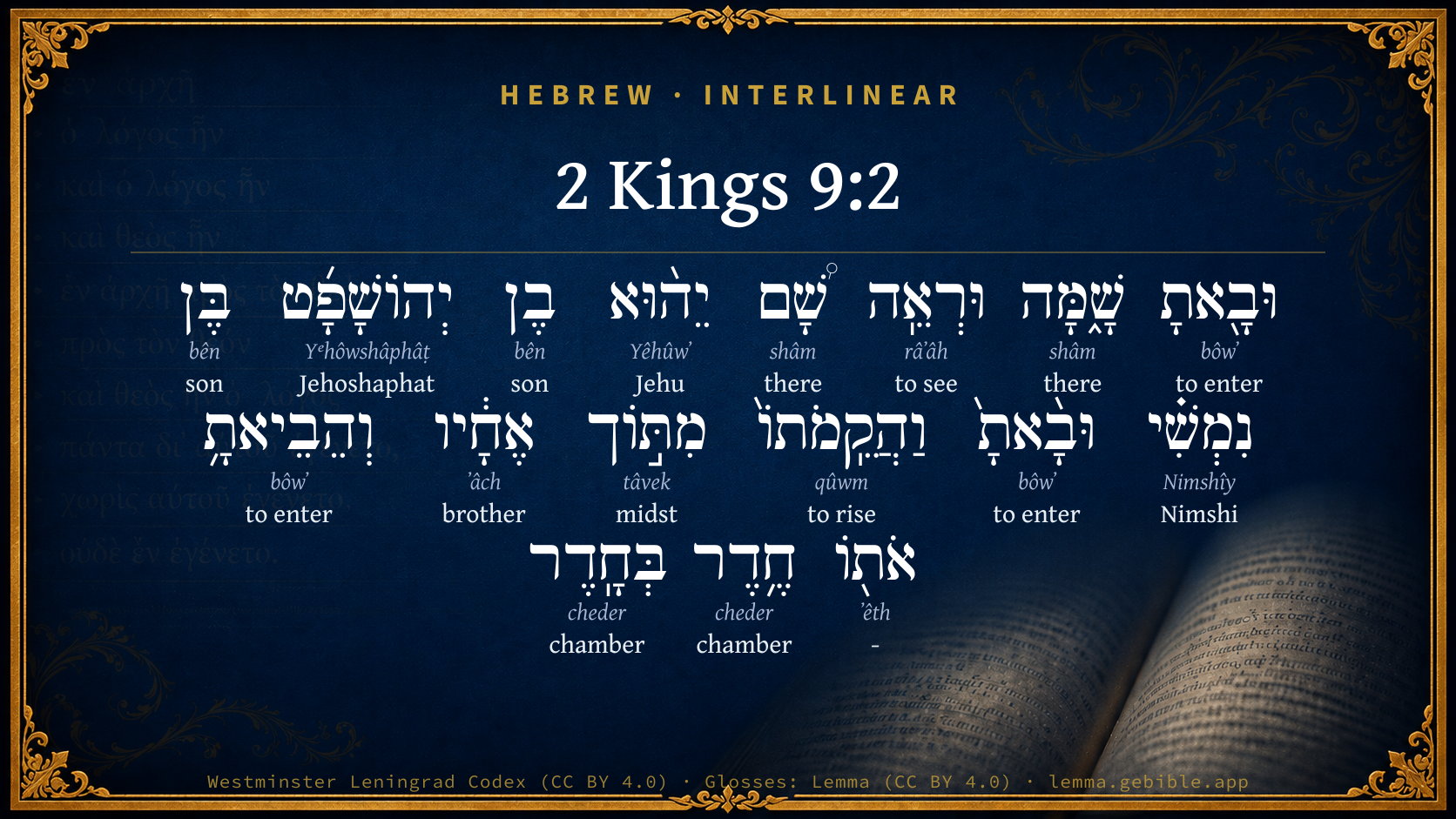
2 Kings 9:2

Hebrew (Westminster Leningrad Codex) 2 Kings 9:2 appears in the Hebrew Old Testament. The text above is from the Westminster Leningrad Codex. Each word links to its Strong’s number, a concise gloss, and parsing drawn from the Open Scriptures Hebrew Bible morphology. Click any word for its full Brown-Driver-Briggs (BDB) entry.
Download image
Cite this verse

2 Kings 9:2 (World English Bible). Public Domain. Lemma interlinear Bible study tool, https://lemma.gebible.app/v/2-kings/9/2.

Show BibTeX & RIS
BibTeX
RIS
English Translation
When you come there, look out there Jehu the son of Jehoshaphat the son of Nimshi, and go in, and make him arise up from among his brothers, and carry him to an inner chamber.
World English Bible · Public Domain
Download a study sheet

One document with this verse’s original text, its word-by-word gloss line, the meaning frame, cross-references with their text, attributed commentary, and full source and license credits — printable, and it pastes into notes with its structure intact.

This verse Autodidact and up

Study sheet (.html) Plain text (.txt)

A passage Seminary Student

Up to 50 verses in one chapter. A passage sheet keeps up to 6 commentary sources and 12 cross-references per verse, in the order this page ranks them, and says so on the sheet whenever that leaves anything out. Ask for a single verse and you get the Autodidact verse sheet above.

Everything on this page stays free to read, with no account — the sheet is a download of what is already on screen, not access to it.

Want to remove ads? Support Godless Engineer
Compare translations 3

The same verse in 3 English versions, stacked beneath the original-language interlinear above. Click any original word for its lexicon entry.

Each is an independent rendering of the whole verse — the interlinear is not word-aligned to these translations.

Highlighted words mark where these versions differ — a whole-verse word diff, not a word-by-word alignment.

  • World English Bible Public Domain
    When you come there, look out there Jehu the son of Jehoshaphat the son of Nimshi, and go in, and make him arise up from among his brothers, and carry him to an inner chamber.
  • King James Version Public Domain
    And when thou comest thither, look out there Jehu the son of Jehoshaphat the son of Nimshi, and go in, and make him arise up from among his brethren, and carry him to an inner chamber;
  • unfoldingWord Literal Text CC BY-SA 4.0
    And you shall come to there, and see Jehu, the son of Jehoshaphat, the son of Nimshi, there. And you shall come, and you shall make him arise from the midst of his brothers, and you shall bring him a chamber in a chamber.

unfoldingWord Literal Text — © unfoldingWord, licensed CC BY-SA 4.0. Word-aligned USFM3 via Door43 (git.door43.org/unfoldingWord/en_ult).

Versions to compare (up to 4)

3 of 4 selected

Show all 18 translations

Every available English version of this verse, each an independent rendering of the whole verse.

  • World English Bible Public Domain
    When you come there, look out there Jehu the son of Jehoshaphat the son of Nimshi, and go in, and make him arise up from among his brothers, and carry him to an inner chamber.
  • Berean Standard Bible Public Domain
    When you arrive, look for Jehu son of Jehoshaphat, the son of Nimshi. Go in, get him away from his companions, and take him to an inner room.
  • Majority Standard Bible Public Domain
    When you arrive, look for Jehu son of Jehoshaphat, the son of Nimshi. Go in, get him away from his companions, and take him to an inner room.
  • King James Version Public Domain
    And when thou comest thither, look out there Jehu the son of Jehoshaphat the son of Nimshi, and go in, and make him arise up from among his brethren, and carry him to an inner chamber;
  • American Standard Version (1901) Public Domain
    And when thou comest thither, look out there Jehu the son of Jehoshaphat the son of Nimshi, and go in, and make him arise up from among his brethren, and carry him to an inner chamber.
  • Revised Version (1885) Public Domain
    And when thou comest thither, look out there Jehu the son of Jehoshaphat the son of Nimshi, and go in, and make him arise up from among his brethren, and carry him to an inner chamber.
  • Geneva Bible (1599) Public Domain
    And when thou commest thither, looke where is Iehu ye sonne of Iehoshaphat, the sonne of Nimshi, and go, and make him arise vp from among his brethren, and leade him to a secret chamber.
  • Douay-Rheims (1899) Public Domain
    And when thou art come thither, thou shalt see Jehu the son of Josaphat the son of Namsi: and going in thou shalt make him rise up from amongst his brethren, and carry him into an inner chamber.
  • Young's Literal Translation Public Domain
    and thou hast gone in there, and see thou there Jehu son of Jehoshaphat, son of Nimshi, and thou hast gone in, and caused him to rise out of the midst of his brethren, and brought him in to the inner part of an inner-chamber,
  • Literal Standard Version CC BY-SA 4.0
    and you have gone in there, and see Jehu son of Jehoshaphat, son of Nimshi, there, and you have gone in, and caused him to rise out of the midst of his brothers, and brought him into the inner part of an inner-chamber,
  • Unlocked Literal Bible CC BY-SA 4.0
    When you arrive, look for Jehu son of Jehoshaphat son of Nimshi, and go in and make him arise up from among his companions, and conduct him to an inner chamber.
  • unfoldingWord Literal Text CC BY-SA 4.0
    And you shall come to there, and see Jehu, the son of Jehoshaphat, the son of Nimshi, there. And you shall come, and you shall make him arise from the midst of his brothers, and you shall bring him a chamber in a chamber.
  • Darby Bible Public Domain
    And when thou art come thither, look out there Jehu the son of Jehoshaphat, son of Nimshi, and go in, and make him rise up from among his brethren, and bring him to an inner chamber;
  • World Messianic Bible Public Domain
    When you come there, find Jehu the son of Jehoshaphat the son of Nimshi, and go in and make him rise up from among his brothers, and take him to an inner room.
  • Webster's Bible Public Domain
    And when thou comest thither, look out there Jehu the son of Jehoshaphat, the son of Nimshi, and go in, and make him arise up from among his brethren, and carry him to an inner chamber;
  • Free Bible Version CC BY-SA 4.0
    Once you get there, look for Jehu, son of Jehoshaphat, son of Nimshi. Go in, get him away from his companions, and take him to an inner room. Get him to leave his friends, lead him to a private room,
  • Bible in Basic English Public Domain
    And when you get there, go in search of Jehu, the son of Jehoshaphat, the son of Nimshi; and go in and make him get up from among his brothers, and take him to an inner room.
  • JPS Tanakh (1917) Public Domain
    And when thou comest thither, look out there Jehu the son of Jehoshaphat the son of Nimshi, and go in, and make him arise up from among his brethren, and carry him to an inner chamber.

Literal Standard Version (2020), Covenant Press — licensed CC BY-SA 4.0. Text via the HelloAO Bible API (eBible.org). Unlocked Literal Bible (unfoldingWord) — licensed CC BY-SA 4.0. Text via the HelloAO Bible API (eBible.org). unfoldingWord Literal Text — © unfoldingWord, licensed CC BY-SA 4.0. Word-aligned USFM3 via Door43 (git.door43.org/unfoldingWord/en_ult). Free Bible Version, Dr. Jonathan Gallagher — licensed CC BY-SA 4.0. Text via the HelloAO Bible API (eBible.org).

Word by word

More ways to search: Search by grammar → Find every occurrence → Compare this word →

Practice this passage: Drill this verse → Learn its vocabulary →

נִמְשִׁ֗י
Nimshîy
H5250
“Nimshi”
Noun, Proper
Part of Speech
Noun
Type
Proper
Full BDB Definition

Origin: probably from H4871

TWOT: None

Nimshi = "rescued" - grandfather of Jehu
  1. וּבָ֖אתָ bôwʼ H935 “and · to enter” Conjunction + Verb, Qal, Perfect, 2nd Person, Masculine, Singular
  2. שָׁ֑מָּה shâm H8033 “there · toward” Adverb + Suffix, Demonstrative
  3. וּרְאֵֽה râʼâh H7200 “and · see” Conjunction + Verb, Qal, Imperative, 2nd Person, Masculine, Singular
  4. שָׁ֠ם shâm H8033 “there” Adverb
  5. יֵה֨וּא Yêhûwʼ H3058 “Jehu” Noun, Proper
  6. בֶן bên H1121 “son of” Noun, Common, Masculine, Singular, Construct
  7. יְהוֹשָׁפָ֜ט Yᵉhôwshâphâṭ H3092 “Jehoshaphat” Noun, Proper
  8. בֶּן bên H1121 “son of” Noun, Common, Masculine, Singular, Construct
  9. וּבָ֨אתָ֙ bôwʼ H935 “and · to enter” Conjunction + Verb, Qal, Perfect, 2nd Person, Masculine, Singular
  10. וַהֲקֵֽמֹתוֹ֙ qûwm H6965 “and · to rise · him” Conjunction + Verb, Hiphil, Perfect, 2nd Person, Masculine, Singular + Suffix, Personal, 3rd Person, Masculine, Singular
  11. מִתּ֣וֹך tâvek H8432 “from · midst of” Preposition + Noun, Common, Masculine, Singular, Construct
  12. אֶחָ֔יו ʼâch H251 “brothers · his” Noun, Common, Masculine, Plural, Construct + Suffix, Personal, 3rd Person, Masculine, Singular
  13. וְהֵבֵיאתָ֥ bôwʼ H935 “and · to enter” Conjunction + Verb, Hiphil, Perfect, 2nd Person, Masculine, Singular
  14. אֹת֖וֹ ʼêth H853 “- · him” Particle, Direct Object + Suffix, Personal, 3rd Person, Masculine, Singular
  15. חֶ֥דֶר cheder H2315 “chamber” Noun, Common, Masculine, Singular, Absolute
  16. בְּחָֽדֶר cheder H2315 “in/at · chamber” Preposition + Noun, Common, Masculine, Singular, Absolute

About this verse

These counts appear in no published source. They are computed here, from the morphology-tagged text and Lemma’s own curated glosses. What Lemma adds →

17
words
12
distinct lemmas
Historical
section

Notable vocabulary

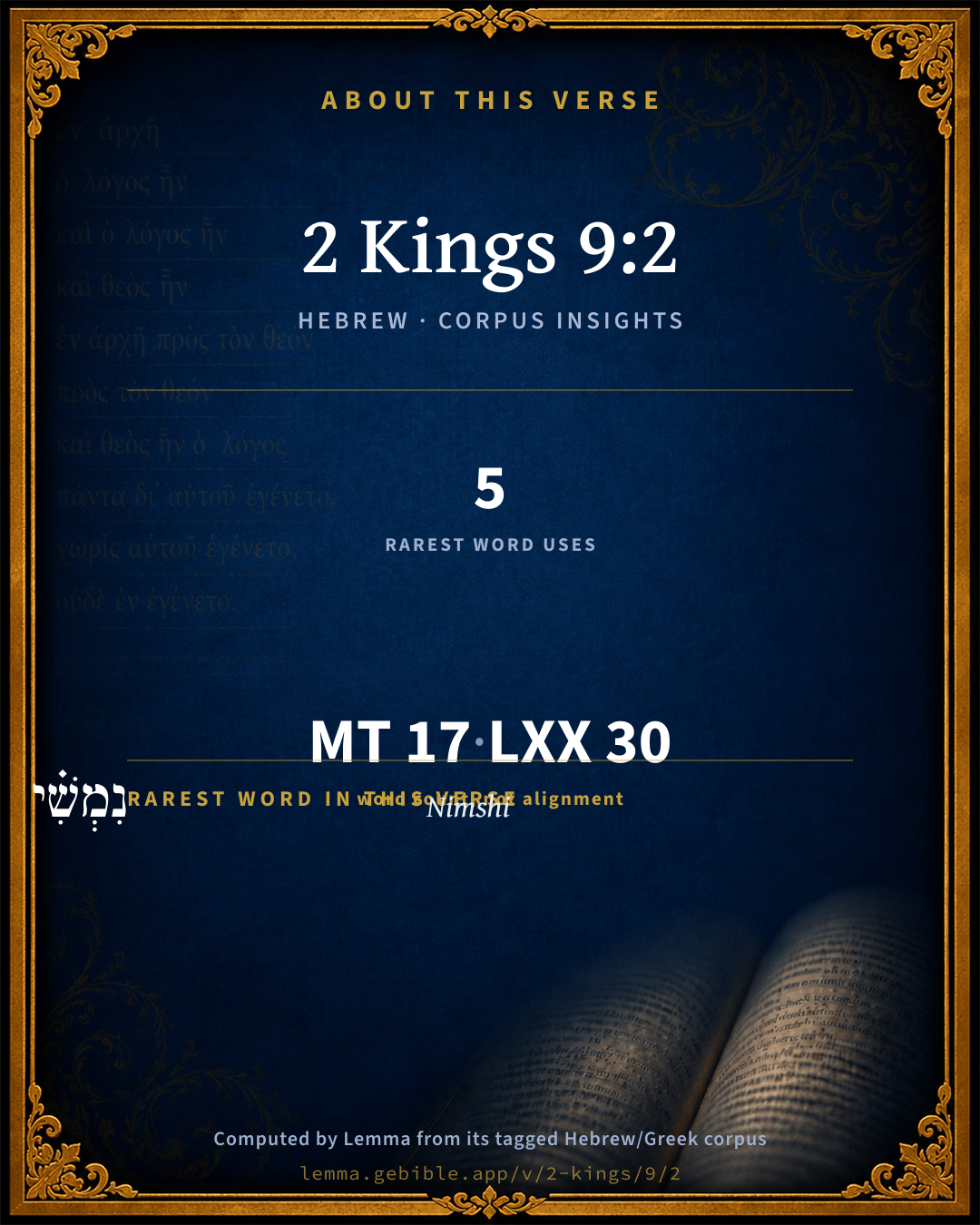
The rarest word here is נִמְשִׁ֗י Nimshi H5250 — appearing just 5 times in the whole Hebrew Bible.

Shared distinctive vocabulary

נִמְשִׁ֗י Nimshi H5250 occurs in 5 verses of the Hebrew Bible. Also found in:

Grammatical profile

  • 5 verbs
  • 9 nouns
  • 2 adverbs
  • 1 particle

Verb forms

  • וּבָ֖אתָ Qal · Perfect
  • וּרְאֵֽה Qal · Imperative
  • וּבָ֨אתָ֙ Qal · Perfect
  • וַהֲקֵֽמֹתוֹ֙ Hiphil · Perfect
  • וְהֵבֵיאתָ֥ Hiphil · Perfect

Repetition

Words recur within this verse — often emphatic in Hebrew:

  • וּבָ֖אתָ to enter H935 ×3
  • שָׁ֑מָּה there H8033 ×2
  • בֶן son H1121 ×2
  • חֶ֥דֶר chamber H2315 ×2

Hebrew & Septuagint length

In English translation the verse runs 35 words from the Hebrew and 38 from the Septuagint (LXX English) — closely comparable.

A rough comparison of the two English renderings, which tokenize alike — not a word-level alignment.

Word counts can differ between the Hebrew and the Greek without any difference in meaning — e.g. the Hebrew direct-object marker אֵת has no separate Greek word, and Greek often adds the article ὁ.

In the original languages it is 17 Hebrew tokens and 30 Greek tokens — but the two are counted differently (Hebrew bundles its prefixes and suffixes into one token; the Greek is in lemma form), so that isn’t a like-for-like length.

Cross-references

7

Topical passages linked to 2 Kings 9:2 in the Treasury of Scripture Knowledge — connected by theme and wording, ordered by reader-vote popularity; previews shown in the World English Bible.

  • 2 Kings 9:5 When he came, behold, the captains of the host were sitting; and he said, I have an errand to you, captain. Jehu said, To which of us all? He said, To you, O captain.
  • 2 Kings 9:11 Then Jehu came forth to the servants of his lord: and one said to him, Is all well? why came this mad fellow to you? He said to them, You know the man and what his talk was.
  • 2 Kings 9:14 So Jehu the son of Jehoshaphat the son of Nimshi conspired against Joram. (Now Joram was keeping Ramoth-gilead, he and all Israel, because of Hazael king of Syria;
  • 1 Kings 19:16–17 and Jehu the son of Nimshi shall you anoint to be king over Israel; and Elisha the son of Shaphat of Abel Meholah shall you anoint to be prophet in your room.
  • 1 Kings 20:30 But the rest fled to Aphek, into the city; and the wall fell on twenty-seven thousand men who were left. Ben Hadad fled, and came into the city, into an inner chamber.
  • 1 Kings 22:25 Micaiah said, Behold, you shall see on that day, when you shall go into an inner chamber to hide yourself.
  • 2 Kings 9:20 The watchman told, saying, He came even to them, and isn't coming back: and the driving is like the driving of Jehu the son of Nimshi; for he drives furiously.

Cross-references courtesy of OpenBible.info (CC BY 4.0).

Hebrew and Greek witnesses Masoretic Hebrew ↔ Greek Septuagint

The same verse in the two great witnesses to the Old Testament, shown verse-for-verse.

These are two independent witnesses, not word-aligned to each other, and the Septuagint is shown in lemma (dictionary) form.

Hebrew 2 Kings 9:2 Masoretic · Westminster Leningrad Codex

וּבָ֖אתָ שָׁ֑מָּה וּרְאֵֽה שָׁ֠ם יֵה֨וּא בֶן יְהוֹשָׁפָ֜ט בֶּן נִמְשִׁ֗י וּבָ֨אתָ֙ וַהֲקֵֽמֹתוֹ֙ מִתּ֣וֹך אֶחָ֔יו וְהֵבֵיאתָ֥ אֹת֖וֹ חֶ֥דֶר בְּחָֽדֶר

When you come there, look out there Jehu the son of Jehoshaphat the son of Nimshi, and go in, and make him arise up from among his brothers, and carry him to an inner chamber.

World English Bible · Public Domain

Greek LXX 2 Kings 9:2 Septuagint · lemma form

καί εἰςἔρχομαι ἐκεῖ καί ὁράω ἐκεῖ ιου υἱός ιωσαφατ υἱός ναμεσσι καί εἰςἔρχομαι καί ἀναἵστημι αὐτός ἐκ μέσος ὁ ἀδελφός αὐτός καί εἰςἄγω αὐτός εἰς ὁ ταμιεῖον ἐν ὁ ταμιεῖον

And you shall enter there, and shall see there Ju the son of Josaphat son of Namessi, and shall go in and make him rise up from among his brethren, and shall bring him into a secret chamber.

LXX2012 (modern English Septuagint) · Public Domain

Hebrew: Westminster Leningrad Codex (CC BY 4.0). Greek: Septuagint (public domain); English from LXX2012 (modern English Septuagint) (Public Domain). How the Septuagint differs from the Hebrew →

Targum (Aramaic paraphrase)

1

The Targum is the ancient Jewish Aramaic paraphrase of the Hebrew Scriptures — an interpretive translation, not the Hebrew text itself. Onkelos (literal) and Pseudo-Jonathan (expansive) render the Torah, and Jonathan the Prophets. Coverage is partial: where no permissively-licensed English translation exists for a verse, only the Aramaic is shown. This is verse-level text, not a word-by-word alignment to the Hebrew.

  1. Targum Jonathan Prophets (Joshua–Malachi)
    וּתְהַךְ לְתַמָן וַחֲזֵי תַמָן יַת יֵהוּא בַּר יְהוֹשָׁפָט בַּר נִמְשִׁי וּתְהַךְ וּתְקִימִינֵיהּ מִגוֹ אֲחוֹהִי וְתָעֵיל יָתֵיהּ תָּוָן בְּגוֹ תָּוָן:

    (no public-domain English translation for this verse)

    Targum Jonathan — Aramaic: “Mikraot Gedolot” (public domain). English: “Sefaria Community Translation” (CC0 1.0 (public-domain dedication)); “London "Chaldee Paraphrase," 1871” (public domain). Text via Sefaria.

Commentary

Notes on 2 Kings 9:2 from classic Christian and Jewish commentators (each source and its license shown beneath its notes). The classic Christian expositions comment on the surrounding passage and are grouped to its opening verse, so a note may address several verses; the Jewish commentaries on the Tanakh (Rashi and others) are per-verse, so they appear only where the commentator wrote on this verse.

Lemma curates 59 commentaries, every one of them public domain or Creative Commons licensed, each selected and text-cleaned for this edition rather than reprinted as found. About our sources →

Trapp's Complete Commentary

John Trapp

2Ki 9:2 And when thou comest thither, look out there Jehu the son of Jehoshaphat the son of Nimshi, and go in, and make him arise up from among his brethren, and carry him to an inner chamber;

Ver. 2. Make him arise up.] Stay not till he ariseth from the council board, but let him know that thou hast a message to him from the Lord, and take him aside for the purpose. God’s mind must be delivered boldly, but yet wisely and warily.

John Trapp, A Commentary or Exposition upon All the Books of the Old and New Testament (1647–1656) — public domain. Text from a community e-Sword module.

The Biblical Illustrator

Joseph S. Exell

2Ki_9:2-37

Look out there Jehu the son of Jehoshaphat.

The history of Jehu

Jehu was the son of Nimshi and the grandson of Jehoshaphat. He was one of the monsters of history. The leading facts of his revolting life will be found in this and the preceding chapter.

I. A revolting exhibition of human depravity. He was ruthlessly and craftily cruel. He shot Jehoram dead in his chariot. He commanded Jezebel, who was looking out of a window as he passed by, to be thrown down, and in her fall she was smashed to destruction (2Ki_9:30.) He then proceeded to exterminate the family of Ahab.

II. A distressing mystery in the government of God. That the merciful Father should permit men to be murderers one of another confounds us with amazement.

III. A mighty argument for future retribution. Were we to believe that this state of things is to continue for ever, religion, which is supreme love to God, would be out of the question. We must all appear before the judgment seat of Christ.

IV. A proof of the supreme need of a moral regenerator. What can alter the character of such men as this Jehu, and put an end to all the cruelties, tyrannies, frauds, and violence, that turn the world into a pandemonium? Philosophy, literature, civilisation, legislative enactments, ceremonial religions? No, nothing short of a Power which can change the moral heart. The Gospel is this regenerating power. Thank God One has come into this world who will create a new heaven and a new earth wherein dwelleth righteousness. (David Thomas, D. D.)

Jehu

The time had now fully come that the wrath of God was to be poured out upon the house of Ahab. The chapters we have selected for consideration bring this subject before us. The anointed of the Lord for the execution of this work was Jehu the son of Jehoshaphat. The first to fall under judgment was Jehoram the king. After him came Ahaziah and Jezebel; then the sons and grandsons of Ahab and the brethren of Ahaziah. After the royal family came the prophets, the priests, and the worshippers of Baal. These were all swept away at one stroke. Next followed the images of Baal and his house. These were devoted to utter destruction. So completely were the judgments of God executed upon apostate Israel and Judah that it is recorded thus Jehu destroyed Baal out of Israel. The narrative, however, has a spiritual aspect. Jehus anointing was to a destruction with carnal weapons. The child of God now is anointed for a destruction of spiritual foes with spiritual weapons.

1. In these words we are presented with a picture of the way in which the Lord acts when He is about to call His servants to do His work. In the first place, there is the anointing--the Holy Spirit. Elisha commands the box of oil to be taken. Nothing can be done without this. In all true consecration to Gods service the work must be, from beginning to end, the work of the Holy Spirit. Jehu can have no commission without the oil. He can put no energy to work till the oil is poured upon him. It is this anointing that gives him his authority, his power, his perseverance, and his success. So it must be with the one who is devoted to the Lords service.

2. In the next place, Jehu is made to rise up from among his brethren. Here is separation. The work of God the Holy Ghost at once separates a man from everything around him. It is a personal call, an individual work. It is the direct action of that Holy Spirit on a mans own soul. He is drawn from every association and influence, and brought into an inner chamber--alone with God. There he is taught of God and trained for His work. There he obtains strength to fulfil it. Thus it is with all Gods chosen ones. The more of this personal dealing of the Holy Spirit there is with the soul, the more of this work of the inner chamber going on, the more effectual will be the work we undertake for God. One marvels to see what one man could do! All the royal family, the prophets and priests, the worshippers and the idols--all fell down before this man at one stroke! What was the cause, what the secret source of this mighty energy and strength and success? It was the off, the separation, and the inner chamber.

3. How little the world can understand or appreciate this Divine work is seen here. The messenger of the Lord is looked upon as a mad fellow. This anointing is a secret into which none can enter but those who are subjects of it. Nor can he who is the subject ever sacrifice truth for the sake of peace. Three times the question is put to Jehu, Is it peace? But what peace can there be while God is dishonoured, sin loved and cherished, and the truth of God trampled in the dust! First purity, then peace--this is Gods order. Peace at any price--this is mans. The world cries out for peace, and there is ready for it the peace of God which passeth all understanding. But this peace springs from the sword which, first piercing mans heart for sin, breaks him from sin. Then follows the peace of God. There could be no peace to Joram, King of Israel, so long as Gods truth was despised and set at nought. Put the sin away, every jot of it, then you can have Gods peace in your soul! But who will maintain this standard? Who will carry it out at all seasons and under all circumstances? Only the consecrated Christian. Such high ground must entail the cross at every step, and none but a consecrated Christian can bear the cross in season and out of season. None will take this ground unless there has been much of the oil, the separation, and the inner chamber.

4. And mark the clear and unhesitating way in which every spiritual foe must be met, everything that stands between the soul and God dealt with. Jehu says, with regard to Ahaziah and Jezebel, Smite him also, throw her down; with regard to Ahabs seventy sons, Take ye the heads of the men, and bring them to me to Jezreel by to-morrow; with regard to the brethren of Ahaziah, Take them alive; with regard to the prophets, and priests, and worshippers, he says, If any of the men escape, he that letteth him go his life shall be for the life of him. What uncompromising faithfulness! What an unreserved cutting-off of every evil one! Kings, nor queens, nor worshippers, are spared! All are swept away without a moments hesitation! Ah, this is faithfulness unto death! This is consecration to God. This is what St. Paul meant when he said--I am determined to know nothing among you but Jesus Christ and Him crucified; to me to live is Christ. It is clear from all I have said, that the difference between a just-saved Christian and one who is thus consecrated, is almost as great as between the former and an unbeliever. And this is the reason there is among Christians so little of the joy of the Lord.

5. Mark the hindrances, and the taunts and sneers such devotion to God has to endure: Wherefore came this mad fellow, said one; Had Zimri peace, who slew his master? was the bitter taunt of Ahabs queen; we are exceedingly afraid, was the cowardly reply of the rulers of Jezreel. To all these taunts and sneers Jehu has but one reply, Who is on my side? Is thine heart right with my heart? His was an eye looking right on, an arm ever uplifted, a course that saw nothing before him but the carrying out of Gods word. Here the faithful one is crowned. Glory rests upon him and, through him, on his descendants. I will give thee a crown of life; Him that overcometh will I grant to sit with Me on My throne, even as I also overcame and am set down with My Father in His throne. See the glory that awaits the consecrated life! Is this life thine? Art thou aiming at it, wrestling in prayer for it, keeping it ever before thee? Christian, nothing but this will bring joy and gladness to thy heart now, and a crown of glory hereafter. This is life--the life of God. This is testimony--testimony to Christ. This is heaven enjoyed on earth--but only enjoyed through the Cross. Christian, again I ask, Is this life thine?

6. But here the curtain falls. A dark shadow crosses our path. Jehu falls. Thank God for the spiritual picture we have been enabled to draw from his life of what a Christian should be. Thank God for the warning his life presents in its fall. But Jehu took no heed to walk in the law of the Lord God of Israel with all his heart: for he departed not from the sins of Jeroboam, who made Israel to sin. Draw the picture of every earthly servant of God as bright as we may, there is a shadow somewhere. It is well. The eye should fix itself only on Him. Looking off unto Jesus. Jehu falls.

Let us mark how he fell, and the solemn warning that fall presents.

1. I have been describing the whole-heartedness which characterises every consecrated Christian. But to be whole-hearted, and to maintain it, from day to day, amid influences on every side destructive of it, needs that we take heed. Jehu took no heed. Here is our first warning,

2. Secondly, to walk. This is where the heed is to be directed. Talk there is, plenty, and the talk of the lips tendeth to penury. Profession there is--it is the garment of the many. Just-saved ones there are--the Church has multitudes of them what we need is to walk--walk in the light, walk before Me, walk as becometh saints. This is where we have to take heed. Jehu took no heed to walk.

3. Thirdly, to Walk in the law of the Lord God of Israel. It is to walk in the truth, to have His commandments and keep them, to ask at every step, what would the Lord have me to do? It is to set the Lord always before me. This is to walk in the law of the Lord God of Israel. This Jehu took no heed to do.

4. And lastly, to walk in the law of the Lord God of Israel with all his heart. Here is whole-heartedness, consecration to God. Some Christians give half a heart. Others give their heart just when it is convenient--just when the Lords claims involve no sacrifice. Jehu fell just here. Christians all around fall just here. The Church of Christ is full of fallen Johns! Fallen Jehus, on whose brows will rest a deep brand of shame when the Lord comes! Fallen Jehus, the heavy drags on the wheels of every chariot that would run a faster race to heaven! (F. Whitefield, M. A.)

Jehus ready obedience

We cannot but be struck by the obedience of Jehu to the heavenly call. There was no hesitation. We show ourselves to be yet under bondage when we hesitate regarding the calls which God addresses to us. We linger, we wish to return and bid those farewell who are in our fathers house; we have sundry things to adjust and determine before we can go, we secretly hope that in the meantime occurrences may transpire which will Change the line of our destiny; by all this we mar the simplicity and purity of obedience, and discover a spirit that is not fit to be trusted with great functions and responsibilities in the Divine economy. (J. Parker, D. D.)

Value of Jehus work

Thus Jehu destroyed Baal out of Israel (verse 28). But the way was wrong. Perhaps for the period within which the destruction took place it was the only ministry that was possible. The incident, however, must stand in historical isolation, being utterly useless as a lesson or guide for our imitation. We are called upon to destroy Baal out of Israel, but not with sword, or staff, or implement of war. The weapons of our warfare are not carnal, but mighty through God to the pulling down of strongholds of Satan. Jehu did his rough-and-ready work, a work, as we have said, adapted to the barbaric conditions under which he reigned, but there must be no Jehu in the Christian Church, except in point of energy, decision, obedience, and single-mindedness of purpose. A Christian persecution is a contradiction in terms. When Christians see evil, they are not to assail it with weapons of war; they are to preach against it, argue against it, pray about it, bring all possible moral force to bear upon it, but in no case is physical persecution to accompany the propagation of Christianity. Not only so: any destruction that is accomplished by physical means is a merely temporary destruction. There is in reality nothing in it. When progress of a Christian kind is reported it must not be tainted by the presence of physical severity. We cannot silence evil speakers by merely closing their mouths; so long as we can hold those mouths there may indeed be silence, but not until the spirit has been changed, not until the very heart has been converted and born again, can the evil-doer be silenced, and his mouth be dispossessed of wicked speeches and filled with words of honesty and pureness. (J. Parker, D. D.)

Incomplete obedience

Visibility and universality are Popish marks of a true Church, and Protestant marks of a true Christian. An hypocritical Jehu will do some things; a murderous Herod will do many things; but an upright Paul is in all things willing to live honestly. A ship that is not of the right make cannot sail trim, and a clock whose spring is faulty will not always go true; so a person of unsound principles cannot be constant and even in his practices. The religion of those that are inwardly rotten, is like a fire in some cold climates, which almost fries a man before, when at the same time he is freezing behind; they are zealous in some things, as holy duties, which are cheap, and cold in other things, especially when they cross their profit or credit; as Mount Hecla is covered with snow on one side, when it burns and casts out cinders on the other; but the holiness of them that are sound at heart is like the natural heat,--though it resorts most to the vitals of sacred performances, yet, as need is, it warms and has an influence upon all the outward parts of civil transactions. It may be said of true sanctity, as of the sun, there is nothing hid from the heat thereof. (G. Swinnock.)

The Biblical Illustrator, edited by Joseph S. Exell (c. 1880s–1900s) — public domain. Text from a community e-Sword module.

Joseph Benson's Commentary

2Ki 9:2-3. Make him arise up from among his brethren — From the other officers of the army, 2Ki 9:5. Carry him to an inner chamber — This he orders, partly that the work might not be hindered, and partly for the security of the young prophet’s own person. And say, Thus saith the Lord, I have anointed &c. — This was not the whole message he was to deliver: but the rest of it is particularly declared 2Ki 9:7-10, and is to be understood here. “According to the Jews, none of the kings of Israel were anointed but those of the house of David, and these only when there was a question about their succession; as Solomon, they say, needed not have been anointed, had it not been for the faction of Adonijah. But in the case of Jehu, in whom the succession of the kingdom of Israel was to be translated out of the right line of the family of Ahab into another family, which had no right to the kingdom, but merely the appointment of God, there was a necessity for his unction, in order both to convey to him a title, and to invest him in the actual possession of the kingdom.” — Dodd.

Joseph Benson's Commentary on the Old and New Testaments (1811–1818) — public domain. Text from a community e-Sword module.

Tyndale Open Study Notes

Tyndale Open Resources

9:2 This Jehoshaphat is not to be confused with the former king of Judah, who was the son of Asa.

Tyndale Open Study Notes — © Tyndale Open Resources, licensed CC BY-SA 4.0. Text via the HelloAO Bible API.

Geneva Bible (1599)

Geneva Bible translators

Hebrew, from chamber to chamber.

Geneva Bible (1599) marginal notes — public domain. Text via Bolls.life.

Jamieson, Fausset & Brown

Robert Jamieson, A. R. Fausset & David Brown

carry him to an inner chamber--both to ensure the safety of the messenger and to prevent all obstruction in the execution of the business.

Jamieson, Fausset & Brown — Commentary Critical and Explanatory on the Whole Bible (1871) — public domain (CC PDM 1.0). Text via the HelloAO Bible API.

Ellicott's Commentary for English Readers

(2) And when thou comest thither.—Rather, And enter into it—i.e., into the town of Ramoth. This makes it clear that the Israelites had retaken Ramoth from the Syrians (comp. also the mention of “chambers” and “the door” in 2Ki_9:3, and the order, 2Ki_9:15, to “let no man escape out of the city”) probably before Joram returned to Jezreel (2Ki_9:14). Josephus expressly asserts this.

Jehu.—Probably left in supreme command of the forces at Jehoram’s departure, as being the ablest of the generals (so Josephus).

The son of Jehoshaphat.—It is curious that the father of Jehu who executed the sentence of Jehovah upon the house of Ahab should have borne this name (“Jehovah judgeth”). Nothing is known of Jehu’s origin. He is twice mentioned by Shalmaneser II., king of Assyria, as one of his tributaries. In a fragment of his Annals relating to the campaign against Hazael, undertaken in his eighteenth year (see Note on 2Ki_8:15), the Assyrian monarch states that, after besieging Damascus, and ravaging the Haurân, he marched to the mountains of Baal-rôsh, the foreland of the sea (Carmel?), and set up his royal image thereon. “In that day the tribute of the land of the Tyrians (and) Sidonians, (and) of Ya’ua (Jehu), son of Omri, I received.” On the Black Obelisk there is a representation of Jehu’s tribute-bearers, and, perhaps, of Jehu himself, kneeling before Shalmaneser. The superscription is: “Tribute of Ya’ua, son of Humrì (Omri)—(ingots of) silver and gold, a bowl of gold, ewers of gold, goblets of gold, buckets of gold, (ingots of) lead, a rod of the hand of the king, spears—I received it.”

Go in.—Into Jehu’s house.

From among his brethren—i.e., his comrades in arms; his fellow-captains.

Carry him.—Literally, cause him to enter. The object was secrecy.

An inner chamber.—Literally, a chamber in a chamber. A phrase which occurred in 1Ki_20:30; 1Ki_22:25. Thenius thinks this a mark of identity of authorship.

A Bible Commentary for English Readers, edited by Charles John Ellicott (1878–1897) — public domain. Text from a community e-Sword module.

The Cambridge Bible for Schools and Colleges

gen. ed. J. J. S. Perowne

2. Jehu the son of Jehoshaphat the son of Nimshi] Jehu was no doubt well known both in the army and elsewhere, and his afterlife shews that he was a man of action and with very slight scruples. The watchman on the tower in Jezreel knows his manner of riding, and there seems to have been little hesitation on the part of the messengers whom Joram sent out about obeying Jehu’s order ‘Turn thee behind me.’

and go in] We see from this that the troops and officers of Israel were within the city, and holding it against the Syrians.

from among his brethren] i.e. His fellow officers, his brothers in arms.

to an inner chamber] Literally ‘a chamber within a chamber’. See note on 1Ki_20:30. The design of this privacy was no doubt that Jehu might be at liberty to take his own measures for carrying out his commission, without the interference of any but comrades of his own choice.

The Cambridge Bible for Schools and Colleges (gen. ed. J. J. S. Perowne; Cambridge University Press, 1878–1918) — public domain. Text from a community e-Sword module.

John Gill's Exposition

And when thou comest thither,.... To Ramothgilead; but from whence he went is uncertain, doubtless where there was a school of the prophets, perhaps that which was erected near Jordan, on the other side of which lay Ramothgilead, Kg2 6:1,

look out there Jehu the son of Jehoshaphat the son of Nimshi; the same that Elijah was ordered to anoint, but it was deferred till now, a reprieve being granted to Ahab upon his humiliation, Kg1 19:16,

and go in, and make him arise up from among his brethren; the captains of the army:

and carry him into an inner chamber; a chamber within a chamber, as in the original; this he was to do for secrecy, that it might not be seen what he did to Jehu; and lest he should be prevented doing it by the captains, or be exposed to danger for doing it; since that might be deemed treason to do what he was to do, and did, as follows.

John Gill's Exposition of the Whole Bible (1746–1763) — public domain (CC PDM 1.0). Text via the HelloAO Bible API.

Haydock's Catholic Bible Commentary

Brethren. The captains, ver. 5.

George Leo Haydock (1774–1849), Haydock's Catholic Family Bible and Commentary, 1859 edition — public domain. Excludes Psalms (Douay-Rheims chapter numbering differs from Protestant) and Deuterocanonical books (Catholic canon only).

Matthew Poole's English Annotations

Partly that the work may not be hindered, and partly for the security of thy own person. See 2Ki 9:3.

Matthew Poole's English Annotations on the Holy Bible (1683–1685) — public domain. Text from a community e-Sword/MySword module.

Whedon's Commentary on the Bible

Daniel D. Whedon

2. Jehu the son of Jehoshaphat — Not, of course, of king Jehoshaphat, but of Jehoshaphat the son of Nimshi. This Jehu had been with Ahab, and had heard, and laid up in his heart, the fearful prediction of Elijah against that monarch when he went to take possession of Naboth’s vineyard. 1Ki_21:18-29. Compare 2Ki_9:25. But already had he been made known to Elijah as the future king of Israel, and that prophet had been commissioned to anoint him; (1Ki_19:16;) but the commission was, in the providence of God, transferred to Elisha, who now fulfils it by the hand of one of his disciples.

His brethren — His brethren in arms; his fellow-soldiers at Ramoth-gilead.

Carry him — Literally, cause him to come in; that is, lead or conduct him.

Inner chamber — This significant act is to be done in secret. In like manner Saul and David were first privately anointed.

Daniel D. Whedon (gen. ed.), Commentary on the Old and New Testaments (1874–1909) — public domain. Text from a community e-Sword module.

The Pulpit Commentary

And when thou comest thither, look out Share Jehu the son of Jehoshaphat the son of Nimshi. Jehu had been in a high position under Ahab (ver. 25), and had been pointed out to Elijah, by Divine revelation, as the future King of Israel. (1Ki_19:16) Elijah had been bidden to anoint him king, but apparently had neglected to do so, or rather had devolved the task upon his successor. Meantime Jehu served as a soldier under Ahaziah and Jehoram, Ahab"s sons, and attained such distinction that he became one of the captains of the host (infra, ver. 5), according to Josephus (l.s.c.) the chief captain. Jehu was commonly known as "the son of Nimshi" (1Ki_19:16; 2Ki_9:20) either because, his father having died young, he was brought up by his grandfather, or perhaps simply "because Nimshi was a person of more importance than Jehoshaphat." And go ini.e., seek his presence, go into his quarters, wherever they may be, have direct speech with himand make him arise up from among his brethren (comp. vers. 5 and 6). Jehu"s "brethren" are his brother-officers, among whom Elisha knows that he will be found sitting. And carry him to an inner chamber. Persuade him, i.e. , to quit the place where thou wilt find him sitting with the other generals, and to go with thee into a private apartment for secret conference. Secrecy was of extreme importance, lest Joram should get knowledge of what was happening, and prepare himself for resistance. Had he not been taken by surprise, the result might have been a long and bloody civil war.

The Pulpit Commentary (1880–1919), ed. H.D.M. Spence-Jones & Joseph S. Exell — public domain. Text from a community e-Sword module.

Lesson kit

Teaching starters — assembled from the data on this page, not authored interpretation. Every prompt links to the verse data it draws on. Edit before teaching.

2 Kings, in the Historical, opens this verse with 17 words (12 distinct Hebrew lemmas). Its most distinctive word is Nimshîy (“Nimshi”). A historical commentator’s framing appears above. Read the whole chapter for the surrounding context.

Discussion questions

  1. The word Nimshîy carries the sense “Nimshi.” How does it shape the verse?
  2. How does 1 Kings 19:16, which shares the word «Nimshi», read alongside this verse?
  3. What does the repetition of “to enter” (3× in this one verse) do in this verse?
  4. The translations on this page render this verse differently — a whole-verse word diff, not a word-by-word alignment. What might account for the different wordings?
  5. «וּבָ֖אתָ» is a Qal Perfect verb. How does that grammatical form shape the action described?
  6. Compare how Trapp's Complete Commentary and The Biblical Illustrator read this verse. Where do they agree or differ?

Things to notice

Reading settings

Reading text

Shown beneath each verse's original-language words.

Old Testament
Old Testament edition

Read the OT as the Masoretic Hebrew (MT) or the Greek Septuagint (LXX).

English shown for the Greek Septuagint (in the Hebrew ↔ Greek comparison).

Comparing translations? Open the Compare panel on any verse page to stack up to four side by side.