Exodus 14:29

Hebrew (Westminster Leningrad Codex) Exodus 14:29 appears in the Hebrew Old Testament. The text above is from the Westminster Leningrad Codex. Each word links to its Strong’s number, a concise gloss, and parsing drawn from the Open Scriptures Hebrew Bible morphology. Click any word for its full Brown-Driver-Briggs (BDB) entry.
Download image
Cite this verse

Exodus 14:29 (World English Bible). Public Domain. Lemma interlinear Bible study tool, https://lemma.gebible.app/v/exodus/14/29.

Show BibTeX & RIS
BibTeX
RIS
English Translation
But the children of Israel walked on dry land in the midst of the sea, and the waters were a wall to them on their right hand, and on their left.
World English Bible · Public Domain
Download a study sheet

One document with this verse’s original text, its word-by-word gloss line, the meaning frame, cross-references with their text, attributed commentary, and full source and license credits — printable, and it pastes into notes with its structure intact.

This verse Autodidact and up

Study sheet (.html) Plain text (.txt)

A passage Seminary Student

Up to 50 verses in one chapter. A passage sheet keeps up to 6 commentary sources and 12 cross-references per verse, in the order this page ranks them, and says so on the sheet whenever that leaves anything out. Ask for a single verse and you get the Autodidact verse sheet above.

Everything on this page stays free to read, with no account — the sheet is a download of what is already on screen, not access to it.

Want to remove ads? Support Godless Engineer
Compare translations 3

The same verse in 3 English versions, stacked beneath the original-language interlinear above. Click any original word for its lexicon entry.

Each is an independent rendering of the whole verse — the interlinear is not word-aligned to these translations.

Highlighted words mark where these versions differ — a whole-verse word diff, not a word-by-word alignment.

  • World English Bible Public Domain
    But the children of Israel walked on dry land in the midst of the sea, and the waters were a wall to them on their right hand, and on their left.
  • King James Version Public Domain
    But the children of Israel walked upon dry land in the midst of the sea; and the waters were a wall unto them on their right hand, and on their left.
  • unfoldingWord Literal Text CC BY-SA 4.0
    And the sons of Israel walked on dry land in the middle of the sea. And the waters were a wall for them on their right and on their left.

unfoldingWord Literal Text — © unfoldingWord, licensed CC BY-SA 4.0. Word-aligned USFM3 via Door43 (git.door43.org/unfoldingWord/en_ult).

Versions to compare (up to 4)

3 of 4 selected

Show all 18 translations

Every available English version of this verse, each an independent rendering of the whole verse.

  • World English Bible Public Domain
    But the children of Israel walked on dry land in the midst of the sea, and the waters were a wall to them on their right hand, and on their left.
  • Berean Standard Bible Public Domain
    But the Israelites had walked through the sea on dry ground, with walls of water on their right and on their left.
  • Majority Standard Bible Public Domain
    But the Israelites had walked through the sea on dry ground, with walls of water on their right and on their left.
  • King James Version Public Domain
    But the children of Israel walked upon dry land in the midst of the sea; and the waters were a wall unto them on their right hand, and on their left.
  • American Standard Version (1901) Public Domain
    But the children of Israel walked upon dry land in the midst of the sea; and the waters were a wall unto them on their right hand, and on their left.
  • Revised Version (1885) Public Domain
    But the children of Israel walked upon dry land in the midst of the sea; and the waters were a wall unto them on their right hand, and on their left.
  • Geneva Bible (1599) Public Domain
    But the children of Israel walked vpon dry land thorowe the middes of the Sea, and the waters were a wall vnto them on their right hande, and on their left.
  • Douay-Rheims (1899) Public Domain
    But the children of Israel marched through the midst of the sea upon dry land, and the waters were to them as a wall on the right hand and on the left:
  • Young's Literal Translation Public Domain
    And the sons of Israel have gone on dry land in the midst of the sea, and the waters `are' to them a wall, on their right and on their left;
  • Literal Standard Version CC BY-SA 4.0
    And the sons of Israel have gone on dry land in the midst of the sea, and the waters [are] a wall to them, on their right and on their left;
  • Unlocked Literal Bible CC BY-SA 4.0
    However, the Israelites walked on dry land in the middle of the sea. The waters were a wall for them on their right hand and on their left.
  • unfoldingWord Literal Text CC BY-SA 4.0
    And the sons of Israel walked on dry land in the middle of the sea. And the waters were a wall for them on their right and on their left.
  • Darby Bible Public Domain
    And the children of Israel walked on dry [ground] through the midst of the sea; and the waters were a wall to them on their right hand and on their left.
  • World Messianic Bible Public Domain
    But the children of Israel walked on dry land in the middle of the sea, and the waters were a wall to them on their right hand and on their left.
  • Webster's Bible Public Domain
    But the children of Israel walked upon dry land in the midst of the sea; and the waters were a wall to them on their right hand, and on their left.
  • Free Bible Version CC BY-SA 4.0
    But the Israelites had walked through the sea on dry ground, with walls of water to their right and left.
  • Bible in Basic English Public Domain
    But the children of Israel went through the sea walking on dry land, and the waters were a wall on their right side and on their left.
  • JPS Tanakh (1917) Public Domain
    But the children of Israel walked upon dry land in the midst of the sea; and the waters were a wall unto them on their right hand, and on their left.

Literal Standard Version (2020), Covenant Press — licensed CC BY-SA 4.0. Text via the HelloAO Bible API (eBible.org). Unlocked Literal Bible (unfoldingWord) — licensed CC BY-SA 4.0. Text via the HelloAO Bible API (eBible.org). unfoldingWord Literal Text — © unfoldingWord, licensed CC BY-SA 4.0. Word-aligned USFM3 via Door43 (git.door43.org/unfoldingWord/en_ult). Free Bible Version, Dr. Jonathan Gallagher — licensed CC BY-SA 4.0. Text via the HelloAO Bible API (eBible.org).

Word by word

More ways to search: Search by grammar → Find every occurrence → Compare this word →

Practice this passage: Drill this verse → Learn its vocabulary →

בַיַּבָּשָׁ֖ה
yabbâshâh
H3004
“in/at the · dry land”
Preposition, Determined + Noun, Common, Feminine, Singular, Absolute
Part of Speech
Preposition + Noun
Type
Common
Gender
Feminine
Number
Singular
State
Absolute
Full BDB Definition

Origin: from H3001

TWOT: 837b

dry land, dry ground
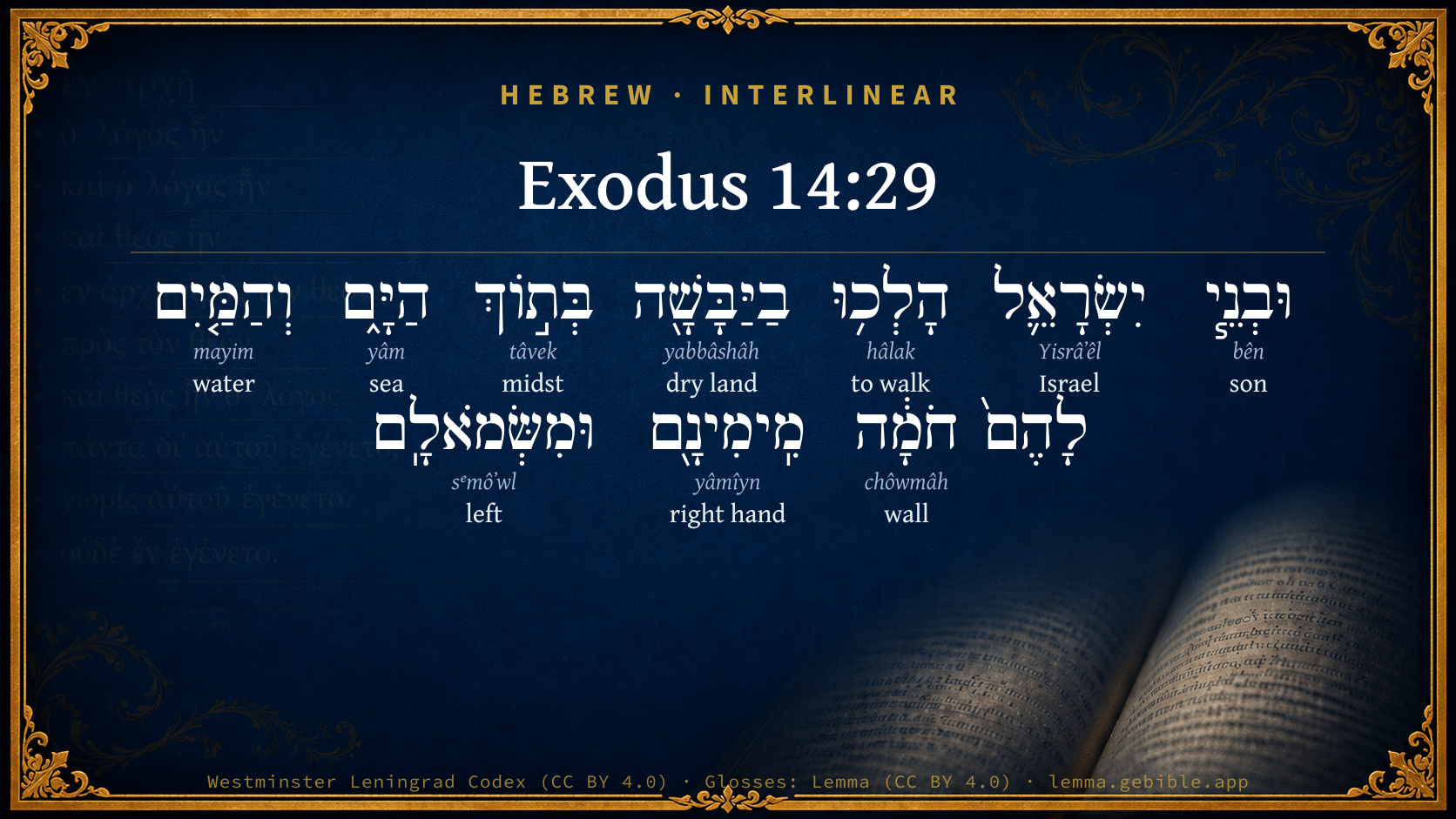
  1. וּבְנֵ֧י bên H1121 “and · sons of” Conjunction + Noun, Common, Masculine, Plural, Construct
  2. יִשְׂרָאֵ֛ל Yisrâʼêl H3478 “Israel” Noun, Proper
  3. הָלְכ֥וּ hâlak H1980 “to walk” Verb, Qal, Perfect, 3rd Person, Common, Plural
  4. בְּת֣וֹךְ tâvek H8432 “in/at · midst of” Preposition + Noun, Common, Masculine, Singular, Construct
  5. הַיָּ֑ם yâm H3220 “the · sea” Particle, Definite Article + Noun, Common, Masculine, Singular, Absolute
  6. וְהַמַּ֤יִם mayim H4325 “and · the · water(s)” Conjunction + Particle, Definite Article + Noun, Common, Masculine, Plural, Absolute
  7. חֹמָ֔ה chôwmâh H2346 “wall” Noun, Common, Feminine, Singular, Absolute
  8. מִֽימִינָ֖ם yâmîyn H3225 “from · right hand · their” Preposition + Noun, Common, Feminine, Singular, Construct + Suffix, Personal, 3rd Person, Masculine, Plural
  9. וּמִשְּׂמֹאלָֽם sᵉmôʼwl H8040 “and · from · left · their” Conjunction + Preposition + Noun, Common, Masculine, Singular, Construct + Suffix, Personal, 3rd Person, Masculine, Plural

About this verse

These counts appear in no published source. They are computed here, from the morphology-tagged text and Lemma’s own curated glosses. What Lemma adds →

11
words
10
distinct lemmas
Pentateuch
section

Notable vocabulary

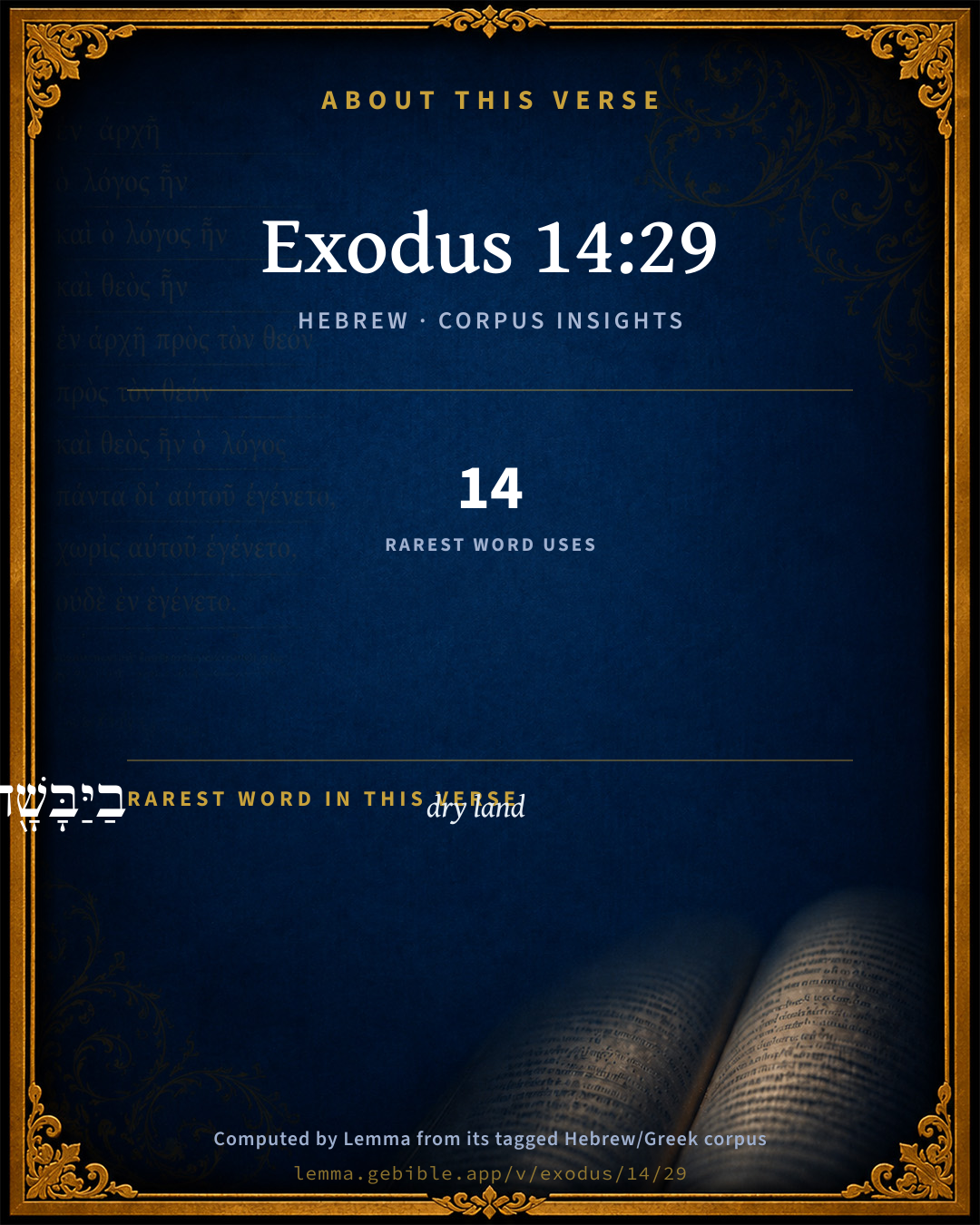
The rarest word here is בַיַּבָּשָׁ֖ה dry land H3004 — appearing just 14 times in the whole Hebrew Bible.

Shared distinctive vocabulary

בַיַּבָּשָׁ֖ה dry land H3004 occurs in 14 verses of the Hebrew Bible. Also found in:

Grammatical profile

  • 1 verb
  • 9 nouns
  • 1 preposition

Verb forms

  • הָלְכ֥וּ Qal · Perfect

Hebrew & Septuagint length

In English translation the verse runs 31 words from the Hebrew and 33 from the Septuagint (LXX English) — closely comparable.

A rough comparison of the two English renderings, which tokenize alike — not a word-level alignment.

Word counts can differ between the Hebrew and the Greek without any difference in meaning — e.g. the Hebrew direct-object marker אֵת has no separate Greek word, and Greek often adds the article ὁ.

Cross-references

10

Topical passages linked to Exodus 14:29 in the Treasury of Scripture Knowledge — connected by theme and wording, ordered by reader-vote popularity; previews shown in the World English Bible.

  • Exodus 14:22 The children of Israel went into the midst of the sea on the dry ground, and the waters were a wall to them on their right hand, and on their left.
  • Joshua 3:16 that the waters which came down from above stood, and rose up in one heap, a great way off, at Adam, the city that is beside Zarethan; and those that went down toward the sea of the Arabah, even the Salt Sea, were wholly cut off: and the people passed over right against Jericho.
  • Job 38:8–11 "Or who shut up the sea with doors, When it broke forth from the womb,
  • Psalms 77:19–20 Your way was through the sea; Your paths through the great waters. Your footsteps were not known.
  • Psalms 78:52–53 But he led forth his own people like sheep, And guided them in the wilderness like a flock.
  • Isaiah 43:2 When you pass through the waters, I will be with you; and through the rivers, they shall not overflow you: when you walk through the fire, you shall not be burned, neither shall the flame kindle on you.
  • Isaiah 51:10 Isn't it you who dried up the sea, the waters of the great deep; who made the depths of the sea a way for the redeemed to pass over?
  • Isaiah 51:13 and have forgotten Yahweh your Maker, who stretched forth the heavens, and laid the foundations of the earth; and fear continually all the day because of the fury of the oppressor, when he makes ready to destroy? and where is the fury of the oppressor?
  • Isaiah 63:12–13 who caused his glorious arm to go at the right hand of Moses? who divided the waters before them, to make himself an everlasting name?
  • Psalms 66:6–7 He turned the sea into dry land. They went through the river on foot. There, we rejoiced in him.

Cross-references courtesy of OpenBible.info (CC BY 4.0).

Hebrew and Greek witnesses Masoretic Hebrew ↔ Greek Septuagint

The same verse in the two great witnesses to the Old Testament, shown verse-for-verse.

These are two independent witnesses, not word-aligned to each other, and the Septuagint is shown in lemma (dictionary) form.

Hebrew Exodus 14:29 Masoretic · Westminster Leningrad Codex

וּבְנֵ֧י יִשְׂרָאֵ֛ל הָלְכ֥וּ בַיַּבָּשָׁ֖ה בְּת֣וֹךְ הַיָּ֑ם וְהַמַּ֤יִם לָהֶם֙ חֹמָ֔ה מִֽימִינָ֖ם וּמִשְּׂמֹאלָֽם

But the children of Israel walked on dry land in the midst of the sea, and the waters were a wall to them on their right hand, and on their left.

World English Bible · Public Domain

Greek LXX Exodus 14:29 Septuagint · lemma form

ὁ δέ υἱός ἰσραήλ πορεύομαι διά ξηρός ἐν μέσος ὁ θάλασσα ὁ δέ ὕδωρ αὐτός τεῖχος ἐκ δεξιός καί τεῖχος ἐκ εὐώνυμος

But the children of Israel went along dry land in the midst of the sea, and the water was to them a wall on the right hand, and a wall on the left.

LXX2012 (modern English Septuagint) · Public Domain

Hebrew: Westminster Leningrad Codex (CC BY 4.0). Greek: Septuagint (public domain); English from LXX2012 (modern English Septuagint) (Public Domain). How the Septuagint differs from the Hebrew →

Targum (Aramaic paraphrase)

2

The Targum is the ancient Jewish Aramaic paraphrase of the Hebrew Scriptures — an interpretive translation, not the Hebrew text itself. Onkelos (literal) and Pseudo-Jonathan (expansive) render the Torah, and Jonathan the Prophets. Coverage is partial: where no permissively-licensed English translation exists for a verse, only the Aramaic is shown. This is verse-level text, not a word-by-word alignment to the Hebrew.

  1. Targum Onkelos Torah (Genesis–Deuteronomy)
    וּבְנֵי יִשְׂרָאֵל הַלִיכוּ בְיַבֶּשְׁתָּא בְּגוֹ יַמָא וּמַיָא לְהוֹן שׁוּרִין מִיַמִינֵהוֹן וּמִסְמָאלֵהוֹן:

    (no public-domain English translation for this verse)

    Targum Onkelos — Aramaic: “Onkelos Genesis” (public domain); “Onkelos Exodus” (public domain); “Onkelos Leviticus” (public domain); “Onkelos Numbers” (public domain); “Onkelos Deuteronomy” (public domain). English: “Sefaria Community Translation” (CC0 1.0 (public-domain dedication)); “J.W. Etheridge. The Targums of Onkelos and Jonathan Ben Uzziel on the Pentateuch. London: Longmans, Green, 1862” (public domain). Text via Sefaria.

  2. Targum Pseudo-Jonathan Torah (Genesis–Deuteronomy)
    וּבְנֵי יִשְרָאֵל הֲלִיכוּ בְּיַבֶּשְׁתָּא בְּגוֹ יַמָא וּמַיָא לְהוֹן הֵי כְשׁוּרִין מִיַמִּינְהוֹן וּמִשְמָאלֵהוֹן

    But the sons of Israel walked on the ground in the midst of the sea, and the waters to them were as walls on their right hand and on their left.

    Targum Pseudo-Jonathan — Aramaic: “Targum Jonathan on Genesis” (public domain); “Targum Jonathan on Exodus” (public domain); “Targum Jonathan on Leviticus” (public domain); “Targum Jonathan on Numbers” (public domain); “Targum Jonathan on Deuteronomy” (public domain). English: “The Targum of Jonathan ben Uzziel, trans. J. W. Etheridge, London, 1862” (public domain). Text via Sefaria.

Commentary

Notes on Exodus 14:29 from classic Christian and Jewish commentators (each source and its license shown beneath its notes). The classic Christian expositions comment on the surrounding passage and are grouped to its opening verse, so a note may address several verses; the Jewish commentaries on the Tanakh (Rashi and others) are per-verse, so they appear only where the commentator wrote on this verse.

Lemma curates 59 commentaries, every one of them public domain or Creative Commons licensed, each selected and text-cleaned for this edition rather than reprinted as found. About our sources →

Trapp's Complete Commentary

John Trapp

Exo 14:29 But the children of Israel walked upon dry [land] in the midst of the sea; and the waters [were] a wall unto them on their right hand, and on their left.

Ver. 29. But the children of Israel walked upon dry land.] This is applied as a type of Christ, {1Co 10:2} to show that Christ is present with his people, to save them in all troubles and afflictions, {Isa 43:2} and from all their spiritual enemies and sins, both by justification and sanctification, {Mic 7:19} through faith in him, {Heb 11:29} and will in the end give them songs of victory and triumph. {Exo 15:1-27 : 1Ki 15:3}

John Trapp, A Commentary or Exposition upon All the Books of the Old and New Testament (1647–1656) — public domain. Text from a community e-Sword module.

The Preacher's Complete Homiletical Commentary

Joseph S. Exell (gen. ed.)

MAIN HOMILETICS OF THE PARAGRAPH.—Exo_14:29-31

THE SALVATION OF THE GOOD

I. That the good are saved while in the very midst of agencies which might be hostile to them. “But the children of Israel walked upon dry land in the midst of the sea.” Thus the Israelites were saved while they were surrounded by the waters of the Red Sea. Their situation was perilous, yet it was sate. The waters were made into a wall of protection. And so the good are saved in this world, even while they are surrounded by sinful men, by influences and maxims which are naturally prejudicial to their moral safety. They are saved in the waters. God makes safe paths in this wicked world for the good to walk in; He makes even the adverse influences of life to minister to the defence of His people. The Israelites were not drowned even though they were surrounded by the waters; the good need not be lost because they are encompassed by sin. Religion enables a man to walk circumspectly in the midst of moral perils, and to go where duty leads. The salvation of God does not take men out of the difficult circumstances of life, but guides through them.

II. That the good are saved notwithstanding all the hindrances and enemies which may pursue them. “Thus the Lord saved Israel that day out of the hand of the Egyptians; and Israel saw the Egyptians dead upon the seashore.” The Israelites had many enemies to their deliverance; they had by Divine aid to overcome many obstacles. And every man has many impediments to his salvation by the grace of God,—he has a carnal mind, a corrupt heart, a wicked companionship, and even the temporal circumstances of life may conspire against him, yet all these shall be overcome by the help of God, as were the Egyptians. The salvation of God is co-extensive with all hindrances and with all enemies,—it gives a man to see all his past sins dead upon the seashore of a new life.

III. That the good are inspired by their salvation with trustful and reverent feelings toward God. “And Israel saw that great work which the Lord did upon the Egyptians: and the people feared the Lord, and believed the Lord, and His servant Moses.” Thus salvation of the soul is a great work, because sin is great, because mercy is great, and because the enemies overcome are great. God is its Author; He only can destroy the Egyptian of sin. Salvation inspires reverence. It awakens trust. It animates with a respect for the ministers of God; the people believed Moses. This is the end of God’s dealings with men, to increase all good duties within them to Himself. Let us never distrust God, or wrong His ministers. Thus we see that the Red Sea which threatened destruction to the Israelites proved the greatest benefit to them. And the pain of correction of sin ends in the joy of salvation. LESSONS:—

1. That the way of salvation is opened up by Christ as was the path to the Red Sea.

2. That men may be saved from all their moral enemies.

3. That the salvation of God should beget reverence and trust within the soul.

4. Are you saved?

SUGGESTIVE COMMENTS ON THE VERSES

Exo_14:29-31. The divided sea is a type of baptism, and, consequently, of all that which is requisite to purify the soul from sin. The Red Sea of the Redeemer’s blood is the abyss into which the sins of believers are so deeply plunged that, if sought for, they can never be found; the sea which swallows up and overwhelms Satan with all his host, and the old man, and quickens in us a new man, who after God is created in righteousness and true holiness. This precious blood of Christ, who offered Himself to God by the Holy Spirit, is that which alone perfectly cleanses our consciences from dead works to serve the living God. Not, indeed, as indispensably necessary as this blood, and the vivifying Spirit inseparably united with it, yet serviceable for the purification from sin, and the mortification of corrupt nature, are the various trials which are not wanting to the true Christian. (Krummacher.)

ILLUSTRATIONS

BY

REV. WM. ADAMSON

Pharaoh’s body! Exo_14:30. At dawn, the surf-beaten shore was strewn with the carcases of Egypt’s chivalry. Among them lay the corpse of the proud and stubborn monarch—a prey to the hosts of vultures that darkened the air, and to the motley groups of wild beasts that lined the shores. The Egyptians considered this as the greatest of all misfortunes; and it was supposed that the soul could find no rest until the body was interred. The ancient poets frequently represented these souls as visiting their friends on earth to announce where their bodies were to be searched for that they might be buried. In Egypt these burials were associated with remarkable ceremonies; but were such for Pharaoh? Apparently, the Israelites took the golden ornaments and jewellery, as well as the richly wrought weapons of the dead; so that Pharaoh’s body would share the fate of the others. The jackals of the desert and the vultures of the air—symbolised by the jackal and vulture-headed colossal stone gods of Thebes—would soon devour them. Near Thebes, the Lybian hills for nearly five miles have been converted into a labyrinth of sepulchres, where all the kings lie in glory—every one in his own house. Among them is the tomb of Pharaoh, the wide extent of whose dominion, at the time of his destruction in the Red Sea, is indicated by five lines of tribute bearers—offering gifts of ivory, apes, leopards, skins, gold, and other valuables. On it are sculptured pictures of masons at work upon monstrous sphinxes—no doubt captive workmen, perhaps Israelite slaves—masses of masonry

“Which now are turned to dust,

And overgrown with black oblivious rust.”

—Spenser.

Deliverance! Exo_14:31. Mr. Bower says that temptations resemble the rocks which rest their jagged sides above the waves when it is low water. No vessel dares come near them. But after a while the tide comes sweeping into the bay, and buries the rocks under a flood of water, so that the largest ships may ride in safety above their teeth of death—as well as the lightest skiff. No doubt Israel thought their difficulties of deliverance very great—incapable on being surmounted; but when the sea of God’s Providence swept in upon the land of Egypt, they were borne high above the jagged rocks towards the haven where He would have them be. Therefore—

“Man’s wisdom is to seek

His strength in God alone;

For e’en an angel would be weak

Who trusted in his own.”

—Cowper.

The Preacher's Complete Homiletical Commentary (gen. ed. Joseph S. Exell; Funk & Wagnalls, c. 1892) — public domain (pre-1929). A full-Bible homiletical/sermon-outline anthology covering 65 of 66 books (2 John is absent from the source module). Text from a community e-Sword module.

The Cambridge Bible for Schools and Colleges

gen. ed. J. J. S. Perowne

29. A repetition, in P’s manner (cf. on Exo_12:17-20), of the substance of the preceding narrative. The expressions, as v. 22, with ‘walked’ for ‘went into, because here the reference is to the entire passage through the Sea.

the dry land] better, the dry ground, as vv. 16, 22, and for distinction from v. 21b J (where the Heb. word is different). So Exo_15:19.

The Cambridge Bible for Schools and Colleges (gen. ed. J. J. S. Perowne; Cambridge University Press, 1878–1918) — public domain. Text from a community e-Sword module.

John Gill's Exposition

But the children of Israel walked upon dry land in the midst of the sea,.... The bottom of it becoming so through the strong east wind, which blew all night until they came to the opposite shore, where they landed on "terra firma"; and so Noldius renders the phrase "through the sea"; that is, from shore to shore:

and the waters were a wall to them on their right hand and on their left; See Gill on Exo 14:22.

John Gill's Exposition of the Whole Bible (1746–1763) — public domain (CC PDM 1.0). Text via the HelloAO Bible API.

The Pulpit Commentary

Walked. Rather, had walked. " The waters were a wall. Rather, had been a wall. " For the meaning of the expression, see note on ver. 22.

The Pulpit Commentary (1880–1919), ed. H.D.M. Spence-Jones & Joseph S. Exell — public domain. Text from a community e-Sword module.

unfoldingWord translationNotes

Door43 World Missions Community

Israel

Each of the occurrences of "Israel" refer to the people of Israel. AT: "the people of Israel" or "the Israelites" (See: Metonymy)

out of the hand of the Egyptians

Here the word "hand" refers to power. AT: "from the Egyptians' power" (See: Metonymy)

on the seashore

"on the land along the edge of the sea"

translationWords

hand

save

power

honor

trust

servant

unfoldingWord translationNotes — © Distant Shores Media and the Door43 World Missions Community, licensed CC BY-SA 4.0. Source: git.door43.org/Door43/en_tn.

Lesson kit

Teaching starters — assembled from the data on this page, not authored interpretation. Every prompt links to the verse data it draws on. Edit before teaching.

Exodus, in the Pentateuch, opens this verse with 11 words (10 distinct Hebrew lemmas). Its most distinctive word is yabbâshâh (“dry land”). A historical commentator’s framing appears above. Read the whole chapter for the surrounding context.

Discussion questions

  1. The word yabbâshâh carries the sense “dry land.” How does it shape the verse?
  2. Genesis 1:9 shares the word «dry land» with this verse. How do the two illuminate each other?
  3. These translations render this verse differently; the difference is in the English rendering, not the original. What questions does that raise?
  4. The verb «הָלְכ֥וּ» is Qal Perfect. How does its form color the action?
  5. Reading how Trapp's Complete Commentary and The Preacher's Complete Homiletical Commentary read this verse, where do the two commentators agree and where do they part?

Things to notice

Reading settings

Reading text

Shown beneath each verse's original-language words.

Old Testament
Old Testament edition

Read the OT as the Masoretic Hebrew (MT) or the Greek Septuagint (LXX).

English shown for the Greek Septuagint (in the Hebrew ↔ Greek comparison).

Comparing translations? Open the Compare panel on any verse page to stack up to four side by side.