Numbers 25:7

Hebrew (Westminster Leningrad Codex) Numbers 25:7 appears in the Hebrew Old Testament. The text above is from the Westminster Leningrad Codex. Each word links to its Strong’s number, a concise gloss, and parsing drawn from the Open Scriptures Hebrew Bible morphology. Click any word for its full Brown-Driver-Briggs (BDB) entry.
Download image
Cite this verse

Numbers 25:7 (World English Bible). Public Domain. Lemma interlinear Bible study tool, https://lemma.gebible.app/v/numbers/25/7.

Show BibTeX & RIS
BibTeX
RIS
English Translation
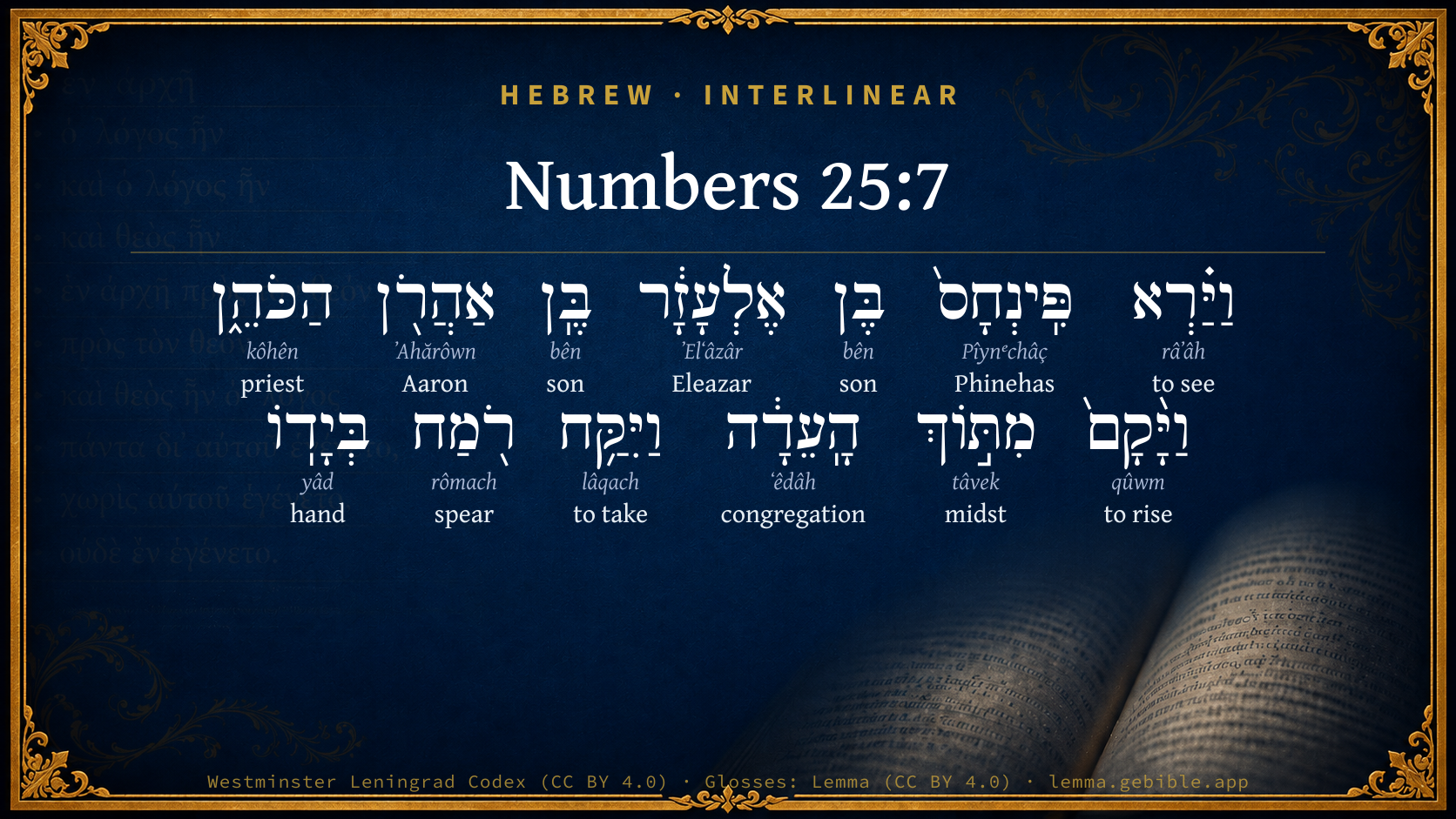
When Phinehas, the son of Eleazar, the son of Aaron the priest, saw it, he rose up from the midst of the congregation, and took a spear in his hand;
World English Bible · Public Domain
Highlights
  • 1 first appearance in the Hebrew Bible
Full analysis ↓
Download a study sheet

One document with this verse’s original text, its word-by-word gloss line, the meaning frame, cross-references with their text, attributed commentary, and full source and license credits — printable, and it pastes into notes with its structure intact.

This verse Autodidact and up

Study sheet (.html) Plain text (.txt)

A passage Seminary Student

Up to 50 verses in one chapter. A passage sheet keeps up to 6 commentary sources and 12 cross-references per verse, in the order this page ranks them, and says so on the sheet whenever that leaves anything out. Ask for a single verse and you get the Autodidact verse sheet above.

Everything on this page stays free to read, with no account — the sheet is a download of what is already on screen, not access to it.

Want to remove ads? Support Godless Engineer
Compare translations 3

The same verse in 3 English versions, stacked beneath the original-language interlinear above. Click any original word for its lexicon entry.

Each is an independent rendering of the whole verse — the interlinear is not word-aligned to these translations.

Highlighted words mark where these versions differ — a whole-verse word diff, not a word-by-word alignment.

  • World English Bible Public Domain
    When Phinehas, the son of Eleazar, the son of Aaron the priest, saw it, he rose up from the midst of the congregation, and took a spear in his hand;
  • King James Version Public Domain
    And when Phinehas, the son of Eleazar, the son of Aaron the priest, saw it, he rose up from among the congregation, and took a javelin in his hand;
  • unfoldingWord Literal Text CC BY-SA 4.0
    And Phinehas the son of Eleazar, the son of Aaron the priest, saw and rose up from the midst of the congregation, and took a spear in his hand.

unfoldingWord Literal Text — © unfoldingWord, licensed CC BY-SA 4.0. Word-aligned USFM3 via Door43 (git.door43.org/unfoldingWord/en_ult).

Versions to compare (up to 4)

3 of 4 selected

Show all 18 translations

Every available English version of this verse, each an independent rendering of the whole verse.

  • World English Bible Public Domain
    When Phinehas, the son of Eleazar, the son of Aaron the priest, saw it, he rose up from the midst of the congregation, and took a spear in his hand;
  • Berean Standard Bible Public Domain
    On seeing this, Phinehas son of Eleazar, the son of Aaron the priest, got up from the assembly, took a spear in his hand,
  • Majority Standard Bible Public Domain
    On seeing this, Phinehas son of Eleazar, the son of Aaron the priest, got up from the assembly, took a spear in his hand,
  • King James Version Public Domain
    And when Phinehas, the son of Eleazar, the son of Aaron the priest, saw it, he rose up from among the congregation, and took a javelin in his hand;
  • American Standard Version (1901) Public Domain
    And when Phinehas, the son of Eleazar, the son of Aaron the priest, saw it, he rose up from the midst of the congregation, and took a spear in his hand;
  • Revised Version (1885) Public Domain
    And when Phinehas, the son of Eleazar, the son of Aaron the priest, saw it, he rose up from the midst of the congregation, and took a spear in his hand;
  • Geneva Bible (1599) Public Domain
    And when Phinehas the sonne of Eleazar the sonne of Aaron the Priest sawe it, hee rose vp from the middes of the Congregation, and tooke a speare in his hand,
  • Douay-Rheims (1899) Public Domain
    And when Phinees the son of Eleazar the son of Aaron the priest saw it, he rose up from the midst; of the multitude, and taking a dagger,
  • Young's Literal Translation Public Domain
    and Phinehas, son of Eleazar, son of Aaron, the priest, seeth, and riseth from the midst of the company, and taketh a javelin in his hand,
  • Literal Standard Version CC BY-SA 4.0
    and Phinehas, son of Eleazar, son of Aaron the priest, sees, and rises from the midst of the congregation, and takes a javelin in his hand,
  • Unlocked Literal Bible CC BY-SA 4.0
    When Phinehas son of Eleazar son of Aaron the priest, saw that, he rose up from among the community and took a spear in his hand.
  • unfoldingWord Literal Text CC BY-SA 4.0
    And Phinehas the son of Eleazar, the son of Aaron the priest, saw and rose up from the midst of the congregation, and took a spear in his hand.
  • Darby Bible Public Domain
    And Phinehas, the son of Eleazar, the son of Aaron the priest, saw it, and rose up from among the assembly, and took a javelin in his hand,
  • World Messianic Bible Public Domain
    When Phinehas, the son of Eleazar, the son of Aaron the priest, saw it, he rose up from the middle of the congregation, and took a spear in his hand.
  • Webster's Bible Public Domain
    And when Phinehas, the son of Eleazar, the son of Aaron the priest, saw it, he rose from among the congregation, and took a javelin in his hand;
  • Free Bible Version CC BY-SA 4.0
    When he saw this, Phinehas, son of Eleazar, the son of Aaron the priest, left the assembly, grabbed a spear
  • Bible in Basic English Public Domain
    And Phinehas, the son of Eleazar, the son of Aaron the priest, seeing it, got up from among the people and took a spear in his hand,
  • JPS Tanakh (1917) Public Domain
    And when Phinehas, the son of Eleazar, the son of Aaron the priest, saw it, he rose up from the midst of the congregation, and took a spear in his hand.

Literal Standard Version (2020), Covenant Press — licensed CC BY-SA 4.0. Text via the HelloAO Bible API (eBible.org). Unlocked Literal Bible (unfoldingWord) — licensed CC BY-SA 4.0. Text via the HelloAO Bible API (eBible.org). unfoldingWord Literal Text — © unfoldingWord, licensed CC BY-SA 4.0. Word-aligned USFM3 via Door43 (git.door43.org/unfoldingWord/en_ult). Free Bible Version, Dr. Jonathan Gallagher — licensed CC BY-SA 4.0. Text via the HelloAO Bible API (eBible.org).

Word by word

More ways to search: Search by grammar → Find every occurrence → Compare this word →

Practice this passage: Drill this verse → Learn its vocabulary →

רֹ֖מַח
rômach
H7420
“spear”
Noun, Common, Masculine, Singular, Absolute
Part of Speech
Noun
Type
Common
Gender
Masculine
Number
Singular
State
Absolute
Full BDB Definition

Origin: from an unused root meaning to hurl

TWOT: 2172

spear, lance
  1. וַיַּ֗רְא râʼâh H7200 “and · to see” Conjunction + Verb, Qal, Sequential Imperfect, 3rd Person, Masculine, Singular
  2. פִּֽינְחָס֙ Pîynᵉchâç H6372 “Phinehas” Noun, Proper
  3. בֶּן bên H1121 “son of” Noun, Common, Masculine, Singular, Construct
  4. אֶלְעָזָ֔ר ʼElʻâzâr H499 “Eleazar” Noun, Proper
  5. בֶּֽן bên H1121 “son of” Noun, Common, Masculine, Singular, Construct
  6. אַהֲרֹ֖ן ʼAhărôwn H175 “Aaron” Noun, Proper
  7. הַכֹּהֵ֑ן kôhên H3548 “the · priest” Particle, Definite Article + Noun, Common, Masculine, Singular, Absolute
  8. וַיָּ֨קָם֙ qûwm H6965 “and · to rise” Conjunction + Verb, Qal, Sequential Imperfect, 3rd Person, Masculine, Singular
  9. מִתּ֣וֹךְ tâvek H8432 “from · midst of” Preposition + Noun, Common, Masculine, Singular, Construct
  10. הָֽעֵדָ֔ה ʻêdâh H5712 “the · congregation” Particle, Definite Article + Noun, Common, Feminine, Singular, Absolute
  11. וַיִּקַּ֥ח lâqach H3947 “and · to take” Conjunction + Verb, Qal, Sequential Imperfect, 3rd Person, Masculine, Singular
  12. בְּיָדֽוֹ yâd H3027 “in/at · hand · his” Preposition + Noun, Common, Both, Singular, Construct + Suffix, Personal, 3rd Person, Masculine, Singular

About this verse

These counts appear in no published source. They are computed here, from the morphology-tagged text and Lemma’s own curated glosses. What Lemma adds →

13
words
12
distinct lemmas
Pentateuch
section

Notable vocabulary

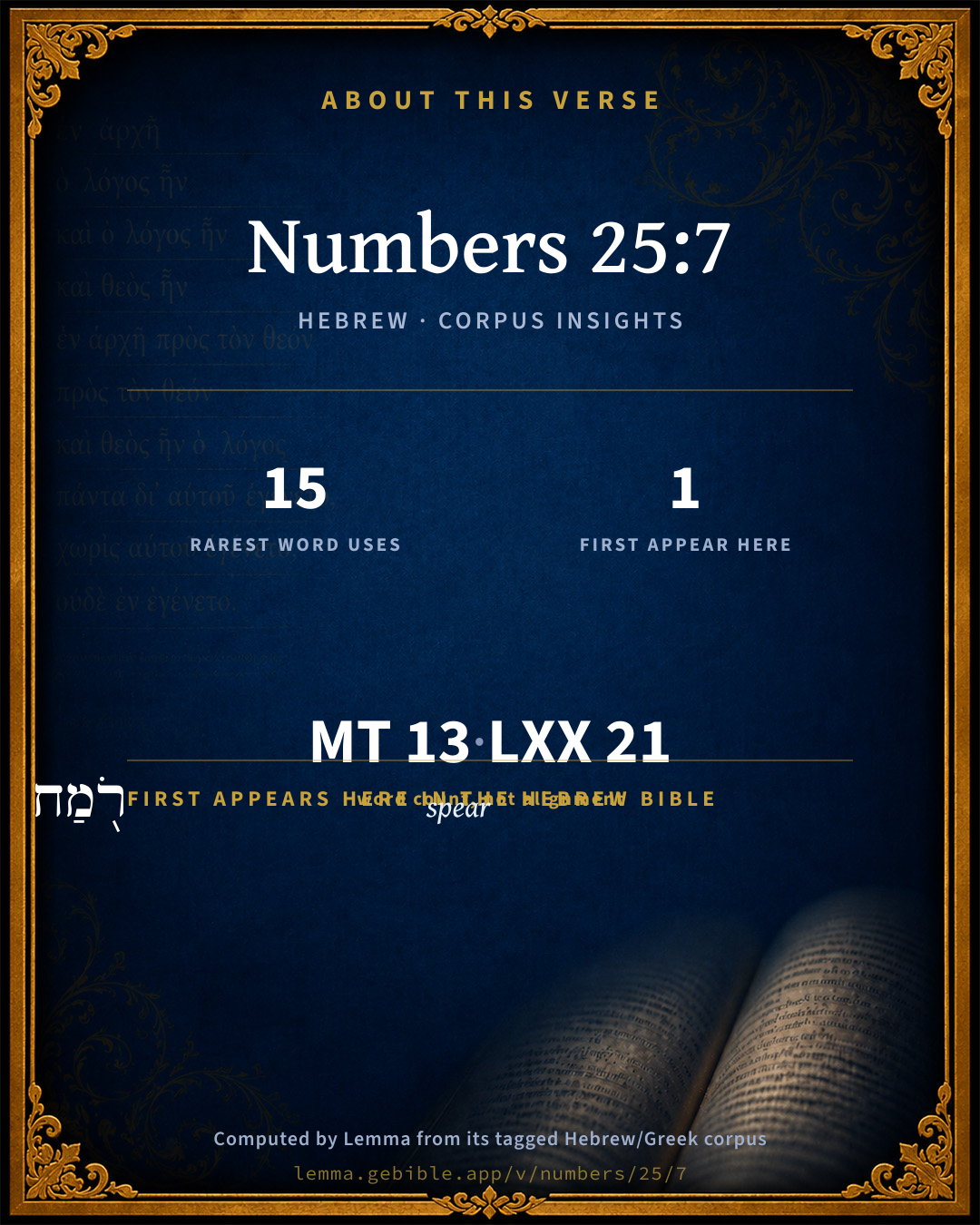
The rarest word here is רֹ֖מַח spear H7420 — appearing just 15 times in the whole Hebrew Bible.

First appearance in Scripture

This word makes its first canonical appearance in the Hebrew Bible here:

  • רֹ֖מַח spear H7420

Shared distinctive vocabulary

רֹ֖מַח spear H7420 occurs in 15 verses of the Hebrew Bible. Also found in:

Grammatical profile

  • 3 verbs
  • 10 nouns

Verb forms

  • וַיַּ֗רְא Qal · Sequential Imperfect
  • וַיָּ֨קָם֙ Qal · Sequential Imperfect
  • וַיִּקַּ֥ח Qal · Sequential Imperfect

Repetition

A word recurs within this verse — often emphatic in Hebrew:

Hebrew & Septuagint length

In English translation the verse runs 30 words from the Hebrew and 30 from the Septuagint (LXX English) — the same length.

A rough comparison of the two English renderings, which tokenize alike — not a word-level alignment.

Word counts can differ between the Hebrew and the Greek without any difference in meaning — e.g. the Hebrew direct-object marker אֵת has no separate Greek word, and Greek often adds the article ὁ.

In the original languages it is 13 Hebrew tokens and 21 Greek tokens — but the two are counted differently (Hebrew bundles its prefixes and suffixes into one token; the Greek is in lemma form), so that isn’t a like-for-like length.

Cross-references

6

Topical passages linked to Numbers 25:7 in the Treasury of Scripture Knowledge — connected by theme and wording, ordered by reader-vote popularity; previews shown in the World English Bible.

  • Exodus 6:25 Eleazar Aaron's son took one of the daughters of Putiel as his wife; and she bore him Phinehas. These are the heads of the fathers' houses of the Levites according to their families.
  • Joshua 22:30–31 When Phinehas the priest, and the princes of the congregation, even the heads of the thousands of Israel that were with him, heard the words that the children of Reuben and the children of Gad and the children of Manasseh spoke, it pleased them well.
  • Judges 20:28 and Phinehas, the son of Eleazar, the son of Aaron, stood before it in those days), saying, Shall I yet again go out to battle against the children of Benjamin my brother, or shall I cease? Yahweh said, Go up; for tomorrow I will deliver him into your hand.
  • 1 Samuel 18:10–11 It happened on the next day, that an evil spirit from God came mightily on Saul, and he prophesied in the midst of the house: and David played with his hand, as he did day by day. Saul had his spear in his hand;
  • 1 Samuel 19:9 An evil spirit from Yahweh was on Saul, as he sat in his house with his spear in his hand; and David was playing with his hand.
  • Psalms 106:30 Then Phinehas stood up, and executed judgment, So the plague was stopped.

Cross-references courtesy of OpenBible.info (CC BY 4.0).

Hebrew and Greek witnesses Masoretic Hebrew ↔ Greek Septuagint

The same verse in the two great witnesses to the Old Testament, shown verse-for-verse.

These are two independent witnesses, not word-aligned to each other, and the Septuagint is shown in lemma (dictionary) form.

Hebrew Numbers 25:7 Masoretic · Westminster Leningrad Codex

וַיַּ֗רְא פִּֽינְחָס֙ בֶּן אֶלְעָזָ֔ר בֶּֽן אַהֲרֹ֖ן הַכֹּהֵ֑ן וַיָּ֨קָם֙ מִתּ֣וֹךְ הָֽעֵדָ֔ה וַיִּקַּ֥ח רֹ֖מַח בְּיָדֽוֹ

When Phinehas, the son of Eleazar, the son of Aaron the priest, saw it, he rose up from the midst of the congregation, and took a spear in his hand;

World English Bible · Public Domain

Greek LXX Numbers 25:7 Septuagint · lemma form

καί ὁράω φινεες υἱός ελεαζαρ υἱός ἀαρών ὁ ἱερεύς ἐκ ἀναἵστημι ἐκ μέσος ὁ συναγωγή καί λαμβάνω σειρομάστης ἐν ὁ χείρ

And Phinees the son of Eleazar, the son of Aaron the priest, saw it, and rose out of the midst of the congregation, and took a javelin in his hand,

LXX2012 (modern English Septuagint) · Public Domain

On this verse, Haydock's Catholic Bible Commentary discusses the Septuagint’s reading. Read the note in Commentary ↓

Hebrew: Westminster Leningrad Codex (CC BY 4.0). Greek: Septuagint (public domain); English from LXX2012 (modern English Septuagint) (Public Domain). How the Septuagint differs from the Hebrew →

Targum (Aramaic paraphrase)

2

The Targum is the ancient Jewish Aramaic paraphrase of the Hebrew Scriptures — an interpretive translation, not the Hebrew text itself. Onkelos (literal) and Pseudo-Jonathan (expansive) render the Torah, and Jonathan the Prophets. Coverage is partial: where no permissively-licensed English translation exists for a verse, only the Aramaic is shown. This is verse-level text, not a word-by-word alignment to the Hebrew.

  1. Targum Onkelos Torah (Genesis–Deuteronomy)
    וַחֲזָא פִּינְחָס בַּר אֶלְעָזָר בַּר אַהֲרֹן כַּהֲנָא וְקָם מִגוֹ כְנִשְׁתָּא וּנְסֵיב רוֹמְחָא בִידֵיהּ

    (no public-domain English translation for this verse)

    Targum Onkelos — Aramaic: “Onkelos Genesis” (public domain); “Onkelos Exodus” (public domain); “Onkelos Leviticus” (public domain); “Onkelos Numbers” (public domain); “Onkelos Deuteronomy” (public domain). English: “Sefaria Community Translation” (CC0 1.0 (public-domain dedication)); “J.W. Etheridge. The Targums of Onkelos and Jonathan Ben Uzziel on the Pentateuch. London: Longmans, Green, 1862” (public domain). Text via Sefaria.

  2. Targum Pseudo-Jonathan Torah (Genesis–Deuteronomy)
    וַחֲמָא פִּינְחָס בַּר אֶלְעָזָר בַּר אַהֲרן כַּהֲנָא וְאִידְכַּר הִילְכְתָא עָנֵי וַאֲמַר מַאן דְיִקְטוֹל וְקָטִיל הָאן אִינוּן אַרְיְוָתָא דְשֵׁיבַט יְהוּדָה כֵּיוַן דְחַמְנוּן שַׁתְקִין קָם מִגוֹ סַנְהֶדְרֵי דִילֵיהּ וּנְסֵיב רוּמְחָא בִּידֵיהּ

    And Phinehas bar Elazar-bar Aharon, the priest, saw, and, remembering the ordination, answered, and said: He who ought to kill, let him kill! Where are the lions of the tribe of Jehudah? When they saw, they were quiet. And he arose from among his Sanhedrin, and took a lance in his hand.

    Targum Pseudo-Jonathan — Aramaic: “Targum Jonathan on Genesis” (public domain); “Targum Jonathan on Exodus” (public domain); “Targum Jonathan on Leviticus” (public domain); “Targum Jonathan on Numbers” (public domain); “Targum Jonathan on Deuteronomy” (public domain). English: “The Targum of Jonathan ben Uzziel, trans. J. W. Etheridge, London, 1862” (public domain). Text via Sefaria.

Commentary

Notes on Numbers 25:7 from classic Christian and Jewish commentators (each source and its license shown beneath its notes). The classic Christian expositions comment on the surrounding passage and are grouped to its opening verse, so a note may address several verses; the Jewish commentaries on the Tanakh (Rashi and others) are per-verse, so they appear only where the commentator wrote on this verse.

Lemma curates 59 commentaries, every one of them public domain or Creative Commons licensed, each selected and text-cleaned for this edition rather than reprinted as found. About our sources →

Trapp's Complete Commentary

John Trapp

Num 25:7 And when Phinehas, the son of Eleazar, the son of Aaron the priest, saw [it], he rose up from among the congregation, and took a javelin in his hand;

Ver. 7. He rose up.] A heroical act, by an extraordinary motion: as was also that of Ehud; and therefore is not to be made a rule of practice, as Burchet conceited, when by this example he held himself warranted to kill a great personage in this kingdom, whom he took to be a vicious man, and God’s enemy.

John Trapp, A Commentary or Exposition upon All the Books of the Old and New Testament (1647–1656) — public domain. Text from a community e-Sword module.

Joseph Benson's Commentary

Num 25:7. Phinehas rose up — The psalmist says, He stood up and executed judgment; which seems to import that he acted as a judge; but in a crime so presumptuous, and so openly committed, he thought it not necessary to wait for a judicial process against the offenders, but cut them off directly with his own hand. It is thought too, not without reason, that the number and dignity of the offenders intimidated the judges from executing their office. So that unless Phinehas, by this seasonable zeal for God, and the interests of the public, had supported the authority of the laws, either a total anarchy had ensued, or the whole body of the people been exposed to the severest judgments from God.

Joseph Benson's Commentary on the Old and New Testaments (1811–1818) — public domain. Text from a community e-Sword module.

Tyndale Open Study Notes

Tyndale Open Resources

25:7-9 Phinehas, acting as a representative of the priestly family, killed Zimri and Cozbi with one thrust of a spear (25:7-8), which probably indicates that they were engaged in sexual intercourse. Phinehas’s zeal stopped the plague (25:1-3).

Tyndale Open Study Notes — © Tyndale Open Resources, licensed CC BY-SA 4.0. Text via the HelloAO Bible API.

Geneva Bible (1599)

Geneva Bible translators

Or, javelin.

Geneva Bible (1599) marginal notes — public domain. Text via Bolls.life.

Ellicott's Commentary for English Readers

(7) And when Phinehas, the son of Eleazar, the son of Aaron the priest . . . —In accordance with this punctuation, the designation the priest (which generally denotes the high priest) refers to Aaron, not to Phinehas. Eleazar was the high priest at this time (Num_20:26); and consequently—although as a general rule any designation which follows the words “the son of such an one” refers to the former, not to the latter noun—it appears most probable that the designation the priest has reference here to Aaron, not to Phinehas, who, although a priest, was not the high priest at this time. He was invested, however, with civil as well as ecclesiastical authority. (See 1Ch_9:20, where he is described as a ruler—Hebrew, nagid.)

A Bible Commentary for English Readers, edited by Charles John Ellicott (1878–1897) — public domain. Text from a community e-Sword module.

John Gill's Exposition

And when Phinehas, the son of Eleazar, the son of Aaron the priest, saw it,.... Saw the man pass by in this impudent manner, and his whore with him; his spirit was stirred up, he was filled and fired with zeal for the glory of God, and with an holy indignation against the sin and sinner, and with a just concern for the honour of the righteous law of God; and, to prevent others from falling into the same sin, led by the public example of so great a personage, as it appears afterwards this man was:

he rose up from among the congregation; who were weeping at the door of the tabernacle, or from the midst of the court of judicature, set for trying and judging such persons who were charged with idolatry; for he was not only the son of the high priest and his successor, but a ruler over the Korahites, and had, besides his priestly office, a civil authority, Ch1 9:20.

and took a javelin in his hand; a spear or pike; the Jews say (y) he snatched it out of the hand of Moses; and, according to Josephus (z), it was a sword; but the word rather signifies an hand pike; this being ready at hand, he took it up and pursued the criminal.

(y) Pirke Eliezer, c. 47. fol. 56. 1. (z) Antiqu. l. 4. c. 6. sect. 12.

John Gill's Exposition of the Whole Bible (1746–1763) — public domain (CC PDM 1.0). Text via the HelloAO Bible API.

Haydock's Catholic Bible Commentary

Dagger. Josephus translates romach, by romphaia, "a sword." Septuagint by seiromasten, a long and sharp iron rod, like a spit, such as people used to try if any smuggled goods be concealed. (Haydock) --- It denotes any sort of offensive weapon. (Calmet) --- The Vulgate sometimes translates, a lance or spear. (Menochius)

George Leo Haydock (1774–1849), Haydock's Catholic Family Bible and Commentary, 1859 edition — public domain. Excludes Psalms (Douay-Rheims chapter numbering differs from Protestant) and Deuterocanonical books (Catholic canon only).

The Pulpit Commentary

Phinehas, the son of Eleazar. See on Exo_6:25. He seems to have been the only son of Eleazar, and his natural successor in the office of high priest.

NOTE ON THE ZEAL OF PHINEHAS.

The act of Phinehas, the son of Eleazar, in slaying Zimri and Cozbi is one of the most memorable in the Old Testament; not so much, however, in itself, as in the commendation bestowed upon it by God. It is unquestionably surprising at first sight that an act of unauthorized zeal, which might so readily be made (as indeed it was made) the excuse for deeds of murderous fanaticism, should be commended in the strongest terms by the Almighty; that an act of summary vengeance, which we find it somewhat hard to justify on moral grounds, should be made in a peculiar sense and in a special degree the pattern of the great atonement wrought by the Saviour of mankind; but this aspect of the deed in the eyes of God by its very unexpectedness draws our attention to it, and obliges us to consider wherein its distinctive religious character and excellence lay.

It is necessary in the first place to point out that the act of Phinehas did really receive stronger testimony from God than any other act done proprio motu in the Old Testament. What he did was not done officially (for he held no office), nor was it clone by command (for the offenders were not under his jurisdiction as judge), nor in fulfillment of any revealed law or duty (for no blame would have attached to him if he had let it alone), and yet it had the same effect in staying the plague as the act of Aaron when he stood between the living and the dead with the hallowed fire in his hand. (see on Num_16:46-48) Of both it is said that "he made an atonement for the people," and so far they both appear as having power with God to turn away his wrath and stay his avenging hand. But the atonement made by Aaron was official, for he was the anointed high priest, and, being made with incense from the sanctuary, it was mate in accordance with and upon the strength of a ceremonial law laid down by God whereby he had bound himself to exercise his Divine right of pardon. The act of Phinehas, on the contrary, had no legal or ritual value; there is no power of atonement in the blood of sinners, nor had the death of 24, 000 guilty people had any effect in turning away the wrath of God from them that survived. It remains, therefore, a startling truth that the deed of Phinehas is the only act neither official nor commanded, but originating in the impulses of the actor himself, to which the power of atoning for sin is ascribed in the Old Testament: for although in 2Sa_21:3 David speaks of making an atonement by giving up seven of Saul"s sons, it is evident from the context that the "atonement" was made to the Gibeonites, and not directly to the Lord. Again, the act of Phinehas merited the highest reward from God, a reward which was promised to him in the most absolute terms. Because he had clone this thing he should have God"s covenant of peace, he and his seed after him, even the covenant of an everlasting priesthood. This promise must mean that he and his seed should have power with God for ever to make peace between heaven and earth, and to make reconciliation for the sins of the people; and, meaning this, it is a republication in favour of Phinehas, and in more absolute terms, of the covenant made with Levi as represented by Aaron. (see on Mal_2:4, Mal_2:5) Nor is this all. In Psa_106:31 it is said of his deed that "it was counted unto him for righteousness unto all generations forevermore." This word "counted" or "imputed" is the same (bvj) which is used of Abraham in Gen_15:6, and the very words of the Septuagint here (elogisyh autw eiv dikaiosunhn ) are applied to the obedience of Abraham in Jam_2:23. It appears then that righteousness was imputed to Phinehas, as to the father of the faithful, with this distinction, that to Phinehas it was imputed as an everlasting righteousness, which is not said of Abraham. Now if we compare the two, it must be evident that the act of Phinehas was not, like Abraham"s, an act of self-sacrificing obedience, nor in any special sense an act of faith. While both acted under the sense of duty, the following of duty in Abraham"s case put the greatest possible strain upon all the natural impulses of mind and heart; in the case of Phinehas it altogether coincided with the impulses of his own will. If faith was imputed to Abraham for righteousness, it is clear that zeal was imputed to Phinehas for righteousness for evermore.

This being so, it is necessary in the second place to point out that the act in question (like that of Abraham in sacrificing his son) was distinctly one of moral virtue according to the standard then Divinely allowed. An act which was in itself wrong, or of doubtful rectitude, could not form the ground for such praise and promise, even supposing that they really looked far beyond the act itself. Now it is clear

(1) that under no circumstances would a similar act be justifiable now;

(2) that no precedent could be established by it then.

The Jews indeed feigned a "zealot-right," examples of which they saw (amongst others) in the act of Samuel slaying Agag, (1Sa_15:33) of Mattathias slaying the idolatrous Jew and the king"s commissioner, (RAPC 1Ma 2:24-26) of the Sanhedrim slaying St. Stephen. But the last-mentioned case is evidence enough that in the absence of distinct Divine guidance zeal is sure to degenerate into fanaticism, or rather that it is impossible to distinguish zeal from fanaticism. Every such act must of necessity stand upon its own merits, for it can only be justified by the coexistence of two conditions which are alike beyond human certainty:

(1) that the deed is itself in accordance with the will of God;

(2) that the doing of it is inspired by motives, absolutely pure.

That Christ came to save men"s lives, and that God would have all men to repent, has made for us the primary condition impossible, and therefore the act of Phinehas would be immoral now. No one may take life unless he has the mandate of the State for doing" so. But it was not so then; God was the King of Israel, and the foes of Israel were the foes of God, with whom there could be no peace or amity as long as they threatened the very existence of God"s people and worship. The Israelite who indulged in sinful intercourse with a heathen was a rebel against his King and a traitor to his country; he became ipso facto an "outlaw," to slay whom was the bounden duty of every true patriot. If it be said that this view of things belongs to an inferior code of morality, which ignored the universal brotherhood of men and Fatherhood of God, that is admitted at once. The elder revelation founded itself plainly and avowedly upon the moral law as then universally held (and by no means supplanted yet by the higher law of Christ), that men were to love their brethren and hate their enemies. To complain that the act of Phinehas was moral in a Jewish and not in a Christian sense is only to find fault with God for suffering a confessedly imperfect and preparatory morality to do its work until the fullness of time was come.

While, therefore, we recognize the act of Phinehas as one determined, in its outward form, by the imperfect morality of the dispensation under which he lived, it is necessary to look below the act to the spirit which animated it for its permanent value and significance. That spirit is clearly defined by the testimony of God he was zealous with my zeal." The excellence of Phinehas was, that he was filled with a zeal which was itself Divine against sin, and that he acted fearlessly and promptly (whilst others apparently hesitated even when commanded) under the impulse of that zeal; in other words, what pleased God so greatly was to see his own hatred of sin, and his own desire to make it to cease, reflected in the mind and expressed in the deed of one who acted upon righteous impulse, not under any command or constraint.

It is impossible, in the third place, not to see that this record throws a flood of light upon the doctrine of the atonement; for the act of Phinehas stands, in some respects, upon a higher level than all the types and shadows of the cross which had gone before; being neither an act of submission to a definite command, like the sacrifice of Isaac, nor a piece of ordered ritual, like the sending forth of the goat for Azazel; but a spontaneous deed, having a moral value of its own. Partly at least for the sake of what it was, not merely what it showed in a figure, it was accepted as an atonement for the sin of Israel (which was very gross), and was imputed to its author for an everlasting righteousness. Phinehas, therefore, in one very important sense, would seem to bear a stronger resemblance to our Lord in his atoning work than any other person in the Old Testament. It may therefore be submitted that we must seek the truest ground of the atonement wrought by Christ not in the simple fact of the passion and death of the God-man, nor in the greatness or value of his sufferings as such; but in that zeal for God, that Divine indignation against sin as the opposite of God, that consuming desire to cause it to cease, which first animated the life of the Redeemer, and then informed his death. Phinehas in his measure, and according to his lights, was governed by the same Spirit, and surrendered himself to the prompting of the same Spirit, by which Christ offered himself without spot unto God. And that Spirit was the Spirit of a consuming zeal, wherein our Lord hastened with an entire eagerness of purpose (Luk_12:50 Joh_2:17 Joh_12:27, Joh_12:28, &c.); to "condemn sin in the flesh" and so to glorify God, and to accomplish the object of his mission, (Rom_8:3) not by the summary execution of individual sinners, but after an infinitely higher fashion, by the sacrifice of himself as the representative of the whole sinful race.

Lastly, it must be noted that as the act of Phinehas enables us, almost more than anything else, to enter into the nature of our Lord"s atonement, so it is only in the light of that atonement that we can justify to ourselves either the strength of the Divine commendation accorded to Phinehas, or the vastness of the promises made to him. For the deed was after all an act of violence, and a dangerous precedent, humanly speaking; and, on the other hand, the covenant of peace given to him and to his seed, even the covenant of an everlasting priesthood, failed to give any peace at all, save in a very broken and partial manner, and did not even continue in the keeping of his family. As the house of Eleazar was the elder of the two descended from Aaron, it would have been only natural that the high priestly dignity should remain with its members; as a fact, however, it passed to the house of Ithamar from the days of Eli until Solomon, for political reasons, deposed Abiathar in favour of Zadok; and it was lost for ever with the final fall of Jerusalem. As in so many cases, therefore, we have to acknowledge that the act of Phinehas was accepted as an atonement for the sake of that truer atonement which (in a remarkable sense) it anticipated; and that the promises given to Phinehas were only partially intended and partially fulfilled for him, while the true and eternal fulfillment was reserved for him of whom Phinehas was a figure. To Christ, in whom was combined an entire zeal against sin and an entire love for the sinner, was indeed given God"s covenant of peace and an everlasting priesthood.

The Pulpit Commentary (1880–1919), ed. H.D.M. Spence-Jones & Joseph S. Exell — public domain. Text from a community e-Sword module.

Rashi

Rabbi Shlomo Yitzchaki (Rashi)

וירא פנחס AND PHINEAS SAW — He saw what was being done and he was thereby reminded of the law on this subject (Sanhedrin 82a). He said to Moses, “I have received a tradition from you: he who has intercourse with an Aramean (heathen) woman, zealous people may attack him”. He replied to him: “Let him who reads the letter be the agent for executing it”; — straightway, ויקח רמח בידו HE TOOK A JAVELIN IN HIS HAND, etc. (Sanhedrin 82a).

Rashi on the Tanakh — English translations: “The Judaica Press complete Tanach with Rashi, translated by A. J. Rosenberg” (CC BY 4.0); “Pentateuch with Rashi's commentary by M. Rosenbaum and A.M. Silbermann, 1929-1934” (public domain); “The Metsudah Tanach series, Lakewood, N.J” (CC BY 4.0); and “The Book of Joshua, Metsudah Publications, 1997” (CC BY 4.0). Text via Sefaria.

Lesson kit

Teaching starters — assembled from the data on this page, not authored interpretation. Every prompt links to the verse data it draws on. Edit before teaching.

Numbers, in the Pentateuch, opens this verse with 13 words (12 distinct Hebrew lemmas). Its most distinctive word is rômach (“spear”). A historical commentator’s framing appears above. Read the whole chapter for the surrounding context.

Discussion questions

  1. The word rômach carries the sense “spear.” How does it shape the verse?
  2. The word “spear” first appears here in Scripture. What is being introduced at this debut?
  3. Judges 5:8 shares the word «spear» with this verse. How do the two illuminate each other?
  4. “son” occurs 2× in this one verse. What is the effect of the repetition?
  5. These translations render this verse differently. What is at stake in choosing one wording over another?
  6. The verb «וַיַּ֗רְא» is Qal Sequential Imperfect. How does its form color the action?
  7. Reading how Trapp's Complete Commentary and Joseph Benson's Commentary read this verse, where do the two commentators agree and where do they part?

Things to notice

Reading settings

Reading text

Shown beneath each verse's original-language words.

Old Testament
Old Testament edition

Read the OT as the Masoretic Hebrew (MT) or the Greek Septuagint (LXX).

English shown for the Greek Septuagint (in the Hebrew ↔ Greek comparison).

Comparing translations? Open the Compare panel on any verse page to stack up to four side by side.