Joshua 16:9

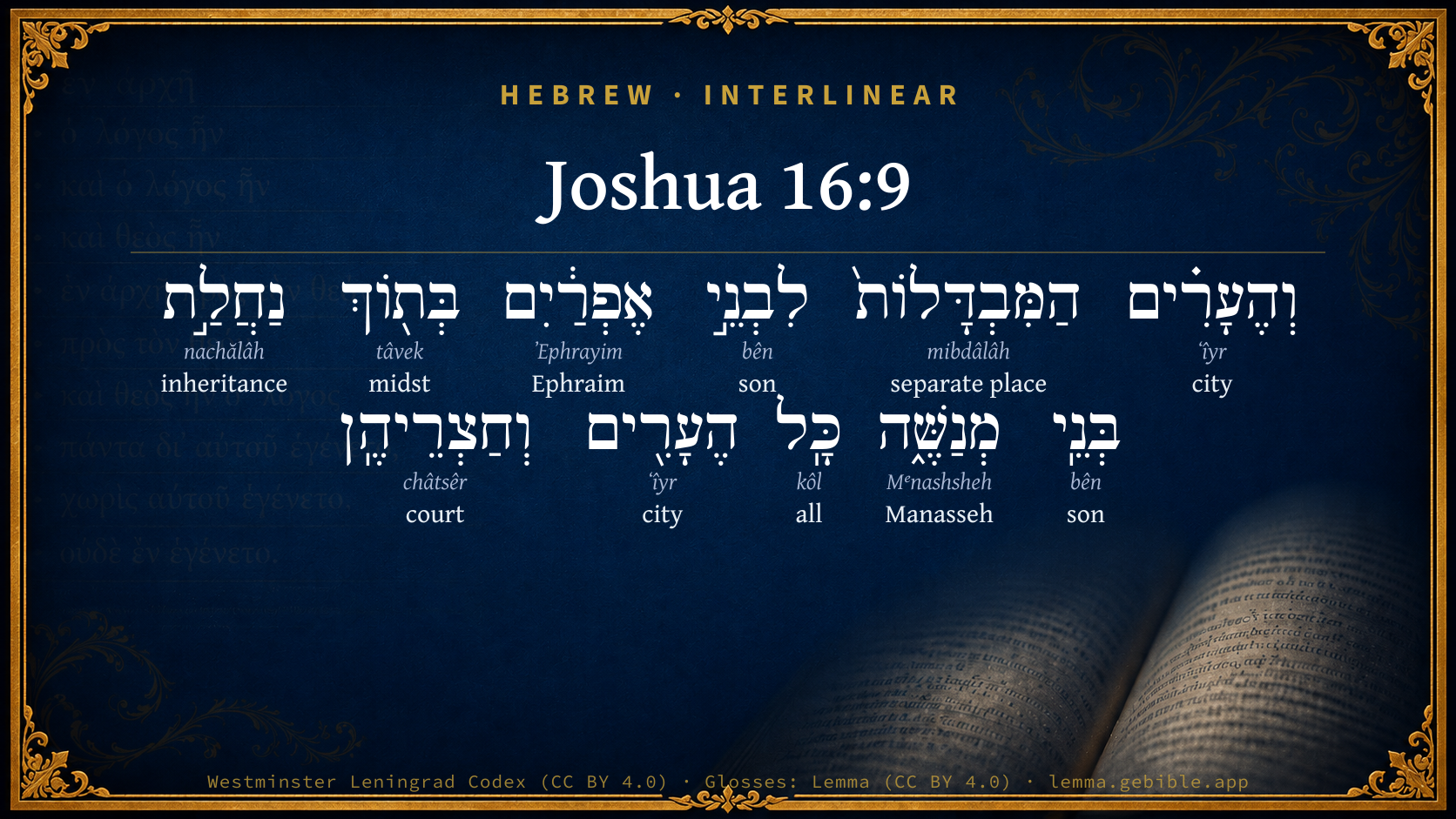
Hebrew (Westminster Leningrad Codex) Joshua 16:9 appears in the Hebrew Old Testament. The text above is from the Westminster Leningrad Codex. Each word links to its Strong’s number, a concise gloss, and parsing drawn from the Open Scriptures Hebrew Bible morphology. Click any word for its full Brown-Driver-Briggs (BDB) entry.
Download image
Cite this verse

Joshua 16:9 (World English Bible). Public Domain. Lemma interlinear Bible study tool, https://lemma.gebible.app/v/joshua/16/9.

Show BibTeX & RIS
BibTeX
RIS
English Translation
together with the cities which were set apart for the children of Ephraim in the midst of the inheritance of the children of Manasseh, all the cities with their villages.
World English Bible · Public Domain
Highlights
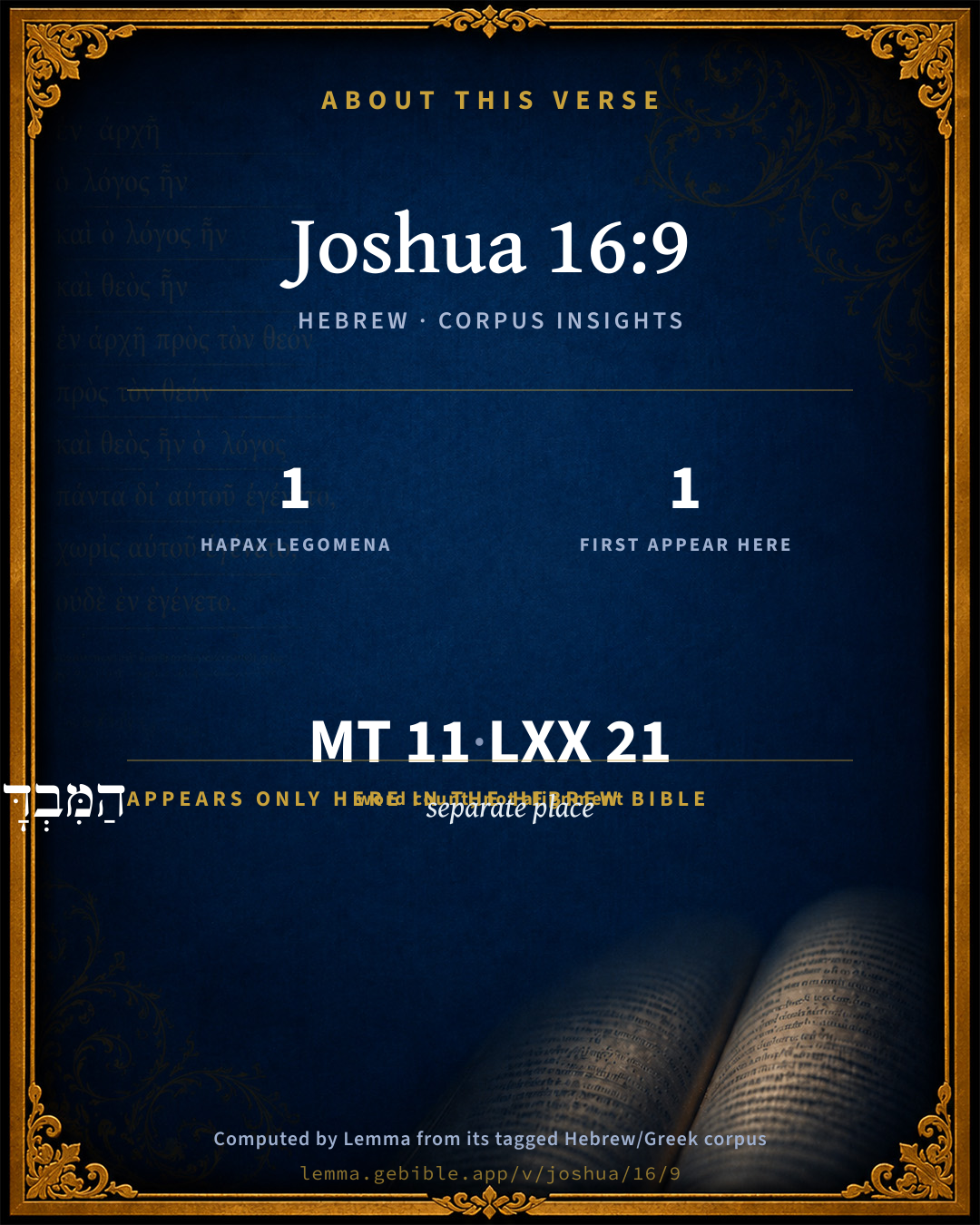
  • 1 hapax legomenon — only here in the Hebrew Bible
  • 1 first appearance in the Hebrew Bible
Full analysis ↓
Download a study sheet

One document with this verse’s original text, its word-by-word gloss line, the meaning frame, cross-references with their text, attributed commentary, and full source and license credits — printable, and it pastes into notes with its structure intact.

This verse Autodidact and up

Study sheet (.html) Plain text (.txt)

A passage Seminary Student

Up to 50 verses in one chapter. A passage sheet keeps up to 6 commentary sources and 12 cross-references per verse, in the order this page ranks them, and says so on the sheet whenever that leaves anything out. Ask for a single verse and you get the Autodidact verse sheet above.

Everything on this page stays free to read, with no account — the sheet is a download of what is already on screen, not access to it.

Want to remove ads? Support Godless Engineer
Compare translations 3

The same verse in 3 English versions, stacked beneath the original-language interlinear above. Click any original word for its lexicon entry.

Each is an independent rendering of the whole verse — the interlinear is not word-aligned to these translations.

Highlighted words mark where these versions differ — a whole-verse word diff, not a word-by-word alignment.

  • World English Bible Public Domain
    together with the cities which were set apart for the children of Ephraim in the midst of the inheritance of the children of Manasseh, all the cities with their villages.
  • King James Version Public Domain
    And the separate cities for the children of Ephraim were among the inheritance of the children of Manasseh, all the cities with their villages.
  • unfoldingWord Literal Text CC BY-SA 4.0
    And cities set apart for the sons of Ephraim in the midst of the inheritance of the sons of Manasseh, all of the cities and their villages.

unfoldingWord Literal Text — © unfoldingWord, licensed CC BY-SA 4.0. Word-aligned USFM3 via Door43 (git.door43.org/unfoldingWord/en_ult).

Versions to compare (up to 4)

3 of 4 selected

Show all 18 translations

Every available English version of this verse, each an independent rendering of the whole verse.

  • World English Bible Public Domain
    together with the cities which were set apart for the children of Ephraim in the midst of the inheritance of the children of Manasseh, all the cities with their villages.
  • Berean Standard Bible Public Domain
    along with all the cities and villages set apart for the descendants of Ephraim within the inheritance of Manasseh.
  • Majority Standard Bible Public Domain
    along with all the cities and villages set apart for the descendants of Ephraim within the inheritance of Manasseh.
  • King James Version Public Domain
    And the separate cities for the children of Ephraim were among the inheritance of the children of Manasseh, all the cities with their villages.
  • American Standard Version (1901) Public Domain
    together with the cities which were set apart for the children of Ephraim in the midst of the inheritance of the children of Manasseh, all the cities with their villages.
  • Revised Version (1885) Public Domain
    together with the cities which were separated for the children of Ephraim in the midst of the inheritance of the children of Manasseh, all the cities with their villages.
  • Geneva Bible (1599) Public Domain
    And the separate cities for the children of Ephraim were among the inheritance of the children of Manasseh: all the cities with their villages.
  • Douay-Rheims (1899) Public Domain
    And there were cities with their villages separated for the children of Ephraim in the midst of the possession of the children of Manasses.
  • Young's Literal Translation Public Domain
    And the separate cities of the sons of Ephraim `are' in the midst of the inheritance of the sons of Manasseh, all the cities and their villages;
  • Literal Standard Version CC BY-SA 4.0
    And the separate cities of the sons of Ephraim [are] in the midst of the inheritance of the sons of Manasseh, all the cities and their villages;
  • Unlocked Literal Bible CC BY-SA 4.0
    together with the cities that were chosen for the tribe of Ephraim within the inheritance of the tribe of Manasseh—all the cities, including their villages.
  • unfoldingWord Literal Text CC BY-SA 4.0
    And cities set apart for the sons of Ephraim in the midst of the inheritance of the sons of Manasseh, all of the cities and their villages.
  • Darby Bible Public Domain
    with the cities that were set apart for the children of Ephraim in the midst of the inheritance of the children of Manasseh, all the cities and their hamlets.
  • World Messianic Bible Public Domain
    together with the cities which were set apart for the children of Ephraim in the middle of the inheritance of the children of Manasseh, all the cities with their villages.
  • Webster's Bible Public Domain
    And the separate cities for the children of Ephraim were among the inheritance of the children of Manasseh, all the cities with their villages.
  • Free Bible Version CC BY-SA 4.0
    Also some towns with their associated villages that lay in the land allotted to the tribe of Manasseh were assigned to the tribe of Ephraim.
  • Bible in Basic English Public Domain
    Together with the towns marked out for the children of Ephraim in the heritage of Manasseh, all the towns with their unwalled places.
  • JPS Tanakh (1917) Public Domain
    together with the cities which were separated for the children of Ephraim in the midst of the inheritance of the children of Manasseh, all the cities with their villages.

Literal Standard Version (2020), Covenant Press — licensed CC BY-SA 4.0. Text via the HelloAO Bible API (eBible.org). Unlocked Literal Bible (unfoldingWord) — licensed CC BY-SA 4.0. Text via the HelloAO Bible API (eBible.org). unfoldingWord Literal Text — © unfoldingWord, licensed CC BY-SA 4.0. Word-aligned USFM3 via Door43 (git.door43.org/unfoldingWord/en_ult). Free Bible Version, Dr. Jonathan Gallagher — licensed CC BY-SA 4.0. Text via the HelloAO Bible API (eBible.org).

Word by word

More ways to search: Search by grammar → Find every occurrence → Compare this word →

Practice this passage: Drill this verse → Learn its vocabulary →

הַמִּבְדָּלוֹת֙
mibdâlâh
H3995
“the · separate places”
Particle, Definite Article + Noun, Common, Feminine, Plural, Absolute
Part of Speech
Particle + Noun
Type
Common
Gender
Feminine
Number
Plural
State
Absolute
Full BDB Definition

Origin: from H914

TWOT: 203b

separate place
  1. וְהֶעָרִ֗ים ʻîyr H5892 “and · the · cities” Conjunction + Particle, Definite Article + Noun, Common, Feminine, Plural, Absolute
  2. לִבְנֵ֣י bên H1121 “to/for · sons of” Preposition + Noun, Common, Masculine, Plural, Construct
  3. אֶפְרַ֔יִם ʼEphrayim H669 “Ephraim” Noun, Proper
  4. בְּת֖וֹךְ tâvek H8432 “in/at · midst of” Preposition + Noun, Common, Masculine, Singular, Construct
  5. נַחֲלַ֣ת nachălâh H5159 “inheritance of” Noun, Common, Feminine, Singular, Construct
  6. בְּנֵֽי bên H1121 “sons of” Noun, Common, Masculine, Plural, Construct
  7. מְנַשֶּׁ֑ה Mᵉnashsheh H4519 “Manasseh” Noun, Proper
  8. כָּֽל kôl H3605 “all of” Noun, Common, Masculine, Singular, Construct
  9. הֶעָרִ֖ים ʻîyr H5892 “the · cities” Particle, Definite Article + Noun, Common, Feminine, Plural, Absolute
  10. וְחַצְרֵיהֶֽן châtsêr H2691 “and · courts · their” Conjunction + Noun, Common, Both, Plural, Construct + Suffix, Personal, 3rd Person, Feminine, Plural

About this verse

These counts appear in no published source. They are computed here, from the morphology-tagged text and Lemma’s own curated glosses. What Lemma adds →

11
words
9
distinct lemmas
Historical
section

Notable vocabulary

1 hapax legomenon — a word that appears only here in the entire Hebrew Bible:

  • הַמִּבְדָּלוֹת֙ separate place H3995

First appearance in Scripture

This word makes its first canonical appearance in the Hebrew Bible here:

  • הַמִּבְדָּלוֹת֙ separate place H3995

Grammatical profile

  • 11 nouns

Repetition

Words recur within this verse — often emphatic in Hebrew:

  • וְהֶעָרִ֗ים city H5892 ×2
  • לִבְנֵ֣י son H1121 ×2

Hebrew & Septuagint length

In English translation the verse runs 30 words from the Hebrew and 27 from the Septuagint (LXX English) — closely comparable.

A rough comparison of the two English renderings, which tokenize alike — not a word-level alignment.

Word counts can differ between the Hebrew and the Greek without any difference in meaning — e.g. the Hebrew direct-object marker אֵת has no separate Greek word, and Greek often adds the article ὁ.

In the original languages it is 11 Hebrew tokens and 21 Greek tokens — but the two are counted differently (Hebrew bundles its prefixes and suffixes into one token; the Greek is in lemma form), so that isn’t a like-for-like length.

Cross-references

1

Topical passages linked to Joshua 16:9 in the Treasury of Scripture Knowledge — connected by theme and wording, ordered by reader-vote popularity; previews shown in the World English Bible.

  • Joshua 17:9 The border went down to the brook of Kanah, southward of the brook: these cities belonged to Ephraim among the cities of Manasseh: and the border of Manasseh was on the north side of the brook, and the goings out of it were at the sea:

Cross-references courtesy of OpenBible.info (CC BY 4.0).

Hebrew and Greek witnesses Masoretic Hebrew ↔ Greek Septuagint

The same verse in the two great witnesses to the Old Testament, shown verse-for-verse.

These are two independent witnesses, not word-aligned to each other, and the Septuagint is shown in lemma (dictionary) form.

Hebrew Joshua 16:9 Masoretic · Westminster Leningrad Codex

וְהֶעָרִ֗ים הַמִּבְדָּלוֹת֙ לִבְנֵ֣י אֶפְרַ֔יִם בְּת֖וֹךְ נַחֲלַ֣ת בְּנֵֽי מְנַשֶּׁ֑ה כָּֽל הֶעָרִ֖ים וְחַצְרֵיהֶֽן

together with the cities which were set apart for the children of Ephraim in the midst of the inheritance of the children of Manasseh, all the cities with their villages.

World English Bible · Public Domain

Greek LXX Joshua 16:9 Septuagint · lemma form

καί ὁ πόλις ὁ ἀποὁρίζω ὁ υἱός ἐφράιμ ἀνά μέσος ὁ κληρονομία υἱός μανασσή πᾶς ὁ πόλις καί ὁ κώμη αὐτός

And the cities separated to the sons of Ephraim were in the midst of the inheritance of the sons of Manasse, all the cities and their villages.

LXX2012 (modern English Septuagint) · Public Domain

Hebrew: Westminster Leningrad Codex (CC BY 4.0). Greek: Septuagint (public domain); English from LXX2012 (modern English Septuagint) (Public Domain). How the Septuagint differs from the Hebrew →

Targum (Aramaic paraphrase)

1

The Targum is the ancient Jewish Aramaic paraphrase of the Hebrew Scriptures — an interpretive translation, not the Hebrew text itself. Onkelos (literal) and Pseudo-Jonathan (expansive) render the Torah, and Jonathan the Prophets. Coverage is partial: where no permissively-licensed English translation exists for a verse, only the Aramaic is shown. This is verse-level text, not a word-by-word alignment to the Hebrew.

  1. Targum Jonathan Prophets (Joshua–Malachi)
    וְקִרְוַיָא דְמַפְרְשָׁן לִבְנֵי אֶפְרַיִם בְּנוֹ אַחְסָנַת בְּנֵי מְנַשֶׁה כָּל קִרְוַיָא וּפַצְחֵיהֶן:

    (no public-domain English translation for this verse)

    Targum Jonathan — Aramaic: “Mikraot Gedolot” (public domain). English: “Sefaria Community Translation” (CC0 1.0 (public-domain dedication)); “London "Chaldee Paraphrase," 1871” (public domain). Text via Sefaria.

Commentary

Notes on Joshua 16:9 from classic Christian and Jewish commentators (each source and its license shown beneath its notes). The classic Christian expositions comment on the surrounding passage and are grouped to its opening verse, so a note may address several verses; the Jewish commentaries on the Tanakh (Rashi and others) are per-verse, so they appear only where the commentator wrote on this verse.

Lemma curates 59 commentaries, every one of them public domain or Creative Commons licensed, each selected and text-cleaned for this edition rather than reprinted as found. About our sources →

Trapp's Complete Commentary

John Trapp

Jos 16:9 And the separate cities for the children of Ephraim [were] among the inheritance of the children of Manasseh, all the cities with their villages.

Ver. 9. And the separate cities, &c.] Allotted to Ephraim, a numerous tribe, within the portion of Manasseh.

John Trapp, A Commentary or Exposition upon All the Books of the Old and New Testament (1647–1656) — public domain. Text from a community e-Sword module.

Albert Barnes' Notes on the Bible

The verb “were,” introduced by the King James Version in this verse should be omitted; and the full stop after Jos 16:8 replaced by a colon. The purport of Jos 16:9 is simply to add to the inheritance of Ephraim, defined by the preceding context, “the separate cities” or more properly “single cities” which were allotted to them in addition within the borders of Manasseh. The reasons for granting these additional cities to the Ephraimites can only be conjectured. Perhaps the territory assigned to this numerous tribe proved on experiment to be too small; and therefore some towns, which are named in 1Ch 7:29, were given to them from the kindred Manassites, the latter being recompensed (Jos 17:11 note) at the expense of Issachar and Asher.

Albert Barnes' Notes on the Bible (1834–1885) — public domain. Text from a community e-Sword/MySword module.

Joseph Benson's Commentary

Jos 16:9. The separate cities — That is, besides those cities which were within Ephraim’s bounds, he had some other cities out of Manasseh’s portion, because his tribe was all here, and was larger than Manasseh’s.

Joseph Benson's Commentary on the Old and New Testaments (1811–1818) — public domain. Text from a community e-Sword module.

Geneva Bible (1599)

Geneva Bible translators

Because Ephraim’s tribe was far greater than Manasseh, therefore he had more cities.

Geneva Bible (1599) marginal notes — public domain. Text via Bolls.life.

Jamieson, Fausset & Brown

Robert Jamieson, A. R. Fausset & David Brown

separate cities for the children of Ephraim were among the inheritance of Manasseh-- (Jos 17:9), because it was found that the tract allotted to Ephraim was too small in proportion to its population and power.

Jamieson, Fausset & Brown — Commentary Critical and Explanatory on the Whole Bible (1871) — public domain (CC PDM 1.0). Text via the HelloAO Bible API.

Adam Clarke's Commentary

Verse 9. And the separate cities] That is, the cities that were separated from the tribe of Manasseh to be given to Ephraim; see Jos 17:9.

Adam Clarke's Commentary on the Bible (1810–1826) — public domain. Text from a community e-Sword/MySword module.

Ellicott's Commentary for English Readers

(9) The separate cities for the children of Ephraim were among the inheritance of the children of Manasseh; and Jos_17:10-11 : “Manasseh had in Issachar and in Asher, Beth-shean,” &c. This fact would manifestly tend to produce a solidarity among the several tribes, and to prevent disunion by creating common interests. The interest of the stronger tribes would be served by completing the conquest of the territory assigned to the weaker. And the general formation thus produced would resemble that which was known by the name of the testudo, or tortoise, in Roman warfare. When a body of soldiers approached the wall of a town which it was intended to assault, they sometimes held their shields over them, overlapping like scales, each man’s shield partly sheltering his own, and partly his neighbour’s body, so that no missile could penetrate. Thus it may be said not only of Jerusalem, but of all the tribes in the land of their possession, that they were built as a city that is compact together, and at unity in itself: united by joints and bands, so that if one member of the body politic should suffer, all the members must suffer with it. For a further illustration of the same topic, see on the inheritance of Benjamin (Jos_18:11) and of Simeon (Jos_19:1).

A Bible Commentary for English Readers, edited by Charles John Ellicott (1878–1897) — public domain. Text from a community e-Sword module.

The Cambridge Bible for Schools and Colleges

gen. ed. J. J. S. Perowne

9. And the separate cities] Or, the places which were portioned off.

were] This verb, introduced into our Version, should be omitted, and the full stop at the end of Jos_16:8 should be replaced by a colon. The author intended us to add to “the inheritance of the children of Ephraim” the “separate” or “single” cities allotted to the tribe within the borders of Manasseh. It is supposed that after their relative boundaries had been fixed—though the subdivision of the territory assigned to the two brother tribes does not seem to have been very definite—it was found that the territory of Ephraim was too small in proportion to its strength.

The Cambridge Bible for Schools and Colleges (gen. ed. J. J. S. Perowne; Cambridge University Press, 1878–1918) — public domain. Text from a community e-Sword module.

John Gill's Exposition

And they drove not out the Canaanites which dwelt in Gezer,.... Which was the border of their tribe length ways, and was near the sea, Jos 16:3; in this they did not obey the command of God, and either they did not drive them out, because they could not, God not delivering them up into their hands, because of their sins; or through their slothfulness, or it may be through covetousness, being willing to make some advantage to themselves by them, being a trading people, which seems to be intended in the next clause:

but the Canaanites dwelt among the Ephraimites unto this day; which Joshua, the writer of this book, might truly say, and be no objection to it, since the same is observed after his death, Jdg 1:29; and indeed they continued to dwell there until the times of Solomon, when it was taken by Pharaoh king of Egypt, and given as a present to his daughter, the wife of Solomon, Kg1 9:15; and though this clause does not furnish out an argument against the writing of this book by Joshua, yet, from the instance given, it appears it must have been written before the times of Solomon, and so not by Ezra, as some:

and serve under tribute; so that they were under their power, and therefore could have driven them out, or slain them, as by the command of God they should; but they spared them for the sake of the tribute they received from them, which seems to agree with the character of the Ephraimites, Hos 12:8.

Next: Joshua Chapter 17

John Gill's Exposition of the Whole Bible (1746–1763) — public domain (CC PDM 1.0). Text via the HelloAO Bible API.

Matthew Poole's English Annotations

The separate cities, i.e. besides those cities which were within Ephraim’s bounds, he had some other cities, to which all their territories were annexed out of Manasseh’s portion, because his tribe was all here, and was larger than Manasseh’s.

Matthew Poole's English Annotations on the Holy Bible (1683–1685) — public domain. Text from a community e-Sword/MySword module.

Whedon's Commentary on the Bible

Daniel D. Whedon

9. Separate cities — That is, cities separated or selected out of Manasseh for the use of Ephraim. Of these only Tappuah is named in Jos_17:8-9. Compare also 1Ch_7:28-29. It is generally supposed, that when the boundary lines had been drawn, the territory of Ephraim was found not as large proportionally as his numbers and importance demanded. But the relation of Ephraim and Manasseh was such that they might be regarded as having one lot. Compare Jos_17:14. Hence they held many cities in common, and hence too, perhaps, the reason why no complete enumeration of the cities of these two brother tribes is anywhere given.] 10. The Canaanites that dwelt in Gezer — These held their ancient seat until the days of Solomon. 1Ki_9:16. Compare Jdg_1:29.

Under tribute — This implies the power to extirpate, but instead of this a fatal compromise was made. Josephus explains the reason: “After this the Israelites grew effeminate as to fighting any more against their enemies, but applied themselves to agriculture, which producing abundance and riches, they indulged in luxury and pleasure, and, contenting themselves with the tributes that were paid them, permitted the Canaanites to live in peace.”

Daniel D. Whedon (gen. ed.), Commentary on the Old and New Testaments (1874–1909) — public domain. Text from a community e-Sword module.

The Pulpit Commentary

And the separate cities. Literally, and the cities divided off. The word "were," in our version, is misplaced. It should be read thus: "And there were cities divided off and assigned to the tribe of Ephraim in the midst of the inheritance of the sons of Manasseh" (see note on ver. 5). This fact, together with the compensation given to Manasseh, may serve to explain the cohesion of the ten tribes in opposition to Judah. The boundaries of the latter tribe were more strictly defined, her attitude more exclusive. We may almost discern this in the prominence given to Judah in the present book. Ephraim, already enraged at the passing away of the preeminence from itself, which had not merely been predicted, but, as Jud 8:1-3 12:1 show, had been actually enjoyed, was closely allied to Manasseh, and Manasseh to Issachar and Zebulun, by the arrangement we are considering. It would naturally be able, by its position and these circumstances, to combine together the rest of the tribe against the somewhat overbearing attitude of the tribe of Judah. (see 2Sa_19:43)

The Pulpit Commentary (1880–1919), ed. H.D.M. Spence-Jones & Joseph S. Exell — public domain. Text from a community e-Sword module.

John Wesley's Explanatory Notes

The separate cities - That is, besides those cities which were within Ephraim's bounds, he had some other cities, to which all of all their territories were annexed out Manasseh's portion, because his tribe was all here, and was larger than Manasseh's.

John Wesley, Explanatory Notes Upon the Whole Bible (1754–1765) — public domain. Text via the GEBible commentary corpus.

Keil & Delitzsch

C. F. Keil & F. Delitzsch

The tribe of Ephraim also received some scattered towns in the territory of the tribe of Manasseh, in fact all those towns to which Tappuah belonged, according to Jos 17:8, with the dependent villaGes.

(Note: The reason why the Ephraimites received scattered towns and villages in the tribe-territory of Manasseh, is supposed by Calvin, Masius, and others, to have been, that after the boundaries had been arranged, on comparing the territory allotted to each with the relative numbers of the two tribes, it was found that Ephraim had received too small a possession. This is quite possible; at the same time there may have been other reasons which we cannot discover now, as precisely the same thing occurs in the case of Manasseh (Jos 17:11).)

Keil & Delitzsch — Biblical Commentary on the Old Testament (1861–1891) — public domain (CC PDM 1.0). Text via the HelloAO Bible API. (Old Testament only.)

Rashi

Rabbi Shlomo Yitzchaki (Rashi)

The separated cities. These too were included in the inheritance of Ephraim. They had cities that were separated from their portion and were incorporated within the boundary of the inheritance of Menashe.

Rashi on the Tanakh — English translations: “The Judaica Press complete Tanach with Rashi, translated by A. J. Rosenberg” (CC BY 4.0); “Pentateuch with Rashi's commentary by M. Rosenbaum and A.M. Silbermann, 1929-1934” (public domain); “The Metsudah Tanach series, Lakewood, N.J” (CC BY 4.0); and “The Book of Joshua, Metsudah Publications, 1997” (CC BY 4.0). Text via Sefaria.

Lesson kit

Teaching starters — assembled from the data on this page, not authored interpretation. Every prompt links to the verse data it draws on. Edit before teaching.

Joshua, in the Historical, opens this verse with 11 words (9 distinct Hebrew lemmas). Its most distinctive word is mibdâlâh (“separate place”). A historical commentator’s framing appears above. Read the whole chapter for the surrounding context.

Discussion questions

  1. The word mibdâlâh carries the sense “separate place.” How does it shape the verse?
  2. This verse holds 1 word here found nowhere else in the Hebrew Bible. What might the rare word draw attention to?
  3. The word “separate place” first appears here in Scripture. What is being introduced at this debut?
  4. Joshua 17:9 shares this passage’s theme. How do the two illuminate each other?
  5. “city” occurs 2× in this one verse. What is the effect of the repetition?
  6. These translations render this verse differently. What is at stake in choosing one wording over another?
  7. Reading how Trapp's Complete Commentary and Albert Barnes' Notes on the Bible read this verse, where do the two commentators agree and where do they part?

Things to notice

  • 1 word in this verse appears nowhere else in the Hebrew Bible.
  • 1 word makes its first canonical appearance in Scripture here.
  • This verse counts 11 Hebrew ↔ 21 Greek words.
  • These translations choose different wording for 9 words in this verse.
  • “city” occurs 2× in this single verse.

Reading settings

Reading text

Shown beneath each verse's original-language words.

Old Testament
Old Testament edition

Read the OT as the Masoretic Hebrew (MT) or the Greek Septuagint (LXX).

English shown for the Greek Septuagint (in the Hebrew ↔ Greek comparison).

Comparing translations? Open the Compare panel on any verse page to stack up to four side by side.