
Leviticus 17:13

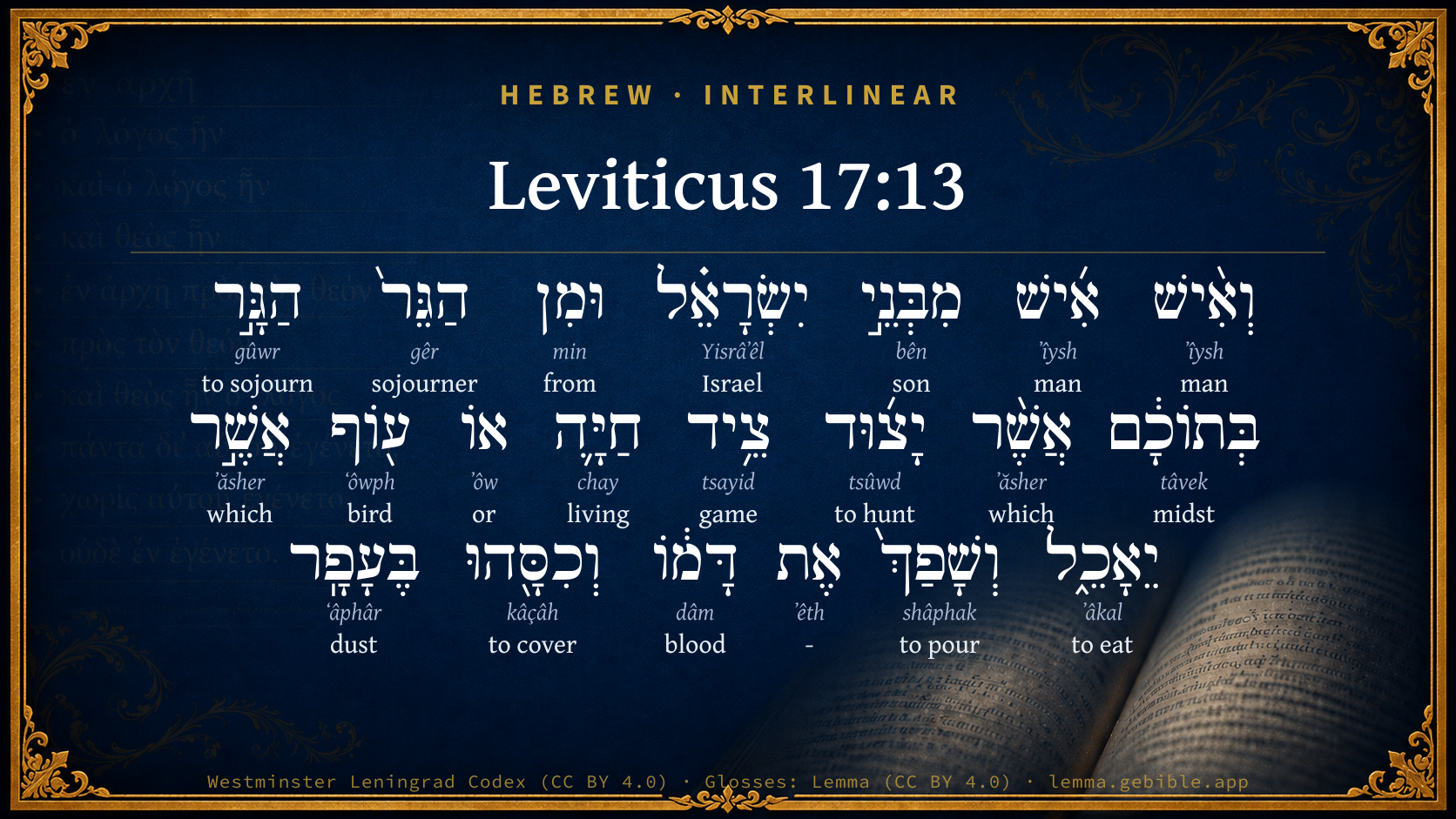
Hebrew (Westminster Leningrad Codex) Leviticus 17:13 appears in the Hebrew Old Testament. The text above is from the Westminster Leningrad Codex. Each word links to its Strong’s number, a concise gloss, and parsing drawn from the Open Scriptures Hebrew Bible morphology. Click any word for its full Brown-Driver-Briggs (BDB) entry.
Download image
Cite this verse

Leviticus 17:13 (World English Bible). Public Domain. Lemma interlinear Bible study tool, https://lemma.gebible.app/v/leviticus/17/13.

Show BibTeX & RIS
BibTeX
RIS
English Translation
"'Whatever man there is of the children of Israel, or of the strangers who live as foreigners among them, who takes in hunting any animal or bird that may be eaten; he shall pour out its blood, and cover it with dust.
World English Bible · Public Domain
Download a study sheet

One document with this verse’s original text, its word-by-word gloss line, the meaning frame, cross-references with their text, attributed commentary, and full source and license credits — printable, and it pastes into notes with its structure intact.

This verse Autodidact and up

Study sheet (.html) Plain text (.txt)

A passage Seminary Student

Up to 50 verses in one chapter. A passage sheet keeps up to 6 commentary sources and 12 cross-references per verse, in the order this page ranks them, and says so on the sheet whenever that leaves anything out. Ask for a single verse and you get the Autodidact verse sheet above.

Everything on this page stays free to read, with no account — the sheet is a download of what is already on screen, not access to it.

Want to remove ads? Support Godless Engineer
Compare translations 3

The same verse in 3 English versions, stacked beneath the original-language interlinear above. Click any original word for its lexicon entry.

Each is an independent rendering of the whole verse — the interlinear is not word-aligned to these translations.

Highlighted words mark where these versions differ — a whole-verse word diff, not a word-by-word alignment.

  • World English Bible Public Domain
    "'Whatever man there is of the children of Israel, or of the strangers who live as foreigners among them, who takes in hunting any animal or bird that may be eaten; he shall pour out its blood, and cover it with dust.
  • King James Version Public Domain
    And whatsoever man there be of the children of Israel, or of the strangers that sojourn among you, which hunteth and catcheth any beast or fowl that may be eaten; he shall even pour out the blood thereof, and cover it with dust.
  • unfoldingWord Literal Text CC BY-SA 4.0
    And a man, a man from the sons of Israel or from the sojourner, the one sojourning in their midst, who hunts a game of animal or wing that will be eaten, then he shall pour out its blood, and he shall cover it with soil,

unfoldingWord Literal Text — © unfoldingWord, licensed CC BY-SA 4.0. Word-aligned USFM3 via Door43 (git.door43.org/unfoldingWord/en_ult).

Versions to compare (up to 4)

3 of 4 selected

Show all 18 translations

Every available English version of this verse, each an independent rendering of the whole verse.

  • World English Bible Public Domain
    "'Whatever man there is of the children of Israel, or of the strangers who live as foreigners among them, who takes in hunting any animal or bird that may be eaten; he shall pour out its blood, and cover it with dust.
  • Berean Standard Bible Public Domain
    And if any Israelite or foreigner living among them hunts down a wild animal or bird that may be eaten, he must drain its blood and cover it with dirt.
  • Majority Standard Bible Public Domain
    And if any Israelite or foreigner living among them hunts down a wild animal or bird that may be eaten, he must drain its blood and cover it with dirt.
  • King James Version Public Domain
    And whatsoever man there be of the children of Israel, or of the strangers that sojourn among you, which hunteth and catcheth any beast or fowl that may be eaten; he shall even pour out the blood thereof, and cover it with dust.
  • American Standard Version (1901) Public Domain
    And whatsoever man there be of the children of Israel, or of the strangers that sojourn among them, who taketh in hunting any beast or bird that may be eaten; he shall pour out the blood thereof, and cover it with dust.
  • Revised Version (1885) Public Domain
    And whatsoever man there be of the children of Israel, or of the strangers that sojourn among them, which taketh in hunting any beast or fowl that may be eaten; he shall pour out the blood thereof, and cover it with dust.
  • Geneva Bible (1599) Public Domain
    Moreouer whosoeuer he be of the children of Israel, or of the strangers that soiourne among the, which by hunting taketh any beast or foule that may be eaten, he shall powre out the blood thereof, and couer it with dust:
  • Douay-Rheims (1899) Public Domain
    Any man whosoever of the children of Israel, and of the strangers that sojourn among you, if by hunting or fowling, he take a wild beast or a bird, which is lawful to eat, let him pour out its blood, and cover it with earth.
  • Young's Literal Translation Public Domain
    and any man of the sons of Israel, or of the sojourners, who is sojourning in your midst, who hunteth venison, beast or fowl, which is eaten -- hath even poured out its blood, and hath covered it with dust;
  • Literal Standard Version CC BY-SA 4.0
    and any man of the sons of Israel, or of the sojourners who is sojourning in your midst, who hunts game, beast or bird, which is eaten—has even poured out its blood and covered it with dust;
  • Unlocked Literal Bible CC BY-SA 4.0
    Anyone of the people of Israel, or any of the foreigners who live among them, who hunts and kills an animal or bird that may be eaten, that person must pour out its blood and cover the blood with earth.
  • unfoldingWord Literal Text CC BY-SA 4.0
    And a man, a man from the sons of Israel or from the sojourner, the one sojourning in their midst, who hunts a game of animal or wing that will be eaten, then he shall pour out its blood, and he shall cover it with soil,
  • Darby Bible Public Domain
    And every one of the children of Israel, and of the strangers who sojourn among them, that catcheth in the hunt a beast or fowl that may be eaten, he shall pour out the blood thereof, and cover it with earth;
  • World Messianic Bible Public Domain
    “‘Whatever man there is of the children of Israel, or of the strangers who live as foreigners among them, who takes in hunting any animal or bird that may be eaten, he shall pour out its blood, and cover it with dust.
  • Webster's Bible Public Domain
    And whatever man there may be of the children of Israel, or of the strangers that sojourn among you, who hunteth and catcheth any beast or fowl that may be eaten; he shall even pour out its blood, and cover it with dust.
  • Free Bible Version CC BY-SA 4.0
    Any Israelite or foreigner living among them who hunts and kills a wild animal or a bird which are allowed be eaten must drain the blood from its body and cover it with earth,
  • Bible in Basic English Public Domain
    And any man of Israel, or any other living among them, who gets with his bow any beast or bird used for food, is to see that its blood is covered with earth.
  • JPS Tanakh (1917) Public Domain
    And whatsoever man there be of the children of Israel, or of the strangers that sojourn among them, that taketh in hunting any beast or fowl that may be eaten, he shall pour out the blood thereof, and cover it with dust.

Literal Standard Version (2020), Covenant Press — licensed CC BY-SA 4.0. Text via the HelloAO Bible API (eBible.org). Unlocked Literal Bible (unfoldingWord) — licensed CC BY-SA 4.0. Text via the HelloAO Bible API (eBible.org). unfoldingWord Literal Text — © unfoldingWord, licensed CC BY-SA 4.0. Word-aligned USFM3 via Door43 (git.door43.org/unfoldingWord/en_ult). Free Bible Version, Dr. Jonathan Gallagher — licensed CC BY-SA 4.0. Text via the HelloAO Bible API (eBible.org).

Word by word

More ways to search: Search by grammar → Find every occurrence → Compare this word →

Practice this passage: Drill this verse → Learn its vocabulary →

צֵ֥יד
tsayid
H6718
“game of”
Noun, Common, Masculine, Singular, Construct
Part of Speech
Noun
Type
Common
Gender
Masculine
Number
Singular
State
Construct
Full BDB Definition

Origin: from a form of H6679 and meaning the same

TWOT: 1885a , 1886a

hunting, game - hunting - game hunted - provision, food - provision, food, food-supply
  1. וְאִ֨ישׁ ʼîysh H376 “and · man” Conjunction + Noun, Common, Masculine, Singular, Absolute
  2. אִ֜ישׁ ʼîysh H376 “man” Noun, Common, Masculine, Singular, Absolute
  3. מִבְּנֵ֣י bên H1121 “from · sons of” Preposition + Noun, Common, Masculine, Plural, Construct
  4. יִשְׂרָאֵ֗ל Yisrâʼêl H3478 “Israel” Noun, Proper
  5. וּמִן min H4480 “and · from” Conjunction + Preposition
  6. הַגֵּר֙ gêr H1616 “the · sojourner” Particle, Definite Article + Noun, Common, Masculine, Singular, Absolute
  7. הַגָּ֣ר gûwr H1481 “the · sojourning” Particle, Definite Article + Verb, Qal, Participle Active, Masculine, Singular, Absolute
  8. בְּתוֹכָ֔ם tâvek H8432 “in/at · midst · their” Preposition + Noun, Common, Masculine, Singular, Construct + Suffix, Personal, 3rd Person, Masculine, Plural
  9. אֲשֶׁ֨ר ʼăsher H834 “which” Particle, Relative
  10. יָצ֜וּד tsûwd H6679 “to hunt” Verb, Qal, Imperfect, 3rd Person, Masculine, Singular
  11. חַיָּ֛ה chay H2416 “living” Noun, Common, Feminine, Singular, Absolute
  12. אוֹ ʼôw H176 “or” Conjunction
  13. ע֖וֹף ʻôwph H5775 “bird” Noun, Common, Masculine, Singular, Absolute
  14. אֲשֶׁ֣ר ʼăsher H834 “which” Particle, Relative
  15. יֵאָכֵ֑ל ʼâkal H398 “to eat” Verb, Niphal, Imperfect, 3rd Person, Masculine, Singular
  16. וְשָׁפַךְ֙ shâphak H8210 “and · to pour” Conjunction + Verb, Qal, Sequential Perfect, 3rd Person, Masculine, Singular
  17. אֶת ʼêth H853 “-” Particle, Direct Object
  18. דָּמ֔וֹ dâm H1818 “blood · his” Noun, Common, Masculine, Singular, Construct + Suffix, Personal, 3rd Person, Masculine, Singular
  19. וְכִסָּ֖הוּ kâçâh H3680 “and · to cover · him” Conjunction + Verb, Piel, Sequential Perfect, 3rd Person, Masculine, Singular + Suffix, Personal, 3rd Person, Masculine, Singular
  20. בֶּעָפָֽר ʻâphâr H6083 “in/at the · dust” Preposition, Determined + Noun, Common, Masculine, Singular, Absolute

About this verse

These counts appear in no published source. They are computed here, from the morphology-tagged text and Lemma’s own curated glosses. What Lemma adds →

21
words
19
distinct lemmas
Pentateuch
section

Notable vocabulary

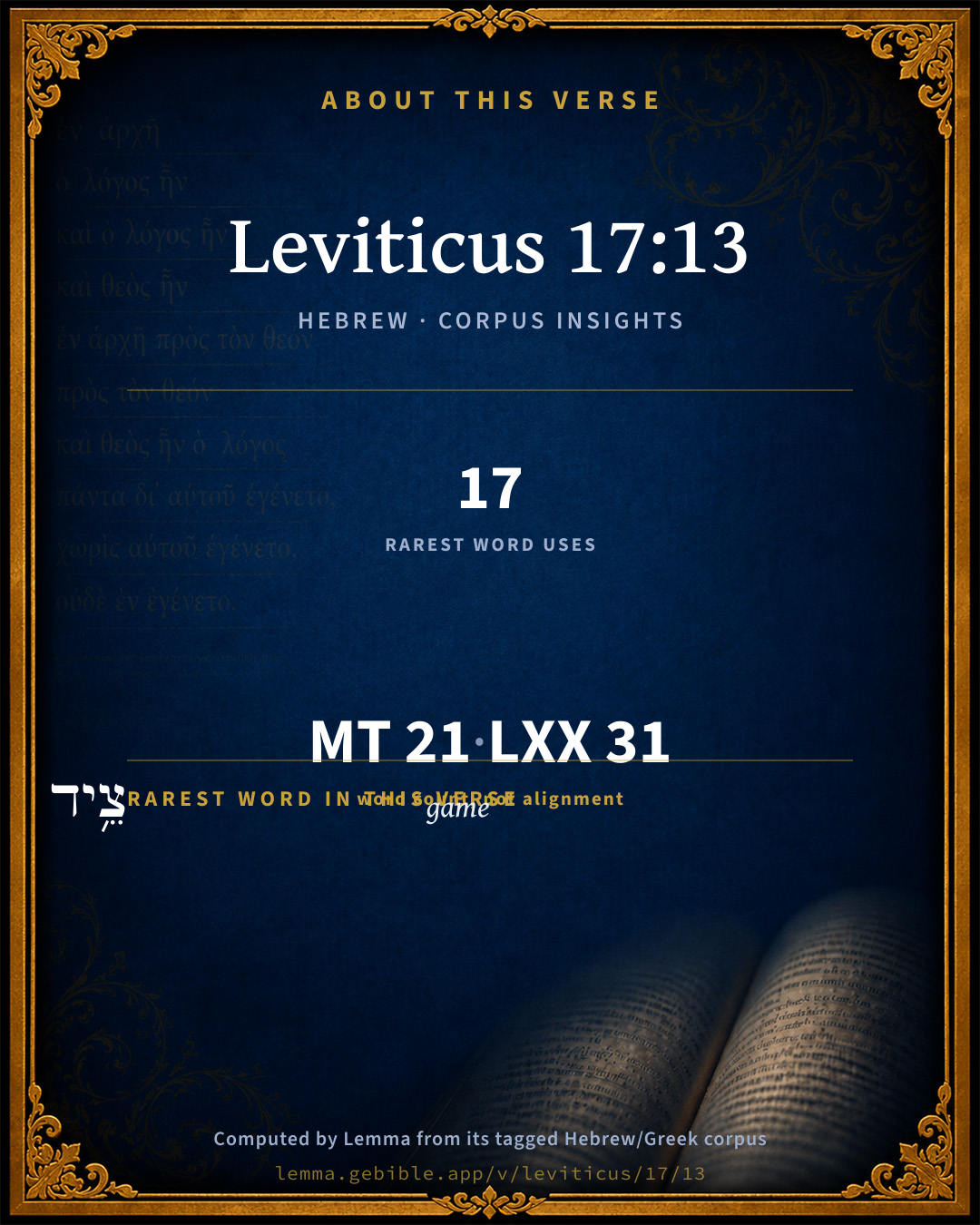
The rarest word here is צֵ֥יד game H6718 — appearing just 17 times in the whole Hebrew Bible.

Shared distinctive vocabulary

צֵ֥יד game H6718 occurs in 16 verses of the Hebrew Bible. Also found in:

Grammatical profile

  • 5 verbs
  • 11 nouns
  • 1 preposition
  • 1 conjunction
  • 3 particles

Verb forms

  • הַגָּ֣ר Qal · Participle Active
  • יָצ֜וּד Qal · Imperfect
  • יֵאָכֵ֑ל Niphal · Imperfect
  • וְשָׁפַךְ֙ Qal · Sequential Perfect
  • וְכִסָּ֖הוּ Piel · Sequential Perfect

Repetition

Words recur within this verse — often emphatic in Hebrew:

  • וְאִ֨ישׁ man H376 ×2
  • אֲשֶׁ֨ר which H834 ×2

Hebrew & Septuagint length

In English translation the verse runs 42 words from the Hebrew and 40 from the Septuagint (LXX English) — closely comparable.

A rough comparison of the two English renderings, which tokenize alike — not a word-level alignment.

Word counts can differ between the Hebrew and the Greek without any difference in meaning — e.g. the Hebrew direct-object marker אֵת has no separate Greek word, and Greek often adds the article ὁ.

In the original languages it is 21 Hebrew tokens and 31 Greek tokens — but the two are counted differently (Hebrew bundles its prefixes and suffixes into one token; the Greek is in lemma form), so that isn’t a like-for-like length.

Cross-references

7

Topical passages linked to Leviticus 17:13 in the Treasury of Scripture Knowledge — connected by theme and wording, ordered by reader-vote popularity; previews shown in the World English Bible.

  • Deuteronomy 12:16 Only you shall not eat the blood; you shall pour it out on the earth as water.
  • Leviticus 7:26 You shall not eat any blood, whether it is of bird or of animal, in any of your dwellings.
  • Deuteronomy 12:24 You shall not eat it; you shall pour it out on the earth as water.
  • Deuteronomy 15:23 Only you shall not eat its blood; you shall pour it out on the ground as water.
  • Ezekiel 24:7 For her blood is in the midst of her; she set it on the bare rock; she didn't pour it on the ground, to cover it with dust.
  • 1 Samuel 14:32–34 and the people flew on the spoil, and took sheep, and oxen, and calves, and killed them on the ground; and the people ate them with the blood.
  • Job 16:18 "Earth, don't cover my blood, Let my cry have no place to rest.

Cross-references courtesy of OpenBible.info (CC BY 4.0).

Hebrew and Greek witnesses Masoretic Hebrew ↔ Greek Septuagint

The same verse in the two great witnesses to the Old Testament, shown verse-for-verse.

These are two independent witnesses, not word-aligned to each other, and the Septuagint is shown in lemma (dictionary) form.

Hebrew Leviticus 17:13 Masoretic · Westminster Leningrad Codex

וְאִ֨ישׁ אִ֜ישׁ מִבְּנֵ֣י יִשְׂרָאֵ֗ל וּמִן הַגֵּר֙ הַגָּ֣ר בְּתוֹכָ֔ם אֲשֶׁ֨ר יָצ֜וּד צֵ֥יד חַיָּ֛ה אוֹ ע֖וֹף אֲשֶׁ֣ר יֵאָכֵ֑ל וְשָׁפַךְ֙ אֶת דָּמ֔וֹ וְכִסָּ֖הוּ בֶּעָפָֽר

"'Whatever man there is of the children of Israel, or of the strangers who live as foreigners among them, who takes in hunting any animal or bird that may be eaten; he shall pour out its blood, and cover it with dust.

World English Bible · Public Domain

Greek LXX Leviticus 17:13 Septuagint · lemma form

καί ἄνθρωπος ἄνθρωπος ὁ υἱός ἰσραήλ καί ὁ προσήλυτος ὁ προςκεῖμαι ἐν σύ ὅς ἄν θηρεύω θήρευμα θηρίον ἤ πετεινόν ὅς ἐσθίω καί ἐκχέω ὁ αἷμα καί καλύπτω αὐτός ὁ γῆ

And whatever man of the children of Israel, or of the strangers dwelling among you shall take any animal in hunting, beast, or bird, which is eaten, then shall he pour out the blood, and cover it in the dust.

LXX2012 (modern English Septuagint) · Public Domain

On this verse, The Cambridge Bible for Schools and Colleges discusses the Septuagint’s reading. Read the note in Commentary ↓

Hebrew: Westminster Leningrad Codex (CC BY 4.0). Greek: Septuagint (public domain); English from LXX2012 (modern English Septuagint) (Public Domain). How the Septuagint differs from the Hebrew →

Targum (Aramaic paraphrase)

2

The Targum is the ancient Jewish Aramaic paraphrase of the Hebrew Scriptures — an interpretive translation, not the Hebrew text itself. Onkelos (literal) and Pseudo-Jonathan (expansive) render the Torah, and Jonathan the Prophets. Coverage is partial: where no permissively-licensed English translation exists for a verse, only the Aramaic is shown. This is verse-level text, not a word-by-word alignment to the Hebrew.

  1. Targum Onkelos Torah (Genesis–Deuteronomy)
    וּגְבַר גְבַר מִן בְּנֵי יִשְׂרָאֵל וּמִן גִיוֹרָא דְיִתְגַיְרוּן בֵּינֵיכוֹן דִי יְצוּד צֵידָא חַיְתָא אוֹ עוֹפָא דִי מִתְאֲכֵל וְיֵשׁוֹד יָת דְמֵהּ וִיכַסִנֵהּ בְּעַפְרָא

    (no public-domain English translation for this verse)

    Targum Onkelos — Aramaic: “Onkelos Genesis” (public domain); “Onkelos Exodus” (public domain); “Onkelos Leviticus” (public domain); “Onkelos Numbers” (public domain); “Onkelos Deuteronomy” (public domain). English: “Sefaria Community Translation” (CC0 1.0 (public-domain dedication)); “J.W. Etheridge. The Targums of Onkelos and Jonathan Ben Uzziel on the Pentateuch. London: Longmans, Green, 1862” (public domain). Text via Sefaria.

  2. Targum Pseudo-Jonathan Torah (Genesis–Deuteronomy)
    וּגְבַר טְלֵי אוֹ גְבַר סִיב מִבֵּית גְנִיסַת יִשְרָאֵל וּמִן גִיוֹרַיָא דְיִתְגַיְירוּן לְמֵיתַב בֵּינֵיהוֹן דִי יְצַד צֵידָא חַיְיתָא אוֹ עוֹפָא דְמִיכַשְׁרִין לְמֵיכַל וְיֵישׁוֹד יַת אַדְמֵיהּ בְּנִיכְסָתָא וְאִין לָא מִתְקַלְקְלָא נִיכְסַתֵּיהּ יְכַסִינֵיהּ בְּעַפְרָא

    And any man, whether young or old, of the house of the stock of Israel, or of the sojourners who sojourn by dwelling among you, who hunteth venison of beast or fowl proper to be eaten, shall pour out its blood when it is killed; and if what he hath killed be not destroyed (or strangled?), let the blood be covered with dust.

    Targum Pseudo-Jonathan — Aramaic: “Targum Jonathan on Genesis” (public domain); “Targum Jonathan on Exodus” (public domain); “Targum Jonathan on Leviticus” (public domain); “Targum Jonathan on Numbers” (public domain); “Targum Jonathan on Deuteronomy” (public domain). English: “The Targum of Jonathan ben Uzziel, trans. J. W. Etheridge, London, 1862” (public domain). Text via Sefaria.

Commentary

Notes on Leviticus 17:13 from classic Christian and Jewish commentators (each source and its license shown beneath its notes). The classic Christian expositions comment on the surrounding passage and are grouped to its opening verse, so a note may address several verses; the Jewish commentaries on the Tanakh (Rashi and others) are per-verse, so they appear only where the commentator wrote on this verse.

Lemma curates 59 commentaries, every one of them public domain or Creative Commons licensed, each selected and text-cleaned for this edition rather than reprinted as found. About our sources →

Trapp's Complete Commentary

John Trapp

Lev 17:13 And whatsoever man [there be] of the children of Israel, or of the strangers that sojourn among you, which hunteth and catcheth any beast or fowl that may be eaten; he shall even pour out the blood thereof, and cover it with dust.

Ver. 13. Which hunteth.] Though he be as hungry as a hunter. See 1Sa 14:32-34.

John Trapp, A Commentary or Exposition upon All the Books of the Old and New Testament (1647–1656) — public domain. Text from a community e-Sword module.

Tyndale Open Study Notes

Tyndale Open Resources

17:13 cover it with earth: This restriction kept the hunter from using an animal’s blood for food. Just like the blood of animals presented in altar offerings, the blood of wild game also represented life. Uncovered blood was also the sign of violent crime; innocent blood defiled the land (Num 35:33) and cried out to God for justice (Gen 4:10; see Job 16:18). Covering the blood of a slain animal gave it a symbolic burial. This demonstrated reverence both for the animal’s life and for God, the life-giver. The burial signified the return of that life to God, just like the disposal of the blood by the priest in the altar offerings.

Tyndale Open Study Notes — © Tyndale Open Resources, licensed CC BY-SA 4.0. Text via the HelloAO Bible API.

Geneva Bible (1599)

Geneva Bible translators

Which the law permitteth to be eaten, because it is clean.

Geneva Bible (1599) marginal notes — public domain. Text via Bolls.life.

Jamieson, Fausset & Brown

Robert Jamieson, A. R. Fausset & David Brown

whatsoever man . . . hunteth--It was customary with heathen sportsmen, when they killed any game or venison, to pour out the blood as a libation to the god of the chase. The Israelites, on the contrary, were enjoined, instead of leaving it exposed, to cover it with dust and, by this means, were effectually debarred from all the superstitious uses to which the heathen applied it.

Jamieson, Fausset & Brown — Commentary Critical and Explanatory on the Whole Bible (1871) — public domain (CC PDM 1.0). Text via the HelloAO Bible API.

Ellicott's Commentary for English Readers

(13) And whatsoever man.—Better, what man soever (see Lev_17:3). Hitherto the law mainly discussed the blood of sacrificial animals, or those quadrupeds which were slaughtered at home. In this and the following verses the statute is extended to all other creatures which, though wild, are legally clean and used as food.

Which hunteth and catcheth.—Hunting, which was an amusement with other nations of antiquity, was with the serious Hebrew a matter of necessity. It was resorted to as a matter of necessity to exterminate dangerous beasts (Exo_23:29), but more especially to procure food (Gen_25:27; Pro_12:27). Besides the numerous pitfalls, snares, traps, &c, which are so frequently mentioned in the Bible, the Hebrews also employed arms in catching game (Gen_27:3). When wounded, or when the game had to be killed to facilitate its being carried home, the hunters were liable to become careless about the blood, as is evident from the practice which obtained among some of the ancients. Thus we are told that the Zabians, when they slew a beast, put the blood into a vessel or into a hole which they dug in the ground, and then sat round and feasted on it. It is to prevent such outrages on the sacred blood, which the hunters were especially liable to commit when hungry, that the law is here enacted. An instance of the hungry army flying upon the spoil, killing the cattle in the field, and eating the flesh with the blood, is recorded in 1Sa_14:32-34. (Comp. also Eze_33:25.)

Any beast or fowl that may be eaten.—That is, those wild beasts or fowl which, according to the dietary law, were usually eaten. During the second Temple this was interpreted strictly to apply to the clean wild beasts, but not to those not permitted to be eaten.

He shall even pour out the blood.—The earth, from which all animals came forth at their creation (Gen_1:24), is to receive back again the principle of their life. They proceeded from the womb of the earth, and their life-blood is to return to it. With such scrupulous care was this law observed during the second Temple, that the following Benediction was ordered to be recited when the blood was covered up: “Blessed art thou, O Lord our God, King of the universe, who hath sanctified us by His precepts, and hath commanded us to cover up the blood.”

A Bible Commentary for English Readers, edited by Charles John Ellicott (1878–1897) — public domain. Text from a community e-Sword module.

The Cambridge Bible for Schools and Colleges

gen. ed. J. J. S. Perowne

13. of the children of Israel] The Samaritan text and certain of Kennicott’s Heb. MSS. read ‘house’ here, as in Lev_17:3; Lev_17:5; Lev_17:10. The LXX. (see above) have ‘sons’ in all four places, but the Vulg. follows MT.

the strangers that sojourn among them] Foreigners are here made to be subject to the same law in the matter as the home born. On the other hand, in Deut. (Deu_14:21) that which dieth of itself may be given to ‘the stranger’ or sold to ‘a foreigner.’ According to Dillm. the contradiction arises from a difference in standpoint, the direction in Deut. basing itself on real and practical life, while that of P has in mind an ideal theocracy. More probably, the greater strictness of P is the product of a time (later than Deut.) when emphasis was laid on the binding character of Israel’s laws upon the resident of foreign extraction, who desired to share the advantages afforded him. So Driver.

13, 14. Directions how the blood of beasts or fowls taken in hunting is to be dealt with.

The Cambridge Bible for Schools and Colleges (gen. ed. J. J. S. Perowne; Cambridge University Press, 1878–1918) — public domain. Text from a community e-Sword module.

John Gill's Exposition

And whatsoever man there be of the children of Israel, or of the strangers that sojourn among you,.... This form of speaking, which is often used in this chapter, is still observed to point out the persons on whom the law is obligatory, Israelites and proselytes of righteousness:

which hunteth and catcheth any beast or fowl that may be eaten; that is, clean beasts and fowls, such as by a former law are observed; and this excepts unclean ones, as Jarchi, but includes all clean ones, whether wild or tame, that may be taken and killed though not taken in hunting; but such are particularly mentioned, because not only hunting beasts and fowl were common, but because such persons were more rustic and brutish and, being hungry, were in haste for their food, and not so careful about the slaying of the creatures, and of, taking care about their blood:

he shall even pour out the blood thereof, and cover it with dust; that it might not be eaten by men, nor licked up by beasts and that there might be kept up a reverend esteem of blood, being the life of the creature; and this covering of it, as Maimonides (l) tells us, was accompanied with a benediction in this form,"Blessed art thou, O Lord our God, the King of the world, who hath sanctified us by his precepts, and hath given commandment to us concerning covering of the blood:''and the same writer elsewhere (m) gives us another reason of this law, that the Israelites might not meet and feast about the blood, as the Zabians did, who, when they slew a beast, took its blood and put it into a vessel, or into a hole dug by them, and sat and feasted around it: see Lev 19:26.

(l) Hilchot Shechitah, c. 4. sect. 1. (m) Moreh Nevochim, p. 3. c. 46.

John Gill's Exposition of the Whole Bible (1746–1763) — public domain (CC PDM 1.0). Text via the HelloAO Bible API.

Haydock's Catholic Bible Commentary

Hunting, with nets, or with bow and arrow. If a dog had killed the prey, it would have rendered it unclean. (Tostat) But perhaps dogs were not employed in hunting by the Hebrews. The Persians use lions, &c. (Chardin.) (Calmet) --- Earth, to prevent any abusive custom, such as that of the magicians, who pretended to raise spirits by blood. Tiresias would not disclose the truth to Ulysses, till he had drunk some blood. (Homer, Odyssey xxii.) The Jews abhorred things strangled, and the apostles forbade the primitive Christians to use them, Acts xv. Phocilides, the pagan, says, "abandon such remains to dogs; beasts eat the leavings of beasts." (Eusebius) (Calmet)

George Leo Haydock (1774–1849), Haydock's Catholic Family Bible and Commentary, 1859 edition — public domain. Excludes Psalms (Douay-Rheims chapter numbering differs from Protestant) and Deuterocanonical books (Catholic canon only).

Matthew Poole's English Annotations

Any beast; he instanceth in this kind, either because persons much given to that exercise are commonly too licentious, and being in haste might easily transgress; or because some might think the former prohibition did reach only to the blood of such creatures as were offered to God in sacrifice. Cover it with dust; partly, to beget an honourable respect unto the blood even of beasts, and much more of men; partly, lest the beasts should lick it up, and by tasting the sweetness of it be made more fierce and cruel to devour and destroy others; and partly, as a license from God upon this condition giving them a right to kill and eat such creatures, without any fear of the blood being imputed to them; for as the not covering of the blood portends the punishment which the sin of bloodshedding calls for, Job 16:18; Eze 24:7,8, so covering it notes impunity.

Matthew Poole's English Annotations on the Holy Bible (1683–1685) — public domain. Text from a community e-Sword/MySword module.

Whedon's Commentary on the Bible

Daniel D. Whedon

13. Pour out the blood… and cover — This prescribes the manner of killing clean wild beasts and birds. Their blood must be treated as something sacred, lest the blood of atonement on their altars might come to be regarded as a common thing. The covering with dust is omitted in the outline in Deu_12:24. Even should the bird be killed by a blow or a shot, it would be unclean unless its throat was immediately cut.

Daniel D. Whedon (gen. ed.), Commentary on the Old and New Testaments (1874–1909) — public domain. Text from a community e-Sword module.

The Pulpit Commentary

Vers. 13, 14. Negatively, it has been ordered that blood shall not be eaten; positively, that it is to be offered to God. But there may be cases where the latter command cannot be caused out, as when animals are killed in hunting. On such occasions the man who kills the animal, whether he be an Israelite or a sojourner, is to pour out the blood thereof, and cover it with dust, regarding it as a sacred thing.

The Pulpit Commentary (1880–1919), ed. H.D.M. Spence-Jones & Joseph S. Exell — public domain. Text from a community e-Sword module.

Rashi

Rabbi Shlomo Yitzchaki (Rashi)

אשר יצוד WHO HUNTETH — I seem to have here only the law that the blood of hunted beasts and fowls caught now by hunting must be covered with dust. Whence do I know that this applies also to geese and fowls which have been kept in the house having already been caught? Scripture therefore states יצוד] ציד], “who hunts a hunted thing"— hunted under any circumstances whether now or before. If this be so why does Scripture at all state אשר יצוד (let it merely state 'אשר ישחט וכו‎)? But it uses the term “hunting” to teach that one should not eat meat except after such toilsome preparation (Sifra, Acharei Mot, Chapter 11 2; Chullin 84a).

אשר יאכל THAT MAY BE EATEN — This is especially mentioned to the exclusion of unclean animals (Sifra, Acharei Mot, Chapter 11 4).

Rashi on the Tanakh — English translations: “The Judaica Press complete Tanach with Rashi, translated by A. J. Rosenberg” (CC BY 4.0); “Pentateuch with Rashi's commentary by M. Rosenbaum and A.M. Silbermann, 1929-1934” (public domain); “The Metsudah Tanach series, Lakewood, N.J” (CC BY 4.0); and “The Book of Joshua, Metsudah Publications, 1997” (CC BY 4.0). Text via Sefaria.

Lesson kit

Teaching starters — assembled from the data on this page, not authored interpretation. Every prompt links to the verse data it draws on. Edit before teaching.

Leviticus, in the Pentateuch, opens this verse with 21 words (19 distinct Hebrew lemmas). Its most distinctive word is tsayid (“game”). A historical commentator’s framing appears above. Read the whole chapter for the surrounding context.

Discussion questions

  1. What does “game” (tsayid) contribute to the verse as a whole?
  2. Genesis 10:9 shares the word «game» with this verse. How do the two illuminate each other?
  3. “man” occurs 2× in this one verse. What is the effect of the repetition?
  4. These translations render this verse differently; the difference is in the English rendering, not the original. What questions does that raise?
  5. The verb «הַגָּ֣ר» is Qal Participle Active. How does its form color the action?
  6. Reading how Trapp's Complete Commentary and Tyndale Open Study Notes read this verse, where do the two commentators agree and where do they part?

Things to notice

Reading settings

Reading text

Shown beneath each verse's original-language words.

Old Testament
Old Testament edition

Read the OT as the Masoretic Hebrew (MT) or the Greek Septuagint (LXX).

English shown for the Greek Septuagint (in the Hebrew ↔ Greek comparison).

Comparing translations? Open the Compare panel on any verse page to stack up to four side by side.