
Genesis 37:7

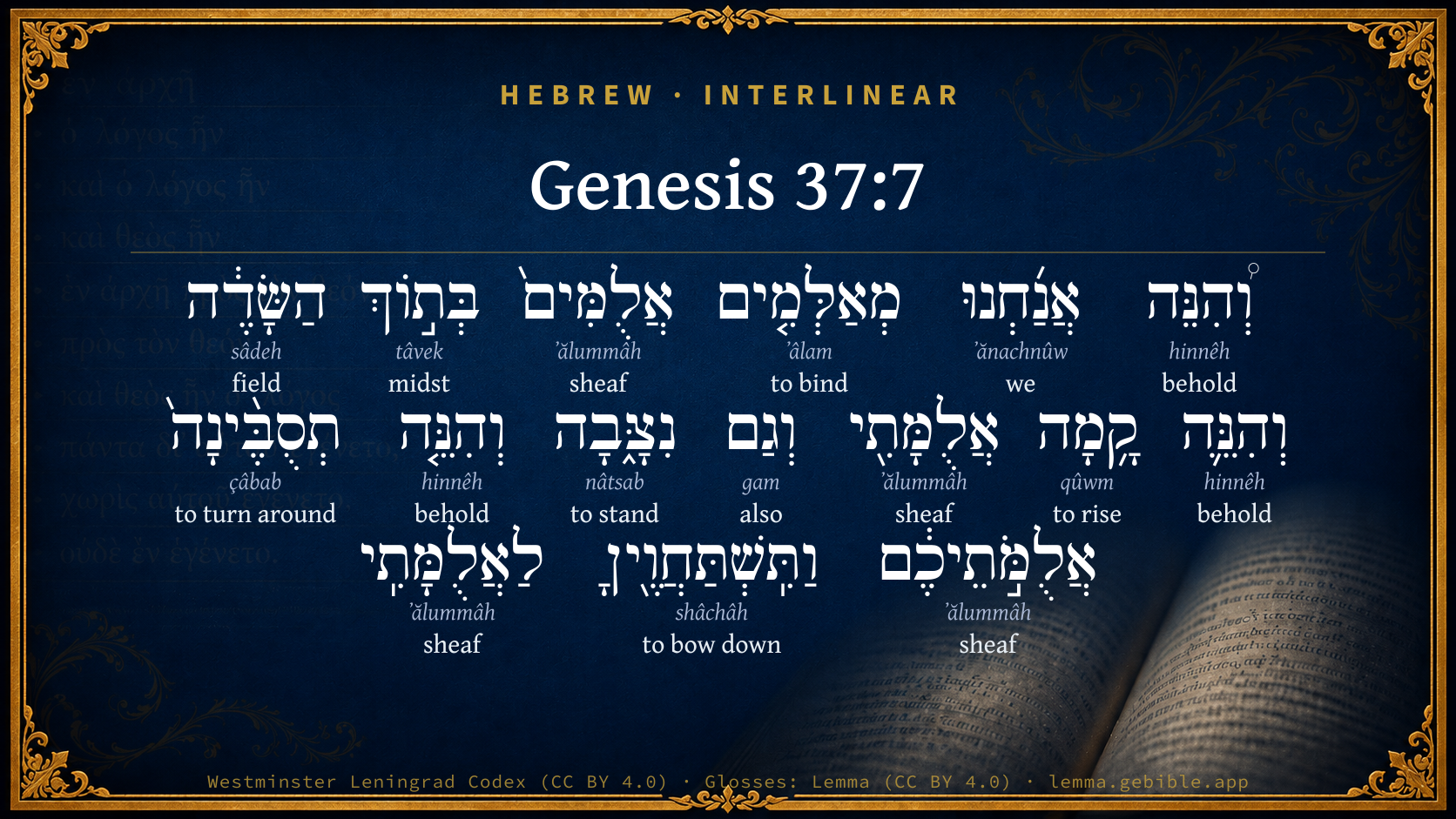
Hebrew (Westminster Leningrad Codex) Genesis 37:7 appears in the Hebrew Old Testament. The text above is from the Westminster Leningrad Codex. Each word links to its Strong’s number, a concise gloss, and parsing drawn from the Open Scriptures Hebrew Bible morphology. Click any word for its full Brown-Driver-Briggs (BDB) entry.
Download image
Cite this verse

Genesis 37:7 (World English Bible). Public Domain. Lemma interlinear Bible study tool, https://lemma.gebible.app/v/genesis/37/7.

Show BibTeX & RIS
BibTeX
RIS
English Translation
for, behold, we were binding sheaves in the field, and behold, my sheaf arose and also stood upright; and behold, your sheaves came around, and bowed down to my sheaf."
World English Bible · Public Domain
Highlights
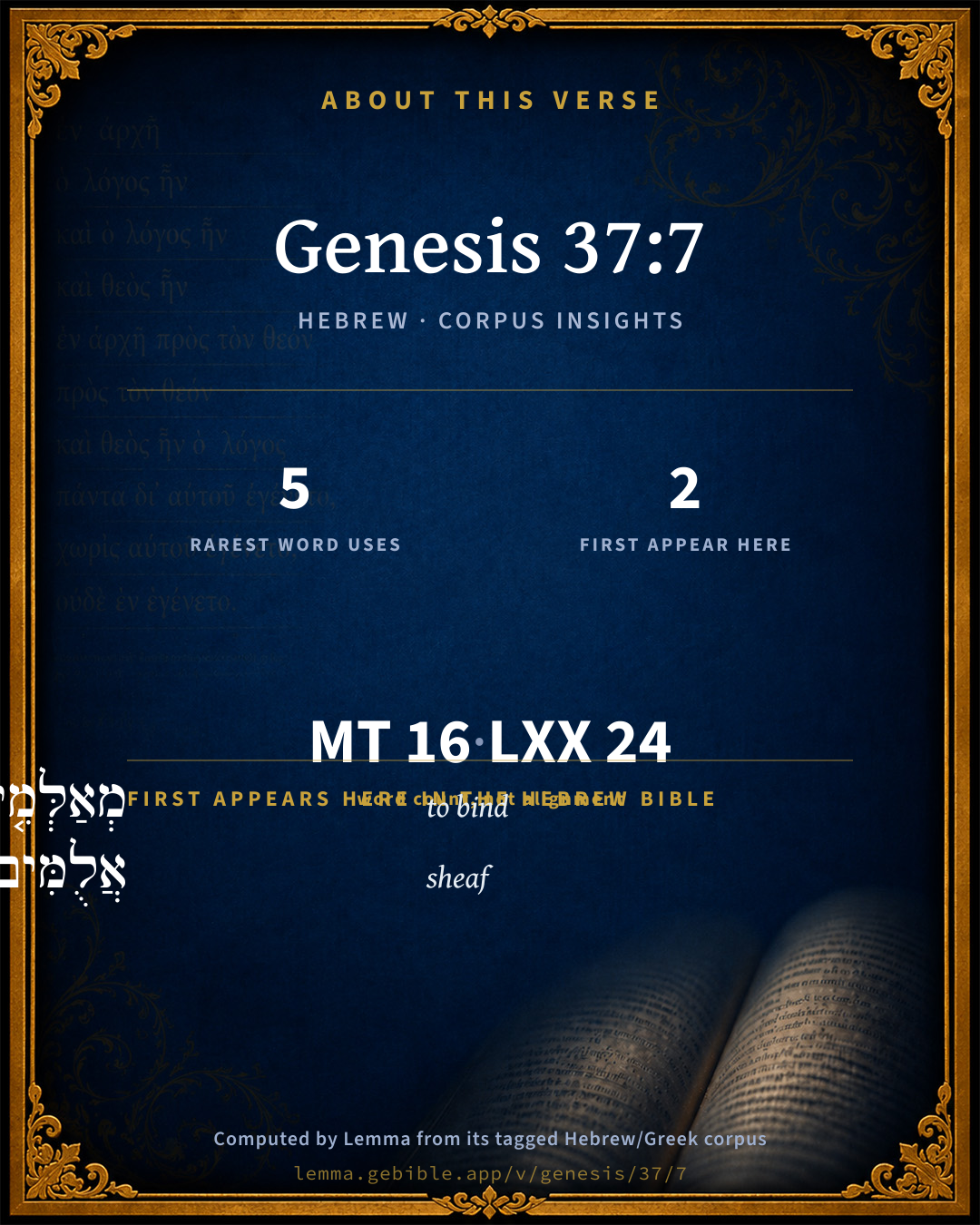
  • 2 first appearances in the Hebrew Bible
Full analysis ↓
Download a study sheet

One document with this verse’s original text, its word-by-word gloss line, the meaning frame, cross-references with their text, attributed commentary, and full source and license credits — printable, and it pastes into notes with its structure intact.

This verse Autodidact and up

Study sheet (.html) Plain text (.txt)

A passage Seminary Student

Up to 50 verses in one chapter. A passage sheet keeps up to 6 commentary sources and 12 cross-references per verse, in the order this page ranks them, and says so on the sheet whenever that leaves anything out. Ask for a single verse and you get the Autodidact verse sheet above.

Everything on this page stays free to read, with no account — the sheet is a download of what is already on screen, not access to it.

Want to remove ads? Support Godless Engineer
Compare translations 3

The same verse in 3 English versions, stacked beneath the original-language interlinear above. Click any original word for its lexicon entry.

Each is an independent rendering of the whole verse — the interlinear is not word-aligned to these translations.

Highlighted words mark where these versions differ — a whole-verse word diff, not a word-by-word alignment.

  • World English Bible Public Domain
    for, behold, we were binding sheaves in the field, and behold, my sheaf arose and also stood upright; and behold, your sheaves came around, and bowed down to my sheaf."
  • King James Version Public Domain
    For, behold, we were binding sheaves in the field, and, lo, my sheaf arose, and also stood upright; and, behold, your sheaves stood round about, and made obeisance to my sheaf.
  • unfoldingWord Literal Text CC BY-SA 4.0
    And behold, we were binding sheaves in the middle of a field, and behold, my sheaf got up and also stood upright, and behold, your sheaves gathered around and bowed down to my sheaf.”

unfoldingWord Literal Text — © unfoldingWord, licensed CC BY-SA 4.0. Word-aligned USFM3 via Door43 (git.door43.org/unfoldingWord/en_ult).

Versions to compare (up to 4)

3 of 4 selected

Show all 18 translations

Every available English version of this verse, each an independent rendering of the whole verse.

  • World English Bible Public Domain
    for, behold, we were binding sheaves in the field, and behold, my sheaf arose and also stood upright; and behold, your sheaves came around, and bowed down to my sheaf."
  • Berean Standard Bible Public Domain
    We were binding sheaves of grain in the field, and suddenly my sheaf rose and stood upright, while your sheaves gathered around and bowed down to mine.”
  • Majority Standard Bible Public Domain
    We were binding sheaves of grain in the field, and suddenly my sheaf rose and stood upright, while your sheaves gathered around and bowed down to mine.”
  • King James Version Public Domain
    For, behold, we were binding sheaves in the field, and, lo, my sheaf arose, and also stood upright; and, behold, your sheaves stood round about, and made obeisance to my sheaf.
  • American Standard Version (1901) Public Domain
    for, behold, we were binding sheaves in the field, and, lo, my sheaf arose, and also stood upright; and, behold, your sheaves came round about, and made obeisance to my sheaf.
  • Revised Version (1885) Public Domain
    for, behold, we were binding sheaves in the field, and, lo, my sheaf arose, and also stood upright; and, behold, your sheaves came round about, and made obeisance to my sheaf.
  • Geneva Bible (1599) Public Domain
    Beholde nowe, wee were binding sheues in the middes of the field: and loe, my shefe arose and also stoode vpright, and behold, your sheues compassed rounde about, and did reuerence to my shefe.
  • Douay-Rheims (1899) Public Domain
    I thought we were binding sheaves in the field: and my sheaf arose as it were, end stood, and your sheaves standing about, bowed down before my sheaf.
  • Young's Literal Translation Public Domain
    that, lo, we are binding bundles in the midst of the field, and lo, my bundle hath arisen, and hath also stood up, and lo, your bundles are round about, and bow themselves to my bundle.'
  • Literal Standard Version CC BY-SA 4.0
    that, behold, we are binding bundles in the midst of the field, and behold, my bundle has arisen, and has also stood up, and behold, your bundles are all around, and they bow themselves to my bundle.”
  • Unlocked Literal Bible CC BY-SA 4.0
    Behold, we were tying bundles of grain in the field and behold, my bundle rose and stood upright, and behold, your bundles came around and bowed down to my bundle.”
  • unfoldingWord Literal Text CC BY-SA 4.0
    And behold, we were binding sheaves in the middle of a field, and behold, my sheaf got up and also stood upright, and behold, your sheaves gathered around and bowed down to my sheaf.”
  • Darby Bible Public Domain
    Behold, we were binding sheaves in the fields, and lo, my sheaf rose up, and remained standing; and behold, your sheaves came round about and bowed down to my sheaf.
  • World Messianic Bible Public Domain
    for behold, we were binding sheaves in the field, and behold, my sheaf arose and also stood upright; and behold, your sheaves came around, and bowed down to my sheaf.”
  • Webster's Bible Public Domain
    For behold, we were binding sheaves in the field, and lo, my sheaf arose, and also stood upright; and behold, your sheaves stood around and made obeisance to my sheaf.
  • Free Bible Version CC BY-SA 4.0
    “We were tying up bundles of grain out in the fields when all of a sudden my bundle stood up, and your bundles came over and bowed down to it.”
  • Bible in Basic English Public Domain
    We were in the field, getting the grain stems together, and my grain kept upright, and yours came round and went down on the earth before mine.
  • JPS Tanakh (1917) Public Domain
    for, behold, we were binding sheaves in the field, and, lo, my sheaf arose, and also stood upright; and, behold, your sheaves came round about, and bowed down to my sheaf.'

Literal Standard Version (2020), Covenant Press — licensed CC BY-SA 4.0. Text via the HelloAO Bible API (eBible.org). Unlocked Literal Bible (unfoldingWord) — licensed CC BY-SA 4.0. Text via the HelloAO Bible API (eBible.org). unfoldingWord Literal Text — © unfoldingWord, licensed CC BY-SA 4.0. Word-aligned USFM3 via Door43 (git.door43.org/unfoldingWord/en_ult). Free Bible Version, Dr. Jonathan Gallagher — licensed CC BY-SA 4.0. Text via the HelloAO Bible API (eBible.org).

Word by word

More ways to search: Search by grammar → Find every occurrence → Compare this word →

Practice this passage: Drill this verse → Learn its vocabulary →

אֲלֻמִּים֙
ʼălummâh
H485
“sheaves”
Noun, Common, Feminine, Plural, Absolute
Part of Speech
Noun
Type
Common
Gender
Feminine
Number
Plural
State
Absolute
Full BDB Definition

Origin: passive participle of H481

TWOT: 102a

sheaf (as something bound) - of Israel returning from exile (figuratively)
  1. וְ֠הִנֵּה hinnêh H2009 “and · behold” Conjunction + Particle, Demonstrative
  2. אֲנַ֜חְנוּ ʼănachnûw H587 “we” Pronoun, Personal, 1st Person, Common, Plural
  3. מְאַלְּמִ֤ים ʼâlam H481 “binding” Verb, Piel, Participle Active, Masculine, Plural, Absolute
  4. בְּת֣וֹךְ tâvek H8432 “in/at · midst of” Preposition + Noun, Common, Masculine, Singular, Construct
  5. הַשָּׂדֶ֔ה sâdeh H7704 “the · field” Particle, Definite Article + Noun, Common, Masculine, Singular, Absolute
  6. וְהִנֵּ֛ה hinnêh H2009 “and · behold” Conjunction + Particle, Demonstrative
  7. קָ֥מָה qûwm H6965 “to rise” Verb, Qal, Perfect, 3rd Person, Feminine, Singular
  8. אֲלֻמָּתִ֖י ʼălummâh H485 “sheaf · my” Noun, Common, Feminine, Singular, Construct + Suffix, Personal, 1st Person, Common, Singular
  9. וְגַם gam H1571 “and · also” Conjunction + Particle, Accusative
  10. נִצָּ֑בָה nâtsab H5324 “to stand” Verb, Niphal, Perfect, 3rd Person, Feminine, Singular
  11. וְהִנֵּ֤ה hinnêh H2009 “and · behold” Conjunction + Particle, Demonstrative
  12. תְסֻבֶּ֨ינָה֙ çâbab H5437 “to turn around” Verb, Qal, Imperfect, 3rd Person, Feminine, Plural
  13. אֲלֻמֹּ֣תֵיכֶ֔ם ʼălummâh H485 “sheaves · your” Noun, Common, Feminine, Plural, Construct + Suffix, Personal, 2nd Person, Masculine, Plural
  14. וַתִּֽשְׁתַּחֲוֶ֖יןָ shâchâh H7812 “and · to bow down” Conjunction + Verb, Hishtaphel, Sequential Imperfect, 3rd Person, Feminine, Plural
  15. לַאֲלֻמָּתִֽי ʼălummâh H485 “to/for · sheaf · my” Preposition + Noun, Common, Feminine, Singular, Construct + Suffix, Personal, 1st Person, Common, Singular

About this verse

These counts appear in no published source. They are computed here, from the morphology-tagged text and Lemma’s own curated glosses. What Lemma adds →

16
words
11
distinct lemmas
Pentateuch
section

Notable vocabulary

The rarest word here is אֲלֻמִּים֙ sheaf H485 — appearing just 5 times in the whole Hebrew Bible.

First appearance in Scripture

These words make their first canonical appearance in the Hebrew Bible here:

  • מְאַלְּמִ֤ים to bind H481
  • אֲלֻמִּים֙ sheaf H485

Shared distinctive vocabulary

אֲלֻמִּים֙ sheaf H485 occurs in 2 verses of the Hebrew Bible. Also found in:

Grammatical profile

  • 5 verbs
  • 6 nouns
  • 1 pronoun
  • 4 particles

Verb forms

  • מְאַלְּמִ֤ים Piel · Participle Active
  • קָ֥מָה Qal · Perfect
  • נִצָּ֑בָה Niphal · Perfect
  • תְסֻבֶּ֨ינָה֙ Qal · Imperfect
  • וַתִּֽשְׁתַּחֲוֶ֖יןָ Hishtaphel · Sequential Imperfect

Repetition

Words recur within this verse — often emphatic in Hebrew:

  • אֲלֻמִּים֙ sheaf H485 ×4
  • וְ֠הִנֵּה behold H2009 ×3

Hebrew & Septuagint length

In English translation the verse runs 30 words from the Hebrew and 31 from the Septuagint (LXX English) — closely comparable.

A rough comparison of the two English renderings, which tokenize alike — not a word-level alignment.

Word counts can differ between the Hebrew and the Greek without any difference in meaning — e.g. the Hebrew direct-object marker אֵת has no separate Greek word, and Greek often adds the article ὁ.

In the original languages it is 16 Hebrew tokens and 24 Greek tokens — but the two are counted differently (Hebrew bundles its prefixes and suffixes into one token; the Greek is in lemma form), so that isn’t a like-for-like length.

Cross-references

7

Topical passages linked to Genesis 37:7 in the Treasury of Scripture Knowledge — connected by theme and wording, ordered by reader-vote popularity; previews shown in the World English Bible.

  • Genesis 42:6 Joseph was the governor over the land. It was he who sold to all the people of the land. Joseph's brothers came, and bowed themselves down to him with their faces to the earth.
  • Genesis 44:14 Judah and his brothers came to Joseph's house, and he was still there. They fell on the ground before him.
  • Genesis 43:26 When Joseph came home, they brought him the present which was in their hand into the house, and bowed down themselves to him to the earth.
  • Genesis 42:9 Joseph remembered the dreams which he dreamed about them, and said to them, "You are spies! You have come to see the nakedness of the land."
  • Genesis 44:19 My lord asked his servants, saying, 'Have you a father, or a brother?'
  • Philippians 2:10 that at the name of Jesus every knee should bow, of those in heaven, those on earth, and those under the earth,
  • Colossians 1:18 He is the head of the body, the assembly, who is the beginning, the firstborn from the dead; that in all things he might have the preeminence.

Cross-references courtesy of OpenBible.info (CC BY 4.0).

Hebrew and Greek witnesses Masoretic Hebrew ↔ Greek Septuagint

The same verse in the two great witnesses to the Old Testament, shown verse-for-verse.

These are two independent witnesses, not word-aligned to each other, and the Septuagint is shown in lemma (dictionary) form.

Hebrew Genesis 37:7 Masoretic · Westminster Leningrad Codex

וְ֠הִנֵּה אֲנַ֜חְנוּ מְאַלְּמִ֤ים אֲלֻמִּים֙ בְּת֣וֹךְ הַשָּׂדֶ֔ה וְהִנֵּ֛ה קָ֥מָה אֲלֻמָּתִ֖י וְגַם נִצָּ֑בָה וְהִנֵּ֤ה תְסֻבֶּ֨ינָה֙ אֲלֻמֹּ֣תֵיכֶ֔ם וַתִּֽשְׁתַּחֲוֶ֖יןָ לַאֲלֻמָּתִֽי

for, behold, we were binding sheaves in the field, and behold, my sheaf arose and also stood upright; and behold, your sheaves came around, and bowed down to my sheaf."

World English Bible · Public Domain

Greek LXX Genesis 37:7 Septuagint · lemma form

οἴομαι ἐγώ δεσμεύω δράγμα ἐν μέσος ὁ πεδίον καί ἀναἵστημι ὁ ἐμός δράγμα καί ὀρθόω περιστρέφω δέ ὁ δράγμα σύ προςκυνέω ὁ ἐμός δράγμα

I thought you⌃ were binding sheaves in the middle of the field, and my sheaf stood up and was erected, and your sheaves turned round, and did obeisance to my sheaf.

LXX2012 (modern English Septuagint) · Public Domain

Hebrew: Westminster Leningrad Codex (CC BY 4.0). Greek: Septuagint (public domain); English from LXX2012 (modern English Septuagint) (Public Domain). How the Septuagint differs from the Hebrew →

Targum (Aramaic paraphrase)

2

The Targum is the ancient Jewish Aramaic paraphrase of the Hebrew Scriptures — an interpretive translation, not the Hebrew text itself. Onkelos (literal) and Pseudo-Jonathan (expansive) render the Torah, and Jonathan the Prophets. Coverage is partial: where no permissively-licensed English translation exists for a verse, only the Aramaic is shown. This is verse-level text, not a word-by-word alignment to the Hebrew.

  1. Targum Onkelos Torah (Genesis–Deuteronomy)
    וְהָא אֲנַחְנָא מְאַסְרִין אֱסָרָן בְּגוֹ חַקְלָא וְהָא קָמַת אֱסַרְתִּי וְאַף אִזְדְקָפַת וְהָא מִסְתַּחֲרָן אֱסָרָתְכוֹן וְסָגְדָן לֶאֱסַרְתִּי

    (no public-domain English translation for this verse)

    Targum Onkelos — Aramaic: “Onkelos Genesis” (public domain); “Onkelos Exodus” (public domain); “Onkelos Leviticus” (public domain); “Onkelos Numbers” (public domain); “Onkelos Deuteronomy” (public domain). English: “Sefaria Community Translation” (CC0 1.0 (public-domain dedication)); “J.W. Etheridge. The Targums of Onkelos and Jonathan Ben Uzziel on the Pentateuch. London: Longmans, Green, 1862” (public domain). Text via Sefaria.

  2. Targum Pseudo-Jonathan Torah (Genesis–Deuteronomy)
    וְהָא אֲנַחְנָא מְפַרְכִין פֵּירוּכִין בְּגוֹ חַקְלָא וְהָא קָמַת פּוּרְכָתִי וְאוּף אִזְדְקֵיפַת וְהָא מִתְחַזְרָן פּוּרְכָתֵיכוֹן וְגַחְנוֹן לְפּוּרְכָתִי

    Behold, we were binding sheaves in the midst of the field, and lo, my sheaf arose, and stood upright; and, behold, your sheaves surrounded and bowed to my sheaf.

    Targum Pseudo-Jonathan — Aramaic: “Targum Jonathan on Genesis” (public domain); “Targum Jonathan on Exodus” (public domain); “Targum Jonathan on Leviticus” (public domain); “Targum Jonathan on Numbers” (public domain); “Targum Jonathan on Deuteronomy” (public domain). English: “The Targum of Jonathan ben Uzziel, trans. J. W. Etheridge, London, 1862” (public domain). Text via Sefaria.

Commentary

Notes on Genesis 37:7 from classic Christian and Jewish commentators (each source and its license shown beneath its notes). The classic Christian expositions comment on the surrounding passage and are grouped to its opening verse, so a note may address several verses; the Jewish commentaries on the Tanakh (Rashi and others) are per-verse, so they appear only where the commentator wrote on this verse.

Lemma curates 59 commentaries, every one of them public domain or Creative Commons licensed, each selected and text-cleaned for this edition rather than reprinted as found. About our sources →

Trapp's Complete Commentary

John Trapp

Gen 37:7 For, behold, we [were] binding sheaves in the field, and, lo, my sheaf arose, and also stood upright; and, behold, your sheaves stood round about, and made obeisance to my sheaf.

Ver. 7. We were binding sheaves.] This was fulfilled, when they came to him for grain into Egypt. Here Joseph dreams of his advancement, but not of his imprisonment: so do many professors, which therefore prove apostates.

John Trapp, A Commentary or Exposition upon All the Books of the Old and New Testament (1647–1656) — public domain. Text from a community e-Sword module.

Joseph Benson's Commentary

Gen 37:7. Behold, we were binding sheaves in the field — This was a secret intimation of the occasion of Joseph’s advancement, which was from his counsel and care about the corn in Egypt. Your sheaves stood round about — A posture this of ministry and service; and made obeisance to my sheaf — How wonderfully was this fulfilled when his brethren, making application to him for corn, came and bowed down themselves before him with their faces to the earth!

Joseph Benson's Commentary on the Old and New Testaments (1811–1818) — public domain. Text from a community e-Sword module.

Tyndale Open Study Notes

Tyndale Open Resources

37:7 The bundles of grain hint at how Joseph’s authority over his family would be achieved (see 42:1-3).

Tyndale Open Study Notes — © Tyndale Open Resources, licensed CC BY-SA 4.0. Text via the HelloAO Bible API.

Adam Clarke's Commentary

Verse 7. We were binding sheaves in the field] Though in these early times we read little of tillage, yet it is evident from this circumstance that it was practised by Jacob and his sons. The whole of this dream is so very plain as to require no comment, unless we could suppose that the sheaves of grain might have some reference to the plenty in Egypt under Joseph's superintendence, and the scarcity in Canaan, which obliged the brethren to go down to Egypt for corn, where the dream was most literally fulfilled, his brethren there bowing in the most abject manner before him.

Adam Clarke's Commentary on the Bible (1810–1826) — public domain. Text from a community e-Sword/MySword module.

Ellicott's Commentary for English Readers

(7) Stood upright.—Heb., took its station. It is the verb used in Gen_24:13, where see Note. It implies that the sheaf took the position of chief. We gather from this dream that Jacob practised agriculture, not occasionally, as had been the case with Isaac (Gen_26:12), but regularly, as seems to have been usual also at Haran (Gen_30:14).

A Bible Commentary for English Readers, edited by Charles John Ellicott (1878–1897) — public domain. Text from a community e-Sword module.

The Cambridge Bible for Schools and Colleges

gen. ed. J. J. S. Perowne

7. sheaves] Joseph’s dream presupposes that the patriarch was leading a settled and agricultural life (cf. Gen_26:12). In Gen_46:31-34 Jacob and his family are shepherds and herdsmen, but the fact that the failure of crops compels them to seek for corn in Egypt, Gen_42:1, shews that they were partly dependent upon local crops. Cf. Gen_12:10, Gen_36:1.

The Cambridge Bible for Schools and Colleges (gen. ed. J. J. S. Perowne; Cambridge University Press, 1878–1918) — public domain. Text from a community e-Sword module.

John Gill's Exposition

And his brethren said unto him,.... After he had told his dream, being highly offended with him, understanding the dream, and the meaning of it, better than he did:

shalt thou indeed reign over us? or shall thou indeed have dominion over us? denying that he ever should, and reproving him for his vanity, in concluding from hence that he would have the dominion over them. So the Targums of Onkelos and Jonathan, dost thou think, suppose, or imagine that thou shall rule over us? it looks as if by telling us this dream that such a whim and fancy has got into thine head:

and they hated him yet the more for his dreams and for his words; for it seems by this that he had dreamt, and told them more dreams besides this, and they hated him both for them, and for his telling them to them; though Jarchi thinks the phrase, "for his words", refers to the ill report he gave of them to his father, Gen 37:2.

John Gill's Exposition of the Whole Bible (1746–1763) — public domain (CC PDM 1.0). Text via the HelloAO Bible API.

Haydock's Catholic Bible Commentary

Sheaf. Joseph probably knew not what this portended, as the prophets were sometimes ignorant of the real purport of their visions. (Calmet) --- But it admirably foreshewed the famine, which would bring his brethren to adore him in Egypt. (Menochius)

George Leo Haydock (1774–1849), Haydock's Catholic Family Bible and Commentary, 1859 edition — public domain. Excludes Psalms (Douay-Rheims chapter numbering differs from Protestant) and Deuterocanonical books (Catholic canon only).

Matthew Poole's English Annotations

We were binding sheaves in the field; a secret insinuation of the occasion of Joseph’s advancement, which was from his counsel and care about the corn of Egypt.

Your sheaves stood round about; this was a posture of ministry and service, as is manifest both from Scripture and from common usage.

Matthew Poole's English Annotations on the Holy Bible (1683–1685) — public domain. Text from a community e-Sword/MySword module.

Whedon's Commentary on the Bible

Daniel D. Whedon

7-9. Sheaves… stars — “The two dreams very obviously shadow forth Joseph as having kingly authority over his father, mother, and brethren. The scene of the first is laid in the wheat field, where he and his brethren are symbolized by the sheaves. But to repeat and solemnly deepen the impression, the scene of the second is laid in heaven, and now not only his brethren, but his father and mother, (Leah probably, since Rachel was dead,) under heavenly symbols bow down, not to his star, but to him.

How powerfully must this dream have returned to the minds of them all, when, more than twenty years after, the venerable patriarch and his eleven sons did obeisance to the prince of Egypt, who said to them, ‘I am Joseph.’” — Newhall. On the import of double dreams, see note on chap.

41:32.

Daniel D. Whedon (gen. ed.), Commentary on the Old and New Testaments (1874–1909) — public domain. Text from a community e-Sword module.

The Pulpit Commentary

For (literally, and), behold, we were binding sheaves literally, binding things bound, i.e. sheaves, alumim, from alam, to bind; the order of the words and the participial form of the verb indicating that the speaker describes the vision as it appeared to his mind (vide Ewald, "Hebrews Synt.," 342)in the field, literally, in the middle of the field; from which it would appear that Jacob was not a mere nomad, but carried on agricultural operations like his father Isaac (Gen_26:12) and, lo, hNhe, as repeated in his narration, shows that he had a presentiment of something great" (Lange) my sheaf arose, and also stood upright (literally, stood, i.e. placed itself upright, and remained so); and, behold, your sheaves stood round about, and made obeisancei.e. bowed themselves down cf. Gen_23:7, Abraham bowing to the Hethites) to my sheaf. The fulfillment of this dream occurred in Egypt. (Gen_42:6 Gen_43:26 Gen_44:14)

The Pulpit Commentary (1880–1919), ed. H.D.M. Spence-Jones & Joseph S. Exell — public domain. Text from a community e-Sword module.

unfoldingWord translationNotes

Door43 World Missions Community

General Information:

Joseph tells his brothers about his dream.

Behold

The word "behold" here alerts us to pay attention to the surprising information that follows.

we were

The word "we" refers to Joseph and includes all of his brothers. (See: Inclusive "We")

tying bundles of grain

When grain is reaped it is tied into bundles and stacked until it is time to separate the grain from the straw.

behold

Here the word "behold" here shows that Joseph was surprised by what he saw.

my bundle rose and stood upright ... your bundles came around and bowed down

Here the bundles of grain are standing and kneeling as if they were people. These bundle represent Joseph and his brothers. (See: Personification)

Will you really reign over us? Will you actually rule over us?

Both of these phrases mean basically the same thing. Joseph's brothers are using questions to mock Joseph. They can be written as statements. AT: "You will never be our king, and we will never bow down to you!" (See: Parallelism and Rhetorical Question)

reign over us

The word "us" refers to Joseph's brothers but not Joseph. (See: Exclusive and Inclusive "We")

for his dreams and for his words

"because of his dreams and what he said"

translationWords

grain

bow

reign

dream

word

unfoldingWord translationNotes — © Distant Shores Media and the Door43 World Missions Community, licensed CC BY-SA 4.0. Source: git.door43.org/Door43/en_tn.

Rashi

Rabbi Shlomo Yitzchaki (Rashi)

מאלמים אלמים — Understand it as the Targum renders it: were binding bundles i.e. sheaves. Similar is (Psalms 126:6) “bearing (אלומותיו) its sheaves”. Similarly in Mishnaic Hebrew we have (Bava Metzia 22b) “and he takes (האלומות) the sheaves and makes public proclamation”.

קמה אלמתי means it raised itself erect.

וגם נצבה means remaining erect in its place.

Rashi on the Tanakh — English translations: “The Judaica Press complete Tanach with Rashi, translated by A. J. Rosenberg” (CC BY 4.0); “Pentateuch with Rashi's commentary by M. Rosenbaum and A.M. Silbermann, 1929-1934” (public domain); “The Metsudah Tanach series, Lakewood, N.J” (CC BY 4.0); and “The Book of Joshua, Metsudah Publications, 1997” (CC BY 4.0). Text via Sefaria.

Ramban (Nachmanides)

Rabbi Moshe ben Nachman (Ramban / Nachmanides)

MY SHEAF AROSE, AND ALSO PLACED ITSELF UPRIGHT, AND, BEHOLD, YOUR SHEAVES SURROUNDED. The purport of the dream concerning the sheaves is that Joseph was shown that through the sheaves and the produce they will prostrate themselves to him. The matter of “surrounding” — [your sheaves surrounded] — is to indicate that they will surround him as they do a king arrayed for battle, around whom his subjects encamp.

Ramban (Nachmanides) on the Tanakh — English translation: “Commentary on the Torah by Ramban (Nachmanides). Translated and annotated by Charles B. Chavel. New York, Shilo Pub. House, 1971-1976” (CC BY 4.0). Text via Sefaria.

Lesson kit

Teaching starters — assembled from the data on this page, not authored interpretation. Every prompt links to the verse data it draws on. Edit before teaching.

Genesis, in the Pentateuch, opens this verse with 16 words (11 distinct Hebrew lemmas). Its most distinctive word is ʼălummâh (“sheaf”). A historical commentator’s framing appears above. Read the whole chapter for the surrounding context.

Discussion questions

  1. How does “sheaf” (ʼălummâh) shape what this verse is saying?
  2. 2 words make their first appearance in Scripture here. What does this debut establish?
  3. How does Psalms 126:6, which shares the word «sheaf», read alongside this verse?
  4. What does the repetition of “sheaf” (4× in this one verse) do in this verse?
  5. These translations render this verse differently. What is at stake in choosing one wording over another?
  6. «מְאַלְּמִ֤ים» is a Piel Participle Active verb. How does that grammatical form shape the action described?
  7. Compare how Trapp's Complete Commentary and Joseph Benson's Commentary read this verse. Where do they agree or differ?

Things to notice

Reading settings

Reading text

Shown beneath each verse's original-language words.

Old Testament
Old Testament edition

Read the OT as the Masoretic Hebrew (MT) or the Greek Septuagint (LXX).

English shown for the Greek Septuagint (in the Hebrew ↔ Greek comparison).

Comparing translations? Open the Compare panel on any verse page to stack up to four side by side.