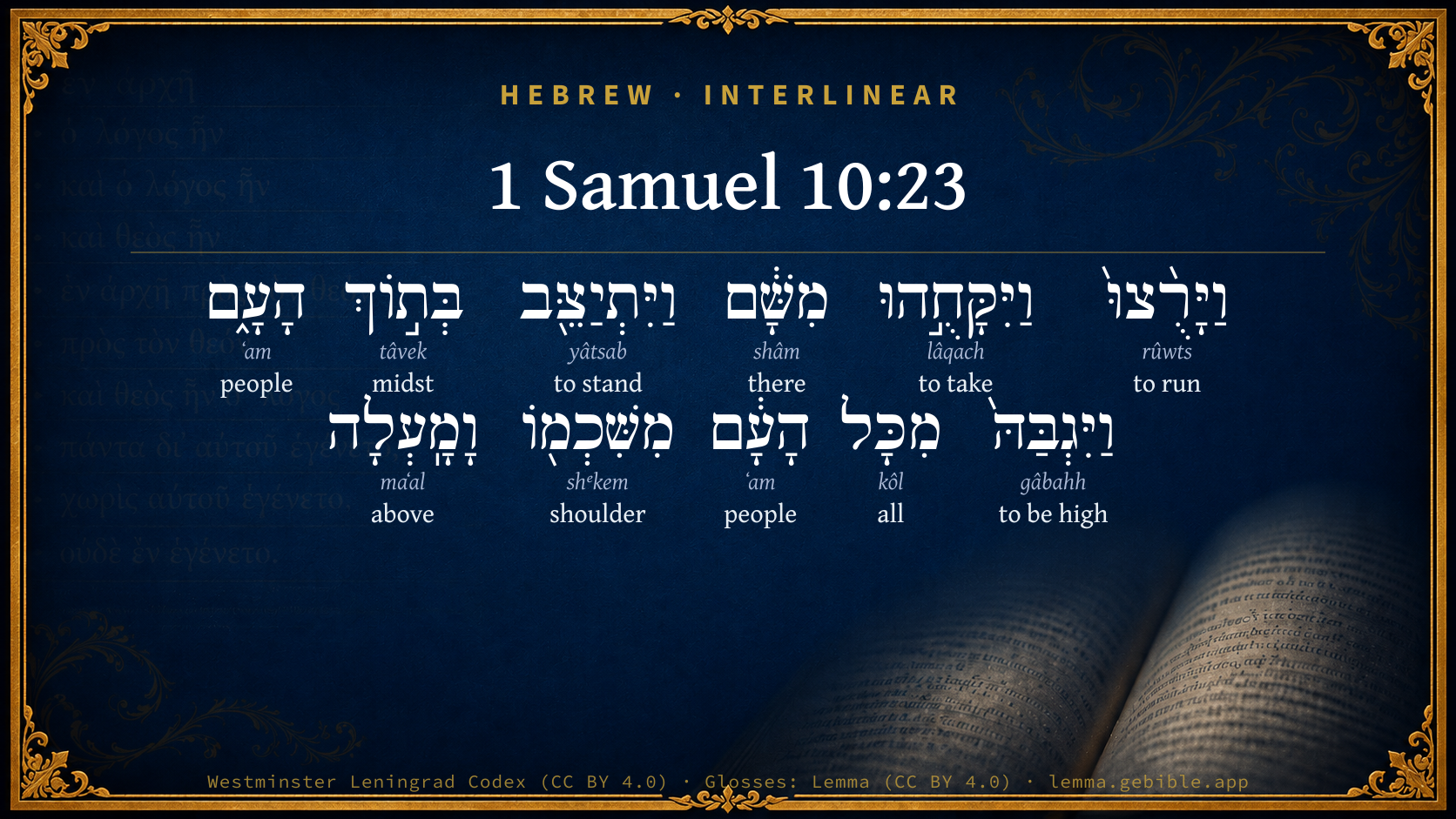
1 Samuel 10:23

Hebrew (Westminster Leningrad Codex) 1 Samuel 10:23 appears in the Hebrew Old Testament. The text above is from the Westminster Leningrad Codex. Each word links to its Strong’s number, a concise gloss, and parsing drawn from the Open Scriptures Hebrew Bible morphology. Click any word for its full Brown-Driver-Briggs (BDB) entry.
Download image
Cite this verse

1 Samuel 10:23 (World English Bible). Public Domain. Lemma interlinear Bible study tool, https://lemma.gebible.app/v/1-samuel/10/23.

Show BibTeX & RIS
BibTeX
RIS
English Translation
They ran and fetched him there; and when he stood among the people, he was higher than any of the people from his shoulders and upward.
World English Bible · Public Domain
Highlights
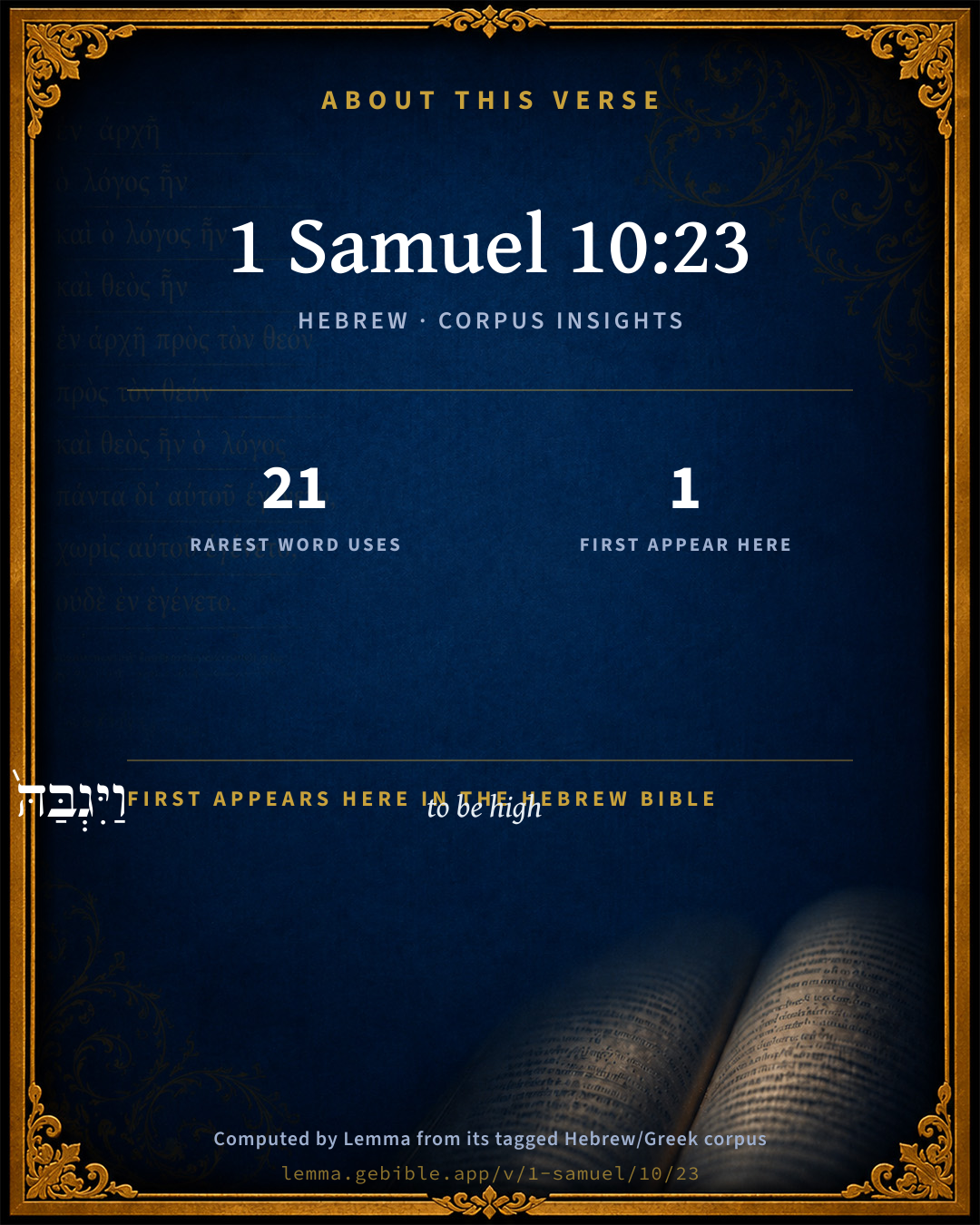
  • 1 first appearance in the Hebrew Bible
Full analysis ↓
Download a study sheet

One document with this verse’s original text, its word-by-word gloss line, the meaning frame, cross-references with their text, attributed commentary, and full source and license credits — printable, and it pastes into notes with its structure intact.

This verse Autodidact and up

Study sheet (.html) Plain text (.txt)

A passage Seminary Student

Up to 50 verses in one chapter. A passage sheet keeps up to 6 commentary sources and 12 cross-references per verse, in the order this page ranks them, and says so on the sheet whenever that leaves anything out. Ask for a single verse and you get the Autodidact verse sheet above.

Everything on this page stays free to read, with no account — the sheet is a download of what is already on screen, not access to it.

Want to remove ads? Support Godless Engineer
Compare translations 3

The same verse in 3 English versions, stacked beneath the original-language interlinear above. Click any original word for its lexicon entry.

Each is an independent rendering of the whole verse — the interlinear is not word-aligned to these translations.

Highlighted words mark where these versions differ — a whole-verse word diff, not a word-by-word alignment.

  • World English Bible Public Domain
    They ran and fetched him there; and when he stood among the people, he was higher than any of the people from his shoulders and upward.
  • King James Version Public Domain
    And they ran and fetched him thence: and when he stood among the people, he was higher than any of the people from his shoulders and upward.
  • unfoldingWord Literal Text CC BY-SA 4.0
    And they ran, and they took him from there. And he stationed himself in the midst of the people. And he was taller than any of the people from his shoulder and upward.

unfoldingWord Literal Text — © unfoldingWord, licensed CC BY-SA 4.0. Word-aligned USFM3 via Door43 (git.door43.org/unfoldingWord/en_ult).

Versions to compare (up to 4)

3 of 4 selected

Show all 18 translations

Every available English version of this verse, each an independent rendering of the whole verse.

  • World English Bible Public Domain
    They ran and fetched him there; and when he stood among the people, he was higher than any of the people from his shoulders and upward.
  • Berean Standard Bible Public Domain
    So they ran and brought Saul, and when he stood among the people, he was a head taller than any of the others.
  • Majority Standard Bible Public Domain
    So they ran and brought Saul, and when he stood among the people, he was a head taller than any of the others.
  • King James Version Public Domain
    And they ran and fetched him thence: and when he stood among the people, he was higher than any of the people from his shoulders and upward.
  • American Standard Version (1901) Public Domain
    And they ran and fetched him thence; and when he stood among the people, he was higher than any of the people from his shoulders and upward.
  • Revised Version (1885) Public Domain
    And they ran and fetched him thence; and when he stood among the people, he was higher than any of the people from his shoulders and upward.
  • Geneva Bible (1599) Public Domain
    And they ranne, and brought him thence: and when he stoode among the people, he was hier then any of the people from the shoulders vpwarde.
  • Douay-Rheims (1899) Public Domain
    And they ran and fetched him thence: and he stood in the midst of the people, and he was higher than any of the people from the shoulders and upward.
  • Young's Literal Translation Public Domain
    And they run and bring him thence, and he stationed himself in the midst of the people, and he is higher than any of the people from his shoulder and upward.
  • Literal Standard Version CC BY-SA 4.0
    And they run and bring him there, and he stationed himself in the midst of the people, and he is higher than any of the people from his shoulder and upward.
  • Unlocked Literal Bible CC BY-SA 4.0
    Then they ran and retrieved Saul from there. When he stood among the people, he was taller than any of the people from his shoulders upward.
  • unfoldingWord Literal Text CC BY-SA 4.0
    And they ran, and they took him from there. And he stationed himself in the midst of the people. And he was taller than any of the people from his shoulder and upward.
  • Darby Bible Public Domain
    And they ran and fetched him thence; and when he stood among the people, he was higher than any of the people from his shoulders and upward.
  • World Messianic Bible Public Domain
    They ran and got him there. When he stood among the people, he was higher than any of the people from his shoulders and upward.
  • Webster's Bible Public Domain
    And they ran and brought him thence: and when he stood among the people, he was higher than any of the people from his shoulders and upward.
  • Free Bible Version CC BY-SA 4.0
    They ran and brought Saul over. When he stood among the people, he was head and shoulders taller than anyone else.
  • Bible in Basic English Public Domain
    So they went quickly and made him come out; and when he took his place among the people, he was taller by a head than any of the people.
  • JPS Tanakh (1917) Public Domain
    And they ran and fetched him thence; and when he stood among the people, he was higher than any of the people from his shoulders and upward.

Literal Standard Version (2020), Covenant Press — licensed CC BY-SA 4.0. Text via the HelloAO Bible API (eBible.org). Unlocked Literal Bible (unfoldingWord) — licensed CC BY-SA 4.0. Text via the HelloAO Bible API (eBible.org). unfoldingWord Literal Text — © unfoldingWord, licensed CC BY-SA 4.0. Word-aligned USFM3 via Door43 (git.door43.org/unfoldingWord/en_ult). Free Bible Version, Dr. Jonathan Gallagher — licensed CC BY-SA 4.0. Text via the HelloAO Bible API (eBible.org).

Word by word

More ways to search: Search by grammar → Find every occurrence → Compare this word →

Practice this passage: Drill this verse → Learn its vocabulary →

מִשִּׁכְמ֖וֹ
shᵉkem
H7926
“from · shoulder · his”
Preposition + Noun, Common, Masculine, Singular, Construct + Suffix, Personal, 3rd Person, Masculine, Singular
Part of Speech
Preposition + Noun
Type
Common
Gender
Masculine
Number
Singular
State
Construct
Full BDB Definition

Origin: from H7925

TWOT: 2386a

shoulder, back - shoulder, shoulder-blade - back (in general)
  1. וַיָּרֻ֨צוּ֙ rûwts H7323 “and · to run” Conjunction + Verb, Qal, Sequential Imperfect, 3rd Person, Masculine, Plural
  2. וַיִּקָּחֻ֣הוּ lâqach H3947 “and · to take · him” Conjunction + Verb, Qal, Sequential Imperfect, 3rd Person, Masculine, Plural + Suffix, Personal, 3rd Person, Masculine, Singular
  3. מִשָּׁ֔ם shâm H8033 “from · there” Preposition + Adverb
  4. וַיִּתְיַצֵּ֖ב yâtsab H3320 “and · to stand” Conjunction + Verb, Hithpael, Sequential Imperfect, 3rd Person, Masculine, Singular
  5. בְּת֣וֹךְ tâvek H8432 “in/at · midst of” Preposition + Noun, Common, Masculine, Singular, Construct
  6. הָעָ֑ם ʻam H5971 “the · people” Particle, Definite Article + Noun, Common, Masculine, Singular, Absolute
  7. וַיִּגְבַּהּ֙ gâbahh H1361 “and · to be high” Conjunction + Verb, Qal, Sequential Imperfect, 3rd Person, Masculine, Singular
  8. מִכָּל kôl H3605 “from · all of” Preposition + Noun, Common, Masculine, Singular, Construct
  9. הָעָ֔ם ʻam H5971 “the · people” Particle, Definite Article + Noun, Common, Masculine, Singular, Absolute
  10. וָמָֽעְלָה maʻal H4605 “and · above · toward” Conjunction + Adverb + Suffix, Demonstrative

About this verse

These counts appear in no published source. They are computed here, from the morphology-tagged text and Lemma’s own curated glosses. What Lemma adds →

11
words
10
distinct lemmas
Historical
section

Notable vocabulary

The rarest word here is מִשִּׁכְמ֖וֹ shoulder H7926 — appearing just 21 times in the whole Hebrew Bible.

First appearance in Scripture

This word makes its first canonical appearance in the Hebrew Bible here:

  • וַיִּגְבַּהּ֙ to be high H1361

Shared distinctive vocabulary

מִשִּׁכְמ֖וֹ shoulder H7926 occurs in 21 verses of the Hebrew Bible. Also found in:

Grammatical profile

  • 4 verbs
  • 5 nouns
  • 2 adverbs

Verb forms

  • וַיָּרֻ֨צוּ֙ Qal · Sequential Imperfect
  • וַיִּקָּחֻ֣הוּ Qal · Sequential Imperfect
  • וַיִּתְיַצֵּ֖ב Hithpael · Sequential Imperfect
  • וַיִּגְבַּהּ֙ Qal · Sequential Imperfect

Repetition

A word recurs within this verse — often emphatic in Hebrew:

  • הָעָ֑ם people H5971 ×2

Hebrew & Septuagint length

In English translation the verse runs 26 words from the Hebrew and 30 from the Septuagint (LXX English) — closely comparable.

A rough comparison of the two English renderings, which tokenize alike — not a word-level alignment.

Word counts can differ between the Hebrew and the Greek without any difference in meaning — e.g. the Hebrew direct-object marker אֵת has no separate Greek word, and Greek often adds the article ὁ.

Cross-references

3

Topical passages linked to 1 Samuel 10:23 in the Treasury of Scripture Knowledge — connected by theme and wording, ordered by reader-vote popularity; previews shown in the World English Bible.

  • 1 Samuel 9:2 He had a son, whose name was Saul, an impressive young man; and there was not among the children of Israel a better person than he. From his shoulders and upward he was higher than any of the people.
  • 1 Samuel 16:7 But Yahweh said to Samuel, "Don't look on his face, or on the height of his stature; because I have rejected him: for [Yahweh sees] not as man sees; for man looks at the outward appearance, but Yahweh looks at the heart."
  • 1 Samuel 17:4 There went out a champion out of the camp of the Philistines, named Goliath, of Gath, whose height was six cubits and a span.

Cross-references courtesy of OpenBible.info (CC BY 4.0).

Hebrew and Greek witnesses Masoretic Hebrew ↔ Greek Septuagint

The same verse in the two great witnesses to the Old Testament, shown verse-for-verse.

These are two independent witnesses, not word-aligned to each other, and the Septuagint is shown in lemma (dictionary) form.

Hebrew 1 Samuel 10:23 Masoretic · Westminster Leningrad Codex

וַיָּרֻ֨צוּ֙ וַיִּקָּחֻ֣הוּ מִשָּׁ֔ם וַיִּתְיַצֵּ֖ב בְּת֣וֹךְ הָעָ֑ם וַיִּגְבַּהּ֙ מִכָּל הָעָ֔ם מִשִּׁכְמ֖וֹ וָמָֽעְלָה

They ran and fetched him there; and when he stood among the people, he was higher than any of the people from his shoulders and upward.

World English Bible · Public Domain

Greek LXX 1 Samuel 10:23 Septuagint · lemma form

καί τρέχω καί λαμβάνω αὐτός ἐκεῖθεν καί καταἵστημι ἐν μέσος ὁ λαός καί ὑψόω ὑπέρ πᾶς ὁ λαός ὑπέρ ὠμία καί ἐπάνω

And he ran and took him thence, and he set him in the midst of the people; and he was higher than all the people by his shoulders and upwards.

LXX2012 (modern English Septuagint) · Public Domain

Hebrew: Westminster Leningrad Codex (CC BY 4.0). Greek: Septuagint (public domain); English from LXX2012 (modern English Septuagint) (Public Domain). How the Septuagint differs from the Hebrew →

Targum (Aramaic paraphrase)

1

The Targum is the ancient Jewish Aramaic paraphrase of the Hebrew Scriptures — an interpretive translation, not the Hebrew text itself. Onkelos (literal) and Pseudo-Jonathan (expansive) render the Torah, and Jonathan the Prophets. Coverage is partial: where no permissively-licensed English translation exists for a verse, only the Aramaic is shown. This is verse-level text, not a word-by-word alignment to the Hebrew.

  1. Targum Jonathan Prophets (Joshua–Malachi)
    וּרְהָטוּ וְדַבְּרוֹהִי מִתַּמָן וְאִתְעֲתַּד בְּגוֹ עַמָא וְרָם מִכָּל עַמָא מִכַּתְפֵיהּ וּלְעֵלָא:

    (no public-domain English translation for this verse)

    Targum Jonathan — Aramaic: “Mikraot Gedolot” (public domain). English: “Sefaria Community Translation” (CC0 1.0 (public-domain dedication)); “London "Chaldee Paraphrase," 1871” (public domain). Text via Sefaria.

Commentary

Notes on 1 Samuel 10:23 from classic Christian and Jewish commentators (each source and its license shown beneath its notes). The classic Christian expositions comment on the surrounding passage and are grouped to its opening verse, so a note may address several verses; the Jewish commentaries on the Tanakh (Rashi and others) are per-verse, so they appear only where the commentator wrote on this verse.

Lemma curates 59 commentaries, every one of them public domain or Creative Commons licensed, each selected and text-cleaned for this edition rather than reprinted as found. About our sources →

Trapp's Complete Commentary

John Trapp

1Sa 10:23 And they ran and fetched him thence: and when he stood among the people, he was higher than any of the people from his shoulders and upward.

Ver. 23. And they ran and fetched him thence.] Thus honour followeth them that fly it, flieth from them that follow it; as they say of the crocodile. It hath been already noted of Claudius, that he was pulled out of a hole by the heels, and made emperor.

He was higher than any of the people by the shoulders.] {a} This did further edge the people’s affections, as hoping that he would be as eminent above others in virtue, as he was in stature. Virgil commendeth his Aeneas and Turnus {b} from their tallness: and Pliny {c} his Trajan, that he was not carried on men’s shoulders as some proud emperors had been, but was taller than others by the head and shoulders.

{a} Eξοχος ανθρωπων κεφαλην και ευρεας ωμους.

{b} Cunctis altior ibat. - Aeneid., lib. viii. Toto vertice supra est ("de Turno") , lib. vii.

{c} Plin., in Paneg.

John Trapp, A Commentary or Exposition upon All the Books of the Old and New Testament (1647–1656) — public domain. Text from a community e-Sword module.

John Gill's Exposition

And Samuel said to all the people, see ye him whom the Lord hath chosen,.... For the choice being made by lot, the disposal of which is of the Lord, it is properly attributed to him, and the people could not object to it, but must allow it was the Lord's doing. Eupolemus (k), an Heathen writer, says, that Saul was made king by Samuel by the counsel or will of God; and Samuel appeals to their eyes for the goodness of the choice, a better could not have been made:

that there is none like him among the people? so graceful, so stately, so prince like and majestic; they wanted to have a king like such the nations had; and Saul was such an one, had all the outward appearance of grandeur that could be wished for, and which in other nations recommended persons to the imperial dignity:

and all the people shouted; made a general ado:

and said, God save the king; or "let the king live" (l); they owned and saluted him as their king, and prayed he might live long to reign over them; the Targum is, "let the king prosper"; let his reign be prosperous and glorious, and let him enjoy all health and happiness, peace and prosperity.

(k) Apud Euseb. Praepar. Evangel. l. 9. c. 30. p. 447. (l) "vivat rex", Pagninus, Montanus, &c.

John Gill's Exposition of the Whole Bible (1746–1763) — public domain (CC PDM 1.0). Text via the HelloAO Bible API.

Haydock's Catholic Bible Commentary

Upwards. God condescended to gratify the desires of the people, who chiefly regarded the stature and corporal qualifications of their king. "Many nations are accustomed to look with veneration on a majestic person, and think none are capable of great exploits except those whom nature has made very handsome." (Curtius vi.) See chap. ix. 2. More civilized nations rather consider the qualities of the mind. Alexander, Agesilaus, &c., were not of a majestic stature.

George Leo Haydock (1774–1849), Haydock's Catholic Family Bible and Commentary, 1859 edition — public domain. Excludes Psalms (Douay-Rheims chapter numbering differs from Protestant) and Deuterocanonical books (Catholic canon only).

The Pulpit Commentary

Vers. 23, 24. And when he stood. This rendering spoils the poetic force of the original, where the rapidity of their action is expressed by three preterites following hard upon one another. The Hebrew is, "And they ran, and took him thence, and he stood forth (see 1Sa_12:7) among the people, and he was taller," etc. And now Samuel presents him to the multitude as "the chosen of Jehovah," and the people shout their assent by saying, "Let the king live." For this the A.V puts our English phrase, but the Hebrew exactly answers to the French Vive le roi!

The Pulpit Commentary (1880–1919), ed. H.D.M. Spence-Jones & Joseph S. Exell — public domain. Text from a community e-Sword module.

Lesson kit

Teaching starters — assembled from the data on this page, not authored interpretation. Every prompt links to the verse data it draws on. Edit before teaching.

1 Samuel, in the Historical, opens this verse with 11 words (10 distinct Hebrew lemmas). Its most distinctive word is shᵉkem (“shoulder”). A historical commentator’s framing appears above. Read the whole chapter for the surrounding context.

Discussion questions

  1. How does “shoulder” (shᵉkem) shape what this verse is saying?
  2. The word “to be high” first appears here in Scripture. What is being introduced at this debut?
  3. Genesis 9:23 shares the word «shoulder» with this verse. How do the two illuminate each other?
  4. “people” occurs 2× in this one verse. What is the effect of the repetition?
  5. These translations render this verse differently; the difference is in the English rendering, not the original. What questions does that raise?
  6. The verb «וַיָּרֻ֨צוּ֙» is Qal Sequential Imperfect. How does its form color the action?
  7. Reading how Trapp's Complete Commentary and John Gill's Exposition read this verse, where do the two commentators agree and where do they part?

Things to notice

  • 1 word makes its first canonical appearance in Scripture here.
  • These translations choose different wording for 14 words in this verse.
  • “people” occurs 2× in this single verse.
  • 10 distinct Hebrew lemmas span 11 words in this verse.

Reading settings

Reading text

Shown beneath each verse's original-language words.

Old Testament
Old Testament edition

Read the OT as the Masoretic Hebrew (MT) or the Greek Septuagint (LXX).

English shown for the Greek Septuagint (in the Hebrew ↔ Greek comparison).

Comparing translations? Open the Compare panel on any verse page to stack up to four side by side.