
Numbers 19:10

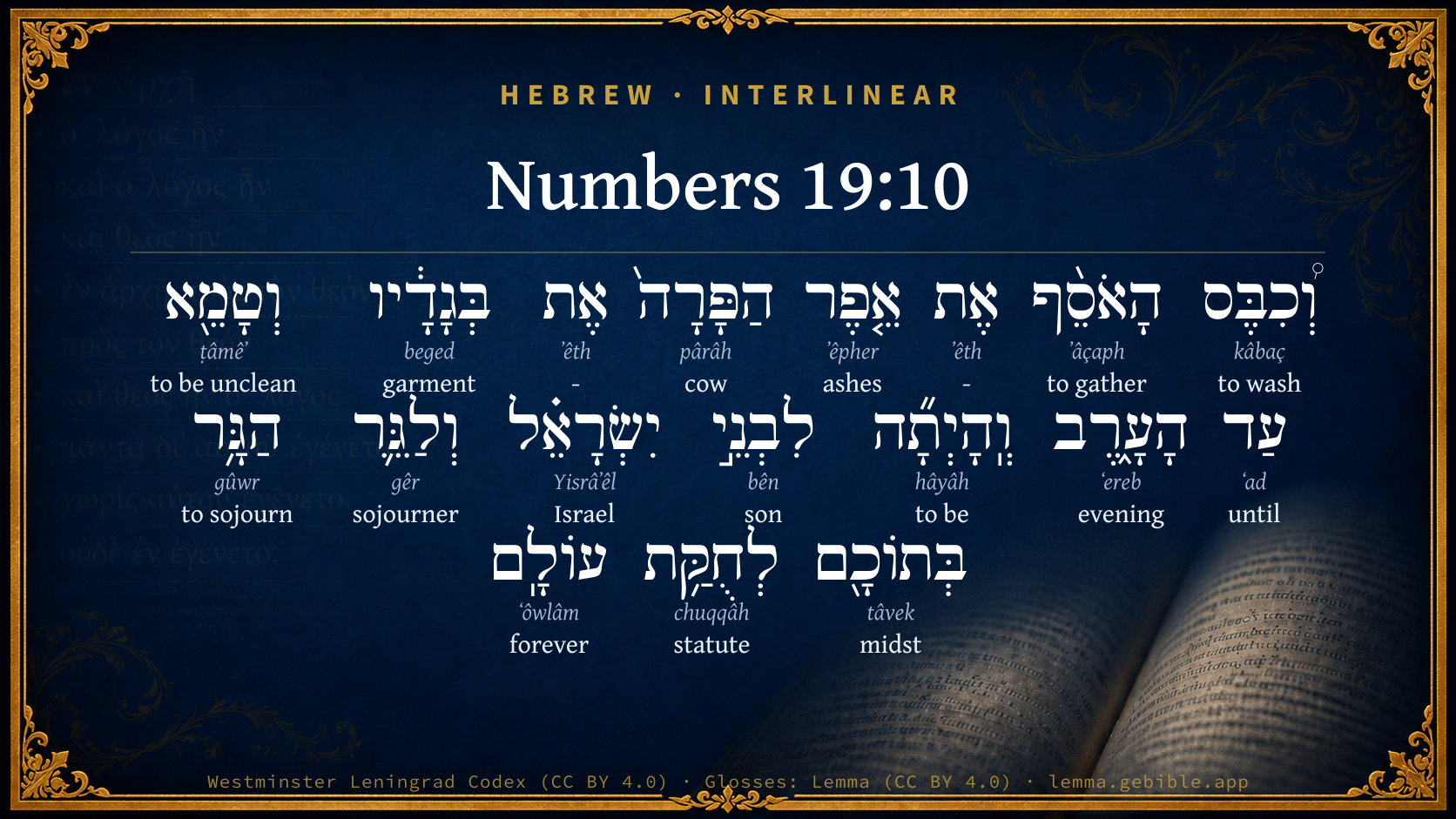
Hebrew (Westminster Leningrad Codex) Numbers 19:10 appears in the Hebrew Old Testament. The text above is from the Westminster Leningrad Codex. Each word links to its Strong’s number, a concise gloss, and parsing drawn from the Open Scriptures Hebrew Bible morphology. Click any word for its full Brown-Driver-Briggs (BDB) entry.
Download image
Cite this verse

Numbers 19:10 (World English Bible). Public Domain. Lemma interlinear Bible study tool, https://lemma.gebible.app/v/numbers/19/10.

Show BibTeX & RIS
BibTeX
RIS
English Translation
He who gathers the ashes of the heifer shall wash his clothes, and be unclean until the even: and it shall be to the children of Israel, and to the stranger who lives as a foreigner among them, for a statute forever.
World English Bible · Public Domain
Download a study sheet

One document with this verse’s original text, its word-by-word gloss line, the meaning frame, cross-references with their text, attributed commentary, and full source and license credits — printable, and it pastes into notes with its structure intact.

This verse Autodidact and up

Study sheet (.html) Plain text (.txt)

A passage Seminary Student

Up to 50 verses in one chapter. A passage sheet keeps up to 6 commentary sources and 12 cross-references per verse, in the order this page ranks them, and says so on the sheet whenever that leaves anything out. Ask for a single verse and you get the Autodidact verse sheet above.

Everything on this page stays free to read, with no account — the sheet is a download of what is already on screen, not access to it.

Want to remove ads? Support Godless Engineer
Compare translations 3

The same verse in 3 English versions, stacked beneath the original-language interlinear above. Click any original word for its lexicon entry.

Each is an independent rendering of the whole verse — the interlinear is not word-aligned to these translations.

Highlighted words mark where these versions differ — a whole-verse word diff, not a word-by-word alignment.

  • World English Bible Public Domain
    He who gathers the ashes of the heifer shall wash his clothes, and be unclean until the even: and it shall be to the children of Israel, and to the stranger who lives as a foreigner among them, for a statute forever.
  • King James Version Public Domain
    And he that gathereth the ashes of the heifer shall wash his clothes, and be unclean until the even: and it shall be unto the children of Israel, and unto the stranger that sojourneth among them, for a statute for ever.
  • unfoldingWord Literal Text CC BY-SA 4.0
    And the one gathering the ashes of the cow shall wash his garments and be unclean until the evening. And it shall be for the sons of Israel and for the sojourner who is sojourning in their midst as a statute of eternity.

unfoldingWord Literal Text — © unfoldingWord, licensed CC BY-SA 4.0. Word-aligned USFM3 via Door43 (git.door43.org/unfoldingWord/en_ult).

Versions to compare (up to 4)

3 of 4 selected

Show all 18 translations

Every available English version of this verse, each an independent rendering of the whole verse.

  • World English Bible Public Domain
    He who gathers the ashes of the heifer shall wash his clothes, and be unclean until the even: and it shall be to the children of Israel, and to the stranger who lives as a foreigner among them, for a statute forever.
  • Berean Standard Bible Public Domain
    The man who has gathered up the ashes of the heifer must also wash his clothes, and he will be ceremonially unclean until evening. This is a permanent statute for the Israelites and for the foreigner residing among them.
  • Majority Standard Bible Public Domain
    The man who has gathered up the ashes of the heifer must also wash his clothes, and he will be ceremonially unclean until evening. This is a permanent statute for the Israelites and for the foreigner residing among them.
  • King James Version Public Domain
    And he that gathereth the ashes of the heifer shall wash his clothes, and be unclean until the even: and it shall be unto the children of Israel, and unto the stranger that sojourneth among them, for a statute for ever.
  • American Standard Version (1901) Public Domain
    And he that gathereth the ashes of the heifer shall wash his clothes, and be unclean until the even: and it shall be unto the children of Israel, and unto the stranger that sojourneth among them, for a statute for ever.
  • Revised Version (1885) Public Domain
    And he that gathereth the ashes of the heifer shall wash his clothes, and be unclean until the even: and it shall be unto the children of Israel, and unto the stranger that sojourneth among them, for a statute for ever.
  • Geneva Bible (1599) Public Domain
    Therefore he that gathereth the ashes of the kow, shall wash his clothes, and remaine vncleane vntil euen: and it shalbe vnto the children of Israel, and vnto the stranger that dwelleth among them, a statute for euer.
  • Douay-Rheims (1899) Public Domain
    And when he that carried the ashes of the cow, hath washed his garments, he shall be unclean until the evening. The children of Israel, and the strangers that dwell among them, shall observe this for a holy thing by a perpetual ordinance.
  • Young's Literal Translation Public Domain
    and he who is gathering the ashes of the heifer hath washed his garments, and is unclean till the evening; and it hath been to the sons of Israel, and to the sojourner who is sojourning in their midst, for a statute age-during.
  • Literal Standard Version CC BY-SA 4.0
    and he who is gathering the ashes of the heifer has washed his garments and is unclean until the evening; and it has been to the sons of Israel and to the sojourner who is sojourning in their midst for a continuous statute.
  • Unlocked Literal Bible CC BY-SA 4.0
    The one who gathered the heifer's ashes must wash his clothes. He will remain unclean until the evening. This will be a permanent law for the people of Israel and the foreigners who stay with them.
  • unfoldingWord Literal Text CC BY-SA 4.0
    And the one gathering the ashes of the cow shall wash his garments and be unclean until the evening. And it shall be for the sons of Israel and for the sojourner who is sojourning in their midst as a statute of eternity.
  • Darby Bible Public Domain
    And he that hath gathered the ashes of the heifer shall wash his clothes, and be unclean until the even. And it shall be unto the children of Israel, and unto the stranger that sojourneth among them, an everlasting statute.
  • World Messianic Bible Public Domain
    He who gathers the ashes of the heifer shall wash his clothes, and be unclean until the evening. It shall be to the children of Israel, and to the stranger who lives as a foreigner among them, for a statute forever.
  • Webster's Bible Public Domain
    And he that gathereth the ashes of the heifer shall wash his clothes, and be unclean until the evening: and it shall be to the children of Israel, and to the stranger that sojourneth among them, for a statute for ever.
  • Free Bible Version CC BY-SA 4.0
    The man who collected the ashes of the cow shall also wash his clothes, and he will remain unclean until the evening. This is a permanent rule for the Israelites and for the foreigner that lives with them.
  • Bible in Basic English Public Domain
    And he who takes up the dust of the burned cow is to have his clothing washed with water and be unclean till evening: this is to be a law for ever, for the children of Israel as well as for the man from another country who is living among them.
  • JPS Tanakh (1917) Public Domain
    And he that gathereth the ashes of the heifer shall wash his clothes, and be unclean until the even; and it shall be unto the children of Israel, and unto the stranger that sojourneth among them, for a statute for ever.

Literal Standard Version (2020), Covenant Press — licensed CC BY-SA 4.0. Text via the HelloAO Bible API (eBible.org). Unlocked Literal Bible (unfoldingWord) — licensed CC BY-SA 4.0. Text via the HelloAO Bible API (eBible.org). unfoldingWord Literal Text — © unfoldingWord, licensed CC BY-SA 4.0. Word-aligned USFM3 via Door43 (git.door43.org/unfoldingWord/en_ult). Free Bible Version, Dr. Jonathan Gallagher — licensed CC BY-SA 4.0. Text via the HelloAO Bible API (eBible.org).

Word by word

More ways to search: Search by grammar → Find every occurrence → Compare this word →

Practice this passage: Drill this verse → Learn its vocabulary →

אֵ֤פֶר
ʼêpher
H665
“ashes of”
Noun, Common, Masculine, Singular, Construct
Part of Speech
Noun
Type
Common
Gender
Masculine
Number
Singular
State
Construct
Full BDB Definition

Origin: from an unused root meaning to bestrew

TWOT: 150a

ashes - (CLBL) worthlessness (figuratively)
  1. וְ֠כִבֶּס kâbaç H3526 “and · to wash” Conjunction + Verb, Piel, Sequential Perfect, 3rd Person, Masculine, Singular
  2. הָאֹסֵ֨ף ʼâçaph H622 “the · gathering” Particle, Definite Article + Verb, Qal, Participle Active, Masculine, Singular, Absolute
  3. אֶת ʼêth H853 “-” Particle, Direct Object
  4. הַפָּרָה֙ pârâh H6510 “the · cow” Particle, Definite Article + Noun, Common, Feminine, Singular, Absolute
  5. אֶת ʼêth H853 “-” Particle, Direct Object
  6. בְּגָדָ֔יו beged H899 “garments · his” Noun, Common, Masculine, Plural, Construct + Suffix, Personal, 3rd Person, Masculine, Singular
  7. וְטָמֵ֖א ṭâmêʼ H2930 “and · to be unclean” Conjunction + Verb, Qal, Sequential Perfect, 3rd Person, Masculine, Singular
  8. עַד ʻad H5704 “until” Preposition
  9. הָעָ֑רֶב ʻereb H6153 “the · evening” Particle, Definite Article + Noun, Common, Masculine, Singular, Absolute
  10. וְֽהָיְתָ֞ה hâyâh H1961 “and · to be” Conjunction + Verb, Qal, Sequential Perfect, 3rd Person, Feminine, Singular
  11. לִבְנֵ֣י bên H1121 “to/for · sons of” Preposition + Noun, Common, Masculine, Plural, Construct
  12. יִשְׂרָאֵ֗ל Yisrâʼêl H3478 “Israel” Noun, Proper
  13. וְלַגֵּ֛ר gêr H1616 “and · to/for the · sojourner” Conjunction + Preposition, Determined + Noun, Common, Masculine, Singular, Absolute
  14. הַגָּ֥ר gûwr H1481 “the · sojourning” Particle, Definite Article + Verb, Qal, Participle Active, Masculine, Singular, Absolute
  15. בְּתוֹכָ֖ם tâvek H8432 “in/at · midst · their” Preposition + Noun, Common, Masculine, Singular, Construct + Suffix, Personal, 3rd Person, Masculine, Plural
  16. לְחֻקַּ֥ת chuqqâh H2708 “to/for · statute of” Preposition + Noun, Common, Both, Singular, Construct
  17. עוֹלָֽם ʻôwlâm H5769 “forever” Noun, Common, Masculine, Singular, Absolute

About this verse

These counts appear in no published source. They are computed here, from the morphology-tagged text and Lemma’s own curated glosses. What Lemma adds →

18
words
17
distinct lemmas
Pentateuch
section

Notable vocabulary

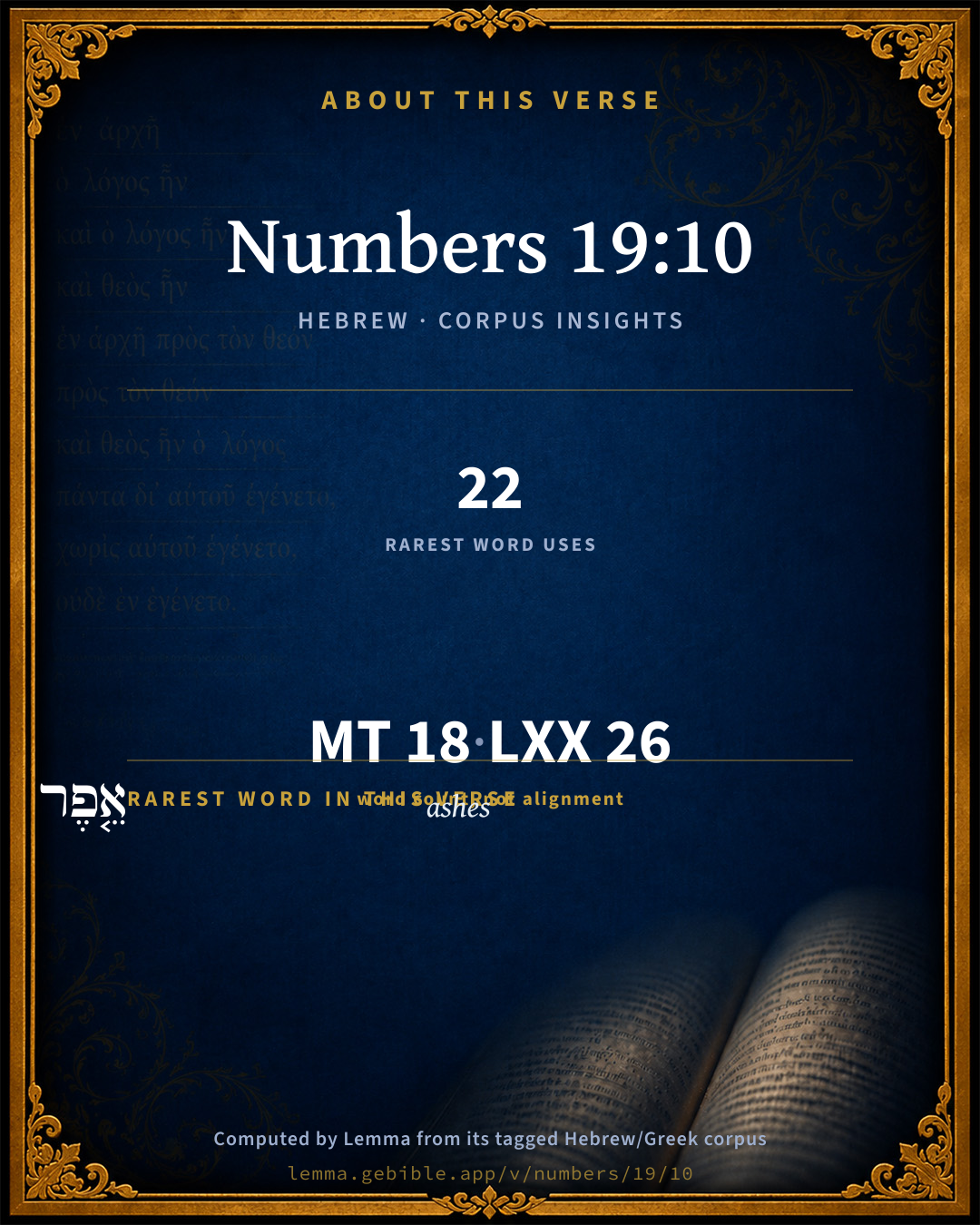
The rarest word here is אֵ֤פֶר ashes H665 — appearing just 22 times in the whole Hebrew Bible.

Shared distinctive vocabulary

אֵ֤פֶר ashes H665 occurs in 22 verses of the Hebrew Bible. Also found in:

Grammatical profile

  • 5 verbs
  • 10 nouns
  • 1 preposition
  • 2 particles

Verb forms

  • וְ֠כִבֶּס Piel · Sequential Perfect
  • הָאֹסֵ֨ף Qal · Participle Active
  • וְטָמֵ֖א Qal · Sequential Perfect
  • וְֽהָיְתָ֞ה Qal · Sequential Perfect
  • הַגָּ֥ר Qal · Participle Active

Hebrew & Septuagint length

In English translation the verse runs 42 words from the Hebrew and 39 from the Septuagint (LXX English) — closely comparable.

A rough comparison of the two English renderings, which tokenize alike — not a word-level alignment.

Word counts can differ between the Hebrew and the Greek without any difference in meaning — e.g. the Hebrew direct-object marker אֵת has no separate Greek word, and Greek often adds the article ὁ.

In the original languages it is 18 Hebrew tokens and 26 Greek tokens — but the two are counted differently (Hebrew bundles its prefixes and suffixes into one token; the Greek is in lemma form), so that isn’t a like-for-like length.

Cross-references

6

Topical passages linked to Numbers 19:10 in the Treasury of Scripture Knowledge — connected by theme and wording, ordered by reader-vote popularity; previews shown in the World English Bible.

  • Exodus 12:49 One law shall be to him who is born at home, and to the stranger who lives as a foreigner among you."
  • Numbers 15:15–16 For the assembly, there shall be one statute for you, and for the stranger who lives as a foreigner [with you], a statute forever throughout your generations: as you are, so shall the foreigner be before Yahweh.
  • Numbers 19:7–8 Then the priest shall wash his clothes, and he shall bathe his flesh in water, and afterward he shall come into the camp, and the priest shall be unclean until the even.
  • Numbers 19:19 and the clean person shall sprinkle on the unclean on the third day, and on the seventh day: and on the seventh day he shall purify him; and he shall wash his clothes, and bathe himself in water, and shall be clean at even.
  • Romans 3:29–30 Or is God the God of Jews only? Isn't he the God of Gentiles also? Yes, of Gentiles also,
  • Colossians 3:11 where there can't be Greek and Jew, circumcision and uncircumcision, barbarian, Scythian, bondservant, freeman; but Christ is all, and in all.

Cross-references courtesy of OpenBible.info (CC BY 4.0).

Hebrew and Greek witnesses Masoretic Hebrew ↔ Greek Septuagint

The same verse in the two great witnesses to the Old Testament, shown verse-for-verse.

These are two independent witnesses, not word-aligned to each other, and the Septuagint is shown in lemma (dictionary) form.

Hebrew Numbers 19:10 Masoretic · Westminster Leningrad Codex

וְ֠כִבֶּס הָאֹסֵ֨ף אֶת אֵ֤פֶר הַפָּרָה֙ אֶת בְּגָדָ֔יו וְטָמֵ֖א עַד הָעָ֑רֶב וְֽהָיְתָ֞ה לִבְנֵ֣י יִשְׂרָאֵ֗ל וְלַגֵּ֛ר הַגָּ֥ר בְּתוֹכָ֖ם לְחֻקַּ֥ת עוֹלָֽם

He who gathers the ashes of the heifer shall wash his clothes, and be unclean until the even: and it shall be to the children of Israel, and to the stranger who lives as a foreigner among them, for a statute forever.

World English Bible · Public Domain

Greek LXX Numbers 19:10 Septuagint · lemma form

καί πλύνω ὁ ἱμάτιον ὁ συνἄγω ὁ σποδιά ὁ δάμαλις καί ἀκάθαρτος εἰμί ἕως ἑσπέρα καί εἰμί ὁ υἱός ἰσραήλ καί ὁ προςκεῖμαι προσήλυτος νόμιμος αἰώνιος

And he that gathers up the ashes of the heifer shall wash his garments, and shall be unclean until evening; and it shall be a perpetual statute for the children of Israel and for the strangers joined to them.

LXX2012 (modern English Septuagint) · Public Domain

Hebrew: Westminster Leningrad Codex (CC BY 4.0). Greek: Septuagint (public domain); English from LXX2012 (modern English Septuagint) (Public Domain). How the Septuagint differs from the Hebrew →

Targum (Aramaic paraphrase)

2

The Targum is the ancient Jewish Aramaic paraphrase of the Hebrew Scriptures — an interpretive translation, not the Hebrew text itself. Onkelos (literal) and Pseudo-Jonathan (expansive) render the Torah, and Jonathan the Prophets. Coverage is partial: where no permissively-licensed English translation exists for a verse, only the Aramaic is shown. This is verse-level text, not a word-by-word alignment to the Hebrew.

  1. Targum Onkelos Torah (Genesis–Deuteronomy)
    וִיצַבַּע דְכַנֵישׁ יָת קִטְמָא דְתוֹרְתָא יָת לְבוּשׁוֹהִי וִיהֵי מְסָאָב עַד רַמְשָׁא וּתְהֵי לִבְנֵי יִשְׂרָאֵל וּלְגִיוֹרַיָא דְיִתְגַיְירוּן בֵּינֵיהוֹן לִקְיַים עֲלָם

    (no public-domain English translation for this verse)

    Targum Onkelos — Aramaic: “Onkelos Genesis” (public domain); “Onkelos Exodus” (public domain); “Onkelos Leviticus” (public domain); “Onkelos Numbers” (public domain); “Onkelos Deuteronomy” (public domain). English: “Sefaria Community Translation” (CC0 1.0 (public-domain dedication)); “J.W. Etheridge. The Targums of Onkelos and Jonathan Ben Uzziel on the Pentateuch. London: Longmans, Green, 1862” (public domain). Text via Sefaria.

  2. Targum Pseudo-Jonathan Torah (Genesis–Deuteronomy)
    וִיצַבַּע כַּהֲנָא דִכְנֵישׁ יַת קִטְמָא דְתוֹרָתָא יַת לְבוּשׁוֹי וִיהֵי מְסָאָב קֳדָם טִיבוּלֵיהּ עַד רַמְשָׁא וּתְהֵי לִדְכוּתָא לִבְנֵי יִשְרָאֵל וּלְגִיוֹרַיָא דְיִתְגַיְירוּן בֵּינֵיהוֹן לִקְיַים עֲלָם

    And the priest who gathered up the ashes of the heifer shall wash his clothes, and before his ablution be unclean till the evening. And this shall be for the cleansing of the children of Israel, a statute for ever.

    Targum Pseudo-Jonathan — Aramaic: “Targum Jonathan on Genesis” (public domain); “Targum Jonathan on Exodus” (public domain); “Targum Jonathan on Leviticus” (public domain); “Targum Jonathan on Numbers” (public domain); “Targum Jonathan on Deuteronomy” (public domain). English: “The Targum of Jonathan ben Uzziel, trans. J. W. Etheridge, London, 1862” (public domain). Text via Sefaria.

Commentary

Notes on Numbers 19:10 from classic Christian and Jewish commentators (each source and its license shown beneath its notes). The classic Christian expositions comment on the surrounding passage and are grouped to its opening verse, so a note may address several verses; the Jewish commentaries on the Tanakh (Rashi and others) are per-verse, so they appear only where the commentator wrote on this verse.

Lemma curates 59 commentaries, every one of them public domain or Creative Commons licensed, each selected and text-cleaned for this edition rather than reprinted as found. About our sources →

Trapp's Complete Commentary

John Trapp

Num 19:10 And he that gathereth the ashes of the heifer shall wash his clothes, and be unclean until the even: and it shall be unto the children of Israel, and unto the stranger that sojourneth among them, for a statute for ever.

Ver. 10. Shall wash his clothes.] To note, that even the nearer a Christian comes to the merits of Christ, the more he is affected with the sense of his own uncleanness; yea, he retains it till even, that is, till death.

John Trapp, A Commentary or Exposition upon All the Books of the Old and New Testament (1647–1656) — public domain. Text from a community e-Sword module.

Keil & Delitzsch

C. F. Keil & F. Delitzsch

Use of the Water of Purification. - The words in Num 19:10, "And it shall be to the children of Israel, and to the stranger in the midst of them, for an everlasting statute," relate to the preparation and application of the sprinkling water, and connect the foregoing instructions with those which follow. - Num 19:1-13 contain the general rules for the use of the water; Num 19:14-22 a more detailed description of the execution of those rules.

Num 19:11-13

Whoever touched a corpse, "with regard to all the souls of men," i.e., the corpse of a person, of whatever age or sex, was unclean for seven days, and on the third and seventh day he was to cleanse himself (התחטּא, as in Num 8:21) with the water (בּו refers, so far as the sense is concerned, to the water of purification). If he neglected this cleansing, he did not become clean, and he defiled the dwelling of Jehovah (see at Lev 15:31). Such a man was to be cut off from Israel (vid., at Gen 17:14).

Num 19:14-16

Special instructions concerning the defilement. If a man died in a tent, every one who entered it, or who was there at the time, became unclean for seven days. So also did every "open vessel upon which there was not a covering, a string," i.e., that had not a covering fastened by a string, to prevent the smell of the corpse from penetrating it. פּתיל, a string, is in apposition to צמיד, a band, or binding (see Ges. 113; Ewald, 287, e.). This also applied to any one in the open field, who touched a man who had either been slain by the sword or had died a natural death, or even a bone (skeleton), or a grave.

Num 19:17-20

Ceremony of purification. They were to take for the unclean person some of the dust of the burning of the cow, i.e., some of the ashes obtained by burning the cow, and put living, i.e., fresh water (see Lev 14:5), upon it in a vessel. A clean man was then to take a bunch of hyssop (see Exo 12:22), on account of its inherent purifying power, and dip it in the water, on the third and seventh day after the defilement had taken place, and to sprinkle the tent, with the vessels and persons in it, as well as every one who had touched a corpse, whether a person slain, or one who had died a natural death, or a grave; after which the persons were to wash their clothes and bathe, that they might be clean in the evening. As the uncleanness in question is held up as the highest grade of uncleanness, by its duration being fixed at seven days, i.e., an entire week, so the appointment of a double purification with the sprinkling water shows the force of the uncleanness to be removed; whilst the selection of the third and seventh days was simply determined by the significance of the numbers themselves. In Num 19:20, the threat of punishment for the neglect of purification is repeated from Num 19:13, for the purpose of making it most emphatic.

Num 19:21-22

This also was to be an everlasting statute, that he who sprinkled the water of purification, or even touched it (see at Num 19:7.), and he who was touched by a person defiled (by a corpse), and also the person who touched him, should be unclean till the evening, - a rule which also applied to other forms of uncleanness.

Keil & Delitzsch — Biblical Commentary on the Old Testament (1861–1891) — public domain (CC PDM 1.0). Text via the HelloAO Bible API. (Old Testament only.)

Ellicott's Commentary for English Readers

(10) And it shall be unto the children of Israel, and unto the stranger . . . —So the promise of the remission of sins through Christ Jesus was not only to the Jews and to their children, but also to all that were afar off. (See Act_2:39.)

A Bible Commentary for English Readers, edited by Charles John Ellicott (1878–1897) — public domain. Text from a community e-Sword module.

John Gill's Exposition

And he that gathereth the ashes of the heifer shall wash his clothes,.... Whom the Targum of Jonathan calls a priest, though it does not seem necessary he should be one:

and be unclean until the even; See Gill on Num 19:7,

and it shall be unto the children of Israel, and unto the stranger that sojourneth among them, for a statute for ever; until the Messiah came, whose sufferings and death are for the expiation of, and purification for the sins of Jews and Gentiles, of all the people of God throughout the world, signified by the burning of this heifer; see Jo1 2:2.

John Gill's Exposition of the Whole Bible (1746–1763) — public domain (CC PDM 1.0). Text via the HelloAO Bible API.

Albert Barnes' Notes on the Bible

He that gathered the ashes became equally unclean with the others. For the defilement of the people, previously transferred to the heifer, was regarded as concentrated in the ashes.

Albert Barnes' Notes on the Bible (1834–1885) — public domain. Text from a community e-Sword/MySword module.

Haydock's Catholic Bible Commentary

Strangers. Even those who had not embraced the Jewish religion. (Grotius) --- Thus, the baptism of Christ brings salvation both to the Jews and to the Gentiles. (St. Augustine)

George Leo Haydock (1774–1849), Haydock's Catholic Family Bible and Commentary, 1859 edition — public domain. Excludes Psalms (Douay-Rheims chapter numbering differs from Protestant) and Deuterocanonical books (Catholic canon only).

Matthew Poole's English Annotations

The stranger that sojourneth, to wit, a proselyte, not any stranger, as some understand it. For since it is confessed all the other ceremonial laws do not oblige them, and that where the name of stranger is put, as here it is, it generally speaks of a proselyte, it is more reasonable to take it so here, than without any reason or evidence to make this a particular exception from the general rule.

Matthew Poole's English Annotations on the Holy Bible (1683–1685) — public domain. Text from a community e-Sword/MySword module.

Whedon's Commentary on the Bible

Daniel D. Whedon

10. He that gathereth — Here we have a paradox. The clean man, in gathering the ashes which make clean, becomes unclean. Does it not fore-show that the scribes, priests, and all others who procured the shedding of the blood of Christ which “cleanseth from all sin” became sinners by this very act? “Yet some of them were, and all might have been, cleansed by the virtue of that same blood which they had brought themselves under the guilt of.” — Henry.

The stranger — See Lev_23:22, note.

Daniel D. Whedon (gen. ed.), Commentary on the Old and New Testaments (1874–1909) — public domain. Text from a community e-Sword module.

The Pulpit Commentary

It shall be unto the children of Israel...a statute for ever. This may refer only to the former part of the verse, according to the analogy of verse 21, or it may refer to the whole ordinance of the red heifer.

The Pulpit Commentary (1880–1919), ed. H.D.M. Spence-Jones & Joseph S. Exell — public domain. Text from a community e-Sword module.

John Wesley's Explanatory Notes

The stranger - A proselyte.

John Wesley, Explanatory Notes Upon the Whole Bible (1754–1765) — public domain. Text via the GEBible commentary corpus.

Lesson kit

Teaching starters — assembled from the data on this page, not authored interpretation. Every prompt links to the verse data it draws on. Edit before teaching.

Numbers, in the Pentateuch, opens this verse with 18 words (17 distinct Hebrew lemmas). Its most distinctive word is ʼêpher (“ashes”). A historical commentator’s framing appears above. Read the whole chapter for the surrounding context.

Discussion questions

  1. The word ʼêpher carries the sense “ashes.” How does it shape the verse?
  2. How does Genesis 18:27, which shares the word «ashes», read alongside this verse?
  3. The translations on this page render this verse differently — a whole-verse word diff, not a word-by-word alignment. What might account for the different wordings?
  4. «וְ֠כִבֶּס» is a Piel Sequential Perfect verb. How does that grammatical form shape the action described?
  5. Compare how Trapp's Complete Commentary and Keil & Delitzsch read this verse. Where do they agree or differ?

Things to notice

Reading settings

Reading text

Shown beneath each verse's original-language words.

Old Testament
Old Testament edition

Read the OT as the Masoretic Hebrew (MT) or the Greek Septuagint (LXX).

English shown for the Greek Septuagint (in the Hebrew ↔ Greek comparison).

Comparing translations? Open the Compare panel on any verse page to stack up to four side by side.