
Joshua 19:49

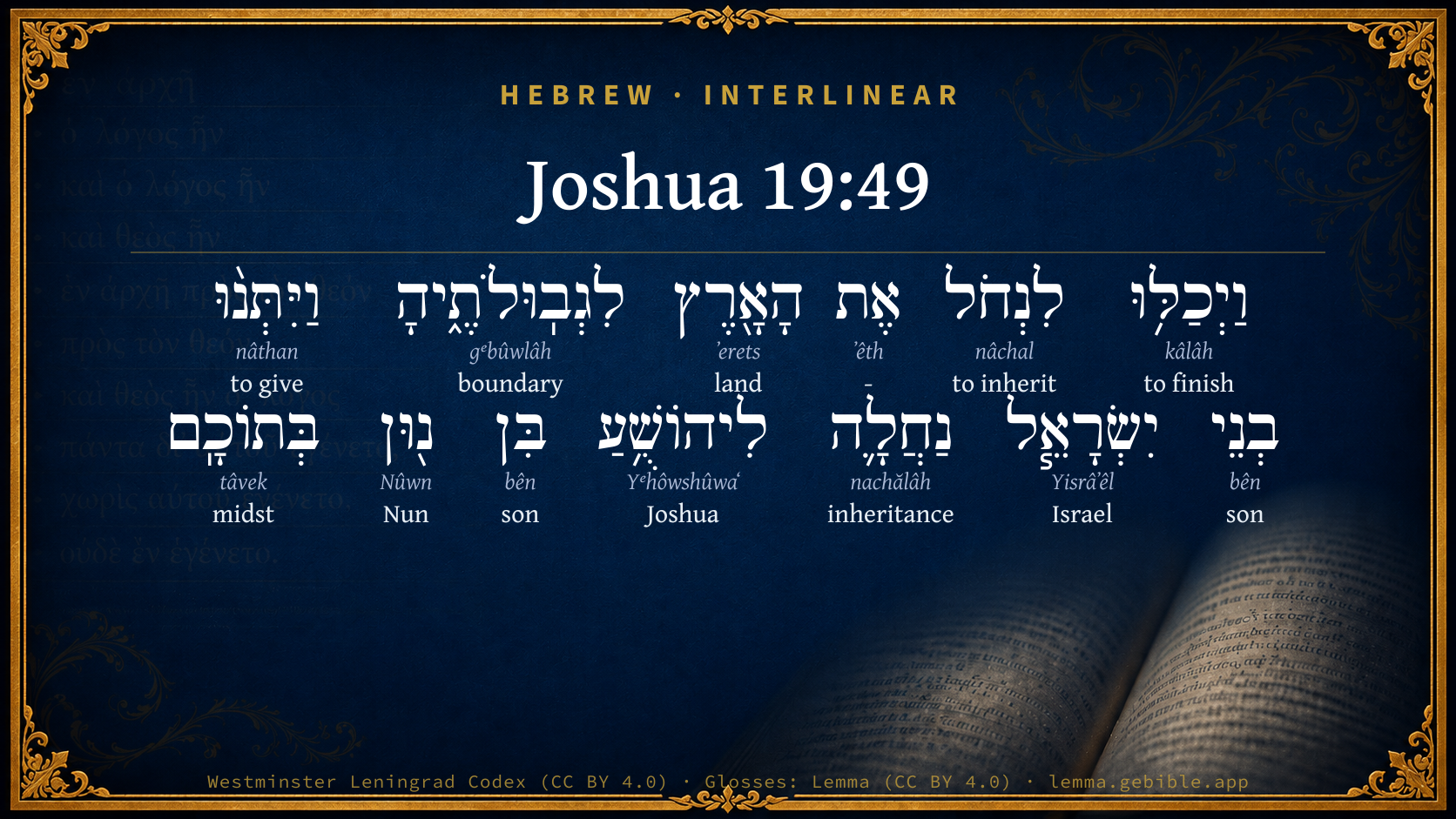
Hebrew (Westminster Leningrad Codex) Joshua 19:49 appears in the Hebrew Old Testament. The text above is from the Westminster Leningrad Codex. Each word links to its Strong’s number, a concise gloss, and parsing drawn from the Open Scriptures Hebrew Bible morphology. Click any word for its full Brown-Driver-Briggs (BDB) entry.
Download image
Cite this verse

Joshua 19:49 (World English Bible). Public Domain. Lemma interlinear Bible study tool, https://lemma.gebible.app/v/joshua/19/49.

Show BibTeX & RIS
BibTeX
RIS
English Translation
So they made an end of distributing the land for inheritance by the borders of it; and the children of Israel gave an inheritance to Joshua the son of Nun in the midst of them:
World English Bible · Public Domain
Download a study sheet

One document with this verse’s original text, its word-by-word gloss line, the meaning frame, cross-references with their text, attributed commentary, and full source and license credits — printable, and it pastes into notes with its structure intact.

This verse Autodidact and up

Study sheet (.html) Plain text (.txt)

A passage Seminary Student

Up to 50 verses in one chapter. A passage sheet keeps up to 6 commentary sources and 12 cross-references per verse, in the order this page ranks them, and says so on the sheet whenever that leaves anything out. Ask for a single verse and you get the Autodidact verse sheet above.

Everything on this page stays free to read, with no account — the sheet is a download of what is already on screen, not access to it.

Want to remove ads? Support Godless Engineer
Compare translations 3

The same verse in 3 English versions, stacked beneath the original-language interlinear above. Click any original word for its lexicon entry.

Each is an independent rendering of the whole verse — the interlinear is not word-aligned to these translations.

Highlighted words mark where these versions differ — a whole-verse word diff, not a word-by-word alignment.

  • World English Bible Public Domain
    So they made an end of distributing the land for inheritance by the borders of it; and the children of Israel gave an inheritance to Joshua the son of Nun in the midst of them:
  • King James Version Public Domain
    When they had made an end of dividing the land for inheritance by their coasts, the children of Israel gave an inheritance to Joshua the son of Nun among them:
  • unfoldingWord Literal Text CC BY-SA 4.0
    And they finished inheriting the land according to its borders. And the sons of Israel gave an inheritance to Joshua the son of Nun in the midst of them.

unfoldingWord Literal Text — © unfoldingWord, licensed CC BY-SA 4.0. Word-aligned USFM3 via Door43 (git.door43.org/unfoldingWord/en_ult).

Versions to compare (up to 4)

3 of 4 selected

Show all 18 translations

Every available English version of this verse, each an independent rendering of the whole verse.

  • World English Bible Public Domain
    So they made an end of distributing the land for inheritance by the borders of it; and the children of Israel gave an inheritance to Joshua the son of Nun in the midst of them:
  • Berean Standard Bible Public Domain
    When they had finished distributing the land into its territories, the Israelites gave Joshua son of Nun an inheritance among them,
  • Majority Standard Bible Public Domain
    When they had finished distributing the land into its territories, the Israelites gave Joshua son of Nun an inheritance among them,
  • King James Version Public Domain
    When they had made an end of dividing the land for inheritance by their coasts, the children of Israel gave an inheritance to Joshua the son of Nun among them:
  • American Standard Version (1901) Public Domain
    So they made an end of distributing the land for inheritance by the borders thereof; and the children of Israel gave an inheritance to Joshua the son of Nun in the midst of them:
  • Revised Version (1885) Public Domain
    So they made an end of distributing the land for inheritance by the borders thereof; and the children of Israel gave an inheritance to Joshua me son of Nun in the midst of them:
  • Geneva Bible (1599) Public Domain
    When they had made an ende of deuiding the lande by the coastes thereof, then the children of Israel gaue an inheritance vnto Ioshua the sonne of Nun among them.
  • Douay-Rheims (1899) Public Domain
    And when he had made an end of dividing the land by lot to each one by their tribes, the children of Israel gave a possession to Josue the son of Nun in the midst of them,
  • Young's Literal Translation Public Domain
    And they finish to give the land in inheritance, by its borders, and the sons of Israel give an inheritance to Joshua son of Nun in their midst;
  • Literal Standard Version CC BY-SA 4.0
    And they finish to give the land in inheritance, by its borders, and the sons of Israel give an inheritance to Joshua son of Nun in their midst;
  • Unlocked Literal Bible CC BY-SA 4.0
    When they finished the allocation of the land as an inheritance, the people of Israel gave an inheritance among themselves to Joshua son of Nun.
  • unfoldingWord Literal Text CC BY-SA 4.0
    And they finished inheriting the land according to its borders. And the sons of Israel gave an inheritance to Joshua the son of Nun in the midst of them.
  • Darby Bible Public Domain
    And they ended dividing the land for inheritance according to its borders. And the children of Israel gave an inheritance to Joshua the son of Nun among them.
  • World Messianic Bible Public Domain
    So they finished distributing the land for inheritance by its borders. The children of Israel gave an inheritance to Joshua the son of Nun among them.
  • Webster's Bible Public Domain
    When they had made an end of dividing the land for inheritance by their borders, the children of Israel gave an inheritance to Joshua the son of Nun among them:
  • Free Bible Version CC BY-SA 4.0
    After they finished allotting the land and establishing its borders, the Israelites gave Joshua, son of Nun, an allocation among them.
  • Bible in Basic English Public Domain
    So the distribution of the land and its limits was complete; and the children of Israel gave Joshua, the son of Nun, a heritage among them;
  • JPS Tanakh (1917) Public Domain
    When they had made an end of distributing the land for inheritance by the borders thereof, the children of Israel gave an inheritance to Joshua the son of Nun in the midst of them;

Literal Standard Version (2020), Covenant Press — licensed CC BY-SA 4.0. Text via the HelloAO Bible API (eBible.org). Unlocked Literal Bible (unfoldingWord) — licensed CC BY-SA 4.0. Text via the HelloAO Bible API (eBible.org). unfoldingWord Literal Text — © unfoldingWord, licensed CC BY-SA 4.0. Word-aligned USFM3 via Door43 (git.door43.org/unfoldingWord/en_ult). Free Bible Version, Dr. Jonathan Gallagher — licensed CC BY-SA 4.0. Text via the HelloAO Bible API (eBible.org).

Word by word

More ways to search: Search by grammar → Find every occurrence → Compare this word →

Practice this passage: Drill this verse → Learn its vocabulary →

לִגְבֽוּלֹתֶ֑יהָ
gᵉbûwlâh
H1367
“to/for · boundaries · her”
Preposition + Noun, Common, Feminine, Plural, Construct + Suffix, Personal, 3rd Person, Feminine, Singular
Part of Speech
Preposition + Noun
Type
Common
Gender
Feminine
Number
Plural
State
Construct
Full BDB Definition

Origin: from H1366

TWOT: 307b

border, boundary
  1. וַיְכַלּ֥וּ kâlâh H3615 “and · to finish” Conjunction + Verb, Piel, Sequential Imperfect, 3rd Person, Masculine, Plural
  2. לִנְחֹל nâchal H5157 “to inherit” Preposition + Verb, Qal, Infinitive Construct
  3. אֶת ʼêth H853 “-” Particle, Direct Object
  4. הָאָ֖רֶץ ʼerets H776 “the · land” Particle, Definite Article + Noun, Common, Both, Singular, Absolute
  5. וַיִּתְּנ֨וּ nâthan H5414 “and · to give” Conjunction + Verb, Qal, Sequential Imperfect, 3rd Person, Masculine, Plural
  6. בְנֵי bên H1121 “sons of” Noun, Common, Masculine, Plural, Construct
  7. יִשְׂרָאֵ֧ל Yisrâʼêl H3478 “Israel” Noun, Proper
  8. נַחֲלָ֛ה nachălâh H5159 “inheritance” Noun, Common, Feminine, Singular, Absolute
  9. לִיהוֹשֻׁ֥עַ Yᵉhôwshûwaʻ H3091 “to/for · Joshua” Preposition + Noun, Proper
  10. בִּן bên H1121 “son of” Noun, Common, Masculine, Singular, Construct
  11. נ֖וּן Nûwn H5126 “Nun” Noun, Proper
  12. בְּתוֹכָֽם tâvek H8432 “in/at · midst · their” Preposition + Noun, Common, Masculine, Singular, Construct + Suffix, Personal, 3rd Person, Masculine, Plural

About this verse

These counts appear in no published source. They are computed here, from the morphology-tagged text and Lemma’s own curated glosses. What Lemma adds →

13
words
12
distinct lemmas
Historical
section

Notable vocabulary

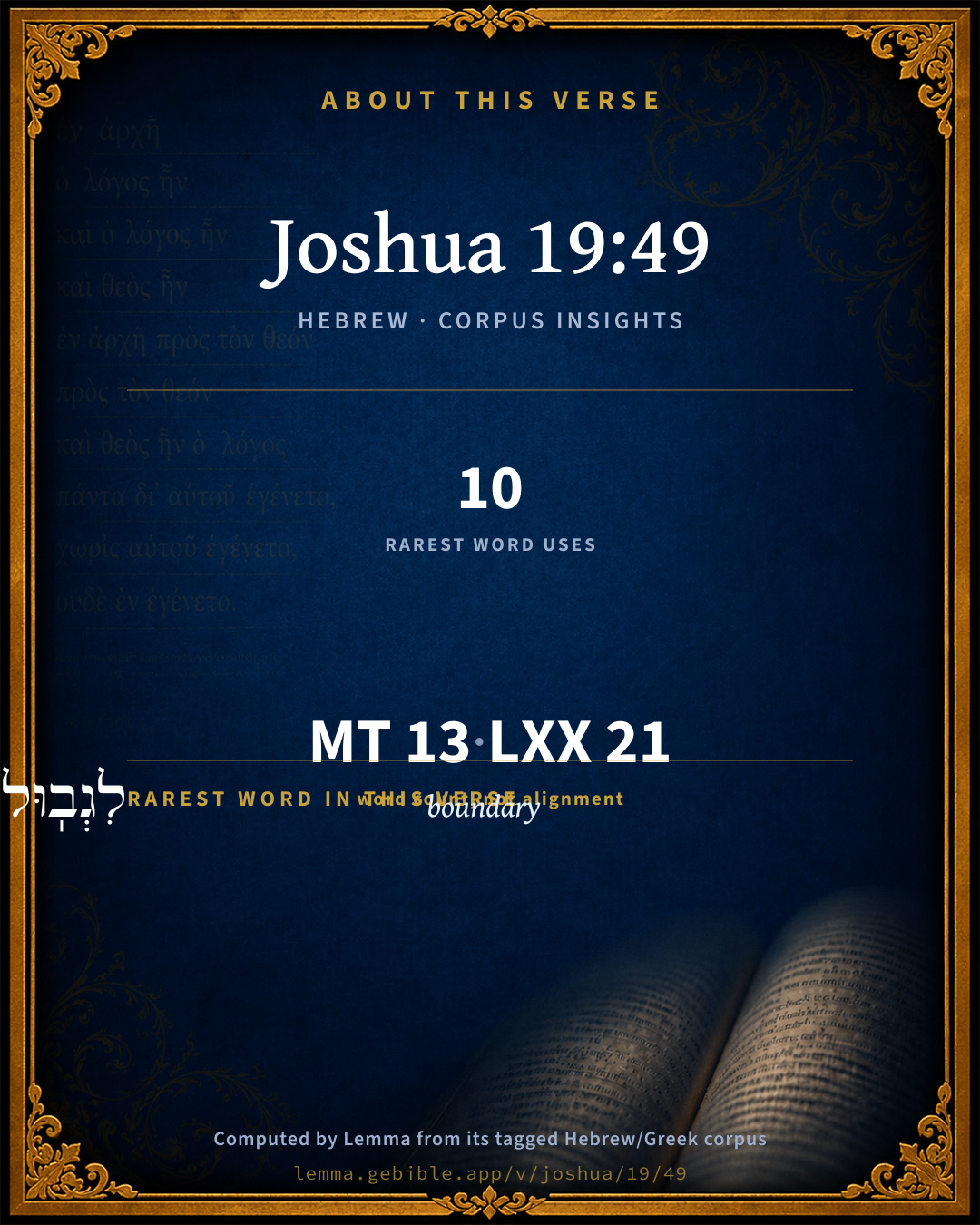
The rarest word here is לִגְבֽוּלֹתֶ֑יהָ boundary H1367 — appearing just 10 times in the whole Hebrew Bible.

Shared distinctive vocabulary

לִגְבֽוּלֹתֶ֑יהָ boundary H1367 occurs in 10 verses of the Hebrew Bible. Also found in:

Grammatical profile

  • 3 verbs
  • 9 nouns
  • 1 particle

Verb forms

  • וַיְכַלּ֥וּ Piel · Sequential Imperfect
  • לִנְחֹל Qal · Infinitive Construct
  • וַיִּתְּנ֨וּ Qal · Sequential Imperfect

Repetition

A word recurs within this verse — often emphatic in Hebrew:

  • בְנֵי son H1121 ×2

Hebrew & Septuagint length

In English translation the verse runs 35 words from the Hebrew and 29 from the Septuagint (LXX English) — closely comparable.

A rough comparison of the two English renderings, which tokenize alike — not a word-level alignment.

Word counts can differ between the Hebrew and the Greek without any difference in meaning — e.g. the Hebrew direct-object marker אֵת has no separate Greek word, and Greek often adds the article ὁ.

In the original languages it is 13 Hebrew tokens and 21 Greek tokens — but the two are counted differently (Hebrew bundles its prefixes and suffixes into one token; the Greek is in lemma form), so that isn’t a like-for-like length.

Cross-references

1

Topical passages linked to Joshua 19:49 in the Treasury of Scripture Knowledge — connected by theme and wording, ordered by reader-vote popularity; previews shown in the World English Bible.

  • Ezekiel 45:7–8 [Whatever is] for the prince [shall be] on the one side and on the other side of the holy offering and of the possession of the city, in front of the holy offering and in front of the possession of the city, on the west side westward, and on the east side eastward; and in length answerable to one of the portions, from the west border to the east border.

Cross-references courtesy of OpenBible.info (CC BY 4.0).

Hebrew and Greek witnesses Masoretic Hebrew ↔ Greek Septuagint

The same verse in the two great witnesses to the Old Testament, shown verse-for-verse.

These are two independent witnesses, not word-aligned to each other, and the Septuagint is shown in lemma (dictionary) form.

Hebrew Joshua 19:49 Masoretic · Westminster Leningrad Codex

וַיְכַלּ֥וּ לִנְחֹל אֶת הָאָ֖רֶץ לִגְבֽוּלֹתֶ֑יהָ וַיִּתְּנ֨וּ בְנֵי יִשְׂרָאֵ֧ל נַחֲלָ֛ה לִיהוֹשֻׁ֥עַ בִּן נ֖וּן בְּתוֹכָֽם

So they made an end of distributing the land for inheritance by the borders of it; and the children of Israel gave an inheritance to Joshua the son of Nun in the midst of them:

World English Bible · Public Domain

Greek LXX Joshua 19:49 Septuagint · lemma form

καί πορεύομαι ἐνβατεύω ὁ γῆ κατά ὁ ὅριον αὐτός καί δίδωμι ὁ υἱός ἰσραήλ κλῆρος ἰησοῦς ὁ υἱός ναυη ἐν αὐτός

And they proceeded to take possession of the land according to their borders, and the children of Israel gave an inheritance to Joshua the son of Naue among them,

LXX2012 (modern English Septuagint) · Public Domain

On this verse, The Pulpit Commentary discusses the Septuagint’s reading. Read the note in Commentary ↓

Hebrew: Westminster Leningrad Codex (CC BY 4.0). Greek: Septuagint (public domain); English from LXX2012 (modern English Septuagint) (Public Domain). How the Septuagint differs from the Hebrew →

Targum (Aramaic paraphrase)

1

The Targum is the ancient Jewish Aramaic paraphrase of the Hebrew Scriptures — an interpretive translation, not the Hebrew text itself. Onkelos (literal) and Pseudo-Jonathan (expansive) render the Torah, and Jonathan the Prophets. Coverage is partial: where no permissively-licensed English translation exists for a verse, only the Aramaic is shown. This is verse-level text, not a word-by-word alignment to the Hebrew.

  1. Targum Jonathan Prophets (Joshua–Malachi)
    וְשֵׁיצִיאוּ לְאַחְסָנָא יַת אַרְעָא לִתְחוּמָהָא וִיהָבוּ בְנֵי יִשְׂרָאֵל אַחֲסָנָא לִיהוֹשֻׁעַ בַּר נוּן בֵּינֵיהוֹן:

    (no public-domain English translation for this verse)

    Targum Jonathan — Aramaic: “Mikraot Gedolot” (public domain). English: “Sefaria Community Translation” (CC0 1.0 (public-domain dedication)); “London "Chaldee Paraphrase," 1871” (public domain). Text via Sefaria.

Commentary

Notes on Joshua 19:49 from classic Christian and Jewish commentators (each source and its license shown beneath its notes). The classic Christian expositions comment on the surrounding passage and are grouped to its opening verse, so a note may address several verses; the Jewish commentaries on the Tanakh (Rashi and others) are per-verse, so they appear only where the commentator wrote on this verse.

Lemma curates 59 commentaries, every one of them public domain or Creative Commons licensed, each selected and text-cleaned for this edition rather than reprinted as found. About our sources →

Matthew Henry's Commentary

Before this account of the dividing of the land is solemnly closed up, in the last verse, which intimates that the thing was done to the satisfaction of all, here is an account of the particular inheritance assigned to Joshua. 1. He was last served, though the eldest and greatest man of all Israel, and who, having commanded in the conquest of Canaan, might have demanded the first settlement in it for himself and his family. But he would make it to appear that in all he did he sought the good of his country, and not any private interest of his own. He was content to be unfixed till he saw them all settled; and herein is a great example to all in public places to prefer the common welfare before their particular satisfaction. Let the public be first served. 2. He had his lot according to the word of the Lord. It is probable that, when God by Moses told Caleb what inheritance he should have (Jos 14:9), he gave the like promise to Joshua, which he had an eye to in making his election: this made his portion doubly pleasant, that he had it, not as the rest by common providence, but by special promise. 3. He chose it in Mount Ephraim, which belonged to his own tribe, with which he thereby put himself in common, when he might by prerogative have chosen his inheritance in some other tribe, as suppose that of Judah, and thereby have distinguished himself from them. Let no man's preferment or honour make him ashamed of his family or country, or estrange him from it. The tabernacle was set up in the lot of Ephraim, and Joshua would forecast not to be far from that. 4. The children of Israel are said to give it to him (Jos 19:49), which bespeaks his humility, that he would not take it to himself without the people's consent and approbation, as if he would thereby own himself, though major singulis - greater than any one, yet minor universis - less than the whole assemblage, and would hold even the estate of his family, under God, by the grant of the people. 5. It was a city that must be built before it was fit to be dwelt in. While others dwelt in houses which they built not, Joshua must erect for himself (that he might be a pattern of industry and contentment with mean things) such buildings as he could hastily run up, without curiosity or magnificence. Our Lord Jesus thus came and dwelt among us, not in pomp but poverty, providing rest for us, yet himself not having where to lay his head. Even Christ pleased not himself.

Matthew Henry's Commentary on the Whole Bible (1708–1710) — public domain (CC PDM 1.0). Text via the HelloAO Bible API.

Trapp's Complete Commentary

John Trapp

Jos 19:49 When they had made an end of dividing the land for inheritance by their coasts, the children of Israel gave an inheritance to Joshua the son of Nun among them:

Ver. 49. When they had made an end of dividing.] Joshua was content to be last served, who had best deserved: such was his humility and modesty.

The children of Israel gave.] He took it as a gift, whenas it was his right by God’s own appointment, as it is in the next verse, "According to the word of the Lord," sc., that he and Caleb for their good service {Num 14:24; Num 14:30} should have whatsoever they best liked in the land.

Among them.] Among the many; in the barren mountains. This Jerome noteth in his epistle upon Paula. He saith she visited the sepulchre of Joshua, Et mirata est quod distributor possessionum sibi montana et aspera deligisset, and she wondered that he who had divided the land to others, had set out for himself so mean a preferment.

John Trapp, A Commentary or Exposition upon All the Books of the Old and New Testament (1647–1656) — public domain. Text from a community e-Sword module.

Joseph Benson's Commentary

Jos 19:49. When they had made an end of dividing the land — That is, after every tribe had had their respective portion assigned to them. The children of Israel gave an inheritance to Joshua — We cannot but admire the wonderful modesty of this great man, who received his portion last of all, and then, not by lot, but by their gift, who were already possessed of the whole land.

Joseph Benson's Commentary on the Old and New Testaments (1811–1818) — public domain. Text from a community e-Sword module.

Whedon's Commentary on the Bible

Daniel D. Whedon

JOSHUA’S INHERITANCE, Jos_19:49-50.

An honourable distinction of Joshua from the whole people and from his tribe is made by conferring on him a separate portion, not by lot, but in accordance with his own choice. It was situated in the territory of Ephraim, the tribe to which he belonged.

50. The word of the Lord, as uttered perhaps through the High Priest, or probably to Moses, but which was not recorded in the Mosaic books. The unrecorded promise to Caleb was a similar instance.

Timnath-serah — That is, the portion that was over and above. [It is called Timnath-heres (portion of the sun) in Jdg_2:9, because, as the Jews explain, he made the sun stand still. It was in Mount Ephraim, on the north side of the hill of Gaash. See Jos_24:30. This spot is without much doubt at the modern Tibneh, some twelve miles northwest of Beth-el. Here Dr. Eli Smith discovered the ruins of a considerable town. On the south of the town is a hill (probably Gaash) in which are a number of sepulchers which in size and richness will bear comparison with the tombs of the kings at Jerusalem. Here, doubtless, the aged commander passed his last days, and here he died and was buried. Jos_24:29-30. “Jerome relates that Paula, when travelling in these parts, marvelled that the distributer of the possessions of the children of Israel should have chosen for himself a situation so rough and mountainous.” — Kitto.

Daniel D. Whedon (gen. ed.), Commentary on the Old and New Testaments (1874–1909) — public domain. Text from a community e-Sword module.

Keil & Delitzsch

C. F. Keil & F. Delitzsch

Conclusion of the Distribution of the Land. - Jos 19:49, Jos 19:50. When the land was distributed among the tribes according to its territories, the Israelites gave Joshua an inheritance in the midst of them, according to the command of Jehovah, namely the town of Timnath-serah, upon the mountains of Ephraim, for which he asked, and which he finished building; and there he dwelt until the time of his death (Jos 24:30; Jdg 2:9). "According to the word of the Lord" (lit. "at the mouth of Jehovah") does not refer to a divine oracle communicated through the high priest, but to a promise which Joshua had probably received from God at the same time as Caleb, viz., in Kadesh, but which, like the promise given to Caleb, is not mentioned in the Pentateuch (see at Jos 15:13; Jos 14:9). Timnath-serah, called Timnath-heres in Jdg 2:9, must not be confounded with Timnah in the tribe of Dan (Jos 19:43; Jos 15:10), as is the case in the Onom. It has been preserved in the present ruins and foundation walls of a place called Tibneh, which was once a large town, about seven hours to the north of Jerusalem, and two hours to the west of Jiljilia, standing upon two mountains, with many caverns that have been used as graves (see Eli Smith in Ritter, Erdk. xvi. pp. 562ff., and Rob. Bibl. Res. p. 141).

Keil & Delitzsch — Biblical Commentary on the Old Testament (1861–1891) — public domain (CC PDM 1.0). Text via the HelloAO Bible API. (Old Testament only.)

Tyndale Open Study Notes

Tyndale Open Resources

19:49-50 The piece of land given to Joshua closes the section on the allocation of land to the tribes of Israel (see study note on 14:1–19:51).

Tyndale Open Study Notes — © Tyndale Open Resources, licensed CC BY-SA 4.0. Text via the HelloAO Bible API.

John Calvin's Commentaries

49. When they had made an end of dividing, etc We have here, at length, an account of the gratitude of the people towards Joshua. For although the partition of the land of Canaan, among the posterity of Abraham, behooved to be equitable, yet Joshua, by his excellent virtues, deserved some honorary reward. Nor could any complain that a single individual was enriched at their expense. For, first, in the delay there was a striking proof of the moderation of this holy servant of God. He does not give any heed to his own interest till the commonweal has been secured. How seldom do we find any who, after they have given one or two specimens of valor, do not forthwith make haste to the prey? Not so Joshua, who thinks not of himself till the land has been divided. In the reward itself also the same temperance and frugality are conspicuous. The city he asks to be given to himself and his family was a mere heap of stones, either because it had been demolished and converted into a heap of ruins, or because no city had yet been built upon it.

It is conjectured with probability, that with the view of making the grant as little invidious as possible, the city he requested was of no great value. If any one thinks it strange that he did not give his labor gratuitously, let him reflect that Joshua liberally obeyed the divine call, and had no mercenary feelings in undergoing so many labors, dangers, and troubles; but having spontaneously performed his duty, he behooved not to repudiate a memorial of the favor of God, unless he wished by perverse contempt to suppress his glory. For the grant voted to him was nothing else than a simple testimonial of the divine power, which had been manifested through his hand. Truly no ambition can be detected here, inasmuch as he desires nothing for himself, and does not rashly act from a feeling of covetousness, but seeks in the popular consent a confirmation of the honor which God had already bestowed upon him. To have been silent in such a case, would have been more indicative of heartlessness than of modesty. The statement in the concluding verse of the chapter, that Joshua and Eleazar made an end of dividing the land, points to the perpetuity of the boundaries, which had been fixed, and warns the children of Israel against moving in any way to unsettle an inviolable decree.

John Calvin's Commentaries (1540-1563) — public domain. Text from the Calvin Translation Society English edition (1840s-50s) via the Christian Classics Ethereal Library (ccel.org). Calvin's coverage is partial (roughly two-thirds of the Bible); uncommented books and verses are honest gaps, never fabricated. The 19th-century editor's footnotes and remarks are omitted so the notes are faithfully Calvin's own voice.

Ellicott's Commentary for English Readers

(49, 50) When they had made an end . . . gave an inheritance to Joshua . . . according to the word of the Lord they gave him the city which he asked, even Timnath-serah in mount Ephraim (Kefr Hâris, sheet 14).—Historically and typically the fact is noticeable. (a) Historically. Joshua waited for his own inheritance until the last. He sought not his own interest, but that of the people. He asked no kingdom for himself or his family, only a city, which he built, and dwelt therein. (6) Typically. “They gave him the city which he asked, according to the word of the Lord.” What does this mean in the case of the true Joshua? “Ask of me, and I shall give thee the nations for thine inheritance, and the utmost parts of the earth for thy possession.” He must reign till God hath put all enemies under His feet. Then, and not till then, will He take His own personal inheritance, and be subject to Him that put all things under Him. Timnath-serah means an abundant portion, a portion of abundance. Though small, it was enough for Joshua. It will be enough for his Antitype, when “He shall see of the travail of His soul, and be satisfied.” It is afterwards called Timnath-heres, the portion of the Sun. “His going forth is from the end of heaven, and his circuit unto the ends of it, and there is nothing hid from the heat thereof.”

A Bible Commentary for English Readers, edited by Charles John Ellicott (1878–1897) — public domain. Text from a community e-Sword module.

The Cambridge Bible for Schools and Colleges

gen. ed. J. J. S. Perowne

49–51. The Inheritance Assigned to Joshua

49. When they had made an end] After all the tribes had been provided for, a modest inheritance was assigned to their noble-hearted leader, who with unselfish generosity was contented with far less than many others would have claimed under similar circumstances.

among them] The portion assigned was among the mountains of his native tribe of Ephraim.

The Cambridge Bible for Schools and Colleges (gen. ed. J. J. S. Perowne; Cambridge University Press, 1878–1918) — public domain. Text from a community e-Sword module.

John Gill's Exposition

According to the word of the Lord,.... Or mouth of the Lord; either according to the oracle of Urim and Thummim, which Eleazar consulted on this occasion; or according to what the Lord had said to Moses, at the same time that Hebron was ordered to Caleb, Jos 14:6; and

they gave him the city which he asked, even Timnathserah in Mount Ephraim; he chose a place in his own tribe, for he was of the tribe of Ephraim; and it seems that what he chose was none of the best of places; for Paula, as Jerom (i) relates, when she travelled into those parts, wondered that the distributor of the possessions of the children of Israel should choose such a rough and mountainous place for himself; of its situation, see Jos 24:30,

and he built the city, and dwelt therein; he rebuilt it, and fitted it for his own habitation, and for those that belonged to him. (Timnathserah means "an abundant portion" or "a place in the sun". Joshua great reward was in seeing the promises of God fulfilled before his very eyes Jos 21:45 and the children of Israel serving the Lord's during his lifetime Jos 24:31. Joshua may have received but a small inheritance in the promised land but this was just an earnest of his future glorious inheritance in eternity. The saints of God have the best portion saved for the last Joh 2:10 whereas the worldling has his best portion now; his worst is yet to come. Editor.)

(i) Epitaph. Paulae, fol. 59. L.

John Gill's Exposition of the Whole Bible (1746–1763) — public domain (CC PDM 1.0). Text via the HelloAO Bible API.

Matthew Poole's English Annotations

i.e. They are said to give it, because the whole land was given to Joshua, and Eleazar, and the princes, as joint trustees, acting in the name and for the good of the people; so that even Joshua could take nothing without their gift.

Matthew Poole's English Annotations on the Holy Bible (1683–1685) — public domain. Text from a community e-Sword/MySword module.

The Pulpit Commentary

When they had made an end. The LXX, both here and in ver. 51, reads Wklye they went. The last thing Joshua thought of was himself. It was only when his work was done, and Israel had received her allotted territory, that Joshua thought it right to take his own inheritance. Calvin remarks that it was "a striking proof of the moderation of this servant of God" that he "thought not of his own interest until that of the community was secured.

HOMILIES BY R. GLOVER Ver. 49. Joshua"s portion.

"When they had made an end of dividing the land," Joshua gets his share. Not first, as kings usually do, but last. When all are helped, then comes his turn. Though he waits longest, yet it does come to him. And when it does come it is all the more welcome from being well earned. Observe two or three things that are thus brought before us.

I A TRAIT OF HONOUR. Honour is the bloom of uprightness; the finer instinctive working of it in matters too delicate to be touched by law. It is not so common as it ought to be; for our natures are often coarse, and honour is always costly. We prefer going in for cheaper virtues, especially for such of them as are loud and obvious, as well as cheap. Even those who attend to the "honest and just and true" of Paul"s precept, sometimes overlook "the pure and the lovely and that which is of good report." Here Joshua comes out, as we would expect him, as a man of honour. Such faith as he had never existed in a selfish heart; such courage as marked him, naturally had emotions of similar nobility to keep it company. Doubtless, some foolish and flattering friends urged him to accept his lot first; and pleaded, perhaps, his first right to it, both as faithful spy and successful leader. Something before Shakespeare had whispered"Love thyself last: let all the ends thou aim"st at Be thy country"s, God"s, and Truth"s.

And the still small voice of sacred honour within him did not speak in vain. Like as in a sinking ship, a brave captain is the last to leave her and seek for safety, so Joshua elects to be the last served. All the best bits of the country others eagerly go in for. Joshua sees it disposed of by lot, but is not moved by the sight of its going to envy others, nor does he catch any greed from the contagion of their example. Quite calm, feeling rich in enriching others, at rest in giving others rest, he has rewards above any freehold, and joys above any wealth. There is here an example all ought to follow. The insistance on our rights is sometimes a duty. In the interest of others we may be obliged to resist and dispute injustice. But such insistance ought always to be practised with regret, and avoided wherever possible. The precept requiring us to give the cloak to him who covets the coat certainly inculcates the surrender of rights wherever any moral advantage can accrue from it. For our own sake, to keep the soul in proper and worthy mood, we ought to cultivate this honourableness that thinks of something sublimer than its private rights. And for the sake of others also, for honour is one of the subtlest, but the strongest, forces of good anywhere existent. It allures men to a better way, charms them to integrity, is a root of brotherliness and peace. Especially should all leaders of their fellows cultivate this honour. It is not too common amongst either sovereigns or statesmen. Men are apt to forget that selfishness is vulgar, whether it seeks to get a throne, in ambition, or to keep its halfpence in sordid avarice. All selfishness is mean; and in the great it is greatly mischievous. It breeds civil wars; it corrupts the patriotism of a people; it prevents the rise of that confidence in the justice and the patriotism and the wisdom of the rulers which gives the nations rest. In leaders in smaller circles boroughs, churches there is the same scope for this high principle. Israel was blessed in this, that its most unselfish man was its leader. And he who was highest in place was highest in honour. Secondly observe

II HONOUR HAS ITS REWARD AT LAST. He had had abundant reward all through. Rivalries and competitions which, under a selfish ruler, would have broken out, and perhaps flamed up into strife and tumult, are repressed by the silent, dignified example of one whose thoughts were above the vulgar delights of wealth. And this reward of being able to compose the conflicting claims of a great multitude was the grandest reward he could have. To win victory over his nation"s foes, and keep contentment and peace in her own borders, was reward indeed. But he does not go without even the material reward. All Israel come and give him Timnath-serah. We cannot identify it now with any definiteness. But it was doubtless worthy of the nation that gave it of the man that received it. Honour often seems, to the coarse hearted, to go without reward. But that is only because the reward is of a sort too subtle for coarse vision to detect. It has always a grand reward in the influence with which it crowns the head of him who practises it. It has, besides, even common outward rewards. The race is not always to the swift, nor the gold to the greedy. We make our own world, and teach men how to deal with us. The world is froward to the froward; it is honourable to the honourable. The fairest treatment men ever give is given to those who treat them fairly. The best masters get the best service. The truest friends form richest friendships. Honourable men rarely meet with dishonourable treatment. And without any clamour or fighting they get a better Timnath-serah than in any other way they could have gained. "Trust in the Lord and do good: so shalt thou dwell in the land, and verily thou shalt be fed." Lastly observe

III THE INHERITANCE GOT BY DESERT, AND HELD WITHOUT BEING ENVIED, IS THE PERFECTION OF A LOT. Not all riches comfort us. Ill-gotten riches curse us. Riches gotten by others and passed on to us are insipid. Wealth gathered by penury is a burden. But the lot that comes as the reward of diligence, consecration, honour, has a special sweetness, and the man who gets it has a special power of enjoying it. Especially when it is ungrudged; no neighbour coveting it; no peasant thinking that by right it should be his; all men glad to see it in such worthy hands. We shall do well to resolve that we will have no fortune and no inheritance which ages not in its way resemble TIMNATH-SERAH. G.

HOMILIES BY W.F. ADENEY Vers. 49, 50. Joshua"s inheritance.

I JOSHUA RECEIVED AN INHERITANCE AMONG HIS BRETHREN. After labour and battle come rest and recompense. Though Joshua was a man of war he was not to spend all his days in fighting. It is sometimes well that the active should have a quiet time of retirement in old age. For all God"s servants there is an inheritance of rest when this world"s work is done. (Heb_4:9)

II JOSHUA"S INHERITANCE WAS GIVEN ACCORDING TO A DIVINE PROMISE. True devotion is founded on unselfish motives. Yet the prospect of reward is added by God"s grace as an encouragement. Christ looked forward to His reward. (Heb_12:2) We are only guilty of acting from low motives when the idea of personal profit is allowed to conflict with duty, or when it is the chief motive leading us to perform any duty.

III JOSHUA"S INHERITANCE WAS SIMILAR TO THAT OF HIS BRETHREN. He was the ruler of the people, yet he took no regal honours. He had led them to victory, yet he received no exceptional reward. Like Cincinnatus, he quietly retired to private life when he had completed his great task. This is a grand example of unselfishness, simplicity, and humility. It is noble to covet high service rather than rich rewards. Ambition is a sin of low selfishness cloaked with a false semblance of magnificence. The Christian is called to fulfil the highest service with the lowliest humility. (Luk_22:26) Christians are all brethren under one Master. (Mat_23:8) Joshua is a type of Christ in his great work and unselfish humility. (Joh 13:18-16)

IV JOSHUA RECEIVED HIS INHERITANCE FROM THE HANDS OF THE PEOPLE. He was not forward to take it for himself. He submitted to the choice and will of the people. It is a mark of true magnanimity to refuse to use influence and power to gain personal advantages. Joshua is a noble example of a man who exercised authority over others without developing a spirit of despotism which would fetter the popular choice. It is a great thing to have a strong, united government ruling over a free people.

V JOSHUA DID NOT RECEIVE HIS INHERITANCE TILL AFTER ALL THE OTHER PEOPLE HAD RECEIVED THEIR POSSESSIONS. He was first in service, last in reward. The true Christian spirit will put self last. He who is rightly devoted to duty will not seek for his reward before his task is completed. The world is too often tardy in recognising these who have rendered it most valuable service. W.F.A.

The Pulpit Commentary (1880–1919), ed. H.D.M. Spence-Jones & Joseph S. Exell — public domain. Text from a community e-Sword module.

John Wesley's Explanatory Notes

The children of Israel - That is, they are said to give it, because the whole land was given to Joshua, and Eleazar, and the princes, as joint trustees, acting in the name, and for the good of the people: so that even Joshua could take nothing without their gift.

John Wesley, Explanatory Notes Upon the Whole Bible (1754–1765) — public domain. Text via the GEBible commentary corpus.

Kretzmann's Popular Commentary

Paul E. Kretzmann

The Inheritance of Joshua

v. 49. When they had made an end of dividing the land for inheritance by their coasts, according to the allotment of the various parts of the Promised Land, the children of Israel gave an inheritance to Joshua, the son of Nun, among them, a special tract of land belonging to him exclusively;

v. 50. according to the word of the Lord, probably a divine promise which was given to Joshua at the same time when Caleb was assured a distinct inheritance in Canaan, they gave him the city which he asked, even Timnath-serah in Mount Ephraim, now the ruins of Tibneh, seven hours north of Jerusalem; and he built the city and dwelt therein.

v. 51. These are the inheritances which Eleazar, the priest, and Joshua, the son of Nun, and the heads of the fathers of the tribes of the children of Israel, as the representatives of the people, divided for an inheritance by lot in Shiloh before the Lord, Jos 18:1-10, at the door of the Tabernacle of the Congregation, before the face, in the presence, of the Lord. So they made an end of dividing the country. It was the Lord Himself who decided the division of the country, and in such a manner as to fulfill the prophecies of Jacob and Moses. It is God who distributes to all His children what they need in this life, but the most blessed portion is reserved for them in heaven.

Paul E. Kretzmann, Popular Commentary of the Bible (1921–1924) — public domain. Text from a community e-Sword module.

unfoldingWord translationNotes

Door43 World Missions Community

gave an inheritance among themselves to Joshua son of Nun

The city that Joshua received is spoken of as if it were an inheritance that he received as a permanent possession. AT: "gave a city within their own land as an inheritance to Joshua son of Nun" (See: Metaphor)

Timnath Serah

This is the name of a city. (See: How to Translate Names)

translationWords

inherit

Israel

Joshua

Yahweh

Ephraim

unfoldingWord translationNotes — © Distant Shores Media and the Door43 World Missions Community, licensed CC BY-SA 4.0. Source: git.door43.org/Door43/en_tn.

Lesson kit

Teaching starters — assembled from the data on this page, not authored interpretation. Every prompt links to the verse data it draws on. Edit before teaching.

Joshua, in the Historical, opens this verse with 13 words (12 distinct Hebrew lemmas). Its most distinctive word is gᵉbûwlâh (“boundary”). A historical commentator’s framing appears above. Read the whole chapter for the surrounding context.

Discussion questions

  1. How does “boundary” (gᵉbûwlâh) shape what this verse is saying?
  2. How does Numbers 32:33, which shares the word «boundary», read alongside this verse?
  3. What does the repetition of “son” (2× in this one verse) do in this verse?
  4. These translations render this verse differently; the difference is in the English rendering, not the original. What questions does that raise?
  5. «וַיְכַלּ֥וּ» is a Piel Sequential Imperfect verb. How does that grammatical form shape the action described?
  6. Compare how Matthew Henry's Commentary and Trapp's Complete Commentary read this verse. Where do they agree or differ?

Things to notice

Reading settings

Reading text

Shown beneath each verse's original-language words.

Old Testament
Old Testament edition

Read the OT as the Masoretic Hebrew (MT) or the Greek Septuagint (LXX).

English shown for the Greek Septuagint (in the Hebrew ↔ Greek comparison).

Comparing translations? Open the Compare panel on any verse page to stack up to four side by side.